





.png)
.png)


What Is a Bitcoin ETF?
A Bitcoin ETF is a stock-exchange-listed fund that holds Bitcoin and tracks its price, letting anyone buy regulated exposure through a brokerage account without owning the coin. A spot Bitcoin ETF holds the actual asset with a custodian; the funds tracked on this page are all spot funds.
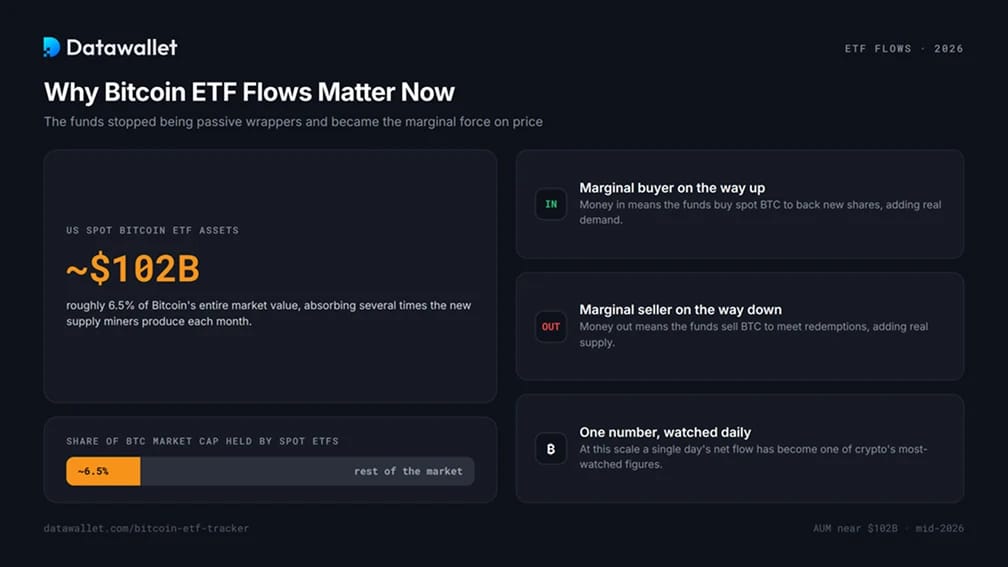
What separates today's market from the launch era is scale. US spot Bitcoin ETFs now hold roughly $102 billion in assets, around 6.5% of Bitcoin's entire market value, and absorb several times the new supply miners produce each month. At that size they no longer sit passively around the price.
Why Bitcoin ETF Flows Matter Now
A Bitcoin ETF is a stock-exchange-listed fund that holds Bitcoin and tracks its price, letting anyone buy regulated exposure through a brokerage account without holding the coin. That much has been true since launch. What changed is the scale.
US spot Bitcoin ETFs now hold roughly $102 billion in assets, around 6.5% of Bitcoin's entire market value, and absorb several times the new supply miners produce each month. At that size the funds are no longer passive wrappers around the price. They are the marginal buyer when money flows in and the marginal seller when it flows out, which is why a single day's flow number has become one of the most watched figures in crypto.
The tracker above reads that signal in real time. Net flow tells you whether regulated capital is adding or shedding Bitcoin today, fund by fund, before it reaches the price.
How ETF Flows Move Bitcoin's Price
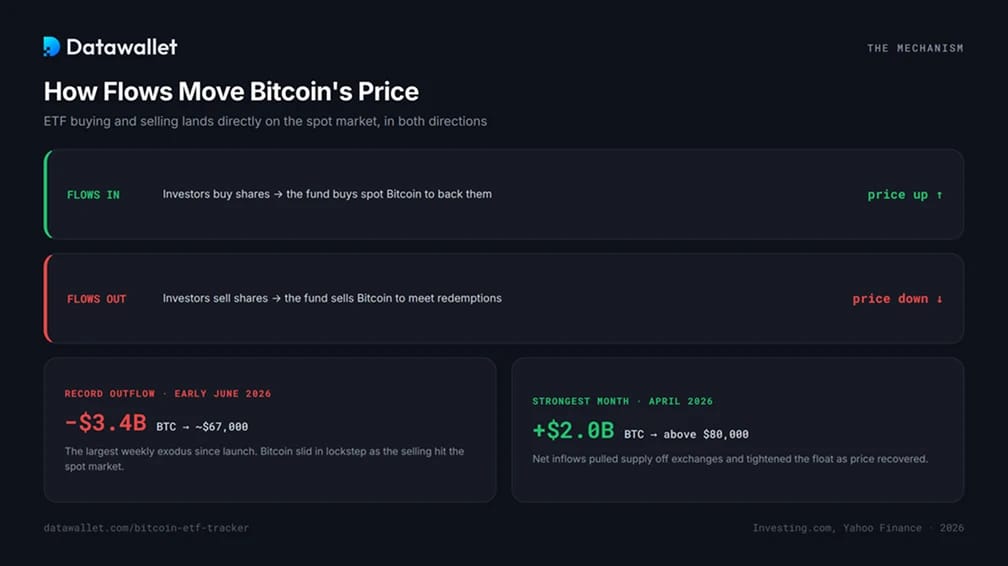
The mechanism is direct, and that is what makes flows worth watching. When investors buy ETF shares, the fund must acquire spot Bitcoin to back them, creating real buy-side pressure. When investors sell, the fund sells Bitcoin to meet redemptions. Flows in, price up; flows out, price down.
The link held visibly through 2026's turbulence. A record $3.4 billion left US spot Bitcoin ETFs in a single week in early June 2026, the largest weekly exodus since launch, and Bitcoin slid toward $67,000 in lockstep as that selling hit the spot market. The funds had become the dominant driver of the price this cycle, more than retail sentiment or on-chain metrics, because they were the marginal buyer on the way up and the marginal seller on the way down.
It cuts both ways. April 2026 saw roughly $2 billion of net inflows, the strongest month of the year, as Bitcoin pushed back above $80,000. Sustained inflows pull supply off exchanges and tighten the float; sustained outflows do the reverse. The daily print is the cleanest early read on which way that pressure runs.
Reading the Data Without Getting Misled
Flow data is noisy day to day and headlines rarely add context, so a few rules separate signal from noise:
- One day is noise; five is signal. A single outflow after a long inflow streak rarely matters. The March 2026 FOMC day saw $129 million leave, but that followed $1.47 billion of inflows the prior week, a retention rate above 90%. Five or more consecutive outflow sessions are the stronger tell that sentiment has shifted.
- AUM and net flow are different. Assets under management move with both flows and price, so AUM can fall on a day money came in. IBIT shows the gap: its cumulative inflows run well above current AUM because Bitcoin's drawdown shrank the value of coins already held. Net flow is the cleaner read.
- The fund-level split matters. If IBIT still draws money while smaller funds bleed, the largest allocators are holding firm and smaller players are rotating. A sector-wide red day, where no fund gains, is more bearish.
- Watch which fund sells first. High-fee Grayscale GBTC tends to bleed before the low-cost core funds, the position investors cut before touching cheaper holdings. That ordering usually signals measured de-risking, not a wholesale exit.
The Funds: IBIT and Everyone Else
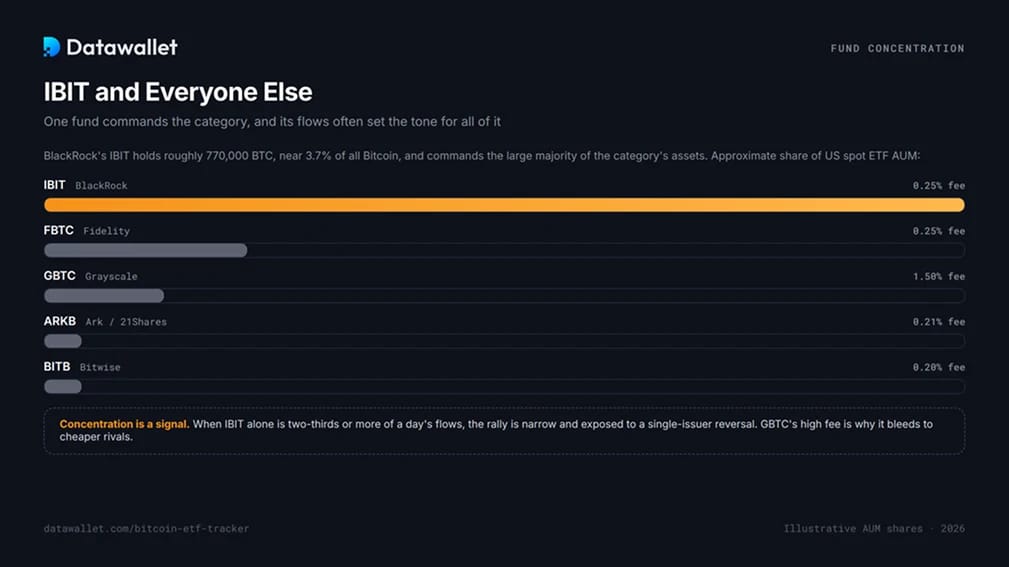
The spot Bitcoin ETF market is really the story of one dominant fund. BlackRock's iShares Bitcoin Trust (IBIT) holds roughly 770,000 BTC, near 3.7% of all the Bitcoin that will ever exist, and commands the large majority of the category's assets. Fidelity's Wise Origin fund (FBTC) is a distant second, with the rest, Bitwise's BITB, Ark and 21Shares' ARKB, Grayscale's GBTC and smaller funds, splitting what is left.
That concentration is a double-edged signal. IBIT's depth makes it the default vehicle for institutions filling large orders with minimal slippage, but it also means the category's tone often hinges on one fund. When IBIT alone accounts for two-thirds or more of a day's flows, a rally is narrow and exposed to a single-issuer reversal. The table above ranks every fund by holdings, AUM, and fee, where the dispersion beneath the headline becomes visible.
Fees are the quiet differentiator. Most core funds charge in the region of 0.20% to 0.25%, while Grayscale's legacy GBTC still charges materially more, which is why it has bled assets to cheaper rivals since launch.
What In-Kind Redemptions Changed in 2025
The most important structural change since launch arrived quietly in 2025. For their first 18 months, US spot Bitcoin ETFs could only create and redeem shares in cash, so every flow ran through a cash-to-Bitcoin conversion that added cost, slippage, and taxable events no gold ETF ever carried.
On July 29, 2025, the SEC approved in-kind creation and redemption for all spot Bitcoin and Ethereum ETFs. Authorized participants, the institutions that supply ETF liquidity, can now swap Bitcoin directly against shares instead of routing through cash. The change tightens spreads, lowers tracking error, and improves tax efficiency across the category, aligning crypto ETFs with how commodity products like gold have always worked.
The same order raised the position limit on IBIT options tenfold, from 25,000 to 250,000 contracts, giving institutions more room to hedge and express views. Together the moves signaled regulatory comfort with a market that had matured from novelty to infrastructure. Our Ethereum ETF tracker follows the same dynamics on the ETH side.
Spot vs Futures Bitcoin ETFs
Not every Bitcoin ETF holds Bitcoin, and the distinction decides which suits a given investor. A spot ETF owns actual BTC in custody and tracks the live price closely, which makes it the cleaner instrument for long-term exposure and the type that dominates the flows on this page.
A futures ETF instead holds Bitcoin futures traded on the CME. It approximates the price but suffers from contango, the tendency for futures to trade above spot, which erodes value as contracts roll and creates gradual tracking drag. For most investors seeking straightforward exposure, spot is the more cost-effective and accurate choice, while futures suit shorter-term tactical positioning. Anyone weighing leverage should understand the best crypto futures exchanges and the risks first.
How to Buy a Bitcoin ETF
Buying a spot Bitcoin ETF works like buying any stock, through a standard brokerage account. The steps are short:
- Open or log in to a brokerage that lists spot Bitcoin ETFs, now most major US platforms including Fidelity and Schwab.
- Compare funds on expense ratio, AUM, and trading volume. The table above sorts every fund on these so the cost and liquidity differences are clear.
- Place a buy order using the fund's ticker, such as IBIT or FBTC, the same way you would buy a share.
- Track your position against the flow data here, since net flows shape the price your holding follows.
An ETF removes the burden of self-custody but also removes direct control of the Bitcoin behind it. Anyone who wants to hold the coin itself can compare the best Bitcoin wallets and weigh convenience against sovereignty.
Frequently Asked Questions
What do Bitcoin ETF inflows and outflows mean?
A net inflow means investors added more than they withdrew that day, forcing funds to buy spot Bitcoin to back new shares. A net outflow is the reverse, with funds selling Bitcoin to meet redemptions. Because the funds are now large enough to move the market, sustained flows tend to push the price the same way.
Why is IBIT so dominant?
BlackRock's IBIT launched with the largest distribution network in asset management and the deepest liquidity, making it the default for institutions placing large orders. That early lead compounded, and it now holds the large majority of US spot Bitcoin ETF assets, roughly 770,000 BTC. Its individual flows often set the tone for the whole category.
Does a Bitcoin ETF actually hold Bitcoin?
A spot Bitcoin ETF does, holding real BTC with a regulated custodian and tracking the price closely. A futures Bitcoin ETF does not; it holds CME futures that approximate the price but can drift from it. The funds tracked on this page are spot funds.
Can a Bitcoin ETF affect the price of Bitcoin?
Yes, far more than it used to. With spot ETFs holding around 6.5% of Bitcoin's market value and absorbing multiples of monthly miner supply, their buying and selling moves the spot market directly. A record $3.4 billion outflow week in June 2026 coincided with Bitcoin falling toward $67,000.
Is a Bitcoin ETF better than buying Bitcoin directly?
It depends on what you want. An ETF is simpler, fits inside a regular brokerage or retirement account, and removes custody risk, but charges a fee and gives no direct control of the coin. Holding Bitcoin yourself avoids the fee and grants full control, at the cost of managing your own security.
How often does this Bitcoin ETF tracker update?
The flow chart and holdings table refresh with the latest available data, including daily net flow, cumulative inflows, total AUM, and fund-level holdings. Flow figures report after each US market close, so the data reflects the most recent completed session.