





What Is a Crypto Staking Calculator?
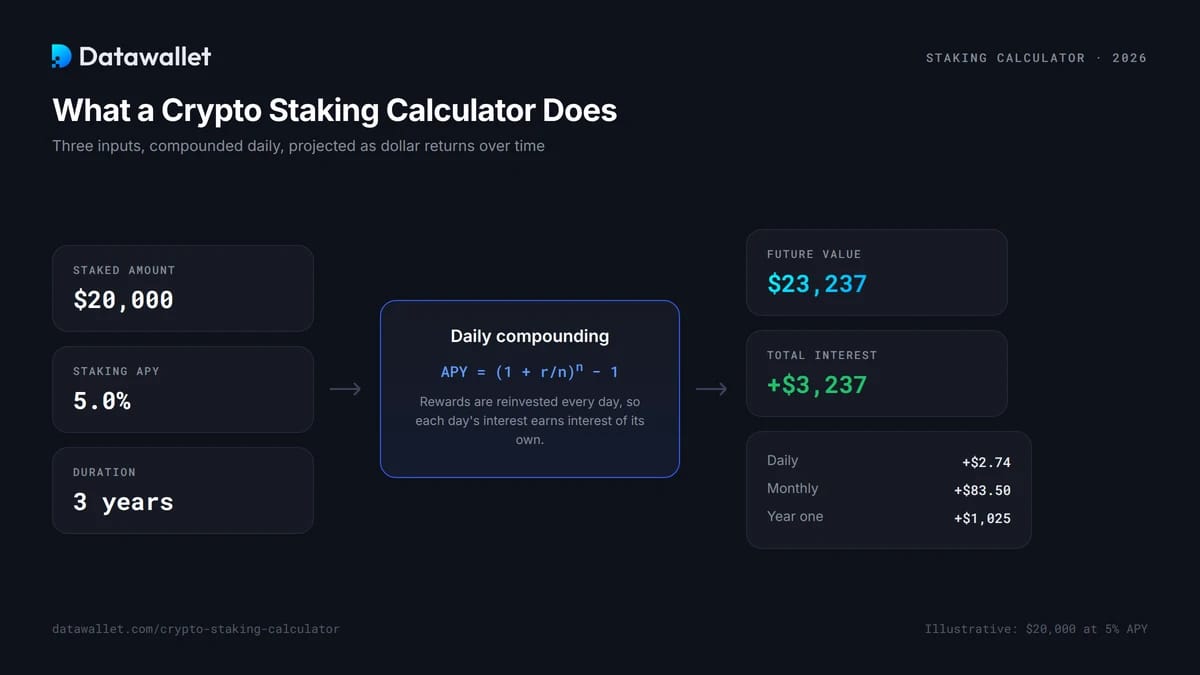
A crypto staking calculator projects how much a staked position earns over time. You enter the dollar value of your tokens, the annual percentage yield your platform quotes, and a duration. The tool then compounds that rate daily and breaks the result into per-minute, daily, weekly, monthly, and yearly dollar returns alongside the future value of the position.
Staking itself is how proof-of-stake networks like Ethereum, Solana, and Cardano secure their chains. Validators lock tokens as collateral to process transactions, and the protocol pays them newly issued tokens plus a share of fees. Most holders never run a validator. They delegate through a wallet, an exchange, or a liquid staking protocol and collect a share of the rewards net of commission. Our guide to liquid staking derivatives covers how tokens like stETH and JitoSOL keep that delegated capital usable in DeFi.
The math behind the tool is compound interest, nothing exotic. What makes the output useful is calibration: feeding it a realistic rate, then stress-testing the assumptions, which the sections below are built to help with.
How to Use the Staking Calculator
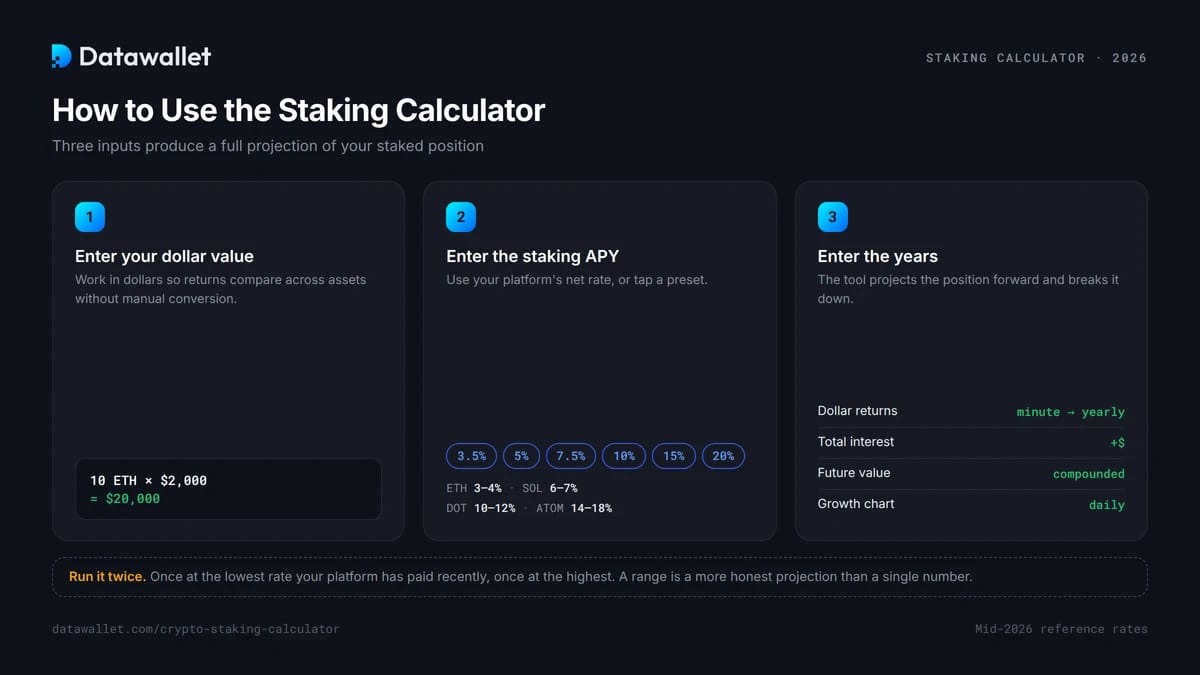
- 1. Enter the dollar value of your crypto tokens. If you hold 10 ETH at $2,000, enter $20,000. Working in dollars lets you compare returns across assets without converting prices manually.2. Enter the staking APY.
- Enter the staking APY. Use the rate your validator, exchange, or liquid staking protocol quotes, or tap a preset (3.5%, 5%, 7.5%, 10%, 15%, 20%). Mid-2026 reference points: Ethereum 3% to 4% including MEV, Solana 6% to 7%, Cardano 2% to 4%, Polkadot 10% to 12%, Cosmos 14% to 18%.3. Enter the number of years.
- Enter the number of years. The calculator populates the dollar return breakdown, total interest, future value, and a projected growth chart.
A practical habit: run it twice, once with the lowest rate your platform has paid recently and once with the highest. Staking yields float, so a range is a more honest projection than a single number.
APR vs APY: Reading Quoted Rates Correctly
APR and APY both describe an annual return but treat compounding differently, and platforms are inconsistent about which they quote.
- APR is simple interest. Stake $10,000 at 5% APR and you receive $500 over twelve months. Native staking on chains like Cardano typically quotes APR because rewards accrue without auto-reinvestment.
- APY includes compounding. At 5% with daily compounding, the same $10,000 grows to roughly $10,513. The gap widens with the rate: 10% APR compounds to about 10.52% APY, and 20% APR to 22.13%.
Liquid staking tokens auto-compound, so protocols like Lido and Jito quote APY. Native validator staking usually pays rewards you must re-stake manually, so it quotes APR. This calculator assumes daily compounding. If your setup pays simple interest, your real result will land below the projection unless you reinvest.
Staking Yields in 2026
Yields are set by each network's issuance schedule, the share of supply already staked, and the commission your validator or protocol takes. Approximate rates for the most widely staked assets as of mid-2026:
Rates reflect approximate mid-2026 yields and change with network conditions.
The defining trend behind this table is reward compression. Ethereum's base APR has fallen below 3% because nearly 39 million ETH, around 32% of supply, is now staked, and the protocol pays a fixed issuance budget across a growing validator set. Our Ethereum staking statistics page tracks the live figures. Solana holds higher nominal yields with roughly 68% participation, a contrast unpacked in our Solana staking statistics breakdown.
Where to actually stake is a separate decision, see our rankings of the best Ethereum staking platforms and best Solana staking platforms.
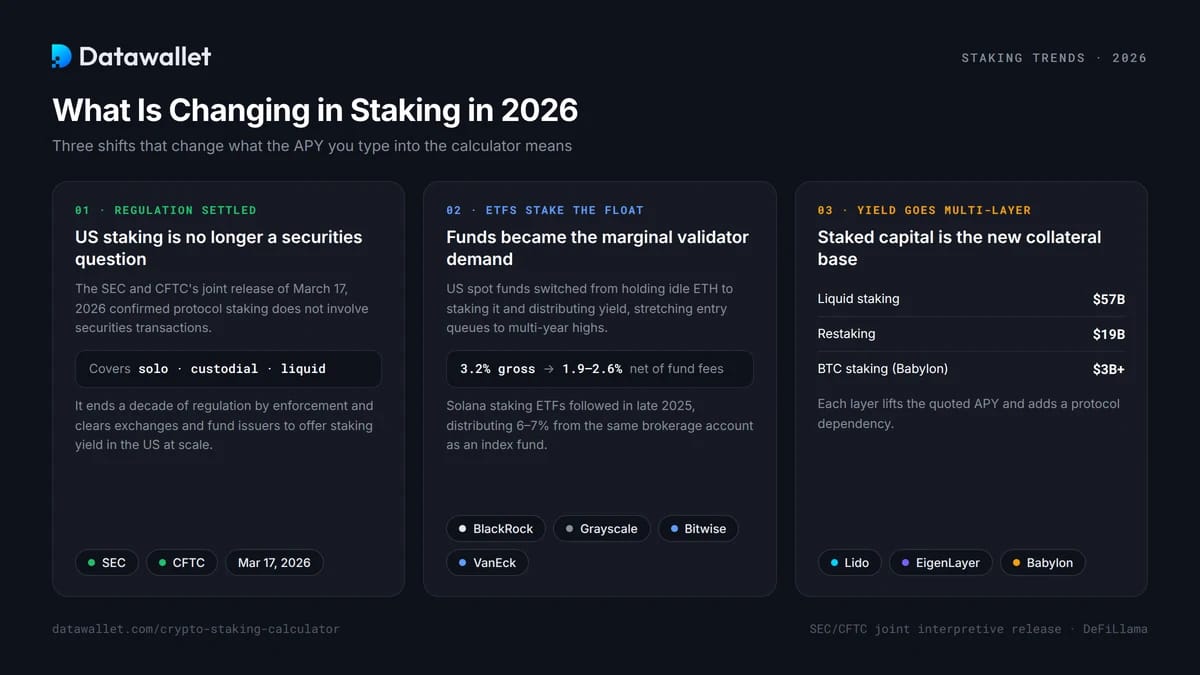
- Regulation settled. On March 17, 2026, the SEC and CFTC issued a joint interpretive release confirming that protocol staking, including solo, custodial, and liquid staking, does not involve securities transactions. That ended years of US ambiguity that had kept exchanges and fund issuers from offering staking yield to American users at scale.Staking ETFs became the marginal buyer.
- Staking ETFs became the marginal buyer: With the legal question resolved, US spot funds switched from holding idle ETH to staking it and distributing the yield. BlackRock's iShares Staked Ethereum Trust launched in March 2026 staking 70% to 95% of holdings, Grayscale began paying out staking rewards in January, and Solana staking ETFs from Bitwise and VanEck arrived in late 2025. ETF demand is now the largest source of new validator deposits, pushing Ethereum's entry queue, and its unbonding times, to multi-year highs. For the calculator, note that ETF holders receive yield net of stacked fees, typically 1.9% to 2.6% on ETH products versus roughly 3.2% gross.Yield went multi-layer.
- Yield went multi-layer: Liquid staking now holds around $57 billion, roughly a third of all DeFi TVL, with restaking adding another $19 billion as protocols like EigenLayer let staked ETH secure additional services for extra yield. Even Bitcoin, which has no native staking, earns through Babylon's $3 billion-plus BTC staking layer. Each added layer raises the quoted APY and adds a protocol dependency. Our best liquid staking platforms guide maps the current options and their trade-offs.
What Is Changing in Staking in 2026
Three shifts this year change what the number you type into the APY field actually means.
- Token inflation. Rewards come partly from new issuance, which dilutes every holder. A 14% APY on Cosmos with roughly 10% supply inflation is closer to 4% real yield in token terms. Subtract the network's inflation rate from the quoted APY before comparing chains, or a high-emission network will always look like the better deal when it rarely is.Commission and fee stacking.
- Commission and fee stacking: Validators take 5% to 10% on most chains, liquid staking protocols typically take 10% of rewards, and exchange or ETF wrappers layer their own cut on top. The rate to enter into the calculator is the net rate you receive, not the gross protocol rate.Compounding assumptions.
- Compounding assumptions: Daily compounding is accurate for liquid staking tokens but generous for native staking, where rewards may sit unclaimed for weeks. Over multi-year horizons that gap compounds too.
Real Yield: Inflation, Fees, and Compounding Drag
The headline APY overstates what you keep, for three reasons worth adjusting before you trust a projection.
Staking Risks the Calculator Cannot Model
The projection assumes the APY holds, the token price holds, and nothing breaks. None of those is guaranteed:
- Price risk: Rewards are paid in the staked token. A 6% yield on an asset that drops 30% in dollar terms still leaves you down 24%. Through 2026's drawdown, record amounts of ETH stayed staked while the price halved, and the yield offset only a fraction of the loss.
- Slashing: Networks including Ethereum and Cosmos destroy part of a validator's stake for downtime or double-signing, and delegators share the loss. Rare, but never zero.
- Lock-ups and unbonding: Ethereum's exit-plus-entry queues now stretch from days to weeks depending on congestion, Polkadot holds tokens 28 days, Cosmos 21. You cannot sell during unbonding even if price collapses.
- Counterparty and contract layers: Exchange staking adds custodial risk, liquid staking adds smart contract risk, and restaking adds both plus slashing conditions from the services being secured. Every layer that lifts the APY adds a failure mode the calculator does not price.
Frequently Asked Questions
Is crypto staking worth it in 2026?
It suits holders keeping a proof-of-stake token long term regardless of price, since rewards compound the token count and offset network inflation. With yields compressing on the largest chains, it rarely justifies buying a volatile asset purely for the rate, because price moves dwarf the yield over most holding periods.
Can you lose money staking crypto?
Yes. The token price can fall more than the yield earns, a validator can be slashed, or a custodian or smart contract holding the stake can fail. The first is by far the most common, and the calculator's projections assume none of the three happens.
Are staking rewards taxed?
In most jurisdictions, including Australia and the US, rewards count as ordinary income at market value when received, and later price moves are capital gains or losses on disposal. The 2026 US securities ruling did not change tax treatment. Confirm specifics with a local tax professional.
Can I stake Bitcoin, USDT, or USDC?
Not in the proof-of-stake sense. Bitcoin runs proof of work, though protocols like Babylon now let BTC earn yield by securing other chains, and stablecoins earn through lending and exchange earn programs rather than staking. The calculator still works for those products: enter the quoted APY and read the output the same way.
Why does my actual return differ from the calculator?
The tool assumes a constant APY with daily compounding. Real rates float with network conditions, validators and protocols take commission, and native staking often needs manual re-staking to compound. Treat the projection as an upper bound at the rate you entered.
Does a higher APY always mean a better return?
No. High nominal yields usually trace to high token inflation or emissions-funded incentives, and the rate can collapse when emissions end. Compare real yield after inflation, then weigh the unbonding period, since a long lock-up carries price risk you cannot exit.