







Compare Top Ethereum Staking Platforms
1. Bybit
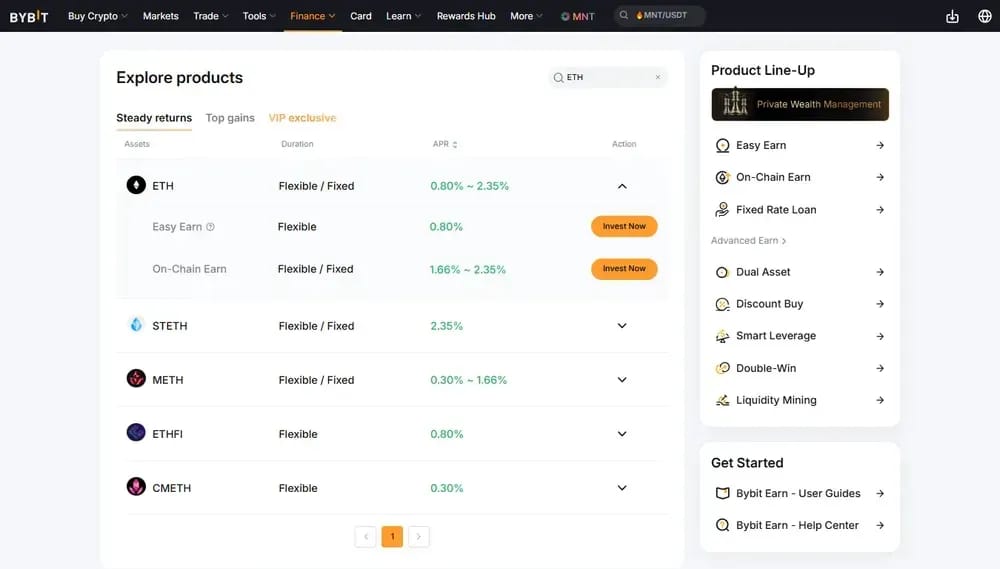
Bybit earns our top overall spot because its ETH yield menu is broader than simple exchange staking. On its official On-Chain Earn page, ETH can be routed into METH at 1.66% estimated APR, stETH at 2.35%, or cmETH at 1.66%, giving users several Ethereum-native choices.
We like that Bybit separates Easy Earn, On-Chain Earn, and Advanced Earn, so ETH holders can choose between simpler yield access and more DeFi-style exposure. Its Earn hub also emphasizes flexible unstaking and low minimums, which makes the platform easier for less technical Ethereum stakers.
The downside is that Bybit’s best ETH-related rates are not always pure validator staking; products like stETH, METH, and cmETH introduce liquid-staking or protocol exposure. Still, we think Bybit is strongest overall for users who want Ethereum yield, exchange liquidity, and multiple staking routes in one account.
Pros
- Multiple ETH yield routes, including METH, stETH, and cmETH options.
- Flexible Earn structure suits beginners and more active crypto users.
- Clear current APRs make comparison easier before subscribing.
Cons
- ETH yield products may involve liquid-staking protocol exposure.
- Highest rates can change quickly across Earn product categories.
- Not ideal for users wanting direct self-custody validator staking.
2. Lido
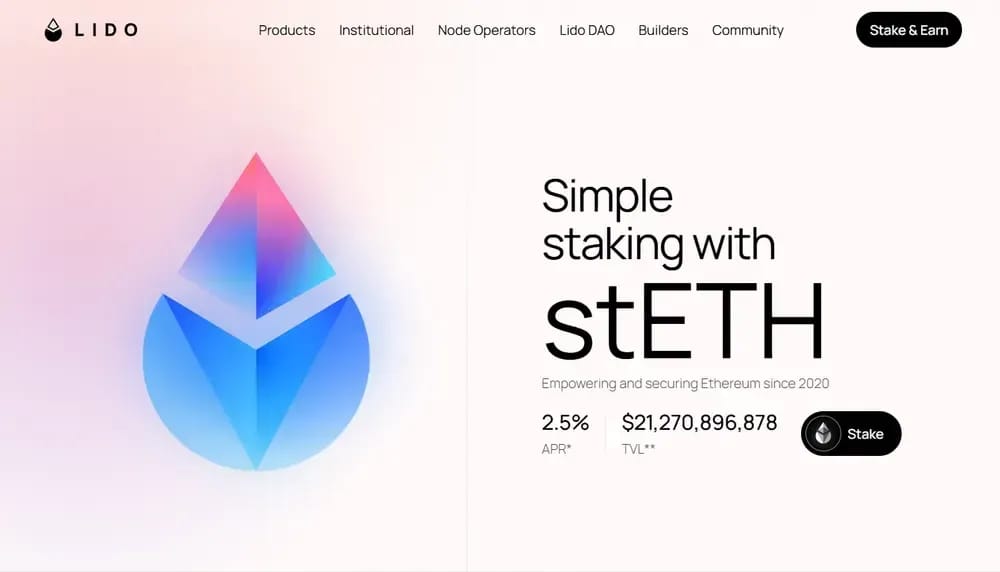
Lido is our strongest decentralized pick because it lets users stake any amount of ETH and receive stETH, a liquid token representing staked ETH plus rewards. Its official calculator currently shows a 2.49% APR estimate, with monthly and yearly ETH rewards projected from the deposit amount.
We think Lido’s biggest advantage is usability without giving up DeFi flexibility. stETH is transferable, rebases daily, and can be wrapped into wstETH for value-accruing use cases. That makes Lido better than basic locked staking for users who want Ethereum rewards and liquidity together.
The trade-off is that Lido is still protocol-based staking, not risk-free ETH yield. Lido applies a 10% fee on staking rewards, and its own help center highlights smart-contract and technical risks. We still rate it highly, but cautious users should understand those layers.
Pros
- Staking starts with any ETH amount, not validator-sized deposits.
- stETH keeps Ethereum staking liquid and usable across DeFi.
- Current APR estimate is clearly shown in Lido’s calculator.
Cons
- Lido charges a 10% fee on staking rewards.
- Smart-contract and technical risks still apply to stakers.
- APR remains variable and can shift with network conditions.
3. Binance
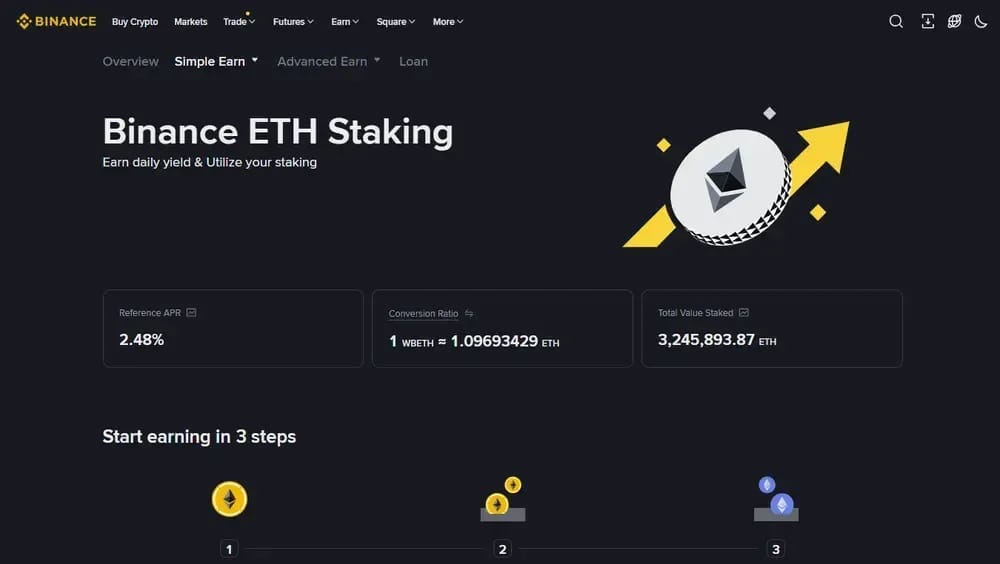
Binance is a strong Bybit alternative because its ETH staking product is built around WBETH, a transferable liquid staking token. Binance’s official Ethereum Staking page says WBETH represents staked ETH plus rewards, and currently lists ETH staking at up to 2.6% APR.
We like Binance most for users who want exchange convenience without fully locking their ETH position. WBETH can be sold, transferred, moved to a personal wallet, or used in Binance products and DeFi while still accumulating staking rewards through its changing conversion value.
The weaker side is that Binance feels more centralized than Lido and less multi-route than Bybit. Still, as a review pick, we think it is one of the cleanest alternatives for ETH holders who value liquidity, brand scale, and straightforward reward tracking.
Pros
- WBETH keeps staked ETH liquid, tradable, and transferable.
- Current ETH staking promotion reaches up to 2.6% APR.
- Rewards accrue through WBETH’s changing ETH redemption value.
Cons
- More centralized than decentralized liquid-staking protocols like Lido.
- Promotional APRs may expire or change after campaign periods.
- Redemption and conversion mechanics are less intuitive for beginners.
4. Rocket Pool
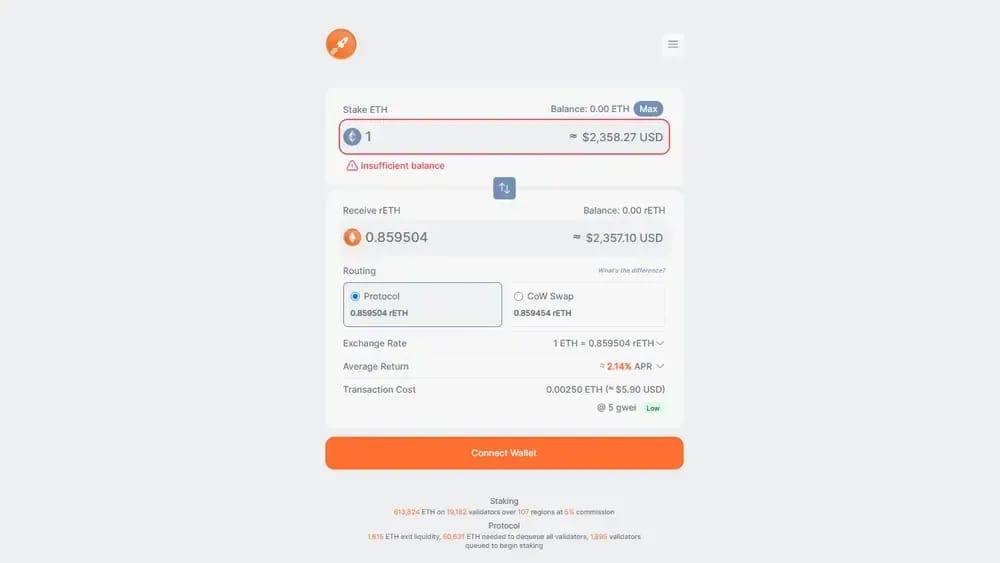
Rocket Pool is recommended for users who care about Ethereum decentralization, not just headline yield. Its official product comparison lists liquid staking at 2.23% APR with a 0.1 ETH minimum, while the protocol also supports node staking for users who want deeper validator participation.
What makes Rocket Pool different from Bybit, Binance, and even Lido is its node-operator angle. Rocket Pool says rETH rewards come from decentralized node operators, and its documentation explains that holders earn automatically as rETH’s value increases over time versus ETH.
We like Rocket Pool most for Ethereum-aligned stakers who value decentralization and transparency over exchange convenience. However, it feels less beginner-friendly than Bybit or Binance, especially for users who need a simple dashboard, instant liquidity, or customer-support-style guidance before committing ETH.
Pros
- Strong decentralization angle through Rocket Pool’s distributed node operators.
- rETH accrues rewards automatically by increasing in ETH value.
- Low 0.1 ETH minimum makes liquid staking broadly accessible.
Cons
- Less beginner-friendly than centralized exchange staking dashboards.
- Current 2.23% APR trails some exchange-based ETH offers.
- rETH liquidity and pricing depend on external market conditions.
5. Ether.fi
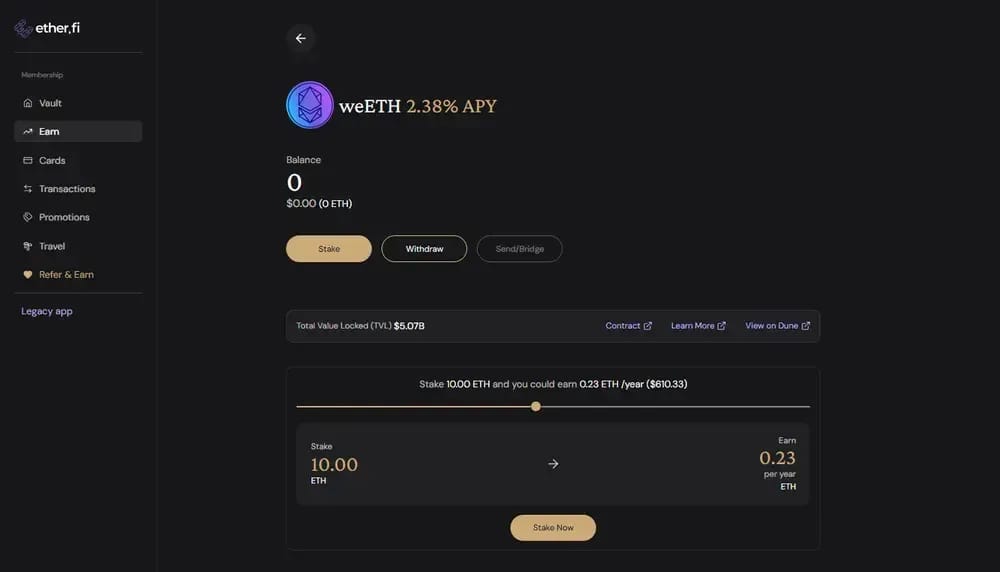
Next on our list is Ether.fi, which stands out because it focuses on liquid restaking rather than plain ETH staking. Its official staking page lists weETH as value-accruing restaked ETH, currently showing 2.8% APY and $9.0 billion in TVL for the product.
We like Ether.fi for users who want Ethereum yield plus broader DeFi composability instead of a simple exchange staking balance. The platform says weETH is integrated across 400+ DeFi protocols, and its assets are redeemable for underlying staked ETH, BTC, or stablecoins.
The key trade-off is complexity. Ether.fi says APY is variable and not guaranteed, while redemption values may vary based on market conditions, protocol liquidity, and smart-contract performance. We think it suits confident DeFi users better than beginners comparing simpler Bybit or Binance staking dashboards.
Pros
- Current weETH APY is listed at 2.8% on Ether.fi.
- Massive $9.0 billion weETH TVL supports strong market depth.
- Integrated across 400+ DeFi protocols for broader utility.
Cons
- Restaking is more complex than standard ETH staking products.
- Ether.fi warns about slashing and smart-contract vulnerability risks.
- APY is variable, not guaranteed, and conditions can change.
6. Coinbase
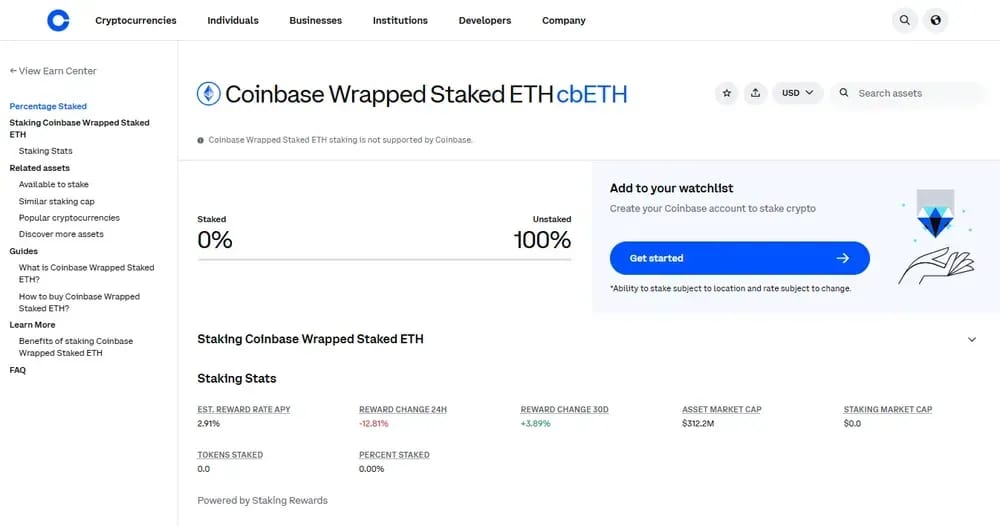
Coinbase is our top recommendation for eligible US users because it offers regulated, familiar ETH staking inside a mainstream exchange account. Coinbase currently lists Ethereum staking at 1.88% APY, but clearly notes that the ability to stake depends on location and the rate can change.
We checked the US angle carefully: Coinbase says customers can stake supported assets only if they have an active account in good standing, are located in a staking-eligible jurisdiction, and provide required tax information where applicable. So, this is best framed as a top US pick where available.
We like Coinbase for users who prioritize compliance, simplicity, and support over chasing the highest ETH yield. It also says users retain ownership and can unstake anytime, although assets must be unstaked before trading or transferring, which makes it less flexible than liquid-staking tokens.
Pros
- Strong fit for eligible US users wanting a familiar exchange.
- Current ETH staking APY is clearly displayed at 1.88%.
- Coinbase says users retain ownership and can unstake anytime.
Cons
- Staking availability depends on the user’s location and eligibility.
- Lower current ETH APY than several liquid-staking alternatives.
- Staked assets must be unstaked before trading or transferring.
7. mETH Protocol
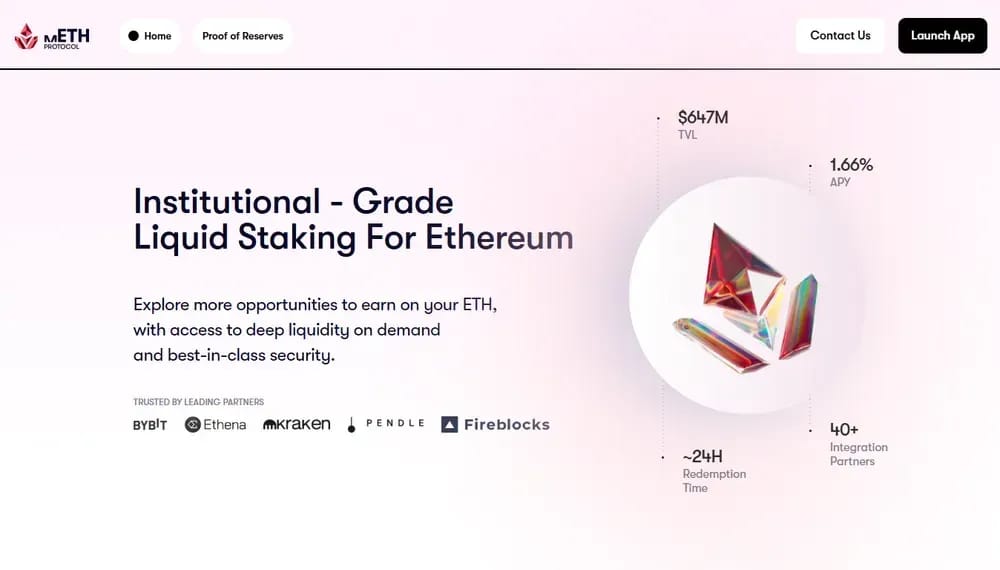
Rounding up our list is mETH Protocol, a Mantle-built liquid staking and restaking option that feels more liquidity-focused than most rivals. Its official app shows mETH active with about 1.63% APY, 240,305.31 ETH TVL, and a 10% reward fee, giving users clear current staking metrics.
What makes mETH Protocol different is its emphasis on exit efficiency rather than only yield. The official site says the Buffer Pool upgrade targets roughly 24-hour redemptions and compares mETH Protocol with around 30% Aave allocation, net protocol APY near 5.00%, and improved liquidity for ETH holders.
We like it as a closing pick for users who want ETH staking with Mantle ecosystem access and a more institutional-style liquidity story. However, it is less universal than Coinbase or Binance, and restaking via cmETH adds third-party rewards, strategies, and extra complexity beyond simple ETH staking.
Pros
- Current app shows active mETH staking with transparent APY and TVL.
- Buffer Pool design targets faster redemptions than traditional withdrawal queues.
- cmETH adds restaking exposure across EigenLayer, Symbiotic, and Karak.
Cons
- mETH Protocol is less beginner-friendly than major exchange staking.
- Restaking through cmETH introduces additional strategy and third-party risk.
- Current mETH APY may trail higher-yielding restaking competitors.
What is Ethereum Staking?
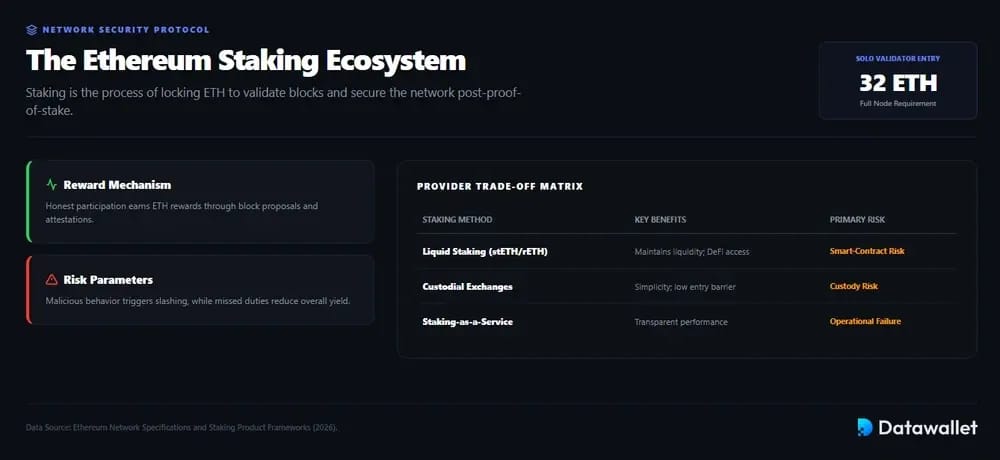
Ethereum staking is the process of locking ETH to help Ethereum validate blocks, finalize transactions, and keep the network secure after its move to proof-of-stake. A solo validator still requires 32 ETH, but staking pools, exchanges, and liquid-staking protocols let smaller holders participate too today.
Validators are chosen to propose blocks and attest to other validators’ blocks. Honest participation earns ETH rewards, while missed duties reduce returns and malicious behavior can trigger slashing. That means staking is not a savings account; it is yield tied to network performance and operational discipline.
Most users do not run validators directly. They choose custodial exchange staking, staking-as-a-service, pooled staking, or liquid staking tokens like stETH and rETH. The right route depends on custody, fees, liquidity, minimum deposit, geography, and whether the user wants DeFi access or simple reward tracking.
In this guide, we treat Ethereum staking platforms as products with different trade-offs. Exchange platforms feel simpler but add custody risk; decentralized protocols improve transparency but add smart-contract risk. APY matters, but unstaking terms, reward fees, token design, and jurisdiction can matter more over time.
Is ETH Staking Worth It?
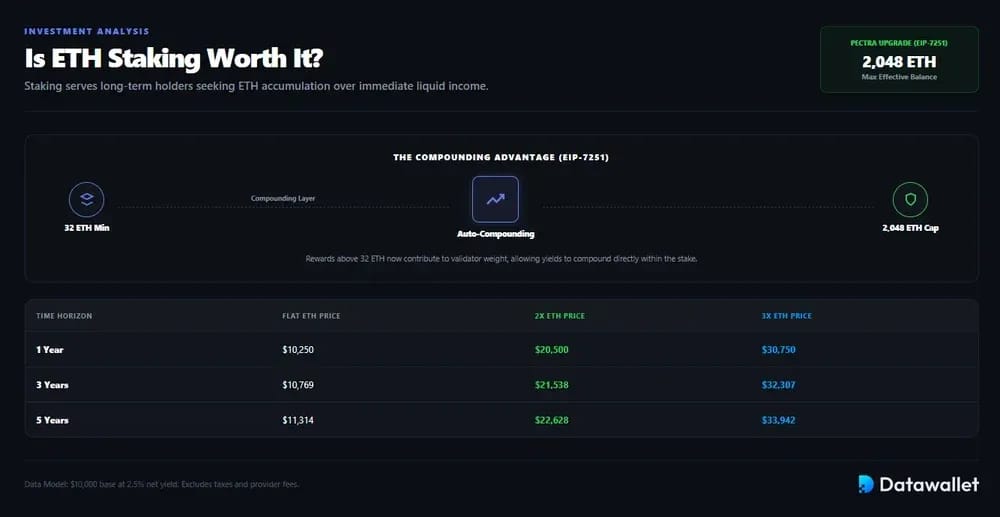
ETH staking can be worth it for long-term holders who want more ETH rather than short-term income. Since The Merge moved Ethereum to proof-of-stake and Shanghai enabled withdrawals, staking has become more usable, but rewards still compete with volatility, fees, taxes, and liquidity needs.
Pectra improved the staking math for serious validators. EIP-7251 raised the maximum effective balance from 32 ETH to 2,048 ETH while keeping the 32 ETH minimum, so rewards above 32 ETH can compound instead of sitting outside validator weight.
For a rough model, assume $10,000 of ETH staked at 2.5% annual net yield, before taxes and provider fees. The ETH balance grows about 2.5% yearly; final dollar value then depends mostly on whether ETH’s market price is flat, double, or triple.
Example scenarios:
- 1 Year: Flat ETH price: $10,250; 2x ETH price: $20,500; 3x ETH price: $30,750.
- 3 Years: Flat ETH price: $10,769; 2x ETH price: $21,538; 3x ETH price: $32,307.
- 5 Years: Flat ETH price: $11,314; 2x ETH price: $22,628; 3x ETH price: $33,942.
Risks of Staking Ethereum
ETH staking can generate passive rewards, but every method adds trade-offs around custody, uptime, liquidity, provider quality, and smart-contract exposure.
Key risks to review before staking ETH:
- Slashing: Validators can lose ETH and be ejected for slashable behavior, especially double-signing or conflicting attestations across validator setups.
- Downtime: Offline validators miss rewards and can face penalties, making reliable internet, client updates, monitoring, and failover planning important for solo operators.
- Custody: Centralized providers hold or control staking flows, creating counterparty risk, regulatory exposure, and a larger target for bugs or attacks.
- Liquidity: Unstaking may take time, and liquid-staking tokens can trade below ETH during stress, reducing flexibility when exits become crowded.
- Smart Contracts: Liquid staking and restaking rely on protocol code, so bugs, oracle issues, or integrations can affect funds even when Ethereum works normally.
- Fees: Provider commissions reduce headline APY, so a higher advertised yield may still underperform after reward fees, spreads, or redemption costs.
- Centralization: Too much ETH concentrated with one provider weakens network resilience and creates systemic risk if that operator fails or misbehaves.
- Restaking: Restaked ETH can earn extra rewards, but it adds more rules, slashing conditions, operators, and smart-contract dependencies beyond standard staking.
What is the Safest Way to Stake ETH?
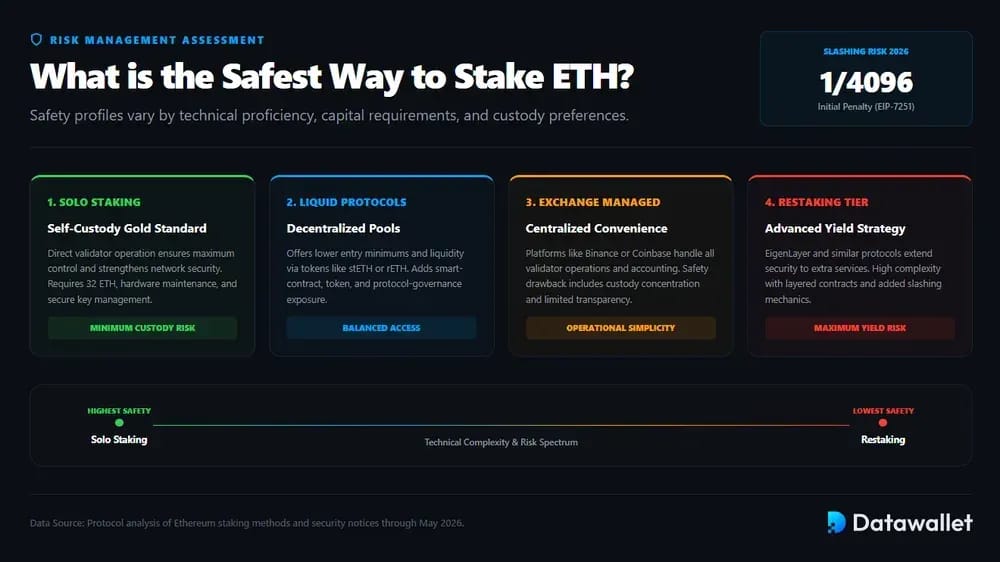
The safest ETH staking method depends on your technical skill, capital size, custody preference, and risk tolerance. Solo staking offers maximum control, while exchanges and liquid protocols trade control for convenience.
1. Solo Staking
Solo staking is the self-custody gold standard because you run your own validator, keep control of key decisions, and earn protocol rewards directly. Ethereum.org says home staking strengthens Ethereum’s decentralization and security, but it also requires hardware, maintenance, uptime, and secure key management.
The trade-off is operational risk. Solo validators need 32 ETH, reliable infrastructure, client diversity, monitoring, and a plan for updates or outages. We think it is safest for technically confident users, but not for casual investors who may miss duties or mishandle keys.
2. Decentralized Liquid Staking
Decentralized liquid staking is safer for users who want lower minimums and liquidity without relying on a major exchange. Protocols like Lido and Rocket Pool issue liquid staking tokens such as stETH or rETH, which represent staked ETH plus accrued rewards.
The risk is that liquid staking adds smart-contract, token, and protocol-governance exposure. We like it for users who value self-custody and DeFi flexibility, but it is not risk-free because stETH, rETH, or similar tokens can face liquidity pressure during stressed markets.
3. Centralized Exchange Staking
Centralized exchange staking is usually the easiest route because platforms like Bybit, Binance, and Coinbase handle validator operations, reward accounting, and interface complexity. It is useful for beginners, smaller balances, and users who prefer account-based staking over running hardware or managing DeFi positions.
The safety drawback is custody and concentration. Users rely on the exchange’s controls, eligibility rules, security practices, and withdrawal process. We think this route is safest operationally for beginners, but weaker for decentralization, transparency, and self-custody than solo or decentralized liquid staking.
4. Restaking
Restaking is best treated as an advanced yield strategy, not the safest default staking method. Protocols like EigenLayer let users restake native ETH or liquid staking tokens, extending Ethereum-backed security to additional services while introducing extra contracts, operators, and reward mechanics.
For experienced DeFi users, restaking through platforms like EigenLayer, Ether.fi, or mETH Protocol can be attractive when rewards justify the added complexity. For safety-first stakers, we would rank it below solo staking, basic liquid staking, and reputable exchange staking.
How Does Slashing Work in Ethereum Staking?
Slashing is Ethereum’s strongest validator penalty: it punishes provably harmful behavior, removes the validator from active duty, and burns part of its stake. Pectra reduced the initial slashing penalty from 1 ETH to 0.0078125 ETH per 32 ETH validator.
Beaconcha.in’s slashings page tracks slashed validators with columns for slashed validator, slasher, age, reason, slot, and epoch, but its crawlable page does not expose a static 2026 aggregate count.
Is Ethereum Staking Yield Taxed?
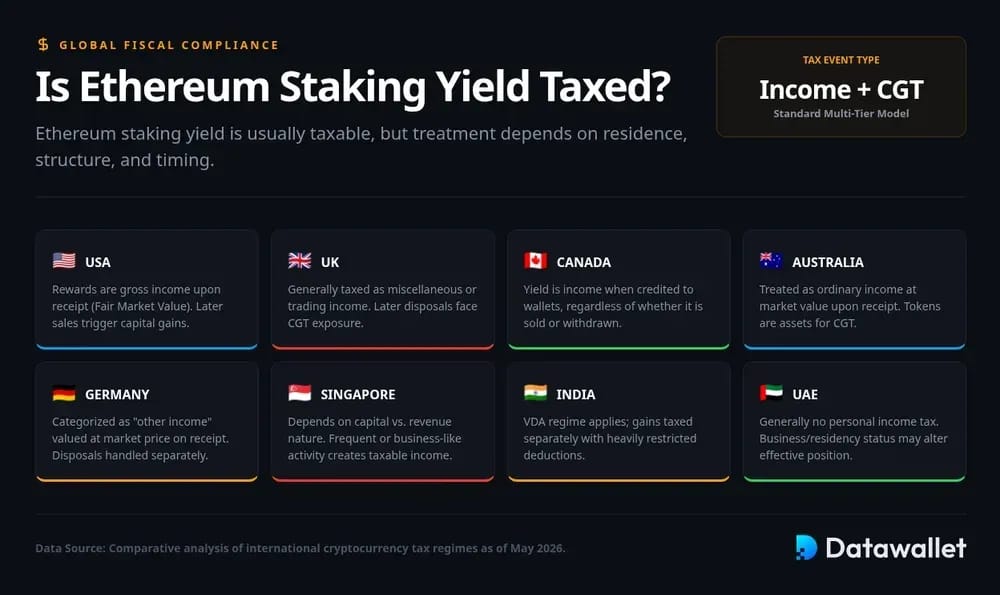
Yes, Ethereum staking yield is usually taxable, but treatment depends on residence, structure, and timing. Rewards may be income when received, and later disposals can create capital gains or losses, so records matter.
Common regional treatments to check before filing locally:
- United States: Staking rewards are gross income when the taxpayer gains dominion and control, valued at fair market value on receipt. Later sales can create capital gains.
- United Kingdom: Staking rewards are generally taxable as miscellaneous or trading income when received, while later disposals may also create capital gains tax exposure.
- Canada: Staking rewards from centralized platforms are generally income when credited to the taxpayer’s platform wallet, even before they are sold or withdrawn.
- Australia: Staking rewards are ordinary income at market value when received, and the reward tokens also become assets for later capital gains calculations.
- Germany: Staking rewards can be treated as other income, generally valued at market price when received, with later disposals handled separately.
- Singapore: Tax depends on whether activity is capital or revenue in nature; frequent, commercial, or business-like crypto activity can create taxable income.
- India: Crypto transfers fall under the virtual digital asset regime, where gains are taxed separately and deductions are heavily restricted under current VDA rules.
- UAE: Individuals generally face no personal income tax, but businesses, residency status, and cross-border obligations can still change the effective tax position.
Final Thoughts
Ethereum staking is best viewed as a long-term ETH accumulation strategy, not guaranteed passive income. The right platform depends on whether you value convenience, decentralization, liquidity, jurisdictional access, or advanced DeFi utility most.
For most users, Bybit, Lido, and Binance cover the broadest needs, while Rocket Pool, Ether.fi, Coinbase, and mETH Protocol serve more specific profiles. Always compare APY, fees, custody, risks, and withdrawal flexibility before staking.
Our Methodology
We evaluated 20+ Ethereum staking platforms across centralized exchanges, decentralized liquid staking protocols, node-focused staking networks, restaking platforms, and ecosystem-specific ETH staking products with different custody models, fees, liquidity profiles, and user requirements.
Here is how we evaluated each platform:
- Yield: We compared current ETH staking, liquid staking, and restaking APY or APR figures, prioritizing live platform pages over third-party estimates or stale promotional claims.
- Fees: We reviewed reward commissions, protocol fees, validator commissions, unstaking charges, and whether each platform clearly separated user yield from provider revenue.
- Staking Model: We classified each provider by structure, including exchange staking, liquid staking, node staking, pooled staking, and restaking, because each model changes the risk profile.
- Liquidity: We checked whether users receive liquid staking tokens, can unstake directly, face withdrawal queues, or must sell derivative assets through secondary markets.
- Custody: We scored platforms differently depending on whether users keep wallet control, rely on centralized custody, or interact with smart contracts and protocol governance.
- Accessibility: We considered minimum deposit requirements, beginner usability, dashboard clarity, supported regions, US eligibility, and whether users need advanced wallet or DeFi knowledge.
- Risk Controls: We reviewed slashing exposure, smart-contract risk, token depeg risk, validator operations, exchange concentration, restaking complexity, and whether users can understand the downside before depositing.
- Transparency: We prioritized platforms with public yield data, fee explanations, TVL figures, token mechanics, risk disclosures, official documentation, and verifiable staking or redemption information.
- Use Case Fit: We ranked platforms by practical user profile, including best overall, decentralized staking, exchange convenience, node diversity, restaked ETH yield, US accessibility, and Mantle ecosystem exposure.
.webp)