



Can I Buy Bitcoin with Venmo?
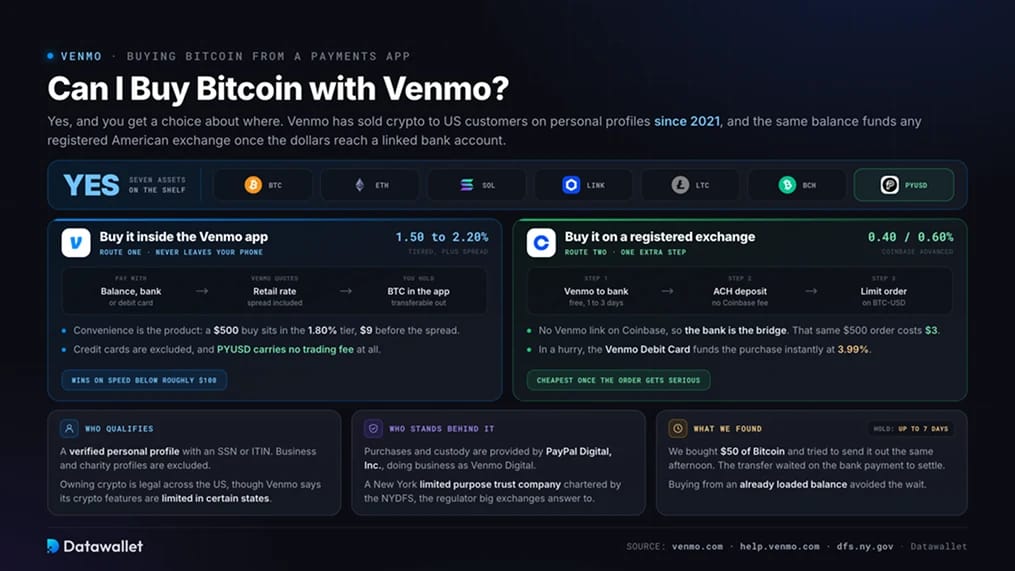
Yes, and you get a choice about where. Venmo has sold crypto to US customers on personal profiles since 2021, and the same balance also funds any registered American exchange once the dollars reach a linked bank account. Owning crypto is legal across the US, though Venmo notes its crypto features are limited in certain states.
The in-app service now runs on serious licensing. Since May this year, purchases and custody have been provided by PayPal Digital, Inc., doing business as Venmo Digital, a New York limited purpose trust company chartered by the NYDFS to conduct virtual currency business. That places Venmo's crypto arm under the same New York supervision as the major exchanges.
When we bought $50 of Bitcoin in the app and tried to send it out the same afternoon, the transfer waited on the underlying bank payment to settle, a hold Venmo says can last up to seven days. Buying from an already loaded balance avoided the wait. Our best crypto exchanges in the USA guide compares the registered venues.
How to Buy Crypto with Venmo
The cheapest path pairs a free standard withdrawal out of Venmo with free ACH funding into Coinbase, which prices trades on a live market instead of a quoted retail rate.
Steps to buy crypto with Venmo:
- Create and verify a Coinbase account: Sign up on Coinbase and complete identity checks with your Social Security number and a government ID, as federal rules require at every registered exchange.
- Move your Venmo balance to your bank: Venmo is absent from Coinbase's payment method list, so send the balance to your linked bank first. The standard withdrawal is free and takes one to three business days, while Instant Transfer arrives in minutes for 1.75%, capped at $25.
- Link that bank inside Coinbase: Add a payment method, choose bank account, and connect through Plaid or trial deposits. Coinbase then pulls your deposit by ACH at no cost.
- Use the Venmo Debit Card when speed matters: The Mastercard attached to your balance works as a debit card on Coinbase at a 3.99% fee, worth paying only when waiting a day is not an option.
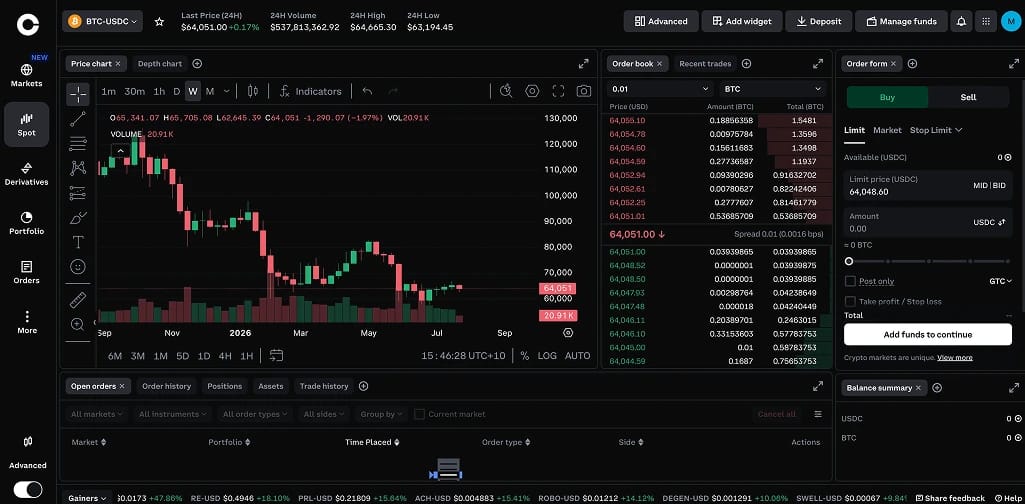
- Trade on Coinbase Advanced: Set a limit order on BTC-USD or your pair. Advanced starts at 0.40% maker and 0.60% taker, while the Simple screen folds a wider spread into its quote.
Venmo also sends dollars to a US PayPal account without a fee, and Coinbase accepts PayPal as a deposit method for US customers, so anyone who keeps a verified PayPal account can skip the bank wait.
Buying Crypto Directly in the Venmo App
For small amounts the in-app purchase is hard to beat on convenience, and for PYUSD it costs nothing.
- Verify your identity: Crypto requires a verified personal profile with an SSN or ITIN, and business or charity profiles are excluded.
- Pick an asset: The shelf covers Bitcoin, Ethereum, Solana, Chainlink, Litecoin, Bitcoin Cash, and PayPal USD, the dollar stablecoin from Venmo's parent company.
- Choose how to pay: A Venmo balance, linked bank account, or debit card all work, and credit cards are excluded. Cash back from the Venmo Credit Card can auto-convert into crypto with no purchase fee.
- Confirm the order: The app displays the exact fee for your amount before you commit, and the exchange rate includes a spread Venmo earns on top.
A $500 Bitcoin purchase pays the 1.80% tier, $9 before the spread, while the same trade on Coinbase Advanced costs $3 at the entry taker rate after a free ACH deposit. Below roughly $100 the gap stops mattering and the app wins on speed.
Sending Crypto From Venmo to Coinbase
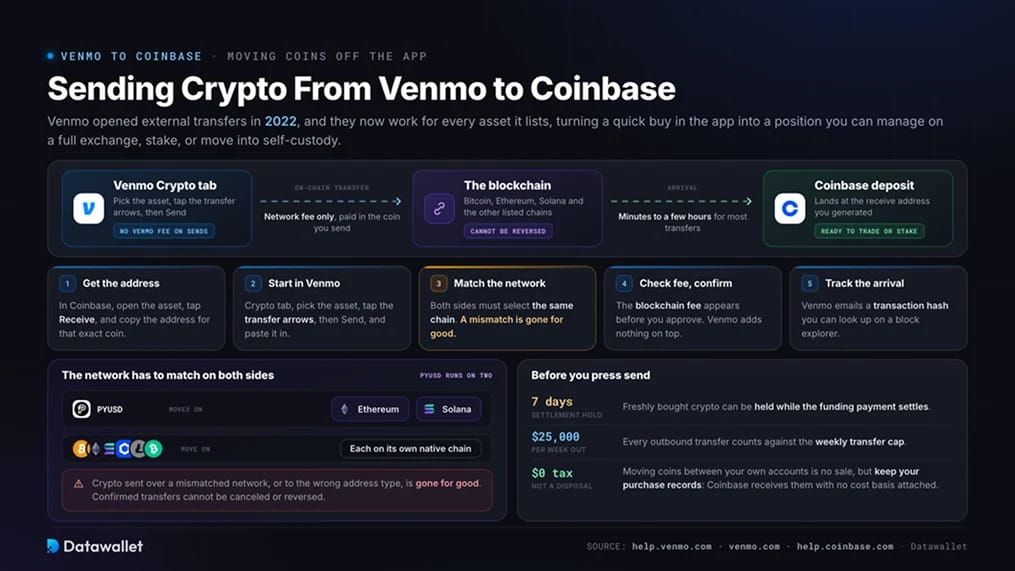
Venmo opened external transfers in 2022, and they now work for every asset it lists. That turns a quick buy in the app into a position you can manage on a full exchange, stake, or move into self-custody.
- Generate a deposit address on Coinbase: Open the asset in Coinbase, tap Receive, and copy the address for the exact coin and network you plan to send.
- Start the transfer in Venmo: Go to the Crypto tab, pick the asset, tap the transfer arrows, then Send, and paste the Coinbase address.
- Match the network: PYUSD moves on Ethereum or Solana, and both sides must select the same one. Crypto sent over a mismatched network or to the wrong address type is gone for good.
- Review the network fee and confirm: Venmo adds no charge of its own on external sends. The blockchain fee appears before you approve and is paid in the crypto you transfer, and confirmed transfers cannot be canceled or reversed.
- Track the arrival: Venmo emails a transaction hash you can look up on a block explorer, and most transfers land within minutes to a few hours.
Freshly purchased crypto can be held while the funding payment settles, up to seven days, and every outbound transfer counts against the $25,000 weekly cap. On the tax side, moving coins between your own accounts creates no taxable sale, though your purchase records should travel with them, because Venmo loses visibility into assets once they leave and Coinbase receives them without a cost basis attached.
Fees, Tax and Transfer Limits for Venmo Customers
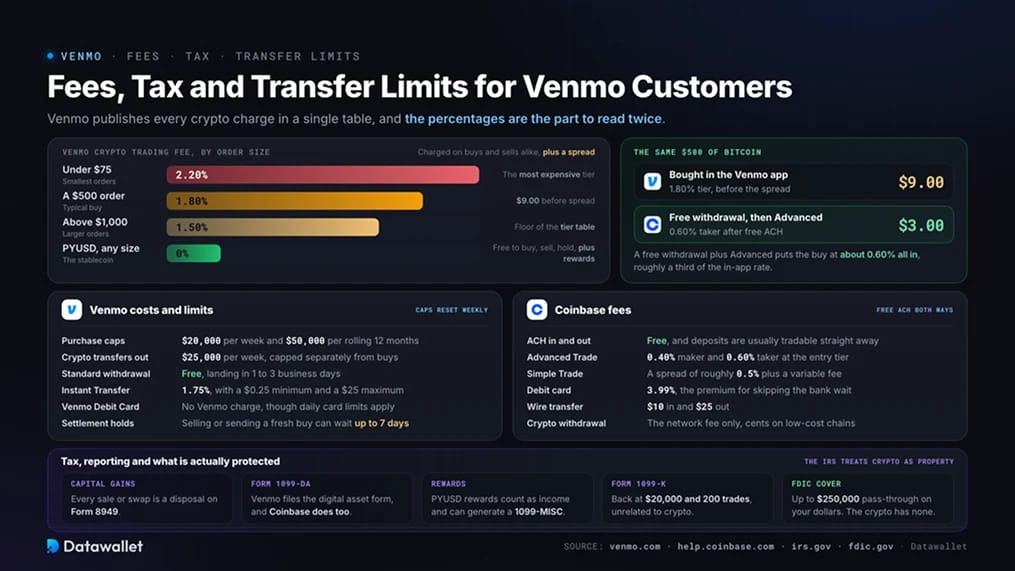
Venmo publishes every crypto charge in a single table. The percentages are the part to read twice.
Venmo costs and limits
- Crypto trading fee: Tiered by size, from 2.20% on amounts under $75 down to 1.50% above $1,000, charged on buys and sells alike. The exchange rate carries an additional spread.
- PYUSD: No fee to buy, sell, or hold, and eligible balances earn rewards paid monthly.
- Purchase caps: $20,000 per week and $50,000 per rolling 12 months, and outbound crypto transfers cap separately at $25,000 per week.
- Standard bank withdrawal: Free, landing in one to three business days, and the step that unlocks free ACH funding at an exchange.
- Instant Transfer: 1.75% with a $0.25 minimum and a $25 maximum.
- Debit card: No Venmo charge when the card funds an exchange purchase, though daily card limits apply and Coinbase adds its own fee.
- Settlement holds: Selling or sending recently bought crypto can wait up to seven days for the original payment to clear.
- FDIC: Holding crypto is one of the triggers that places your US dollar balance in Program Banks, where it becomes eligible for pass-through insurance up to $250,000. The crypto itself carries no FDIC protection anywhere.
Coinbase fees
- ACH deposit and withdrawal: Free, and deposited funds are usually tradable straight away.
- Advanced Trade: 0.40% maker and 0.60% taker at the entry tier, falling with volume. Our Coinbase fees guide breaks down every tier.
- Simple Trade: A spread of roughly 0.5% plus a variable fee, which is why we stay on Advanced.
- Debit card: 3.99%, the premium for skipping the bank wait.
- Wire: $10 in and $25 out.
- Crypto withdrawal: The network fee only, cents on low-cost chains.
US tax on crypto
- Capital gains: The IRS treats crypto as property, so every sale, swap, or purchase paid in crypto is a disposal reported on Form 8949 and Schedule D.
- Form 1099-DA: Venmo files the new digital asset form for sales and exchanges, and Coinbase does the same, so the IRS sees proceeds from both sides of your setup.
- Rewards: PYUSD rewards and other crypto incentives count as income and can generate a 1099-MISC.
- 1099-K: Back at the $20,000 and 200 transaction threshold after Congress restored it, and unrelated to your crypto trades.
Funded by a standard withdrawal and traded on Advanced, a Venmo-sourced Bitcoin buy costs about 0.60% all in, roughly a third of the in-app rate before the spread is counted.
Best Exchanges for Venmo Customers
Each platform below is registered with FinCEN, open to US residents, and reachable with Venmo money through a linked bank account or the Venmo Debit Card. Coinbase leads on regulatory standing and free ACH funding.
Venmo Cryptocurrency Policy
Venmo runs crypto as a headline feature rather than a tolerated payment category. Custody and trading sit with PayPal Digital, Inc. (NMLS ID 2610315), a limited purpose trust company answering to the New York State Department of Financial Services, the strictest state crypto regulator in the country.
The stablecoin on its shelf follows the same pattern. PYUSD is issued by Paxos Trust Company under NYDFS oversight and now operates inside the federal framework the GENIUS Act created for payment stablecoins in July 2025, which is why Venmo can pay rewards on balances and waive trading fees on it.
Outbound money faces no crypto filter. Venmo clears withdrawals and card payments that end up at registered exchanges as ordinary account activity, subject to the same fraud screening as anything else.
Within PayPal's own family, the PayPal app carries the same coins under the same trust company, while Cash App keeps its in-app trading to Bitcoin alone. Our guide to the most crypto-friendly banks in the USA shows how traditional accounts compare on the same test.
About Venmo
Venmo launched in 2009 as a way for friends to split bills from their phones and became the default social payments app in the US after PayPal picked it up through the Braintree acquisition in 2013. The service is operated by PayPal, Inc. under state money transmitter licenses, and Venmo itself is not a bank.
The account has grown well past peer payments. A balance with optional direct deposit and early paydays, the Venmo Debit Card issued by The Bancorp Bank on the Mastercard network, a Visa credit card from Synchrony Bank, teen accounts, and business profiles all hang off the same app. US dollar funds are placed with partner Program Banks once you use features like the debit card or crypto, the basis of the pass-through FDIC eligibility.
Crypto arrived in 2021 and has deepened since, from external transfers to Cash Back to Crypto and PYUSD rewards. Among American payment apps, only Cash App comes close on reach, and Venmo carries the broader asset list.
Bottom Line
Venmo covers both ends of a sensible setup. The app handles small, instant buys and fee-free PYUSD, and the balance behind it funds a registered exchange whenever the order deserves better pricing than a 1.50% to 2.20% tier plus spread.
We point most Venmo users to Coinbase for its FinCEN registration, NYDFS supervision, public company reporting, and free ACH deposits. Send the balance to your bank with the free standard withdrawal, trade on Advanced rather than Simple, and if you started with coins in Venmo, transfer them across on-chain instead of selling and rebuying. Long-term holdings belong in a wallet you control either way.