





.png)
.png)



What Does the Ethereum Liquidation Heatmap Measure?
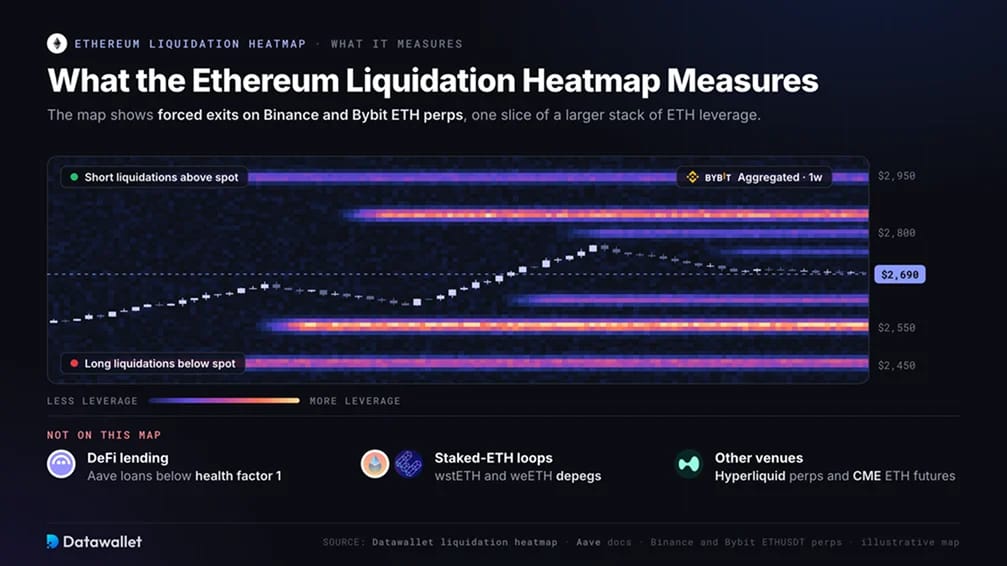
The Ethereum liquidation heatmap estimates the ETH prices where leveraged perpetual futures positions on Binance and Bybit would be force-closed. Short liquidation clusters sit above the current ETH price and become forced market buys if price reaches them. Long liquidation clusters sit below and become forced sells.
On the chart, ETH/USDT candles sit on top of a color gradient: the warmer the color, the more ETH leverage the model expects to be forced out at that price. Read the liquidity profile on the right as the centralized-exchange slice of a larger stack. It totals estimated liquidation value per level for the latest snapshot, while DeFi loans and staked-ETH loops add pressure the model can't see. The 1w and 1m windows are most useful for spotting levels built around ETF flow swings and network upgrade dates.
Perpetual futures are only one place where ETH leverage builds up. Ethereum is also the main collateral asset in decentralized finance, so a sharp ETH move can set off liquidations in several systems at once.
Why Does Ethereum Have More Layers of Liquidation Risk?
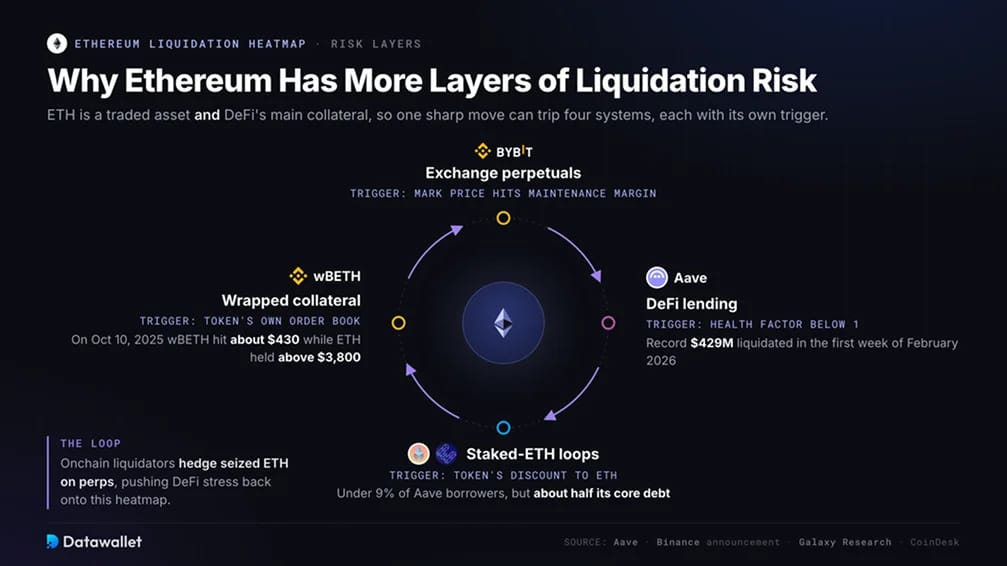
ETH leverage builds up in four connected layers. Each has its own trigger.
- Centralized perpetuals: Positions on Binance and Bybit are liquidated when the mark price hits the maintenance margin level. This is the layer the heatmap models.
- DeFi lending: On Aave, the largest lending protocol, a loan can be liquidated once its health factor falls below 1. At that point, collateral value multiplied by its liquidation threshold no longer covers the debt. Aave processed a record $429 million of liquidations in the first week of February 2026, as ETH and BTC fell 30% to 40%.
- Liquid staking loops: Traders deposit staked-ETH tokens like weETH or wstETH, borrow ETH against them, and stake the borrowed ETH again to multiply their yield. Galaxy research from August 2026 found these positions were under 9% of Aave borrowers but held about half of its core-market debt, at an average health factor near 1.06. Their trigger is a widening discount between the staking token and ETH, not the ETH price itself. Datawallet's guide to leveraged staking and looping explains how these positions are built.
- Wrapped collateral on exchanges: During the October 10, 2025 crash, Binance's wrapped staked ETH (wBETH) briefly traded near $430 on Binance's own order book while ETH stayed above $3,800. Users who had posted wBETH as margin were liquidated. Binance then added redemption prices to its collateral indexes to prevent a repeat.
The layers feed each other. Onchain liquidators often hedge the collateral they seize with short perpetual positions, so a DeFi liquidation wave can quickly show up as selling pressure on the heatmap.
What Does Positioning Data Say About ETH Leverage?
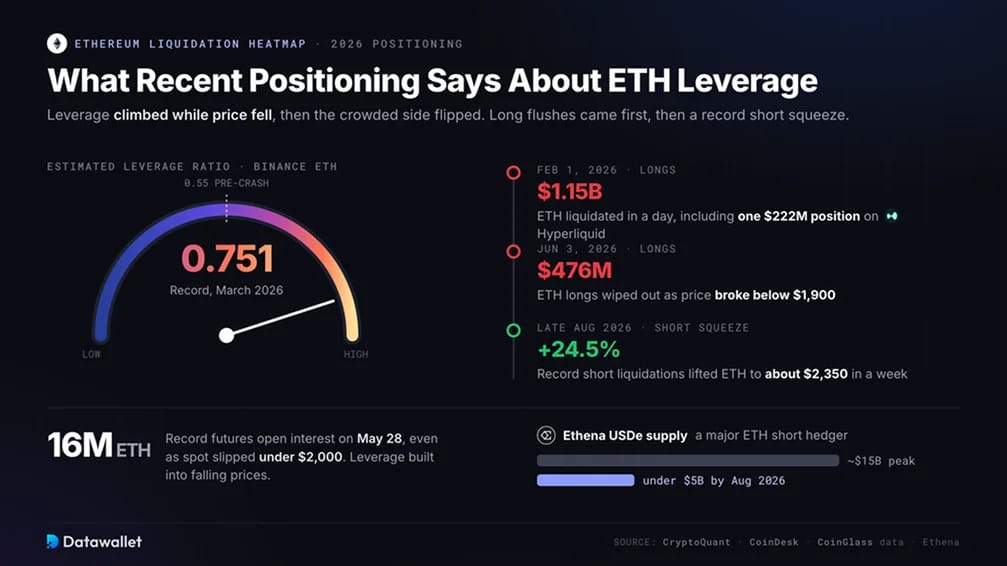
- Leverage climbed while price fell: CryptoQuant's estimated leverage ratio for ETH on Binance divides open interest by the exchange's ETH reserves. It hit a record 0.751 in March 2026, up from about 0.55 before the October 2025 crash. On May 28, total ETH futures open interest reached a record of about 16 million ETH, even as spot fell below $2,000.
- Single positions can move the market: On February 1, 2026, ETH liquidations topped $1.15 billion in one day. They included a single $222 million position closed on Hyperliquid.
- Long flushes, then short squeezes: On June 3, $476 million of ETH longs were liquidated as ETH broke below $1,900. In late August the trade reversed. Record short liquidations across crypto pushed ETH up 24.5% in a week to about $2,350.
- A major source of short hedging is shrinking: Ethena's USDe stablecoin holds short ETH perpetual positions to hedge its collateral. USDe supply fell from about $15 billion to under $5 billion, and Ethena has moved part of its hedging into equity perpetuals. Less structural shorting changes how ETH funding rates behave.
- Treasury companies are a new kind of holder: BitMine held almost 6 million ETH by September 2026, most of it staked. Smaller treasury companies have become forced sellers, though. ETHZilla sold $74.5 million of ETH in December 2025 to repay secured notes. Datawallet's Ethereum treasury tracker shows each company's holdings and whether its stock trades above or below the value of its ETH (mNAV).
How Should You Read ETH Liquidation Clusters?
- Use percentage distance: Judge a cluster by how far it sits from spot in percent, not dollars. A 5% ETH move within a week is routine, so clusters within that range are live targets.
- Look for stacked layers: If a large long cluster on the heatmap sits near prices where big DeFi loans also approach liquidation, a break can set off centralized-exchange and onchain selling together.
- Watch staking-token pegs during stress: If weETH or wstETH starts trading at a widening discount to ETH, looped positions can unwind even without a large ETH move.
- Read funding alongside open interest: ETH funding turned negative in March 2026 and stayed weak while open interest climbed to records. Together, those readings flagged a crowded short book before the August squeeze.
- Mark the calendar: Network upgrades and shifts in ETF flows tend to attract new leverage. Glamsterdam, Ethereum's next major upgrade, is scheduled for mainnet in late 2026.
What Are the Limits of the Ethereum Heatmap?
- It covers centralized exchanges only: DeFi lending positions, Hyperliquid, and CME ETH futures aren't in the model.
- Collateral assumptions: Cross-margin accounts, and accounts that post staked ETH or stablecoins as margin, can liquidate at prices well away from the modeled levels.
- Positions change constantly: A bright cluster can fade within hours as traders add margin or close positions.
- Network congestion: During cascades, Ethereum gas fees can spike. That slows collateral top-ups and bridge transfers, so liquidations can happen faster than users can react.
- It doesn't predict direction: The heatmap shows where forced orders would land if price gets there. It doesn't say which side breaks first.