





What Is the Bitcoin Halving?
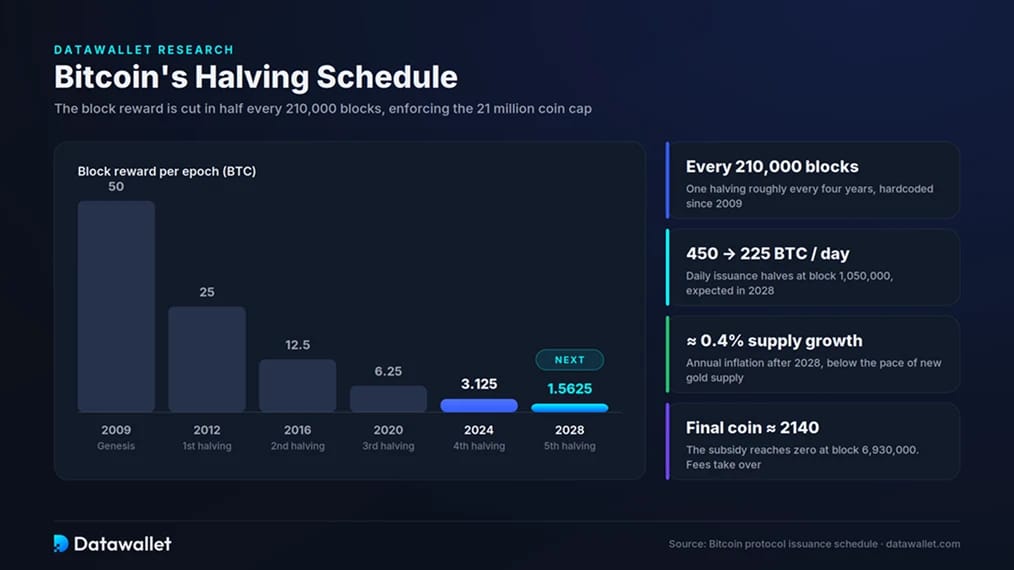
Every 210,000 blocks, Bitcoin cuts the subsidy paid to miners in half. The rule has been part of the protocol since 2009 and is the mechanism that enforces the 21 million coin cap. Miners currently earn 3.125 BTC per block, which puts new issuance near 450 BTC per day.
The fifth halving triggers at block 1,050,000 and drops the subsidy to 1.5625 BTC, taking daily issuance to roughly 225 BTC. After it, Bitcoin's annual supply growth falls to about 0.4%, below the rate at which new gold is mined. The schedule runs until around 2140, when the subsidy reaches zero and miners earn transaction fees alone.
How the BTC Halving Countdown Estimate Works
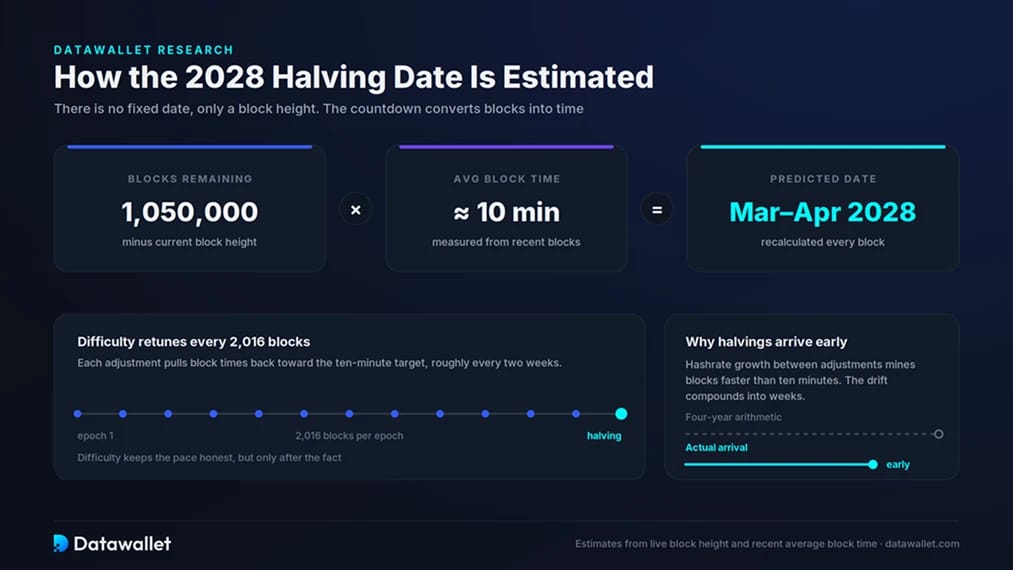
There is no fixed halving date, only a block height. The countdown above multiplies the blocks remaining until 1,050,000 by the network's recent average block time, so the predicted date moves as blocks arrive faster or slower than the ten-minute target.
Difficulty retunes every 2,016 blocks to pull block times back toward that target, but hashrate growth between adjustments mines blocks ahead of schedule. Every halving so far has landed earlier than simple four-year arithmetic implied, and the same drift applies here. Current projections cluster around late March to April 2028, with the estimate tightening as the block height closes in.
The Four-Year Cycle Is on Trial
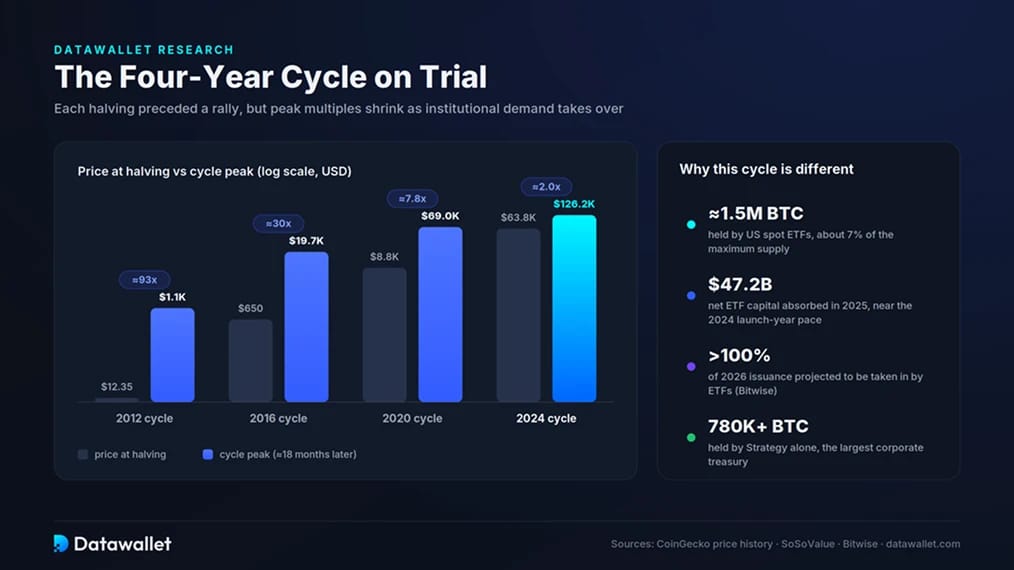
For three halvings running, the same pattern held. Bitcoin traded at $12.35 at the 2012 event and crossed $1,000 within a year. The 2016 halving at $650 preceded the 2017 run to $20,000, and the 2020 halving at $8,821 led into the 2021 peak above $68,000. Each rally topped out roughly 18 months after the supply cut, then gave back 77% or more.
The 2024 cycle kept the timing and broke everything else. Bitcoin set an all-time high before the halving for the first time, pulled forward by the spot ETFs approved in January 2024, then peaked near $126,200 in October 2025, right on the 18-month mark. The drawdown since has been the shallowest on record, and that divergence has made the cycle the most contested question in the market. Standard Chartered, Grayscale, and Bitwise have each published research arguing the four-year pattern is finished, with Michael Saylor, Cathie Wood, and Raoul Pal in the same camp.
The structural argument is hard to dismiss. US spot Bitcoin ETFs now hold around 1.5 million BTC, roughly 7% of the maximum supply, and absorbed $47.2 billion in net new capital during 2025. Bitwise projects the funds could take in more than 100% of all newly mined Bitcoin in 2026. Set against daily issuance worth around $35 million, ETF activity and corporate treasury accumulation, led by Strategy's stack of more than 780,000 BTC, now move multiples of what miners produce. When demand at that scale sets the marginal price, halving the trickle of new supply matters less than it did when miners were the dominant sellers.
The counterargument is that the October 2025 top landed exactly where cycle timing predicted it, eighteen months post-halving, same as 2017 and 2021. On that reading the cycle has dampened rather than died, with each iteration producing smaller peak multiples and shallower drawdowns as the asset's market cap grows. The 2028 halving is the first event with the evidence to settle it.
Miners Are Walking Into 2028 Wounded
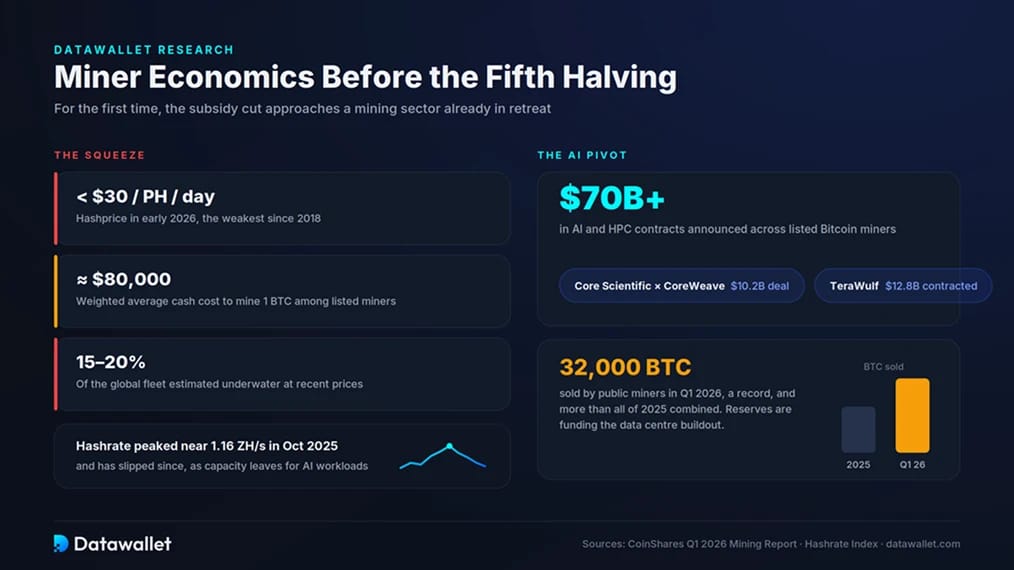
Previous halvings hit a mining industry in expansion. This one approaches a sector already in retreat. Network hashrate peaked near 1.16 zetahashes per second in October 2025 and has since slipped, while hashprice, the daily revenue per petahash of computing power, fell below $30 in early 2026, its weakest reading since 2018. CoinShares puts the weighted average cash cost of producing one Bitcoin among listed miners near $80,000, leaving an estimated 15 to 20% of the global fleet underwater at recent prices. Cutting the subsidy in half from that starting position roughly doubles production costs overnight.
The sector's response has been to stop being a pure mining business. More than $70 billion in AI and high-performance computing contracts have been announced across listed miners, including Core Scientific's $10.2 billion CoreWeave deal and TeraWulf's $12.8 billion in contracted HPC revenue, and analysts expect AI to supply up to 70% of listed-miner revenue by the end of 2026. Funding the buildout has meant liquidating reserves: public miners sold a record 32,000 BTC in the first quarter of 2026, more than in all of 2025 combined.
For the halving, this cuts both ways. Hashrate leaving for AI workloads lowers difficulty and improves margins for the operators who stay, cushioning the 2028 cut. It also means the network's security is increasingly supplied by a shrinking set of low-cost specialists rather than a diversified industry, which concentrates the risk if the economics deteriorate further.
Bitcoin's Security Budget Question Gets Louder
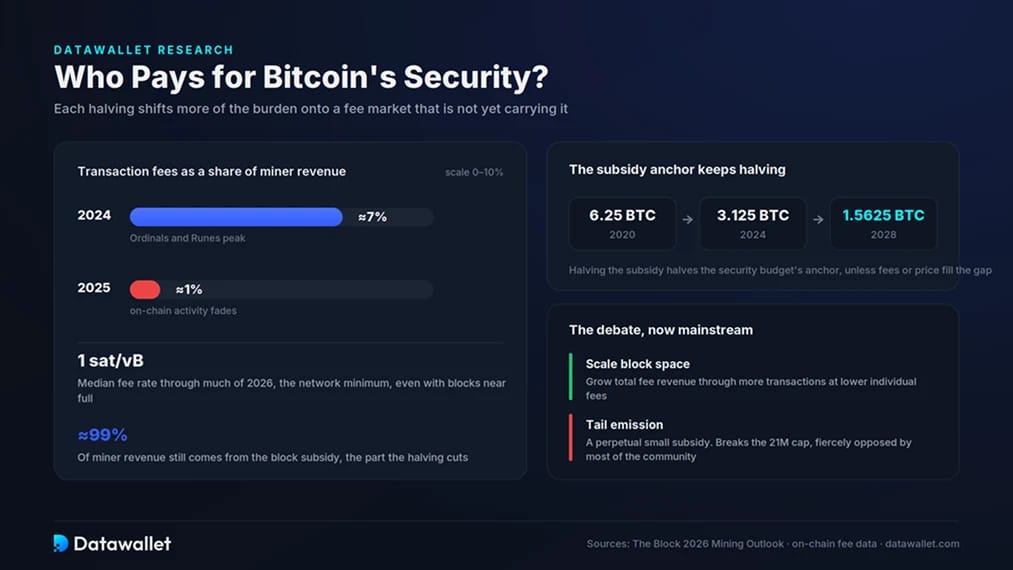
Each halving shrinks the pool of money paying for Bitcoin's security, unless fees or price make up the difference. Price has done the work so far. Fees have not. Transaction fees collapsed from roughly 7% of miner revenue in 2024 to about 1% in 2025 as the Ordinals and Runes activity faded, and median fee rates have sat at the 1 satoshi per virtual byte minimum through much of 2026 even with blocks near full.
That is why the long-term security debate has moved from theoretical to mainstream. Researchers and developers are openly arguing over whether a fee-only future can fund enough hashrate to keep 51% attacks prohibitively expensive, with proposed answers ranging from scaling block space to grow total fee revenue, through to the deeply controversial idea of a perpetual tail emission that would break the 21 million cap. Most of the community treats the cap as untouchable, and any change would require consensus that does not exist. The 2028 cut to 1.5625 BTC will not break anything by itself, but it halves the subsidy's weight again and makes the fee market's stagnation harder to ignore.
What to Watch Before Block 1,050,000
The countdown gives the date. These variables decide what the date means:
- Demand absorption: Whether ETF and treasury buying keeps exceeding issuance determines if the halving registers as a supply event at all. Sustained outflows would hand influence back to the supply schedule.
- Hashrate trajectory: CoinShares forecasts hashrate reaching 1.8 zetahashes by the end of 2026, but only if price recovers enough to justify the expansion. A flat or falling hashrate into the halving would be a first.
- Fee market revival: Any durable return of on-chain demand changes miner maths and quiets the security budget debate. Continued 1 sat/vB conditions sharpen it.
- Protocol politics: Quantum-resistance proposals such as BIP-360 and the tail emission argument both touch consensus rules. Neither is close to activation, but the debates will intensify as the subsidy shrinks.
Frequently Asked Questions
When is the next Bitcoin halving?
At block 1,050,000, currently projected for late March or April 2028. The exact date depends on block times between now and then, and the countdown on this page recalculates with every block mined.
Why do halving dates keep arriving early?
Because hashrate tends to grow faster than difficulty adjusts. Blocks get mined slightly quicker than the ten-minute target during expansion phases, compounding across tens of thousands of blocks into weeks of drift.
Will Bitcoin's price rise after the 2028 halving?
Nobody knows, and this cycle has weakened the old assumption. Three prior halvings preceded major rallies, but institutional demand now dwarfs the supply effect, and the analyst community is split on whether the four-year pattern survives. Our Bitcoin rainbow chart is useful for long-term price context, not for predicting a single event.
What happens to miners when the reward halves?
Subsidy revenue drops 50% instantly while costs stay flat, which historically forces high-cost operators offline until difficulty adjusts. The 2028 event is unusual because much of the listed mining sector is already redirecting capital and power toward AI infrastructure before the cut arrives.
Does the halving make Bitcoin less secure?
Not directly, but each halving shifts more of the security burden onto transaction fees, which currently contribute around 1% of miner revenue. That gap is the core of the security budget debate, and it has decades to resolve before the subsidy becomes negligible.
How many halvings are left?
Around 30 more, every 210,000 blocks until the subsidy rounds to zero near block 6,930,000, expected around 2140. The reward becomes economically marginal far sooner, which is why the fee market matters this century, not next.