



Can I Add Core to MetaMask?
Yes. Core is a fully EVM-compatible Layer-1, so MetaMask connects to it like it does Ethereum once you add a custom network. No Snap or bridge is needed; you just supply the RPC URL, Chain ID, currency symbol, and block explorer. Under the hood, Core runs on Satoshi Plus consensus, which borrows delegated Bitcoin hash power for security while keeping Ethereum-style smart contracts.
Pull the network values straight from Core's official documentation rather than a random search result. Most failed setups trace to three errors: the wrong Chain ID, mixed-up mainnet and testnet values, or a stale RPC endpoint. Only approve an "Add network" prompt once the details match what Core publishes.
How to Add Core to MetaMask
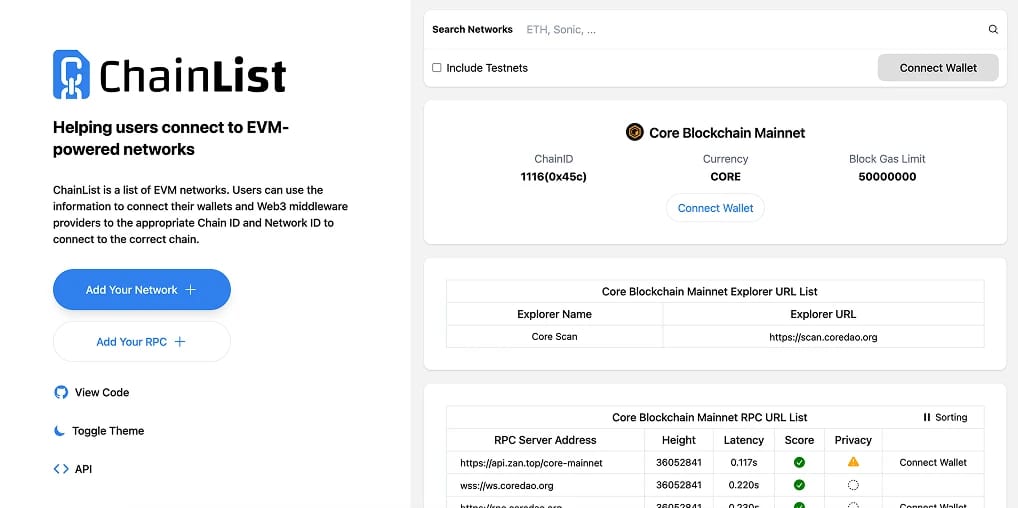
ChainList is the fastest path because it autofills verified parameters, sidestepping manual typos. Still, check the values against Core's docs before approving, since a directory is only as fresh as its last update.
Follow these steps to connect Core through ChainList:
- Open ChainList: Go to ChainList, confirm the URL, then click Connect Wallet to link MetaMask.
- Find the network: Search Core. For the development environment, tick Include Testnets and pick the Core testnet entry.
- Add to MetaMask: Select Core Blockchain Mainnet, choose Add to MetaMask, then review the wallet prompt.
- Approve and switch: Confirm, then open MetaMask's network dropdown and select Core to verify you are on the right environment.
After it is added, MetaMask usually detects Core whenever a dApp requests a network switch. Read each prompt before approving rather than clicking through.
Core Mainnet RPC Details
These mainnet parameters come straight from Core's network configuration page. Verify them against the official docs before saving, since RPC endpoints rotate occasionally.
- Network Name: Core Blockchain Mainnet
- RPC URL: https://rpc.coredao.org
- Chain ID: 1116 (0x45c in hexadecimal)
- Currency Symbol: CORE
- Block Explorer URL: https://scan.coredao.org
If MetaMask shows the Chain ID as 0x45c instead of 1116, that is expected; newer versions display it in hex, and both values are identical.
Core Testnet (Testnet2) RPC Details
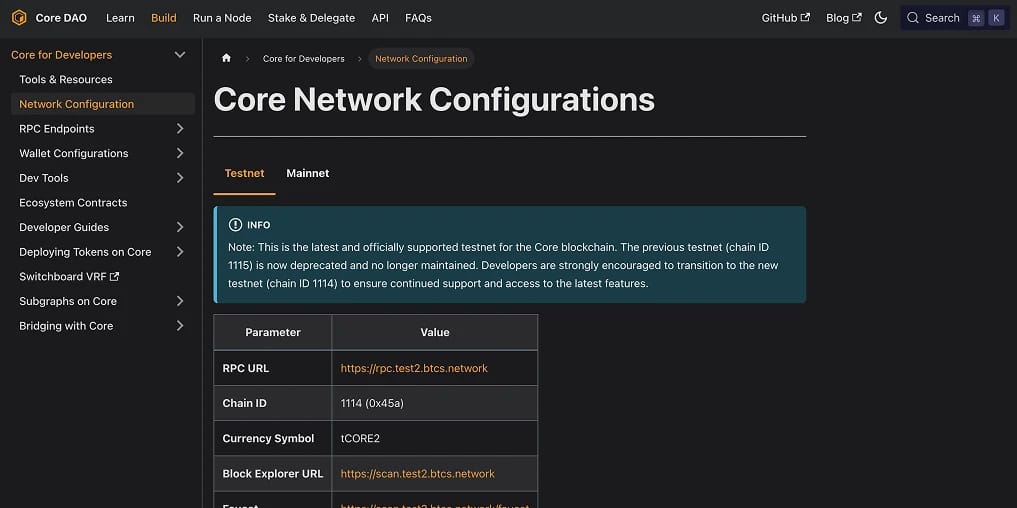
For building or testing instead of moving real funds, use Core's current test network. The old testnet on Chain ID 1115 is decommissioned, so anything pointing at it will fail. The supported environment is Core Testnet2.
- Network Name: Core Blockchain Testnet2
- RPC URL: https://rpc.test2.btcs.network
- Chain ID: 1114 (0x45a in hexadecimal)
- Currency Symbol: tCORE2
- Block Explorer URL: https://scan.test2.btcs.network
- Faucet: https://scan.test2.btcs.network/faucet
Keep mainnet and testnet separate. The names look alike, but the RPC URL, Chain ID, and symbol all differ, and crossing them wastes time chasing a transaction that was never going to confirm.
About Core
Core is an EVM-compatible Layer-1 that launched its mainnet in January 2023 to make Bitcoin productive without giving up custody. Its Satoshi Plus consensus combines delegated Bitcoin hash power with delegated CORE staking, letting holders lock BTC natively on Bitcoin and earn CORE rewards in return.
That model has made Core a leading name in Bitcoin DeFi (BTCfi). Recent developments include Dual Staking, the institutional-grade lstBTC liquid staking token, and a 2026 roadmap focused on protocol revenue and CORE buybacks. Adding Core to MetaMask is the on-ramp to that ecosystem, and a reputable cross-chain bridge is the usual way to move assets onto the chain.
Final Thoughts
Adding Core to MetaMask takes about a minute, and ChainList removes most of the friction. The step to keep is verification: confirm the RPC URL, Chain ID, and explorer against Core's documentation, and make sure you are on mainnet when you mean to be.
If you would rather not route Bitcoin-linked assets through a browser extension, a dedicated self-custody wallet with a hardware device suits larger balances. New to adding chains? Our guide on adding a network to MetaMask covers the same workflow for any EVM chain.