

Can You Add Polygon to MetaMask?
Yes, and Polygon is one of the few networks where you may not need to add anything at all. MetaMask ships with Polygon Mainnet in its built-in network list, so on a recent version of the extension or mobile app you can often just open the network menu, enable Polygon, and start transacting. Because Polygon is a fully EVM-compatible chain, your existing Ethereum address carries over unchanged.
The manual details still matter for two groups. Anyone running an older MetaMask install, a fork, or a hardware wallet interface will need to enter the parameters by hand. And anyone who added Polygon before September 2024 is likely sitting on a stale entry, since that is when POL replaced MATIC as the native gas token. The Chain ID and RPC never changed, so old entries keep working, but the currency symbol should read POL to match what the network actually charges.
How to Add Polygon to MetaMask
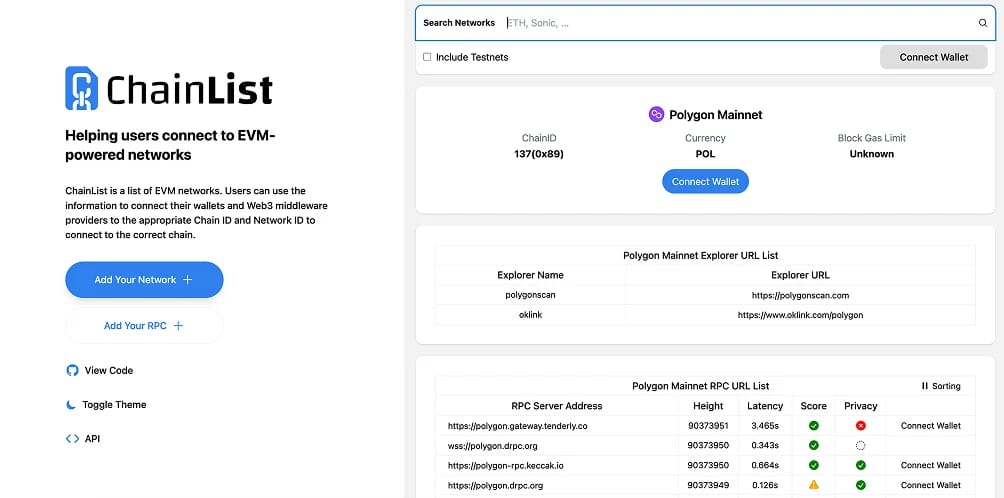
If Polygon is not already in your network list, ChainList remains the safest shortcut because its entries are pulled from the community-audited ethereum-lists registry rather than screenshots circulating on social media. Polygon's own documentation recommends it as the first method.
Follow these steps to add Polygon to MetaMask:
- Open ChainList: Go to the Polygon Mainnet page, confirm the address bar reads chainlist.org, and connect your MetaMask wallet.
- Verify the parameters: The listing should show Chain ID 137 with POL as the currency. Searching "Polygon" also surfaces Amoy and several unrelated CDK chains, so make sure you have the mainnet entry.
- Approve in MetaMask: Click "Add to Metamask" and compare the pop-up values against the official docs before accepting.
- Switch networks: Select Polygon from the network menu. Your POL and token balances on the chain appear immediately.
Polygon RPC and Chain ID
To enter the network manually, open "Add a custom network" in MetaMask settings and use this configuration:
- Network Name: Polygon Mainnet
- RPC URL: https://polygon-rpc.com
- Chain ID: 137
- Currency Symbol: POL
- Block Explorer URL: https://polygonscan.com
The endpoint above is the official public RPC and handles everyday wallet activity without an account. Heavier workloads such as bots and indexers should move to a dedicated provider, and Polygon's RPC endpoint reference lists Alchemy, Infura, QuickNode, dRPC, and Chainstack among the supported options.
Guides written before late 2024 list MATIC as the currency symbol. The migration converted MATIC to POL at 1:1 and the token contract on the network changed, so if your existing entry still shows MATIC, edit the symbol to POL to avoid confusing balance displays.
Polygon Amoy Testnet RPC Details
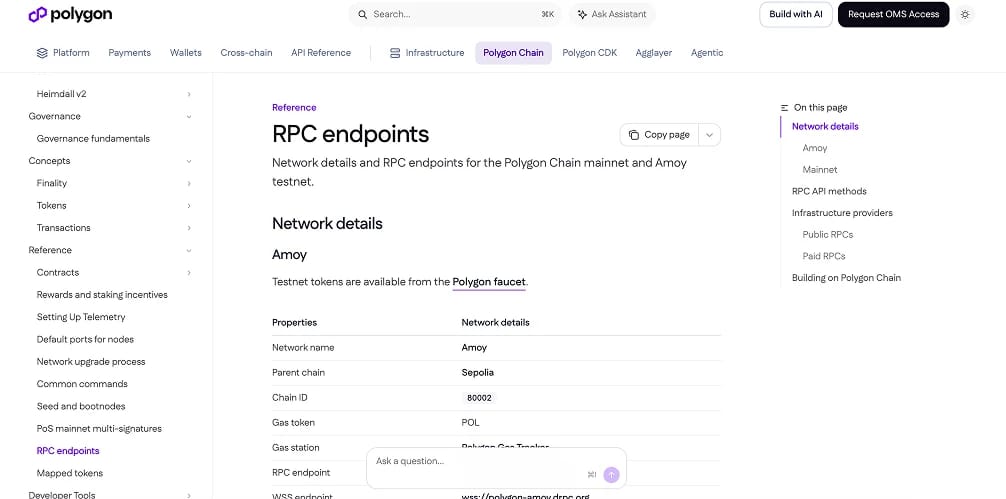
Amoy is the official Polygon testnet, anchored to Ethereum Sepolia after the older Mumbai environment was retired in 2024. Add it to MetaMask with these settings:
- Network Name: Polygon Amoy Testnet
- RPC URL: https://rpc-amoy.polygon.technology
- Chain ID: 80002
- Currency Symbol: POL
- Block Explorer URL: https://amoy.polygonscan.com
Free test POL is dispensed through the official Polygon faucet, with larger allocations available through the faucet bot in Polygon's Discord. Mainnet and Amoy share the POL symbol, which makes the Chain ID your only reliable check on which environment you are signing in, and testnet balances carry no real-world value.
Amoy runs the same consensus and client software as mainnet, and Polygon has consistently used it to stage hard forks before they ship, meaning contracts tested there behave the way they will in production. Use a separate account for testnet work rather than your funded mainnet wallet.
About Polygon: Rebuilt for Payments
Polygon launched in 2017 as an Ethereum sidechain secured by its own validator set, and for years it competed for general dApp activity alongside the leading Layer 2 networks. Since co-founder Sandeep Nailwal took over the Polygon Foundation in mid-2025, the project has narrowed almost entirely to stablecoin payments and tokenized assets, and the chain you connect to in 2026 reflects that.
The engineering record backs the repositioning. Heimdall v2 in July 2025 cut finality from a couple of minutes to around five seconds, the October 2025 Rio hard fork rebuilt block production and eliminated reorgs so every confirmed block is final, and the Giugliano fork in April 2026 shaved another two seconds off confirmations. With the block gas limit now at 160M, the network handles up to 5,000 payments per second at fees around a fifth of a cent, with a long-term gigagas target of 100,000 TPS.
The strategy shows up in what Polygon shut down as much as what it shipped. The zkEVM, once its flagship rollup, was retired on July 1, 2026 after a twelve-month wind-down, with remaining wallet balances auto-migrated to Ethereum. Resources went instead to the Open Money Stack, a payments platform announced in January 2026, and to AggLayer, the cross-chain settlement layer connecting CDK chains. By stablecoin transaction count Polygon now ranks among the most active networks anywhere, and its tokenized asset base features prominently in our tokenization statistics tracker.
Final Thoughts
Adding Polygon to MetaMask is either zero clicks if your wallet already lists it, or a minute of work through ChainList or a manual entry with Chain ID 137. Amoy takes the same minute with Chain ID 80002 and a faucet visit for test POL.
The one legacy detail to fix is the currency symbol. If your Polygon entry predates the POL migration, update MATIC to POL so your wallet matches what the chain charges for gas.
Beyond setup, expect the network to keep changing underneath the same Chain ID. Polygon has shipped six hard forks across 2025 and 2026 without users needing to touch their wallet settings once, which is exactly how upgrades should feel.