



Who is Anatoly Yakovenko?
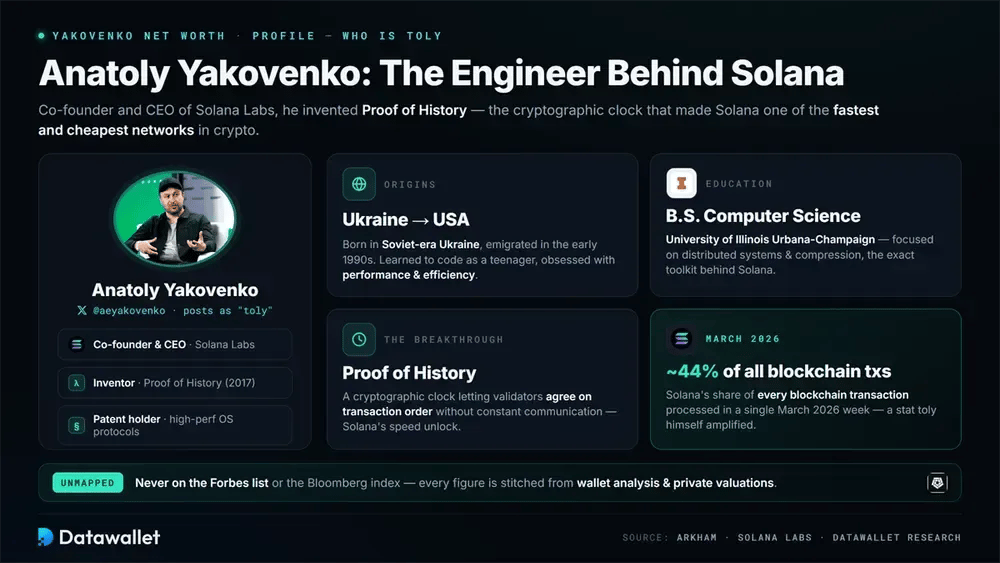
Anatoly Yakovenko is a software engineer and entrepreneur best known as the co-founder and CEO of Solana Labs. He designed Proof of History, a cryptographic clock that lets validators agree on transaction order without constant communication, making Solana one of the fastest and cheapest networks in crypto.
Born in Soviet-era Ukraine, Yakovenko moved to the United States as a child in the early 1990s and studied computer science at the University of Illinois Urbana-Champaign. He holds several patents for high-performance operating system protocols, is married to Laura Skelton, and lives in the San Francisco Bay Area.
By 2026, he is as much a public voice as a protocol architect. Posting as "toly" on X, he shares predictions on stablecoins, AI, and robotics, and recently highlighted data showing Solana processed roughly 44% of all blockchain transactions in a single March 2026 week.
What stands out to us is how unmapped his fortune remains. Yakovenko has never appeared on the Forbes billionaire list or the Bloomberg index, so every figure attached to him is stitched together from wallet analysis, private valuations, and assumptions about undisclosed holdings.
Anatoly Yakovenko's Background
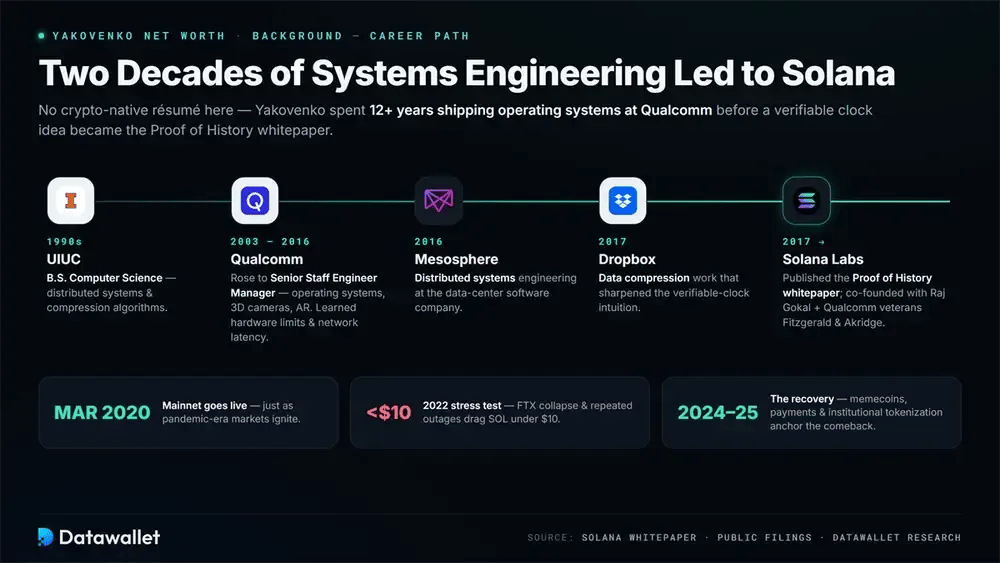
Yakovenko's path runs from a computer science degree through more than a decade of systems engineering at Qualcomm, short stints at Mesosphere and Dropbox, and finally the whitepaper that became Solana.
Early Life and Education
Anatoly Yakovenko was born in Ukraine, then part of the Soviet Union, and emigrated to the United States with his family in the early 1990s. He learned to program as a teenager and developed an obsession with performance and efficiency that shaped his engineering career.
He earned a bachelor's degree in computer science from the University of Illinois Urbana-Champaign, one of America's strongest programs for the field. His focus on distributed systems and compression algorithms later became the exact toolkit for attacking blockchain's scalability problem from first principles.
Qualcomm, Mesosphere, and Dropbox
Yakovenko spent over a decade at Qualcomm, where he worked on operating systems, 3D camera technology, and augmented reality products. He rose to Senior Staff Engineer Manager, absorbing lessons about hardware limits and network latency that most blockchain founders never encounter.
After Qualcomm, he held engineering roles at Mesosphere, a data center software company, and Dropbox, working on distributed systems and data compression. Both roles sharpened the intuition behind his later insight that a verifiable clock could remove blockchain's biggest bottleneck.
Founding Solana
In 2017, Yakovenko published the Proof of History whitepaper and co-founded Solana Labs alongside Raj Gokal, with fellow Qualcomm veterans Greg Fitzgerald and Stephen Akridge joining as founding engineers. The network's mainnet went live in March 2020, just as pandemic-era markets ignited.
Solana survived a brutal stress test in 2022, when the FTX collapse and repeated outages dragged SOL below $10. Its recovery through 2024 and 2025, driven by memecoins, payments, and institutional tokenization, now anchors Yakovenko's financial story.
Anatoly Yakovenko's Net Worth in 2026
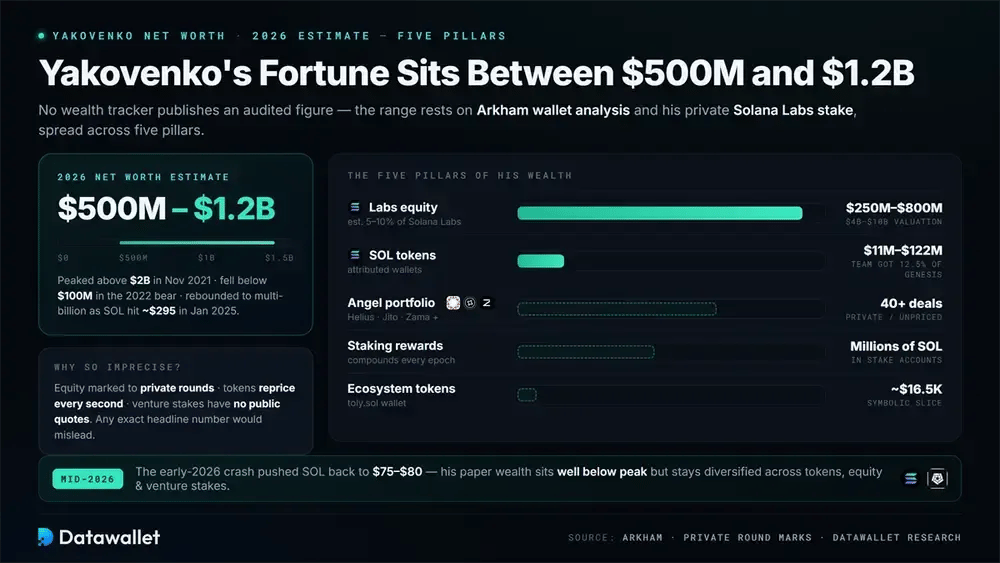
Anatoly Yakovenko's net worth in 2026 is estimated between $500 million and $1.2 billion, based on Arkham's analysis of his attributed wallets and his private stake in Solana Labs. No wealth tracker publishes an audited figure, so the wide range reflects genuinely private inputs.
His wealth in 2026 rests on five main pillars:
- SOL tokens: Solana's genesis minted 500 million SOL with 12.5% allocated to the founding team, and wallets attributed to Yakovenko hold between $11 million and $122 million today.
- Labs equity: His estimated 5% to 10% stake in Solana Labs, valued between $4 billion and $10 billion, contributes roughly $250 million to $800 million on paper.
- Angel portfolio: More than 40 early-stage investments across the Solana ecosystem, including Helius, Jito Labs, and the encryption unicorn Zama, form his least visible wealth layer.
- Staking rewards: Millions of SOL attributed to him sit in stake accounts, compounding yield each epoch and quietly growing his token position through every market cycle.
- Ecosystem tokens: The wallet behind his toly.sol domain holds a scattering of Solana ecosystem tokens, a small but symbolic slice worth only about $16,500 in liquid assets.
The imprecision is structural. His equity is marked to private funding rounds, his tokens reprice every second, and his venture stakes have no public quotes, so any precise headline number would mislead.
Historical Fluctation
The trajectory has been violent. His combined holdings likely topped $2 billion when SOL peaked near $260 in November 2021, collapsed below $100 million in the 2022 bear market, and rebounded into multi-billion territory as SOL hit a new all-time high near $295 in January 2025.
The early 2026 market crash then pushed SOL back under $100, compressing his paper wealth into the current range. With SOL trading around $75 to $80 by mid-2026, his fortune sits well below its peak but stays diversified across tokens, equity, and venture stakes.
How Much SOL Does Anatoly Yakovenko Own?
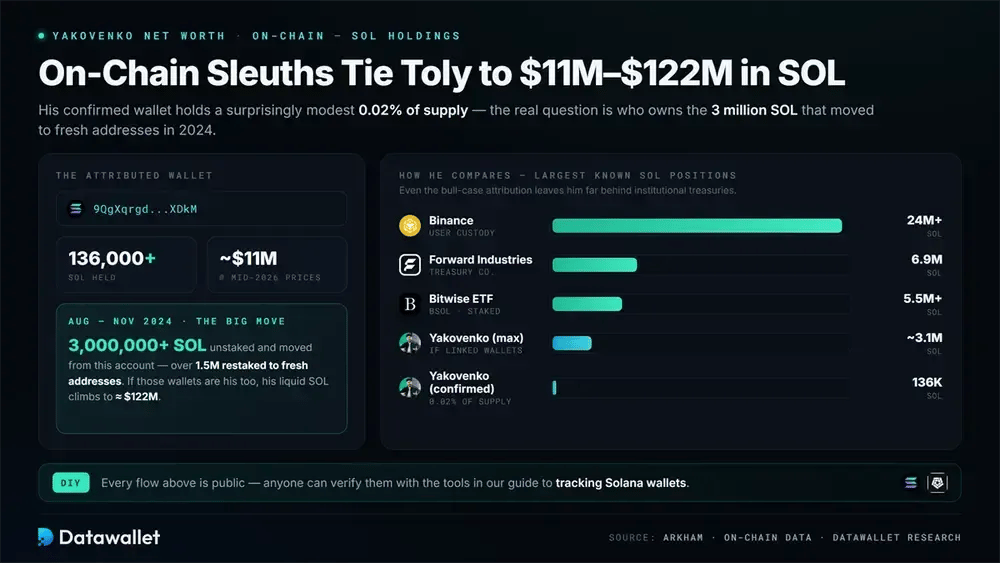
Onchain sleuths generally link Yakovenko to the address 9QgXqrgd...XDkM, which holds over 136,000 SOL worth roughly $11 million at mid-2026 prices. That represents only about 0.02% of supply, a modest slice for the network's most recognizable founder.
The real position may be far larger. Between August and November 2024, that account unstaked and moved more than 3 million SOL, with over 1.5 million restaked to fresh addresses. If those wallets also belong to Yakovenko, his liquid SOL climbs to approximately $122 million.
Even so, he is not Solana's largest holder. Treasury company Forward Industries holds nearly 6.9 million SOL, Binance custodies over 24 million for users, and the Bitwise staking ETF controls more than 5.5 million. Anyone can verify these flows with the tools in our guide to tracking Solana wallets.
Anatoly Yakovenko's Investments
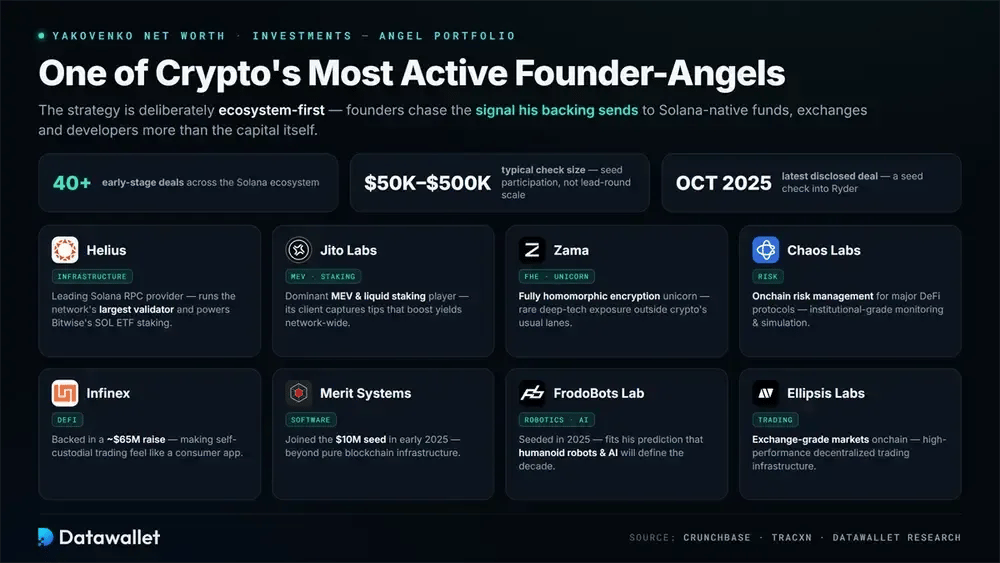
Beyond Solana Labs, Yakovenko is one of crypto's most active founder-angels. Public trackers like Crunchbase and Tracxn list dozens of deals, the most recent a disclosed seed check into Ryder in October 2025.
Notable positions in his angel portfolio include:
- Helius: A leading Solana RPC and infrastructure provider that now runs the network's largest validator and powers the staking behind Bitwise's flagship SOL ETF.
- Jito Labs: The dominant MEV and liquid staking player on Solana, whose client software captures tips that materially boost validator and staker yields network-wide.
- Zama: A fully homomorphic encryption company that reached unicorn status, giving Yakovenko rare deep-tech exposure outside crypto's usual trading and infrastructure lanes.
- Chaos Labs: An onchain risk management platform serving major DeFi protocols, aligning with his thesis that serious finance needs institutional-grade monitoring and simulation tools.
- Infinex: A DeFi infrastructure provider he backed during a raise of roughly $65 million, aimed at making self-custodial trading feel like a consumer app.
- Merit Systems: A software development company where he joined a $10 million seed round in early 2025, extending his portfolio beyond pure blockchain infrastructure.
- FrodoBots Lab: A robotics and AI startup he seeded in 2025, fitting his public prediction that humanoid robots and machine intelligence will define the decade.
- Ellipsis Labs: The team behind high-performance decentralized trading infrastructure on Solana, reinforcing his bet that exchange-grade markets will eventually live fully onchain.
His strategy is deliberately ecosystem-first. Check sizes reportedly run from $50,000 to $500,000, meaningful seed participation rather than lead-round scale, and founders chase the signal his backing sends to Solana-native funds, exchanges, and developers more than the capital itself.
What Is Powering Yakovenko's Wealth in 2026?
Yakovenko's fortune no longer tracks retail hype alone. Protocol upgrades, regulated investment products, and institutional adoption now determine how his SOL and Solana Labs equity get valued each cycle.
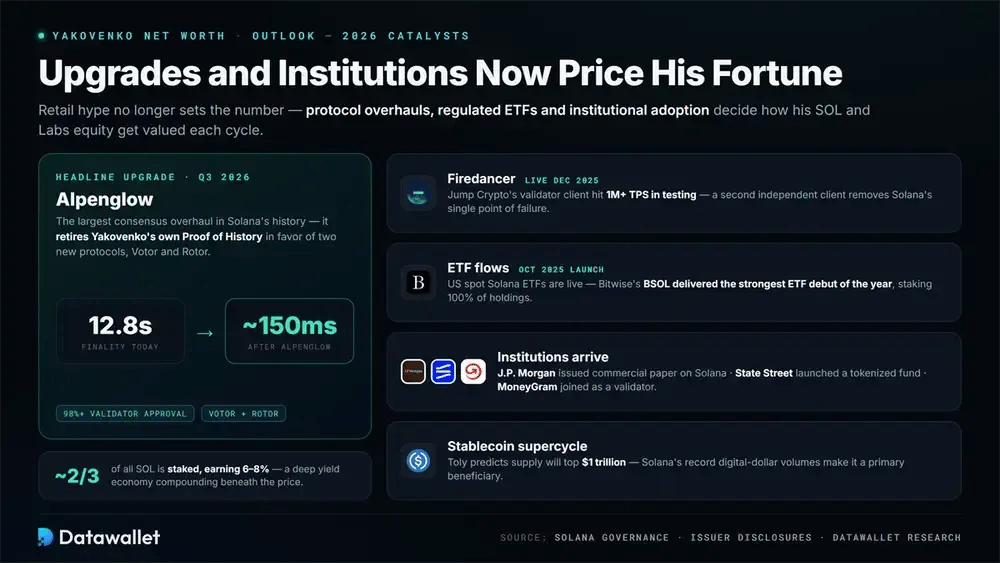
The headline upgrade is Alpenglow, the largest consensus overhaul in Solana's history. It retires his own Proof of History invention in favor of two new protocols, Votor and Rotor, cutting transaction finality from roughly 12.8 seconds to around 150 milliseconds after validators approved the change with over 98% support.
Alongside it, the Firedancer validator client built by Jump Crypto went live on mainnet in December 2025 after processing over 1 million transactions per second in testing. Yakovenko points to both upgrades as proof the network's core design works, with Alpenglow's mainnet targeted for Q3 2026.
Potential Catalysts
Key catalysts shaping Yakovenko net worth this year include:
- Alpenglow: Sub-second finality positions Solana for institutional settlement and real-world assets, directly supporting the Solana Labs equity valuation behind his wealth.
- Firedancer: A second independent validator client removes Solana's single point of failure, addressing the outage history that once capped how institutions priced the network.
- ETF flows: US spot Solana ETFs launched in October 2025, and Bitwise's BSOL delivered the strongest ETF debut of the year while staking 100% of holdings.
- Institutions: J.P. Morgan issued commercial paper on Solana, State Street launched a tokenized fund, and MoneyGram joined as a validator for stablecoin payments.
- Stablecoins: Yakovenko predicts stablecoin supply will exceed $1 trillion, and Solana's record digital-dollar volumes make his network a primary beneficiary of that shift.
- Staking economy: Roughly two-thirds of SOL is staked earning 6% to 8%, deepening the yield infrastructure covered in our Solana staking statistics report.
Final Thoughts
Anatoly Yakovenko's net worth resists a clean figure because almost everything he owns is tied to infrastructure rather than liquid tokens. The $500 million to $1.2 billion range is a defensible estimate, not a measured number, and it will keep moving with SOL.
His position differs sharply from peers. Where Vitalik Buterin's net worth sits almost entirely in publicly visible ETH, Yakovenko keeps a for-profit equity stake in Solana Labs, giving him higher upside if the network captures tokenized assets, payments, and institutional settlement at scale.
What we would watch from here is execution. If Alpenglow ships cleanly, ETF inflows persist, and stablecoin volume keeps migrating to Solana, Yakovenko re-enters billionaire territory on fundamentals rather than speculation. If the 2026 downturn deepens, his fortune compresses again, exactly as it was designed to.