







Compare the Best Crypto Futures Exchanges
1. Bybit
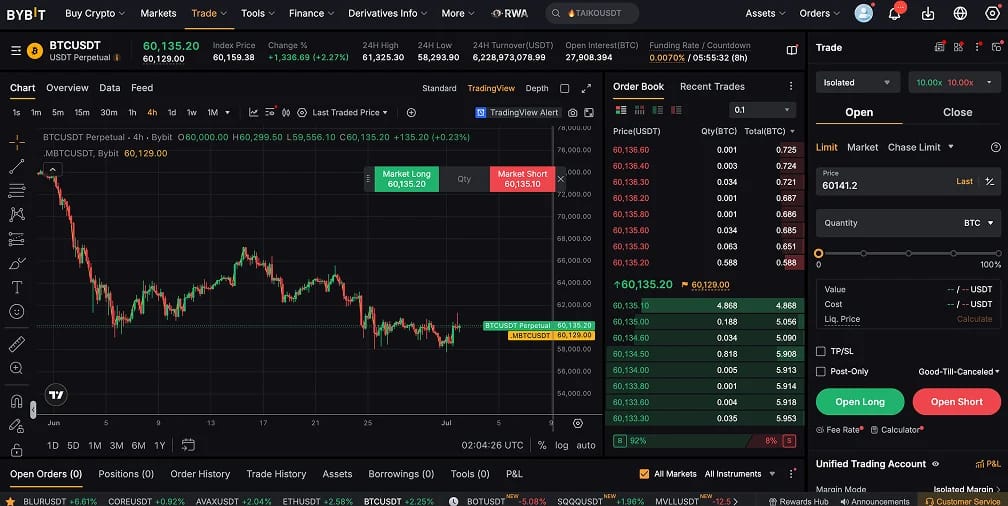
Bybit tops the ranking by balancing liquidity, cost, and account structure better than any rival. Its order book is the second deepest in crypto derivatives, with open interest above $11 billion across more than 700 perpetual and expiry contracts, and BTCUSDT slippage stayed tight in our testing through fast markets. Base futures fees run 0.02% maker and 0.055% taker, with leverage up to 125x on BTC and ETH.
The Unified Trading Account is the most practical engineering here. Spot holdings, USDT, USDC and even tokenised stocks sit in one margin pool, so a BTC long and a gold hedge draw on the same collateral without transfers between sub-wallets. Bybit has also pushed hardest into non-crypto contracts, adding gold, FX, oil and equity products that suit traders running macro positions from a single balance.
The February 2025 hack, oddly, strengthened the case for Bybit. North Korea's Lazarus Group stole roughly $1.5 billion in ETH, confirmed by the FBI as the largest crypto theft on record, yet withdrawals never paused. CEO Ben Zhou fronted the crisis within the hour, guaranteed all client assets against $20 billion-plus under management, and closed the gap with treasury reserves and bridge loans, restoring 1:1 backing in days without a cent of customer losses.
Few venues have proven their solvency under that kind of fire. Our Bybit futures review covers the margin engine and risk tiers, and the restricted countries page maps availability. The US and Canada are excluded, and the licensed EU entity offers spot only.
Pros
- Second-largest derivatives order book, with tight BTC and ETH spreads under load.
- Unified Trading Account margins perps against spot, stablecoins, and tokenised assets.
- Broadest non-crypto range of any major venue, spanning gold, FX, oil, and equities.
- Predictable liquidation mechanics with published risk-limit tiers per contract.
Cons
- The 2025 Lazarus theft, though fully absorbed, exposed weaknesses in its cold-wallet signing process.
- Unavailable in the US and Canada, and EEA retail cannot access perps through the licensed EU entity.
- Taker fees sit marginally above Binance and OKX at the base tier.
2. BloFin
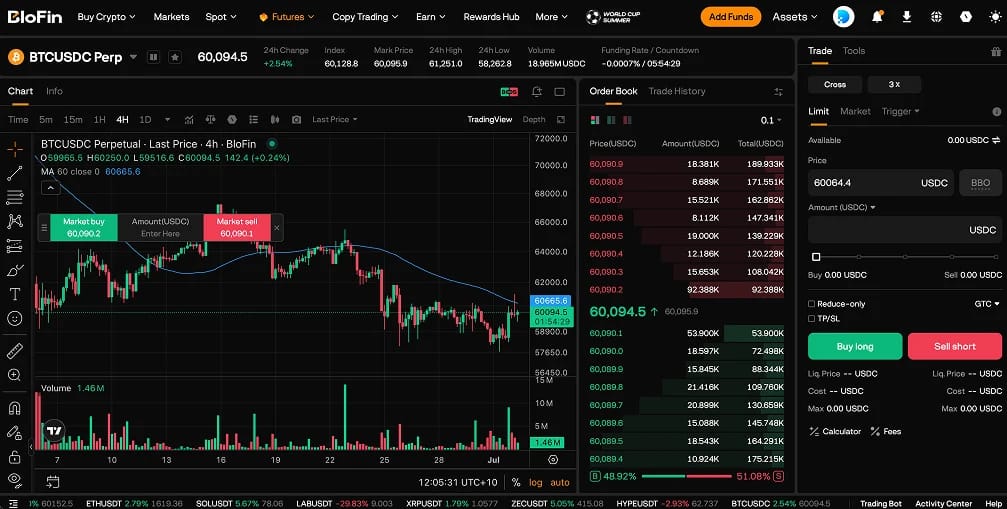
BloFin takes the no-KYC slot now that most large centralised venues, MEXC included, demand full identity verification. An email address opens a live account with unrestricted futures access at up to 150x leverage, and withdrawals run to 20,000 USDT per day without a single document. Verification matters only for higher limits, which reach 1 million USDT daily at Level 1.
Substance, rather than privacy alone, earns the slot. BloFin grew out of a quantitative trading firm founded by Matt Hu, launched its exchange in January 2023, and holds a $50 million Series B from KuCoin, SIG and Matrix Partners. Its 500-plus perpetual markets clear several hundred million dollars daily at 0.02% maker and 0.06% taker, alongside copy trading, TradingView signal bots, a demo mode, and a unified account across USDT, USDC and Coin-M contracts.
Transparency runs deeper than the offshore label suggests, with Fireblocks custody under insurance cover, Merkle-proof reserves, and ISO 27001 certification. The trade-offs sit on the regulatory side. No major licence stands behind the platform, fiat arrives through third-party processors, and the US, Canada and Singapore lead the exclusions our BloFin restricted countries guide maps. For the wider category, see our no-KYC exchange comparison.
Pros
- Full futures access and 20,000 USDT daily withdrawals with no identity verification.
- 150x maximum leverage across 500+ perpetual markets with USDT, USDC, and Coin-M settlement.
- Fireblocks custody, Merkle proof-of-reserves, and ISO 27001 certification.
- Copy trading, signal bots, and a demo account ease newer traders in.
Cons
- No authorisation from a top-tier regulator like the FCA or a MiCA member state.
- Fiat deposits depend on third-party processors that add their own fees.
- Blocked in the US, Canada, Singapore, and other restricted jurisdictions.
3. Hyperliquid
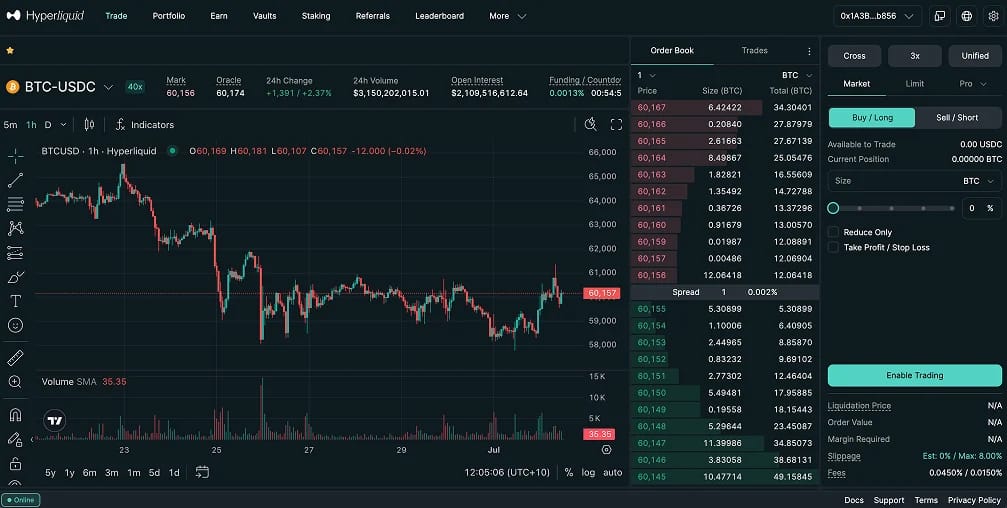
Hyperliquid makes the best case yet against needing a centralised futures account. Trading runs from a self-custodial wallet against a fully onchain order book with sub-second finality, no sign-up and no identity checks, and the venue clears the large majority of decentralised perp volume. Mid-June DefiLlama data showed around $8 billion in daily volume and $9.6 billion in open interest, figures rivalling second-tier centralised exchanges.
Costs undercut most of this list. Base fees are 0.015% maker and 0.045% taker, funding settles hourly, top makers earn rebates, and nearly all protocol revenue is recycled into HYPE buybacks rather than a corporate balance sheet. Our Hyperliquid fee breakdown works through the tiers and staking discounts.
What separates the platform now is HIP-3, the framework letting anyone who stakes 500,000 HYPE deploy new perp markets. Builder-run contracts on gold, oil, the S&P 500, US equities and pre-IPO names pushed HIP-3 open interest past $3 billion in early June, and tokenised assets now fill 23 of its top 30 pairs.
The caveats are structural. Leverage caps at 40x on majors, thinner builder markets carry genuine gap risk, as late May's SpaceX contract flash crash showed, and with no fiat on-ramp you arrive with USDC or not at all. Our perp DEX comparison covers the onchain alternatives.
Pros
- Self-custody throughout, with every order, fill, and liquidation verifiable onchain.
- Lower base fees than any centralised venue here, plus hourly funding and maker rebates.
- HIP-3 adds 24/7 leveraged trading on commodities, indices, equities, and pre-IPO names.
- Liquidity and open interest rival mid-tier centralised exchanges on BTC and ETH.
Cons
- Maximum leverage of 40x trails the 125x to 500x at centralised rivals.
- No fiat rails, so funding requires bridging USDC from another venue or chain.
- Newer builder-deployed markets trade thin and have produced sharp dislocations.
4. Binance
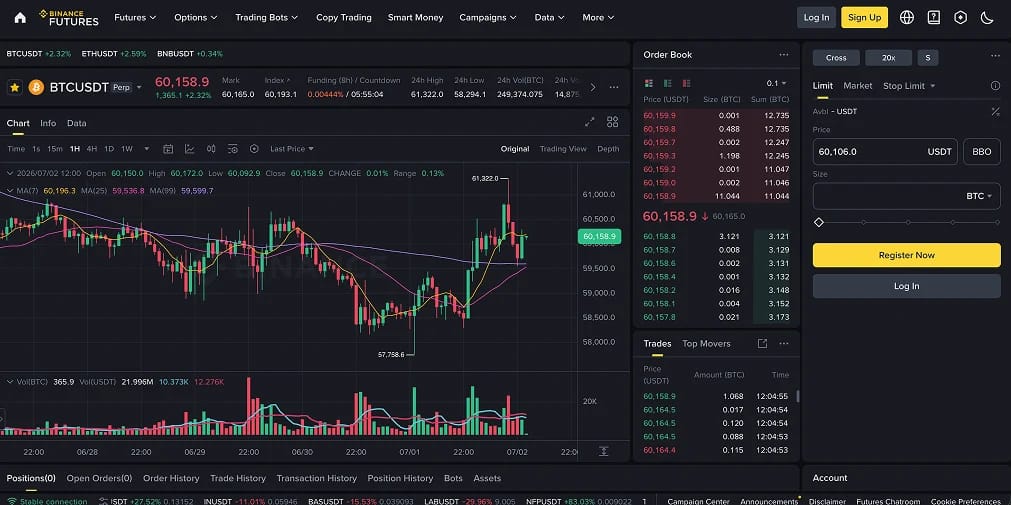
Binance remains the liquidity benchmark. It holds roughly 30% of Bitcoin futures open interest, more than double any rival, and a large BTCUSDT market order moves the price less here than anywhere else. The catalogue spans 600+ USDT-margined contracts plus Coin-M and USDC settlement, with 0.02% maker and 0.05% taker fees, a 10% BNB payment discount, and zero maker fees on USDC perps.
Scale bought scrutiny after the October 2025 cascade. USDe collateral briefly repriced to $0.65 on Binance alone, amplifying liquidations, and the exchange later paid over $328 million in user compensation while attributing the crash primarily to the macro shock. Its SAFU emergency fund, valued near $1 billion, absorbed bad debt during the event, a backstop thinner venues cannot match. Our Binance futures review covers the margin modes and risk engine.
The regulatory position needs watching. Binance withdrew its MiCA application in Greece days before the EU's 1 July licensing deadline and told customers in several member states to expect restrictions while it seeks authorisation elsewhere. For traders outside affected regions the product is unmatched on depth, and the futures leaderboard remains a useful read on how the most profitable accounts are positioned.
Pros
- Deepest order books in the market, with around 30% of Bitcoin futures open interest.
- Three settlement rails across USDT, USDC, and Coin-M, with zero maker fees on USDC perps.
- SAFU emergency fund near $1 billion, a rare insurance backstop at scale.
Cons
- Lacks a MiCA licence, leaving EU access unsettled after the July deadline.
- The USDe repricing during the October 2025 crash exposed collateral-design weaknesses.
- Interface density and promotional clutter slow down newer traders.
5. OKX
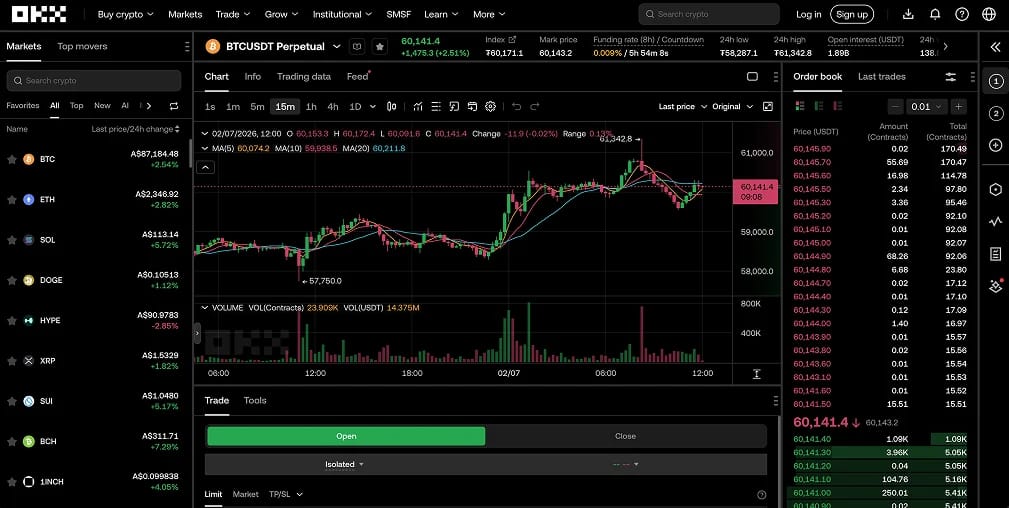
OKX is where we point professionals when capital efficiency matters more than raw depth. Its portfolio margin nets risk across perps, options and spot more cleanly than any rival, and Nitro Spreads gives basis and funding-rate traders a purpose-built execution lane rather than two legs and a prayer. Base fees of 0.02% maker and 0.05% taker match Binance, with leverage to 125x across 300+ perpetual markets.
Reliability is the quieter strength. OKX publishes monthly proof-of-reserves with consistently healthy ratios, and its infrastructure held up well during the October stress test that broke several competitors' APIs. Founder Star Xu has been the industry's loudest voice on that crash's structural causes, and the exchange's conservative collateral listing reflects the same philosophy.
The trade-offs concern focus rather than fundamentals. Fee improvements lean on holding OKB, the derivatives suite will feel steep to first-time futures traders, and availability excludes the US along with several other markets. For a desk running delta-neutral and directional books side by side, the platform earns its slot.
Pros
- Best-in-class portfolio margin netting risk across perps, options, and spot.
- Nitro Spreads enables single-click basis and funding-rate trades.
- Monthly proof-of-reserves and strong infrastructure uptime during volatility.
Cons
- The deepest fee discounts are tied to holding the OKB token.
- Portfolio margin and the pro toolkit carry a steep learning curve.
- Unavailable in the US and restricted in several other jurisdictions.
6. MEXC
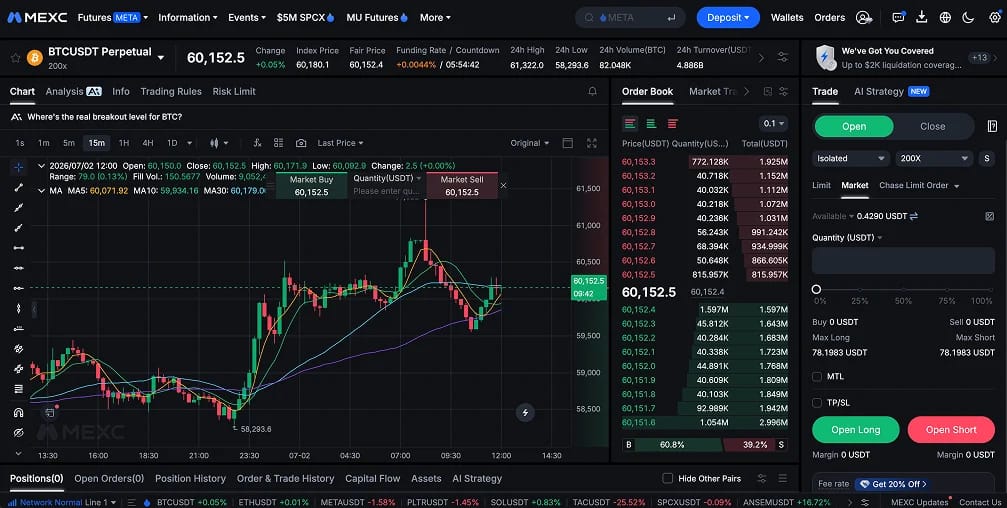
MEXC closes the list for traders who prioritise breadth and cost over institutional polish. The catalogue exceeds 800 USDT-margined perpetuals, CoinGecko's derivatives research ranked it first for new contract listings over the past year, and small caps routinely trade here weeks before larger exchanges list them. Base pricing of 0% maker and 0.04% taker is the cheapest here, with rotating promotions dropping selected pairs to zero on both sides.
Leverage reaches 500x on select majors, the highest of any significant exchange. We treat that as a specialist scalping tool rather than a selling point, since a 0.2% adverse move liquidates a maxed position and fees plus funding are charged on full notional. Read our MEXC fee breakdown before sizing anything at those tiers.
Two changes since our last update matter. MEXC now requires full KYC for all users, ending the anonymity that once defined it, and disclosure has improved with published proof-of-reserves and an insurance fund the exchange values at $684 million. Reserve reporting still trails OKX and Binance, fiat access relies on third parties, and the Seychelles registration means no tier-one licence stands behind the platform.
Pros
- Cheapest base futures pricing here, with 0% maker fees and rotating zero-fee pairs.
- 800+ perpetual markets and the fastest new-listing pipeline among major venues.
- 500x maximum leverage for specialist short-horizon strategies.
Cons
- Full KYC is now mandatory, ending its historical no-verification appeal.
- Extreme leverage tiers invite near-instant liquidation for the inexperienced.
- Reserve disclosure and regulatory standing trail the top-tier exchanges.
What Are Crypto Perpetual Futures?
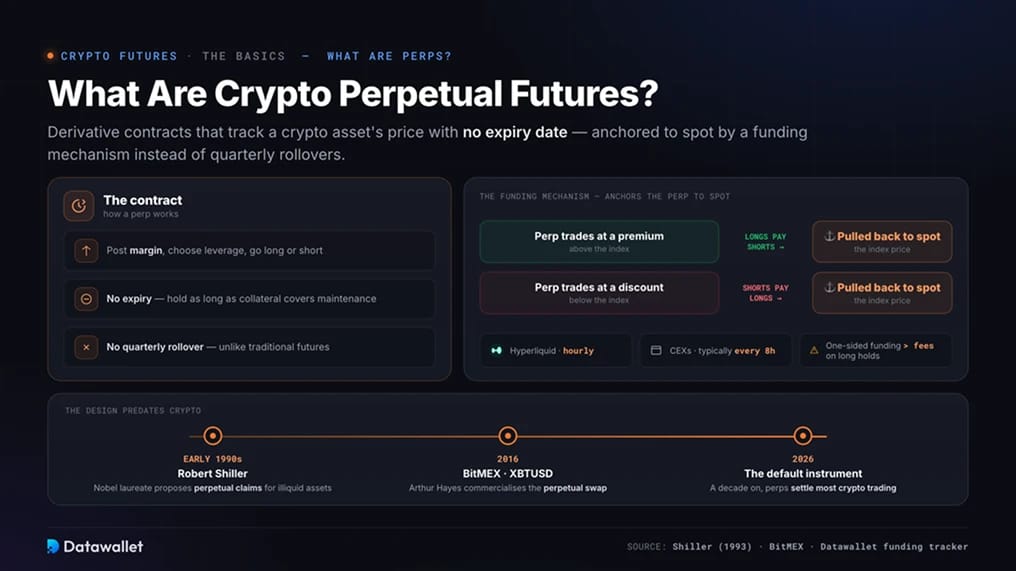
Perpetual futures, or perps, are derivative contracts that track a crypto asset's price with no expiry date. Traders post margin, choose leverage, and hold long or short exposure for as long as collateral covers maintenance requirements, removing the quarterly rollover traditional futures impose. Our perpetual versus spot explainer covers how the two differ in practice.
A funding mechanism anchors the contract to spot. At set intervals, hourly on Hyperliquid and typically every eight hours on centralised venues, payments pass between longs and shorts based on whether the perp trades at a premium or discount to the index. We track live rates across venues on our funding rates page, and persistent one-sided funding can cost more than trading fees on positions held for weeks.
The design predates crypto. Nobel laureate Robert Shiller proposed perpetual claims in the early 1990s to build liquid markets for illiquid assets, and BitMEX adapted the idea with the XBTUSD swap in 2016. A decade on, the instrument Arthur Hayes commercialised settles most crypto trading.
How to Choose a Crypto Futures Exchange
Picking a futures venue means testing how it behaves under stress, not comparing fee tables alone. Four checks we run before committing capital anywhere:
- Confirm legal access and which entity serves you. Perps are aggressively geo-fenced. US residents are limited to newly approved CFTC-regulated products, EEA retail cannot trade perps through MiCA-licensed entities, and the FCA bans the sale of crypto derivatives to UK retail consumers outright. Read the eligibility list before funding, since discovering a restriction after deposit is the most common avoidable mistake we see.
- Stress-test liquidity on your pairs. BTCUSDT depth proves little about the mid-cap altcoin you trade. Place small market orders at different hours, measure slippage against mid, and check how the pair behaved on 10 October 2025. Order books that vanished then will vanish again.
- Read the liquidation and ADL policy before you need it. Find the insurance fund size, the auto-deleveraging queue rules, and whether the venue publishes risk-limit tiers. The October cascade proved these documents outweigh any fee discount.
- Model your all-in monthly cost. Combine maker and taker fees with expected funding, withdrawal costs, and any token-discount conditions across a typical month. A 0.01% fee edge disappears fast if funding runs against your usual direction or withdrawals cost $20 a time.
The Perpetual Futures Market Right Now
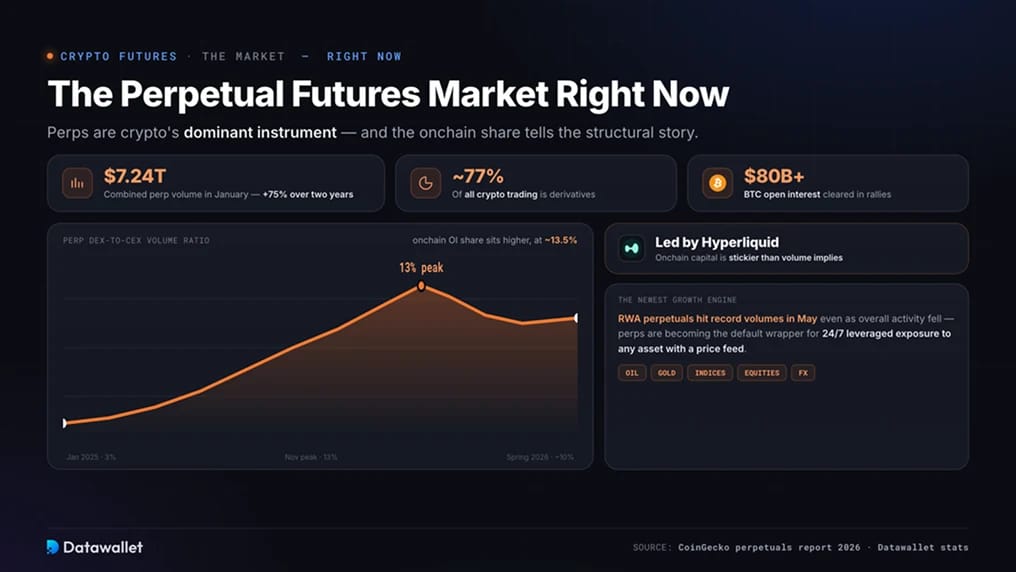
Perps are now crypto's dominant instrument. Combined perpetual volume reached $7.24 trillion this January, up 75% over two years, and derivatives carry close to 77% of all crypto trading, figures we track in our perpetual futures statistics report. Aggregate Bitcoin open interest has repeatedly cleared $80 billion across venues during rallies.
The onchain share tells the structural story. CoinGecko's perpetuals report shows the perp DEX-to-CEX volume ratio climbing from 3% in January 2025 to a 13% November peak, then settling near 10% this spring as centralised volumes recovered. Onchain open interest share sits higher at around 13.5%, led overwhelmingly by Hyperliquid, suggesting the capital that moved onchain is stickier than volume figures imply.
The newest growth engine is non-crypto exposure. RWA perpetuals on oil, gold, indices and equities hit record volumes in May even as overall exchange activity fell, and centralised venues including Bybit and Kraken responded with their own commodity and FX contracts. Perps are becoming the default wrapper for 24/7 leveraged exposure to any asset with a price feed, far beyond crypto.
What the October 2025 Crash Changed
The 10 October 2025 deleveraging reset how serious traders evaluate futures venues. Roughly $19 billion in positions were force-closed within about a day, 1.6 million accounts were liquidated, and 87% of wiped positions were longs. Our full crash breakdown traces the sequence, and the Bitcoin liquidation heatmap shows where leverage clusters build today.
The venue-level failures did the lasting damage. API outages and frozen interfaces locked traders out of managing positions mid-cascade, margin assets repriced violently and dragged solvent accounts through liquidation, and auto-deleveraging force-closed even profitable shorts once insurance funds ran dry. At the worst point, order book depth on major venues collapsed by more than 90%.
The practical response is simple. Prefer venues that publish insurance fund balances and ADL mechanics, hold margin in top-tier stablecoins rather than yield-bearing collateral, as our safest stablecoin analysis explains, and assume the exit narrows exactly when you need it most.
Crypto Futures Regulation This Year
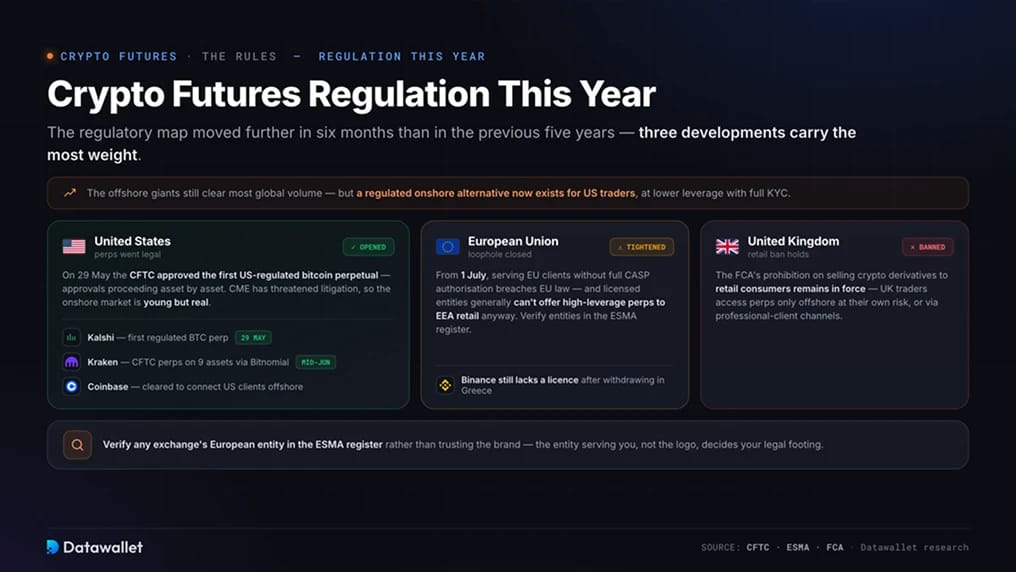
The regulatory map moved further in six months than in the previous five years. Three developments carry the most weight for futures traders:
- US perps went legal: On 29 May the CFTC approved the first US-regulated bitcoin perpetual on Kalshi's registered exchange, and cleared Coinbase to connect US clients into offshore perps and options. Kraken followed in mid-June with CFTC-regulated perps on nine assets through its Bitnomial acquisition. Chairman Michael Selig says approvals will proceed asset by asset, and CME has threatened litigation over the framework, so the onshore market is young but real.
- MiCA closed the EU loophole: From 1 July, serving EU clients without full CASP authorisation breaches EU law, and licensed entities generally cannot offer high-leverage perps to EEA retail anyway. Verify any exchange's European entity in the ESMA register rather than trusting the brand. Binance still lacks a licence.
- The UK retail ban holds: The FCA's prohibition on selling crypto derivatives to retail consumers remains in force, so UK traders access perps only through offshore venues at their own risk, or via professional-client channels.
The offshore giants on this list still clear most global perp volume, but a regulated onshore alternative now exists for US traders, at lower leverage and with full KYC.
Understanding Perpetual Futures Trading Costs
Headline maker and taker rates are the smallest part of what a leveraged trader pays. Five cost lines deserve attention before sizing any position:
- Trading fees on notional. Fees apply to full position size rather than margin. A 0.055% taker fee on a 50x position consumes 2.75% of margin per fill, which is why scalpers chase maker rebates and zero-fee promotions.
- Funding payments. Settled hourly to eight-hourly between longs and shorts, funding compounds on held positions. Check your pair's history on our funding rates tracker before carrying anything overnight.
- Liquidation and ADL costs. Forced closes execute at the bankruptcy price with slippage, and insurance fund contributions or auto-deleveraging can hit even winning positions during extreme moves.
- Spread and slippage. Thin books charge an invisible fee on every market order, and on volatile altcoin perps it regularly exceeds the stated taker rate.
- Withdrawal and transfer fees. Moving margin between venues costs $5 to $20 per transfer on most centralised exchanges, against roughly 1 USDC on Hyperliquid's native bridge, a gap that matters when rotating collateral weekly.
USDT-M vs Coin-M Perpetual Contracts
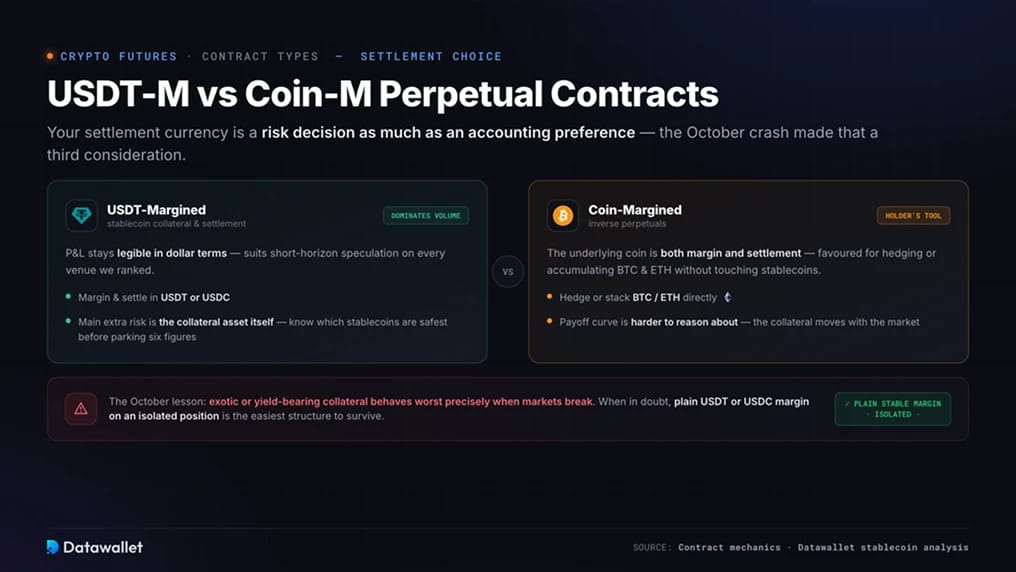
USDT-margined contracts collateralise and settle in stablecoins, keeping profit and loss legible in dollar terms and suiting short-horizon speculation. They dominate volume on every venue we ranked, and the main risk beyond the trade itself is the collateral asset, a reason to understand which stablecoins are safest before parking six figures of margin in one.
Coin-margined contracts, also called inverse perpetuals, use the underlying coin as both margin and settlement. Long-term holders favour them for hedging or accumulating BTC and ETH without touching stablecoins, at the cost of a payoff curve that is harder to reason about because the collateral itself moves with the market.
The October crash added a third consideration. Exotic or yield-bearing collateral behaves worst precisely when markets break, making your settlement currency a risk decision as much as an accounting preference. When in doubt, plain USDT or USDC margin on an isolated position is the easiest structure to survive.
Final Thoughts
Bybit earns the overall pick by pairing top-three liquidity with the most capital-efficient account structure in the market, and its handling of the 2025 hack settled any lingering solvency question.
The rest splits by priority. BloFin is the credible option for trading without identity checks, Hyperliquid makes the strongest case yet that perps belong onchain, Binance still owns depth on the majors, OKX serves multi-strategy professionals, and MEXC wins on catalogue and cost for disciplined traders.
Whatever you choose, the past year's lasting lesson is that venue risk is position risk. Check the entity legally serving you, read the liquidation and ADL rules, keep leverage modest, and never hold more margin on one exchange than you could afford to see frozen on the cycle's worst day.
Our Methodology
We opened and funded accounts on each ranked platform where our jurisdiction allowed, then traded BTC and altcoin perpetuals with both market and limit orders. Fee schedules, leverage caps and contract counts were verified against each exchange's published documentation, and every regulatory claim was checked against the relevant regulator or register. Each platform scored across six criteria:
- Liquidity and Execution: Order book depth, measured slippage on market orders, and behaviour during volatile sessions including the October 2025 event.
- Fees and Total Cost: Base maker and taker rates, funding cadence, discount conditions, and withdrawal costs across a modelled month of trading.
- Risk Infrastructure: Insurance fund size and disclosure, ADL policy transparency, liquidation mechanics, and collateral design.
- Transparency and Security: Proof-of-reserves cadence, custody arrangements, audit history, and incident record.
- Product Depth: Contract count, settlement options, leverage range, order types, and non-crypto markets.
- Access and Compliance: Which jurisdictions each venue legally serves, KYC requirements, and the entity behind the product.
Testing ran from April through late June. We excluded venues with unresolved solvency questions, platforms unable to demonstrate reserve backing, and products not yet live for retail traders.
%20(1)%20(1).webp)