







Compare Top Hungarian Crypto Exchanges
1. Bybit
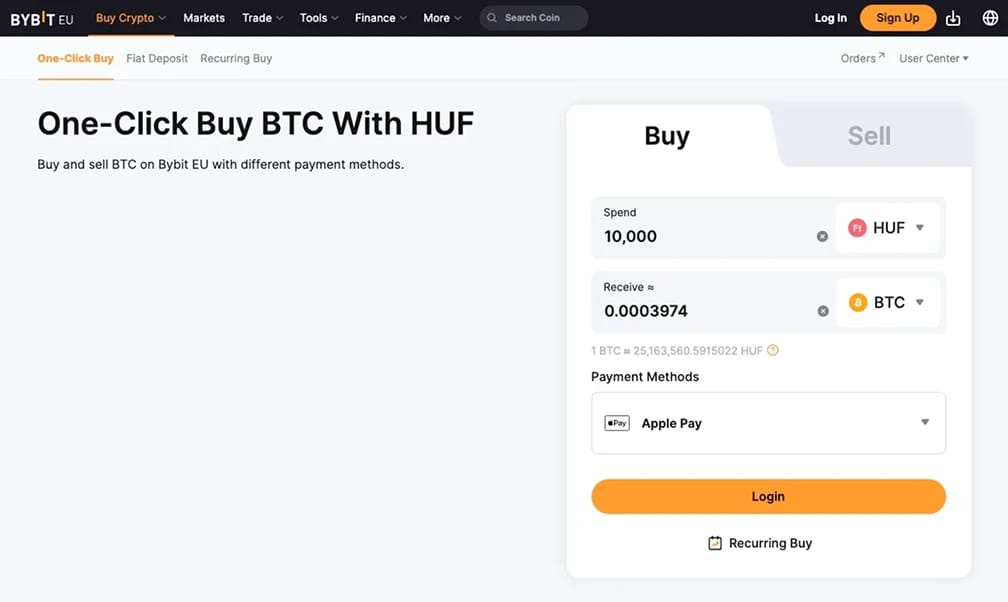
Bybit ranks first for Hungarian users because it combines low total costs with an accessible trading interface. Bybit EU GmbH, its Vienna-based company, received MiCA authorization from Austria’s FMA in May 2025. Hungary is included among the EEA countries the entity supports. Identity verification on our Budapest-registered account took less than ten minutes.
Spot orders carry a flat 0.10% fee. The same pricing covers roughly 600 cryptocurrencies. Users can fund their euro balance through SEPA Instant, standard SEPA, Apple Pay, Google Pay, or cards. During testing, money sent from an OTP euro account reached Bybit within seconds. The account also includes copy trading portfolios, grid and DCA bots, Earn products, and a cashback card accepted at Hungarian terminals.
The European platform has two current limitations. Perpetual futures remain unavailable while a separate application from an Austrian investment firm is under review, leaving leverage capped at 10x using spot margin. Bybit’s record also includes the February 2025 theft of about $1.4 billion from a cold wallet. The company covered all customer balances within days. Our Bybit review assesses that incident alongside its reserve reporting.
Pros
- Bybit’s flat 0.10% spot fee is the lowest among licensed exchanges for traders below professional volume tiers.
- Hungarian euro deposits through SEPA Instant settled within seconds during testing. Cards and mobile wallets are also supported.
- Its FMA-supervised EU company holds MiCA authorization, while a sister company received an e-money permission in August 2026.
Cons
- EEA customers cannot trade perpetual futures while the Austrian investment firm application remains pending.
- The 2025 cold wallet exploit remains the largest exchange theft on record, although customers incurred no losses.
- HUF deposits are unavailable, requiring Hungarian users to convert their funds into euros first.
2. Kraken
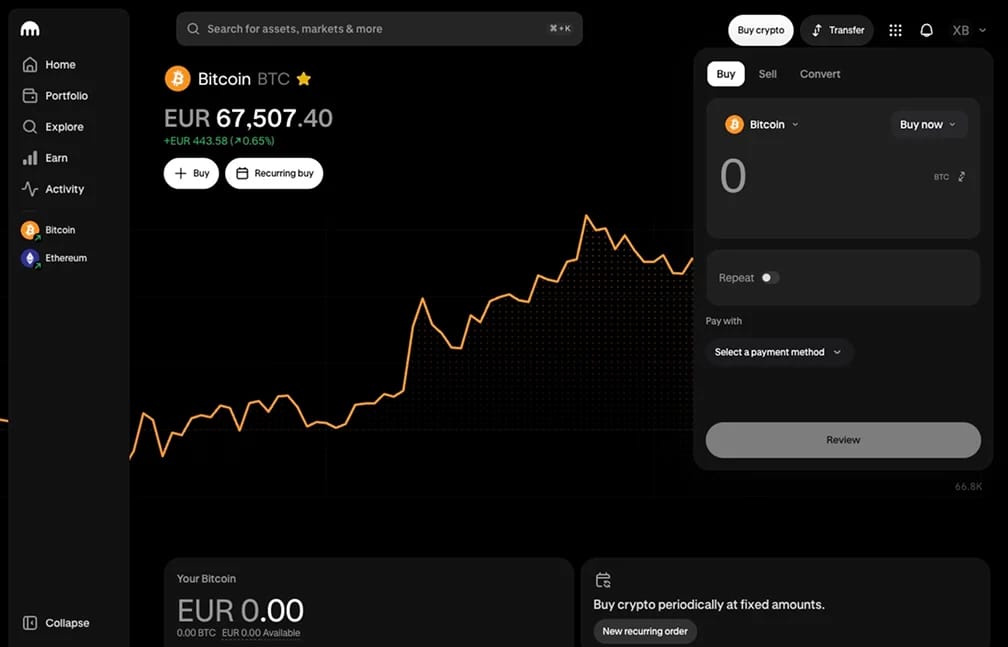
Kraken is better suited to Hungarian investors who prioritize market depth and security history over headline pricing. Payward Europe Solutions Limited, the group’s Irish company, received a MiCA license from the Central Bank of Ireland in June 2025. The authorization covers all thirty EEA countries. Kraken also continued supporting Hungarian customers throughout the validator period.
Its euro order books are deeper than those of any other MiCA-authorized exchange. That difference becomes important when an order is large enough to move prices on thinner markets. Kraken lists around 450 cryptocurrencies and offers tokenized US stocks. Eligible customers can also access regulated futures through a Cypriot group company supervised under MiFID II. No breach has caused customers to lose funds since Kraken opened in 2011.
Higher fees are the main compromise. Kraken Pro charges makers 0.25% and takers 0.40%, several times more than Bybit’s flat fee. Its basic purchase screen adds close to 1% plus a spread, so we recommend switching to Pro before placing the first order. Free SEPA and SEPA Instant deposits from our K&H euro account are settled within the same minute. The full pricing structure is covered in our Kraken review.
Pros
- Kraken’s Irish MiCA authorization comes from one of the EU’s strictest supervisors and was passported into Hungary throughout 2025 and 2026.
- Its deep EUR order books limit slippage when Hungarian investors place larger trades.
- The exchange has operated for fifteen years without a security breach and publishes independently verified Proof of Reserves.
Cons
- Starting fees of 0.25% for makers and 0.40% for takers exceed those charged by Bybit, OKX, and Gate.
- Occasional buyers using the basic screen may pay several times the Pro rate without recognizing the difference.
- Kraken does not support HUF, so deposits must come from a euro account.
3. Coinbase
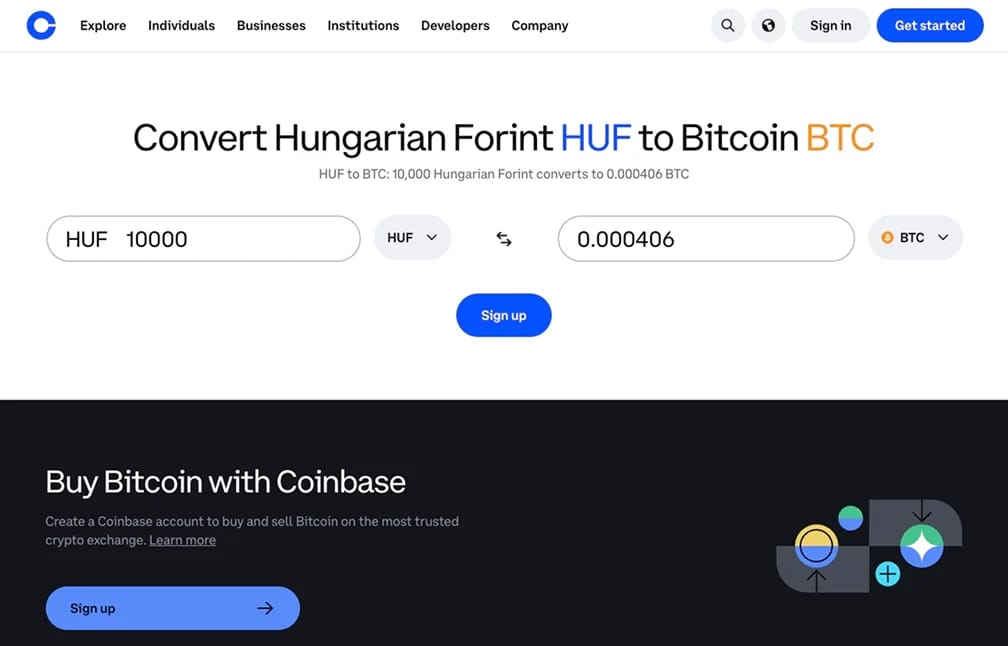
Coinbase is our recommendation for Hungarians buying crypto for the first time. It had the simplest onboarding process in our tests. Its Nasdaq-listed parent also publishes audited financial accounts every quarter. European users contract with Coinbase Luxembourg S.A., which received MiCA authorization from Luxembourg’s CSSF in June 2025.
The company addressed the Hungarian validator rules more publicly than most competitors. In March 2026, a Coinbase spokesperson told a Hungarian civic tracker that its cross-border services fell outside the scope of the validator law. This position followed a review with local counsel. Coinbase continued accepting Hungarian customers, and the August repeal resolved the remaining legal uncertainty.
Pricing is weaker on both of its purchasing interfaces. The simple app adds about 2% markup, with card transactions costing even more. Advanced Trade uses a live order book but charges 0.40% to makers and 0.60% to takers. Paying for convenience may be reasonable on a single small purchase. Monthly buyers should move to Advanced Trade early. Our Coinbase fees guide identifies where each charge appears.
Pros
- A Nasdaq-listed parent with quarterly audited accounts offers a level of financial transparency private exchanges cannot match.
- Coinbase provided the clearest first-purchase process in our tests, as well as the clearest processes for recurring purchases and staking for major proof-of-stake assets.
- Its Luxembourg MiCA authorization and public statement on Hungarian law gave customers greater certainty during the validator period.
Cons
- Purchases through the simple app include a markup of nearly 2%. Advanced Trade fees of 0.40% and 0.60% are four times Bybit’s rate.
- Coinbase lists roughly 250 assets, excluding many smaller tokens found on Bybit or Gate.
- In November 2025, Ireland’s central bank fined a sister company EUR 21.5 million over transaction-monitoring failures.
4. Bitpanda
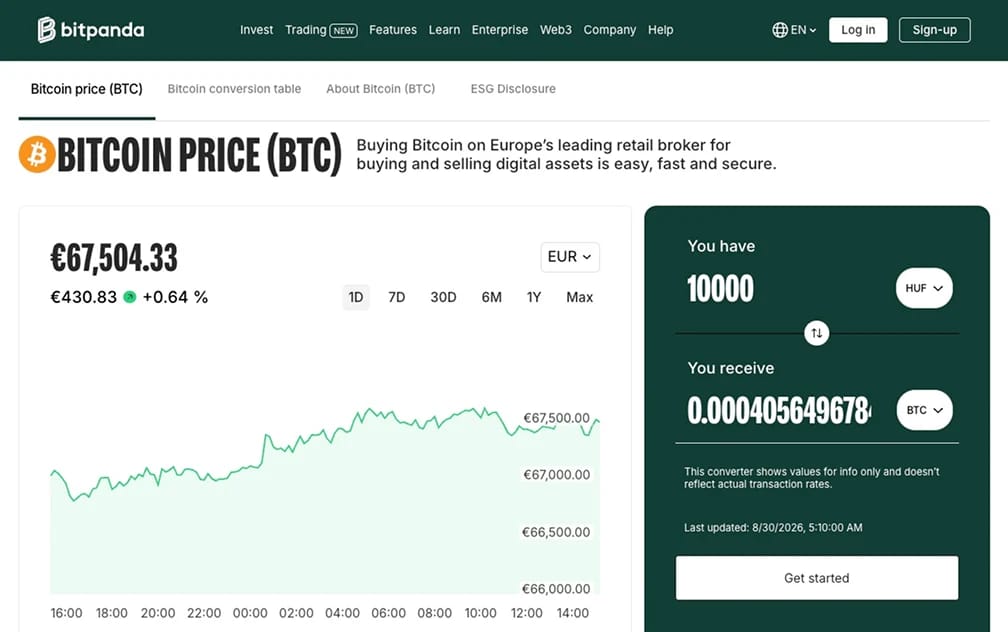
Bitpanda is the only ranked platform that provides a forint wallet. Users can deposit HUF through bank transfer, retain a forint balance, and view asset prices in HUF. This removes the euro conversion required by every other exchange in the ranking. Its interface is also available in Hungarian. During 2025, Bitpanda group companies secured MiCA approvals in Germany, Malta, and Austria.
No other platform responded as fully to the validator law. Bitpanda contracted with Caduceus Zrt. in February 2026 after it became Hungary’s first licensed validator. The exchange was also the first to state that it met all Hungarian requirements. Its contract ended when validator licenses expired on 7 August. Even so, the agreement showed that Bitpanda was prepared to invest in local compliance rather than dispute the law’s reach.
The service is built for investors rather than active traders. More than 600 cryptocurrencies are available alongside fractional stocks, ETFs, and precious metals. Savings plans can draw a fixed amount in forints from a Hungarian bank account each month. Costs remain the central weakness. Instant purchases incur a markup of up to 1.49%. Our Bitpanda countries guide details the services offered to EEA residents.
Pros
- Direct HUF deposits and a Hungarian interface make Bitpanda the most locally adapted exchange in this ranking.
- MiCA approvals in three EU countries, together with its 2026 validator contract, demonstrate continued spending on regulatory compliance.
- One account provides access to crypto, stocks, ETFs, metals, and automated savings plans.
Cons
- Purchase markups can reach 1.49%, far above the rates charged by order-book exchanges.
- Spread-based pricing conceals the precise cost until checkout. Margin and futures trading are also unavailable.
- Investors needing limit orders or deeper liquidity will find Kraken or Bybit more suitable.
5. OKX
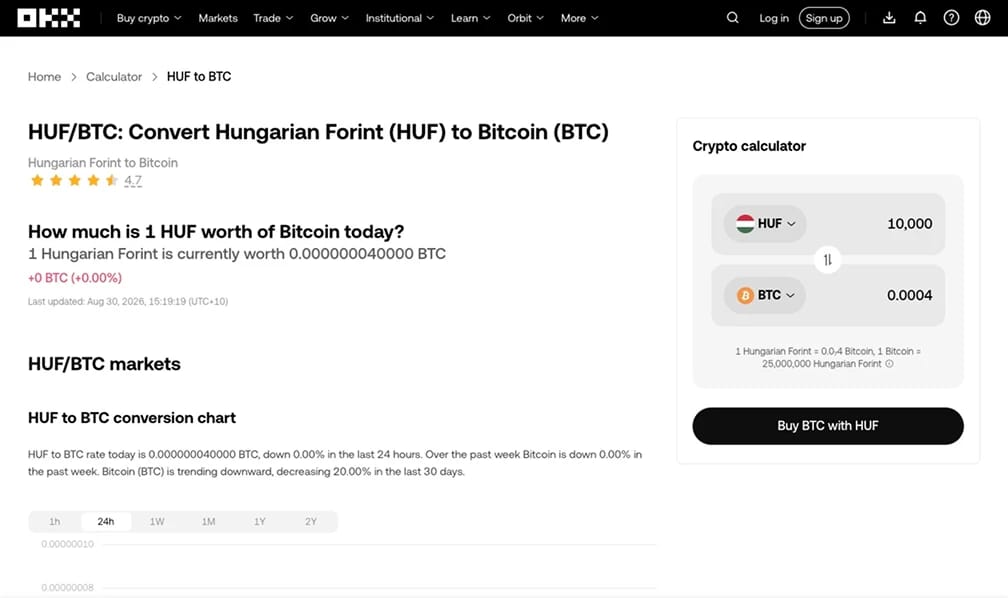
OKX has the lowest starting commissions in the ranking. Makers pay 0.08%, while taker fees begin at 0.10%, with further reductions at higher volumes. Malta’s MFSA authorized the local company under MiCA in January 2025. MiFID II investment firm permission followed two months later, and the company added an EU payment institution license in February 2026.
The integrated Web3 wallet separates OKX from the other exchanges listed here. Funds received via SEPA can be transferred to self-custody in the same app, with swaps supported across more than 130 blockchains. Introduced with Mastercard in January 2026, the OKX Card lets customers spend USDC and other compliant stablecoins at Hungarian stores. EEA accounts have access to around 300 cryptocurrencies.
Prospective users should consider two concerns. Malta’s FIAU fined the local company slightly more than EUR 1 million in April 2025 for earlier anti-money-laundering weaknesses. ESMA later called for tighter MFSA licensing practices in a peer review. Placing an exchange account and a self-custody wallet within a single interface may also be confusing for new users. Our OKX review examines the two products separately.
Pros
- Starting maker and taker rates of 0.08% and 0.10% are the lowest in this ranking.
- Permissions covering MiCA, MiFID II, and payment services allow the Maltese entities to provide spot markets, regulated derivatives, and stablecoin payments.
- Hungarian customers can move from a regulated exchange into DeFi and self-custody using the integrated Web3 wallet.
Cons
- The 2025 AML fine and ESMA’s review of Maltese licensing weaken the company’s supervisory record.
- Combining the exchange and wallet in a single app increases the risk of irreversible mistakes.
- Its staking selection and Earn yields fall behind Kraken and Bybit.
6. Gate
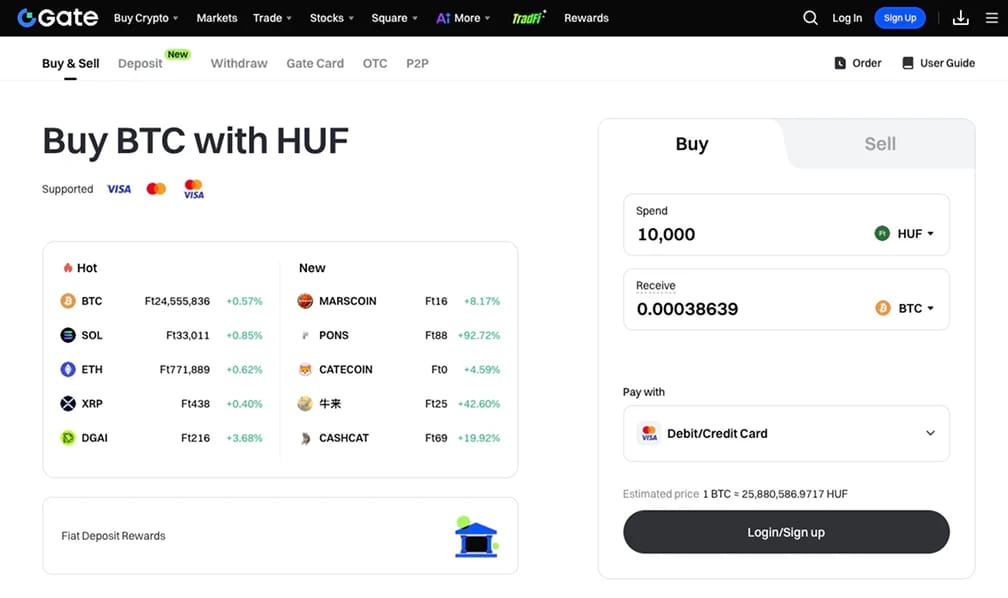
Gate ranks because of its token catalog, which offers the world’s largest selection of cryptocurrencies. Gate Technology Ltd has held MiCA authorization from Malta’s MFSA since September 2025. Its EEA platform lists more than 1,000 tokens, far beyond any other licensed exchange available in Hungary. New tokens frequently reach Gate several months before larger competitors add them.
Spot makers pay 0.09%, and takers are charged 0.10%. The account includes trading bots, copy portfolios, Earn products, and access to a launchpad for new token sales. An EU payment institution license, obtained in February 2026, supports the group’s euro funding. Our SEPA transfer from Erste settled within one business day. By comparison, deposits to Kraken and Bybit arrived instantly.
Usability and liquidity require compromise. Menus contain several layers, while promotional banners make the interface feel crowded. Order books also become thin outside the leading few hundred assets. For smaller tokens, a wide difference between bid and ask prices may outweigh any commission savings. Gate is best used as a secondary account for altcoin exposure, as explained in our Gate review.
Pros
- With more than 1,000 cryptocurrencies, Gate offers Hungarian altcoin traders the broadest licensed catalog.
- Fees start at 0.09% for makers and 0.10% for takers, with bots, copy portfolios, and launchpad access included.
- Its Maltese MiCA authorization and EU payment license cover both trading and euro payments.
Cons
- For obscure tokens, wide spreads can outweigh the savings on commission.
- Gate has the most difficult interface to learn among the six ranked platforms.
- Our SEPA transfer settled overnight, and euro deposits through mobile wallets are unavailable.
How to Choose a Crypto Exchange in Hungary
Each exchange above holds MiCA authorization, removing licensing as a point of difference. Hungarian investors should instead compare how they plan to deposit, trade, and withdraw. Complete these five checks before sending money.
- Confirm the legal entity on ESMA’s register: Licenses apply to individual companies rather than entire brands. Identify the operating company in the platform’s terms, then compare it with ESMA’s MiCA register. Our guide to the best MiCA-licensed crypto exchanges maintains a verified list.
- Decide between HUF and EUR funding: Bitpanda accepts direct forint deposits. The other five exchanges require euros, which means paying the bank’s conversion margin when funding a euro sub-account. OTP, K&H, Erste, Raiffeisen, and MBH provide SEPA Instant transfers from euro accounts. Our OTP Bank guide explains the setup.
- Price the whole round trip: Calculate the bank’s HUF-to-EUR spread, the exchange’s trading fee or markup, and the eventual withdrawal charge. If a bank charges an expensive currency conversion fee, Bybit’s 0.10% commission can still result in a higher total cost than Bitpanda’s 1.49% markup.
- Check which providers have returned: Repealing the validator rules did not immediately restore every service. At publication, Revolut, Bitvavo, and eToro’s spot crypto product remained unavailable to Hungarians. CoinCash restarted after obtaining an MNB license in July.
- Run a small test cycle: Deposit a limited amount, complete a purchase and sale, then withdraw to the originating account. Most delays in our testing resulted from differences between the names on exchange profiles and bank accounts. A small initial transaction reveals these problems early.
Crypto and Bitcoin Regulation in Hungary
Hungarian residents may legally buy, hold, and trade crypto. Since 7 August 2026, MiCA has applied without an additional national requirement. The MNB licenses and supervises providers. Hungary’s rules changed sharply over the previous two years:
- Act VII of 2024: Parliament adopted Hungary’s crypto-asset market law, implementing MiCA locally and naming the MNB as the competent authority. Existing providers had until 1 July 2025 to receive authorization.
- 17 June 2025: An extraordinary parliamentary session passed Act LXVII of 2025. Added during the committee stage, its provisions required every crypto conversion to be reviewed by a SZTFH-licensed validator. The law also created two criminal offenses for conversions from HUF 5 million, carrying prison terms of up to five years for individuals and eight years for providers.
- July to December 2025: Revolut suspended Hungarian crypto services within days of 1 July and closed the product on 18 December. During the same period, Bitstamp, Uphold, SwissBorg, Bitvavo, eToro, Kriptomat, and CoinCash restricted or suspended access.
- 19 December 2025: The SZTFH approved Caduceus Zrt. as Hungary’s first validator. Its decree applied from 27 December, and uncertified conversions became criminal offenses on 1 January 2026.
- 30 January 2026: The European Commission began infringement proceedings INFR(2025)2174. It found that the validator regime and associated criminal liability conflicted with MiCA.
- 12 April 2026: The Tisza party secured a two-thirds parliamentary majority after campaigning to abolish the validator system. Its government opened consultation on the repeal bill on 11 June, then submitted it as T/305 on 30 June.
- 28 July 2026: Parliament passed T/305 by 143 votes to 46. Promulgated as Act XXXVIII of 2026 on 30 July, it entered into force on 7 August. Validator licenses ended, and conversion data had to be deleted within three working days.
MNB supervision under MiCA remains unchanged. The central bank has taken action against providers that failed to meet the July 2025 deadline. CoinCash's receipt of a license in July 2026 also indicates that domestic approvals are being issued again.
.webp)
How Does NAV Tax Crypto?
Hungary applies relatively light crypto taxation by EU standards, with more favorable rules set to take effect in 2026. The Hungarian tax authority (NAV) uses a dedicated framework under Section 67/C of the Personal Income Tax Act:
- A flat 15% on net annual gains: Individuals owe 15% personal income tax on annual proceeds from converting crypto into money or goods, after deducting documented acquisition costs. No social contribution tax is charged.
- Swaps between cryptocurrencies are not taxed: Trades from Bitcoin into Ether, or from either asset into a stablecoin, do not trigger tax. Liability begins when crypto is converted into money or goods.
- Losses now carry forward without a time limit: Act LXXXIII of 2025 ended the time restriction on offsetting declared losses against later profits. A reported loss can be applied in any subsequent year from the 2026 tax year. Transitional provisions extend the treatment to 2025 returns.
- Small transactions are exempt: Income below one tenth of the monthly minimum wage is disregarded if daily and annual totals remain within their respective limits. For 2026, that threshold is HUF 32,280. The annual limit equals one month’s minimum wage.
- Reporting is becoming automatic: Since 1 January 2026, DAC8 has required licensed EU exchanges to collect transaction data for Hungarian customers. NAV will receive the first exchange reports in 2027, making it important that tax returns match platform records.
Returns filed through eSZJA are due by 20 May of the following year. A loss must be declared in the year it occurs before it can offset future gains. This information is general and should not replace advice from a Hungarian tax professional on complex positions.
.webp)
Cryptocurrency Adoption in Hungary
The validator regime caused Hungary’s crypto user base to contract sharply. A PwC survey conducted in June 2026 estimated that the number of active Hungarian crypto holders fell by about 80,000 over the previous year. This represents a 38% reduction from the 210,000 users recorded in 2025.
Much of that decline came from one app. Revolut was used by 74% of Hungarian crypto investors in 2025, and most did not transfer to another provider when its crypto product closed in December. PwC found that the investors who remained were generally more experienced and better capitalized, though still cautious. Weaker global crypto prices added further pressure.
There have been two signs of recovery since July. Budapest-based CoinCash received an MNB license in July 2026 and started restoring access for existing customers. The government has also presented the repeal as the beginning of a proportionate framework aligned with MiCA. The pace of recovery will depend heavily on whether Revolut and Bitvavo return.
.webp)
How to Buy Bitcoin in Hungary
The cheapest dependable approach is to deposit euros or forints by bank transfer and place a limit order on a licensed exchange. With the required documents prepared, the process takes less than an hour:
- Open an account on a MiCA-authorized exchange: Bybit is our main recommendation for low costs and fast deposits. Kraken is better for market depth, while Bitpanda suits investors who want to keep their balance in forints.
- Verify your identity: Submit a passport or Hungarian identity card (személyi igazolvány), complete the selfie check, and provide proof of address if required. Every platform we tested approved our documents within minutes.
- Fund the account: Bitpanda accepts forints through a domestic bank transfer. For the other exchanges, send euros from a euro sub-account using SEPA or SEPA Instant. Our Erste Bank and Raiffeisen Bank guides explain the currency conversion process.
- Submit a BTC/EUR limit order: Use the advanced trading interface and set the purchase price. One-click purchase screens conceal markups inside their quotes, which may cost several times the advertised commission.
- Move long-term holdings to self-custody: Assets intended for long-term storage should sit in a wallet controlled by the owner’s private keys. Our guide to the best crypto wallets compares hardware models. Verify both the address and network before approving a withdrawal.
Selling follows the same process in reverse, with the proceeds withdrawn to the account originally used for the deposit. Export transaction records every quarter because NAV will receive the exchange’s records from 2027.
Final Thoughts
Bybit leads this ranking because its 0.10% flat trading fee, instant euro deposits, and Austrian MiCA authorization keep costs low. Kraken is stronger for large orders and maintains the longest clean security record. Coinbase is our choice for a first purchase, while Bitpanda is the only ranked platform that lets users remain in forints. OKX and Gate suit traders seeking lower starting fees or more listed tokens.
The most important change during the past year was legal. From July 2025 until August 2026, Hungary operated the EU’s only criminal validator regime. During that period, it lost the app used by three-quarters of local crypto investors. A new government and an EU infringement case preceded the eventual repeal.
Investor behavior still has a greater effect than platform choice. Use bank transfers instead of cards, place limit orders rather than buying through an instant screen, and retain quarterly records for the 15% NAV return. Long-term holdings should move into self-custody. Our ranking of the best crypto exchanges in Europe compares licensed providers across the wider bloc.
Our Methodology
We reviewed MiCA-authorized platforms accepting new Hungarian customers in August 2026, after the validator system ended. The ranking uses six criteria:
- Trust score: Datawallet’s rating out of 5 considers the supervising regulator, security incidents, reserve transparency, and the number of years without customer losses.
- Entity verification: Each brand was traced to the company identified in its terms. We then checked that company against ESMA’s register and MNB communications.
- Hungarian funding in practice: We deposited forints where supported and sent euros through SEPA or SEPA Instant from OTP, K&H, and Erste accounts. Settlement was timed before funds were withdrawn to the same accounts.
- True cost of a purchase: We priced a live BTC/EUR transaction on every platform, including the bank conversion margin, exchange fees or markups, and withdrawal charges.
- Product range in the EEA: Asset totals and access to staking, bots, derivatives, and cards were assessed based on what the European entity offers, rather than the global brand.
- Hungarian relevance: Our review considered HUF deposits, Hungarian-language support, each company’s conduct under the validator rules, and any public statement addressing Hungarian law.
Testing ended in late August 2026. We checked Hungarian availability and MiCA status again on the publication date. Our editorial methodology explains how each claim was verified.
.webp)