







Compare Top Lithuania Crypto Exchanges
1. Kraken
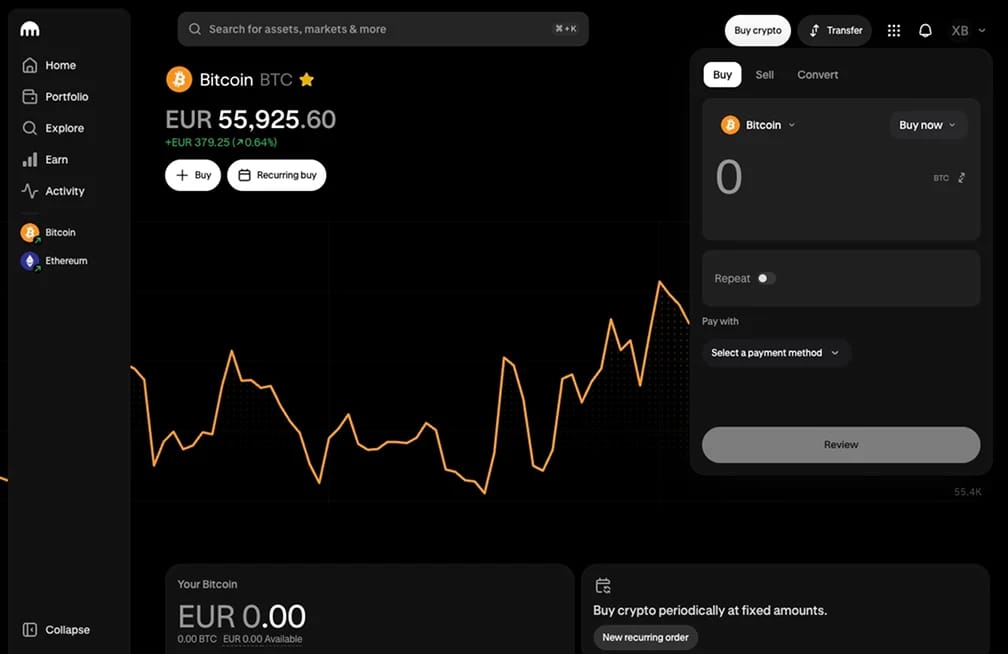
Kraken ranks first because of its operating and security record. It has been operating since 2011 and has never been hacked or experienced a serious safety incident. Its Irish company, Payward Europe Solutions Limited, holds a MiCA license from the Central Bank of Ireland in Dublin. Periodic independent Proof of Reserves snapshots are also published daily, more frequently than those of any other exchange in this ranking.
Euro purchases can be made through the standard app. Kraken Pro adds professional charting and access to more than 450 markets. Fees start at 0.25% for makers and 0.40% for takers. Futures sit in a separate subaccount governed under MiFID II through a Cypriot group entity, giving Kraken a regulated product that spot-only competitors cannot legally offer.
SEPA and SEPA Instant deposits are free. Its BTC/EUR and ETH/EUR order books are among Europe’s deepest, while our withdrawals to a Lithuanian account arrived on the same day. The main omission is Lithuanian, which is not included among the platform’s 28 interface languages. Visit our Kraken Review to learn more about the platform’s features, fees and security measures.
Pros
- Kraken has operated since 2011 without losing customer funds, with reserve attestations updated each day.
- Regulated MiFID II futures complement its spot and staking products for active traders.
- Free SEPA Instant deposits and deep euro order books work well for large Lithuanian orders.
Cons
- Markups on the default buy screen are several times higher than Kraken Pro’s posted fees. Moving between the two interfaces can also confuse new users.
- Futures require a separate application and appropriateness questionnaire.
- Listings tend to arrive later than on Bybit or OKX, while many small-cap tokens are never added.
2. Bybit
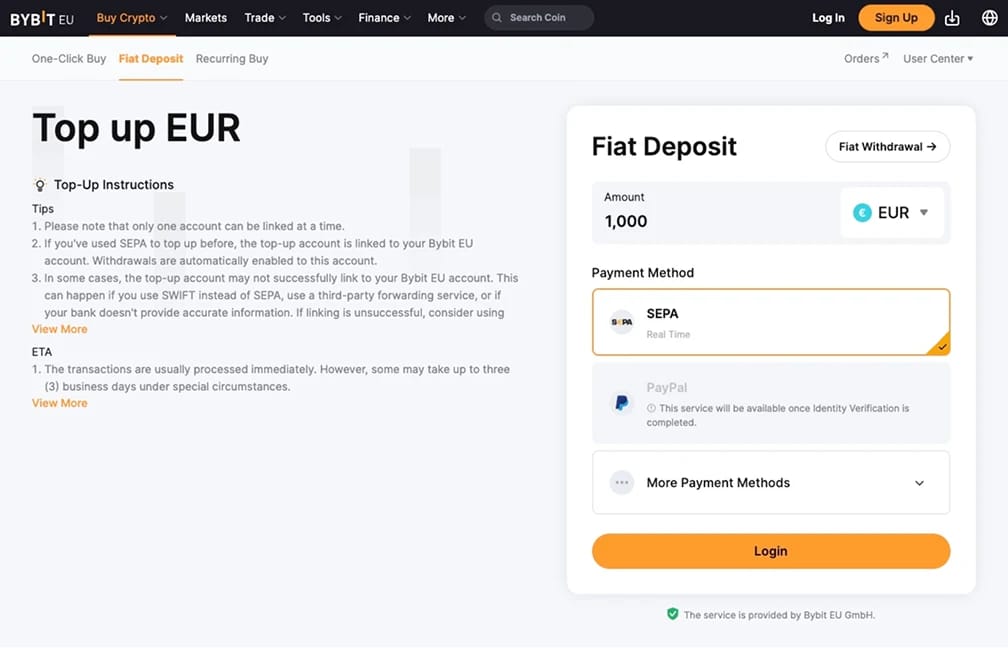
Bybit is our recommendation for experienced traders. Its European operation is a standalone exchange, not a reduced copy of the global platform, so you cannot access the full product suite. Lithuanian accounts use bybit.eu, operated from Vienna by Bybit EU GmbH under MiCA supervision from Austria’s Financial Market Authority (FMA). Roughly 600 cryptocurrencies are approved for EEA customers.
Spot trading has a flat 0.10% fee for both makers and takers. SEPA and SEPA Instant deposits are free, allowing transfers from Swedbank, SEB, Luminor, or Artea to become tradable within minutes. Copy trading, trading bots, Earn products, and the Bybit Card remain available. Our Bybit review covers the complete feature set available to Lithuanian and European investors.
The European exchange still has two clear restrictions. Perpetual futures will remain unavailable until Bybit’s investment firm application receives approval. English and Russian are supported, but Lithuanian is not. It’s important to note that in 2025, Bybit was the victim of the largest hack in crypto history, but no customer funds were affected. Hacken-audited reserve reports indicate that customer assets are fully backed on a 1:1 basis.
Pros
- Bybit is authorized under MiCA and supervised by Austria’s FMA. The group’s payments entity also has separate e-money permission.
- Spot trades across roughly 600 assets carry a flat 0.10% fee, below every licensed rival with a similar selection.
- Free SEPA Instant transfers from major Lithuanian banks are credited within minutes.
Cons
- Derivatives remain unavailable on the EU platform while the MiFID II application is pending.
- The global exchange lost about $1.5 billion in a cold wallet theft in February 2025. Customers were fully reimbursed, and the EU company operates separately, but it remains the industry’s largest breach.
- MiCA compliance excludes USDT pairs from the European catalog.
3. Coinbase
Coinbase fits Lithuanian investors seeking a familiar brand and publicly listed counterparty. Its shares trade on the Nasdaq, and the company releases audited quarterly accounts. Its public filings provide greater financial transparency than those of privately held competitors, making it one of the safer exchanges on this list. EEA customers are handled by Coinbase Luxembourg S.A., which received MiCA authorization from Luxembourg’s CSSF in June 2025.
The registration process was the quickest we tested, taking new users from sign-up to a first Bitcoin purchase within minutes. SEPA deposits cost nothing. In-app staking and Learning Rewards add useful features for beginners, while institutional customers receive segregated cold storage through Coinbase Prime at a scale unmatched by the other platforms listed.
That convenience is expensive. Simple purchases cost up to 1.49%, while card transactions can reach 3.99%, with spreads added to both. Advanced Trade lowers the rates to 0.40% for makers and 0.60% for takers, but the interface sits behind a toggle that many users miss. Coinbase also retains at least 25% of most staking rewards, the highest deduction in this ranking.
Pros
- Its Nasdaq listing requires audited public disclosures that privately held exchanges do not provide.
- Coinbase recorded the fastest journey from account creation to first purchase in our testing.
- Free SEPA deposits sit alongside staking and Learning Rewards, which pay small crypto amounts for completing lessons.
Cons
- Simple purchases can cost 1.49%, and card fees reach 3.99%, making Coinbase the most expensive entry point listed.
- Its catalog of roughly 250 assets is smaller than those of Bybit, OKX, and Bitpanda.
- Coinbase keeps 25% or more of staking rewards, a larger share than any rival in the ranking.
.webp)
4. OKX
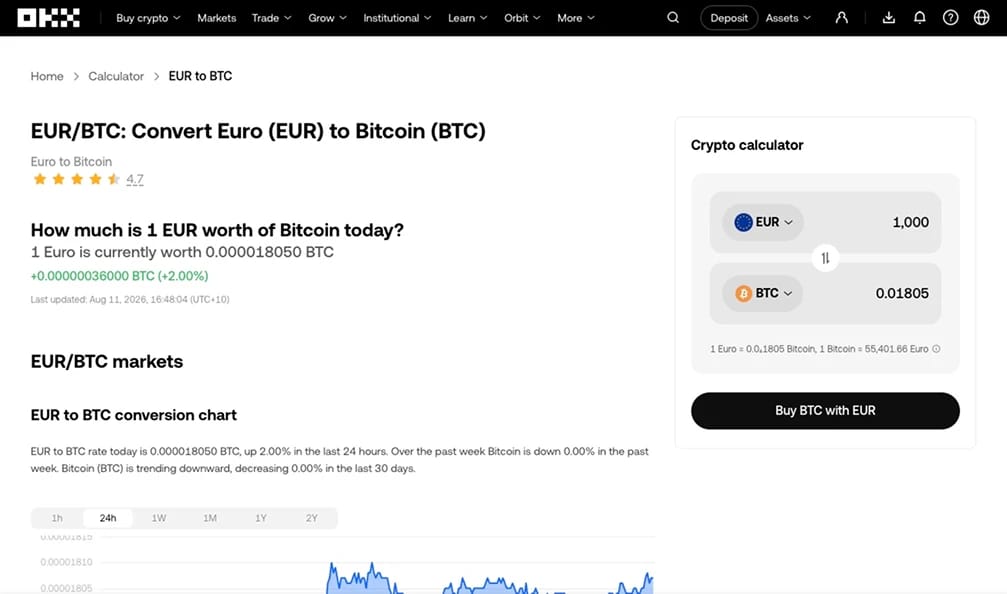
OKX offers the lowest order book fees available to Lithuanian residents. Makers pay 0.08%, while takers are charged 0.10% before volume discounts. OKX Europe Ltd, its Maltese company, was among the first exchanges to secure MiCA authorization from the Malta Financial Services Authority (MFSA). Derivatives followed in 2026 under separate MiFID II permission.
Its Web3 tools distinguish it from the three platforms above. The integrated OKX wallet supports more than 100 networks. A DEX aggregator checks on-chain swap prices against OKX’s exchange pricing, while monthly zk-STARK Proof of Reserves reports offer a level of transparency few competitors match. Investors can read our OKX review to learn about the exchange’s security.
The trade-off is a crowded user interface. Exchange trading and a self-custody wallet share the app with NFT tools and yield products, making basic functions harder for first-time buyers to locate. Card and mobile wallet transactions use outside payment providers whose markups exceed the posted trading fee. SEPA was the cheapest funding method in our test.
Pros
- Order book makers pay 0.08% and takers 0.10%, below every other MiCA-authorized exchange serving Lithuania.
- Monthly zk-STARK reports provide cryptographic proof that customer assets are backed.
- Its Web3 wallet and DEX aggregator provide access to on-chain markets without leaving the app.
Cons
- Combining exchange trading, self-custody, and DeFi in one interface creates a steep learning curve.
- Processor markups make card and mobile payment purchases much more expensive than the trading fee suggests.
- Lithuanian is unavailable across both the app and support channels.
5. Robinhood
Robinhood is the only platform in this ranking supervised inside Lithuania. Robinhood Europe, UAB operates from Vilnius and holds three Bank of Lithuania licenses. It received a Category A brokerage permission in April 2025 and Lithuania’s first MiCA CASP authorization on 29 May 2025. A payment institution license followed in March 2026.
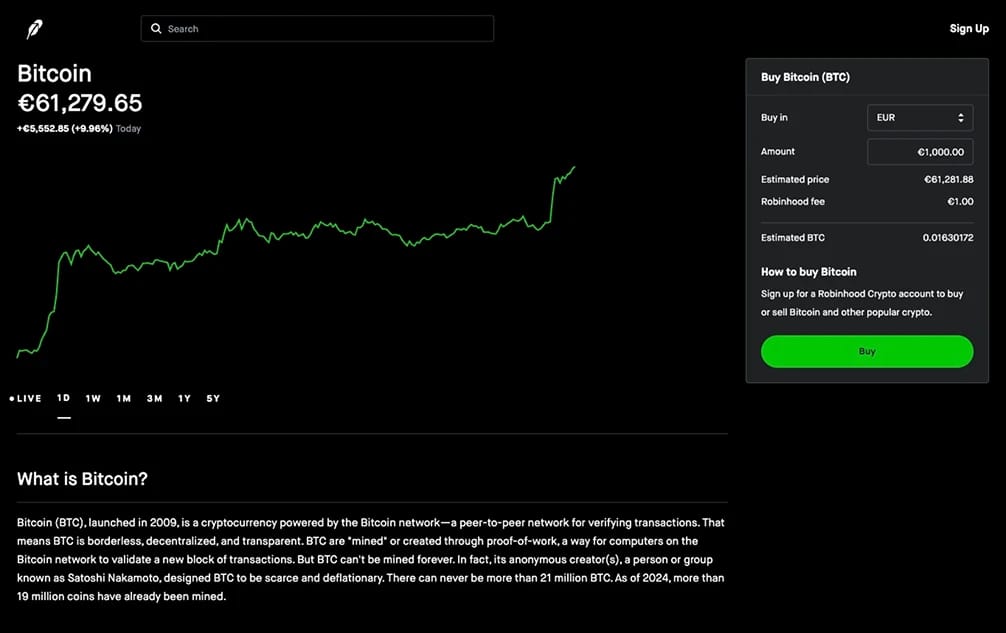
More than 65 cryptocurrencies are available at a flat 0.50% fee with a €0.01 minimum. Customers can deposit and withdraw coins to external wallets. ETH and SOL staking starts at €1, with Robinhood keeping 15% of the rewards. The app also provides more than 200 tokenized US stocks and ETFs, which trade around the clock on weekdays using Arbitrum-issued stock tokens.
The catalog covers major coins but offers little beyond them. A 0.50% charge is also higher than the order book rates on Bybit and OKX. Robinhood’s stock tokens are derivative contracts that follow market prices without granting shareholder rights, a distinction the Bank of Lithuania asked the company to clarify after launch.
Pros
- The Bank of Lithuania's supervision covers its brokerage, crypto, and payment licenses, providing Lithuanian investors with a locally regulated platform.
- One mobile-first account supports crypto and tokenized US equities, as well as staking and perpetual futures.
- The flat 0.50% crypto fee and €0.01 minimum make costs predictable for small recurring purchases.
Cons
- Its 65+ coin selection excludes thousands of tokens offered by Bybit, OKX, and Kraken.
- Stock tokens carry no ownership or voting rights. Regulators publicly requested clarification about their structure in 2025.
- The 0.50% rate is expensive compared to Bybit’s 0.10% fee and OKX’s 0.08% maker fee.
6. Bitpanda
Bitpanda is aimed at Lithuanians who want crypto and traditional investments under one login. It supports shares and ETFs alongside precious metals. The Vienna company has MiCA licenses in three jurisdictions after satisfying regulators in Germany, Malta, and Austria, giving it an unusually broad licensing record for a retail platform.
Its savings plans are particularly useful for long-term investors. Weekly or monthly SEPA direct debits transfer a fixed euro amount from a Lithuanian bank account, then distribute it automatically across selected coins, indices, or stocks. The Bitpanda Card can convert those balances into euros at Visa terminals, linking investment holdings with everyday spending.
The cost becomes clear at purchase. Instant transactions include up to 1.49% in the quoted price, several times the cost of an equivalent order on Bybit or OKX. Its spread-based model is also difficult to compare directly with order book exchanges. Bitpanda supports spot trading only. In August 2026, the FMA fined the company over a delayed whitepaper submission, issuing the first binding MiCA penalty.
Pros
- MiCA approvals from supervisors in Germany, Malta, and Austria give Bitpanda greater licensing depth than any rival listed.
- Recurring savings plans draw funds directly from a bank account.
- A single account covers more than 600 cryptocurrencies, plus fractional stocks, ETFs, indices, and metals.
Cons
- Pricing of up to 1.49% makes Bitpanda the most expensive buying method in the ranking.
- Margin, futures, and advanced order types are unavailable.
- Although small, the August 2026 FMA fine made Bitpanda the first platform penalized under MiCA.
How to Choose a Crypto Exchange in Lithuania
Every listed platform holds MiCA authorization. Your choice should depend on its supervising authority, euro transfer speed, and whether the fee structure matches your trading habits. Complete these five checks before depositing money:
- Match the legal entity to a register: Licenses belong to legal companies, not brand names. Find the company named in your account terms, then verify it in the Bank of Lithuania’s participant list or ESMA’s register. Our guide to the best MiCA-licensed exchanges identifies the authorized companies behind major global brands.
- Confirm how euros reach the platform: Free SEPA transfers are accepted by all six exchanges. Kraken, Bybit, Coinbase, and OKX also support SEPA Instant. Payments from SEB and other major Lithuanian banks can arrive within minutes when the sender’s name matches the verified account holder.
- Calculate the full transaction cost: Express purchase screens may add a spread, and withdrawing funds can carry another charge. Once those markups are included, the platform with the lowest advertised rate may not be the cheapest.
- Consider your VMI position before trading: Under DAC8, licensed exchanges now send customer trading records to the tax authority. Platforms with clear, downloadable transaction histories make the annual declaration easier to complete.
- Test the complete cycle with a small amount: Deposit a modest sum, make a purchase, sell it, and withdraw the euros to your bank before committing more. This exposes hidden charges and confirms that withdrawals work.
Crypto and Bitcoin Regulation in Lithuania
Crypto ownership and trading are legal in Lithuania. Providing crypto services now requires authorization, a point the country reached earlier than most EU members. The regulatory framework developed through these milestones:
- 11 July 2024: The Seimas adopted the Law on Markets in Crypto-Assets. Authorization powers passed to the Bank of Lithuania, while the Financial Crime Investigation Service (FNTT) retained anti-money-laundering oversight.
- 30 December 2024: MiCA rules for crypto-asset service providers took effect across the EU, opening the licensing window.
- May 2025: Parliament moved the national transition deadline from 1 June 2025 to the end of the year after the volume of applications strained the regulator. On 29 May, the Bank of Lithuania issued its first CASP license to Robinhood Europe.
- 17 December 2025: CoinGate operator UAB Decentralized and Nuvei Liquidity received authorizations shortly before the cutoff. Micar assets UAB later became the fourth licensed company.
- 1 January 2026: Legacy registrations expired, removing the right of unlicensed companies to serve Lithuanian customers. Lithuania had about 850 registered crypto companies in late 2022, but only 102 license applications were submitted in 2025, covering 55 firms.
- 1 July 2026: The EU-wide transition ended. Binance withdrew its Greek application shortly beforehand and suspended EU services, leaving existing accounts open only for withdrawals.
Always identify the company legally responsible for an account before transferring money. Check that entity against the Bank of Lithuania’s participant records and ESMA’s central register. Brand recognition does not replace active authorization.
.webp)
How Does VMI Tax Crypto?
The State Tax Inspectorate (VMI) treats cryptocurrency as property. Tax is triggered when you dispose of it by selling for euros, swapping it for another coin, or using it to pay for goods or services. Simply holding crypto creates no tax event. Reforms introduced for 2026 changed how gains are taxed:
- Progressive rates replaced the old model: From 1 January 2026, most personal income is combined and taxed progressively. The rate is 20% up to 36 average wages, or about €82,962. It rises to 25% up to 60 average wages, approximately €138,270, and reaches 32% above that level. Occasional crypto gains contribute to this combined total.
- A €2,500 exemption still applies: Occasional net crypto gains retain the €2,500 annual exemption. Subject to VMI classification, qualifying non-employment income above that exemption is generally taxed at 15% up to 12 average wages, or €27,745.80 in 2026. Income above that level can enter the 20%, 25%, and 32% bands after aggregate taxable income is considered.
- Frequent trading becomes individual activity: The VMI may classify repeated, profit-seeking trading as individual activity. Registered traders can deduct documented expenses or claim a flat deduction equal to 30% of income without receipts. State social insurance (VSD) and compulsory health insurance (PSD) apply in addition to income tax.
- Companies pay more from this year: The corporate income tax rate increased to 17% in 2026. Small companies with fewer than 10 employees and turnover below €300,000 pay 7%. EU case law continues to exempt exchanges between crypto and fiat from VAT.
- Reporting became automatic: From January 2026, DAC8 and the OECD’s Crypto-Asset Reporting Framework require licensed platforms to submit customer transaction data to tax authorities. Your declaration should therefore correspond with the records already held by the VMI.
This section provides general information, not tax advice. Check complex situations with the VMI or a qualified adviser before submitting a return.
.webp)
Cryptocurrency Adoption in Lithuania
Crypto ownership in Lithuania continues to grow steadily. Statista Market Insights forecasts about 239,000 users by the end of 2026, equal to roughly 8.5% of the population. Annual market revenue is projected to reach approximately $12.3 million.
The surrounding financial infrastructure is substantial for a country of 2.8 million people. Lithuania issues more fintech licenses than any other EU member. Robinhood selected Vilnius for its European crypto hub partly because of that local expertise.
Regulatory supervision has become Lithuania’s defining crypto export. Our crypto adoption statistics page compares its user figures with those of neighboring European countries.
.webp)
How to Buy Bitcoin in Lithuania
The best approach is to send euros to a licensed exchange by free SEPA transfer, then place a limit order on its professional BTC/EUR market. With identification ready, the process takes less than 30 minutes:
- Open an account with a licensed platform: Kraken ranks first overall. Coinbase offers the simplest first purchase, while Robinhood fits investors who prefer direct supervision from Vilnius.
- Complete identity checks: Submit a passport or national ID card, then finish the liveness scan. Approval generally takes a few minutes. Deposits remain blocked until verification is complete.
- Transfer euros by SEPA: Every exchange in this guide accepts free transfers from Swedbank, SEB, Luminor, and Artea. Platforms supporting SEPA Instant can credit funds within minutes at any time.
- Use the order book to buy: Open BTC/EUR in the professional trading interface and set your preferred price. Express purchase buttons include markups that often exceed the complete trading commission.
- Move long-term holdings into self-custody: Crypto intended for long-term storage should remain under your own keys. Our best crypto wallets guide compares suitable hardware models.
To sell, reverse the process and withdraw the euro proceeds by SEPA to the original funding account. Export transaction records every quarter instead of rebuilding them during tax season. Under DAC8, the VMI will already possess the exchange’s records.
Final Thoughts
Kraken takes first place for trust. Its record extends to 2011, periodic independent Proof of Reserves snapshots are published daily, and traders receive access to deep euro markets plus regulated futures. Bybit is still our choice for experienced traders seeking the lowest flat fee. Robinhood converts Lithuania’s early licensing lead into a locally supervised product.
The broader conclusion is simple: public registers now determine which platforms can operate. The Bank of Lithuania granted its first CASP authorization within a year of MiCA taking effect. It then closed the domestic transition six months before the EU-wide deadline, prompting hundreds of registered firms to leave instead of meeting the new standard.
Good trading habits carry more weight than minor differences between platforms. Fund accounts by SEPA rather than card, place orders through the professional interface, and complete a small test cycle before transferring a significant amount. Anyone comparing platforms beyond Lithuania can consult our Europe-wide exchange ranking.
Our Methodology
We considered only exchanges with full MiCA authorization that remained open to Lithuanian residents after the national cutoff on 1 January 2026. Six criteria determined the final order:
- Trust score: Our 5-point Datawallet assessment measures regulatory quality and reserve transparency alongside incident history and operating record.
- License verification: Every operating company was matched against the Bank of Lithuania’s records and ESMA’s register. We also confirmed which regulated services each authorization covers.
- Euro funding from Lithuania: We funded accounts from a Lithuanian bank using SEPA and SEPA Instant, measured how long deposits took to become tradable, then withdrew the proceeds to the original account.
- True trading cost: Each platform processed a real euro-denominated Bitcoin purchase. We combined deposit fees and trading commissions with express-screen markups and withdrawal charges.
- EEA asset coverage: Asset counts come from each European company’s catalog, not its global platform. MiCA-related delistings determine what Lithuanian customers can trade.
- Local relevance: We assessed Lithuanian language support, transfer performance with major domestic banks, and whether the company maintains a legal presence in the country.
Testing concluded in August 2026 after the EU-wide transition had settled. Before publication, we checked every authorization against the registers once more.
.webp)