







Compare Top New Zealand Crypto Exchanges
1. Binance NZ
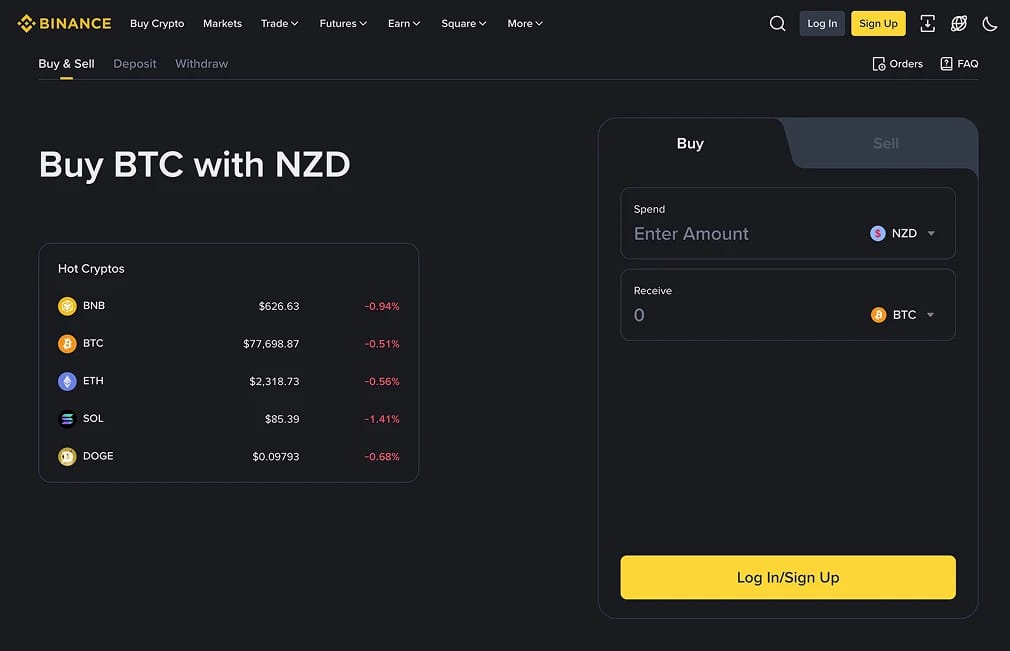
Binance NZ is the world’s largest crypto exchange with over 300 million users and the one we point Kiwis to first in 2026. It operates through Investbybit Limited, a New Zealand-incorporated company (company number 7101293), registered on the FSPR under FSP1003864 since 2022.
What you get is a platform that is unmistakably Binance, with the asset depth, charting tools, and liquidity that come with that, but presented through a New Zealand-localized entity. NZD pairs are supported, POLi is the fastest funding option, and bank transfers also work for larger amounts.
Spot fees are a flat 0.10% with further reductions for VIP tiers and BNB holders, making it very affordable. There are over 350 digital assets to trade. The constraint Kiwi users need to be aware of is that the NZ entity does not offer futures, options, margin trading, or any leveraged products.
Pros
- Investbybit Limited is a fully NZ-incorporated entity (company number 7101293) registered under FSP1003864.
- 0.10% spot fees with further BNB and VIP tier discounts make Binance NZ one of the cheapest places to execute on a per-trade basis in this country.
- POLi and direct NZD bank transfer support across all the major NZ banks, plus a P2P marketplace for users who prefer to fund without going through the bank rail.
Cons
- No futures, options, margin, or leveraged products for NZ users, since Investbybit's FSP registration scope is limited to spot. That is a hard ceiling for active traders.
- Binance’s NZ entity is structurally separate; some Kiwi banks have been known to flag transfers to Binance for additional review.
- The interface, while powerful, can be overwhelming for first-time buyers. The default screen presents an institutional-grade trading terminal, not a friendly buy button.
2. Swyftx
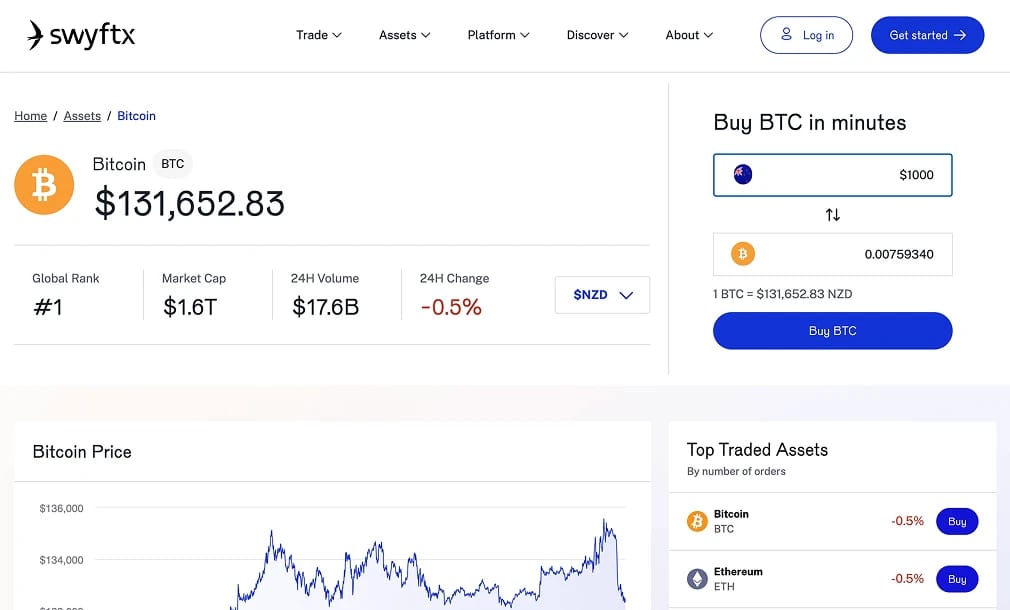
Swyftx is the exchange we recommend for any Kiwi who wants the cleanest, most reliable NZD deposit and withdrawal experience. The platform registered on the FSPR back in July 2021 (FSP1000861) and launched a dedicated New Zealand interface that supports direct NZD deposits.
Practically, the funding experience is what sets Swyftx apart. Bank transfers settle into an NZD-denominated account. POLi is supported for near-instant deposits up to NZ$20,000, and card deposits work via Banxa for those who prefer that route, though you do absorb a card fee.
Where Swyftx holds up is on the all-in cost. Spot trading is 0.6% with high-volume tier discounts. The asset selection runs to 440+ coins, the mobile app is genuinely well built, there is an OTC desk for large orders, and recurring orders make dollar-cost averaging actually painless.
Pros
- FSP1000861 registration with NZD-denominated accounts, free local bank deposits, and clean integration with all major Kiwi banks.
- The Easy Crypto acquisition in March 2025 brought local Auckland-based staff and support into the Swyftx fold, so you are dealing with a team that actually knows the New Zealand banking and tax landscape.
- Mobile app rated 4.6/5 on Product Review and 4.5/5 on Trustpilot, recurring orders for DCA, integrated tax reports that line up with IRD's IR3 disposal-by-disposal expectations, and a solid 24/7 support team.
Cons
- The 0.6% spot fee is much higher than what you would pay on Binance NZ (0.10%) or Bybit (0.10%), so high-frequency traders will find Swyftx more expensive on a pure cost-per-trade basis.
- No derivatives, no margin, and no perpetual futures available to NZ users, which is a genuine limitation for active traders who want leverage.
- The Easy Crypto brand transition is still ongoing in 2026, and some legacy Easy Crypto customers have reported a slightly clunky migration experience moving across to the Swyftx platform.
3. Bybit
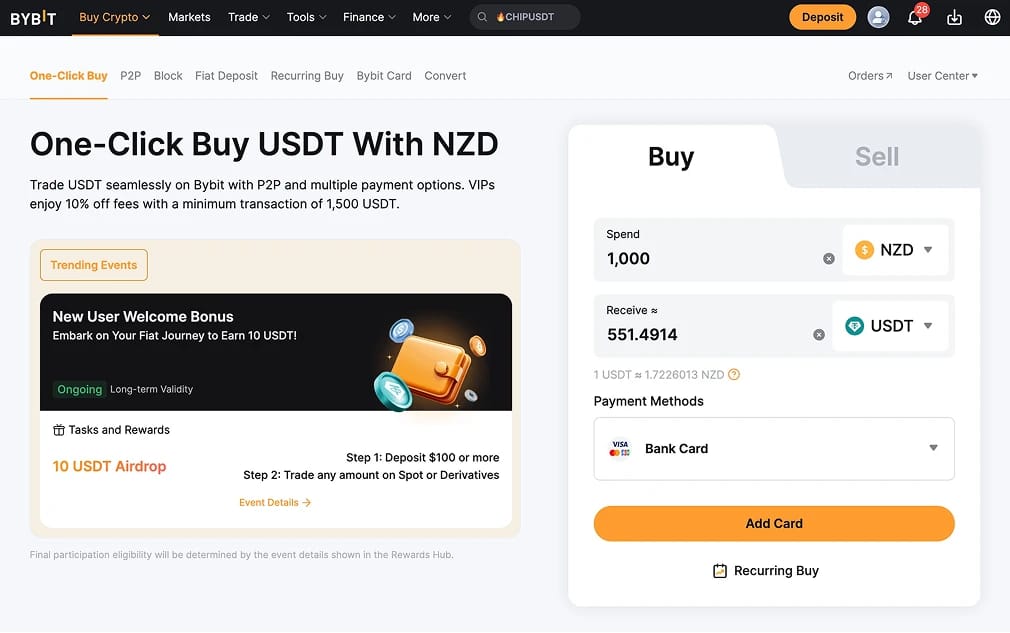
Bybit is on this list for Kiwi users who want a wide range of products. The platform lists over 2,600 cryptocurrencies, regularly publishes Proof of Reserves audited by Hacken, and has built out a feature set that spans spot, Earn, copy trading, trading bots, the Bybit Card, and a Web3 wallet.
For active traders, the cost story is genuinely competitive. Spot fees run at a flat 0.10% maker and taker, with VIP tier discounts available for higher-volume accounts. The order book on majors like BTC and ETH is deep enough to absorb size without meaningful slippage.
The catch for New Zealand specifically is twofold. First, Bybit does not support direct NZD bank deposits. Funding routes are limited to card purchases and the P2P marketplace, where you transact directly with another user via bank transfer or other agreed methods.
Pros
- By far the largest asset selection on this list at 2,600+ cryptocurrencies, including newly launched tokens that take weeks to appear on Swyftx, Independent Reserve, or Kraken.
- 0.10% flat spot fees for both makers and takers, deep liquidity on majors, and a comprehensive product stack covering spot, Earn, copy trading, trading bots, and the Bybit Card.
- Regularly published Proof of Reserves audited by Hacken, plus a Web3 wallet for users who want direct DeFi access without leaving the Bybit ecosystem.
Cons
- No direct NZD bank deposit rail, so Kiwi users are stuck with card purchases (3% to 4% all-in cost) or P2P, both of which are clunkier than what Binance NZ or Swyftx offer.
- No FSPR registration and no NZ-incorporated entity, which means no domestic dispute resolution scheme and no AML/CFT supervision specific to your account in this country.
- Some products have been progressively rolled back for NZ users since June 2024 in response to regulatory pressure, so feature parity with what is offered to traders in other jurisdictions is no longer guaranteed.
4. Independent Reserve
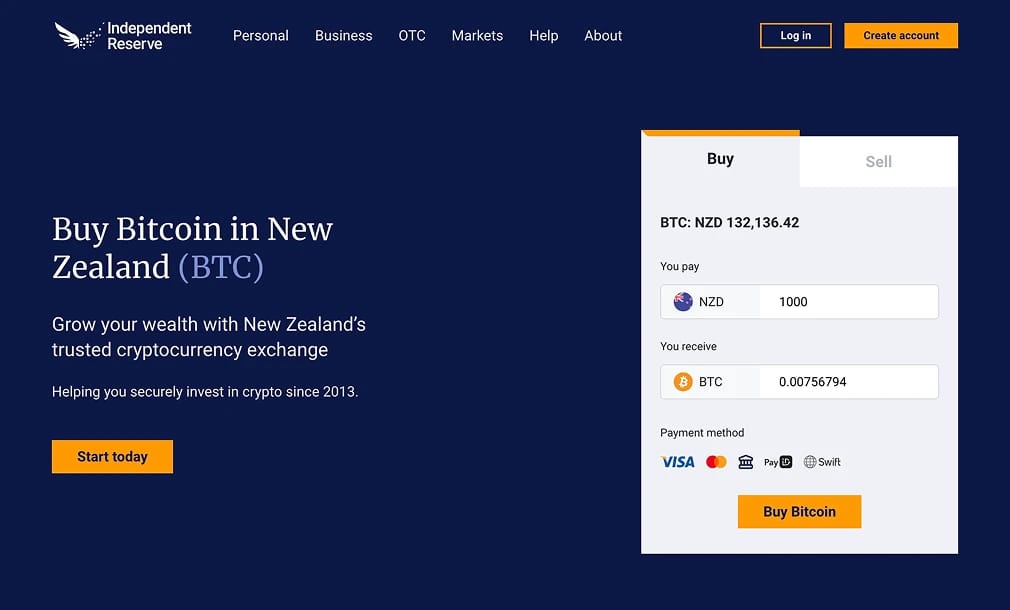
Independent Reserve is the strongest choice for institutional users, family offices, and serious retail traders who want proper compliance-grade infrastructure. For Kiwi users, the practical headline is that NZD is one of the four primary base currencies on the platform.
The order book is multi-currency and converts orders into the currency of your choice, so you can place a BTC/NZD limit order against the global book. Spot fees start at 0.5% and tier down to 0.02% based on 30-day trading volume, which makes it competitive once you are trading size.
The catch for New Zealand specifically is the funding mechanic. NZD deposits go in via SWIFT rather than a domestic bank transfer, and SWIFT in this country adds friction. Deposits of NZ$5,000 or more are free, but anything below that incurs a NZ$15 processing fee.
Pros
- AUSTRAC DCE registration in Australia, and IG Group corporate ownership as of February 2026, providing the strongest combined compliance posture available to NZ users.
- NZD-denominated accounts with a multi-currency order book, OTC desk above NZ$50,000, AutoTrader strategy templates, and dedicated relationship managers for corporate clients.
- ISO 27001 certified with regular audits, segregated client funds, and a track record running back to 2013 with no material security incidents.
Cons
- SWIFT-only NZD deposits with a NZ$15 fee on amounts under NZ$5,000 and a flat NZ$20 NZD withdrawal fee make this an awkward fit for casual or small-volume retail use.
- The asset list of around 30 coins is curated rather than expansive, so anything outside the major caps will not be available here.
- Independent Reserve liquidity on NZD pairs is meaningfully thinner than the AUD or USD books, so larger orders on BTC/NZD or ETH/NZD can move the price more than you would expect from screen depth.
5. Kraken
Kraken is the platform we recommend for advanced Kiwi traders who want a serious order book, deep liquidity on majors, and tools like staking and margin. It has one of the longest unbroken track records in the industry, with regular Proof of Reserves audits going back years.
The product depth is the genuine selling point. Kraken Pro provides a full order book with limit, stop, take-profit, and conditional orders. Margin is available up to 5x, staking pays out twice weekly on most assets, and there is an OTC desk and dedicated institutional services team.
The reason it sits at fifth and not higher for New Zealand specifically is the funding methods. Kraken does not support direct NZD deposits. You can fund via SWIFT in USD or AUD, or via SEPA-equivalent rails in EUR, but every NZD that enters Kraken does so via FX conversion.
Pros
- Kraken Pro offers the deepest order book on this list at this asset count, with margin up to 5x, staking, futures (subject to eligibility), and a full institutional services team for high-volume Kiwi accounts.
- Proof of Reserves has been audited and published since well before it became standard practice, and Kraken's security track record back to 2011 has held up better than almost any other major exchange.
- The spot interface and Kraken Pro charts are excellent for serious traders, and Kraken's stablecoin rails are tight and reliable for getting in and out of positions.
Cons
- No direct NZD deposit rail, so Kiwi users are funding via SWIFT in USD or AUD, which adds 50 to 100 basis points of FX cost and 1 to 5 business days of settlement time.
- No FSPR registration in New Zealand under Kraken's own name, which means no domestic dispute resolution scheme and no DIA AML/CFT supervision specific to your account.
- The Instant Buy interface starts at 1% per trade, which is steep, so you have to be willing to use Kraken Pro to get the proper fee schedule.
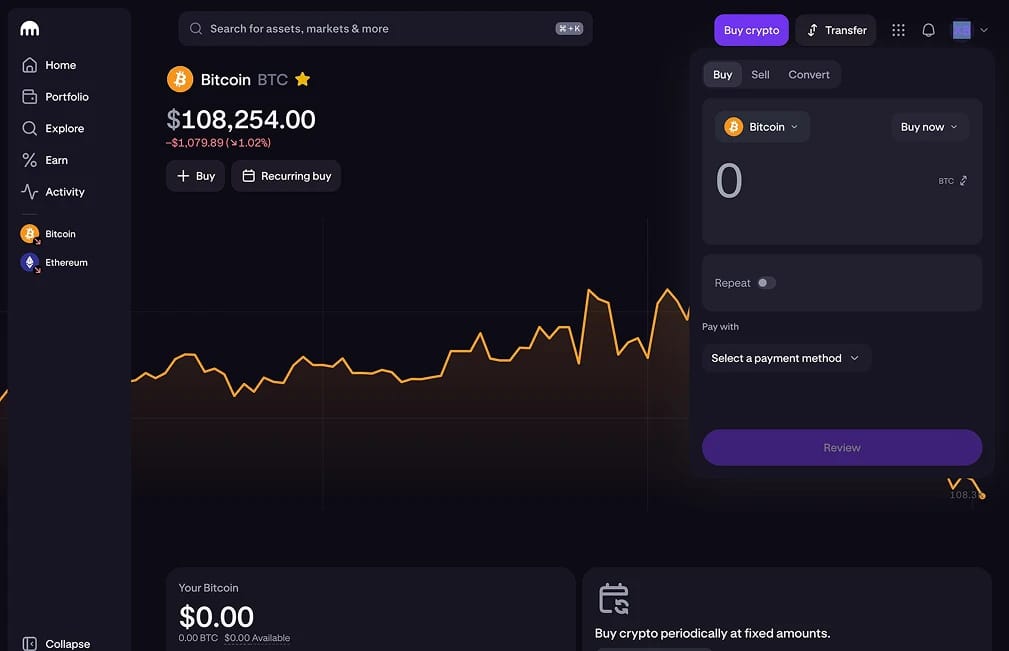
6. Bitget
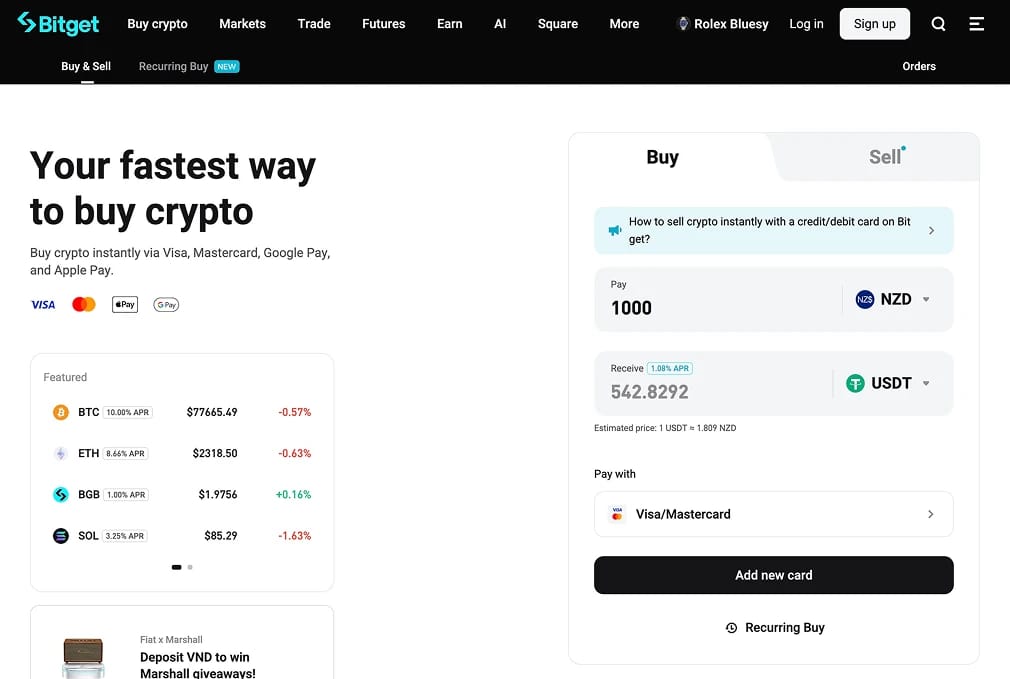
Bitget earns its place on this list for Kiwis interested in copy trading, along with access to the long tail of crypto: newly launched tokens, niche altcoins, and the kinds of assets that take six to twelve months to appear on Kraken or Independent Reserve. Bitget lists 1,300+ cryptocurrencies.
Copy trading is the standout feature, and it is genuinely well executed. The Bitget leaderboards show transparent risk scores, profit and loss histories, win rates, and asset allocations for the traders you can mirror, with one of the largest pools of elite traders to copy among the major exchanges.
Spot fees run at a flat 0.10%, with further discounts of up to 80% if you hold and use BGB (the native exchange token). Futures fees are 0.02% maker and 0.06% taker. The product stack also covers automated bots, leveraged tokens, crypto loans, and Simple Earn.
The downside for NZ users is the funding rail. Bitget does not support direct NZD deposits. Card purchases via Visa or Mastercard are supported up to NZ$16,100 through third-party providers, and there is a P2P marketplace for those who want to fund via direct bank transfer to another user.
Pros
- Copy trading is one of the most mature implementations on this list, with transparent leaderboards, risk scores, and a deep pool of elite traders to mirror, making it the easiest way for NZ users to access active strategies without running them themselves.
- 1,300+ cryptocurrencies, 0.10% spot fees with BGB-holder discounts down to as low as 0.02%, and a $300M+ on-chain Protection Fund providing a self-insurance layer that most NZ-accessible exchanges do not match.
- Comprehensive product stack including spot, perpetual futures, automated bots, leveraged tokens, crypto loans, and Simple Earn, all from a single account.
Cons
- No FSPR registration and no NZ-incorporated entity, which means no domestic dispute resolution scheme and no AML/CFT supervision specific to your account in this country.
- No direct NZD bank transfer rail, with funding routes limited to card (3% to 4% all-in cost) or P2P, both of which are clunkier than what Binance NZ or Swyftx offer.
- Copy trading performance depends entirely on the traders you follow, and past performance is not a reliable guide to future returns. The breadth of the asset catalog also means many extremely low-liquidity tokens with elevated pump-and-dump risk.
Crypto and Bitcoin Regulation in New Zealand
New Zealand does not have a crypto licensing regime. There is no validator regime and no specific crypto law on the books. Instead, the regulatory framework rests on a combination of existing financial services legislation, AML/CFT supervision, and a tax compliance layer.
The first pillar is the Financial Service Providers (Registration and Dispute Resolution) Act 2008. Any business providing financial services in or from New Zealand has to register on the FSPR, which is administered by the Companies Office under the Ministry of Business, Innovation and Employment.
Crypto exchanges fit this definition because they provide services such as money custody and currency exchange. Registration gives users access to dispute resolution via an independent scheme, but it is not a license and does not entail active regulatory oversight.
The second pillar is the Anti-Money Laundering and Countering Financing of Terrorism Act 2009. Crypto exchanges in New Zealand are supervised by the Department of Internal Affairs under the AML/CFT Act, which requires them to run KYC, monitor transactions, and maintain records.
The third pillar is the Financial Markets Authority, which supervises crypto only at the edges. The FMA's main crypto-relevant power is over derivatives issuers, which is why any platform offering crypto CFDs to NZ retail users requires a derivatives issuer license.
How Does the IRD Tax Crypto?
The Inland Revenue Department (IRD) treats crypto as property rather than as currency. There is no separate crypto-specific tax regime, no broad capital gains tax in New Zealand, and no equivalent of an annual exemption threshold.
Here are the main taxes that apply to crypto for individuals in New Zealand:
- Income tax: Profits from selling, swapping, or spending crypto are ordinary income, taxed at your marginal rate. The 2025/26 brackets run 10.5% on the first $14,000, 17.5% to $48,000, 30% to $78,100, 33% to $180,000, and 39% above that.
- Crypto-to-crypto swaps: Swapping BTC for ETH is a disposal of the BTC at its fair market value in NZD, which means the gain or loss is realized at that moment, even if you have not converted back to NZD. This is the rule that catches the most Kiwi traders out.
- No capital gains tax: New Zealand does not have a CGT in the traditional sense. The IRD states that crypto is generally acquired with the dominant purpose of disposal, which makes the gain taxable income rather than a capital gain.
- Losses are deductible: Crypto disposal losses can offset gains in the same income year, and any net loss can typically be carried forward to reduce future crypto profits, subject to the rules around revenue-account treatment.
- Staking, mining, and airdrops: Treated as ordinary income at the NZD value on the date received. Mining and staking are then potentially taxed twice, once on receipt and again on disposal of the rewards, with the cost basis equal to the receipt-date NZD value.
- Records must be kept for seven years: Date, amount, NZD value, wallet address, and any fees for every transaction. The IRD can request these directly, and from 1 April 2026, will also receive transaction data from FSPR-registered exchanges automatically.
The big change for 2026 is the Crypto-Asset Reporting Framework (CARF), which came into NZ law in March 2025 and takes effect from 1 April 2026.
Under CARF, NZ-based Reporting Crypto-Asset Service Providers must collect customer KYC data and report all transaction details to the IRD annually, with first reports due by 30 June 2027 covering the period from 1 April 2026 to 31 March 2027.
The IRD has already begun acting on the data it has. In April 2026, it sent a first batch of letters to taxpayers it had identified through exchange data as having received crypto disposal income that was not on their tax returns, asking them to file an IR3 and correct the position.
Cryptocurrency Adoption in New Zealand
Crypto adoption in New Zealand is in a different shape from many of its peers. Ownership has moved into the mainstream in the past five years, but the local exchange landscape has consolidated, and the regulatory environment has tightened in the last 18 months.
According to research conducted by Easy Crypto with Protocol Theory and reported alongside its 2025 acquisition by Swyftx, almost 50% of New Zealanders either own crypto, have owned crypto, or are considering investing.
Statista Market Insights projects 1.96 million NZ users by 2025, representing a user penetration rate of around 37%. The IRD has reported that 188,000 New Zealanders traded approximately NZ$7.2 billion in cryptocurrency through local exchanges between June 2024 and June 2025 alone.
Looking at the regional picture, New Zealand sits roughly mid-table in the Asia-Pacific region for adoption. The 2025 Chainalysis Crypto Adoption Index ranks New Zealand below Australia, Singapore, and several Southeast Asian markets on grassroots adoption metrics.
Given the wide variation between the Easy Crypto / Protocol Theory 50% interest figure, Statista's 1.96 million user estimate, and the IRD's 188,000 active trader figure, these numbers should be treated as directional rather than precise.
.webp)
How to Buy Bitcoin in New Zealand
For most NZ users in 2026, the best setup is an FSPR-registered platform with NZD accounts, free or near-free local bank transfer funding, and a withdrawal path back to your Kiwi bank account that actually works.
This is the process we use in New Zealand:
- Choose an FSPR-registered exchange: We start with platforms registered on the FSPR with NZD support and a member relationship with an independent dispute resolution scheme. Trusted options include Binance NZ, Swyftx, and Independent Reserve.
- Complete KYC verification: We finish identity verification before sending any funds. NZ platforms typically need a passport or driver licence, a selfie or liveness scan, and a recent proof-of-address document.
- Fund the account: For most Kiwis, a direct NZD bank transfer or POLi payment from your ANZ, ASB, BNZ, Westpac, or Kiwibank account is the right choice. Free on most platforms, settles in 1 to 2 business days (or near-instant on POLi), and works cleanly with all major NZ banks.
- Buy Bitcoin on the spot market: If price matters, skip the Instant Buy screen and use the BTC/NZD or BTC/USD spot pair directly. A limit order just below the current ask usually gives you a cleaner execution than the one-click quote.
- Move to self-custody for long-term holdings: If you are buying Bitcoin to hold for more than a few months, we transfer it off the exchange to a hardware wallet like a Ledger or Trezor.
That process gives NZ users the cleanest path from a Kiwi dollar balance to Bitcoin in self-custody, while keeping exposure to platform risk and bank-side friction as low as practical in the current environment.
Final Thoughts
For most people in New Zealand right now, the right approach is straightforward: pick an FSPR-registered exchange that handles NZD natively, fund via direct bank transfer or POLi rather than card, and test the exit path with a small withdrawal early.
Binance NZ is our top overall pick because it combines the lowest spot fees on this list (0.10%) with FSP1003864 registration, POLi support, and direct bank transfer integration with major Kiwi banks. The flat 0.1% fee makes it hard to beat for most NZ users who are focused on spot trading.
Whichever you pick, complete KYC before funding, start with a small test deposit and withdrawal to confirm everything works, and stay on top of your IRD obligations as CARF data feeds come online from 1 April 2026.
Our Methodology
We evaluated over 12 crypto exchanges available to New Zealand users by creating accounts, funding in NZD, executing spot trades, and withdrawing to NZ bank accounts. Each platform was scored across six criteria:
- Trust Score: Our proprietary rating (out of 5) weights FSPR registration, AML/CFT supervision via the DIA, security history, proof-of-reserves transparency, platform longevity, and audit coverage. Exchanges with NZ-incorporated entities and dispute resolution scheme membership scored highest.
- NZD Funding Methods: Confirmed direct bank transfer, POLi, card, and alternative payment rails from major NZ banks. We tested settlement speed, bank friction, deposit limits, and the all-in cost from a Kiwi dollar balance into a tradeable position on the platform.
- NZ Regulatory Standing: Verified each platform's FSPR registration via the FSP Register, confirmed dispute resolution scheme membership, checked AML/CFT supervision posture, and assessed CARF reporting readiness ahead of the 1 April 2026 effective date.
- Security Track Record: Reviewed breach history, custody setup, proof-of-reserves cadence, segregation of client assets, and account-level protections, including 2FA, withdrawal whitelists, and anti-phishing codes. The 2019 Cryptopia incident remains the local benchmark for what happens when these controls fail.
- Assets and Liquidity: Tested execution by placing market and limit orders on BTC/NZD, ETH/NZD, and at least one mid-cap pair to measure spread, depth, and fill quality. Where direct NZD pairs were not available, we tested the equivalent USD or AUD execution and added the FX cost on top.
- Fee Structure: Compared maker and taker fees, NZD deposit and withdrawal charges, spread on order books, and the all-in cost of a full Kiwi-dollar-to-crypto-to-Kiwi-dollar round trip rather than relying on headline fee tables.
We excluded platforms that have suspended services for NZ users, platforms with active enforcement issues from major regulators, and providers with no clear AML/CFT posture relevant to New Zealand. Testing ran from February to April 2026.
%20(1).webp)