






Compare Top Turkish Crypto Exchanges
1. Bybit
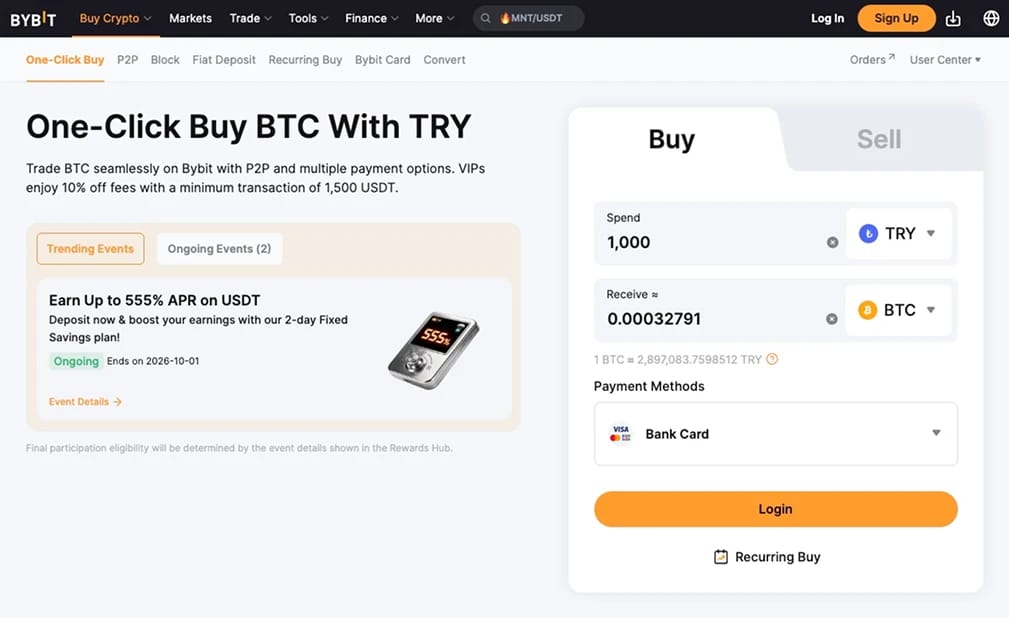
Bybit sits at the top of our Turkey list because it solved the problem most global exchanges ignored: legal standing. Its local arm, Bybit Türkiye, operates through the Turkish entity Narkasa and appears on the CMB's CASP operating list, so lira deposits arrive by bank transfer rather than P2P marketplaces. Our FAST transfer from Ziraat landed in under a minute.
The platform itself needs little introduction. There are 2,800+ assets across spot, perpetuals, and options, copy trading with audited leaderboards, grid bots, and Bybit Earn for yield on idle balances. Spot fees remain flat at 0.1%, and the order books on BTC and ETH pairs are deep enough that our market orders are filled without visible slippage.
One adjustment Turkish users should expect is the MASAK clock. Our first crypto withdrawal sat in the 72-hour new-account hold, and later ones cleared after 48 hours where Travel Rule data was incomplete. The delay comes from the rules rather than from Bybit, and every compliant venue here applies the same one. Our Bybit review covers the full offerings the exchange provides.
Pros
- Bybit Türkiye is on the CMB operating list, with direct TRY deposits over FAST and havale.
- 2,800+ assets, derivatives, copy trading, and Earn products in one account.
- Flat 0.1% spot fees with deep liquidity on major pairs.
Cons
- The user interface can be overwhelming for beginners.
- Leverage products can punish newcomers who skip risk controls.
- Withdrawal holds of 48 to 72 hours apply when Travel Rule data is missing.
2. Binance
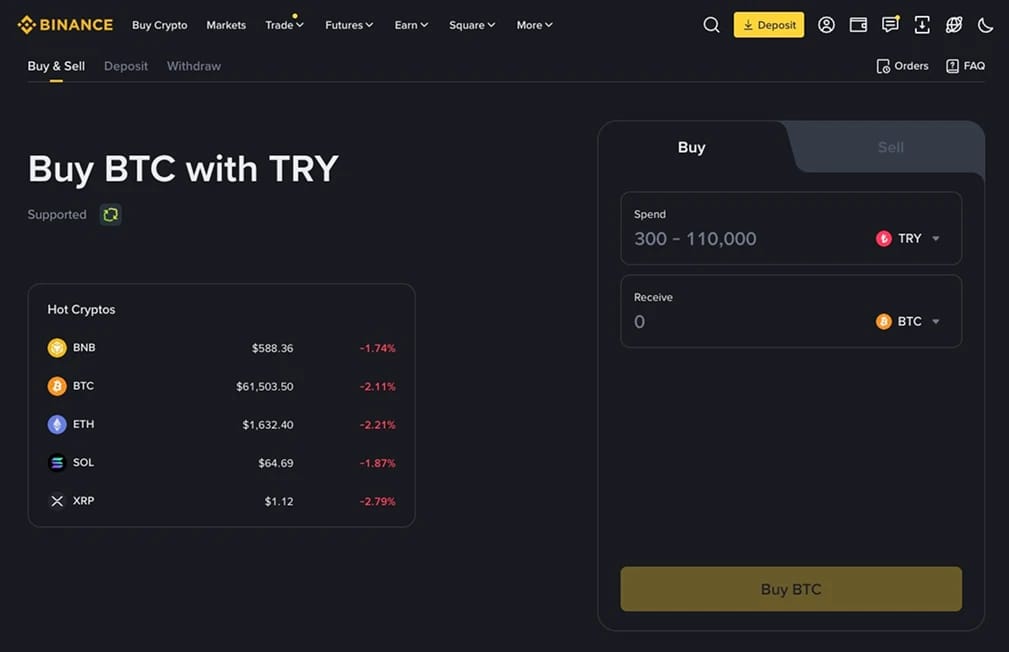
Binance holds second place on the strength of Binance TR, the localized platform it runs through a Turkish entity on the CMB operating list. For sheer lira liquidity, nothing matches it. The BTC/TRY and USDT/TRY books absorb large orders cleanly, and we moved six-figure lira amounts in and out without the spread widening. It’s the world’s largest exchange, serving 320 million+ users.
The TR platform carries a tighter list than global Binance, around 400 assets, but the essentials are all present: spot trading at 0.1% with BNB discounts, recurring buys, crypto loans, Simple Earn for yield, and copy trading for anyone who prefers mirroring proven accounts to picking entries alone. The app switches fully into Turkish, including support.
Deposits run over bank transfer and FAST from all the major banks, and we had no friction funding from İş Bankası or Ziraat. The trade-off against Bybit is range: fewer listings and no deep derivatives suite on the TR platform. Our Binance review breaks down where the global and local products differ.
Pros
- Binance TR runs on the CMB operating list with the deepest TRY order books in the market.
- 0.1% spot fees, BNB discounts, recurring buys, and Simple Earn.
- Full Turkish-language app and support, with FAST deposits from every major bank.
Cons
- The TR platform lists far fewer assets than global Binance.
- Derivatives access is limited compared with Bybit or OKX.
- Past regulatory penalties abroad still color the brand's compliance record.
3. OKX
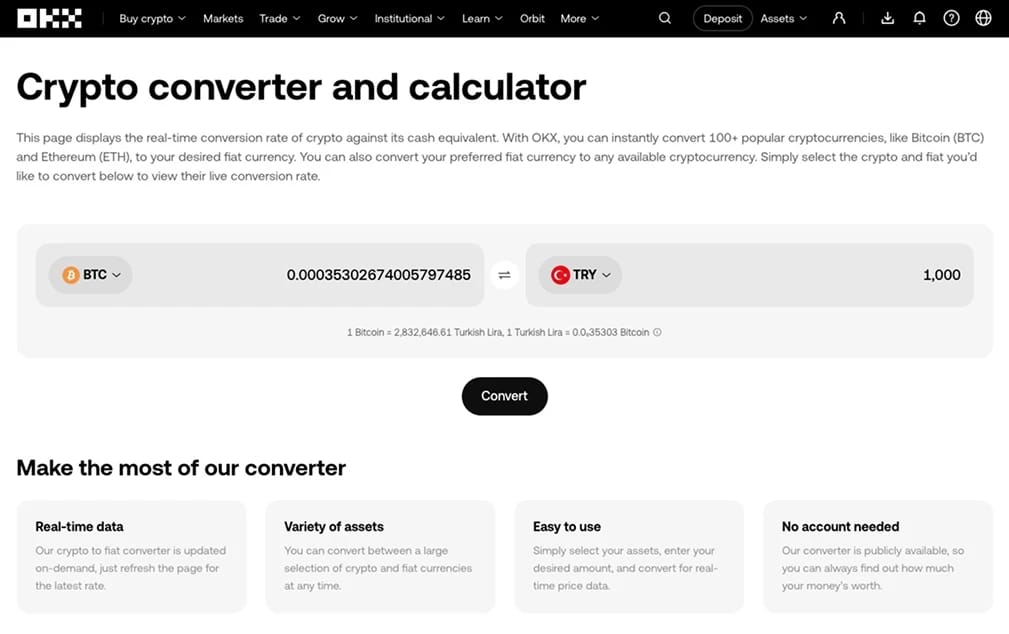
OKX committed to Turkey earlier than most, launching OKX TR as a dedicated local platform in 2024 and securing a place on the CMB operating list. That early move shows in the product: the interface, listings, and funding rails were built for Turkish users rather than translated after the fact. The user interface is accessible in Turkish, and local customer support is offered.
Traders get 300+ assets, spot fees from 0.08% maker and 0.10% taker, and TradingView-grade charting that serious users will recognize immediately. The standout is the self-custody OKX Wallet, which connects to DeFi and on-chain apps, useful in a market where many of us prefer holding assets in our own keys after the BtcTurk incidents.
TRY arrives by bank transfer or card, with a P2P desk as backup. The honest caveat is that OKX TR is leaner than the global exchange, so anyone chasing every new listing will notice gaps. For a regulated account with proper charting and a credible on-chain bridge, it earns its place. We go deeper into the features in our OKX review.
Pros
- OKX TR is a purpose-built local platform on the CMB operating list.
- Competitive 0.08% maker fees and professional TradingView charting.
- The self-custody OKX Wallet links the exchange to DeFi and on-chain apps.
Cons
- The TR platform offers a narrower menu than global OKX.
- The pro-grade interface takes time for first-time buyers.
- Some yield and Web3 features sit outside the local entity's scope.
4. Gate
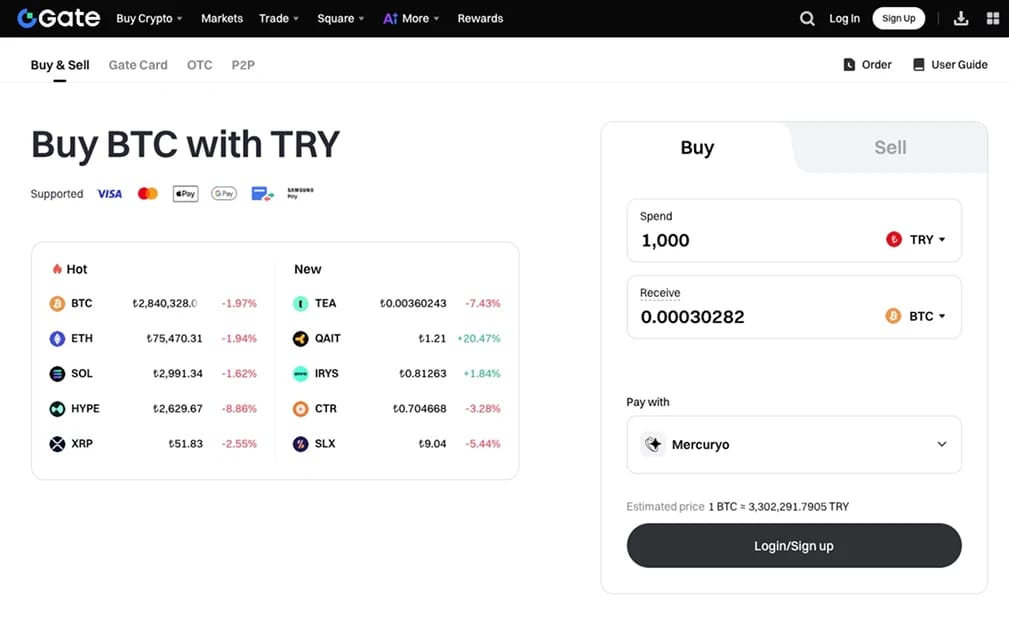
Gate is listed here because it offers the most diverse selection of cryptocurrencies globally. With 4,800+ listed digital assets, it carries small caps, new launches, and early-stage tokens that never make it onto a Turkish platform's curated list. When we wanted exposure beyond the top 100 assets like Bitcoin, Ethereum, and Solana, we opened this account.
The product set runs wide, covering spot, futures, copy trading, Earn products, and the Startup launchpad for new token sales, all backed by published Proof-of-Reserves showing assets over 100% covered. Spot fees start at 0.1%, with GT token discounts cutting them further for active accounts. GT is the native token of Gate, which powers the ecosystem.
The compliance picture is the part to weigh. Gate serves Turkish users from its global platform rather than through a CMB-listed local entity, so there is no TRY wallet; funding means a card purchase or buying USDT and transferring it in. Treat it as a satellite account for altcoin depth next to a licensed primary venue. Our Gate review covers the platform in full.
Pros
- One of the largest asset menus anywhere, at 4,800+ listings.
- Proof-of-Reserves transparency and 0.1% spot fees with GT discounts.
- Futures, copy trading, and launchpad access in a single account.
Cons
- No CMB-listed Turkish entity, so it sits outside the local regulatory perimeter.
- No TRY wallet; funding requires cards or a USDT transfer.
- Access conditions could tighten as Turkey finalizes CASP licensing.
5. BtcTurk
BtcTurk opened in 2013 as Turkey's first Bitcoin exchange, and for many locals, it remains the default. Everything is TRY-native, from deposits made by FAST, havale, or EFT, pairs quote directly in lira, and the support team answers in Turkish. The Pro platform adds serious charting, and zero-fee Bitcoin withdrawals over Lightning are a perk no rival here matches.
Security is where the record is mixed. Hot wallets lost roughly $54 million in June 2024 and around $48 million again in August 2025. In both cases, the company kept lira operations running, stated that cold storage and customer balances were unaffected, and absorbed the losses, but two breaches in fourteen months look like a pattern rather than bad luck.
Fees start from 0.12% on the standard platform, with lower tiers on Pro for volume. Our practical read: BtcTurk is excellent as a lira gateway and for TRY pairs, and larger long-term holdings belong in self-custody. Our guide to the best crypto wallets covers the options.
Pros
- Turkey's longest-running exchange, fully TRY-native with FAST and EFT rails.
- Zero-fee Bitcoin withdrawals over the Lightning Network.
- Kept operating and covered customer balances through both security incidents.
Cons
- Two hot wallet breaches in 2024 and 2025 raise fair custody questions.
- Around 100 coins, far fewer than the global venues on this list.
- Fees on the standard platform run above the 0.1% global benchmark.
.webp)
6. BloFin
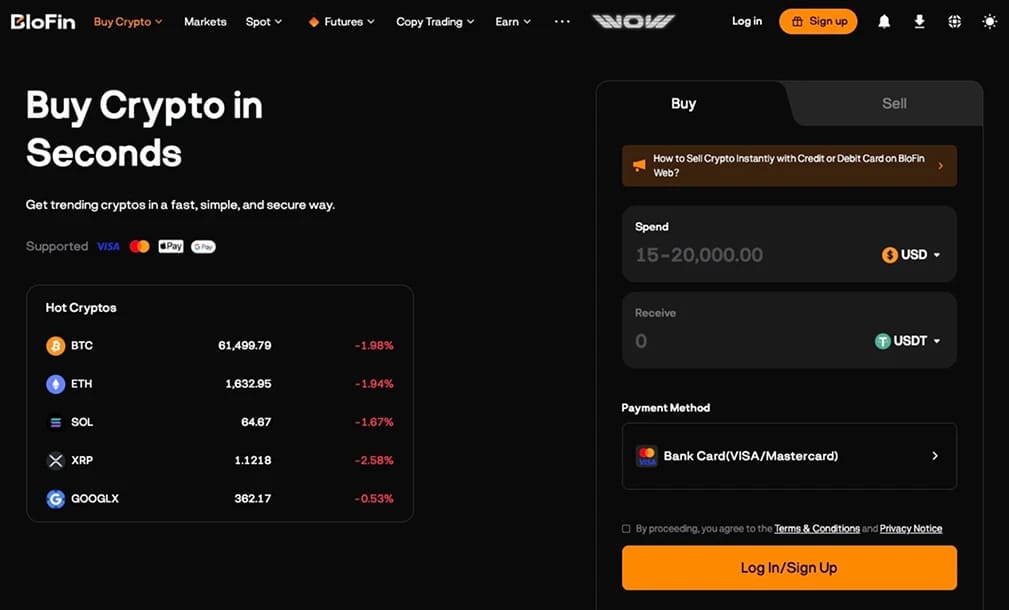
BloFin closes the list as the one venue here where you can trade without handing over an ID. Basic accounts open with an email address alone, and that privacy angle has won it a loyal Turkish following at a time when every licensed platform logs identity on transactions above 15,000 TRY and holds withdrawals for the MASAK clock.
The platform leans hard into derivatives. Perpetual futures cover 600+ assets with deep BTC and ETH books, copy trading runs on leaderboards showing 30-day ROI, drawdown, and assets under management for each lead trader, and the bot suite spans futures grid, DCA, signal bots, and TWAP execution. Earn products add fixed and flexible yield, and the exchange publishes Proof-of-Reserves updates.
Be clear-eyed about what you give up. There is no Turkish entity, no place on the CMB operating list, and no lira wallet, so funding means a card purchase or a crypto transfer in, typically USDT. Access could also tighten if the regulator widens its blocking campaign. We treat it as a derivatives side account for experienced traders, never a primary venue for savings.
Pros
- No mandatory KYC for basic accounts, a privacy option no licensed rival offers.
- Strong derivatives stack with copy trading, grid and signal bots, and TWAP tools.
- Proof-of-Reserves publication and deep liquidity on major perpetual pairs.
Cons
- No CMB-listed Turkish entity, so it operates outside the local regulatory perimeter and could face access blocks.
- No TRY wallet; funding is limited to cards or crypto transfers.
- Derivatives-first design with leverage that can wipe out inexperienced accounts.
How to Choose a Crypto Exchange in Turkey
The licensing shakeout did most of the filtering for you, but four checks still matter before your first deposit:
- Check the CMB operating list: Platforms operating legally in Turkey appear on the CMB's published list while full licenses are finalized. Bybit Türkiye, Binance TR, OKX TR, and BtcTurk are all on it; unauthorized sites have been blocked outright since July 2025. Anything off-list, BloFin included, carries access risk you should accept knowingly.
- Fund from your own bank account: Every compliant platform takes TRY by FAST, havale, or EFT from an account in your name, whether you bank with Ziraat, İş Bankası, Garanti BBVA, Akbank, or VakıfBank. Third-party deposits get rejected, and Papara is no longer an option after its license was revoked.
- Plan around the withdrawal holds: Expect 48 hours on crypto withdrawals where Travel Rule data is incomplete, 72 hours on a new account, and stablecoin transfer caps of $3,000 daily and $50,000 monthly on platforms without full Travel Rule compliance. Time your transfers rather than fighting the rules.
- Match the venue to the job: A pure lira on-ramp points to BtcTurk, depth and derivatives to Bybit, the thickest TRY books to Binance TR, on-chain access to OKX, long-tail altcoins to Gate, and private no-KYC derivatives to BloFin. Most experienced users here run a local account and a global one side by side.
Crypto & Bitcoin Regulation in Turkey
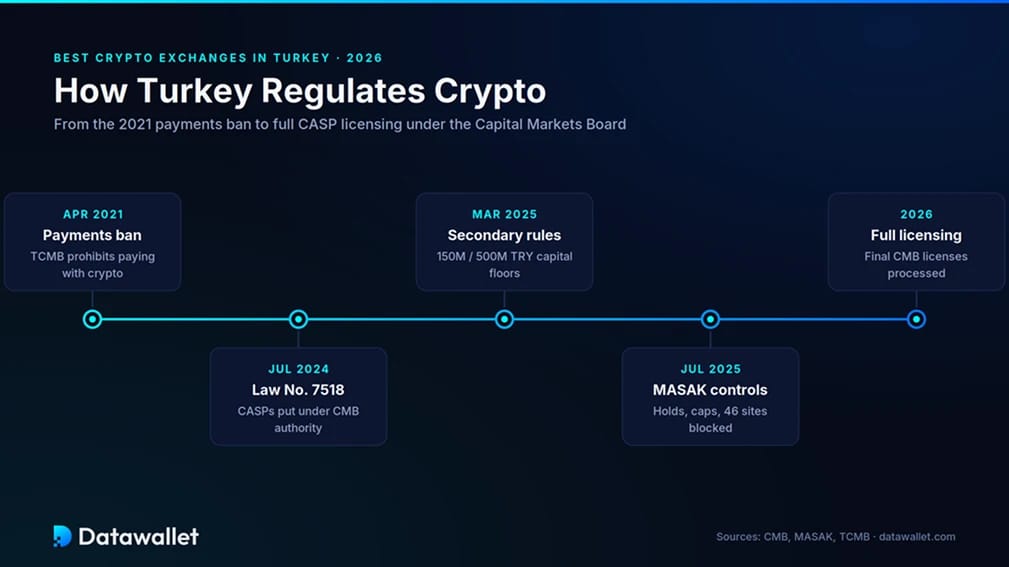
Turkey legalized the industry and tightened it in the same stroke. Owning and trading crypto is legal, paying with it is banned, and platforms carry heavy compliance duties. Three layers define the framework:
- CMB licensing under Law No. 7518: In force since 2 July 2024, the law amended the Capital Markets Law to put every crypto asset service provider under CMB authority. Secondary rules from March 2025 set capital floors of 150 million TRY for exchanges and 500 million TRY for custodians.
- MASAK's transaction controls: Rules effective from mid-2025 under MASAK require identity details on transactions above 15,000 TRY, a transfer description of at least 20 characters, 48-to-72-hour withdrawal holds where Travel Rule data is absent, and the stablecoin caps above, with exemptions for documented market-making and arbitrage.
- The payments ban: The Central Bank of the Republic of Türkiye has prohibited using crypto assets directly or indirectly in payments since April 2021. You can hold, trade, and transfer within the rules, but settling a bill in Bitcoin remains off the table.
For a Turkish user, the conclusion is to trade on an operating-list platform, fund it from your own bank, write proper transfer descriptions, and build the holds into your timing.
How Is Crypto Taxed in Turkey?
Turkey still has no dedicated crypto tax in place for individual investors, making it an outlier among major markets, though that window is visibly closing. Three things define the current position:
- No specific levy on personal gains today: Profits from buying and selling crypto as a private individual are not subject to a dedicated capital gains tax. Income from commercial-scale trading, mining, or being paid in crypto falls under ordinary income tax with the Revenue Administration, at progressive rates of roughly 15% to 40%.
- The 2026 bill that almost landed: In March 2026, the ruling AK Party proposed a 10% withholding tax on gains, deducted quarterly by licensed platforms, plus a 0.03% transaction levy on service providers, with the president able to set the rate anywhere from 0% to 20%.
- Pulled, not abandoned: Parliament removed the crypto articles from the omnibus package in late March 2026 after industry and opposition pushback. A standalone draft is widely expected to return, and licensed platforms are already preparing the reporting plumbing.
Keep dated records of every buy, sell, and transfer now, in lira values, so a future withholding regime cannot surprise you. None of this constitutes tax advice; confirm your position with a qualified Turkish tax adviser.
Cryptocurrency Adoption in Turkey
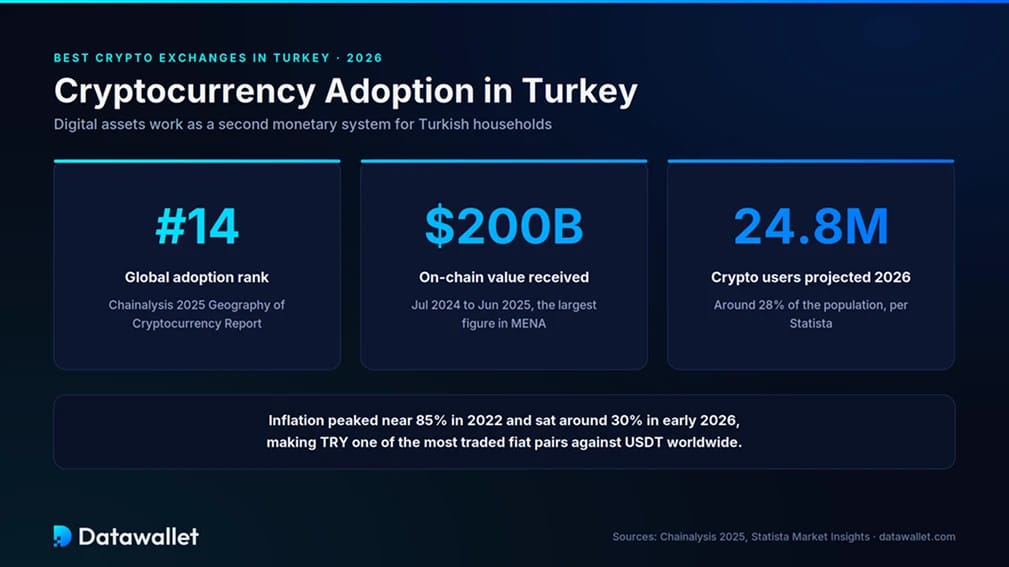
Few countries use crypto the way Turkey does, where digital assets work less as a bet and more as a second monetary system. Three numbers show it:
- A top-15 global market: The Chainalysis 2025 Geography of Cryptocurrency Report ranks Turkey 14th worldwide on its adoption index, with roughly $200 billion in on-chain value received between July 2024 and June 2025, the largest figure in the MENA region.
- Stablecoins as the household hedge: Lira depreciation, with inflation peaking near 85% in 2022 and still around 30% in early 2026, pushed savers into USDT, making TRY one of the most traded fiat pairs globally. Our stablecoin statistics page tracks the trend.
- Mass-market ownership: Statista Market Insights projects around 24.8 million Turkish crypto users in 2026, roughly 28% of the population, among the highest penetration rates anywhere.
For cross-market comparisons, see our crypto adoption statistics.
How to Buy Bitcoin in Turkey
Buying BTC here means moving lira onto an operating-list platform and converting it. The process takes five steps:
- Pick a compliant platform. Bybit for the deepest all-round product, Binance TR for lira liquidity, BtcTurk for a fully local experience. Confirm the platform appears on the CMB operating list before registering.
- Verify your identity. You will need your TC Kimlik number and a chip ID card or passport, plus a liveness check. Most platforms cleared our verification within minutes; remember that any transaction above 15,000 TRY requires verified identity by law.
- Deposit Turkish lira. Send TRY by FAST for instant settlement around the clock, or havale/EFT during banking hours, always from an account in your own name. Include the deposit code the platform gives you in the transfer description.
- Buy Bitcoin (BTC). Open the BTC/TRY pair and use a limit order on the order book rather than the one-tap quick buy, which carries a spread on every platform here.
- Secure your Bitcoin. Shift anything you are not actively trading into self-custody on a hardware device like Ledger or Trezor. The BtcTurk breaches are the local argument for holding your own keys; our best crypto wallets guide compares the options.
Plan your first withdrawal in advance, since the 72-hour new-account hold applies once regardless of which platform you choose.
Final Thoughts
Pick what you need most. Bybit is our overall choice in Turkey, combining a CMB-listed local entity with the depth of a global top-three exchange.
Binance TR wins on lira liquidity, OKX TR on tools and on-chain access, and Gate on asset selection. BtcTurk remains the platform to hand a first-timer, while BloFin serves experienced derivatives traders who put privacy first and understand the regulatory risk that comes with it.
The larger change is structural: between the CMB's operating list, MASAK's holds, and the tax bill waiting in parliament, Turkey has traded its open-frontier market for a supervised one, and the platforms that built local entities early are the ones positioned to last.
Our Methodology
We evaluated each platform under identical conditions as a Turkish user: registering with a TC Kimlik, passing KYC, depositing TRY over FAST and havale from Ziraat, İş Bankası, and VakıfBank accounts, trading, and withdrawing both lira and crypto. Six factors fed the scores:
- Trust Score: Our 5-point rating reflects standing on the CMB operating list alongside breach history, custody structure, and years in the market.
- TRY Funding: Whether lira settles cleanly by FAST, havale, and EFT, tested on real transfers from major Turkish banks.
- Fees: Maker and taker rates, the spread baked into quick buys, and what a full deposit-trade-withdraw cycle actually costs us.
- Asset Availability: Coverage from majors and TRY pairs through to long-tail tokens, derivatives, and yield products.
- Security and Custody: Cold storage practice, breach history, Proof-of-Reserves, and account protections such as MFA.
- Local Usability: Turkish-language quality, KYC speed, how the platform communicates with MASAK, and support responsiveness.
Scores favor what a Turkish resident can legally open and fund this year, which is why CMB standing and lira rails carry more weight than raw listing numbers. All hands-on testing took place between February and June 2026.
.webp)