




Best Crypto Options Exchanges Compared
We opened funded accounts on each venue, placed live orders across both near-dated and quarterly expiries, and measured realised spreads rather than quoted ones. Contract specifications, settlement mechanics and margin rules were each verified against official exchange documentation instead of third-party aggregator summaries.
Options liquidity concentrates far more heavily than spot markets do, and the data shows how sharply. The table below compares how the leading platforms differ:
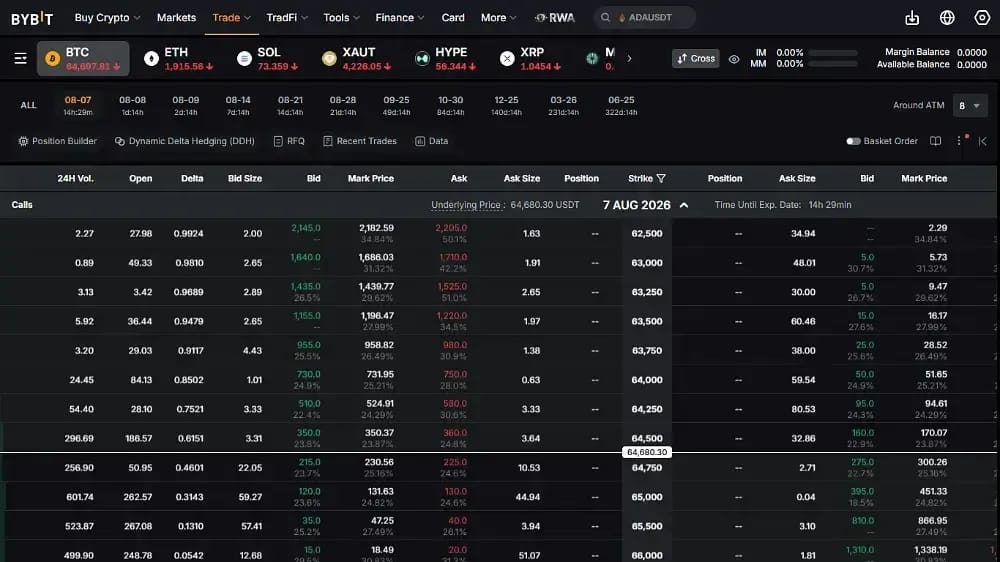
1. Bybit
We rank Bybit first because it delivers professional options infrastructure without demanding professional expertise. Its European-style contracts on Bitcoin, Ethereum and Solana settle automatically at expiry using a 30-minute time-weighted average index, which meaningfully reduces the manipulation risk around settlement windows.
What we like most is the collateral model. Portfolio margin lets multi-leg spreads offset against each other rather than posting margin on every leg separately, and the unified account shares collateral with spot and perpetuals. Running the same iron condor on three platforms, we found Bybit's margin requirement consistently among the lowest.
The mobile experience genuinely mirrors desktop, with strike selection, rolling and position closing all handled cleanly rather than stripped back. We recommend it for anyone graduating from perpetuals into options, though our Bybit review notes the platform remains entirely unavailable to United States residents.
Pros
- Best retail execution: Clean ticketing, guarded defaults and payoff previews make complex structures approachable without stripping out advanced functionality.
- Efficient margining: Portfolio margin across options, spot and perpetuals frees up collateral that isolated-margin platforms would otherwise lock away.
- Altcoin coverage: Solana, XRP and Dogecoin options extend beyond the Bitcoin and Ethereum pairs most competitors restrict themselves to.
Cons
- Shallower than Deribit: Longer-dated and far out-of-the-money strikes carry noticeably wider spreads than the institutional venue offers.
- No US access: American traders cannot register, which removes it from consideration for a large share of readers.
- Settlement fees add up: A 0.015% delivery fee on exercised contracts quietly compounds for traders holding positions through expiry regularly.
2. Deribit
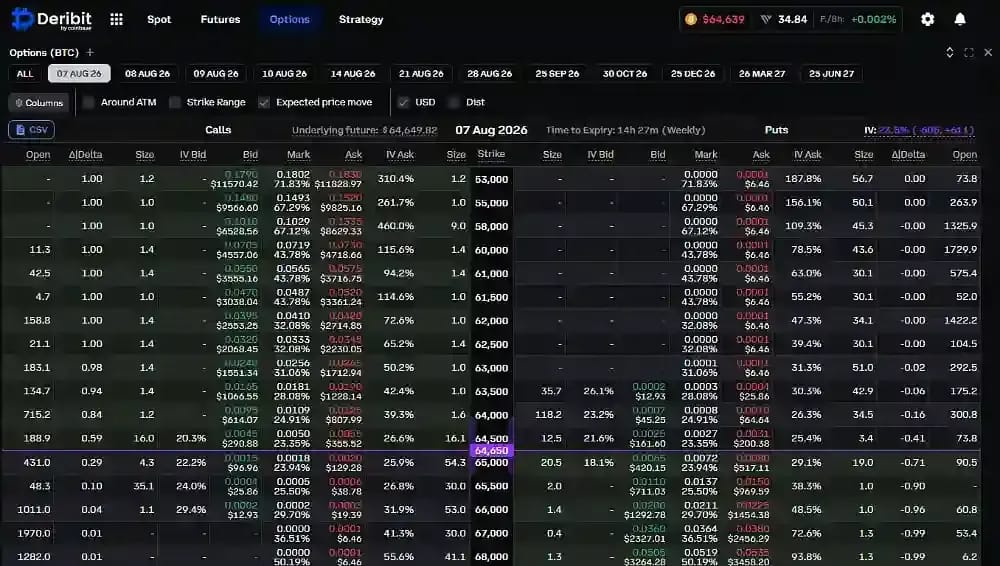
Deribit remains the deepest crypto options venue in existence, and we still route size-sensitive trades here. It carries roughly $27 billion in open interest and its combined operation with Coinbase Derivatives posts around $4.75 billion in daily volume, dwarfing every competitor on this list.
Its ownership changed fundamentally. Coinbase completed a $2.9 billion acquisition in August 2025, and institutional accounts from Coinbase International are scheduled to migrate onto Deribit's infrastructure in September 2026. We read that consolidation as strengthening liquidity rather than threatening it, though it does concentrate the market considerably.
The tooling is unapologetically professional, with position-level Greeks, block trading, RFQ and precise margin reporting. A free testnet lets newcomers rehearse settlement mechanics first, but we would still steer genuine beginners elsewhere, and its restricted country list excludes several major markets.
Pros
- Unmatched depth: Roughly $27 billion in open interest delivers tight spreads even on distant strikes and quarterly expiries.
- Institutional tooling: Block trades, RFQ, portfolio margin and granular Greeks match what professional volatility desks actually require daily.
- Coinbase backing: The acquisition adds a Nasdaq-listed parent's balance sheet behind what was previously an independent offshore venue.
Cons
- Steep learning curve: The interface assumes options fluency, and newer traders will find the density genuinely intimidating at first.
- Migration uncertainty: The September 2026 institutional transition introduces operational risk that has not yet been tested at scale.
- Geographic limits: United States retail access remains unavailable despite the American parent company owning the platform outright.
3. OKX
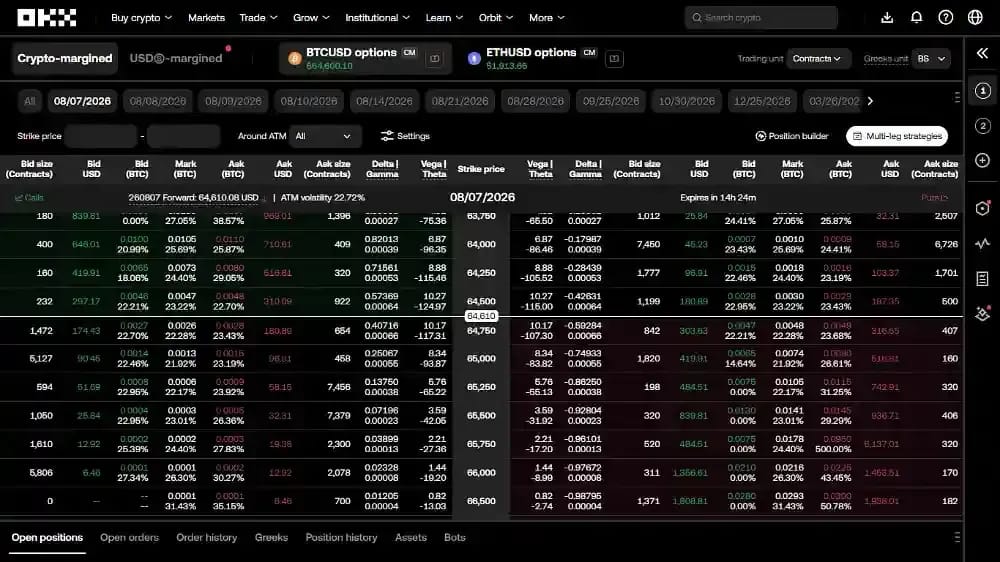
OKX runs the most capital-efficient options operation among the large exchanges, and we recommend it specifically to traders running combined options and futures books. Its unified account treats every position as one risk portfolio, so directional futures hedges genuinely offset options exposure rather than being margined separately.
The RFQ portal is what separates it from retail-first platforms. Rather than working a multi-leg order across a thin book, you request quotes directly from liquidity providers and receive executable pricing on the full structure. We found fills on four-leg combinations noticeably cleaner than working them manually.
Contract sizing helps too, with a 0.01 BTC multiplier and 0.1 ETH multiplier allowing precise position scaling. The trade-off we dislike is coverage, since standard options remain limited to Bitcoin and Ethereum, as our OKX review sets out in more detail.
Pros
- Best margin efficiency: Unified accounts let futures hedges genuinely offset options risk, freeing collateral that isolated platforms would lock up.
- RFQ liquidity: Direct quotes from market makers deliver executable pricing on multi-leg structures without working thin order books manually.
- VIP rebates: Top-tier makers earn negative fees, meaning high-volume traders are paid rather than charged for providing liquidity.
Cons
- Two assets only: Standard options cover Bitcoin and Ethereum exclusively, so altcoin volatility views require a different venue entirely.
- Complex onboarding: Portfolio margin and unified accounts demand configuration that newer traders will find genuinely confusing initially.
- US derivatives blocked: American users get spot access only following the relaunch, with options unavailable across every state.
4. Binance
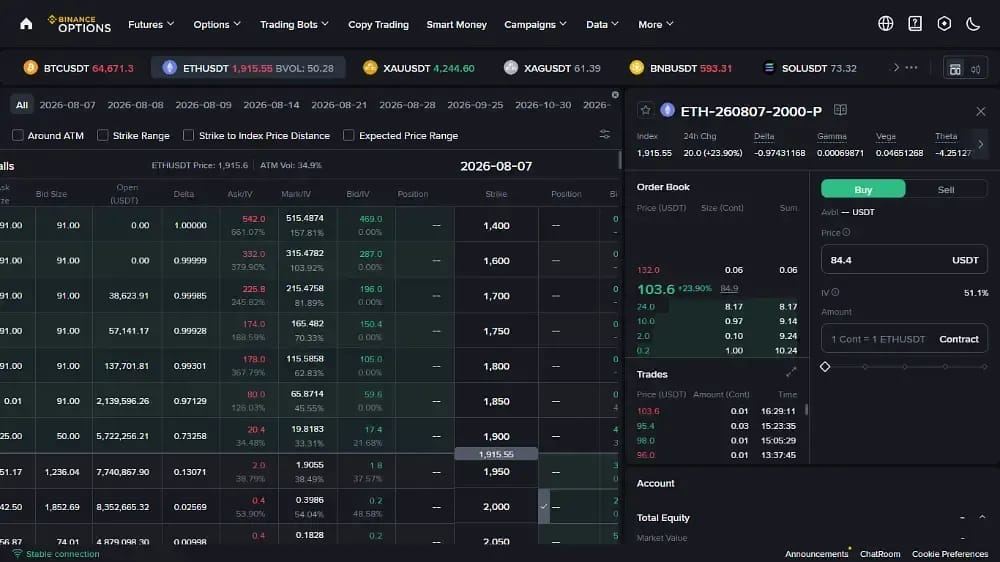
Binance makes the most sense for traders already holding spot and perpetual positions there, since unified USDT margin means options draw on the same collateral pool. We like that it removes the internal transfers and fragmented balances that plague multi-venue setups.
Its asset coverage is the broadest among major centralised platforms, listing options on Bitcoin, Ethereum, BNB, Solana and XRP with multiple weekly and monthly expiries trading continuously. Market-maker support keeps pricing tight on high-interest strikes, though depth thins considerably on longer-dated contracts.
The Easy Options mobile flow simplifies strike and expiry selection for newcomers while desktop exposes the full chain with Greeks. The caveat we would flag is European access, since Binance suspended certain EU services in July 2026 after missing MiCA authorisation, as our Binance review explains.
Pros
- Unified collateral: Options, spot and futures share one USDT margin pool, simplifying profit and loss tracking across the entire portfolio.
- Lowest headline fees: Symmetric 0.024% maker and taker pricing undercuts most competitors before any volume discounts apply.
- Broad listings: BNB, Solana and XRP options give directional coverage that Deribit, OKX and KuCoin do not currently match.
Cons
- European suspension: Certain EU services were withdrawn in July 2026 after the platform failed to secure MiCA authorisation in time.
- Thin long-dated books: Liquidity concentrates heavily in near-dated strikes, so quarterly expiries carry meaningfully wider spreads and higher execution costs.
- Regulatory overhang: A five-year DOJ compliance monitorship from the 2023 settlement continues to constrain expansion and product launches.
5. Gate
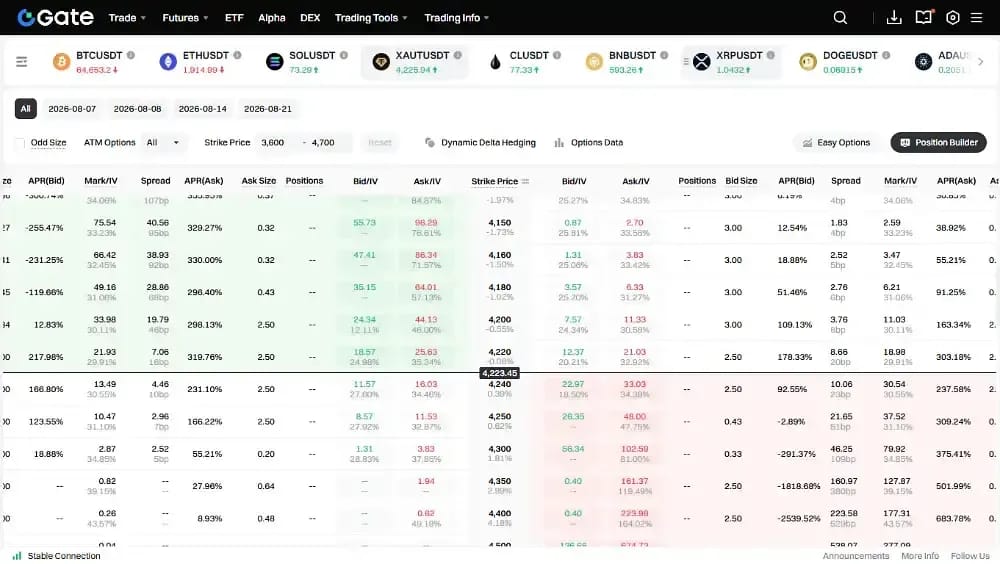
Gate offers the widest options coverage of any venue here, listing contracts on Bitcoin, Ethereum, Solana, XRP, Dogecoin and Cardano when most competitors stop at two assets. We recommend it specifically to traders who want directional options exposure beyond the majors.
Its expiry structure is equally unusual. Alongside standard daily and weekly contracts, Gate lists hourly expiries that suit event-driven trades around scheduled catalysts. Testing those short-dated contracts, we found premiums cheap but decay brutal, so they reward precision rather than patience.
A demo environment with virtual balances lets newcomers rehearse before committing capital, and unified accounts share collateral across options and futures. What we dislike is depth, since liquidity on altcoin strikes thins quickly, and Gate restricts more than 30 jurisdictions per our Gate review.
Pros
- Broadest asset list: Options on six-plus assets including Solana, XRP, Dogecoin and Cardano surpass every other venue in this comparison.
- Hourly expiries: Ultra short-dated contracts enable event-driven trades around catalysts that daily and weekly expiries cannot capture precisely.
- Risk-free practice: A full demo mode with virtual balances lets beginners learn settlement mechanics before risking any real capital.
Cons
- Thin altcoin depth: Liquidity concentrates in Bitcoin and Ethereum, so exotic strikes carry spreads wide enough to erode edge.
- Heavy restrictions: More than 30 jurisdictions remain blocked, including the United States, United Kingdom and much of Western Europe.
- Decay on short expiries: Hourly contracts lose extrinsic value extremely fast, punishing anyone whose timing is even slightly imprecise.
6. HTX
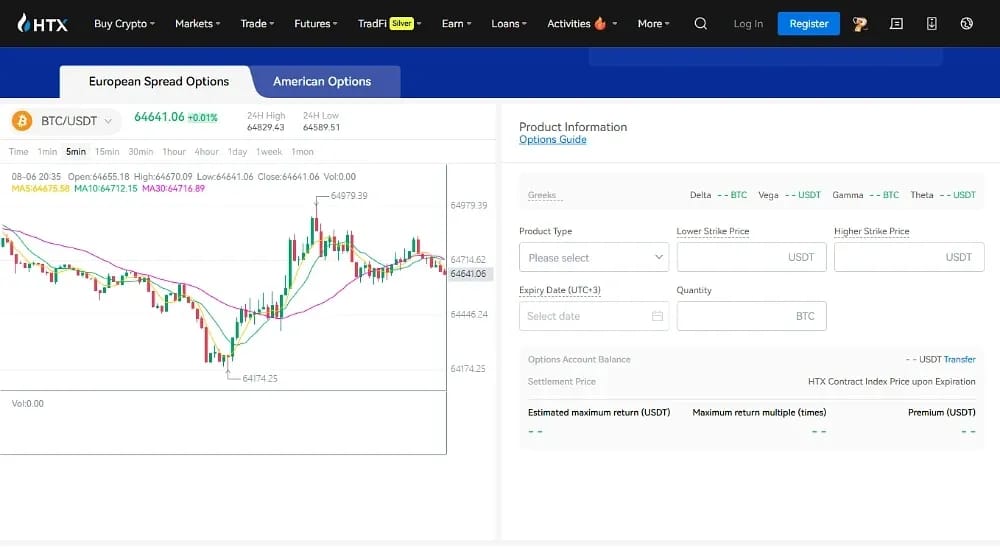
HTX earns its place on contract design, offering both European and American-style options where nearly every crypto venue restricts traders to European exercise. That flexibility genuinely matters, since American style permits exercise at any point before expiry rather than only at settlement.
We like what that unlocks strategically. Holding an in-the-money call through a volatile week, European style forces you to wait or close in the market, while American style lets you exercise immediately and capture intrinsic value. For hedgers managing spot exposure, that optionality has real value.
The platform pairs this with guided onboarding, cash settlement in USDT and coverage across Bitcoin, Ethereum and Solana. What we dislike is liquidity, which trails Deribit and Bybit substantially, and the exchange's history under its former Huobi branding still colours perception among longer-tenured traders.
Pros
- Dual exercise styles: Supporting both American and European contracts gives strategic flexibility that essentially no other major crypto venue offers.
- Early exercise value: American-style options let hedgers capture intrinsic value immediately rather than waiting for a fixed settlement date.
- Guided onboarding: Structured tutorials and clear payoff visualisation make the options product approachable for traders arriving from spot markets.
Cons
- Weaker liquidity: Order book depth trails Deribit and Bybit noticeably, widening spreads on anything beyond front-month at-the-money strikes.
- Higher taker fees: At 0.05%, takers pay meaningfully more than the 0.03% that Deribit, OKX and Gate all charge.
- Reputational baggage: The legacy Huobi association and subsequent restructuring still make some traders cautious about custody with this venue.
7. Derive
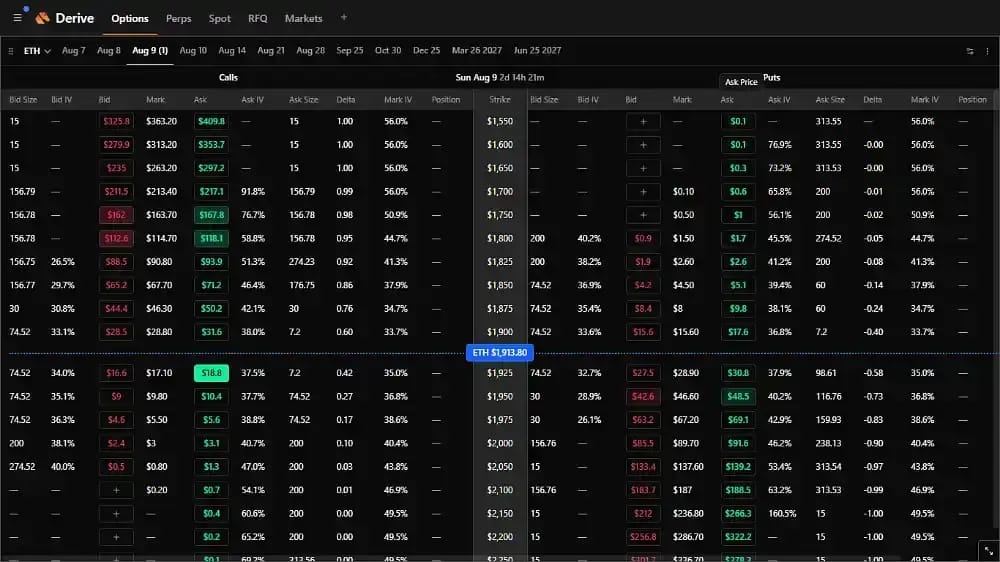
Derive, formerly Lyra, closes our list as the strongest onchain options venue for traders who refuse to surrender custody. Settlement happens entirely on an Optimistic Rollup, so positions and collateral stay verifiable onchain rather than sitting on an exchange balance sheet you cannot audit.
We recommend it narrowly but genuinely. Derive processes over $100 million in total value locked with roughly $369 million in monthly volume, and has historically held the majority share of decentralised options markets. Those numbers are strong for DeFi and modest beside Deribit's monthly turnover.
The AMM model matches liquidity providers with traders permissionlessly, removing counterparty risk from the equation entirely. What we dislike is the practical cost of that purity: wider spreads, fewer available strikes, and gas considerations making frequent adjustment expensive versus centralised platforms.
Pros
- True self-custody: Positions settle onchain with no exchange holding collateral, eliminating the counterparty risk every centralised venue here carries.
- Permissionless access: No identity verification or geographic restriction, so traders in excluded jurisdictions retain genuine access to options markets.
- Verifiable mechanics: Open-source contracts let anyone audit pricing, margin and settlement logic rather than trusting an exchange's internal systems.
Cons
- Thinner liquidity: Monthly volume sits far below the centralised platforms, producing materially wider spreads on directly comparable contracts.
- Limited strikes: Available expiries and strike coverage remain sparse, constraining the precise structures that centralised options chains support easily.
- Onchain friction: Gas costs and transaction latency make frequent position adjustment expensive relative to centralised order-book execution speeds.
What are Crypto Options?
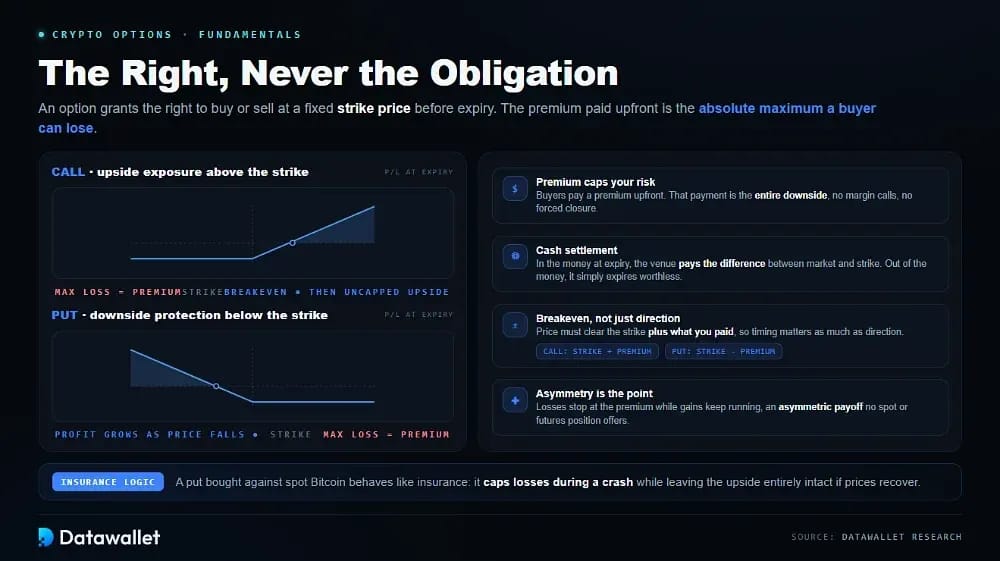
A crypto option is a contract giving you the right, but never the obligation, to buy or sell an asset at a fixed strike price before a set expiry. You pay a premium upfront, and that premium is the absolute maximum you can lose as a buyer.
Calls provide upside exposure above the strike while puts provide downside protection below it. The asymmetry is what makes options useful: a put bought against spot Bitcoin behaves like insurance, capping losses during a crash while leaving your upside entirely intact if prices recover.
Settlement in crypto is almost always cash-based. If your option finishes in the money, the venue pays the difference between the market and strike price, and if it finishes out of the money, it simply expires worthless with no further obligation.
Breakeven works identically to traditional markets. For a call it is the strike plus the premium paid, and for a put it is the strike minus premium, which is why timing matters as much as direction when trading these instruments.
The Institutional Shift Reshaping Crypto Options
The defining development of 2026 was not a product launch but a structural realignment across the entire market. Crypto options stopped being an offshore niche and became a genuinely regulated institutional asset class, a shift the SEC and CFTC jointly formalised in March.
Coinbase Absorbed the Market Leader
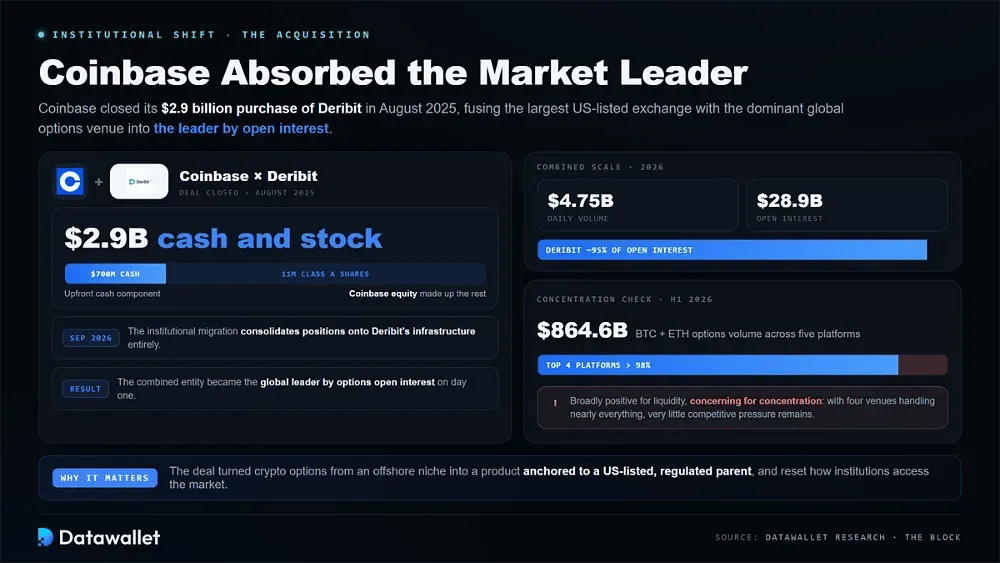
Coinbase completed its $2.9 billion acquisition of Deribit in August 2025, combining the largest US-listed exchange with the dominant global options venue. The deal included $700 million in cash plus 11 million Class A shares, and immediately made Coinbase the global leader by options open interest.
Integration accelerated through 2026. Combined daily volume across Coinbase Derivatives and Deribit reached roughly $4.75 billion against $28.9 billion in open interest, with Deribit contributing approximately 95% of that open interest. The institutional migration scheduled for September 2026 consolidates positions onto Deribit's infrastructure entirely.
We read this as broadly positive for liquidity but concerning for concentration. Five platforms accounted for around $864.6 billion in combined Bitcoin and Ethereum options volume during the first half of 2026, with the top four handling more than 98% of it, leaving very little competitive pressure.
Regulated Products Overtook Offshore platforms
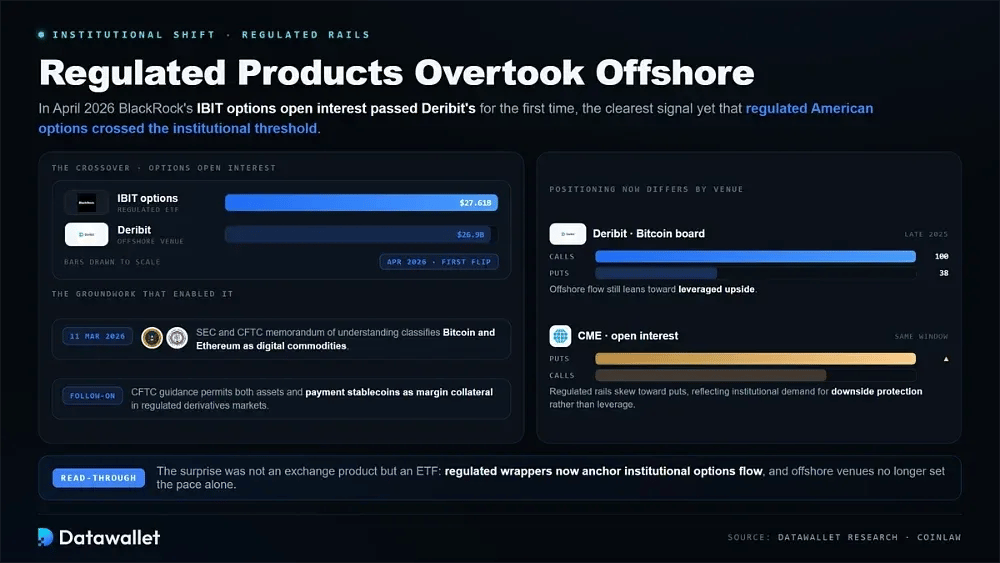
The more surprising shift came from exchange-traded funds rather than exchanges. BlackRock's IBIT options open interest reached $27.61 billion in April 2026, overtaking Deribit's $26.9 billion for the first time and signalling that regulated American options had finally crossed the institutional threshold.
Regulatory groundwork enabled it. The SEC and CFTC signed a memorandum of understanding on 11 March 2026 classifying Bitcoin and Ethereum as digital commodities, followed by CFTC guidance permitting those assets and payment stablecoins as margin collateral in regulated derivatives markets.
Positioning now differs meaningfully by venue. Deribit's Bitcoin board ran roughly 100 calls for every 38 puts in late 2025, while CME open interest skewed toward puts over the same window, reflecting institutional demand for downside protection on regulated rails rather than leveraged upside.
How to Choose a Crypto Options Platform
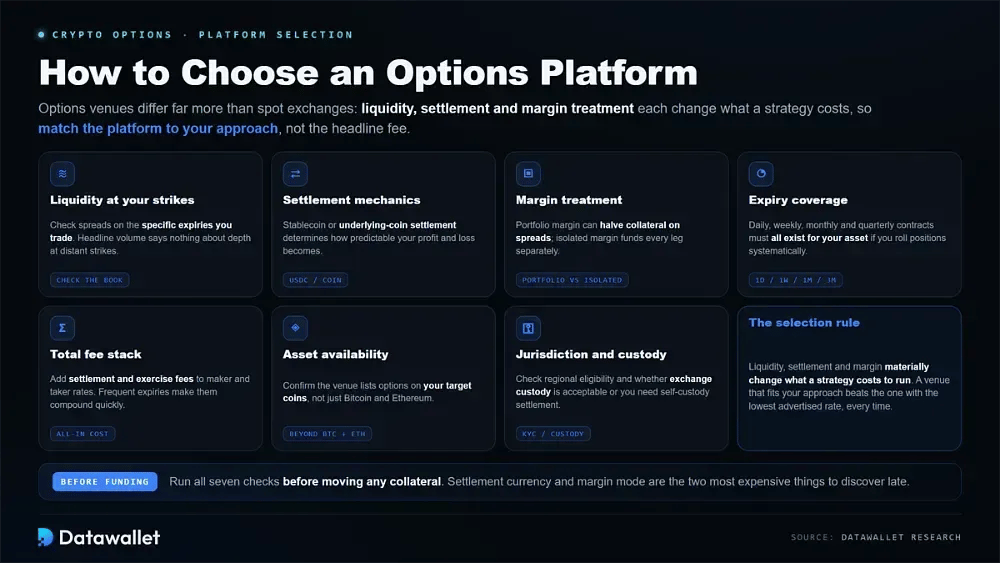
Options platforms differ far more from each other than spot exchanges do, because liquidity, settlement mechanics and margin treatment each materially change what a given strategy costs to run. Matching the platform to your actual approach matters considerably more than chasing the lowest headline fee.
Evaluate these factors before funding any options account:
- Liquidity at your strikes: Check spreads on the specific expiries you trade, since headline volume tells you nothing about depth at distant strikes.
- Settlement mechanics: Confirm whether contracts settle in stablecoins or the underlying coin, because that determines how predictable your profit and loss becomes.
- Margin treatment: Portfolio margin can halve collateral requirements on spreads, while isolated margin forces you to fund every leg separately.
- Expiry coverage: Verify daily, weekly, monthly and quarterly contracts all exist for your asset if you plan to roll positions systematically.
- Total fee stack: Add settlement and exercise fees to maker and taker rates, since frequent expiries make those charges compound quickly.
- Asset availability: Confirm the venue lists options on your target coins rather than restricting coverage to Bitcoin and Ethereum only.
- Jurisdiction and custody: Check regional eligibility and whether you are comfortable with exchange custody or need self-custody settlement instead.
Crypto Options Trading Fees
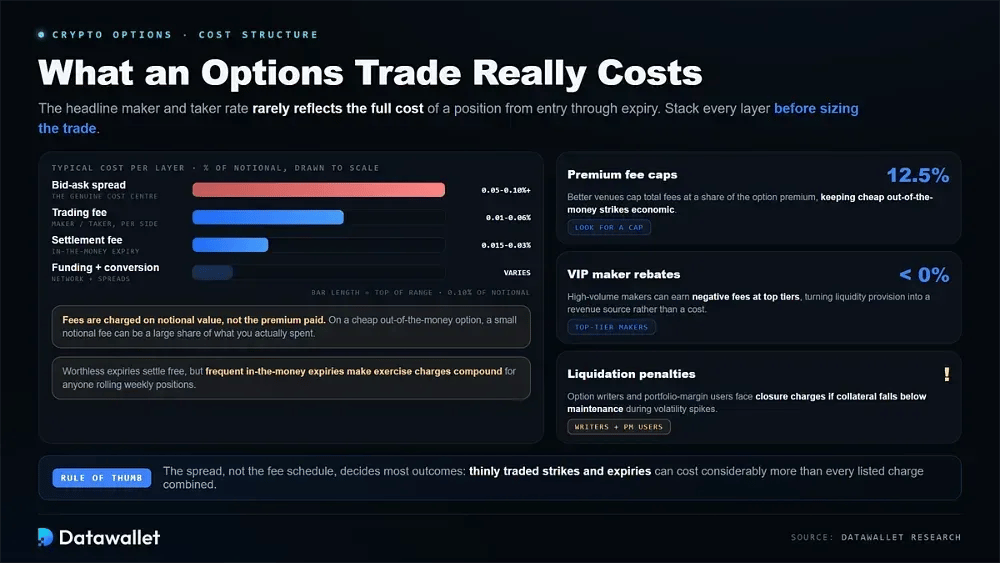
Options fees are structured quite differently from spot trading, and the headline maker and taker rate rarely represents what a position actually costs you from entry through to expiry.
Account for each of these cost layers before sizing a trade:
- Trading fees: Maker and taker rates typically run 0.01% to 0.06% per side, calculated on notional value rather than the premium paid.
- Settlement fees: In-the-money contracts usually incur an exercise charge at expiry, commonly 0.015% to 0.03%, while worthless options expire free.
- Premium caps: Better platforms cap fees at a percentage of the option premium, typically 12.5%, preventing cheap out-of-the-money strikes becoming uneconomic.
- Bid-ask spread: The genuine cost centre, frequently adding 0.05% to 0.10% or considerably more on thinly traded strikes and expiries.
- Funding and conversion: Moving collateral between wallets or converting into USDC or USDT adds network fees and conversion spreads.
- Liquidation penalties: Option writers and portfolio-margin users face closure charges if collateral falls below maintenance during volatility spikes.
- VIP rebates: High-volume makers can earn negative fees at top tiers, meaning liquidity provision becomes a revenue source rather than a cost.
Crypto Options Trading Risks
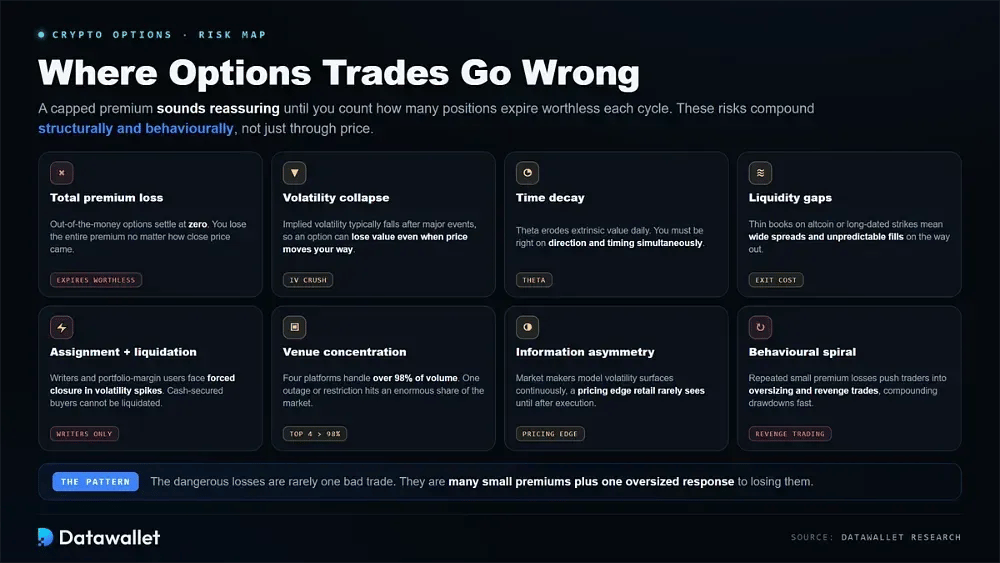
Buying options caps your maximum loss at the premium paid, which sounds reassuring right up until you review how many positions actually expire worthless in each cycle. The risks here compound structurally and behaviourally rather than simply arriving through adverse price direction.
Weigh each of these before committing capital to any options strategy:
- Total premium loss: Options finishing out of the money settle at zero, so you lose the entire premium regardless of how close price came.
- Volatility collapse: Implied volatility typically falls after major events, so your option can lose value even when price moves favourably.
- Time decay: Theta erodes extrinsic value every day, meaning you must be correct on direction and timing simultaneously to profit.
- Liquidity gaps: Thin books on altcoin or long-dated strikes create wide spreads and unpredictable fills, making exits costlier than entries suggested.
- Assignment and liquidation: Writers and portfolio-margin users face forced closure when volatility spikes, unlike cash-secured buyers who cannot be liquidated.
- Venue concentration: With four platforms handling over 98% of volume, an outage or restriction at one venue affects an enormous share of the market.
- Information asymmetry: Market makers model volatility surfaces continuously, giving them pricing advantages that retail traders rarely recognise until after execution.
- Behavioural spiral: Repeated small premium losses push traders toward oversizing and revenge trades, which compound drawdowns far faster than the original losses.
Crypto Options vs Crypto Futures
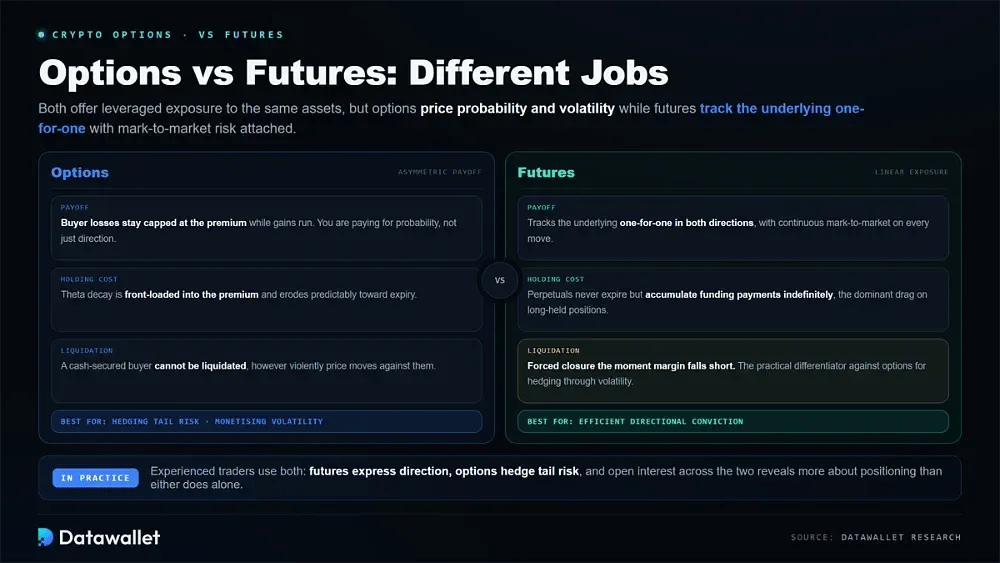
Options and futures solve genuinely different problems despite both offering leveraged exposure to the same assets. Options price probability and volatility, delivering asymmetric payoffs where buyer losses stay capped, while futures track the underlying one-for-one with continuous mark-to-market risk attached.
The cost structures diverge accordingly. Options decay through theta, so holding costs are front-loaded into the premium and erode predictably toward expiry. Perpetual futures on crypto futures exchanges carry no expiry but accumulate funding payments indefinitely, which becomes the dominant drag on long-held positions.
Liquidation risk is the practical differentiator. A cash-secured option buyer cannot be liquidated regardless of how violently price moves against them, whereas a futures position faces forced closure the moment margin falls short. That distinction makes options considerably better suited to hedging spot exposure through volatile periods.
Most experienced traders we know use both instruments together rather than choosing between them. Futures express directional conviction efficiently while options hedge tail risk or monetise volatility expectations, and the open interest across both markets reveals more about positioning than either does alone.
How Are Crypto Options Taxed?
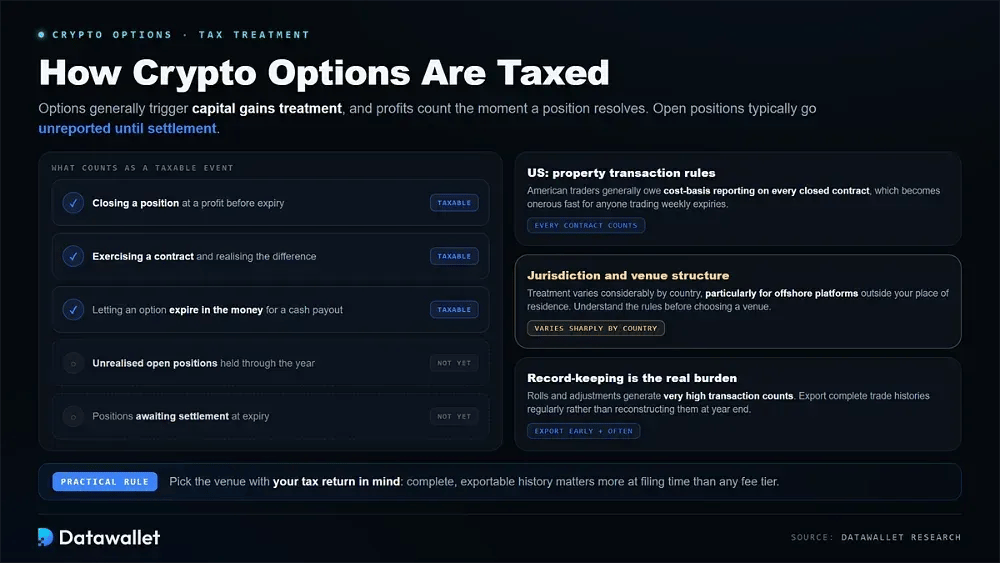
Crypto options generally trigger capital gains treatment, with profits realised through closing a position, exercising a contract, or letting one expire in the money all counting as taxable events. Unrealised open positions typically go entirely unreported until settlement actually occurs at expiry.
Treatment varies considerably by jurisdiction and venue structure, particularly for offshore platforms outside your country of residence. United States traders generally face property transaction rules requiring cost-basis reporting on every closed contract, which becomes onerous for anyone trading weekly expiries.
Record-keeping is the practical burden most traders badly underestimate. Options generate very high transaction counts through rolls and adjustments, so exporting complete histories regularly matters, and tax treatment differs sharply between countries in ways worth understanding before choosing any venue.
Final Thoughts
Crypto options matured faster during 2026 than most observers expected, but that maturation arrived through consolidation rather than proliferation. Coinbase now owns the dominant venue outright, regulated ETF options overtook offshore open interest, and just four platforms handle nearly all the volume.
Bybit remains our top pick because it delivers institutional mechanics through a genuinely usable interface. Deribit is where we send size, OKX wins on margin efficiency, and Gate offers the broadest altcoin coverage if you need exposure beyond Bitcoin and Ethereum.
Whatever you choose, size every position assuming the premium goes to zero, because a meaningful share of options expire worthless entirely by design. If that asymmetry does not suit your approach, perpetual futures platforms offer simpler directional exposure carrying different risks.
Our Methodology
We evaluated each venue by opening and funding real trading accounts, executing live orders across multiple expiries and strikes, measuring realised spreads against quoted ones, and testing actual settlement behaviour through expiry rather than relying on published contract specifications alone.
Six criteria shaped the final ranking:
- Liquidity depth: We measured spreads at the money and several strikes out, comparing near-dated against quarterly expiries under identical conditions.
- Margin efficiency: We ran identical multi-leg structures on each venue and compared collateral requirements to expose real portfolio margin differences.
- Total cost: We calculated trading, settlement and exercise fees alongside observed spread cost, cross-checked against each venue's published fee schedule.
- Contract design: We reviewed settlement currency, exercise style, index methodology and expiry cycles, since these determine how predictable outcomes actually are.
- Platform usability: We tested order entry, strike selection, rolling and position management across desktop and mobile for both novice and advanced workflows.
- Access and custody: We verified regional eligibility, verification requirements, and whether collateral sits with the venue or settles onchain.
Options liquidity and venue ownership shifted unusually fast throughout 2026, particularly around the Coinbase consolidation, so our testing cycle ran from March through to July, with every figure independently verified against exchange documentation, CoinGlass data and official regulatory filings before publication.