







Compare Top Australian Crypto Exchanges
1. Kraken
Kraken tops our Australian rankings by pairing domestic-grade banking rails with the custody credibility of a global exchange. Local arm Bit Trade Pty Ltd has been AUSTRAC-registered since Kraken acquired the Sydney firm in 2020, and AUD deposits and withdrawals through PayID and Osko are free with a $5 minimum. Our first test deposit from a CommBank account sat in a new-payee hold for a day, then every PayID transfer cleared in under a minute.
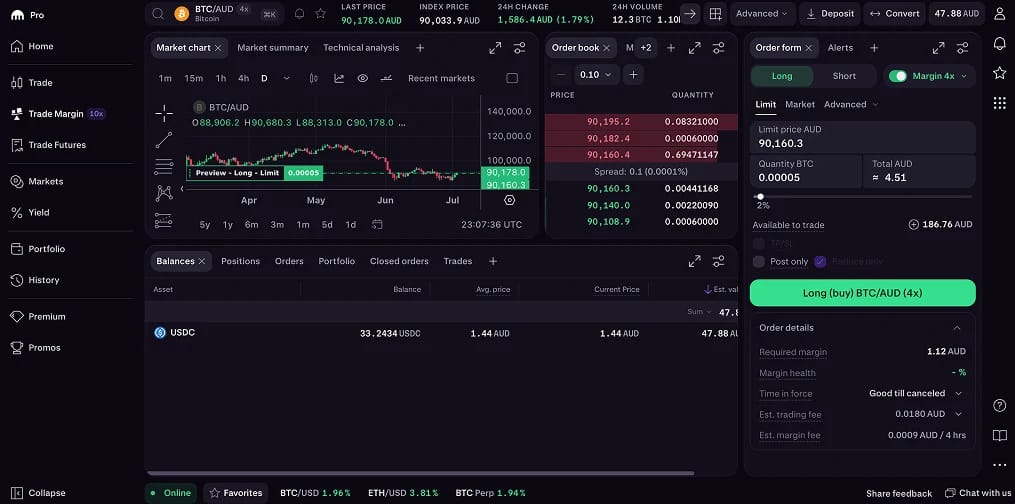
The trading stack rewards leaving the simple app behind. Kraken Pro charges 0.25% maker and 0.40% taker at the base tier, falling with volume, against roughly 1% plus spread on Instant Buy. Around 600 assets trade on deep BTC/AUD and ETH/AUD books, proof-of-reserves attestations date back to 2014, and customer funds have never been lost to a breach. SMSF onboarding and clean EOFY exports round out a practical core account.
The compliance record is not spotless. In December 2024, the Federal Court ordered Bit Trade to pay an $8 million penalty after offering its margin extension product to more than 1,100 Australians without the required target market determination. The product has been wound back for retail, and the case reflects the pre-DAF legal vacuum more than custody risk. Our Kraken review covers the full platform.
Pros
- Free, near-instant AUD deposits and withdrawals via PayID and Osko, with a $5 minimum.
- Kraken Pro fees of 0.25% and 0.40% undercut every Australian-owned platform here.
- Proof-of-reserves history back to 2014 and customer funds never lost to a breach since 2011.
- SMSF support and detailed transaction exports simplify ATO reporting.
Cons
- Osko and PayID deposits cap at $10,000 daily and $40,000 per rolling 30 days on standard accounts.
- The December 2024 Federal Court penalty over its margin product remains a blemish.
- Most altcoin liquidity sits in USD pairs, so smaller coins involve a conversion step.
2. OKX
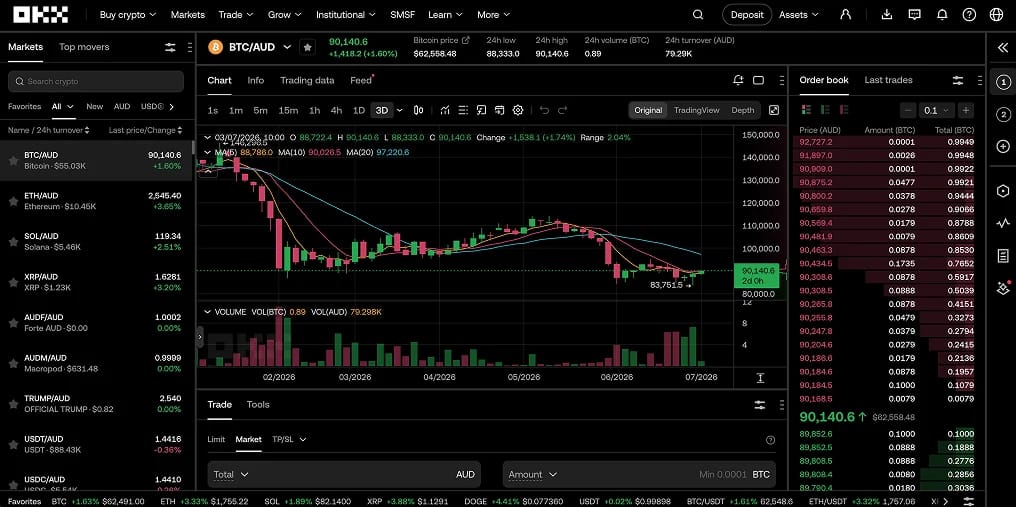
OKX takes second on price. Spot fees of 0.08% maker and 0.10% taker are the lowest of any major exchange serving Australian retail, and AUD deposits by PayID or direct bank transfer carry no fee. The exchange launched its dedicated Australian platform in May 2024 and now offers more than 70 AUD trading pairs, so BTC, ETH, SOL and other majors trade directly against dollars without a stablecoin detour.
Spot services run through OKX Australia Pty Ltd, a locally incorporated AUSTRAC registrant, while derivatives sit with OKX Australia Financial Pty Ltd under AFSL 379035, restricted to verified wholesale clients under the Corporations Act. Retail traders wanting perpetuals should see our best crypto futures exchanges guide, because registered local exchanges keep derivatives behind the wholesale test.
The built-in Web3 wallet spans 100+ chains with a DEX aggregator, letting users step from regulated spot into DeFi in one app. Monthly Merkle-tree proof-of-reserves disclosures have run since late 2022. The trade-offs are thinner AUD books than the USDT pairs off-peak and support that slows when a compliance review lands. Our OKX review goes deeper.
Pros
- Lowest spot fees available to Australian retail at 0.08% maker and 0.10% taker.
- 70+ AUD pairs allow direct dollar trading with free PayID and bank transfer deposits.
- Web3 wallet and DEX aggregation built into the same app as the exchange.
Cons
- Derivatives are restricted to wholesale clients, so retail access is spot only.
- AUD books run thinner than global USDT pairs outside Australian trading hours.
- Support response times lag local exchanges on verification issues.
3. CoinSpot
CoinSpot remains the default first exchange for Australians. The Melbourne platform has run since 2013 under Casey Block Services Pty Ltd, holds ISO 27001 certification, serves more than three million accounts, and lists over 500 cryptocurrencies, the widest local selection. PayID and direct deposits are free and instant, AUD withdrawals cost nothing, and the 24/7 local live chat reached a human faster than any support desk we tested.
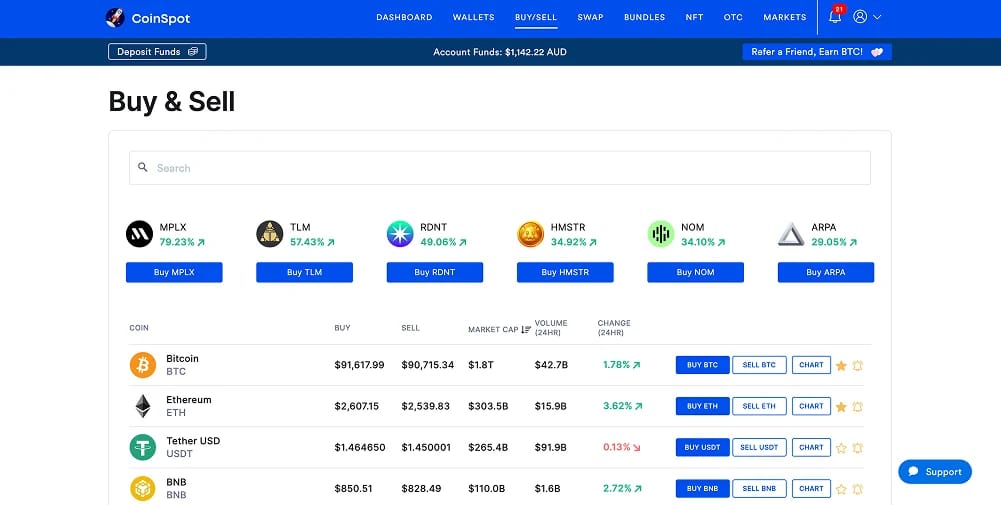
Cost is the catch. The default Instant Buy screen charges 1% per trade with a spread of roughly 1% to 2% baked into the quote, while the Markets order book charges 0.1% on the same coins. One button versus the other changes the cost of an identical Bitcoin purchase by a factor of ten. Market orders cover only the majors and that book can run thin, a limitation we unpack in our CoinSpot fees breakdown. An OTC desk handles orders above $20,000 at 0.1% with locked pricing.
For a beginner buying BTC or ETH monthly, or an SMSF trustee valuing local support and EOFY tooling, CoinSpot works. Blockchain investigators reported a roughly US$2.4 million hot wallet compromise in November 2023, with no customer losses reported, and its security record has otherwise held since 2013. Our CoinSpot review has the full picture.
Pros
- Largest Australian exchange with 500+ coins and free PayID deposits and AUD withdrawals.
- ISO 27001 certified since 2020 with 24/7 Melbourne-based human support.
- SMSF accounts, an OTC desk at 0.1%, and a dedicated EOFY tax centre.
Cons
- The default Instant Buy costs 1% plus a 1% to 2% spread, roughly ten times the Markets rate.
- The 0.1% order book covers majors only and liquidity there can be shallow.
- Spot only, with no margin, futures, or automated recurring buy feature.
4. Binance
Binance re-entered serious contention in January by restoring full AUD deposits and withdrawals through PayID and BSB transfer for all verified users. That ended a freeze running since June 2023, when payments provider Cuscal cut the exchange off with a day's notice, leaving Australians on cards and P2P for two and a half years. Binance again pairs the world's deepest order books with a direct dollar on-ramp.
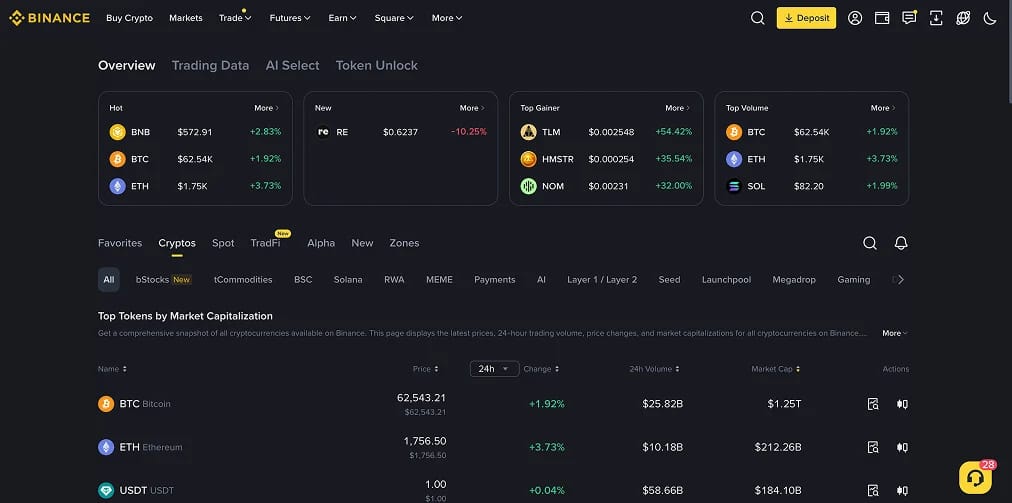
Raw trading value is hard to fault. Spot fees sit at 0.1%, dropping to 0.075% when paid in BNB, across 400+ listed assets. AUD pairs returned with the banking rails, Binance Earn offers yield products, and the P2P desk remains a fallback channel Australians know from the outage years.
History is the reason it sits fourth. ASIC cancelled the AFSL of Binance's local derivatives arm in 2023 after it misclassified over 500 retail clients as wholesale, the global entity settled with the US Department of Justice for $4.3 billion the same year, and the AUD freeze showed how quickly access can vanish when banking partners walk. The compliance rebuild looks genuine, and our Binance review tracks it, but we treat it as a trading venue rather than a sole fiat gateway.
Pros
- Deepest global liquidity with 0.1% spot fees, or 0.075% paid in BNB.
- PayID and BSB deposits and withdrawals restored for all verified Australian users.
- Wide product surface including Earn, P2P, and 400+ listed assets.
Cons
- Lost its AUD banking rails for two and a half years, a risk that could recur.
- No derivatives for Australian retail after ASIC cancelled the local licence.
- The 2023 US DOJ settlement still weighs on the global compliance record.
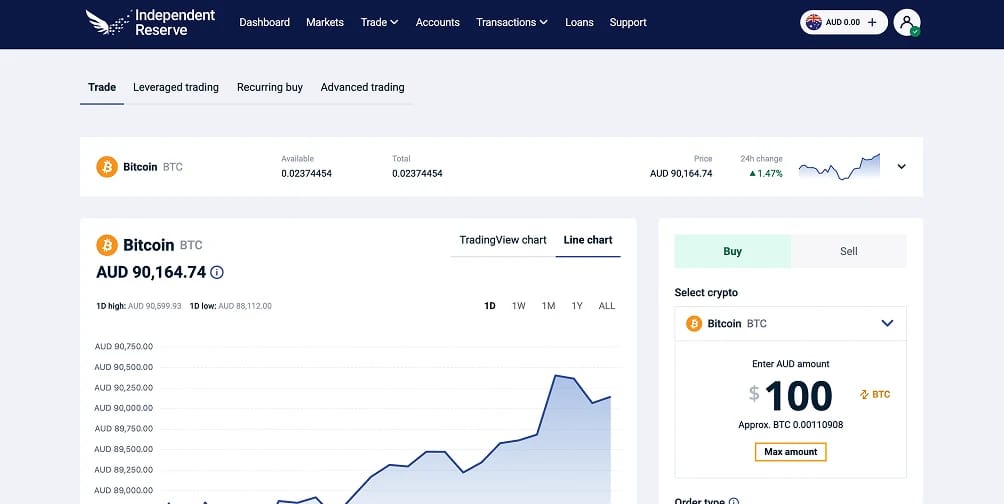
5. Independent Reserve
Independent Reserve is where we point long-term investors and SMSF trustees. Founded in Sydney in 2013, it runs a genuine order book with no spread markup, publishes tiered fees from 0.5% down to 0.02% by 30-day volume, and has never been hacked. ISO 27001 certification, segregated client funds held 1:1, and a Major Payment Institution licence in Singapore round out the strongest institutional posture of any Australian-founded exchange.
Ownership changed this year and strengthened the case. FTSE 250 broker IG Group completed its acquisition of Independent Reserve on 30 January, taking an initial 70% stake with founders retaining the rest, and plans a broader regulated crypto offering across Australia, Singapore, and the UAE later this year. For an SMSF weighing counterparty risk, a listed parent with audited accounts matters.
Multi-user accounts let trustees, accountants, and advisers share access with role-based permissions, integrations cover BGL, Koinly, and Summ for reporting, and the OTC desk quotes blocks from $50,000. The catalogue of around 30 established coins will frustrate altcoin hunters, and the 0.5% entry tier costs more than Kraken Pro for small trades, but neither is what this exchange is for.
Pros
- Order book pricing with no spread and tiered fees falling to 0.02% at volume.
- Never breached since 2013, with ISO 27001 certification and 1:1 segregated reserves.
- Multi-user SMSF, trust, and company accounts backed by FTSE 250 owner IG Group.
Cons
- Roughly 30 supported coins, the narrowest selection on this list.
- The 0.5% entry fee tier is expensive for small casual trades.
- Support is email-based, with no live chat for urgent issues.
6. Swyftx
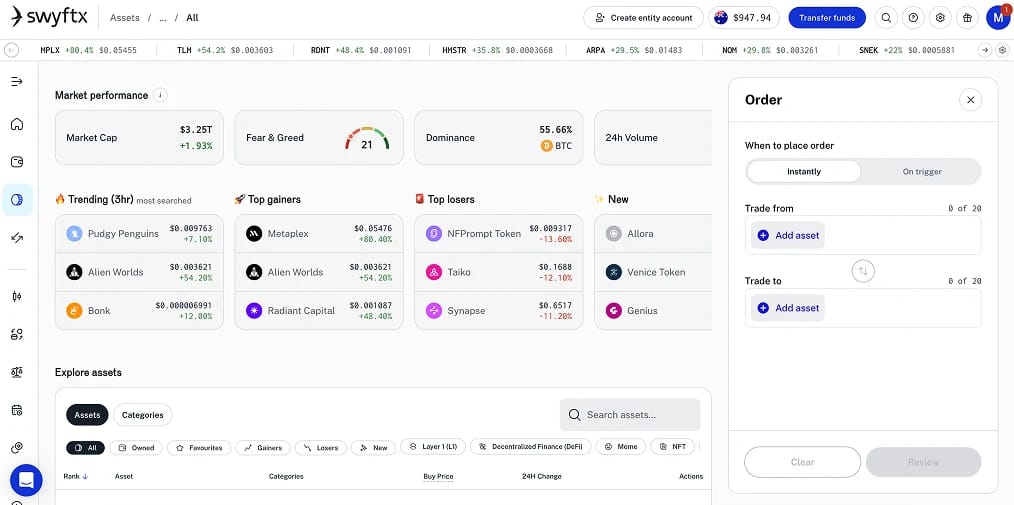
Swyftx runs the cleanest retail experience of the Australian-owned platforms. The Brisbane exchange lists 440+ cryptocurrencies, takes free PayID, Osko, and bank transfer deposits with free AUD withdrawals, plus a $10,000 demo account, recurring buys for dollar cost averaging, themed bundles, and SMSF support. Onboarding from sign-up to first trade took us under ten minutes.
Pricing needs a clear-eyed read. The trading fee starts at 0.6% and falls to 0.1% with volume, and a spread with base and market-driven components sits inside every quoted price. Our test round trips on BTC/AUD landed near 0.45% each way all-in, cheaper than CoinSpot's Instant Buy and dearer than Kraken Pro. Swaps book the fee on both legs, doubling the cost of hopping between altcoins.
Swyftx wins on trust infrastructure for everyday users. It holds SOC 2 Type II certification, partners with Fireblocks for custody and Chainalysis for monitoring, and its staking product remains paused pending regulatory clarity. Our CoinSpot vs Swyftx comparison covers the head-to-head with its biggest local rival.
Pros
- Free PayID, Osko, and bank transfer deposits with free AUD withdrawals.
- Demo mode, recurring buys, and bundles make it the strongest beginner toolkit locally.
- SOC 2 Type II certified with Fireblocks custody and Chainalysis monitoring.
Cons
- Spreads apply on top of the 0.6% base fee, so all-in costs beat only the instant-buy platforms.
- Coin-to-coin swaps incur the trading fee on both legs.
- Spot only, with staking paused and no derivatives.
7. Coinbase
Coinbase closes the list with the strongest regulatory credential of any global exchange here. Coinbase Australia holds an Australian Financial Services Licence from ASIC, AFSL 569752, alongside its AUSTRAC registration, putting it ahead of the April 2027 licensing deadline the industry is working toward. As a Nasdaq-listed company it also publishes audited financials, a level of disclosure no crypto-native rival matches.
The Australian product has matured since its 2022 relaunch. AUD deposits and withdrawals through PayID and bank transfer carry no Coinbase fee, the minimum trade is $2, the app is the gentlest introduction here, and an SMSF product launched this year targets the retirement market. USDC support gives a credible stablecoin home, and staking covers the majors.
Costs are the persistent weakness. Simple buys stack a spread on top of tiered fees, and Coinbase Advanced, where maker and taker fees start at 0.40% and 0.60%, offers few AUD pairs, so most order book trading first converts dollars to USDC at around a 0.5% spread. Priced against Kraken Pro or OKX, an active Australian trader pays noticeably more for the brand. Our Coinbase review weighs the full trade-off.
Pros
- ASIC-issued AFSL plus AUSTRAC registration, the strongest licensing position locally.
- Nasdaq-listed transparency with audited financials and a new SMSF product.
- Free PayID funding, a $2 minimum trade, and the easiest app for first-time buyers.
Cons
- Simple-buy pricing is among the most expensive paths on this list.
- Advanced trading offers few AUD pairs, forcing a USDC conversion step.
- Smaller asset selection than the crypto-native venues.
How to Choose a Crypto Exchange in Australia
Choosing a crypto exchange in Australia means checking AUSTRAC registration, testing the PayID rails, understanding your bank's crypto policy, and pricing the full trade rather than the headline fee.
- Verify registration today and licensing direction. Every legitimate exchange appears on AUSTRAC's public register of digital currency exchange providers. From April 2027, platforms holding client crypto will also need an AFSL under the new Digital Assets Framework, with a six-month window where a lodged application keeps a platform operating while ASIC decides. Coinbase and OKX's derivatives arm already hold AFSLs.
- Test the AUD rails before committing real money. PayID and Osko deposits are free on every exchange on this list, while card deposits cost 1.5% to nearly 4%. Send $50 first. Expect a new-payee hold of up to a day or two on the first payment, then transfers clear in seconds.
- Know your bank's crypto policy. The IRCI survey found 30% of investors were blocked or delayed by their bank last year. CommBank introduced 24-hour holds and a $10,000 monthly cap on payments to crypto exchanges in 2023, and other majors apply their own friction. Our guides to buying crypto with CommBank and Westpac cover what each bank permits.
- Price the whole trade, spread included. A 0.1% headline fee means little if the quote carries a 2% spread. Order book venues like Kraken, OKX, and Independent Reserve show true market pricing, while instant-buy screens on CoinSpot and Swyftx embed spreads in the quote. Run a small buy and immediate sell, and measure the round trip cost.
- Plan for the ATO from the first trade. Every AUSTRAC-registered exchange hands account and transaction data to the tax office under its data-matching program. Pick a platform with clean CSV exports or direct integrations with Koinly, Syla, or Crypto Tax Calculator, and save statements as you go.
Crypto and Bitcoin Regulation in Australia
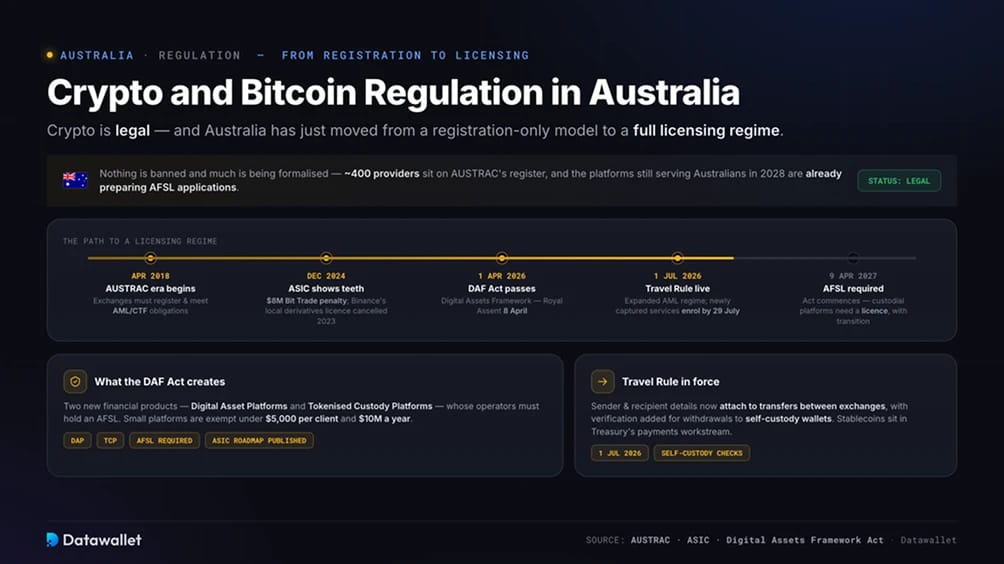
Crypto is legal in Australia, and the country has just moved from a registration-only model to a full licensing regime.
- AUSTRAC registration since 2018. Digital currency exchanges have needed to register with AUSTRAC and meet AML/CTF obligations since April 2018. Roughly 400 providers sit on the register, and AUSTRAC has shown teeth, cancelling registrations and imposing $5,000 cash limits and scam warnings on crypto ATMs in June 2025 after finding heavy scam activity targeting older Australians.
- ASIC enforcement under existing law. ASIC policed crypto through general financial services law before the new framework arrived. The $8 million Bit Trade penalty in December 2024 over an unlicensed margin product, and the 2023 cancellation of Binance's local derivatives licence, both came from that toolkit, alongside updated guidance in Information Sheet 225.
- The Digital Assets Framework Act. Passed 1 April 2026 with Royal Assent on 8 April, the Act creates two new financial products, Digital Asset Platforms and Tokenised Custody Platforms, and requires their operators to hold an AFSL. It commences on 9 April 2027 with a transition period, and ASIC has published a roadmap for the standards and guidance to come. Small platforms holding under $5,000 per client and transacting under $10 million a year are exempt.
- New AML rules and the Travel Rule from 1 July. AUSTRAC's expanded regime for virtual asset services took effect on 1 July, with newly captured services required to enrol by 29 July. The Travel Rule now attaches sender and recipient details to transfers between exchanges and adds verification for withdrawals to self-custody wallets.
- Stablecoins sit in the payments workstream. Payment stablecoins sit within Treasury's stored-value facility reforms rather than the DAF Act, with ASIC granting transitional relief for distribution in the meantime.
For users, nothing is banned and much is being formalised. The exchanges most likely to be serving Australians in 2028 are already registered, exporting clean records, and preparing AFSL applications.
How Does Australia Tax Crypto?
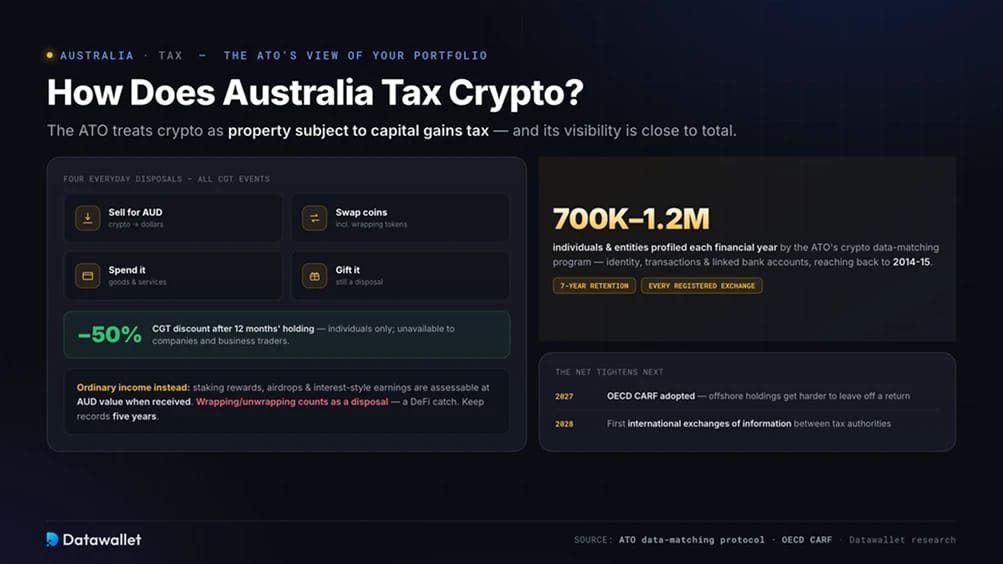
The ATO treats crypto as property subject to capital gains tax, and its visibility into Australian trading activity is close to total.
- Most disposals are CGT events. Selling crypto for dollars, swapping one coin for another, spending it, and gifting it all trigger CGT. Individuals holding an asset longer than 12 months before disposal qualify for the 50% CGT discount, unavailable to companies and business traders.
- Some receipts are ordinary income. Staking rewards, airdrops, and interest-style earnings are assessable at their AUD value when received, with that value forming the cost base for later CGT. The ATO has also confirmed that wrapping and unwrapping tokens counts as a disposal, which catches many DeFi users off guard.
- The data-matching program sees your trades. The ATO's crypto asset data-matching program collects identity, transaction, and linked bank account data on an estimated 700,000 to 1.2 million individuals and entities each financial year, reaching back to 2014-15 with seven-year retention. Assume every trade on a registered exchange is already visible.
- International reporting arrives from 2027. The government confirmed it will implement the OECD's Crypto-Asset Reporting Framework from 2027, with the first exchanges of information between tax authorities in 2028 and a parallel domestic reporting regime for local providers. Offshore holdings will get progressively harder to leave off a return.
- Records must be kept for five years. Dates, AUD values, transaction types, and counterparty details for every disposal. Exchange exports plus a tool like Koinly or the Australian-built Crypto Tax Calculator keep it manageable.
None of this is tax advice, and DeFi edge cases deserve a registered tax agent. For stablecoin purchases, our guide to buying USDT in Australia covers the practical side.
Cryptocurrency Adoption in Australia
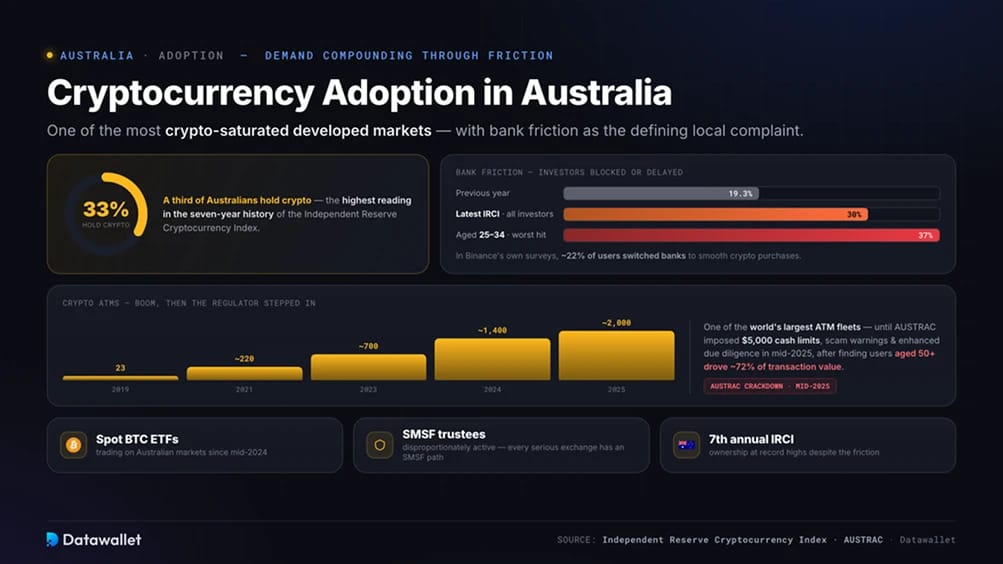
Australia ranks among the most crypto-saturated developed markets, with a few distinctive local patterns.
- A third of the country holds crypto. The seventh annual Independent Reserve Cryptocurrency Index put ownership at 33% of Australians, the highest reading in the survey's history.
- Bank friction is the defining local complaint. 30% of investors reported their bank prevented or delayed a crypto transfer, nearly double the prior year's 19.3%, with those aged 25 to 34 blocked most often at 37%. In Binance's own surveys, around 22% of users said they switched banks to smooth crypto purchases.
- Crypto ATMs boomed until the regulator stepped in. Australia hosts one of the world's largest crypto ATM fleets, growing from 23 machines in 2019 to roughly 2,000, before AUSTRAC imposed $5,000 cash limits, mandatory scam warnings, and enhanced due diligence in mid 2025 after finding users aged over 50 accounted for nearly 72% of transaction value.
- Regulated wrappers keep expanding. Spot Bitcoin ETFs have traded on Australian markets since mid 2024, and SMSF trustees remain a disproportionately active investor class, hence the dedicated SMSF onboarding paths at every serious local exchange.
Global comparisons sit on our crypto adoption statistics page. What stands out in Australia is demand that kept compounding through the friction meant to slow it.
How to Buy Bitcoin in Australia
Buying Bitcoin in Australia takes about fifteen minutes once your ID is handy, and the cheapest path pairs a free PayID deposit with a limit order on an order book.
- Pick a platform that fits your profile. Kraken for low fees and custody credibility, CoinSpot or Swyftx for the simplest local experience, Independent Reserve for an SMSF or trust structure. Confirm the AUSTRAC registration before signing up.
- Complete verification. A driver's licence or passport plus a selfie clears most platforms within minutes, though manual reviews can take a day. Enter your name exactly as it appears on the ID to avoid a stall.
- Deposit AUD by PayID or Osko. Both are free everywhere on this list. Expect a new-payee hold on the first transfer, then near-instant clearing. Skip card deposits at 1.5% to 4%.
- Buy with a limit order where an order book exists. On Kraken Pro, OKX, or CoinSpot Markets, a limit order on BTC/AUD avoids the instant-buy spread and typically saves 1% to 2%.
- Decide on custody and start a record. Active traders can leave coins on a registered exchange. Long-term holders should withdraw to self-custody, noting that Travel Rule checks now add a verification step. Our best crypto wallets guide compares hardware and software options, and a dated CSV export saves a painful rebuild at tax time.
Selling reverses the path, with free AUD withdrawals landing in minutes on PayID.
Final Thoughts
Kraken earns the top slot for the widest overlap of cheap AUD rails, low Pro fees, and a custody record without a breach. OKX wins on raw trading costs, CoinSpot and Swyftx remain the friendliest local on-ramps, Binance is back as a liquidity venue now its PayID rails have returned, Independent Reserve owns the SMSF and institutional lane under its new FTSE 250 parent, and Coinbase converts regulatory credentials into peace of mind for buyers willing to pay a premium.
The bigger shift is structural. Australia now has a licensing regime with a hard deadline, a Travel Rule in force, and a tax office that already holds most trading data. Platforms that treated compliance as optional are running out of road, and the register of AFSL applications through the 2027 transition will say more about an exchange's future than any marketing page.
Whichever platform you choose, put $100 through it before committing real size. Deposit by PayID, buy with a limit order, sell, and withdraw. The all-in cost and the time your money spent in limbo will show whether the exchange fits your bank and habits better than any review can. Kiwi readers will find the neighbouring market in our guide to the best crypto exchanges in New Zealand.
Our Methodology
We opened accounts on each exchange, completed KYC with Australian documents, funded through PayID, Osko, BSB transfers, and cards from big-four accounts, traded on live books, and withdrew AUD back out. Each platform scored across six criteria.
- Trust Score: Our proprietary rating out of 5, weighting regulatory standing with AUSTRAC and ASIC, custody and reserve transparency, security history, longevity, and audit coverage.
- AUD Funding Methods: Confirmed PayID, Osko, bank transfer, BPAY, card, and cash support, measuring settlement speed, new-payee holds, deposit limits, and withdrawal times.
- Regulatory Standing: Verified AUSTRAC registration, any AFSL held, enforcement history, and readiness for the licensing window opening in April 2027.
- Security Track Record: Reviewed breach history, custody and cold storage arrangements, proof-of-reserves cadence, certifications like ISO 27001 and SOC 2, plus 2FA and withdrawal whitelists.
- Assets and Liquidity: Placed market and limit orders on BTC/AUD, ETH/AUD, and at least one mid-cap pair on each venue, measuring spread, depth, and fill quality against mid-market.
- Fee Structure: Compared maker and taker fees, instant-buy spreads, deposit and withdrawal costs, and the all-in cost of a $1,000 AUD round trip.
We excluded platforms without AUSTRAC registration, without a functional AUD deposit path, or with unresolved compliance failures. Testing ran from March to July, with regulatory statuses rechecked after the 1 July AML changes took effect.
%20(1).webp)