







Can I Buy USDT in the Philippines?
Filipinos can buy and own USDT legally. Regulation applies to the platform rather than the buyer. Under BSP Circular No. 1108, any business converting pesos into crypto must hold a Virtual Asset Service Provider (VASP) license. Licensed providers must conduct identity checks and comply with anti-money-laundering reporting requirements. USDT is not legal tender, but ownership is unrestricted.
For now, the list of licensed providers is short and closed to new entrants. The BSP stopped accepting new VASP applications in September 2022, then extended the freeze indefinitely in August 2025. Most buyers will encounter Coins.ph, PDAX, Maya, UnionBank, GoTyme Bank, or GCash's GCrypto, which is operated by PDAX.
Access is also governed by the SEC. Its Crypto-Asset Service Provider rules took effect on 5 July 2025. Platforms serving Filipinos must incorporate locally and maintain ₱100 million in paid-up capital. Within a month, the SEC named ten offshore exchanges as non-compliant, and internet providers blocked access to them. When we attempted to register from a Manila IP, the platform rejected a +63 number.
How to Buy Tether (USDT) in the Philippines
The simplest route is to verify a Coins.ph account, fund it through InstaPay, and place a limit order on the Coins Pro USDT/PHP order book. Since BSP Circular 1238 took effect in July, BDO, BPI, Metrobank, LandBank, and UnionBank have removed InstaPay and PESONet fees for individuals. As a result, neither side charges for the cash-in.
Steps to buy USDT on Coins.ph with pesos:
- Create and verify your account: Register through the Coins.ph app using a Philippine mobile number. Complete Identity Verification with a government-issued ID, such as PhilSys, a passport, UMID, or a driver's license, followed by a face scan. Verification enables cash-ins, trading, and withdrawals. You can raise your limits through Enhanced Verification by providing proof of income.
- Cash in pesos over InstaPay: Open your bank app, select InstaPay, and choose DCPay Philippines / Coins.ph as the destination. Enter your mobile number to complete the transfer. Coins.ph charges no receiving fee. Each transfer is capped at ₱50,000, with funds usually arriving within seconds. For larger amounts, PESONet settles within the banking day.
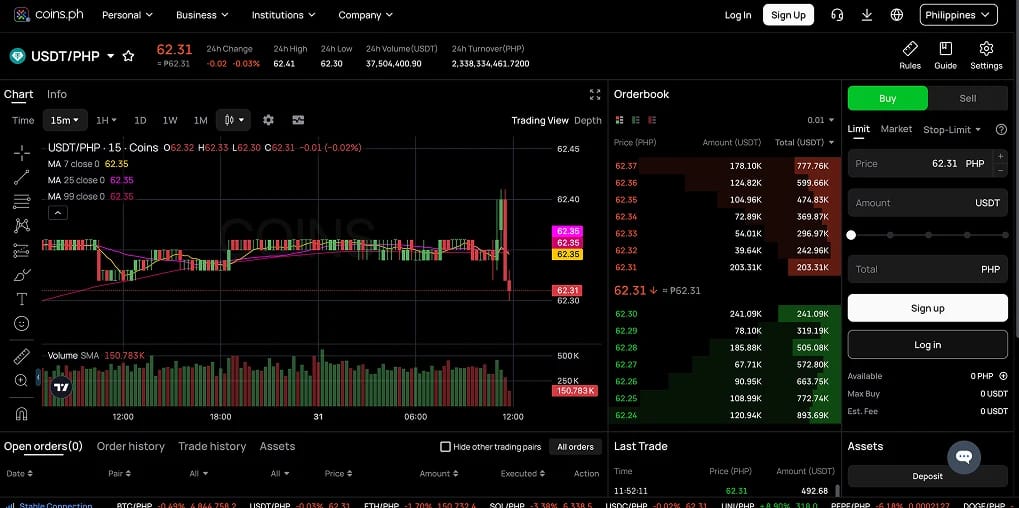
- Open Coins Pro and load USDT/PHP: Use the live order book instead of the Convert button, which includes its cost in the quoted price. During our test in Manila business hours, the USDT/PHP spread remained within a few centavos and sat slightly above the day's dollar rate.
- Place a limit order: Set your bid at the best ask or just inside it. At the entry tier, a resting order incurs a 0.10% maker fee. Market orders are charged a 0.15% taker fee under the Coins.ph fee schedule.
- Hold, spend, or withdraw: You can leave the USDT in the app, convert it back to pesos at any time, or transfer it to a wallet you control. Tron (TRC-20) costs about a dollar and confirms in under a minute. Ethereum transfers can cost several dollars in gas.
PHP to USDT Fees
Your funding method determines most of the cost of converting pesos into USDT through Coins.ph.
Deposits
- InstaPay (recommended): Coins.ph does not charge to receive the transfer, while major banks now offer free sending after the BSP's July pricing reform. Transfers are real-time and capped at ₱50,000 each. You can make multiple transfers within your account limits.
- PESONet: Receiving funds through PESONet is free on Coins.ph, and most banks no longer charge individuals to send. Payments settle in batches on banking days. There is no per-transfer cap beyond the limit attached to your verification level.
- GCash and Maya: Coins.ph adds no receiving charge, although each e-wallet sets its own outbound fee. Check the confirmation screen before transferring. Our guide to buying crypto with GCash explains how to buy through the GCash app itself.
- 7-Eleven and partner outlets: These outlets provide an alternative for buyers without bank accounts. A service charge appears before confirmation, so we use this method only for small top-ups.
Trading and withdrawals
- Coins Pro order book: Base VIP fees are 0.10% for makers and 0.15% for takers. They fall to 0.03% and 0.05% as 30-day trading volume increases. Because Coins Pro offers a direct USDT/PHP pair, peso holders avoid the extra conversion required by global exchanges.
- Convert: There is no separate fee, but the quoted price includes a wider spread than the order book. We use Convert only for amounts below a few thousand pesos.
- USDT network fees: TRC-20 transfers cost approximately US$1, while Solana transfers cost a few cents. ERC-20 fees depend on Ethereum gas when the transaction is sent.
- Cashing out to pesos: Individuals can make PESONet cash-outs for free. InstaPay cash-outs cost a flat ₱5 for transfers up to ₱50,000. Funds usually reach a bank, GCash, or Maya balance within minutes.
For a comparison with global platforms, see our roundup of the best USDT exchanges.
Best USDT Exchanges in the Philippines
The following table ranks BSP-licensed platforms that allow Filipinos to buy USDT with pesos. We weighted funding options, fees, liquidity, and regulatory standing. Every provider listed appears on the BSP's VASP register. For a broader comparison, read our guide to the best crypto exchanges in the Philippines.
Bybit, OKX, and Binance have been excluded deliberately. The SEC issued an earlier advisory against Binance, which was blocked in 2024. Its August 2025 advisory then identified Bybit and OKX among ten platforms operating without CASP registration.
Regulatory Status of USDT in the Philippines
Philippine rules govern the platforms selling USDT and the standards they must follow. They do not restrict the token itself. Four authorities shape the experience of Filipino holders:
The latest rule determines which tokens licensed platforms may offer. BSP Memorandum No. M-2026-023, signed on 5 June, requires VASPs to complete a six-pillar due-diligence review before listing an asset. It also prohibits privacy coins.
Fiat-backed tokens receive additional scrutiny under the memo, including reviews of their issuance and redemption processes, as well as how they are minted and burned. USDT remained available on every licensed platform we checked. The rule therefore removes anonymity-focused assets without taking stablecoins off the market.
Coins.ph is operated by Betur Inc., which holds BSP registration as a VASP, Electronic Money Issuer, and Remittance and Transfer Company. Its sister entity, DCPay Philippines Inc., has a separate EMI license. Peso balances held in the app are regulated e-money, allowing the platform to settle with banks through InstaPay.
In February, the BSP instructed every supervised bank and e-wallet to work only with VASPs that hold both BSP authority and SEC CASP registration. Buyers should check a platform against both registers before depositing, which is the same standard now applied by banks.
Tax Implications of USDT in the Philippines
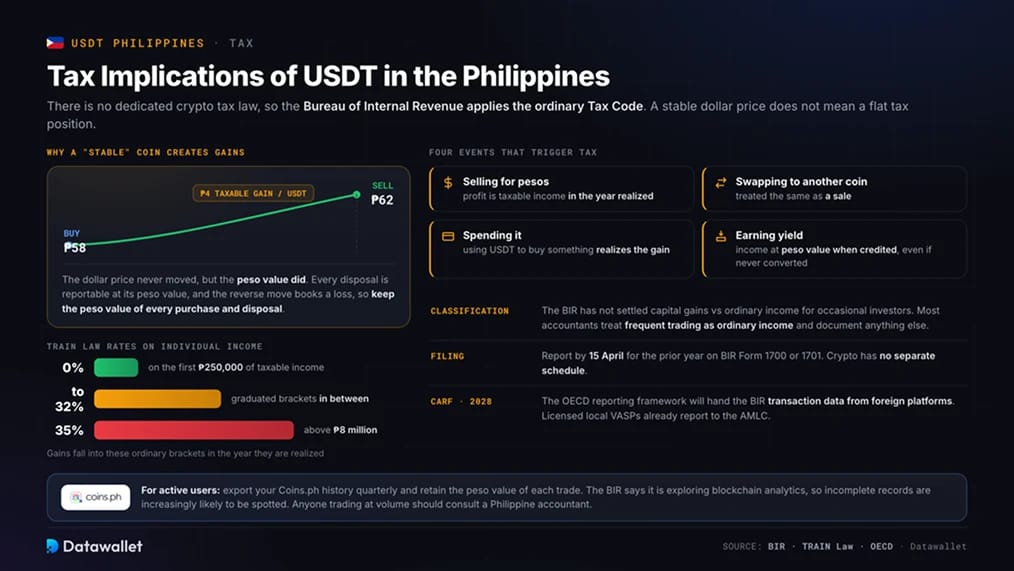
USDT may maintain a stable dollar price, but its tax position is not necessarily flat. The Philippines has no dedicated crypto tax law, so the Bureau of Internal Revenue relies on the ordinary provisions of the Tax Code.
- Gains are taxable income: Selling USDT for pesos at a profit creates taxable income in the year the gain is realized. The same applies when swapping it for another coin or using it to make a purchase. Under the TRAIN Law, individual tax rates range from 0% on the first ₱250,000 of taxable income to 35% above ₱8 million.
- The peso price moves even when the dollar price does not: Buying one USDT at ₱58 and selling it at ₱62 creates a fully reportable gain of ₱4 per token. A move in the opposite direction produces a loss. Keep the peso value of every purchase and disposal.
- Classification is still open: The BIR has not decided whether gains earned by occasional crypto investors should be treated as capital gains or ordinary income. Most accountants classify frequent trading as ordinary income and document the basis for any other treatment.
- Yield is income on receipt: Rewards from staking or earn products are taxable at their peso value when credited, even if they are not converted.
- Filing runs to 15 April: Individuals report income for the previous calendar year using BIR Form 1700 or 1701. Crypto does not have a separate schedule.
- Cross-border reporting arrives in 2028: The Department of Finance has committed the Philippines to implementing the OECD Crypto-Asset Reporting Framework. This will provide the BIR with transaction data from foreign platforms. Licensed VASPs in the Philippines already submit reports to the AMLC.
💡 For active users: Export your Coins.ph transaction history every quarter and retain the peso value of each trade. In April, the BIR said it was exploring blockchain analytics for compliance work, increasing the likelihood that incomplete records will be identified. This is general information. Anyone trading at volume should consult a Philippine accountant.
Why Filipinos Hold USDT
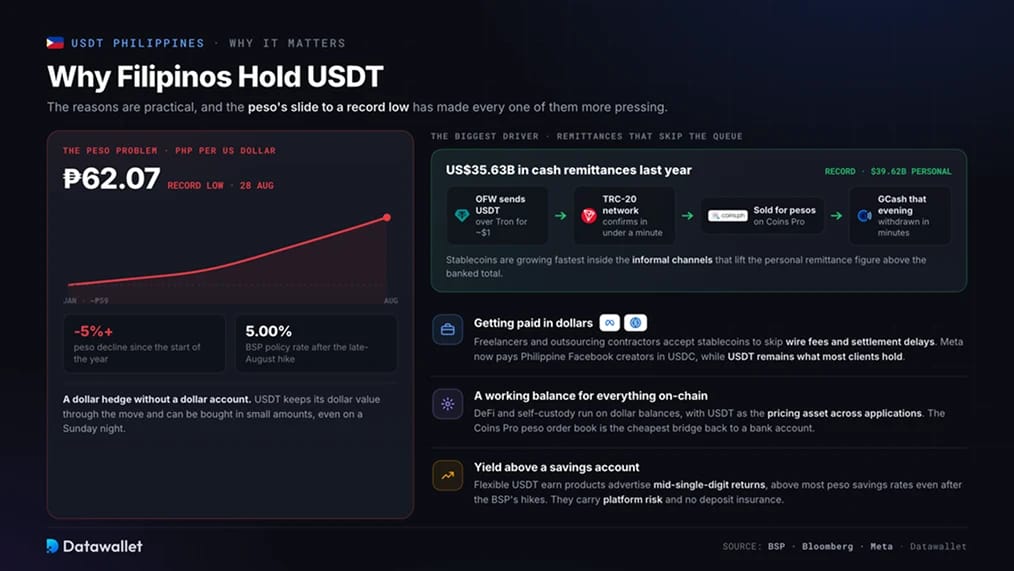
The reasons Filipinos hold USDT are practical, and the peso's decline has made them more pressing.
- A dollar hedge without a dollar account: On 28 August, the peso breached ₱62 per dollar for the first time. It has lost more than 5% since the beginning of the year. USDT retains its dollar value through that movement and can be purchased in small amounts, even on a Sunday night.
- Remittances that skip the queue: Overseas Filipinos sent a record US$35.63 billion in cash remittances last year. Stablecoin use is growing within the informal channels that raise the personal remittance figure to US$39.62 billion. A relative overseas can send USDT over TRC-20 for about a dollar. The recipient can then sell it through Coins.ph and withdraw to GCash that evening. Our USDT statistics page follows the token's increasing use for payments.
- Getting paid in dollars: More freelancers and outsourcing contractors are accepting stablecoins from overseas clients to avoid wire fees and settlement delays. Meta's April decision to pay Philippine Facebook creators in USDC shows that stablecoin payouts are entering the mainstream. USDT remains the token held by most clients.
- A working balance for everything on-chain: Decentralized finance and self-custody both rely on dollar-denominated balances, with USDT serving as the pricing asset across many applications. The Coins Pro peso order book provides the cheapest connection between those applications and a bank account.
- Yield above a savings account: Flexible USDT earn products advertise mid-single-digit returns, exceeding most peso savings rates even after the BSP's rate increases. These products carry platform risk and are not covered by deposit insurance. Our guide to USDT yield opportunities explains the trade-offs.
Final Thoughts
Coins.ph is our preferred platform for Filipinos buying USDT. It combines the country's longest-running BSP crypto license with free InstaPay and PESONet cash-ins from major banks. Coins Pro also provides a native USDT/PHP order book with a 0.10% maker fee, while withdrawals can reach any bank, GCash, or Maya balance within minutes.
Verify your account with a PhilSys ID and begin with a small InstaPay test. For purchases above pocket money, place limit orders through Coins Pro instead of using Convert. Keep peso-denominated records of every trade for the BIR. Any balance beyond your trading capital should be transferred to a USDT wallet you control.
The wider market has one important limitation. The BSP's freeze on new licenses keeps the regulated sector small, which can lead to wider pricing. Before placing a large order, compare the Coins Pro USDT/PHP quote with PDAX and GCrypto.
Avoid accessing offshore exchanges through a VPN. The SEC has warned that Filipino users have no legal recourse if withdrawals stall on an unregistered platform. Licensed local providers already cover everything a USDT buyer needs.
.webp)