



What Was the October 10 (10/10) Crypto Crash?
The October 10 crypto crash was a mechanical unwind of leveraged derivatives positions. It began on a Friday evening, with most of the damage occurring within 40 minutes. No exchange went bankrupt and no protocol failed, distinguishing it from the FTX collapse and Terra implosion covered in our ranking of the biggest crypto crashes in history.
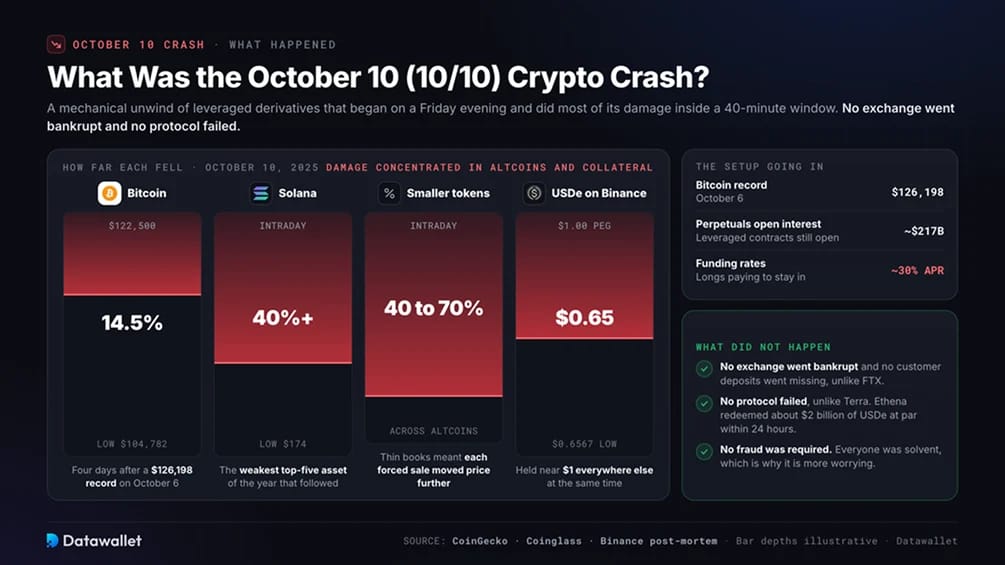
Four days earlier, on October 6, Bitcoin had reached a record $126,198. Open interest in perpetual futures, the total value of leveraged contracts still open, stood near $217 billion. With longs crowded around fresh highs, even a modest decline could push many accounts through their liquidation thresholds together.
Altcoins and collateral tokens that lost their pegs on one venue suffered the most. Bitcoin fell about 14.5%, while smaller tokens dropped 40% to 70% intraday. Ethena's USDe, a synthetic dollar that earns yield from hedged derivatives positions, briefly traded at $0.65 on Binance despite holding close to $1 everywhere else.
October 10 Crypto Crash Statistics
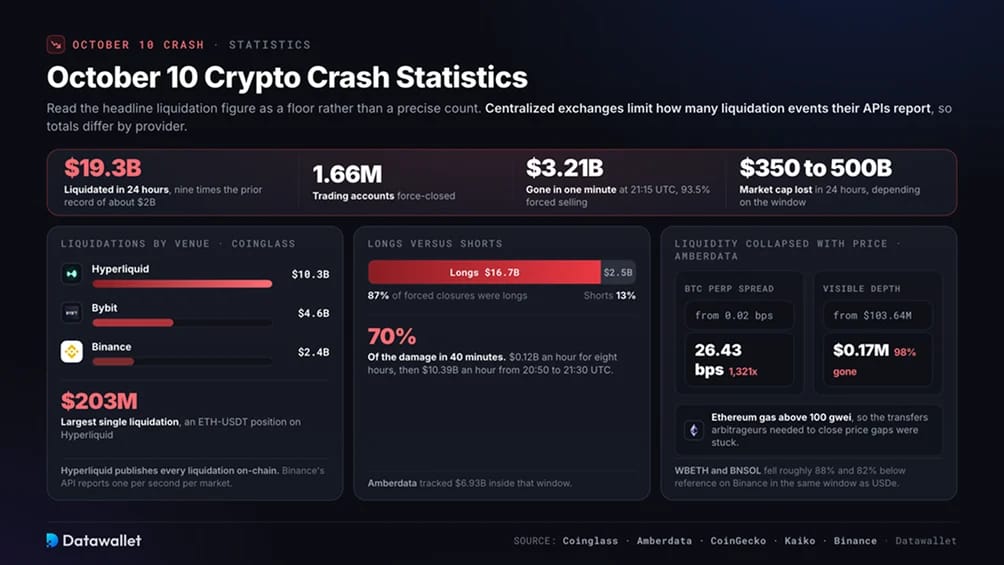
The headline liquidation figure is a floor, not a precise count. Centralized exchanges limit the liquidation events reported through their APIs, so totals vary by provider. The figures below draw on Coinglass, Amberdata, CoinGecko, and exchanges' own post-mortems.
The numbers that matter most:
- Nine times the prior record: Coinglass data put forced closures near $19.3 billion, compared with a previous single-day high of about $2 billion. Longs accounted for 87% of the total.
- Seventy percent of the damage in forty minutes: Amberdata's minute-level analysis shows liquidations ran at $0.12 billion per hour for eight hours before surging to $10.39 billion per hour between 20:50 and 21:30 UTC. At 21:15 UTC, $3.21 billion disappeared in 60 seconds, with forced selling accounting for 93.5%.
- Hyperliquid carried the largest reported share: Its $10.3 billion exceeded half the Coinglass total. Reporting explains part of that share. Every Hyperliquid liquidation is visible on-chain, whereas Binance's API reports one liquidation per second per market, understating actual activity in its $2.4 billion figure.
- Liquidity collapsed alongside price: Visible depth on tracked order books fell 98%, and BTC perpetual spreads widened 1,321 times. Each forced sale therefore moved prices much more than it would have an hour earlier.
- USDe lost a third of its value on one exchange: Between 21:36 and 22:15 UTC, the synthetic dollar fell to $0.6567 on Binance while holding near $1 elsewhere. Binance's wrapped staking tokens, WBETH and BNSOL, traded roughly 88% and 82% below their reference values during the same window.
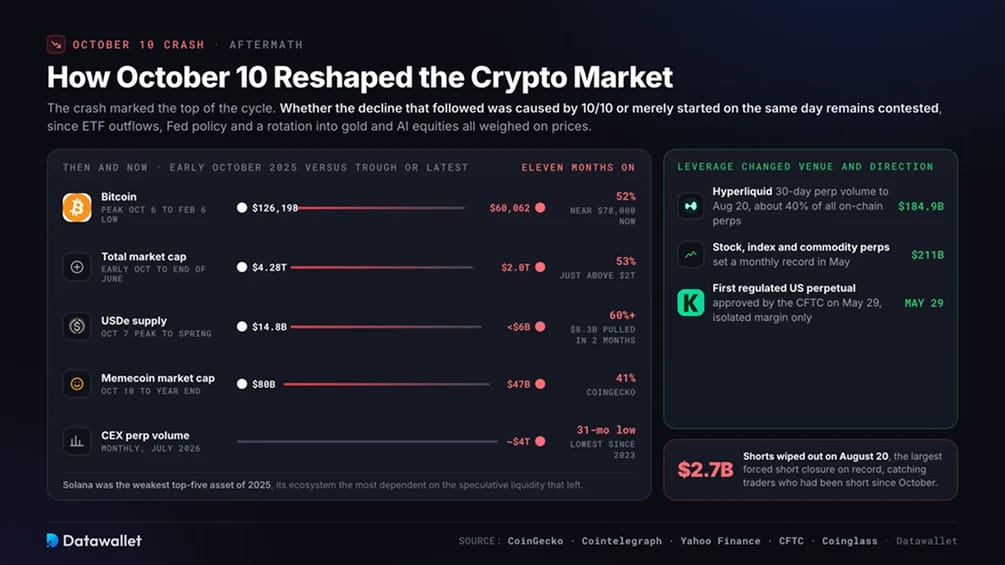
- The repricing did not end that weekend: Bitcoin reached $60,062 on February 6 as our Fear and Greed Index recorded an all-time low of 5. It slipped below $59,000 in late June before trading near $78,000 in early September 2026.
Why Did Crypto Crash on October 10?
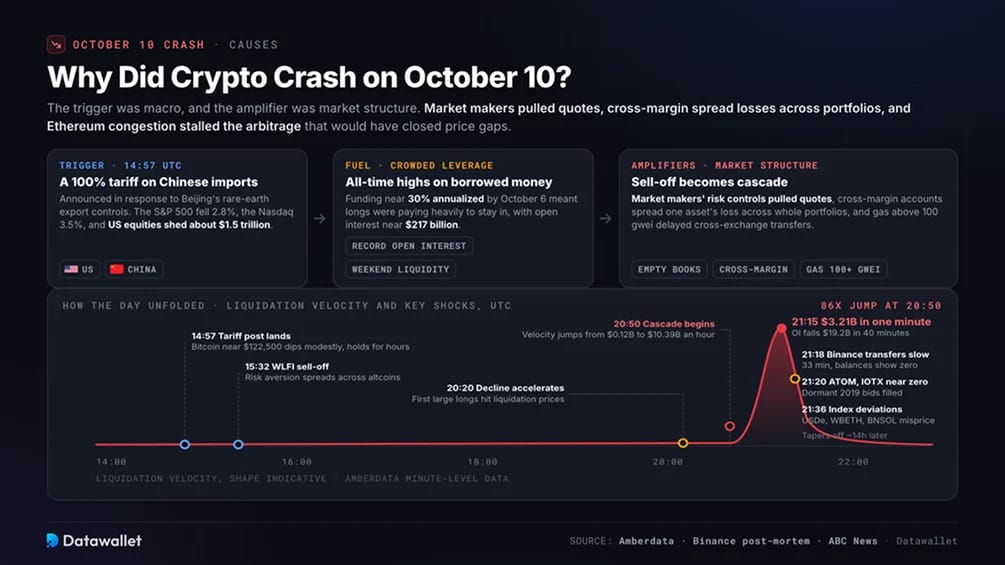
At 14:57 UTC, President Trump announced a 100% tariff on Chinese imports, effective November 1, in response to Beijing's new rare-earth export controls. The S&P 500 fell about 2.8% and the Nasdaq about 3.5%. By the close, US equities had shed roughly $1.5 trillion in value.
Crypto entered the sell-off heavily leveraged after spending the first week of October at all-time highs. By October 6, funding rates had reached around 30% annualized. These periodic payments from longs to shorts when perpetual prices exceed spot prices showed how heavily traders were paying to maintain long exposure. Our funding rates tracker and Bitcoin open interest page both showed positioning at or near record levels going into the weekend.
As volatility rose, market makers' automated risk controls withdrew quotes, leaving almost no resting orders near the current price. Cross-margin accounts used one collateral pool to back all open positions, spreading losses from individual assets across entire portfolios.
Ethereum congestion compounded the problem. Gas rose above 100 gwei, delaying the cross-exchange transfers arbitrageurs needed to close price gaps. A macro-driven sell-off had become a market-structure cascade.
How the Day Unfolded
The key shocks, in order:
- 14:57 UTC: The tariff post lands. Bitcoin, trading near $122,500, dips modestly and holds for several hours.
- 15:32 UTC: Selling in the WLFI token spreads risk aversion across altcoins, according to Amberdata's timeline.
- 20:20 UTC: Bitcoin's decline accelerates as weekend liquidity thins. The first large long positions reach their liquidation prices.
- 20:50 UTC: The cascade begins, with liquidation velocity jumping 86 times from the pre-cascade rate.
- 21:15 UTC: Forced closures reach $3.21 billion in a single minute. Across the 40-minute window, open interest in Amberdata's dataset falls $19.2 billion.
- 21:18 to 21:51 UTC: Binance's internal asset-transfer subsystem slows for 33 minutes. Some users see zero balances displayed while their positions are being liquidated.
- 21:20 UTC: ATOM and IOTX briefly trade near zero on Binance spot. With order books empty, dormant bid orders from 2019 are filled.
- 21:31 UTC: BTC perpetual spreads peak at 26.43 basis points, up from a normal 0.02.
- 21:36 to 22:15 UTC: Binance's index prices for USDe, followed by WBETH and BNSOL, diverge from their reference values. Accounts using these tokens as collateral are liquidated at prices found on no other venue.
- Overnight into October 11: Forced selling tapers off roughly 14 hours after it began. Bitcoin bottoms near $104,782. Within 24 hours, Ethena processes about $2 billion of USDe redemptions at par.
Which Exchanges Were Hit Hardest?
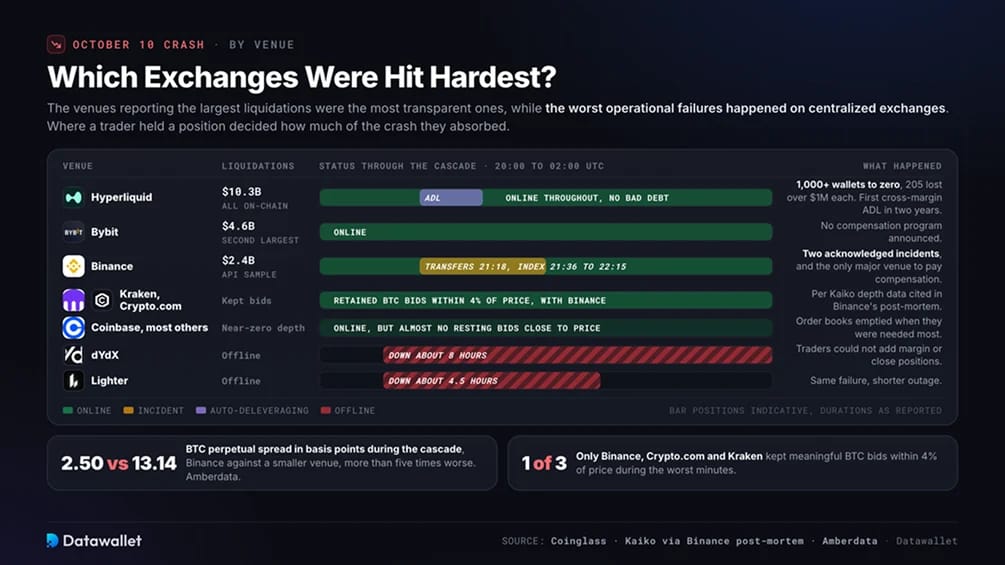
The most transparent venues reported the largest liquidation totals. Centralized exchanges experienced the worst operational failures.
- Hyperliquid: Coinglass attributed $10.3 billion in liquidations to the on-chain perpetuals exchange. More than 1,000 wallets were wiped to zero, and 205 lost over $1 million each. Hyperliquid remained online with no bad debt, although it triggered its first cross-margin auto-deleveraging event in more than two years. Profitable shorts were forcibly closed to cover insolvent longs.
- Bybit: Liquidations totaled $4.6 billion, the second-largest reported amount. Bybit did not announce a compensation program.
- Binance: The exchange reported $2.4 billion in liquidations and had the largest number of documented failures. Its own report identifies two incidents: the 33-minute transfer slowdown and the three-token index deviation. Binance is the only major venue to have announced compensation.
- Kraken, Coinbase, and Crypto.com: Kaiko's depth data, cited in Binance's post-mortem, showed that only Binance, Crypto.com, and Kraken retained meaningful BTC bids within 4% of the prevailing price during the worst minutes. Coinbase and most other major venues had near-zero depth close to that price.
- dYdX and Lighter: Both decentralized venues went offline. The dYdX outage lasted about eight hours and Lighter's around four and a half, preventing traders from adding margin or closing positions during the cascade.
Binance's BTC perpetual spread averaged 2.50 basis points during the cascade, according to Amberdata. A smaller venue reached 13.14, more than five times worse. The exchange a trader used determined how much of the crash they absorbed.
Binance, USDe, and the Blame Debate
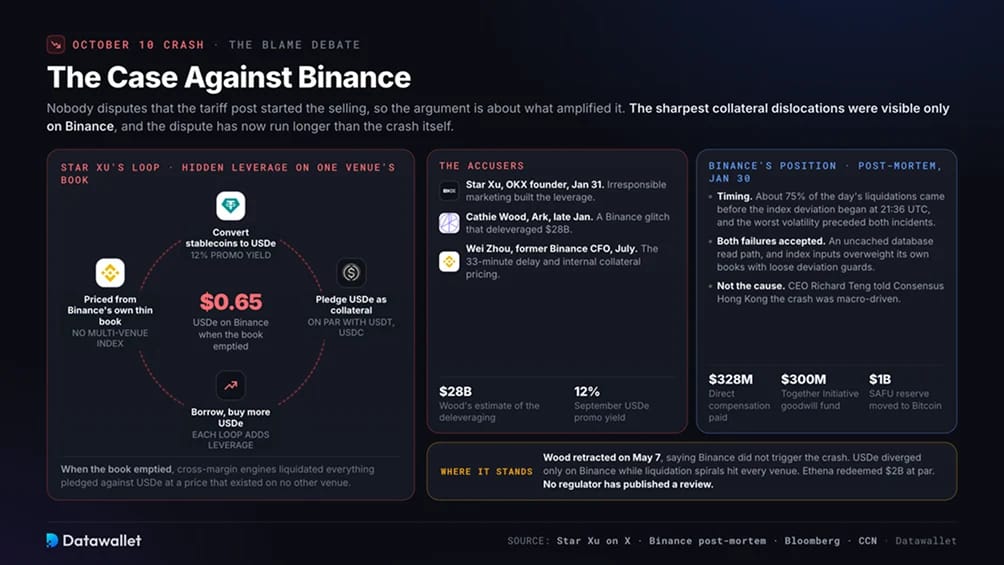
The sharpest collateral dislocations occurred only on Binance, putting the world's largest exchange at the center of a dispute that has outlasted the crash. The tariff post is undisputed as the trigger. The disagreement concerns what amplified the selling.
The Case Against Binance
On January 31, OKX founder Star Xu posted that 10/10 was caused by irresponsible marketing campaigns, making the most detailed accusation against Binance. He singled out a September promotion offering a 12% annual yield on USDe held on the exchange. Binance also allowed traders to use USDe as collateral on equal terms with USDT and USDC.
Xu described traders converting stablecoins into USDe, borrowing against it, then using the proceeds to buy more USDe. Repeating the process added hidden leverage to a token priced from Binance's own thin order book. Once that book emptied, USDe fell to $0.65. Cross-margin engines then liquidated everything pledged against it.
Ark Invest's Cathie Wood brought the criticism to a wider audience in late January by attributing the crash to a Binance software glitch. She estimated that it deleveraged the system by $28 billion.
In July, former Binance CFO Wei Zhou highlighted the 33-minute processing delay and a unified margin system that valued collateral using internal quotes rather than multi-venue reference prices. Xu endorsed Zhou's analysis, arguing that rebuilding lost trust takes years.
Binance's Position
Timing forms the basis of Binance's January 30 post-mortem. Roughly 75% of the day's liquidations occurred before the index deviation began at 21:36 UTC. The report also places the highest-volatility window, 21:10 to 21:20 UTC, before both platform incidents. Binance's position is that the macro shock and crowded leverage had already caused most of the damage.
The exchange accepted responsibility for both incidents. A database read path without caching became saturated under five to ten times normal traffic, causing the transfer slowdown. Its price indices placed too much weight on internal order books and too little on redemption values. Deviation limits were also too loose for a fast-moving market.
By October 12, Binance had paid about $283 million to users affected during the depeg window. That amount later rose to $328 million. On October 14, it introduced the Together Initiative, with a $300 million goodwill program for liquidated users outside the compensation criteria and a $100 million low-interest loan pool for institutions.
Binance converted its $1 billion SAFU emergency reserve, the Secure Asset Fund for Users, into Bitcoin in late January. The following month, CEO Richard Teng told Consensus Hong Kong that the crash was macro-driven and Binance was not the cause.
Where the Argument Stands
Wood, the most prominent critic, has since reversed her position. On May 7, she clarified that Binance did not trigger the crash but maintained that a software error occurred. Dragonfly's Haseeb Qureshi observed that USDe diverged only on Binance while liquidation spirals affected every venue, pointing to market-wide leverage rather than a single exchange. Wintermute CEO Evgeny Gaevoy called both the glitch narrative and the single-culprit narrative dishonest.
Ethena's data supports elements of both arguments. Founder Guy Young said minting and redemption continued normally, with about $2 billion redeemed at par within 24 hours. He attributed Binance's price to an internal oracle problem, not the token's collateral. His account aligns with Binance's description of the failure and with critics who say that failure resulted from Binance's design choices.
No regulator has published a formal review. Former CFTC official Salman Banaei has called for an inquiry modeled on the SEC and CFTC's joint report into the 2010 equities flash crash. Protos reported in February that lawsuits and arbitration claims against Binance were accumulating. Without a neutral post-mortem, the dispute will resurface whenever the market weakens.
What Changed After October 10
Exchanges mainly revised pricing and collateral rules rather than imposing blanket leverage restrictions. Regulators have favored approved products over bans.
The concrete changes we can verify:
- Binance rebuilt its index methodology: The exchange added redemption prices to the index weights for USDe, WBETH, and BNSOL. It introduced a minimum USDe price threshold and tighter deviation guards, alongside a commitment to more frequent risk parameter reviews. Database capacity and caching were expanded on the transfer path that failed.
- Collateral haircuts and leverage caps tightened: FTI Consulting's review found that several large venues increased discounts on fragile collateral and lowered maximum leverage on selected pairs. They also began shifting key oracles toward multi-venue pricing. Retail inflows into leveraged products cooled for months.
- Auto-deleveraging came under academic scrutiny: A December study of Hyperliquid's on-chain ADL data counted 34,983 executions across 19,337 wallets. It estimated that the queue cut positions by about $653 million more than the deficits that materialized. Hyperliquid's founder has said research into refined ADL formulas remains ongoing.
- US regulators approved perpetuals rather than banning them: On May 29, the CFTC approved the first regulated US bitcoin perpetual, listed by Kalshi, and classified perpetuals as futures. The design limits leverage, includes volatility controls, and permits isolated margin only. It is the closest regulatory answer to 10/10 so far. Our guide to Kalshi perpetuals explains how the product differs from offshore contracts.
- Compensation became a benchmark: Binance's $328 million payout remains the largest user remediation in exchange history. No other major venue announced a comparable program for October 10 losses.
- Liquidity has not fully returned: CoinDesk reported in February that order books remained thin and fragmented after the crash. Wider spreads were blamed for Bitcoin's continued slide, while market makers with damaged balance sheets returned slowly.
How October 10 Reshaped the Crypto Market
The crash marked the cycle's top. Bitcoin has not traded above $126,000 since, and total crypto market capitalization declined from about $4.28 trillion in early October to just above $2 trillion by the end of June. Whether 10/10 caused that decline or simply marked its beginning remains disputed. ETF outflows and Fed policy also weighed on prices through the year, alongside a broad rotation into gold and AI equities.
USDe was the clearest casualty. Supply peaked near $14.8 billion on October 7, then fell below $6 billion by spring, a decline of more than half. Investors pulled about $8.3 billion in the two months following the crash. Ethena has since directed part of its reserve strategy toward institutional lending and real-world assets. Our explainer on how Ethena and USDe work covers the mechanics behind the yield.
Speculative altcoins lost liquidity as the traders supplying it withdrew. CoinGecko found that memecoin market capitalization dropped from about $80 billion on October 10 to $47 billion by year end. Solana, whose ecosystem relied most heavily on that activity, finished 2025 as the weakest top-five asset. Monthly perpetual volume on centralized exchanges fell to roughly $4 trillion in July, a 31-month low documented on our perpetual futures statistics page.
Leverage persisted, but its venue and direction changed. In the 30 days to August 20, Hyperliquid handled $184.9 billion in perpetual volume, about 40% of all on-chain perpetuals. Perpetuals on stocks, indices, and commodities had set a monthly record of $211 billion in May.
The August 20 rally caught traders who had held shorts since October, wiping out about $2.7 billion in short positions. It was the largest forced short closure on record. Our live liquidations tracker shows how quickly positioning can reverse.
Lessons for Traders
Specific trading decisions, rather than leverage alone, determined losses on October 10.
What would have limited losses on the day:
- Treat collateral as a position in its own right: Pledging a yield-bearing synthetic dollar at par is a trade on its peg, regardless of how the interface presents it. Assume any collateral other than USDT, USDC, or the asset you are trading will face a discount. Expect promotional yields to disappear under stress.
- Know how your exchange builds its index price: Binance's dislocation occurred because it valued collateral from one venue's order book. Before trading with size, check the index used to value collateral and trigger liquidations. It should draw on multiple venues, incorporate redemption values for wrapped assets, and have deviation guards.
- Prefer isolated margin for directional bets: Cross-margin spread single-asset losses into portfolio-wide liquidations. Isolated margin confines the damage to one position, though it requires manual margin top-ups.
- Read funding and open interest together: Funding near 30% annualized combined with record open interest signaled crowded positioning in early October. Reduce leverage or hedge when both reach extremes, particularly before weekends when order book depth thins.
- Keep spare margin on the venue you trade: With Ethereum gas above 100 gwei, collateral held in a wallet could not reach an exchange in time. Pre-fund margin buffers where you hold positions and maintain accounts on more than one exchange.
- Understand auto-deleveraging before it happens to you: If an insurance fund runs dry, your profitable short can be closed against your will. Check the ADL ranking indicator and consider a hedged position only partially hedged during a cascade. Our BTC liquidation heatmap identifies clustered liquidation levels before a move.
- Document everything during volatility: Binance calculated compensation using system logs and documented attempts to act. Keep timestamped screenshots and file support tickets during the event so you can substantiate a later claim.
Final Thoughts
October 10 exposed failures that can recur without fraud. Order books emptied, Binance priced collateral from its own thin market, and Ethereum congestion delayed transfers needed to close price gaps. That makes the event more worrying than FTX: nobody needs to break the law for it to happen again.
Binance fixed its two acknowledged failures and paid record compensation, but eleven months later, no neutral review exists and rival executives still dispute responsibility. The strongest structural response came from outside offshore markets: the CFTC's approval of leverage-limited onshore perpetuals.
For traders, venue design matters as much as market direction. Another 10/10 depends less on the next headline than on how much leverage has rebuilt, the collateral backing it, and how exchanges price that collateral.