



About Coinbase
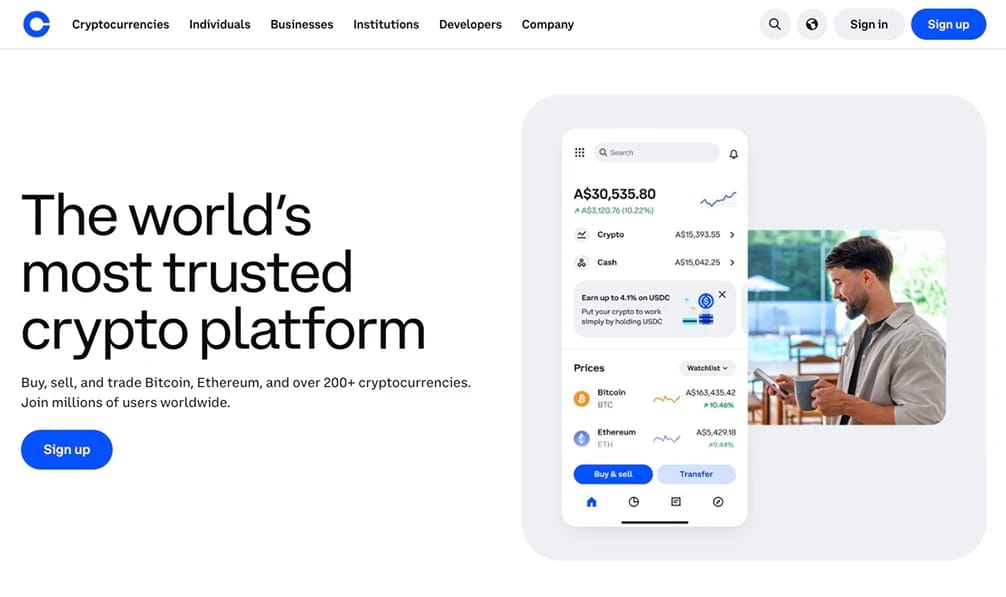
Brian Armstrong and Fred Ehrsam launched Coinbase in 2012 as a simple way to buy Bitcoin with a bank account. It listed on Nasdaq in April 2021 and joined the S&P 500 in May 2025, the first crypto company admitted to the index.
The Q4 2025 shareholder letter states that over 12% of the world's crypto sat on the platform during 2025, and the institutional arm alone held $245.7 billion by mid-2025, including reserves for the large majority of US spot Bitcoin and Ethereum ETFs.
The 2026 numbers show diversification working as trading cools. Second-quarter revenue came in at $1.2 billion with a $359 million net loss after crypto prices fell, yet the company's share of global crypto trading volume reached a record 10.3%, and subscriptions and services produced 48% of net revenue. Availability spans 115 countries, mapped on our Coinbase supported countries page.
Coinbase Features
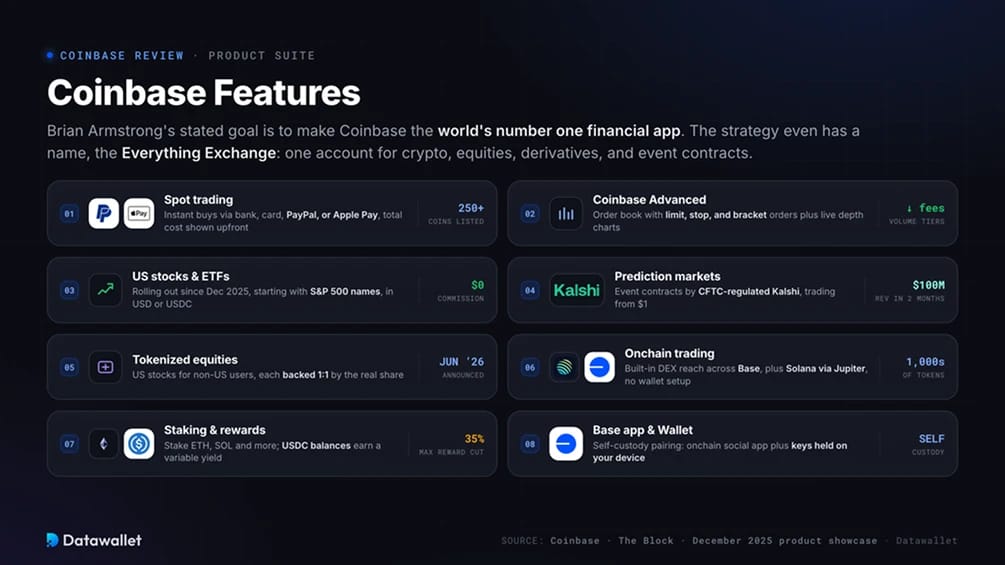
Armstrong has set a public goal of making Coinbase the world's number one financial app, and the product list reads accordingly. At a December 2025 showcase, the company named the strategy the Everything Exchange, one account for crypto, equities, derivatives, and event contracts.
- Spot trading: More than 250 cryptocurrencies can be bought instantly with bank transfers, cards, PayPal, or Apple Pay on the simple interface, with the total cost shown before confirmation.
- Coinbase Advanced: The order-book venue inside the same account adds limit, stop, and bracket orders, live depth charts, and volume-based pricing that undercuts the simple screen.
- US stocks and ETFs: Commission-free equities began rolling out to American users in December 2025, starting with S&P 500 names and payable in dollars or USDC.
- Prediction markets: Event contracts supplied by Kalshi, the CFTC-regulated exchange, trade from $1 beside crypto balances. The product passed $100 million in annualized revenue within two months, the fastest launch in company history.
- Tokenized equities: In June 2026, Coinbase announced tokenized US stocks for customers outside the US, each fully collateralized by the underlying share, a product class we compare in our best tokenized stock trading exchanges guide.
- Onchain trading: A built-in DEX aggregator reaches thousands of Base tokens, and a Jupiter integration extends the same access to Solana tokens, no separate wallet required.
- Staking and rewards: Users can stake ETH, SOL, and other supported assets, with Coinbase deducting a commission of up to 35% from protocol rewards, while USDC balances earn a variable yield.
- Base app and Coinbase Wallet: The self-custody side pairs an onchain trading and social app with a wallet holding keys on the user's device.
Did Coinbase Buy Deribit?
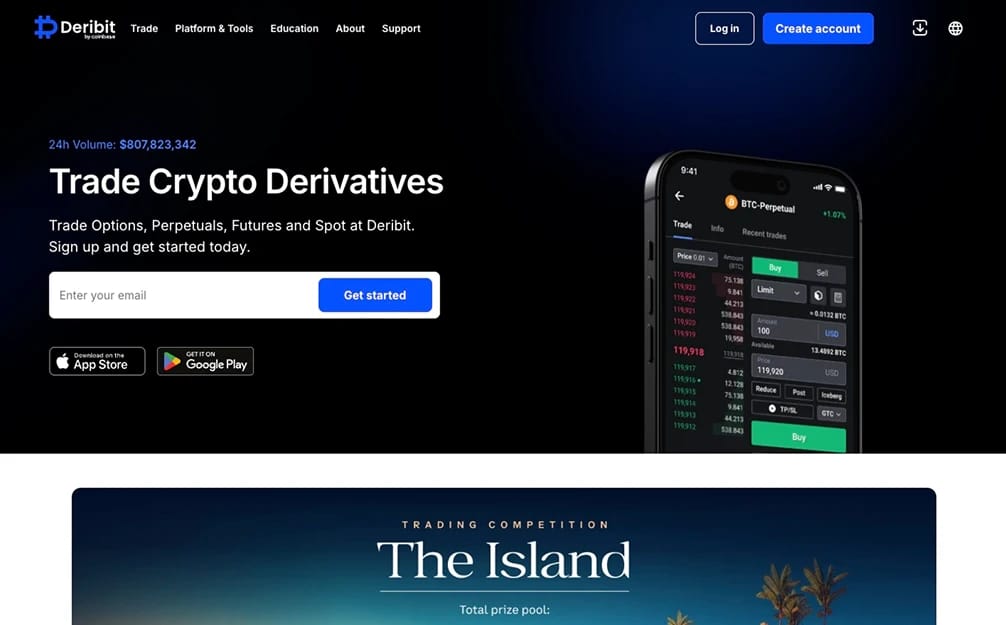
Yes, Coinbase paid $2.9 billion for Deribit, the dominant crypto options exchange, and closed the deal in 2025. The purchase folded the market's deepest options order books into a company already running regulated US futures and an offshore perpetuals venue.
In May 2026, CFTC guidance allowed Coinbase Financial Markets, a registered futures commission merchant, to connect eligible US institutional clients to Deribit options. Retail access had not launched at the time, with Coinbase stating that broader availability was planned.
Domestic retail products keep widening too. Coinbase Financial Markets runs CFTC-regulated futures and perpetual-style contracts on major coins with up to 10x leverage, added copper and platinum futures in January 2026, and launched 24/7 stock index perpetuals at up to 20x with USDC settlement in June.
Perpetuals clear tens of trillions of dollars a year across the industry, and our best crypto futures exchanges guide shows how Coinbase's pricing compares with the specialist venues.
Coinbase One and the One Card
Coinbase One is the subscription layer, with a Basic plan at $4.99 a month or $49.99 a year and higher tiers reaching $299.99 a month. Membership removes fees on simple trades up to plan limits, lifts the USDC yield, trims the staking commission, and adds priority support.
The headline perk is the Coinbase One Card, a credit card on the American Express network that opened to all US members in October 2025. It pays 2% to 4% back in Bitcoin depending on how much the holder keeps on Coinbase, with the boosted rates capped at $10,000 of spending a month, and charges no annual fee beyond the membership itself.
The economics reward existing customers. Anyone holding under $10,000 on the platform earns the base 2%, which a fee-free cashback card matches without a subscription, so the card suits members with larger balances.
Coinbase Fees Explained
Coinbase runs two very different pricing systems, and an identical order can cost several times more on one than on the other.
- Simple trades: Purchases on the standard interface pay a spread plus a transaction fee, and paying by card can add as much as 3.99%. This is among the most expensive ways to buy crypto anywhere.
- Coinbase Advanced: The order book charges 0.40% maker and 0.60% taker below $10,000 in 30-day volume, stepping down to 0.00% maker and 0.04% taker above $400 million, with no spread added to order-book executions. The official schedule updates hourly with your volume tier.
- Stablecoin pairs: Eligible pairs such as USDC/USD charge 0% maker fees and near-zero taker fees at every tier, so moving between dollars and stablecoins costs almost nothing.
- Deposits and withdrawals: ACH transfers are free in the US, domestic wires cost about $10 in and $25 out, SEPA transfers cost cents, and crypto withdrawals pass through network fees only.
- Staking commission: Coinbase keeps up to 35% of staking rewards before they reach you, one of the highest cuts among major exchanges, reduced on Coinbase One plans.
Switching from the simple screen to Advanced takes seconds and requires no new account. Our maker vs taker fees explainer covers how order types are priced, and the full breakdown sits in our Coinbase fees guide.
Is Coinbase Regulated?
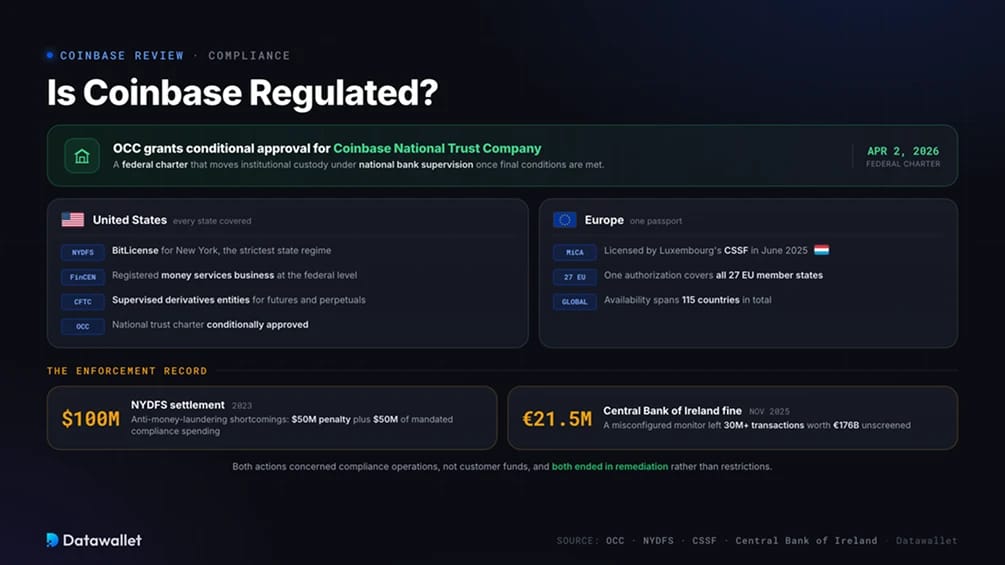
Coinbase operates in every US state, serves New York through a NYDFS BitLicense, is registered with FinCEN, and runs CFTC-supervised derivatives entities. On April 2, 2026, the OCC granted conditional approval for Coinbase National Trust Company, a federal charter that would move its institutional custody business under national bank supervision once final conditions are met.
Europe runs on a single passport. Coinbase secured a MiCA license from Luxembourg's financial regulator, the CSSF, in June 2025, letting one authorization cover all 27 EU member states.
The enforcement record deserves equal attention. Coinbase paid a $100 million settlement to the NYDFS in 2023 over anti-money-laundering shortcomings, split between a $50 million penalty and $50 million of mandated compliance spending.
In November 2025, the Central Bank of Ireland fined Coinbase Europe €21.5 million after a misconfigured monitoring system left more than 30 million transactions worth €176 billion unscreened. Both actions concerned compliance operations rather than customer funds, and both ended in remediation rather than restrictions.
Is Coinbase Safe?
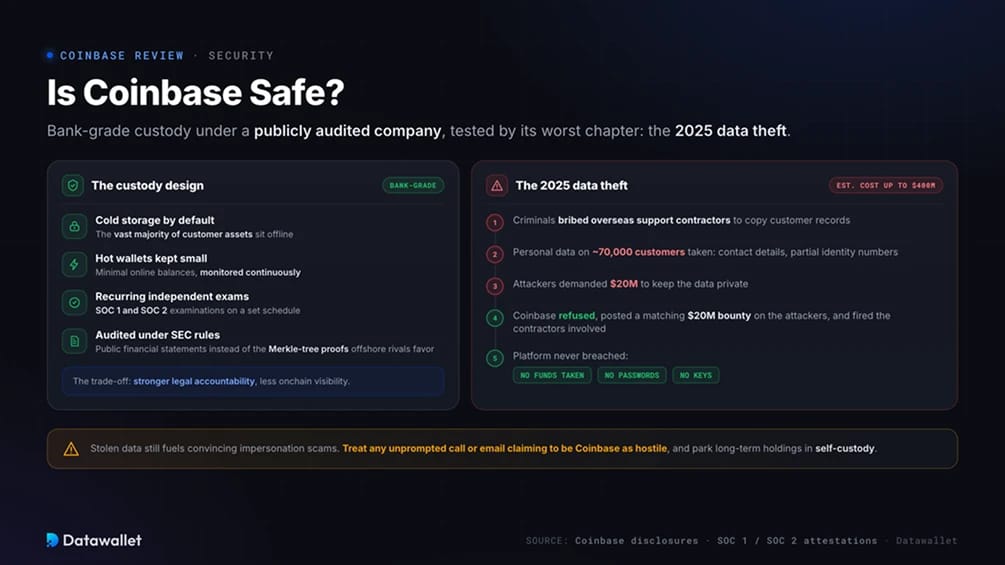
The custody design follows bank-grade convention. The vast majority of customer assets sit offline in cold storage, hot wallets are kept small and monitored, and independent SOC 1 and SOC 2 examinations run on a recurring schedule.
As a public company, Coinbase publishes financial statements audited under SEC rules instead of the Merkle-tree reserve proofs offshore rivals favor. This trade-off offers stronger legal accountability with less onchain visibility.
The record's worst chapter is the 2025 data theft. Criminals bribed overseas support contractors to copy personal data on roughly 70,000 customers, including contact details and partial identity numbers, then demanded $20 million to keep it private. Coinbase refused, posted a matching $20 million bounty on the attackers, and fired the contractors involved.
No passwords, keys, or customer funds were taken from the platform itself, and the response was faster and more open than most exchanges manage. The lasting lesson sits with users. Data stolen in that incident continues to power convincing impersonation scams, so treat any unprompted call or email claiming to be Coinbase as hostile, and park long-term holdings in self-custody.
Base: Coinbase's Layer 2
Base is the Ethereum Layer 2 network Coinbase incubated and launched in August 2023 on Optimism's OP Stack. It now anchors the company's onchain strategy, ranking as the largest Layer 2 by locked value at roughly $15 billion, and its monthly stablecoin settlement passed Ethereum itself in June 2026 at $565 billion.
Base creator Jesse Pollak confirmed the team is exploring a network token in September 2025, reversing the earlier no-token stance, though no launch, snapshot, or eligibility criteria have been announced as of this writing.
Strategy shifted hard in 2026. Pollak conceded that the consumer social bet failed, handed the Base app to trader and podcaster Jordan Fish, better known as Cobie, and refocused the network on trading, stablecoin payments, and AI agents.
COIN Stock
Coinbase Global trades on Nasdaq under COIN and entered the S&P 500 in May 2025. The shares peaked above $400 in mid-2025, then retreated, trading near $170 in mid-June 2026, down roughly 28% for the year as crypto prices retreated.
The register reads like an index fund roll call. BlackRock, Vanguard, and Fidelity hold the largest institutional positions, joined by the ARK Invest funds run by Cathie Wood. Management has leaned on the balance sheet through the drawdown, returning more than $2 billion to shareholders through buybacks with a further $2 billion authorized.
Coinbase User Reviews
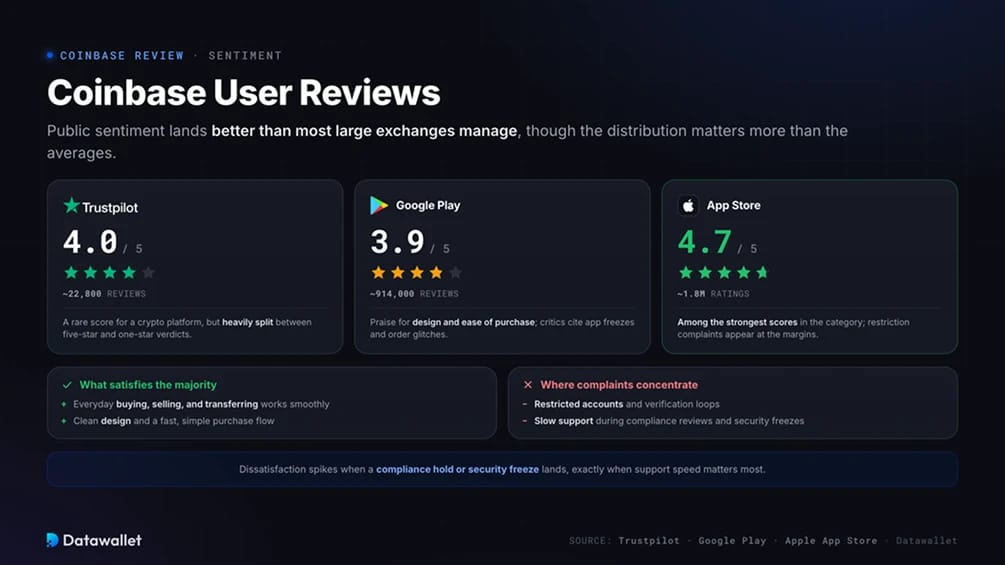
Public sentiment lands better than most large exchanges manage, though the distribution matters more than the averages.
- Trustpilot: Coinbase scores 4/5 across roughly 22,800 reviews, a rare figure for a crypto platform, though heavily split between five-star and one-star verdicts. Complaints concentrate on restricted accounts, verification loops, and slow support during compliance reviews.
- Google Play: The Android app holds 3.9/5 from about 914,000 reviews. Praise covers design and ease of purchase, while critical reviews cite app freezes, order glitches, and support wait times.
- Apple App Store: The iOS app rates 4.7/5 from around 1.8 million ratings, among the strongest scores in the category, with the same account-restriction complaints appearing at the margins.
Everyday buying, selling, and transferring satisfies the majority, and dissatisfaction spikes when a compliance hold or a security freeze lands, exactly when support speed matters most.
Final Thoughts
Coinbase in 2026 is less a crypto exchange than a regulated markets company that happens to have started with crypto. Stocks, prediction markets, global options through Deribit, a federal trust charter in progress, and the busiest Layer 2 in the industry give it a breadth no US rival matches.
The costs of that position are plain. Simple-interface pricing and the 35% staking cut remain expensive; the 2025 data theft showed that outsourced support can undo strong technical security, and enforcement actions on two continents point to compliance systems that trailed the company's growth.
For most people, the practical advice is short. Fund by bank transfer, trade on Coinbase Advanced with limit orders rather than the simple screen, and move long-term holdings to self-custody. To weigh the alternatives, read our Coinbase vs Kraken comparison or see where it ranks among the best crypto exchanges in the USA.