



Which Countries Does Coinbase Restrict?
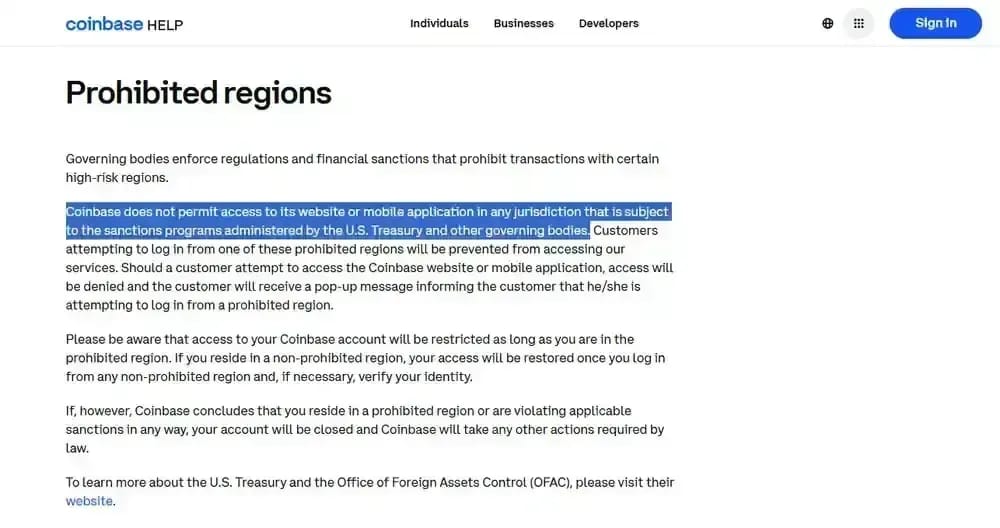
Coinbase does not publish a country blocklist, so there is no official list where you can simply look up your own country. Its prohibited regions policy states only that access is denied in jurisdictions subject to US Treasury sanctions.
The practical list therefore comes from OFAC, which maintains comprehensive embargoes on four countries and three occupied Ukrainian regions. Coinbase is also absent from some markets for licensing reasons rather than sanctions.
Coinbase Restricted Countries List
The table distinguishes sanctions blocks from commercial absences. Only the first category represents a legal prohibition.
A blocked login is not a closed account. Coinbase restores access after you sign in from a permitted country. It closes accounts, however, when it determines that you reside in a prohibited region.
Why Does Coinbase Restrict These Countries?
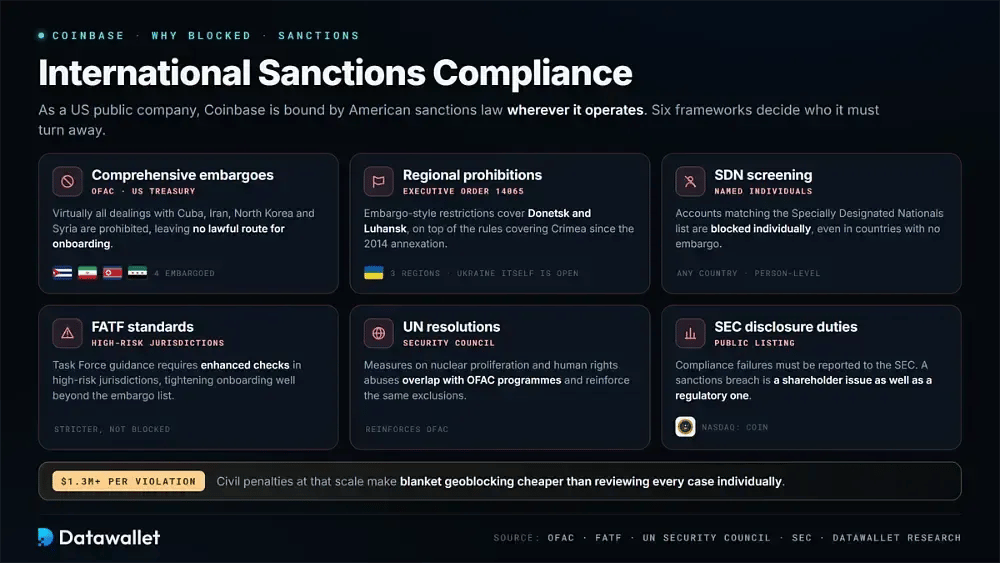
As a US public company, Coinbase is bound by American sanctions law wherever it operates. Some restrictions are mandatory, while other market exits reflect choices made by the company.
International Sanctions Compliance
Sanctions violations can carry civil penalties above $1.3 million per violation. That makes blanket geoblocking less costly than reviewing every case individually.
The frameworks that decide who Coinbase must turn away:
- Comprehensive embargoes: The Office of Foreign Assets Control prohibits virtually all dealings with Cuba, Iran, North Korea and Syria, leaving no lawful route for onboarding residents.
- Regional prohibitions: Executive Order 14065 extended embargo-style restrictions to Donetsk and Luhansk, on top of the rules covering Crimea since the 2014 annexation.
- SDN screening: Accounts that match the Specially Designated Nationals list are blocked individually. This also affects users in countries without a country-wide embargo.
- FATF standards: Financial Action Task Force guidance requires exchanges to apply enhanced checks to high-risk jurisdictions, making onboarding stricter well beyond the embargo list.
- UN resolutions: Security Council measures addressing nuclear proliferation and human rights abuses overlap with OFAC programmes and reinforce many of the same exclusions.
- SEC disclosure duties: Because Coinbase is listed, it must report compliance failures to the SEC. A sanctions breach therefore creates a shareholder issue as well as a regulatory one.
Licensing and Commercial Withdrawals
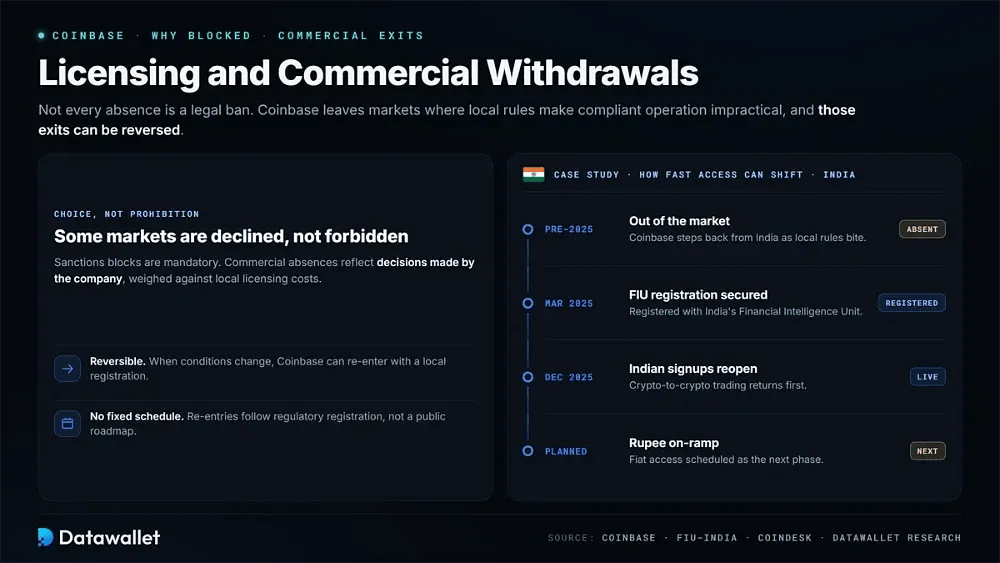
Not every absence results from a legal ban. Coinbase also leaves markets where local rules make compliant operation impractical, and those decisions can be reversed when conditions change.
India illustrates how quickly access can shift. Coinbase registered with the Financial Intelligence Unit and reopened Indian signups in December 2025. Crypto-to-crypto trading returned first, ahead of a planned rupee on-ramp.
Coinbase Supported Countries
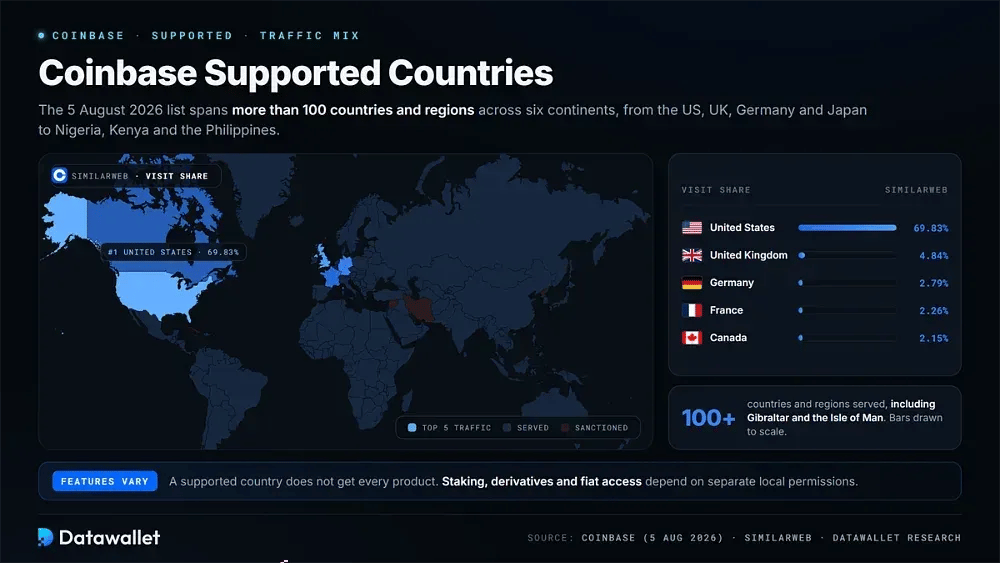
Coinbase now publishes the markets where it operates. Its 5 August 2026 list includes more than 100 countries and regions across six continents, ranging from the US, UK, Germany and Japan to Gibraltar, the Isle of Man, Nigeria, Kenya and the Philippines.
Traffic is much more concentrated. Similarweb figures place the United States at 69.83% of visits, followed by the United Kingdom at 4.84%, Germany at 2.79%, France at 2.26% and Canada at 2.15%.
Being in a supported country does not mean every feature is available. Staking, derivatives and fiat access depend on separate local permissions, so product access can differ between two countries that Coinbase serves.
Language and Currency Support
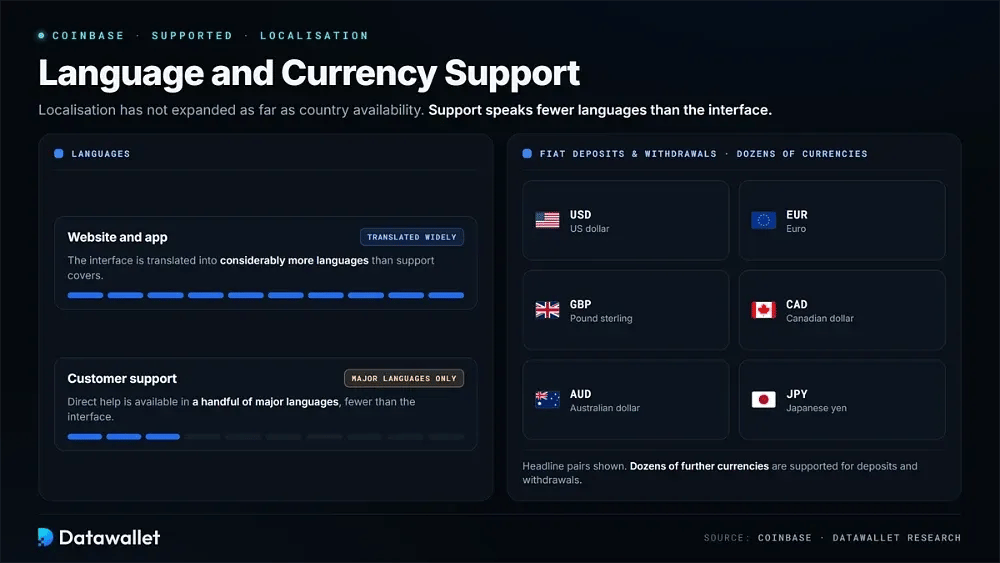
Localisation has not expanded as far as country availability, and customer support is offered in fewer languages than the interface.
- Languages: Direct customer support is available in a handful of major languages. The website and app are translated into considerably more.
- Fiat currencies: Deposits and withdrawals support dozens of currencies, including the US dollar, euro, pound sterling, Canadian dollar, Australian dollar and Japanese yen.
Is Coinbase Available in the EU?
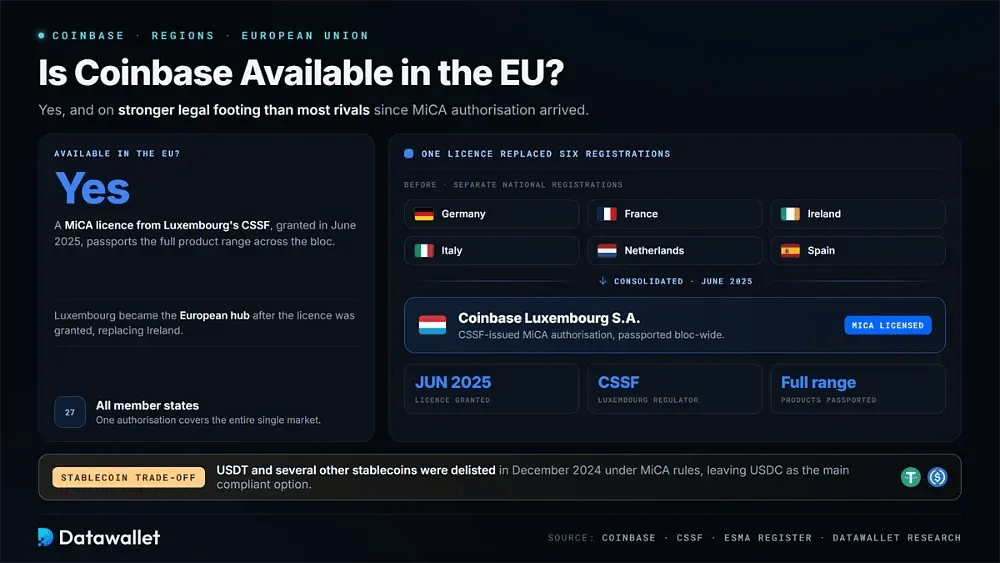
Yes, and its legal footing is stronger than that of most rivals. Coinbase received a MiCA licence from Luxembourg's CSSF in June 2025, allowing it to passport its full product range across all 27 member states.
Luxembourg became Coinbase's European hub after the licence was granted, replacing Ireland. Coinbase Luxembourg S.A. now consolidates authorisations that had previously been held separately in Germany, France, Ireland, Italy, the Netherlands and Spain.
European users lost some choice as a result of the new framework. Coinbase delisted USDT and several other stablecoins in December 2024 because they did not meet MiCA requirements, leaving USDC as the main compliant option. Traders comparing authorised venues can review the MiCA-licensed crypto exchanges on the ESMA register.
Coinbase Perpetual Futures and Staking Availability
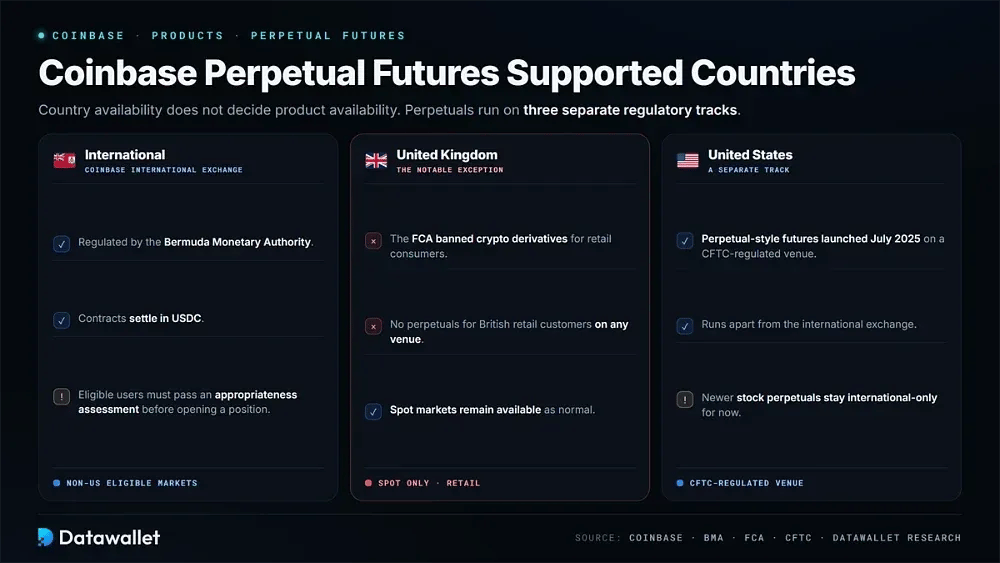
Country availability does not automatically determine product availability. Futures and staking each have their own restrictions, including inside markets that Coinbase otherwise fully serves.
Coinbase Perpetual Futures Supported Countries
Outside the US, traders access perpetual futures through Coinbase International Exchange, which is regulated by the Bermuda Monetary Authority. Contracts settle in USDC. Before opening a position, eligible users must pass an appropriateness assessment.
The UK remains a notable exception. Retail customers cannot access crypto derivatives because the FCA banned their sale to consumers, leaving British users with spot markets only.
US access developed on a separate track. US perpetual-style futures launched in July 2025 through a CFTC-regulated venue. Newer stock perpetual products are still limited to international users.
Coinbase Staking Availability
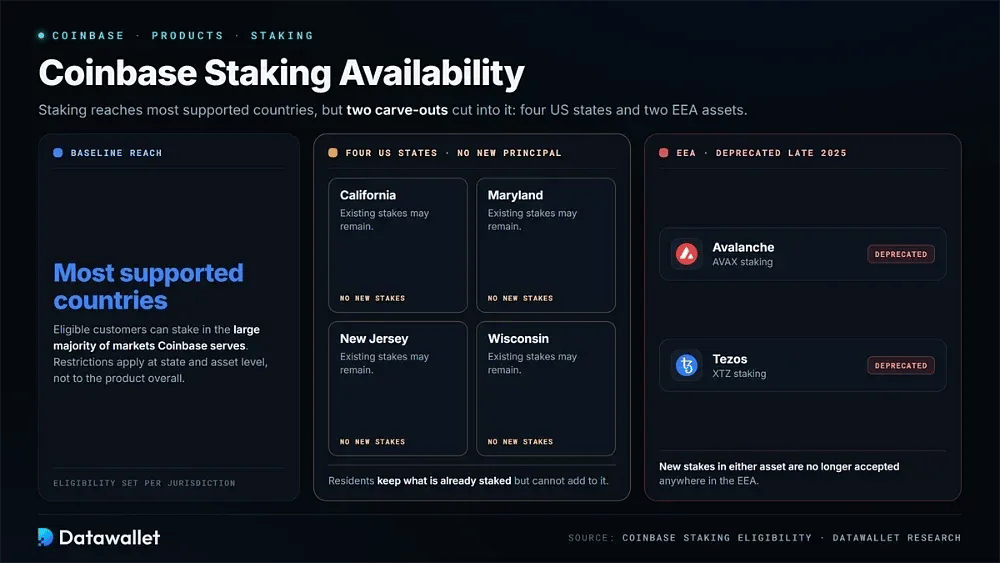
Staking reaches most supported countries, although four US states restrict new principal. Residents of California, Maryland, New Jersey and Wisconsin may keep existing stakes but cannot add to them.
In late 2025, European users lost staking access to two assets when Avalanche and Tezos staking was deprecated across the EEA. New stakes in either asset are no longer accepted. Anyone comparing yields elsewhere can consider the best Ethereum staking platforms.
What Happens If Coinbase Blocks Your Account?
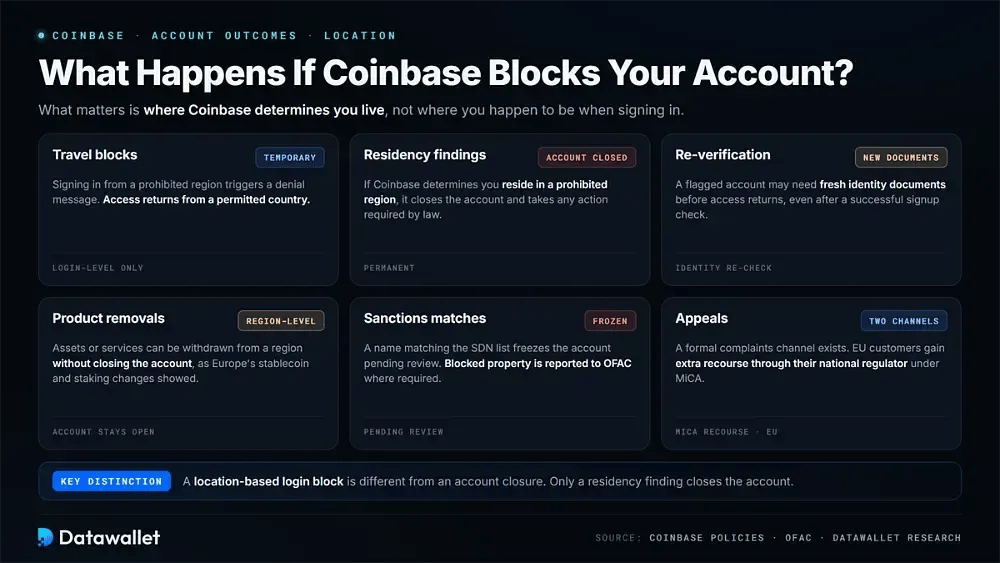
A location-based login block is different from an account closure. What matters is where Coinbase determines that you live, not simply where you happen to be when signing in.
How Coinbase handles access problems tied to location:
- Travel blocks: Signing in from a prohibited region triggers a denial message. Access returns once you log in from a permitted country.
- Residency findings: If Coinbase determines that you reside in a prohibited region, it closes the account and takes any additional action required by law.
- Re-verification: A flagged account may require new identity documents before access is restored, even if verification was completed successfully at signup.
- Product removals: Coinbase can withdraw particular assets or services from a region without closing the account itself, as the European stablecoin and staking changes showed.
- Sanctions matches: When a name matches the SDN list, the account is frozen pending review. Coinbase reports blocked property to OFAC where required.
- Appeals: Coinbase provides a formal complaints channel. EU customers also have additional recourse through their national regulator under MiCA.
Coinbase Licensing and Regulation
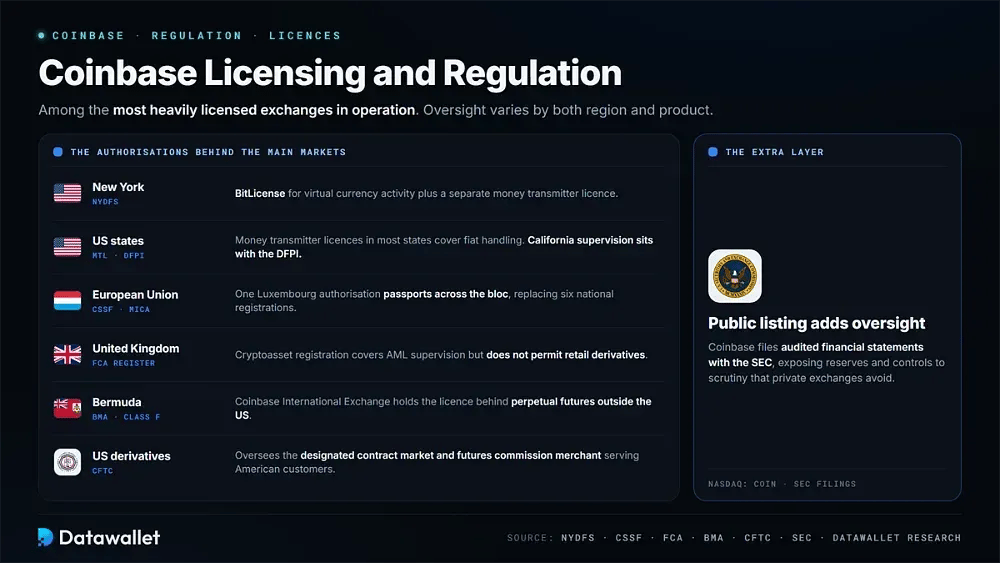
Coinbase is among the most heavily licensed exchanges in operation, and those licences affect the protections available when problems arise. Oversight varies according to both region and product.
The authorisations behind Coinbase's main markets:
- New York: The Department of Financial Services grants Coinbase a BitLicense for virtual currency business activity as well as a separate money transmitter licence.
- US states: Money transmitter licences in most states cover fiat handling. In California, supervision rests with the Department of Financial Protection and Innovation.
- European Union: Coinbase Luxembourg S.A. operates under a CSSF-issued MiCA authorisation that passports across the bloc and replaces six separate national registrations.
- United Kingdom: Registration on the FCA cryptoasset register covers anti-money-laundering supervision but does not permit retail derivatives.
- Bermuda: Coinbase International Exchange holds a Class F licence from the Bermuda Monetary Authority, providing the basis for perpetual futures outside the US.
- US derivatives: CFTC oversight applies to the designated contract market and futures commission merchant used by American customers to trade regulated futures.
Its public listing adds another layer of oversight. Coinbase files audited financial statements with the SEC, exposing its reserves and controls to scrutiny that private exchanges avoid.
Does Coinbase Require KYC?
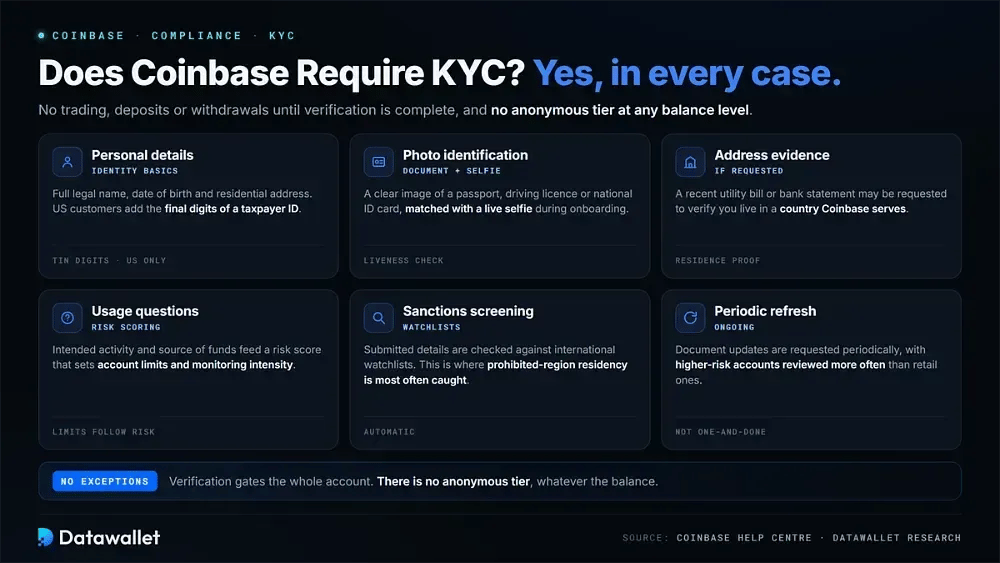
Yes, in every case. Coinbase does not allow users to trade, deposit or withdraw until identity verification is complete, and there is no anonymous tier at any balance level.
What verification asks of you at signup:
- Personal details: Users provide their full legal name, date of birth and residential address. American customers must also supply the final digits of a taxpayer identification number.
- Photo identification: Coinbase requires a clear image of a passport, driving licence or national identity card, which is matched with a live selfie during onboarding.
- Address evidence: A recent utility bill or bank statement may be requested to verify that you live in a country Coinbase serves.
- Usage questions: Information about intended activity and source of funds contributes to risk scoring, which affects account limits and monitoring intensity.
- Sanctions screening: Submitted information is checked automatically against international watchlists. This is where prohibited-region residency is most often identified.
- Periodic refresh: Document updates are requested periodically, with higher-risk accounts reviewed more often than ordinary retail accounts.
About Coinbase
Brian Armstrong founded Coinbase in 2012. The company listed on Nasdaq under the ticker COIN in 2021, becoming the first major public crypto firm, and it remains the largest US exchange by regulated volume.
The company has expanded well beyond spot trading. Coinbase operates the Base layer-2 network and issues USDC alongside Circle. It also runs institutional custody and has entered prediction markets.
Its legal position strengthened after the SEC dropped its case in 2025. The focus has since shifted from whether Coinbase may operate to how regulators should supervise its newer products.
Final Thoughts
Coinbase restricts far fewer countries than many exchange guides suggest. The actual prohibitions follow US sanctions law, while the remaining absences reflect licensing decisions that can change as regulators move.
Product availability warrants closer attention than country availability alone. Derivatives, staking and stablecoin access can differ within supported markets, so confirm that the specific product is available before committing funds.
Check the official availability list and prohibited regions policy before opening an account. Both can change without notice, and neither provides an exemption for users connecting through a VPN.