






Who is Brian Armstrong?
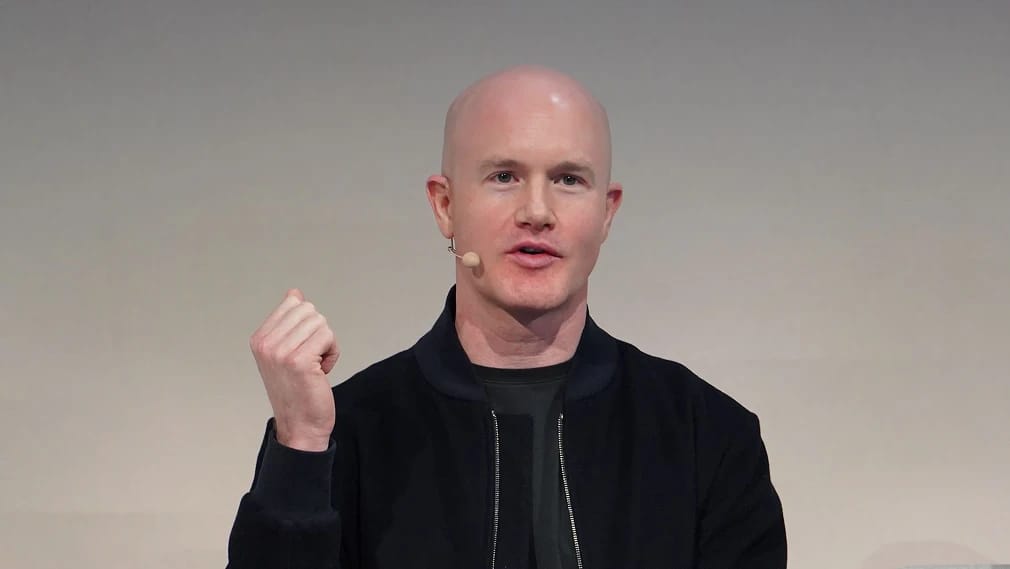
Brian Armstrong is an American entrepreneur best known for co-founding Coinbase in 2012 and steering it from a small San Francisco apartment to a publicly traded company. He is widely considered the most influential US-based executive in crypto.
What sets him apart from most crypto founders is the path he chose. Rather than launching a token, he built a regulated, dollar-denominated business and then spent more than a decade arguing in courtrooms, earnings calls, and Washington offices that crypto deserved clear rules.
He is also outspoken for a Fortune 500 CEO. His 2020 blog post declaring Coinbase a "mission-focused company" that would not engage in social activism cost him about 5% of his workforce. His decision to fight the SEC instead of settling cost the company an estimated $50 million in legal fees.
And in 2024, his super PAC Fairshake spent roughly $40 million to unseat a sitting US senator who had been hostile to crypto. The through line in all of it is that Brian tends to bet large, in public, on positions most other CEOs would soften.
Brian Armstrong Background
Brian's path to running the largest US crypto exchange is more conventional than most in this industry. He came up through traditional engineering jobs, started a small side hustle in college, then quietly built Coinbase nights and weekends while at Airbnb.
Early Life and Education
Brian Armstrong was born on January 25, 1983, near San Jose, California. Both of his parents were engineers, and he was raised in Silicon Valley during the years when its tech culture was being shaped. He attended Bellarmine College Preparatory before heading to Texas for college.
At Rice University, he earned a dual bachelor's degree in economics and computer science in 2005, followed by a master's in computer science in 2006. While still an undergraduate, he started UniversityTutor.com, a directory matching tutors to students, which he ran as CEO until 2012.
After graduating, he spent a year in Buenos Aires working for an education company, an experience that exposed him to the friction of moving money across borders. That detail matters more than it might sound, because it foreshadowed the problem Coinbase would later try to solve.
Professional Career
His first roles after Rice were not in crypto or even in startups. He worked as a developer at IBM and then as a risk consultant at Deloitte & Touche. By his own account, neither role excited him, though both gave him a working understanding of how large enterprise systems work.
In 2011, he joined Airbnb as a software engineer. The company was operating in close to 190 countries at the time, and Brian was assigned to fraud detection and payments. Watching how hard it was for Airbnb to send money to hosts in places like Argentina and Brazil shaped his thinking.
As he later told the press, he started writing Ruby and JavaScript code on weekends to buy and store Bitcoin, which he had first read about in 2010 after stumbling onto Satoshi Nakamoto's Bitcoin white paper.
Founding Coinbase
In 2012, Brian applied to Y Combinator with a pitch to make buying and storing Bitcoin simple for ordinary people. He received $150,000 in seed funding, which became the initial capital for Coinbase.
He found his co-founder, Fred Ehrsam, a former Goldman Sachs trader, on Reddit after reportedly meeting more than fifty candidates. Coinbase officially launched in October 2012, initially run from a San Francisco apartment.
By December 2013, the company had completed a $25 million funding round led by Andreessen Horowitz, which at the time was one of the largest checks Silicon Valley had written into crypto.
The platform reached 30 million users by July 2019, and the company never raised more than $547 million privately before going public.
Taking Coinbase Public
In December 2020, Coinbase filed with the SEC for a direct listing rather than a traditional IPO. When COIN started trading on the Nasdaq on April 14, 2021, the company hit a peak market capitalization of approximately $85 billion to $100 billion on its first day.
That moment was the high-water mark of the 2021 cycle for crypto equity, and it instantly turned Brian into a paper multibillionaire.
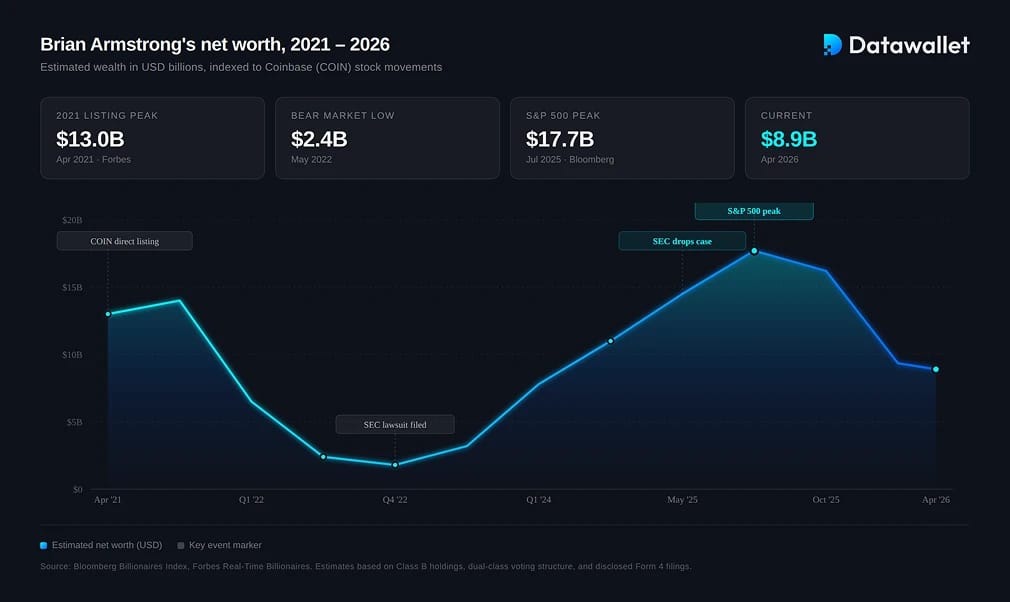
His estimated net worth on Forbes peaked at roughly $13 billion shortly after the listing. It then fell sharply as crypto entered its 2022 bear market, dropping to around $2.4 billion by May 2022.
Surviving the Bear Market and the SEC
The hardest stretch of Brian's career was probably 2022 to early 2025. Coinbase laid off about 18% of its staff in June 2022 and another roughly 950 employees in January 2023.
COIN traded as low as $31 at the bottom. Then, in June 2023, the SEC sued Coinbase, alleging it operated as an unregistered exchange, broker, and clearing agency.
Brian refused to settle. The legal fight ran for almost two years and cost the company roughly $50 million. In February 2025, after the departure of former SEC Chair Gary Gensler, the SEC voluntarily dismissed the case with prejudice, with Coinbase paying no fines.
Joining the S&P 500
On May 19, 2025, Coinbase became the first crypto company added to the S&P 500, replacing Discover Financial Services after Discover's acquisition by Capital One.
The inclusion forced every S&P 500 index fund to buy Coinbase stock, and Brian's net worth jumped accordingly. By July 2025, Bloomberg had it at $17.7 billion. That figure has since contracted with the broader crypto pullback, but the structural change is permanent.
Coinbase is now embedded in the most-tracked equity benchmark in the world, which means a portion of every American 401(k) tracking the S&P now owns a sliver of Brian Armstrong's company.
.webp)
Brian Armstrong's Net Worth in 2026
Brian Armstrong's net worth in 2026 sits in a range of roughly $7 billion to $14 billion, depending almost entirely on where Coinbase stock is trading on any given day.
Bloomberg estimated his fortune at $17.7 billion at its July 2025 peak, then revised it down to $8.9 billion by April 2026. Comparatively, Forbes estimates his net worth to be $9.4 billion in April 2026.
The composition of his wealth is unusually concentrated. According to the Bloomberg Billionaires Index and recent Form 4 filings, Brian holds approximately 14% of Coinbase but his voting power is closer to 64% of the company.
Beyond Coinbase, the main components of his wealth are:
- NewLimit equity: Brian co-founded the longevity biotech NewLimit in 2021 with Blake Byers. The two have committed roughly $110 million in personal capital. Brian is credited with about a 19% stake, worth approximately $150 million on paper.
- ResearchHub: A self-funded, GitHub-style platform for sharing scientific research, which pays contributors in crypto. Smaller in dollar terms but treated by Brian as a long-term project.
- Próspera and angel investments: In January 2025, Coinbase Ventures invested in Próspera, a charter city off the coast of Honduras tied to the Trump administration's "Freedom Cities" framework. He has at least 16 disclosed angel investments across biotech, fintech, and adjacent sectors.
- Cash and diversification: He has consistently sold COIN under Rule 10b5-1 trading plans, including a $10 million sale on January 5, 2026. His cash base has grown over the past three years, but it is still modest relative to his Coinbase exposure.
The reason his net worth swings so violently is that he never meaningfully diversified. Most public-company founders take aggressive secondary sales the moment they list.
Brian Armstrong Crypto Holdings
Unlike Justin Sun or Do Kwon, Brian's wallet activity is not the main story here. The asset that matters is COIN.
Key positions:
- Coinbase Class B common stock: As of his June 2025 Form 4, The Brian Armstrong Living Trust held roughly 23.48 million Class B shares plus a small Class A balance, giving him an estimated 14% economic interest and majority voting control through the dual-class structure.
- Coinbase Class A sales: Across the past 18 months, Brian has executed dozens of insider sales for a net disposal of roughly 3.2 million shares, almost all under pre-arranged 10b5-1 plans. By any reasonable measure, his selling has been measured, especially compared to other crypto-era founders.
- Personal Bitcoin and crypto: He has not publicly disclosed personal wallet holdings. He is on record stating he holds Bitcoin and several other major crypto assets, but specific balances are not visible on Arkham or other on-chain trackers in a way that major outlets have verified.
- Coinbase corporate Bitcoin treasury: Coinbase itself held 9,267 BTC on its balance sheet as of May 2025, worth close to $1 billion at the time. Brian does not personally own this Bitcoin, but as the largest individual shareholder, his wealth indirectly tracks its value.
We think the honest framing of his crypto holdings is this: Brian is rich because he owns the exchange, not because he held the right tokens early. That makes him an outlier in a sector where most large fortunes were built by being early to a single coin.
.webp)
Brian Armstrong Controversies and Legal Battles
Brian's career has not been controversy-free. The list below covers the events that have most consistently shown up in financial coverage.
Key controversies and legal events:
- Sep 2020: His “mission-focused company” blog post drew sharp criticism. About 60 employees, roughly 5% of the company, accepted severance and left.
- Mar 2023: NYDFS fined Coinbase $100 million ($50 million penalty plus $50 million in compliance investment) over what regulators called wide-ranging anti-money-laundering failures.
- Jun 2023: The SEC sued Coinbase for operating as an unregistered exchange, broker, and clearing agency. Coinbase fought rather than settled.
- Feb 2025: The SEC voted to dismiss its case against Coinbase with prejudice, with no fines paid and no business changes required.
- May 2025: Coinbase disclosed a data breach in which overseas customer-service contractors were bribed to leak user data. He publicly refused a $20 million ransom and the company estimated remediation would cost $180 million to $400 million.
- Nov 2025: Brian drew criticism for deliberately speaking crypto-related buzzwords at the end of Coinbase's Q3 earnings call, in what observers said appeared to be an attempt to influence prediction markets betting on which words would be mentioned. Industry figures called it market manipulation.
- Dec 2025: A former Coinbase customer-service agent was arrested in India in connection with the May 2025 breach.
- Mar 2026: A shareholder derivative lawsuit was filed against Brian and other Coinbase executives in the District of New Jersey, alleging materially false statements between April 2021 and June 2023 about custody, listings, and AML controls.
Some of these are fairly typical for a fast-growing financial platform. The 2020 mission post and the 2025 earnings call moment are the more revealing ones, because both show Brian willing to take public actions that other CEOs in his position would not.
Final Thoughts
Brian Armstrong's net worth is probably the cleanest test case in finance for what the crypto industry is actually worth at any given moment. Almost every dollar he has tracks COIN, which in turn tracks the volume, regulatory standing, and adoption curve of digital assets in the United States.
That is also why his story is more interesting than the headline number. He is the rare crypto founder who chose to fight regulators inside the system rather than work around them, and the rare big-tech CEO who wields a super PAC.
For now, his fortune is best understood as a real-time barometer of US crypto policy, not as a pile of static wealth. The number on Bloomberg's index will keep moving. The structural position, as the largest individual shareholder of the only crypto-native S&P 500 company, is harder to dislodge.
.webp)