







Compare Top Crypto Exchanges in Palau
1. Gate
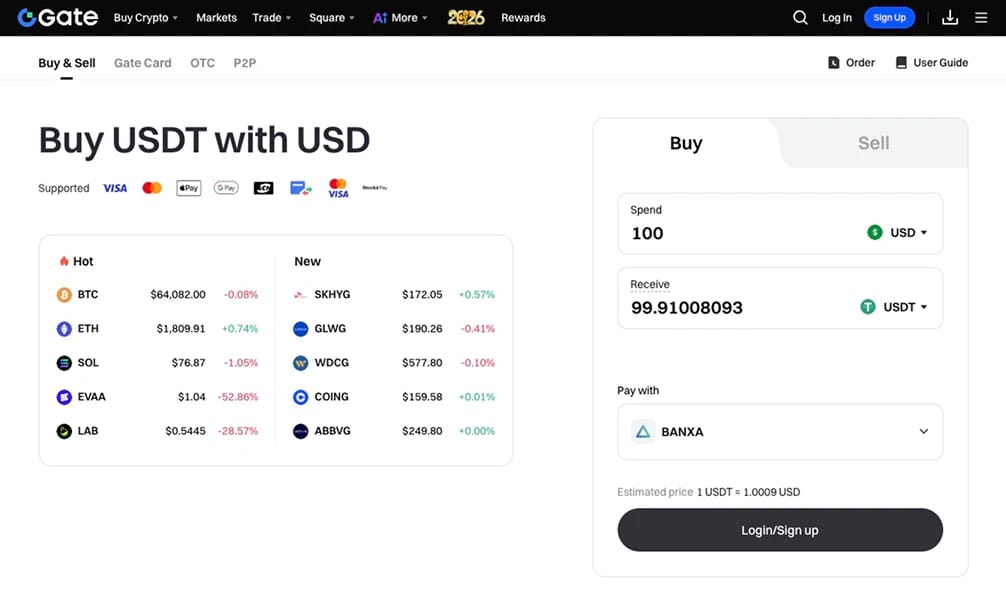
Gate takes first place in Palau because it removes the two obstacles that trip residents up the most: funding and documents. The exchange has been operating since 2013, counts over 30 million users, and offers a catalog of over 3,800 cryptocurrencies, more than any other platform a Palauan can access. New sectors, whether AI tokens, memecoins, or real-world assets, tend to appear here months before the bigger names list them.
Entry pricing is 0.10% for makers and 0.20% for takers, and users who hold GateToken can reduce these fees even further. Proof of reserves is backed by a zero-knowledge proof that anyone can independently check. Our USD card purchase cleared on a Palau-issued card, and the P2P marketplace offers a fallback, though USD offers are thin in a market this small.
Documents seal the ranking. Gate's verification accepts the full spread of Palauan identification, and holders of the RNS-issued digital residency card consistently report passing its KYC, while Bybit now rejects that card outright. Liquidity is where the catalog costs you, since the long tail trades thinly, and small caps can be easy to enter and hard to exit. Our Gate review examines the 2018 breach, which was fully repaid, and the security overhaul that followed.
Pros
- The widest coin selection available from Palau at 3,800+ assets.
- Reserves are provable through zero-knowledge attestations, with maker pricing from 0.10%.
- Flexible identity verification that accepts Palau-issued documents where others decline them.
Cons
- Thin order books deep in the catalog make small caps risky to exit.
- A 2018 security breach appears in its past, although every user was repaid.
- The interface packs in more products than a first-time buyer needs.
2. OKX
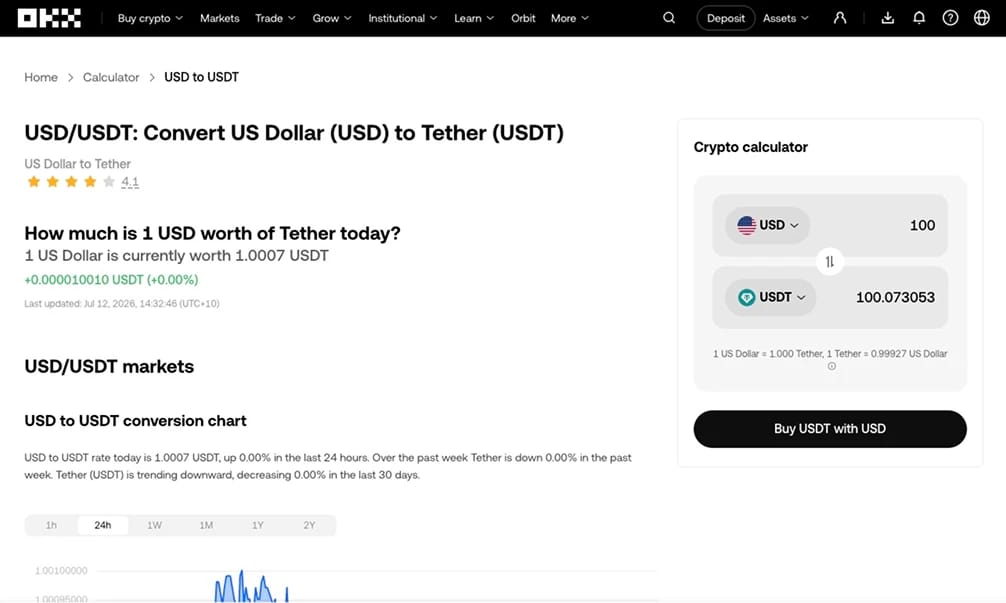
OKX wins on cost and on-chain reach. Spot fees of 0.08% maker and 0.10% taker are the lowest of any major venue serving Palau, and monthly Merkle-tree reserve reports let users confirm their own balance is included. Around 350 cryptocurrencies trade against USD and USDT pairs with liquidity that beats the smaller platforms in our fills.
The standout is OKX Wallet, a self-custody product that reaches over 100 networks and carries its own DEX aggregation. In a country where the nearest exchange office is an ocean away, holding the trading venue and the self-custody door in one app is a real advantage. Moving coins off the exchange after buying takes a couple of taps instead of a second application.
Funding options are card purchases, Apple Pay, and Google Pay, and our USD card buy settled without a hold. The trade-offs are a cryptocurrency selection that is well short of Gate's and a menu of advanced instruments that a first-time buyer should walk past for now. The full picture sits in our OKX review.
Pros
- The cheapest spot pricing available from Palau at 0.08% maker and 0.10% taker.
- Reserve reports are released monthly and are verifiable down to the individual account.
- A self-custodial wallet covering 100+ chains is built into the same app.
Cons
- Roughly 350 assets, far fewer than Gate or MEXC.
- The sheer number of tools is more than a first purchase requires.
- No licensing anywhere applies to Palauan users.
3. KuCoin
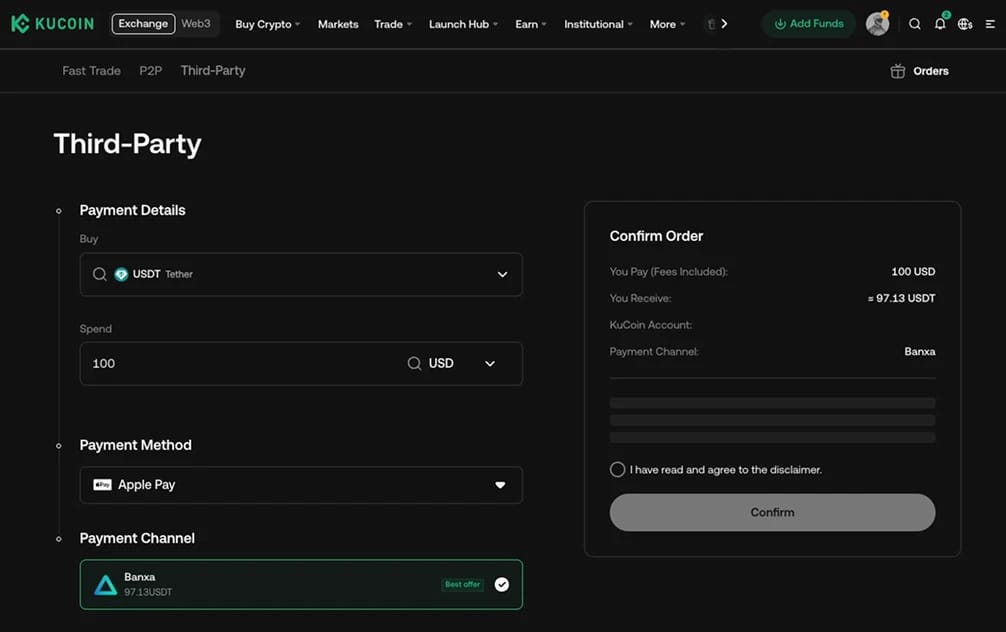
KuCoin suits the investor who wants their coins working between trades. The exchange lists over 900 cryptocurrencies and serves more than 40 million users, but its pull in Palau is the Earn program. Simple Earn, flexible savings, fixed staking terms, structured products, and lending sit in one section, with stablecoin returns typically in the low single digits and promotional pools reaching far higher for short windows.
Trading costs a flat 0.1% on spot before KCS token discounts, and the bot suite covers grid, DCA, and futures strategies. GemSPACE surfaces early-stage tokens before they reach larger venues. Verification accepted standard Palauan documents, and community reports confirm the digital residency card passes its KYC as well.
Funding is similar to that of the other global exchanges. Cards and Google Pay handle the USD entry, crypto transfers do the rest, and the P2P board rarely shows USD offers relevant to a buyer in Koror. Yield products carry platform risk that a plain spot balance does not, which is worth weighing before locking a term. More details are in our KuCoin review.
Pros
- A broad Earn menu spanning flexible savings, fixed staking, lending, and structured products.
- 900+ assets at a flat 0.1% spot fee with KCS discounts on top.
- Trading bots and early-stage listings through GemSPACE.
Cons
- Promotional headline yields fade quickly and the fine print matters.
- Locked Earn terms add platform risk beyond simply holding coins.
- USD P2P activity is close to nonexistent for Palau-based buyers.
4. Bitget
Bitget is the pick for those who want to automate their trading. Its copy trading network follows verified traders in spot and futures markets, with leaderboards showing return, drawdown, and assets under management so followers can filter by risk rather than hype. In a market with no local trading community, that visibility replaces the conversations Palauans cannot have at a meetup.
The wider platform stands on its own. Over 800 cryptocurrencies trade at a flat 0.1% spot fee, a Web3 wallet handles on-chain activity, and Earn products cover the passive side. Behind it sits a Protection Fund worth hundreds of millions of dollars and proof of reserves showing better than 1:1 backing of client assets.
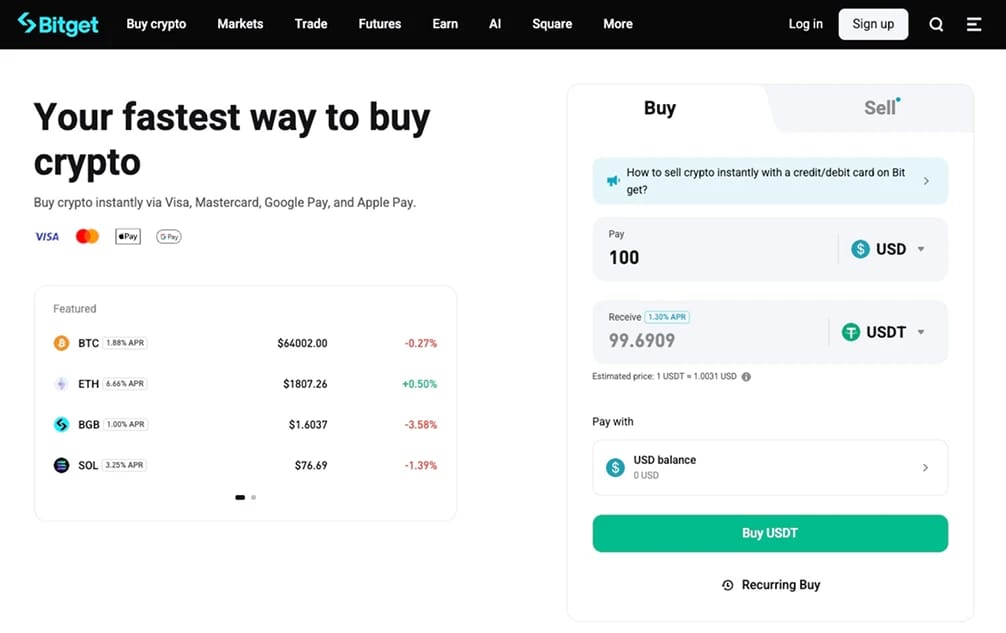
Card purchases, Apple Pay, and Google Pay cover the USD entry; verification cleared quickly on a passport in our test, and the Palau digital residency card is also reported to pass. The limit is that copy trading transfers someone else's judgment, not their discipline, and followers routinely join a strategy right after its best month. Check out our Bitget review to learn more about the platform.
Pros
- The most developed copy trading system accessible from Palau, with transparent trader statistics.
- A Protection Fund and published proof of reserves behind 800+ listed assets.
- Card and mobile wallet purchases that worked with Palau-issued cards.
Cons
- Copy trading results depend heavily on when you start following a trader.
- The app layers promotions and products thickly for a newcomer.
- No regulatory coverage extends to Palauan users.
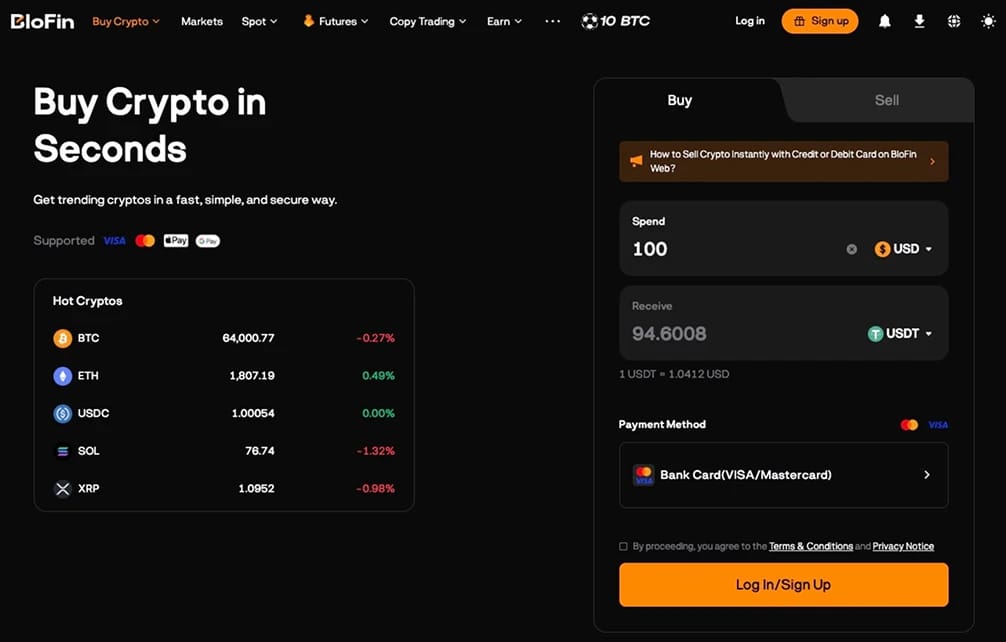
5. BloFin
BloFin is here for people who want to skip the document question altogether. Its basic tier requires no identity verification, with registration, crypto deposits, trading, and withdrawals up to 20,000 USDT per day available before any ID is uploaded. Where KYC document acceptance varies from platform to platform, that removes the problem rather than solving it.
The platform is built for derivatives. More than 400 assets trade on spot at 0.1%, futures run across 350+ USDT-margined pairs at 0.02% maker and 0.06% taker with leverage to 150x, and copy trading, bots, and a demo mode round out the toolkit. Custody sits with Fireblocks, reserves are verified 1:1 via Merkle-tree proofs, and the exchange holds ISO 27001 certification.
Unfortunately, there is no fiat withdrawal, card purchases run through third-party processors with their own fees, and BloFin is an offshore operation with no licensing a Palauan could lean on, like everything here but with less history behind it. Treat the no-KYC tier as a convenience that can tighten, since the industry trend runs toward more verification. Availability sits in our BloFin restricted countries guide, and Palau is not on the excluded list.
Pros
- Deposits, trading, and withdrawals up to 20,000 USDT daily with no identity documents required.
- Futures fees from 0.02% maker across 350+ pairs, with copy trading and a demo account.
- Fireblocks custody, 1:1 Merkle-tree reserves, and ISO 27001 certification behind the scenes.
Cons
- No fiat withdrawals, so every exit runs through crypto.
- Leverage to 150x is a fast way for a newcomer to lose a deposit.
- A shorter operating history and thinner regulatory footprint than the platforms above.
6. MEXC
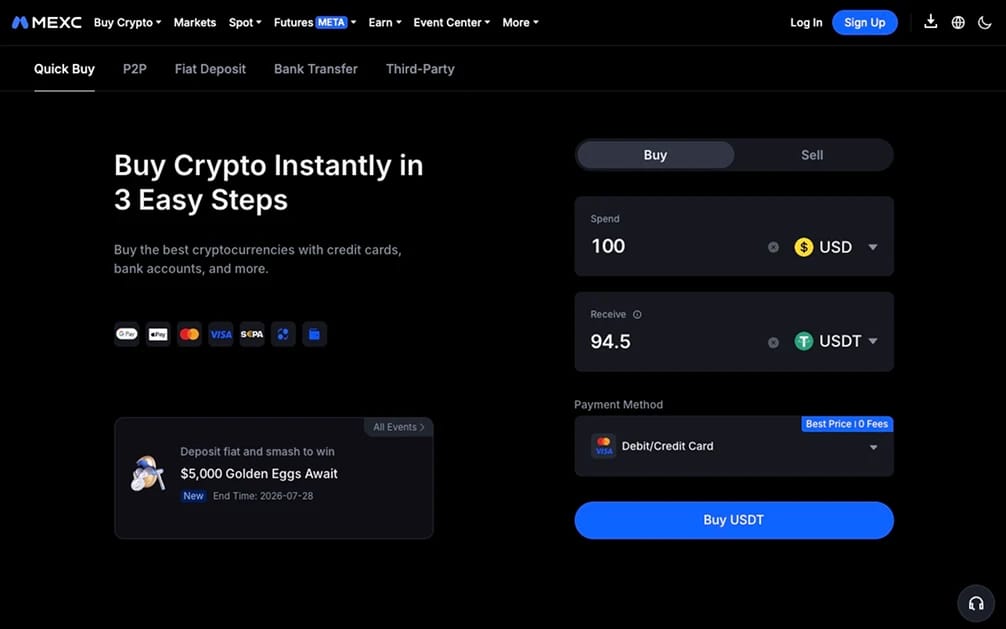
MEXC closes the list on price. Spot makers pay nothing, and takers pay 0.05%, the cheapest schedule of any platform here, and the exchange lists around 3,000 cryptocurrencies with a reputation for adding new tokens within days of launch. For an active Palau trader, no venue on this list costs less per round trip.
The platform runs spot, margin, and futures at leverage levels most rivals stopped offering, and its listing speed means it often carries the token of the week before Gate does. Verification accepted a Palau passport without friction, and the digital residency card is among the documents its KYC recognizes, a point several holders have confirmed publicly.
The compromises are real. MEXC discloses less about its corporate structure and reserves than OKX or Bitget; support is slower than the majors, and ultra-new listings carry the same exit risk as Gate's long tail with even less history. It works best as a cheap trading account beside a primary venue, not the home for a whole portfolio. Our MEXC review and MEXC fees guide go deeper.
Pros
- Zero maker and 0.05% taker fees, the lowest costs available from Palau.
- Roughly 3,000 assets with some of the fastest new listings in the industry.
- Straightforward verification that accepts Palauan documents.
Cons
- Less transparency around reserves and corporate structure than the platforms above.
- Brand-new listings can be nearly impossible to exit at a fair price.
- Support response times lag behind the larger exchanges.
How to Choose a Crypto Exchange in Palau
No platform holds a Palauan license, so the shortlist depends on funding reality, document acceptance, and how much trust a crypto exchange has earned. These are the five checks we would run before depositing funds.
- Confirm the platform actually serves Palau: Availability is not universal. Coinbase's fully supported country list skips Palau, while all six platforms above accept Palauan sign-ups. Check the terms of service for excluded jurisdictions before verifying, not after.
- Test your card before you need it: A Visa or Mastercard from Bank of Guam, Bank of Hawaii, or BankPacific is the practical way in. Run a $20 purchase first because processors treat an unfamiliar issuing country inconsistently, and our guides to buying crypto with Apple Pay and Google Pay cover the mechanics.
- Match your documents to the KYC list: A Palau passport clears verification everywhere on this list. The digital residency card is issued through RNS.ID passes at Gate, KuCoin, Bitget, and MEXC, while Bybit has rejected it in recent verification updates, which is why that exchange no longer appears here.
- Check proof of reserves: With no supervisor watching these venues on your behalf, proof of reserves is the closest substitute. OKX and Bitget publish verifiable attestations monthly, Gate runs a zero-knowledge version, and a platform that publishes nothing asks for more trust than it has earned.
- Plan the exit as carefully as the entry: Selling back to dollars is harder than buying, since card purchases only run one way. Most Palauans prefer stablecoins to cashing out, so confirm the platform supports cheap USDT or USDC withdrawals on a low-fee network.
Crypto and Bitcoin Regulation in Palau
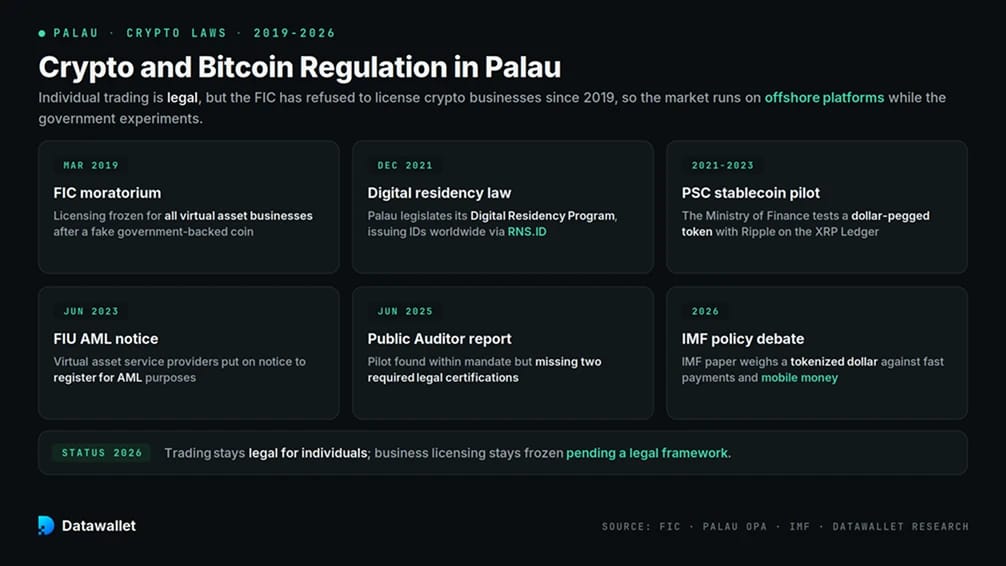
Owning and trading crypto is legal for individuals in Palau, but running a crypto business is not currently possible, a split that has defined the market for seven years. No statute governs digital assets, so the Financial Institutions Commission filled the gap with a blunt instrument.
- March 2019: The FIC board resolved to stop licensing any new applicant seeking to deal in virtual assets or virtual currencies, after a project calling itself PalauCoin falsely claimed government backing. The freeze holds until Palau adopts a legal framework the FIC can supervise under.
- November 2019: The FIC and the Bureau of Revenue and Taxation jointly declared that anyone running crypto operations on an old or voided business license was breaking the law, and urged the public to treat claims of government endorsement as fraud.
- 2021 to 2023: The Ministry of Finance ran the Palau Stablecoin (PSC) pilot with Ripple on the XRP Ledger, issuing a dollar-pegged token to 154 volunteer government employees who spent it at three Koror merchants, Surangel and Sons, Penthouse Hotel, and King's Minute Mart.
- June 2023: Palau's Financial Intelligence Unit put virtual asset service providers on notice to register for anti-money-laundering purposes, a small step toward the framework the moratorium is waiting on.
- June 2025: The Office of the Public Auditor reviewed the stablecoin pilot and found the Ministry acted within its mandate but skipped required certifications from the Attorney General and the budget director.
- 2026: An IMF Selected Issues Paper on modernizing Palau's financial system weighed a tokenized dollar against alternatives like fast payment systems and licensed mobile money, and stressed that any path forward needs a proper legal and regulatory foundation first.
The upshot for a resident is simple. Your own buying, holding, and trading break no Palauan law; no local platform can legally exist to serve you, and any outfit claiming a Palau license to sell you crypto is lying. The FIC names such firms on its public notices page, worth a glance before trusting anything that sounds local.
How Is Crypto Taxed in Palau?
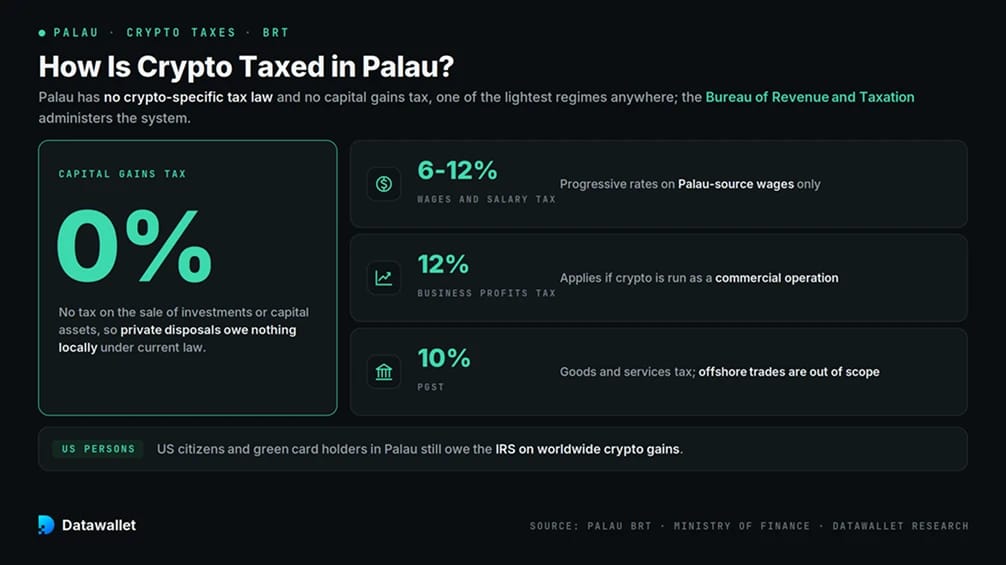
Palau has no crypto-specific tax law, and the general system is among the lightest a crypto holder will find anywhere. Tax administration sits with the Bureau of Revenue and Taxation under the Ministry of Finance.
- No capital gains tax exists: Palau does not tax gains on the sale of investments or other capital assets, and no provision singles out crypto disposals. Selling Bitcoin at a profit as a private individual triggers no Palauan tax under current law.
- The system taxes Palau-source income: Wages earned in Palau face the Wages and Salary Tax at progressive rates from 6% to 12%, and businesses registered under the reformed system pay the 12% Business Profits Tax on net income. Neither reaches a personal investment portfolio.
- Trading as a business changes the answer: Running crypto as a commercial operation in Palau, mining at scale or dealing for clients, falls under the business tax regime like any other enterprise, quite apart from needing FIC permission it cannot currently get.
- PGST does not touch trades: The 10% Palau Goods and Services Tax introduced in January 2023 applies to goods and services sold or consumed in Palau. Buying and selling crypto on an offshore exchange is outside its scope.
Records still matter where no tax is due today. A dated log of purchases, sales, and transfer costs nothing and covers you if Palau legislates later or another country's tax authority asks. None of this replaces advice from a qualified professional for anything beyond simple personal holdings.
Cryptocurrency Adoption in Palau
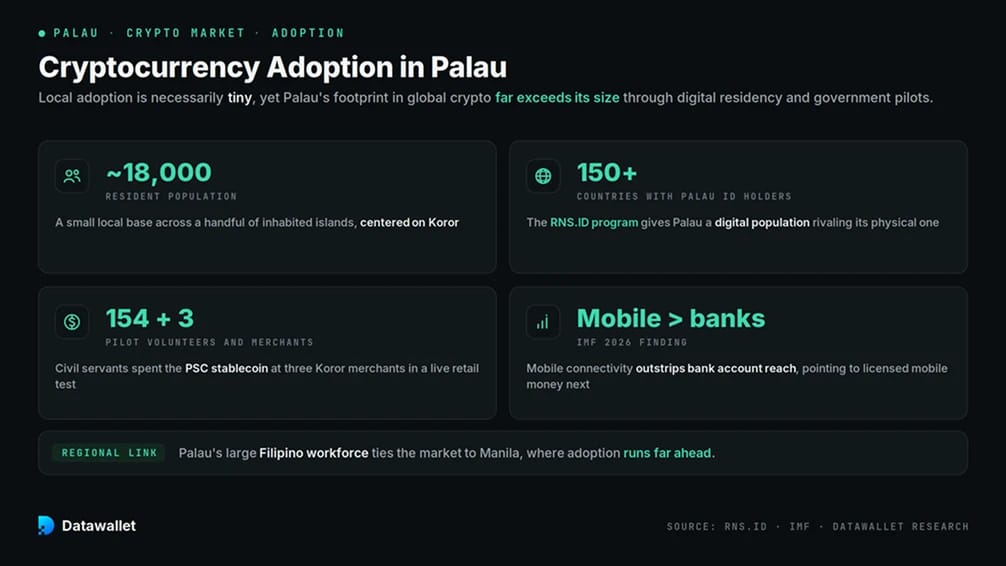
Palau's crypto story is lopsided in a way no other country matches. Local adoption is necessarily tiny, with a population of around 18,000 spread across a handful of inhabited islands, yet the country's footprint in global crypto far exceeds its size.
- The digital residency effect: The RNS.ID program has issued government-backed identity cards to applicants from over 150 countries since its 2022 launch, giving Palau a digital population that rivals its physical one. Most holders will never set foot in Koror, yet their fees fund a government that actively courts the industry.
- A government that experiments: Few countries of any size have put a stablecoin in their own civil servants' hands and let them spend it at the supermarket. The PSC pilot was small, three merchants and 154 volunteers, yet it made Palau one of the only governments to run a live retail test on a public blockchain.
- Ground-level reality: Daily life runs on cash and cards, banking is concentrated in Koror, and the IMF's 2026 analysis notes mobile connectivity outstrips bank account reach, which is why it floats licensed mobile money as a nearer-term win than a tokenized dollar. Crypto here is an individual pursuit, not a payments layer.
- The regional connection: Palau's large Filipino workforce keeps money moving toward Manila, where crypto adoption runs far ahead of Micronesia. Workers can see how platforms and GCash-linked funding work back home in our guide to the best crypto exchanges in the Philippines.
For how Palau sits against the rest of the world, our crypto adoption statistics page carries the global comparison.
How to Buy Bitcoin in Palau
Buying BTC from Palau takes minutes once the account exists, and the dollar removes the conversion step nearly every other country faces. This is the sequence we used.
- Pick a platform from the list above: Gate for the broadest account and the friendliest document policy, MEXC for cost, OKX for the lowest major-pair fees and the built-in wallet, BloFin if verification is a sticking point. Confirm Palau is accepted in the sign-up country selector before going further.
- Verify your identity: A Palau passport clears every platform here, usually within minutes with a selfie check. Enter your name exactly as the document prints it, since mismatches are the most common reason applications stall.
- Fund with a locally issued card: Use a Visa or Mastercard from your Koror bank and start small to confirm the processor accepts the card's country code. Expect roughly 2% to 3% in card fees, the cost of a market without direct bank transfers to exchanges.
- Buy with a limit order where you can: On every platform we tested, placing a limit order on the BTC/USDT or BTC/USD book beat the price offered by the instant purchase screen. Instant buttons charge for their convenience through the spread.
- Decide where the bitcoin lives: Active traders can leave a working balance on the exchange, but anything long-term belongs in self-custody, especially where no regulator will chase your funds if a platform fails. Our best crypto wallets guide compares the options, and double-check the address and network before every withdrawal.
Selling differs in one respect. Card purchases cannot run in reverse, so exits go through stablecoins, a P2P sale, or a platform's withdrawal partners, and most holders in Palau simply park value in USDT or USDC.
Final Thoughts
If we were starting from zero in Palau, Gate is where the first account would go. It holds the largest catalog a resident can reach, its card purchases cleared on a locally issued Visa, and its verification takes every Palauan document we know of. OKX earns its place on cost and self-custody, KuCoin on yield, Bitget on copy trading, BloFin on no-KYC access, and MEXC on fee savings.
Step back and Palau is a country whose government keeps testing the water while its regulator holds the gate shut. A stablecoin pilot, a digital residency program built for the crypto industry, and an IMF conversation about tokenized dollars all point in one direction, while the 2019 moratorium holds until a real framework arrives.
Until then, keep one strong offshore account, hold long-term coins in self-custody, and treat any claim of a Palauan crypto license as the red flag it is, because none exists.
Our Methodology
Every ranking reflects use under Palau's conditions rather than global spec sheets. We created accounts, completed identity verification, funded with Palau-relevant methods, placed real orders, and withdrew funds back out. Six criteria decided the order.
- Trust Score: Our proprietary rating out of 5, weighing reserve transparency, breach history and its handling, platform longevity, and the credibility of published attestations in the absence of any licensing that covers Palau.
- Palau Availability: Confirmed that each platform accepts Palauan residents in its terms of service and its sign-up region list, and that verification passes with Palauan documents.
- USD Funding Methods: Tested card purchases with locally issued Visa and Mastercard, checked Apple Pay and Google Pay support, and measured the fees and holds on each.
- Security Track Record: Reviewed breach history, custody arrangements, proof-of-reserves cadence, and account protections including 2FA and withdrawal allowlisting.
- Assets and Liquidity: Placed market and limit orders on BTC, ETH, and a mid-cap pair on each venue, recording spreads and fill quality on USD and USDT books.
- Fee Structure: Compared maker and taker schedules, card purchase surcharges, and withdrawal costs on the networks a Palau user would realistically choose.
Platforms that exclude Palau in their terms, failed verification with Palauan documents, or could not complete our funding loop were left off. We tested across the first half of 2026 and re-verified availability and document acceptance in July.
.webp)