

Can I Buy Bitcoin with Robinhood?
Robinhood sells Bitcoin directly, with no outside exchange required. US accounts trade through Robinhood Crypto, LLC, which holds a New York virtual currency license and state money transmitter licenses. Robinhood Europe, UAB serves EU residents under a Lithuanian license. UK customers gained access in August through Bitstamp UK.
A default order appears free but costs about 1%. Standard app orders go to market makers, firms that quote their own buy and sell prices. Robinhood receives $0.95 per $100 traded from these firms through the spread. When we tested a $500 Bitcoin order, the review screen displayed an ask price just under 1% above the chart price.
The crypto account has a narrower scope than a dedicated exchange. Just over 80 coins are supported for transfer, and the daily withdrawal ceiling cannot be raised on request. Robinhood also keeps 25% of staking rewards, the yield earned by locking up coins. These limits have little effect on a first $100 purchase but become more significant for monthly buyers.
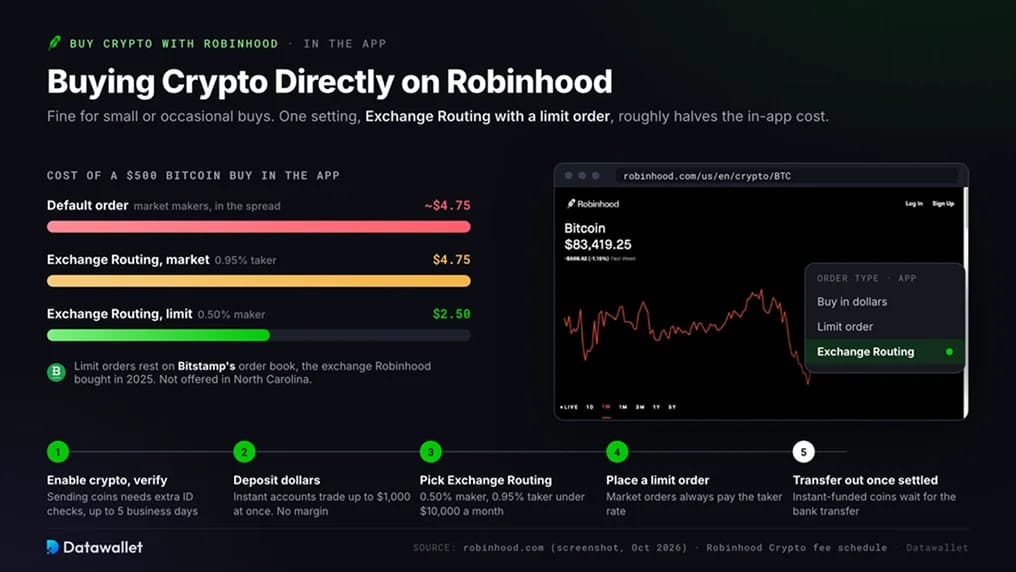
Buying Crypto Directly on Robinhood
For small or occasional purchases, Robinhood's convenience can outweigh a fraction of a percent in fees. Its cheapest in-app option routes a limit order to a partner exchange, replacing the spread with a stated fee.
- Enable crypto and verify: You need a Robinhood Crypto account in addition to your brokerage account. To send or receive coins, complete a further identity check. Approval can take up to five business days.
- Deposit dollars: Link your bank and transfer cash. Instant accounts can trade up to $1,000 straight away, while Gold members receive a higher allowance through Robinhood's paid subscription. You cannot use margin to buy crypto.
- Switch to exchange pricing: On the order screen, open the order type menu and select Exchange Routing. Below $10,000 in 30-day volume, fees start at 0.50% maker and 0.95% taker. North Carolina residents cannot use this setting.
- Place a limit order: These orders rest on Bitstamp's order book and earn the maker rate when matched. Robinhood bought Bitstamp in 2025. Market orders always incur the taker rate.
- Transfer out once settled: If you bought coins with instant funds, the bank transfer must settle before you can withdraw them. Find your daily withdrawal limit under Account, Menu, then Crypto.
How to Buy Crypto with a Robinhood Alternative
To move from Robinhood to Kraken, withdraw dollars through your linked bank account or send existing coins directly for the blockchain's network fee. Either route lets you trade on Kraken Pro, where fees are lowest and orders match against an order book, a live list of other users' buy and sell offers.
Steps to move funds from Robinhood and trade on Kraken:
- Open and verify a Kraken account: Register at Kraken using a government ID, your Social Security number and a US address. Residents of New York or Maine should start with our best crypto exchanges in New York guide, as Kraken does not serve New York or Maine.
- Withdraw cash from Robinhood: In the Robinhood app, open Transfers and send dollars to your linked bank account. Free standard transfers usually arrive within one to three business days. The 1.75% charge for an instant transfer wipes out the fee saving on a small purchase.
- Fund Kraken by ACH: Select Deposit, then US Dollar in Kraken. Connect the same bank through Plaid, which links bank accounts to financial apps. Deposits are free and normally credit within five minutes. See our Plaid guide for details on the data this connection shares.
- Or send coins directly: Open the coin's page in Robinhood, tap Send and paste your Kraken deposit address. You pay the network fee on top of the transfer, with no additional Robinhood charge. Bitcoin addresses must start with bc1q, 1 or 3 because Robinhood cannot send to newer Taproot or Lightning addresses.
- Buy on Kraken Pro: Switch to Kraken Pro and open BTC/USD. Limit orders that wait on the order book pay the 0.40% maker fee. Orders that execute immediately pay the 0.80% taker fee. Avoid the simple Buy button, which charges 1% plus a spread.
Our $500 standard withdrawal arrived in a checking account after two business days. The subsequent Plaid deposit became tradable on Kraken within minutes. In a separate test, Bitcoin sent directly from Robinhood reached Kraken in under an hour.
Buying Crypto Directly on Robinhood
For small or occasional purchases, Robinhood's convenience can outweigh a fraction of a percent in fees. Its cheapest in-app option routes a limit order to a partner exchange, replacing the spread with a stated fee.
- Enable crypto and verify: You need a Robinhood Crypto account in addition to your brokerage account. To send or receive coins, complete a further identity check. Approval can take up to five business days.
- Deposit dollars: Link your bank and transfer cash. Instant accounts can trade up to $1,000 straight away, while Gold members receive a higher allowance through Robinhood's paid subscription. You cannot use margin to buy crypto.
- Switch to exchange pricing: On the order screen, open the order type menu and select Exchange Routing. Below $10,000 in 30-day volume, fees start at 0.50% maker and 0.95% taker. North Carolina residents cannot use this setting.
- Place a limit order: These orders rest on Bitstamp's order book and earn the maker rate when matched. Robinhood bought Bitstamp in 2025. Market orders always incur the taker rate.
- Transfer out once settled: If you bought coins with instant funds, the bank transfer must settle before you can withdraw them. Find your daily withdrawal limit under Account, Menu, then Crypto.
Fees, Tax and Transfer Limits for Robinhood Customers
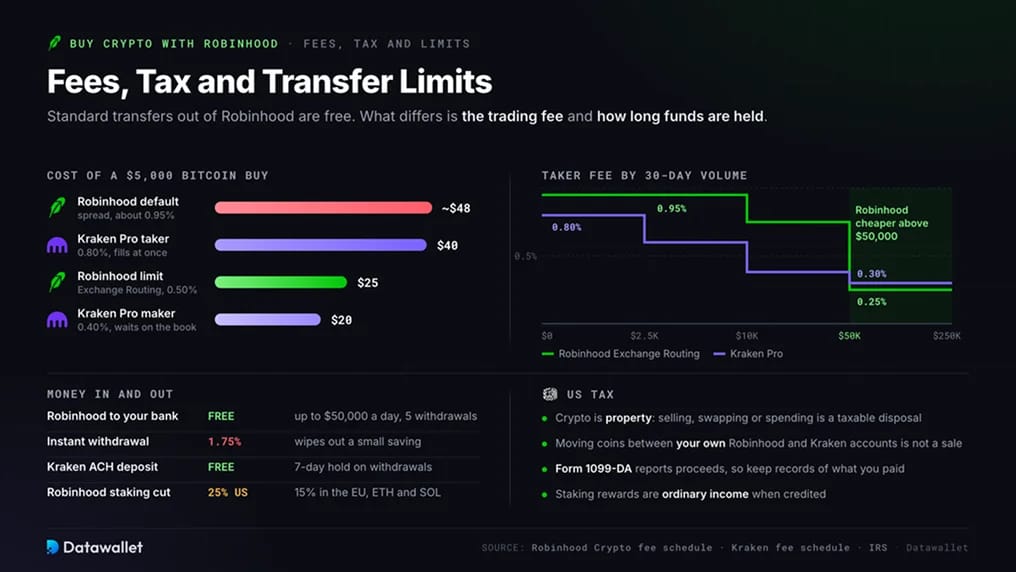
Standard transfers out of Robinhood are free. Trading costs and the time funds remain locked differ between the two platforms.
Robinhood costs and limits
- Default orders: No commission. As of June 15, market makers pay Robinhood $0.95 per $100 traded, with the cost carried in the spread on both purchases and sales.
- Exchange orders: Maker and taker fees are 0.50% and 0.95% below $10,000 in 30-day volume. They drop to 0.35% and 0.75% up to $50,000, then 0.125% and 0.25% up to $250,000.
- Crypto transfers: Deposits have no limit. Withdrawal limits depend on the account and cannot be raised manually.
- Bank withdrawals: Free standard transfers are capped at $50,000 per business day across five withdrawals. Instant withdrawals carry a 1.75% fee.
- Spending account: JPMorgan Chase issues its bank account numbers, which accept third-party ACH pulls of up to $250,000 a day. The account does not support wires.
- Staking: Robinhood retains 25% of Ethereum and Solana rewards in the US. Its share in the EU is 15%.
- State restrictions: New York excludes 26 of the 80-plus transferable coins from trading. Texas excludes USDC.
- Allowlisting: This optional security feature restricts withdrawals to approved addresses. Newly added addresses have a 48-hour waiting period.
- Protection: Robinhood crypto holdings lack FDIC and SIPC coverage, the US protections for bank deposits and brokerage securities.
Kraken fees and holds
- ACH deposit: Cash or coins equal to the deposit are subject to a seven-day withdrawal hold. You can still trade during that period.
- Kraken Pro trading: Entry fees are 0.40% maker and 0.80% taker, falling to 0.30% and 0.60% after $2,500 in 30-day volume. After $10,000, the rates become 0.22% and 0.38%. Our maker and taker fee explainer explains how each applies.
- Instant Buy: Trades made through the simple Buy screen do not contribute to Kraken Pro volume tiers.
- High-volume crossover: Once monthly volume exceeds $50,000, Robinhood's exchange rates of 0.125% and 0.25% are lower than Kraken's 0.15% and 0.30%.
Tax on crypto
- US property treatment: Because the IRS classes digital assets as property, a sale, swap or purchase made with coins is a taxable disposal. Transferring coins between your own Robinhood and Kraken accounts is not a sale.
- Form 1099-DA: Both platforms use this form to report gross sale proceeds to the IRS. Transferred coins arrive without a purchase price attached. Keep your Robinhood trade history as evidence of your cost basis, the amount you paid.
- Staking rewards: The dollar value of rewards when credited counts as ordinary income.
- EU and UK: Each country sets its own tax rules. Since January, EU platforms have had to record customer transactions for tax authorities under DAC8, the EU tax reporting directive. UK disposals fall under Capital Gains Tax.
For a $5,000 Bitcoin purchase, the default Robinhood order costs roughly $48 in spread. Routing a limit order to a partner exchange costs $25. On Kraken Pro, the same purchase incurs a $20 maker fee or a $40 taker fee, with no deposit charge.
Best Exchanges for Robinhood Customers
All four exchanges below accept free ACH deposits. Fees, asset selection and state coverage are the main differences. Kraken offers 500+ coins, a full order book and commission-free US stocks. Coinbase serves all 50 states, including New York, where Gemini holds a trust charter. Robinhood-owned Bitstamp charges less than Robinhood's in-app fee tiers.
For a broader comparison, see our best crypto exchanges in the USA ranking. Our Coinbase vs Robinhood guide examines those two platforms in more detail.
Robinhood Crypto in Europe and the UK
Robinhood serves markets outside the US through separate companies, each with its own pricing. Whether Kraken costs less therefore depends on where you live.
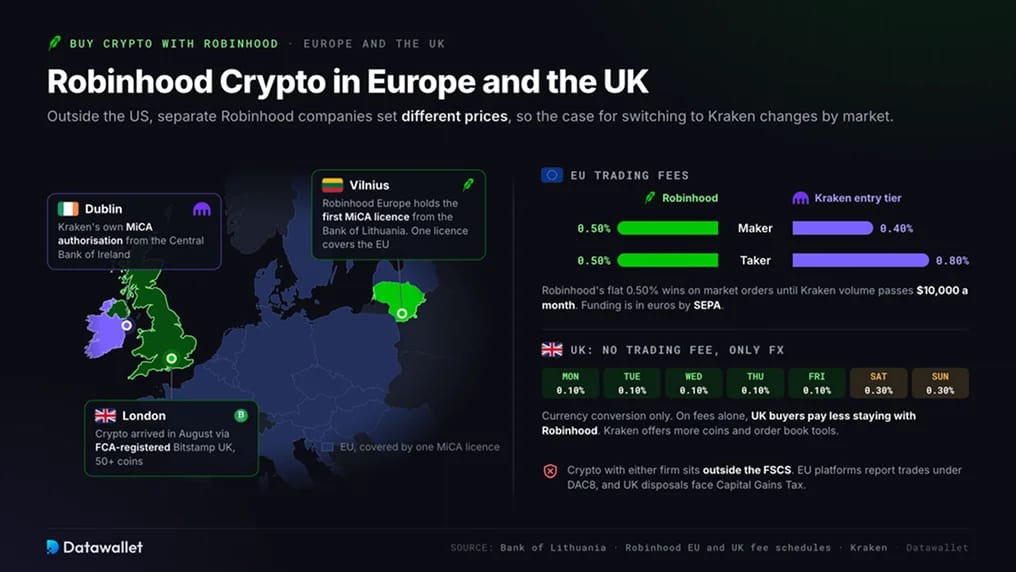
- European Union: On May 29, 2025, Robinhood Europe, UAB received the first MiCA license issued by the Bank of Lithuania. MiCA provides a single EU rulebook for crypto firms, allowing one license to cover the bloc. Trading costs a flat 0.50%. Customers fund accounts in euros through SEPA, the standard European bank transfer.
- Kraken in the EU: Authorized under MiCA by the Central Bank of Ireland, Kraken charges a 0.40% maker fee against Robinhood's 0.50%. Its taker fee remains higher until 30-day volume exceeds $10,000. See our list of MiCA-licensed crypto exchanges for alternatives.
- United Kingdom: Crypto reached the UK app in August through FCA-registered cryptoasset firm Bitstamp UK Ltd, with more than 50 coins available. Trading carries no Robinhood fee. Currency conversion costs 0.10%, rising to 0.30% at weekends.
- Kraken in the UK: Robinhood is cheaper for UK customers on fees alone. Kraken offers a broader coin selection and order book tools. Neither firm's crypto holdings qualify for Financial Services Compensation Scheme coverage.
- Other countries: Check our Robinhood restricted countries guide for availability by product.
Bitcoin ETFs on Robinhood
You can also follow Bitcoin's price through Robinhood's brokerage account without holding coins. Spot Bitcoin ETFs, including the iShares Bitcoin Trust (IBIT), trade commission-free like other listed funds. They are also eligible for a Robinhood retirement account.
ETF shares cannot be transferred to a wallet, staked or spent, and the fund collects an annual management fee. As brokerage securities, however, they receive SIPC protection that coins held in Robinhood Crypto do not. Our Bitcoin ETF tracker records daily inflows and outflows for each fund.
Robinhood Cryptocurrency Policy
Crypto is a core Robinhood product, generating $100 million in revenue in the second quarter, down 38% from a year earlier. Robinhood holds customer coins in custody and retains the private keys, the codes that control them. To hold their own keys, customers use the separate Robinhood Wallet app.
Customers could not always withdraw crypto. In 2024, California's Attorney General secured a $3.9 million settlement over Robinhood's failure to allow withdrawals between 2018 and 2022. The settlement requires the firm to keep withdrawals available. Separately, the SEC closed its investigation into Robinhood Crypto in February 2025 without enforcement action.
US exchanges continue to operate through state licenses and registration with FinCEN, the Treasury bureau responsible for policing money laundering. Robinhood Crypto follows this model and is listed in the national licensing registry under NMLS ID 1702840. Kraken operates under the same model through Payward Interactive, Inc.
Robinhood Chain is the latest addition. Launched on July 1, this layer 2 network processes transactions cheaply and settles them on Ethereum. Our Robinhood Chain explainer details how it works. Transfers on the network remain unavailable to New York customers.
About Robinhood
Founded in 2013 by Vlad Tenev and Baiju Bhatt, Robinhood began with commission-free stock trading. The Menlo Park, California-based company has traded on Nasdaq as HOOD since July 2021. It introduced crypto trading in 2018, then acquired Bitstamp in June 2025, adding an exchange licensed across the US, EU and UK.
Robinhood reported 28.4 million funded customers at the end of June, with $369 billion in platform assets and 4.8 million Gold subscribers. More than 1 million customers live outside the US. Alongside stocks and options, the app now offers futures, prediction markets and retirement accounts, as well as banking and credit cards.
Robinhood Financial LLC, a registered broker-dealer and SIPC member, holds brokerage accounts. Robinhood Crypto, LLC handles crypto, while spending accounts sit with Robinhood Money, LLC. Our Charles Schwab and Cash App guides explain how other US brokers and money apps handle the same purchase.
Bottom Line
Robinhood provides a licensed, straightforward way to buy your first Bitcoin. Changing one setting lowers the in-app cost. A limit order routed to a partner exchange costs 0.50%, roughly half the default spread.
For US customers buying regularly or seeking coins Robinhood does not list, we recommend Kraken. It is also our recommendation for those trading less than $50,000 a month. Read our Kraken review for a full assessment.
Residents of New York and Maine need Coinbase or Gemini, while UK customers already pay less through Robinhood. Before transferring coins, download your Robinhood transaction history. The receiving exchange will not know your original purchase price.