







Compare Top Azerbaijani Crypto Exchanges
1. Bybit
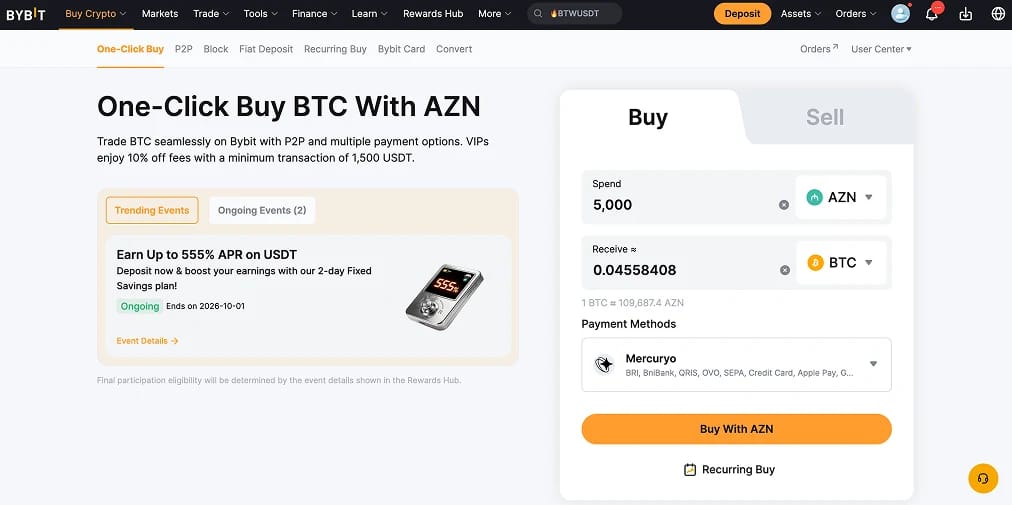
Bybit takes the top slot because it has done something no other foreign exchange has bothered with: building compliance plumbing specifically for Azerbaijani users. The platform integrated a third-party verification service for AZN trades that checks whether a bank account name matches the trader's KYC name before payment counts as valid proof. Unverified Azerbaijani accounts cannot settle a P2P order at all.
It adds friction, and we felt it on our first order. The payoff is a cleaner desk. Name matching kills the most common scam in AZN P2P, where a buyer pays from a third-party card and later disputes the trade. The desk lists Kapital Bank, Leobank, m10, ABB, Unibank, Bank Respublika and several smaller banks, covering nearly every card a Baku resident holds. When we funded a 300 manat test order through m10, escrow released in under ten minutes.
Underneath the on-ramp sits a complete stack: 1,800+ spot assets at 0.1% fees, perpetuals, copy trading, earn products and a card programme. Bybit publishes proof-of-reserves and does not list Azerbaijan among its restricted countries. Like every venue here, it holds no Azerbaijani licence, because no licence yet exists to hold.
Pros
- AZN P2P with mandatory bank-name verification, which sharply cuts third-party payment scams.
- Broadest local payment coverage we tested, spanning Kapital Bank, Leobank, m10, ABB and Unibank.
- Full product depth with 0.1% spot fees, copy trading, earn and published proof-of-reserves.
Cons
- The name-match rule blocks anyone paying from a relative's card, which catches genuine users too.
- No direct AZN wallet deposit, so every fiat entry runs through a P2P counterparty.
- Interface depth is more than a first-time buyer needs.
2. Binance
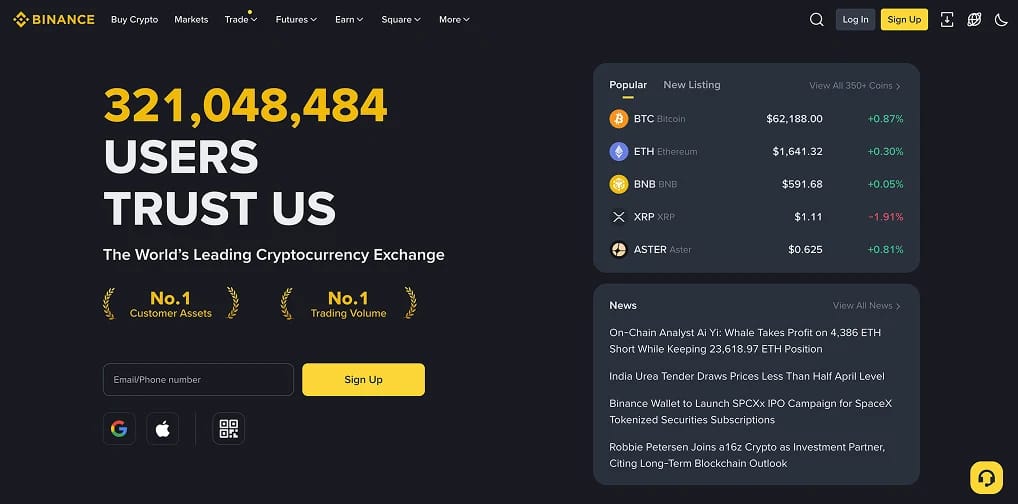
Binance is the only exchange with a true direct AZN deposit channel. Through its m10 integration, you push manats from the m10 app, a payment institution licensed in Azerbaijan, straight into a Binance fiat wallet and buy crypto against the balance. No counterparty, no escrow, no waiting on a merchant. For anyone who keeps money in m10, in Baku that is most people under 40, it is the shortest distance between a salary and a stablecoin.
The P2P desk is the country's deepest on merchant count. Beyond the standard bank list, Binance runs azInstant rails for Kapital Bank and m10 that settle near-instantly, and USDT/AZN spreads sat tightest here during our testing, typically 1 to 2% over the official 1.70 rate the Central Bank holds the manat at. Spot liquidity is unmatched globally, so conversions and withdrawals never stall.
The trade-offs are platform-level rather than local. Binance's compliance history, including its 2023 US settlement, is well documented, and account reviews can freeze funds for weeks when triggered. We compare the two leaders directly in our Bybit vs Binance breakdown.
Pros
- Direct AZN deposits through the m10 app, the only non-P2P fiat channel available to Azerbaijani users.
- Deepest AZN P2P merchant pool with azInstant settlement on Kapital Bank and m10.
- Tightest USDT/AZN spreads we measured, plus unmatched global spot liquidity.
Cons
- Compliance reviews can lock accounts for extended periods with slow support escalation.
- The app is dense, and lite mode hides the cheaper spot market behind instant-buy spreads.
- m10 deposit limits are modest, so larger purchases still push you back to P2P.
3. Bitget
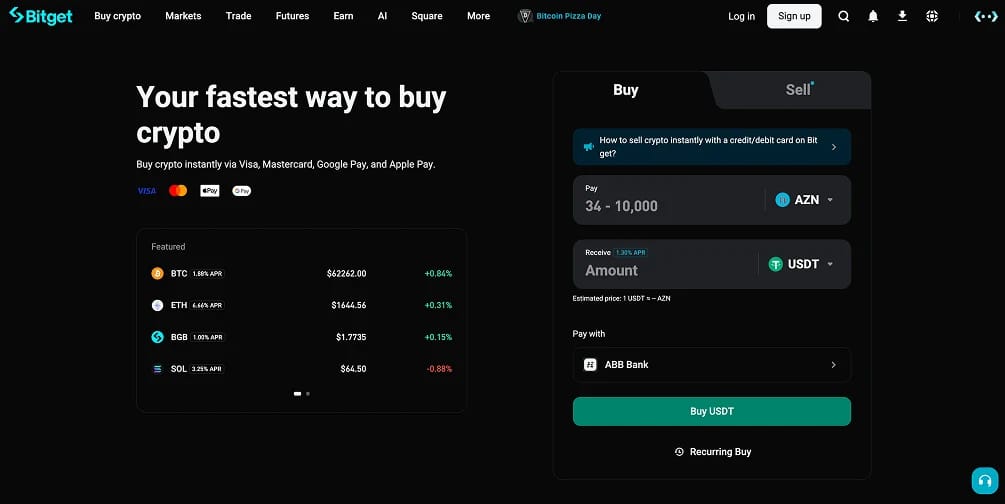
Bitget earns third on AZN P2P coverage paired with the best copy trading product of the group. The desk accepts Kapital Bank, m10, Leobank, Azer Turk Bank, ABB and Unibank, level with Bybit on local payment breadth, though merchant counts thin out outside Baku evening hours. On a Tuesday morning test our buy order waited fourteen minutes for a merchant to respond. The same order at 8pm cleared in three.
Copy trading is where Bitget separates itself. The platform hosts one of the industry's largest trader pools, with filters for drawdown, win rate and AUM, and it is why Azerbaijani users we spoke with keep an account here alongside a primary venue. Spot fees start at 0.1% across 800+ assets, and futures liquidity on majors competes with far larger books.
On safety, Bitget publishes a Merkle tree proof-of-reserves with ratios consistently above 100% and maintains a protection fund worth several hundred million dollars. It lacks the longest history, but its disclosure cadence has been steady.
Pros
- AZN P2P breadth on par with Bybit, including Kapital Bank, m10, Leobank and Azer Turk Bank.
- Best-in-class copy trading with deep trader filters and a large strategy pool.
- Regular Merkle proof-of-reserves and a sizeable protection fund.
Cons
- Merchant response times lag badly outside peak Baku hours.
- No bank-name verification layer, so counterparty diligence falls entirely on you.
- Product menu is heavy for someone who only wants to hold USDT.
4. OKX
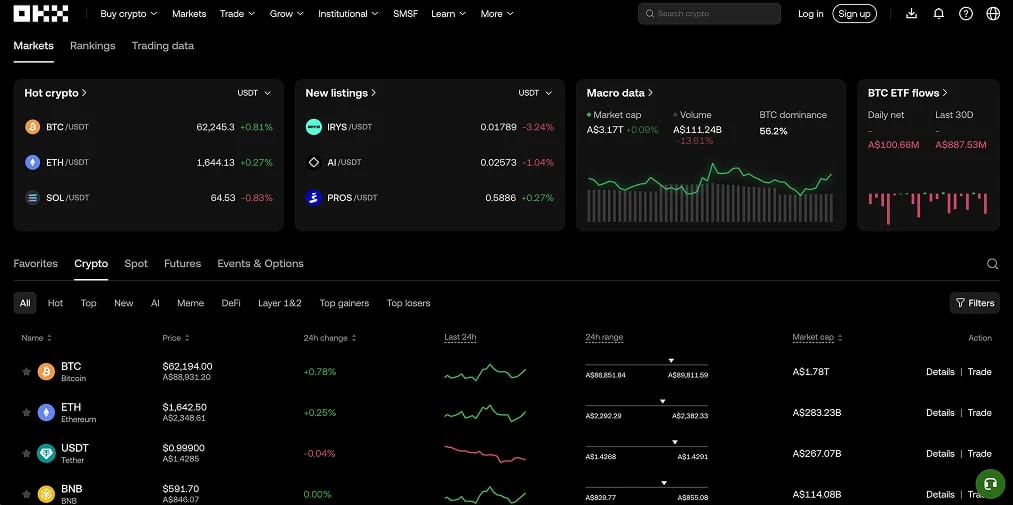
OKX is the pick for users planning to go past holding stablecoins on an exchange. The Web3 wallet built into the main app supports dozens of chains, routes swaps through an aggregator scanning hundreds of DEXs, and removes the separate-wallet juggling that keeps most people out of DeFi. For an Azerbaijani user, where on-chain activity ranks well behind centralised usage, it is the lowest-friction bridge to that side of the market.
The catch is the on-ramp. OKX's AZN P2P desk lists only Kapital Bank and m10, and the merchant pool is a fraction of what Bybit or Binance carry. On orders under a few hundred manats the spread leakage is real. Most OKX users in Azerbaijan fund elsewhere and move USDT across on TRC20, which costs around a dollar and settles in minutes.
As a trading venue it is excellent. Spot fees start at 0.08% maker, the lowest of the six, and the exchange publishes monthly proof-of-reserves attestations with one of the better disclosure records among majors.
Pros
- Built-in Web3 wallet and DEX aggregation, the cleanest DeFi access of any platform here.
- Lowest headline spot fees on this list at 0.08% maker.
- Monthly proof-of-reserves with a consistent publication history.
Cons
- AZN P2P is thin, limited to Kapital Bank and m10 with few active merchants.
- Spreads on small AZN orders run wider than Bybit or Binance.
- Web3 features add complexity a pure spot buyer will never use.
5. MEXC
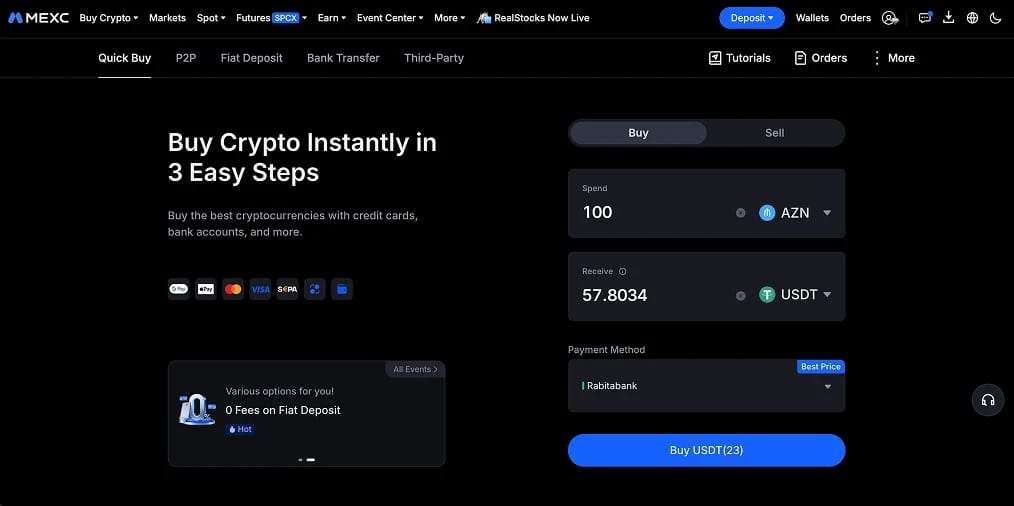
MEXC is the answer when fees decide. Spot makers pay nothing and takers pay 0.05%, which compounds into real savings for anyone buying BTC or ETH on a schedule. We unpack the structure in our MEXC fee guide, but no major venue undercuts it on spot.
The listing pipeline is the other draw. MEXC carries 2,800+ assets and routinely lists new tokens weeks before they reach Bybit or Binance, which matters to Azerbaijani traders hunting early-stage names. AZN P2P exists on paper but the desk is shallow, so the standard pattern is buying USDT on Bybit or Binance P2P first and bridging it across on TRC20.
The trade-off is transparency. MEXC's proof-of-reserves disclosures are less frequent and less detailed than Bitget's or OKX's, and its Seychelles base offers little recourse if a dispute escalates. Treat it as a trading venue, not long-term custody.
Pros
- 0% maker and 0.05% taker on spot, the cheapest structure of the six.
- 2,800+ assets with the fastest new-listing cadence here.
- Low-friction USDT transfers in via TRC20 once funded elsewhere.
Cons
- AZN P2P is too thin to rely on as a primary on-ramp.
- Proof-of-reserves cadence trails the top-tier venues.
- Weak regulatory footprint and limited dispute recourse.
6. Gate
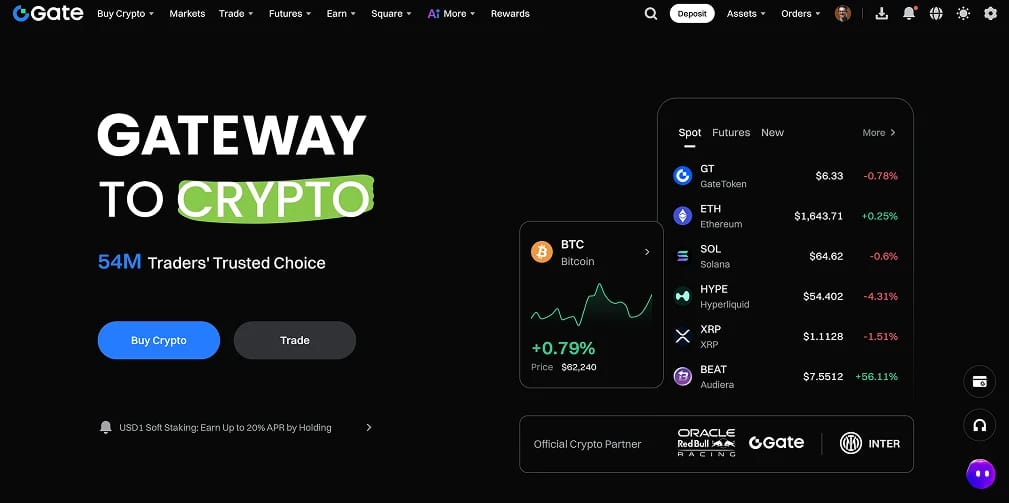
Gate closes the list for one audience: traders who want long-tail altcoin exposure nothing above can match. The platform lists 3,600+ assets, picks up small caps months before larger venues, and pairs the catalogue with copy trading, bots and leveraged tokens.
There is no meaningful AZN on-ramp. The handful of P2P listings that surface are too thin to price fairly, so funding means a USDT transfer from a venue with a working manat desk. That two-step suits an active trader and a first-time buyer poorly.
Gate's on-chain proof-of-reserves ratio sits above 100% and has been published consistently, and the platform has operated since 2013 without a catastrophic security failure. We cover the trust question in our review of whether Gate is safe. The honest summary: credible for trading, but the long tail of low-liquidity listings demands your own due diligence on every position.
Pros
- Largest asset catalogue available to Azerbaijani users at 3,600+ tokens.
- Consistent on-chain proof-of-reserves and a thirteen-year operating history.
- Strong bot, copy trading and leveraged token tooling.
Cons
- No functional AZN on-ramp, so funding always requires a second platform.
- Thousands of low-liquidity listings carry elevated token risk.
- Compliance profile sits behind Bybit, Binance and OKX.
How to Choose a Crypto Exchange in Azerbaijan
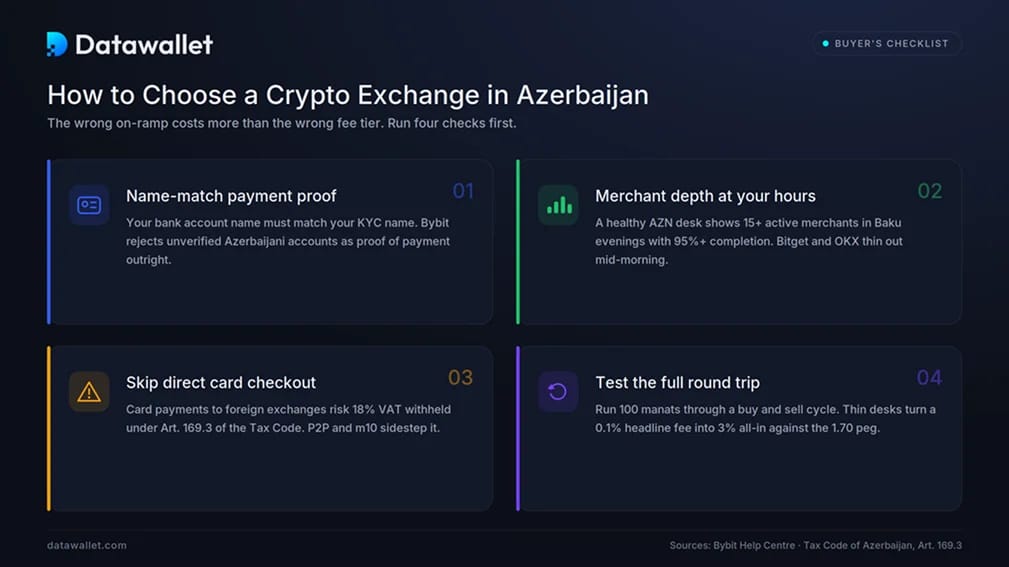
The Azerbaijani market punishes the wrong on-ramp far more than the wrong fee tier. Four checks before you commit:
- Confirm your bank card will be accepted as proof of payment. On Bybit, the account name must match your KYC name exactly, and unverified Azerbaijani accounts are rejected outright. Even without that rule, paying from someone else's Birbank card is the fastest way to lose a P2P dispute. Use your own card.
- Check AZN merchant depth at the hour you actually trade. Open the P2P section, filter for AZN, and count active merchants offering Kapital Bank or m10. A healthy desk shows 15 or more during Baku evening hours with completion rates above 95%. Bitget and OKX both thin out badly mid-morning.
- Avoid direct card purchases on foreign exchange checkout pages. Card payments to non-resident e-commerce providers can have 18% VAT withheld by the bank under Article 169.3 of the Tax Code, on top of the usual 2 to 4% processor markup. P2P and m10 sidestep this entirely, which is why almost nobody in Azerbaijan buys with a card directly.
- Measure the round trip, not the headline fee. Run 100 manats through a buy and sell cycle and compare what comes back. The real cost sits in the P2P spread over the 1.70 peg on both legs plus the withdrawal fee. A venue advertising 0.1% spot fees can still cost 3% all-in if its merchant desk is thin.
Crypto and Bitcoin Regulation in Azerbaijan
Azerbaijan sits in a genuine grey zone: no ban, no licence, and a framework that exists on paper but has not switched on. The pieces that matter:
- The manat is the only legal tender. The 1995 Constitution reserves currency issuance for the Central Bank, so crypto cannot serve as a payment instrument. The CBA's leadership has framed crypto as an investment asset rather than money since 2017, and issued a public volatility warning in 2018.
- Dormant virtual asset rules. In April 2023, CBA Governor Taleh Kazimov signed the Rules of Operations with Virtual Assets, drafted under the AML law. The rules only take effect once legislation governing virtual asset service providers is adopted, so they currently bind nobody.
- A VASP law in the works. The Central Bank has been drafting a law on the activity of virtual assets and virtual asset service providers, with industry proposals from the Blockchain Azerbaijan Center submitted in late 2025. Once passed, it would create the country's first licensing regime and activate the 2023 rules.
- Tax law has moved first. In February 2025, parliament added virtual assets to the list of intangible assets in the Tax Code, the first time crypto has been defined in primary legislation.
The practical reading: holding and trading crypto as an individual is not prohibited and is not prosecuted. Operating an exchange or accepting crypto as payment is where the legal exposure starts. Every platform on this list serves Azerbaijani users from offshore, and that stays true until the VASP law lands.
How Does Azerbaijan Tax Crypto?
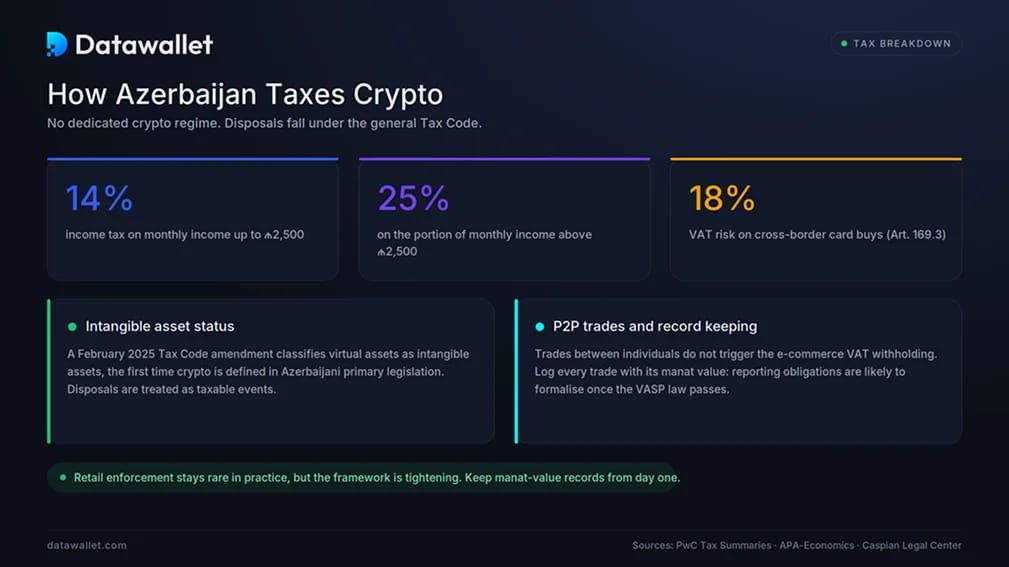
There is no dedicated crypto tax regime, but income does not escape tax. Since 2018 the tax authorities' position has been that proceeds from selling or trading virtual currency fall under the general Tax Code:
- Individual income: Gains from disposing of crypto are taxable as ordinary income. Standard personal rates apply, 14% on monthly income up to 2,500 manats and 25% on the portion above, though there is no crypto-specific filing guidance and retail enforcement is rare in practice.
- Intangible asset status: The February 2025 Tax Code amendment classifying virtual assets as intangible assets gives crypto a defined place in the tax framework for the first time, signalling the State Tax Service intends to treat disposals as taxable events.
- VAT on cross-border card purchases: Buying crypto from a foreign platform with a local card can be treated as an e-commerce import, with the bank withholding 18% VAT on the payment under Article 169.3. P2P trades between individuals do not trigger this.
- Record keeping: Log every trade with its manat value at the time. When the VASP law passes and reporting infrastructure follows, historical records will be the difference between a clean filing and an argument.
Cryptocurrency Adoption in Azerbaijan
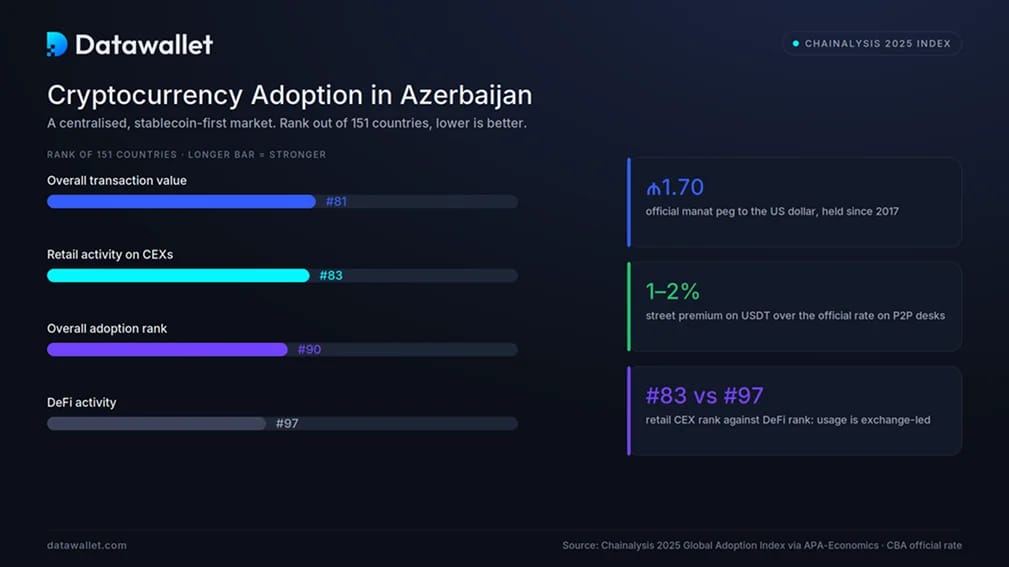
Azerbaijan ranked 90th of 151 countries in the Chainalysis 2025 Global Adoption Index, between El Salvador and Ireland. The detail under the headline is more telling: the country ranks 83rd for retail activity on centralised exchanges and 81st for overall transaction value, against just 97th for DeFi. Azerbaijani crypto usage is overwhelmingly a centralised, stablecoin-first story.
The drivers are familiar to anyone who watched the manat lose roughly half its value across the two devaluations of 2015. The currency has held near 1.70 to the dollar since 2017, but the memory shapes behaviour: households keep savings in dollars, and USDT has become the digital version of the cash dollar under the mattress. On P2P desks, USDT consistently trades at a 1 to 2% premium over the official rate, a standing measure of demand behind the peg.
The fintech layer has accelerated things. m10's growth into the default payment app in Baku gave exchanges a clean settlement rail, and the global pattern of stablecoin adoption running through markets with managed currencies and strong dollar habits fits Azerbaijan precisely.
How to Buy Bitcoin in Azerbaijan
Buying BTC here is a two-step trade: manats into USDT first, then USDT into Bitcoin on the spot book. The sequence we use:
- Open and verify an account. Bybit or Binance for the deepest AZN desks. KYC needs your Azerbaijani ID card or passport plus a selfie. Make sure the account name matches your bank card exactly, since mismatches void P2P payment proof on Bybit.
- Fund in manats. On Binance, the m10 deposit is the cleanest entry: push AZN from the m10 app and the balance lands in your fiat wallet. On any P2P desk, filter for AZN, pick a merchant with 500+ completed trades and a 97%+ completion rate, and pay through Kapital Bank, Leobank or m10.
- Buy USDT first. P2P trades settle in USDT, and even the m10 channel prices stablecoins tightest. Wait for escrow release before marking anything complete.
- Swap USDT for BTC with a limit order. Skip the one-tap convert screen, open the BTC/USDT spot pair, and place a limit order. The difference against instant buy is typically 1 to 2%.
- Decide on custody. Active traders can leave BTC on the exchange. For longer holds, withdraw to a wallet you control. Our best crypto wallets guide covers hardware and software options.
Final Thoughts
For most Azerbaijani users the decision resolves quickly. Bybit if you want the safest P2P desk, where the name-match rule does the counterparty screening for you. Binance if m10 is already your daily payment app and you want the only direct fiat channel in the country. Bitget, OKX, MEXC and Gate each earn a slot for a specific job, copy trading, DeFi access, fees and altcoins respectively, usually funded by a USDT transfer from one of the top two.
The regulatory picture is about to change. The VASP law in drafting will activate the 2023 rules, create licensing, and almost certainly bring reporting obligations. The 2025 intangible-asset amendment shows the tax side is already moving. None of that threatens individual holders today, but it argues for keeping clean records now rather than reconstructing them later.
Before committing real money anywhere, run a small manat round trip and confirm the exit works against your own bank card. Ten minutes of testing beats any ranking, including this one.
Our Methodology
We evaluated over 15 exchanges accessible from Azerbaijan by creating accounts, completing KYC with Azerbaijani documents, funding AZN through m10 and local bank cards on P2P, executing spot trades, and withdrawing back to local accounts. Each platform was scored across six criteria:
- Trust Score: Our proprietary rating (out of 5) weighting security history, proof-of-reserves transparency, regulatory standing, platform longevity and audit coverage.
- AZN Funding Methods: Confirmed support for Kapital Bank, Leobank, m10, ABB and Unibank across P2P and direct channels, with testing of settlement speed and escrow reliability.
- Spread and Liquidity: Measured USDT/AZN pricing against the 1.70 official rate at multiple times of day, plus order book depth on BTC/USDT and ETH/USDT.
- Counterparty Safety: Reviewed merchant verification programmes, payment-proof rules, dispute handling and the prevalence of third-party payment scams on each desk.
- Security Track Record: Assessed breach history, custody arrangements, proof-of-reserves cadence and account protections such as 2FA and withdrawal whitelists.
- Fee Structure: Compared maker and taker fees, withdrawal charges and the all-in cost of a manat-to-USDT-to-manat round trip.
We excluded platforms with no workable AZN path, persistent access problems, or unresolved compliance failures. Testing ran from March to June 2026.
.webp)