










Can I Buy Bitcoin with FNB?
FNB customers can buy Bitcoin in two ways. FNB Crypto Investing offers Bitcoin and four other assets in the app from R10. To hold the coins yourself, you need an exchange funded from your FNB cheque account. These payments have no separate FNB crypto allowance and count against the daily payment limit you control in the FNB App. Bybit imposes its own limits of under $10,000 per Instant EFT order and $20,000 a day at standard verification.
Exchange payments follow FNB's normal online transfer process, with the usual approval prompt in the app as the only check. During our test, Bybit redirected us to South African payment processor Ozow. FNB's approval request arrived within seconds, but our first attempt expired because we unlocked the app too late. Open it before confirming the payment.
Your FNB card will not work on a crypto platform. Since July 2021, the bank has declined international debit and credit card purchases coded as crypto, directing customers to SWIFT transfers through its forex desk instead. Instant EFT, PayShap and ordinary EFT bank transfers still work.
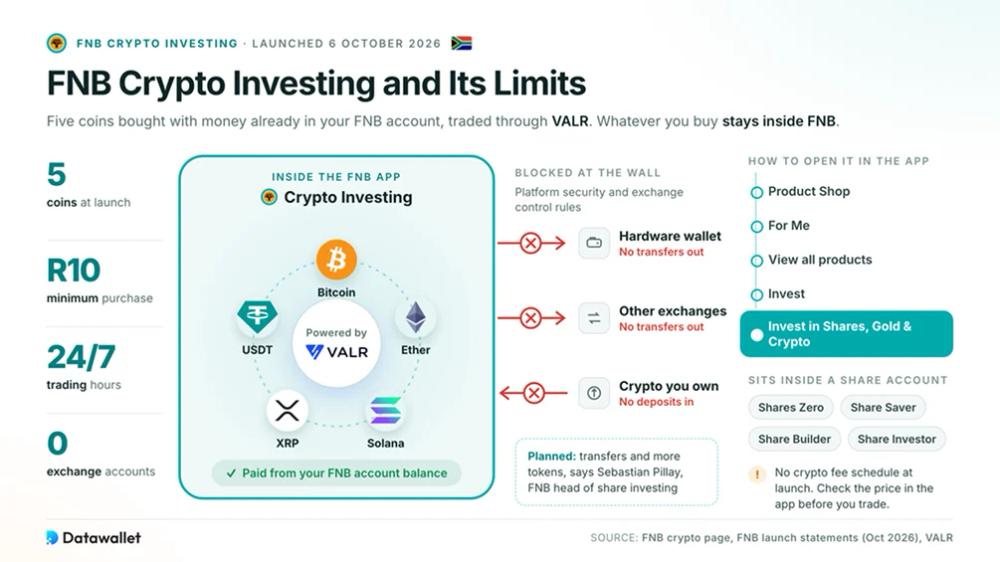
FNB Crypto Investing and Its Limits
FNB launched Crypto Investing on 6 October 2026. It uses money already in your FNB account and requires no exchange account. Trading runs through VALR, a Johannesburg exchange licensed by the FSCA, with Bitcoin, Ether, XRP, Solana and USDT available from R10 around the clock.
The service sits within FNB's share accounts (Shares Zero, Share Saver, Share Builder and Share Investor). FNB's crypto page explains how to open one. Follow Product Shop, For Me and View all products, then select Invest in Shares, Gold & Crypto under Invest.
Any coins you buy must stay inside FNB. Transfers to hardware wallets or other exchanges are unavailable, and you cannot deposit crypto you already own. FNB attributes these restrictions to platform security and a cautious reading of exchange control law, which governs how money and assets leave South Africa. No crypto fee schedule was published at launch, so check the price in the app before trading.
Sebastian Pillay, FNB's head of share investing, says transfers and more tokens are planned as the business matures. For now, the service suits a small crypto position alongside your shares. Staking, a wider choice of coins or holding assets in your own wallet still requires an exchange.
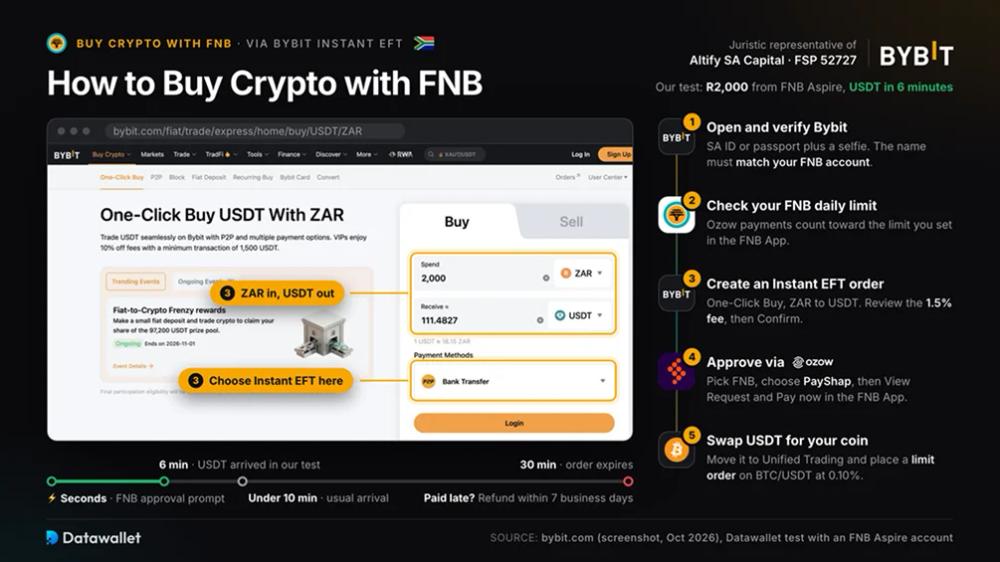
How to Buy Crypto with FNB
To buy crypto with FNB and retain the ability to withdraw it, fund Bybit through Instant EFT. You receive USDT, which you can swap on its spot market, where coins trade for immediate delivery. The payment bypasses card networks, so FNB's crypto card block does not apply.
Steps to buy crypto with FNB:
- Open and verify a Bybit account: Register on Bybit and complete identity checks (KYC) using your South African ID or passport plus a selfie. The name must match your FNB account, as Instant EFT accepts payments only from an account in your own name.
- Check your FNB daily limit: Open the limit settings in the FNB App and make sure your daily payment limit covers the deposit. Ozow payments count towards this limit. Raise it before checkout if needed.
- Create an Instant EFT order: Open Buy Crypto in Bybit, then One-Click Buy. Set the currency to ZAR, select USDT (a stablecoin pegged to the US dollar) and choose Instant EFT as the payment method. Review the 1.5% fee and USDT amount on the confirmation screen before tapping Confirm.
- Approve the payment through Ozow: Select FNB on the Ozow page. Choose PayShap if it appears, then open the FNB App and tap View Request followed by Pay now. This keeps your online banking password off third-party pages. Otherwise, log in on Ozow and approve the prompt FNB sends to your phone.
- Swap USDT for your chosen coin: USDT usually arrives in your Bybit Funding account within ten minutes. Transfer it to your Unified Trading account and open BTC/USDT or another pair. Place a limit order, which fills only at your chosen price, at the 0.10% spot fee. You can then withdraw to your own wallet whenever you like.
Each Bybit order stays open for 30 minutes. If FNB releases the payment after that window, your rand returns within seven business days. Wait for the refund rather than paying twice.
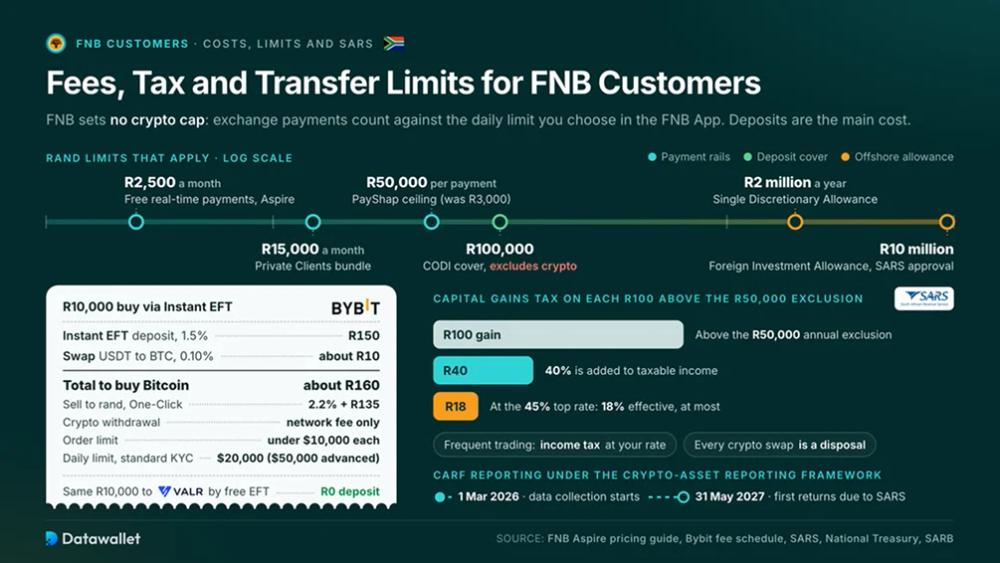
Fees, Tax and Transfer Limits for FNB Customers
Deposits account for most of the cost for FNB customers. Trading and withdrawals remain cheap.
FNB costs and limits
- Daily payment limit: FNB publishes no crypto cap. Payments to exchanges count against the daily limit you set in the FNB App.
- Real-Time Payments: PayShap, Instant Payments and Pay & Clear Now share a pricing category. The current Aspire pricing guide includes R2,500 a month free, after which payments cost R3 to a ShapID (a phone-number alias) or R5 to an account number. Private Clients accounts bundle R15,000 a month across PayShap, real-time payments and EFTs to other banks.
- PayShap ceiling: In October 2024, the scheme maximum increased from R3,000 to R50,000 per transaction. Use a standard EFT or Pay & Clear Now for larger amounts.
- Pay & Clear Now: Payments below R5 million clear within an hour at participating banks, at FNB's premium rate.
- International cards: FNB has declined crypto purchases since July 2021, regardless of your balance.
- Sharing your login: FNB opposes screen scraping, where a third party logs into your banking on your behalf. A joint SARB and FSCA consumer alert warns that sharing credentials may breach your bank's terms and weaken your recourse after fraud.
- Offshore transfers: Rand sent abroad by SWIFT uses your Single Discretionary Allowance, which the 2026 Budget doubled to R2 million per calendar year. Alternatively, the R10 million Foreign Investment Allowance requires SARS approval.
- Deposit insurance: The SARB's Corporation for Deposit Insurance (CODI) protects up to R100,000 per depositor at FNB. This protection excludes crypto held on exchanges or through FNB Crypto Investing.
Bybit fees
- Instant EFT purchase: 1.5% per transaction, subject to a R1 minimum.
- Order limits: Orders must remain under $10,000 each. Standard verification allows a daily total of $20,000, rising to $50,000 with advanced verification.
- Spot trading: Base-tier maker and taker fees are both 0.10% and fall with 30-day volume. Maker orders wait on the order book. Taker orders fill against it.
- Selling to rand: Selling through One-Click Buy costs 2.2% plus R135 per order. Peer-to-peer (P2P) sales to other users usually cost less, though you should check each buyer's completion record first.
- Crypto withdrawal: A network fee only, set per chain. USDT on Tron is among the cheapest networks for moving dollars between platforms.
South African tax on crypto
- Capital or revenue: SARS treats gains on crypto held as an investment as capital gains. Profits from frequent trading are taxed as ordinary income at your marginal rate.
- Capital Gains Tax: The annual exclusion rose to R50,000 for the 2027 tax year, which began on 1 March 2026. Individuals include 40% of the remaining gain in taxable income, giving a top effective rate of 18%. Every crypto-to-crypto swap counts as a disposal.
- CARF reporting: Providers with a South African nexus began collecting customer transaction data on 1 March 2026 under the Crypto-Asset Reporting Framework. Their first returns are due to SARS by 31 May 2027.
A R10,000 purchase incurs R150 in Bybit Instant EFT fees, with a subsequent swap into Bitcoin adding about R10. Sending the same R10,000 to VALR by free EFT costs nothing to deposit. That difference matters more to a one-off buyer than to someone who trades regularly.
Best Exchanges for FNB Customers
All the platforms below accept rand from an FNB account without requiring a card. The local exchanges hold their own FSCA crypto asset service provider (CASP) licences and accept free EFT deposits. Bybit charges for deposits but offers far more coins, alongside copy trading, futures and Earn savings products.
Exchange |
Trust Score |
Cryptos |
Trading Fees |
ZAR Deposits |
Key Features |
|---|---|---|---|---|---|
| Bybit |
4.9/5
|
2,000+ |
0.10% / 0.10% |
Instant EFT (1.5%), P2P, Cards |
Altify SA Capital JR (FSP 52727), Copy Trading, Earn, Futures |
| VALR |
4.8/5
|
100+ |
0.00% / 0.10% |
EFT (free), PayShap, Cards |
FSCA CASP, Powers FNB Crypto Investing, Futures |
| Luno |
4.6/5
|
50+ |
Spread on Instant Buy, lower on Exchange |
EFT (free), Instant EFT |
FSCA CASP, Discovery Bank Integration, Beginner-friendly App |
FNB Crypto Investing |
4.0/5
|
5 |
Not itemised at launch |
Direct from FNB account |
VALR-powered, From R10, No Transfers In or Out |
For a wider comparison, see our best crypto exchanges in South Africa guide. It also covers global exchanges that rely on P2P desks for rand.
FNB Cryptocurrency Policy
FNB's move into crypto comes seven years after it cut off the country's exchanges. In November 2019, FirstRand closed the bank accounts of local exchanges, including Luno and VALR, citing its risk appetite for virtual currencies. It said greater regulatory clarity could change that position. A block on crypto card purchases followed in 2021. By October 2026, FNB had launched its own service through VALR, one of the exchanges it previously dropped.
Clearer regulation enabled the change. In October 2022, the FSCA declared crypto assets a financial product under the FAIS Act. Exchanges now need a CASP licence to serve South Africans and must conduct anti-money laundering checks as accountable institutions under the FIC Act. FNB's launch also followed Discovery Bank's addition of Luno-powered trading in late 2025. Our Capitec and Standard Bank guides explain how those banks handle exchange transfers.
Offshore crypto transfers may soon carry SARB reporting requirements, although the rules remain in draft form. National Treasury published the draft Capital Flow Management Regulations on 17 April 2026. Treasury and the SARB then released a draft Crypto Assets Manual on 3 August. It proposes routing cross-border crypto transfers through authorised providers and reporting them to the SARB's Financial Surveillance Department. Neither text is final, which helps explain FNB's decision to keep customers' coins inside the bank for now.
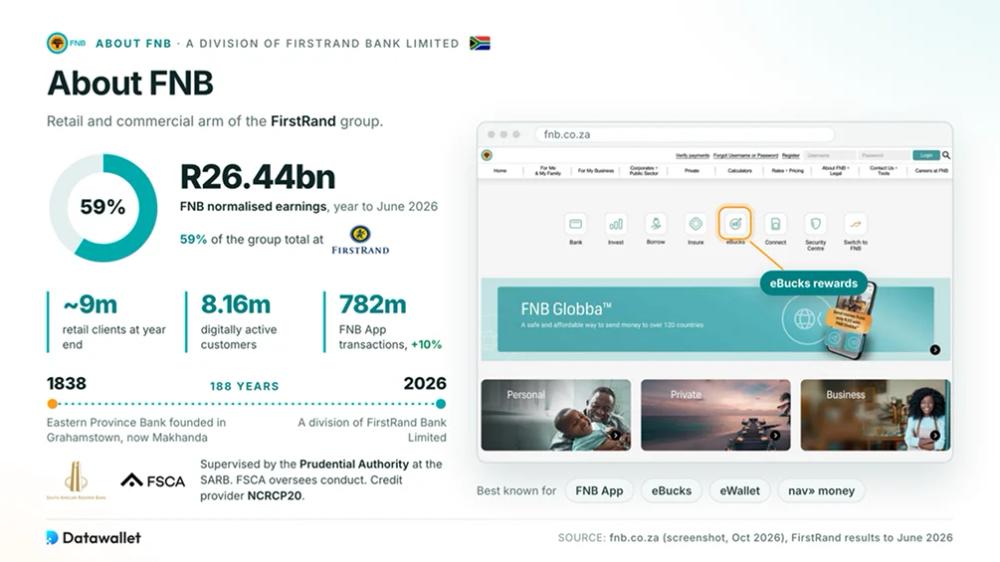
About FNB
First National Bank's history dates to the Eastern Province Bank, founded in Grahamstown (now Makhanda) in 1838. Today, FNB operates as a division of FirstRand Bank Limited. As the group's retail and commercial bank, it generated R26.44 billion in normalised earnings in the year to June 2026, accounting for 59% of the group total.
At year-end, FNB had nearly 9 million retail clients and 8.16 million digitally active customers. Transaction volumes on the FNB App rose 10% to 782 million. Its best-known services include the app and eBucks rewards, along with eWallet transfers and nav» money tools.
FirstRand Bank is an authorised financial services and credit provider (NCRCP20), supervised by the Prudential Authority at the SARB. The FSCA oversees its conduct.
Bottom Line
FNB Crypto Investing gives customers a way to hold a small Bitcoin position alongside their shares. Its five-coin selection and withdrawal restrictions will not suit those who want to move their assets, stake or trade more widely. An Instant EFT to an exchange remains the dependable option for those needs.
We recommend Bybit for access to 2,000+ assets, 0.10% spot fees and withdrawals to your own wallet. Consolidate deposits to limit the 1.5% Instant EFT fee and select PayShap on the Ozow page when available. Keep your Bybit records for SARS, which starts receiving CARF data in 2027. Our Bybit review covers the platform in depth.


