


Can You Add USDC to MetaMask?
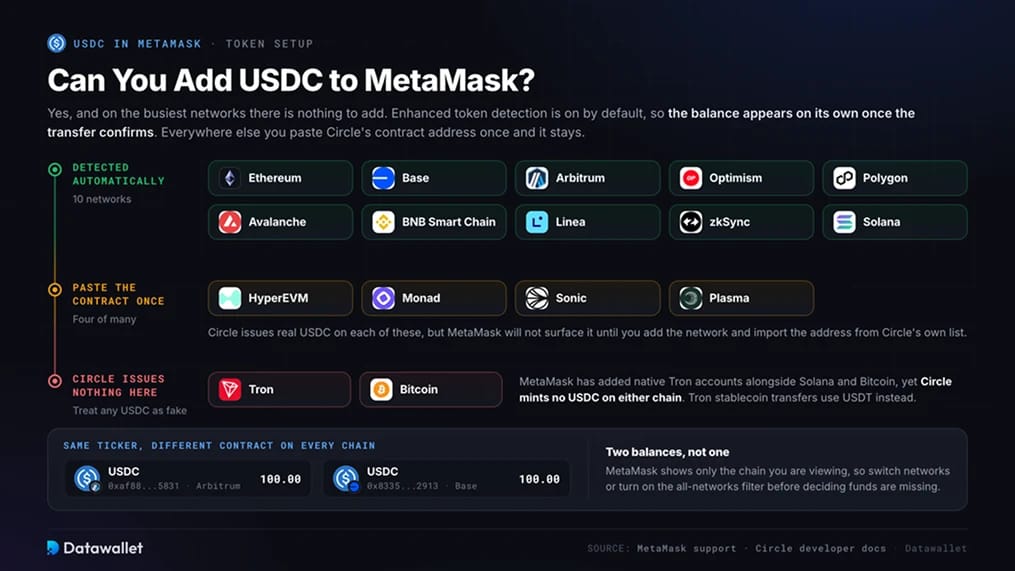
You can add USDC to MetaMask, though the busiest networks require no manual import. Enabled by default, MetaMask's enhanced token detection scans your address for recognized tokens on Ethereum, Linea, Avalanche, BNB Smart Chain, Polygon, Arbitrum, Optimism, Base, zkSync and Solana. Your USDC balance appears shortly after a transfer confirms on any of these networks.
Other networks require a manual import. Each blockchain has a separate USDC contract, so 100 USDC on Arbitrum and 100 USDC on Base appear as distinct holdings. MetaMask displays the selected network unless you switch to the all-networks view. For HyperEVM, Monad, Sonic and Plasma, which fall outside the detection list, you need to import the contract address.
Alongside Solana and Bitcoin, MetaMask now offers native Tron accounts. Circle issues native USDC on Solana but not on Tron or Bitcoin. A Solana account therefore detects the real token, while anything labeled USDC in a Tron or Bitcoin account is a fake. Tron stablecoin transfers use USDT, covered in our guide to adding USDT to MetaMask.
How to Add USDC to MetaMask
Importing USDC tells MetaMask which contract to read. It does not change your holdings, which are already recorded against your address. This also explains the danger of a fake contract address: the wallet can display a worthless token under the USDC name.
- Switch to the network your USDC is on: Open the network selector at the top of MetaMask and choose the chain used by the sender. If it is missing, follow our guide to adding a network to MetaMask first.
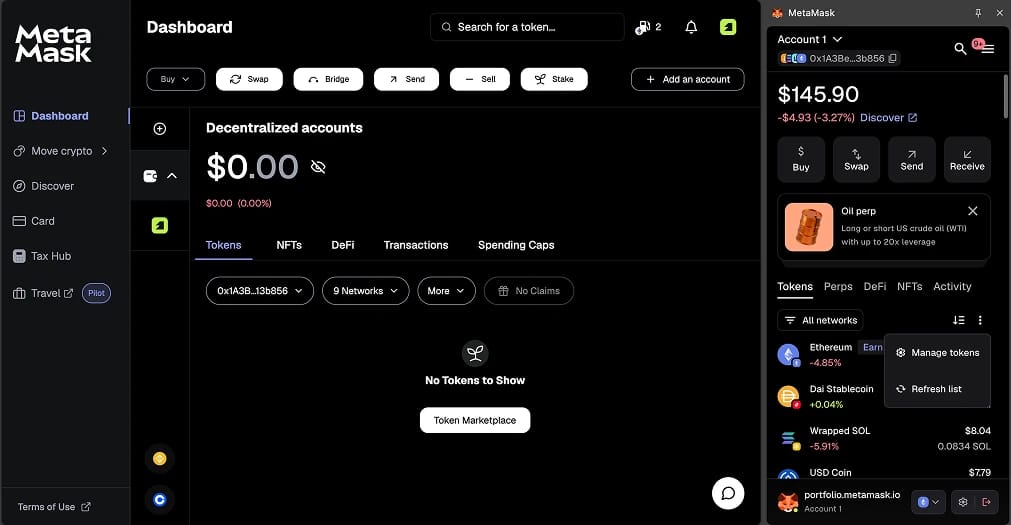
- Check the token list before importing: Click the three dots next to your tokens and select Refresh list. This usually reveals USDC on chains that support token detection. The all-networks filter also shows funds received on a chain you were not viewing.
- Copy the address from Circle's official list: Find your exact network on Circle's USDC contract addresses page and copy its mainnet address. Never use an address from a search result or Telegram message, or copy one from an airdropped token.
- Import the token manually: In the extension, click the three dots and choose Manage tokens. Scroll to Add custom token, paste the address, then click Next and Import. On mobile, expand the tokens section, tap the plus button and open the Custom token tab. MetaMask fills in the symbol and decimals from the contract.
- Confirm the balance on a block explorer: Paste your wallet address into the relevant explorer (Etherscan, Basescan, Arbiscan, Solscan) and open the token holdings tab. USDC visible on the explorer but missing from MetaMask indicates an import problem. If the explorer shows nothing, the funds went to another network or address.
You can also import directly from a block explorer. Open the USDC token page on Etherscan or one of its sister sites, click More and choose Add token to MetaMask. Approve the prompt to finish. On MetaMask Mobile, this shortcut works only in the in-app browser.
USDC Contract Addresses for Networks MetaMask Supports
The addresses below are Circle's mainnet deployments, copied from its developer documentation. Circle now issues native USDC on 37 blockchains. This table covers the Ethereum-compatible (EVM) networks and Solana, which MetaMask can hold directly.
Native USDC is also available on Algorand, Aptos, Hedera, NEAR, Noble, Polkadot Asset Hub, Starknet, Stellar, Sui and the XRP Ledger. These require a MetaMask Snap, an add-on that extends the wallet, or a separate wallet.
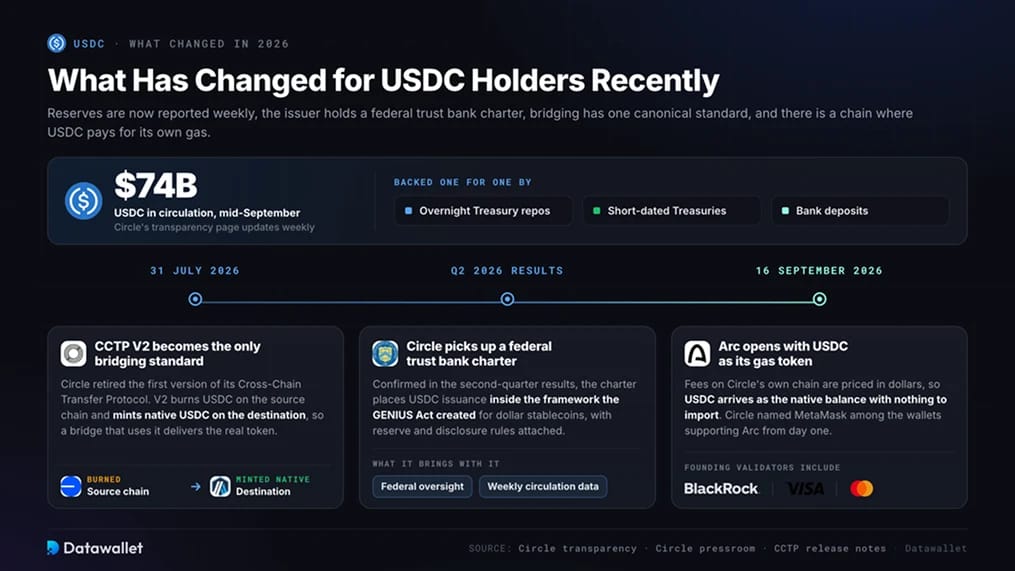
Arc, Circle's network that opened its public mainnet on September 16, uses USDC as its gas token. It appears as the native balance and needs no import. Circle named MetaMask among the wallets expected to support Arc from day one. When we checked, however, Circle's contract page listed only the Arc Testnet address. Use Circle's Arc documentation for mainnet parameters rather than a third-party chain list.
Native USDC vs USDC.e in MetaMask
USDC.e is a bridged token that circulates on several chains without Circle's backing. Before Circle deployed native contracts, bridges brought USDC to these networks by locking it on Ethereum and issuing a corresponding token on the destination chain. Those bridged tokens, called USDC.e or USDbC on Base, still circulate on Polygon, Arbitrum, Optimism, Avalanche and X Layer.
Although they trade close to $1, Circle neither issues nor redeems them. Many exchanges credit only native USDC deposits. Our USDC.e vs USDC explainer explains how the two versions work.
Older dapps and some CoinGecko listings still label bridged tokens as plain USDC, though MetaMask usually identifies them correctly. If an unexpected balance appears, open the token and compare its contract address with the two tables above.
You can swap USDC.e for native USDC through a normal trade on any major decentralized exchange (DEX). The price gap and gas cost mean this is only worth doing when a platform refuses the bridged version.
Why USDC Is Not Showing in MetaMask
Missing USDC usually means the wallet is looking in the wrong place, with the funds still safe. Check the following in order.
- Wrong network selected: This is the most common cause. If an exchange withdrew USDC on Arbitrum while MetaMask displays Ethereum, switch networks or enable the all-networks view.
- Token detection is switched off: Go to Settings, then Assets. Confirm Autodetect tokens is on and refresh the token list.
- The chain is not added to MetaMask: Add HyperEVM, Monad, Plasma or Sonic before trying to view USDC on those networks. The funds remain at your address even when the chain is missing from your wallet.
- You received USDC.e instead of USDC: Import the bridged contract from the table above to display the balance under its correct ticker.
- The transaction has not confirmed: Look up the hash on the sender's block explorer. Ethereum and its rollups, the layer-2 networks that settle back to it, clear transactions in seconds to minutes. A congested exchange withdrawal queue can hold funds for an hour or more before broadcast.
- The funds were sent to a different address: Compare the transaction's recipient address with your own, character by character. Any mismatch requires the sender to investigate. MetaMask cannot recover tokens sent elsewhere.
Sending USDC From MetaMask Without Holding ETH
MetaMask's gas included transactions let you pay network fees in the token you are sending, removing the previous need to hold a separate gas token. The feature supports Ethereum Mainnet, BNB Smart Chain, Arbitrum, Polygon, Linea, Base and Tempo.
When you confirm a send without ETH, MetaMask automatically selects an eligible fee token. USDC qualifies on all these networks, with a small MetaMask charge added to the network fee. Enable both Smart Transactions and Estimate balance changes in Settings to use the feature.
Tempo has no gas token, so its fees are always paid in a stablecoin. MetaMask upgrades your account to a smart account on your first transaction there. Our guide to adding Tempo to MetaMask explains the setup.
Every other network, including Avalanche, Optimism and Solana, still requires a native gas balance. Check our Ethereum gas tracker before a large transfer and keep a few dollars of the gas asset on each chain you use.
Do not confuse USDC with mUSD, MetaMask's own stablecoin. Issued with Bridge on the M0 protocol, mUSD appears prominently in the Swap and Buy menus. Both tokens hold a dollar peg but have separate reserves. A platform expecting mUSD will not recognize USDC sent in its place.
What Has Changed for USDC Holders Recently
Circle now publishes USDC's backing weekly and holds a bank charter, developments that matter to anyone storing meaningful sums in the token. Its transparency page reported roughly $74 billion in circulation in mid-September, matched by overnight Treasury repos, short-dated Treasuries and bank deposits.
In its second-quarter results, Circle also confirmed receipt of a federal trust bank charter. This places USDC issuance within the GENIUS Act framework. Our GENIUS Act explainer details the requirements for issuers.
Cross-chain transfers have become simpler, too. On July 31, Circle began phasing out the first version of its Cross-Chain Transfer Protocol, leaving CCTP V2 as the canonical standard. CCTP burns USDC on the source chain and mints native USDC at the destination. Any bridge using it in MetaMask's Bridge tab therefore delivers real USDC. Fast-transfer mode settles in seconds without waiting for Ethereum finality, and the best crypto bridges we have tested all support CCTP for the major chains.
Is It Safe to Store USDC in MetaMask?
As a self-custody wallet, MetaMask makes the security of your USDC dependent on your Secret Recovery Phrase and signing habits. Circle can freeze USDC at specific addresses under legal orders. Neither Circle nor MetaMask can recover tokens you send to the wrong place.
- Address poisoning: Scammers create addresses with the same first and last few characters as a wallet you frequently transact with. They then send a tiny amount of USDC or a zero-value transfer to place the fake address in your transaction history. Copying that address for a later payment sends your funds to the attacker. Individual losses have reached tens of millions of dollars. Check the full address, not just the shortened version MetaMask displays. Save trusted recipients in Contacts so you never need to copy addresses from history.
- Fake and airdropped tokens: Anyone can deploy a contract named USDC. Under MetaMask's token safety guidance, unfamiliar tokens should be treated as hostile and hidden from your list. Never try to sell or swap them. If a failed swap produces a block explorer error directing you to a website, that site is the phishing page.
- Token approvals: DeFi protocols need your permission to move USDC from your wallet. An unlimited approval lets a malicious or later-compromised contract drain the balance without another signature. Limit approvals to the amount needed, and regularly check open allowances with our guide to revoking token permissions.
Pair MetaMask with a hardware wallet for balances you cannot afford to lose. The private key stays off your computer, and each transfer requires confirmation on the device screen. Our best Ethereum wallets roundup compares compatible Ledger and Trezor models.
About USDC
Issued by Circle, USDC is a US dollar stablecoin redeemable one-for-one for dollars through Circle Mint. Cash and short-dated US Treasuries back its reserves, much of which sits in a BlackRock-managed money market fund. Circle publishes monthly third-party attestations alongside weekly circulation figures.
USDC is the second-largest stablecoin by supply and the default settlement asset on Base, Arbitrum, Solana and Hyperliquid. Circle's own contract mints it on each chain, distinguishing native USDC from bridged copies.
Our What is USDC guide covers its history and differences from USDT. For a comparison of its reserve model with the alternatives, see our safest stablecoin analysis.
Final Thoughts
Adding USDC to MetaMask takes under a minute once you identify the network used for the transfer and its contract address. The wallet handles both on Ethereum, Base, Arbitrum, Polygon and Solana. For other networks, copy addresses only from Circle's contract list.
Protecting that balance requires ongoing care. Check full recipient addresses before sending and leave airdropped tokens alone. Cap DeFi approvals, and secure substantial holdings with a hardware wallet. Neither MetaMask nor Circle can reverse losses caused by these mistakes.