Bullish Exchange Review 2025: Features, Fees, Liquidity & OTC
Summary: Bullish is a crypto exchange launched in 2021, offering institutional-grade trading infrastructure, automated liquidity, and deep markets for major digital assets.
The platform delivers high-performance order execution, transparent fees, and a full reserve model designed to support secure, compliant professional trading.
.svg)
Bullish Review
Bullish is an institution-focused cryptocurrency exchange offering deep liquidity, full reserve asset backing, and regulated trading infrastructure for professional market participants.
Available Assets
40+ crypto assets with major pairs including BTC, ETH, and USDC
Regulation & Licensing
Licensed by NYDFS, GFSC, and BaFin aligned EU entity
Deposit Methods
Bank wire, SWIFT, SEPA, and crypto transfers
About Bullish Exchange
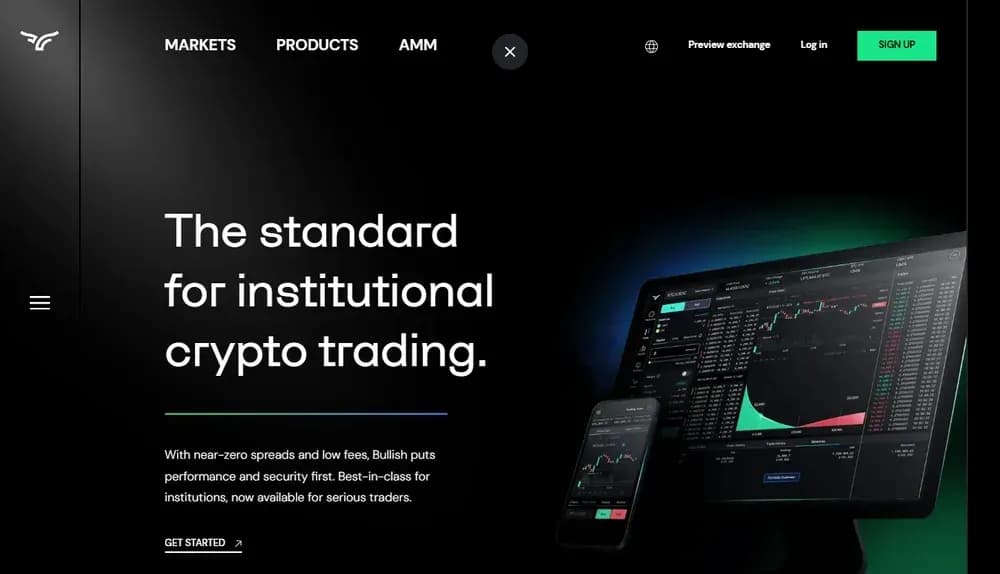
Bullish is a centralized cryptocurrency exchange and digital asset platform founded in 2020 by Block.one and launched publicly in November 2021. It is headquartered in George Town, Cayman Islands, and is backed by prominent investors, including Peter Thiel’s Founders Fund, Galaxy Digital, and Nomura.
Since its launch, the platform has processed over $1.5 trillion in total trading volume, matching many older exchanges. It supports over 25 major assets and consistently maintains high liquidity scores for institutional-sized execution, often ranking among the top exchanges for Bitcoin and Ether depth.
The exchange distinguishes itself through a proprietary hybrid order book that integrates automated market makers directly into the matching engine. This unique architecture ensures deterministic execution and deep liquidity while providing a verifiable, immutable audit trail for all transactions.
Bullish Features and Services
Bullish's products focus on spot, margin, perpetual futures, dated futures, and options trading on a unified collateral account, alongside Over-the-Counter (OTC) servicing, indices, and automated market-making instructions intended primarily for institutional and professional investors.
Trading Types
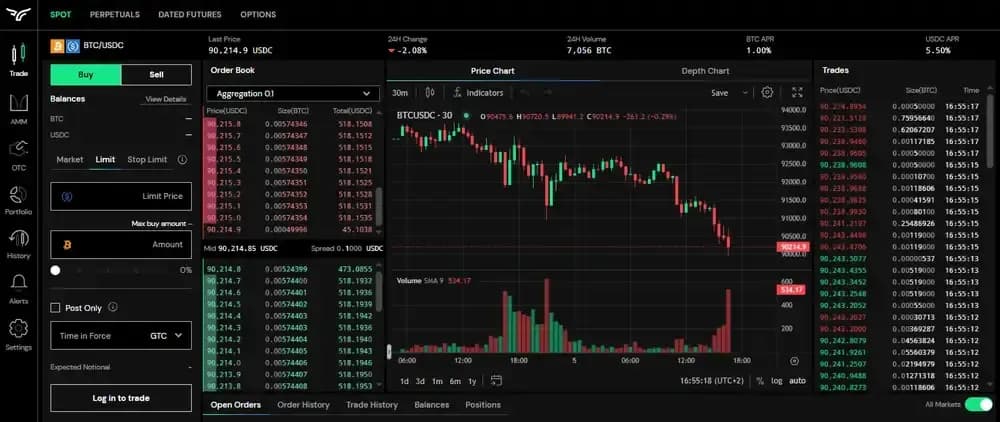
- Spot Trading: The exchange supports conventional Central Limit Order Book (CLOB) order types, ensuring best execution with high-speed, and time priority.
- Margin Trading: Unified margin lets eligible clients trade multiple markets from one collateral pool, improving capital efficiency while maintaining conservative risk parameters.
- Perpetual Futures: The platform offers perpetuals, dated futures, and options with cross-collateralized, real-time risk management and flexible long/short exposure.
- Options Trading: A growing options desk handled over $82 million notional in its first five days, primarily serving sophisticated institutional flows.
Earning Options
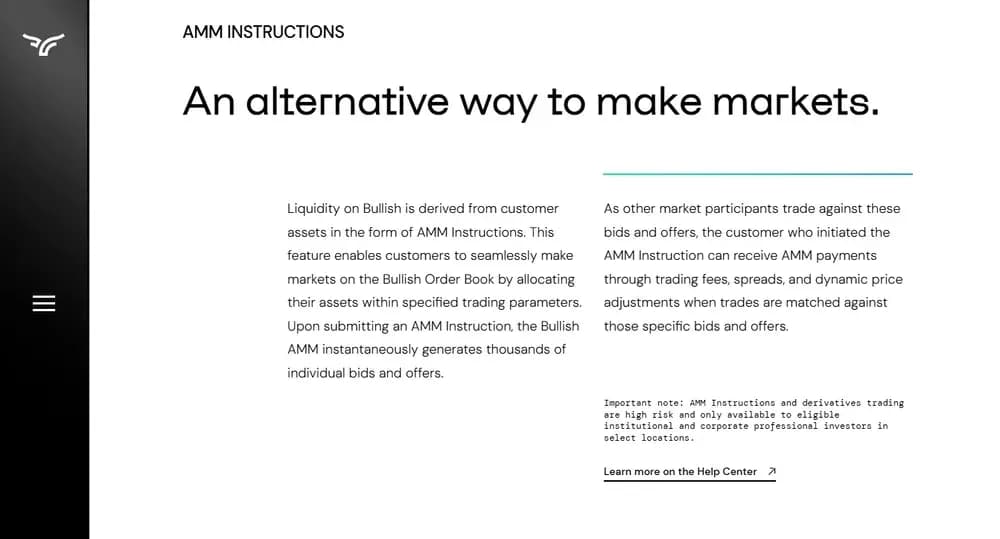
- Standard Liquidity Pools: Participants deposit assets into compliant pools to earn yield generated directly from trading fees and spreads.
- Range-Bound Pools: Advanced users provide concentrated liquidity within specific price ranges to maximize fee efficiency and capital utilization.
- Lending Services: The platform enables users to lend idle assets through automated protocols that adjust interest rates dynamically.
- Maker Rebates: High-volume market makers earn rebates by providing liquidity to the order book, effectively generating yield on trading activity.
Additional Services
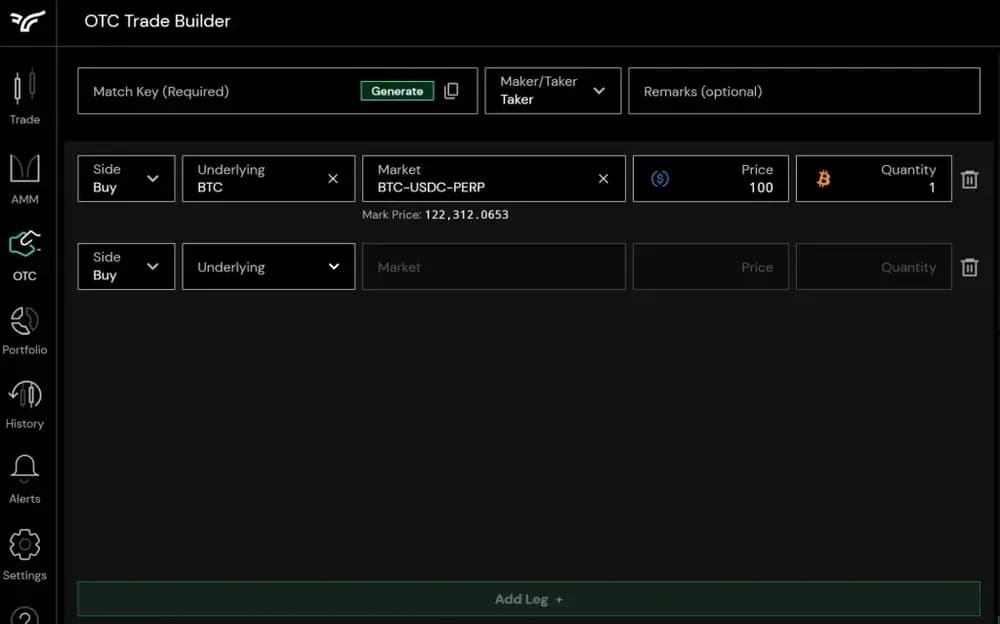
- OTC Desk: Institutional clients access tailored OTC liquidity and block execution, often with dedicated relationship managers and post-trade settlement support.
- Indices & Data: Through its ownership of CoinDesk, Bullish provides integrated, institutional-grade market insights and indices directly to clients.
- API Connectivity: Low-latency REST and FIX APIs target quant funds and HFT firms, with options for cross-connected institutional infrastructure.
Is Bullish Exchange Regulated?
Bullish currently holds four primary digital asset exchange licenses, covering the US, the European Union, Hong Kong, Gibraltar, and related jurisdictions.
Key regulatory authorizations by region include the following:
- United States: Licensed by the New York State Department of Financial Services with BitLicense and money transmission approvals, supporting trading in 20 states.
- European Union: Operates a MiCA aligned exchange entity supervised by BaFin in Germany, enabling service to EU professional and institutional investors.
- Hong Kong: Authorized by the Securities and Futures Commission, with Deutsche Bank supporting fiat flows for SFC regulated customers.
- Gibraltar: Bullish (GI) Limited holds a distributed ledger technology license from the Gibraltar Financial Services Commission, serving more than 50 global jurisdictions.
Is Bullish Safe?
Bullish operates a full reserve model, keeping customer assets segregated and consistently maintained in a 1:1 ratio at all times. It uses cold, warm, and hot wallets, with approximately 95% of customer funds held offline in cold storage, supported by partners such as BitGo and Fireblocks.
Account security relies on mandatory multi-factor authentication, hardware-backed WebAuthn logins, security questions, and strict session controls. The exchange runs public bug bounty programs through Bugcrowd, uses dedicated API security tooling, and its Gibraltar and Europe entities have completed SOC 1 Type 1 and SOC 2 Type 1 examinations by Deloitte.
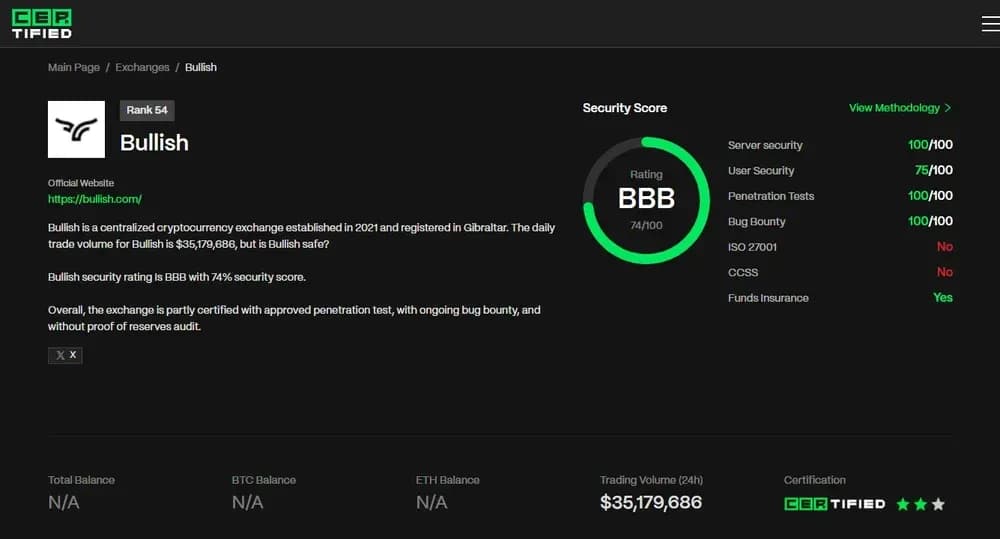
As of December 2025, there are no publicly reported Bullish exchange hacks or customer loss incidents. However, the platform does not yet publish a cryptographic proof of reserves, and independent security trackers like CER.live rate it as partly certified, with an overall security score around 74/100.
Bullish Exchange Fees Schedule
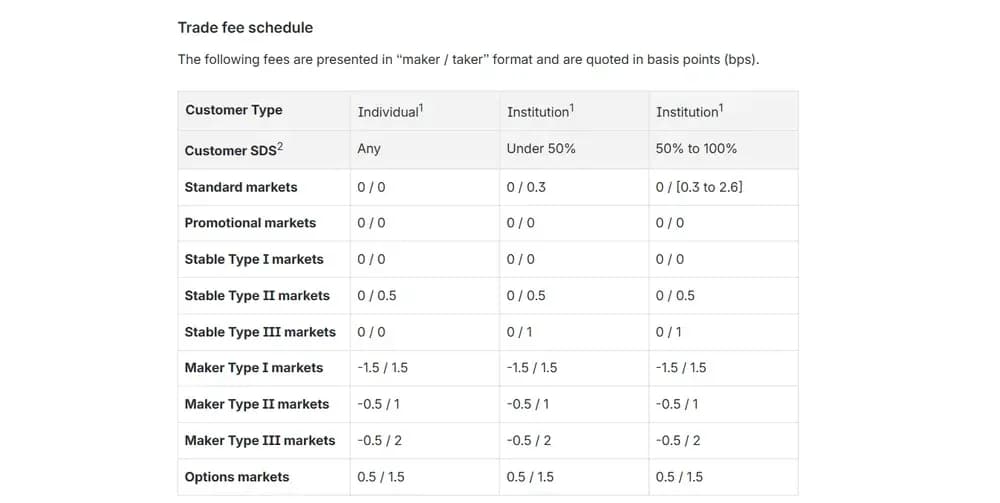
Bullish advertises zero maker fees across spot and derivatives, extremely low taker fees, no deposit charges, and predictable blockchain withdrawal and fiat wire costs. Fee tiers vary by product and 30 day volume, with additional discounts for large and institutional clients.
Spot Trading
On most spot pairs, Bullish charges 0% maker fees. For institutional clients, the base taker fee starts at approximately 0.003% and increases up to a maximum of 0.026% for certain trading behaviors, depending on the Same Direction Score (SDS).
Your Average Daily Taker Volume (ADTV), which provides lower taker rates as trading activity increases, determines the fee tiers based on volume. AMM instructions pay users fees, while Bullish retains between 0% and 25% of the revenues through its AMM fee split schedules, varying by market.
Futures and Derivatives Trading
Perpetual and dated futures generally follow the same headline structure as spot, but often with a negative maker fee (a rebate). For example, makers on the BTC-USDC perpetual future can receive a rebate of up to 0.015%. Taker fees on these markets typically range from 0.01% to 0.02% depending on the contract type.
Derivatives traders face a fixed 0.5% liquidation fee for orders executed by the automated liquidation engine, plus normal funding payments between longs and shorts on perpetual contracts, which vary by market conditions.
Deposit and Withdrawal Fees
Bullish does not charge deposit fees on crypto or fiat, but withdrawals incur fixed, transparent network-style charges, for example, 0.00006 BTC, typically 5 USDT or USDC on stablecoin networks, $30 for most USD wires, and €2 for SEPA transfers. Actual amounts vary by asset and currency.
Discounts and VIP Program
Trading fees on Bullish are tiered by your Average Daily Taker Volume and a performance metric called the Same Direction Score. Individual accounts are initially marketed at 0% trading fees but transition to the institutional schedule once their ADTV exceeds 0.01% of the total exchange volume.
Note: Exact thresholds and percentages are outlined in Bullish’s institutional fee schedules.
Final Thoughts
Bullish’s strongest point is its deep liquidity combined with institutional-grade infrastructure, creating highly efficient trading conditions for large spot and derivatives flows.
The exchange still lacks broader retail features such as extensive staking products, launchpads, and wide asset listings common on larger consumer-focused platforms.
Bullish suits professional traders and institutions needing secure high-throughput execution, but casual users seeking diverse tokens or gamified earning products may find alternatives preferable.
Frequently asked questions

.webp)
.webp)