




About Binance
Binance launched in July 2017 and now sits at the center of global crypto trading, serving 300 million registered accounts across roughly 180 markets worldwide. Changpeng Zhao founded the company and still owns most of it, while Richard Teng and co-founder Yi He have shared the chief executive role since December 2025.
Scale is the headline figure. The exchange reported $34 trillion in total product volume for 2025, turns over more than $20 billion in daily spot trading across 1,600-plus pairs, and held close to 39% of centralized spot market share through the opening quarter of 2026.
December 2025 finally delivered the regulatory anchor the company had chased for years. Abu Dhabi's Financial Services Regulatory Authority approved three licences covering exchange, clearing, custody and brokerage, with regulated activity beginning on 5 January 2026 through three entities trading under the Nest name in Abu Dhabi.
Transparency tooling has expanded alongside that growth. Binance publishes monthly Merkle-tree Proof-of-Reserves attestations, which verified roughly $162.8 billion in customer assets across 45 tokens at the end of 2025, and it maintains a $1 billion Secure Asset Fund for Users as a standing emergency backstop.
Europe is the glaring exception to all of it. After withdrawing its Greek licence application in June 2026, Binance stopped serving European Union residents on 1 July, leaving the exchange dominant almost everywhere except the single bloc it had spent two years preparing to enter.
Binance Features and Services
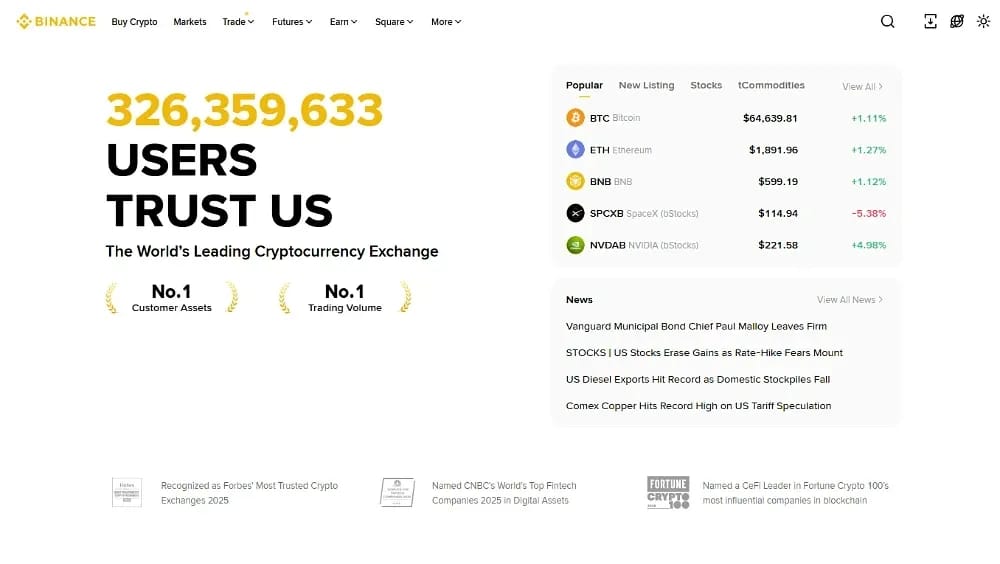
Few platforms match the product surface here. A single account covers everything from one-click purchases through 125x leveraged derivatives, alongside yield products, token launches, payments, US equities and a self-custody wallet for onchain activity elsewhere in the market.
Trading Types
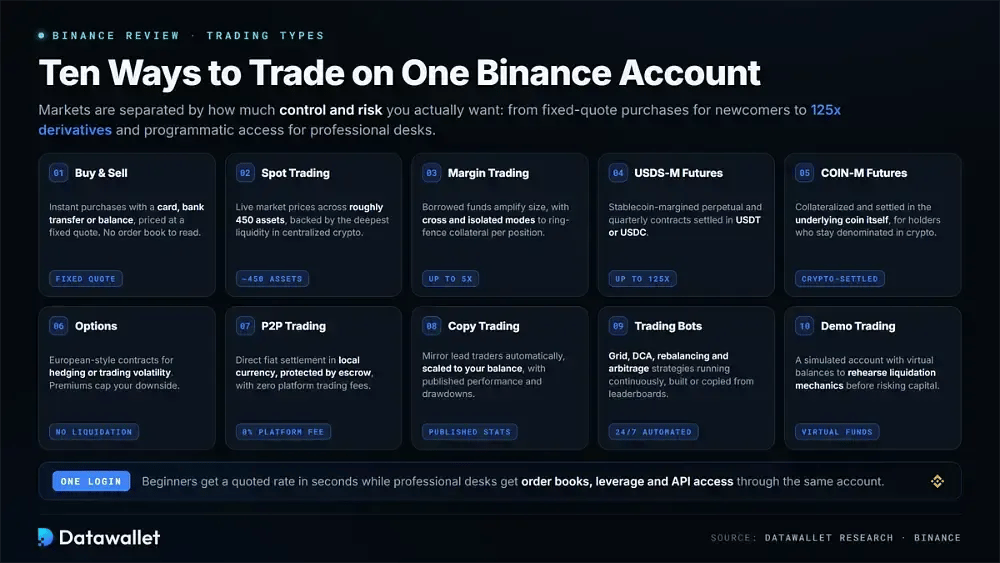
Binance separates its markets by how much control and risk you actually want. Beginners can buy at a quoted rate in seconds, while professional desks get order books, leverage and programmatic access through the same login.
Here are the main trading products available to Binance users:
- Buy and sell: Instant purchases with a card, bank transfer or existing balance, priced at a fixed quote so newcomers never have to read an order book.
- Spot trading: Direct exchange at live market prices across roughly 450 listed assets, backed by the deepest liquidity and tightest spreads available anywhere in centralized crypto markets today.
- Margin trading: Borrowed funds amplify position size up to 5x, with cross and isolated modes letting you ring-fence collateral against a single position instead of the whole account.
- USDⓈ-M futures: Stablecoin-margined perpetual and quarterly contracts settled in USDT or USDC, offering leverage as high as 125x on the most liquid pairs Binance lists for derivatives traders.
- COIN-M futures: Contracts collateralized and settled in the underlying coin itself, favored by long-term holders who prefer keeping both margin and profits denominated in crypto instead of dollars.
- Options: European-style contracts on major assets, used for hedging spot exposure or trading volatility directly, with premiums capping your downside instead of exposing the position to forced liquidation.
- P2P trading: Direct fiat settlement between users in local currency, protected by escrow, with zero platform trading fees charged to either the buyer or the seller on completion.
- Copy trading: Automatic mirroring of lead traders, scaled to your own account balance, with published performance history and drawdown statistics for every portfolio you can follow.
- Trading bots: Grid, DCA, rebalancing and arbitrage strategies that run continuously in the background, either configured yourself from scratch or copied straight from the public community leaderboard.
- Demo trading: A simulated account funded with virtual balances, letting you rehearse derivatives mechanics and liquidation behavior before committing any real capital to leveraged positions on live markets.
Earning Options
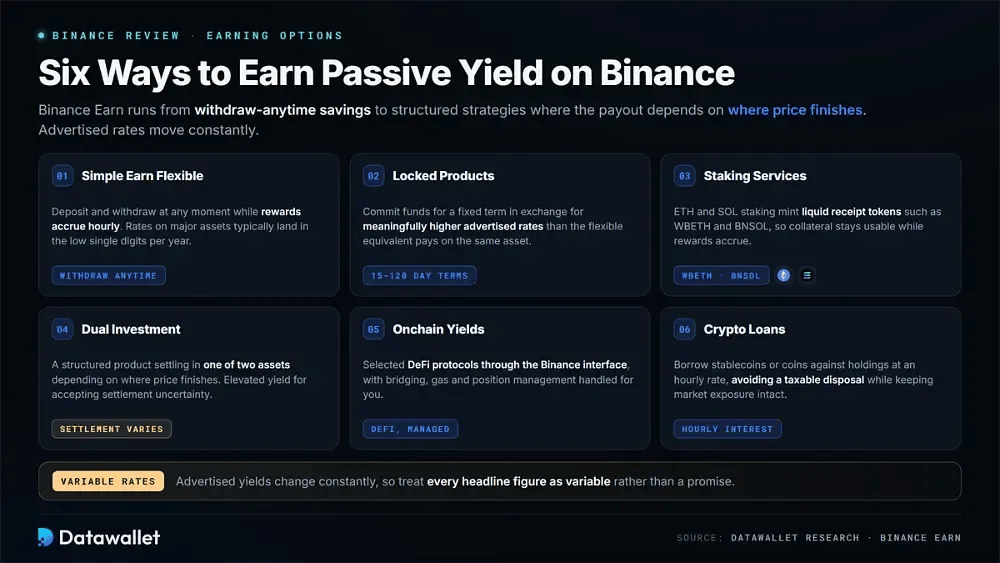
Binance Earn packages passive yield into products ranging from withdraw-anytime savings through structured strategies where the payout depends on where price finishes. Advertised rates move constantly, so treat every headline figure as variable.
These are the main ways to earn passive yield on Binance:
- Simple Earn Flexible: Deposit and withdraw at any moment while rewards accrue hourly, with rates on major assets typically landing somewhere in the low single digits each year.
- Locked products: Commit funds for a fixed term between 15 and 120 days, in exchange for meaningfully higher advertised rates than the flexible equivalent pays on the same asset.
- Staking services: ETH and SOL staking mint liquid receipt tokens such as WBETH and BNSOL, so rewards accrue while the underlying collateral stays usable elsewhere on the platform.
- Dual Investment: A structured product settling in one of two assets depending on where price finishes, paying elevated yields in return for accepting that settlement uncertainty upfront.
- Onchain yields: Access to selected DeFi protocols through the Binance interface, with the exchange handling bridging, gas and position management on your behalf throughout the position lifecycle.
- Crypto loans: Borrow stablecoins or coins against existing holdings at an hourly interest rate, which avoids a taxable disposal while keeping your original market exposure fully intact.
Additional Services
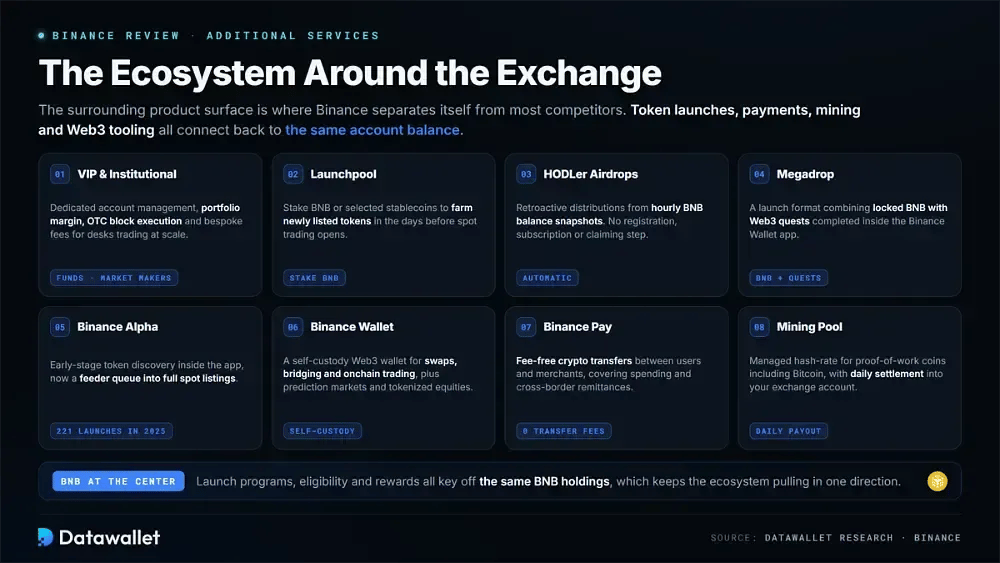
The surrounding ecosystem is where Binance separates itself from most competitors. Token distribution programs, payments, mining and Web3 tooling all connect back to the same account balance and the same BNB holdings.
Binance also operates the following services around its core exchange:
- VIP and institutional: Dedicated account management, elevated API limits, portfolio margin, OTC block execution and bespoke fee schedules for funds, market makers and corporate treasury desks trading at scale.
- Launchpool: Stake BNB or selected stablecoins into farming pools to earn newly listed tokens during the days before spot trading opens for that asset on the exchange.
- HODLer Airdrops: Retroactive token distributions to users holding BNB in Simple Earn, calculated from hourly balance snapshots that need no registration, subscription or manual claiming step.
- Megadrop: A launch format combining locked BNB positions with Web3 quests, rewarding participation across both the exchange and onchain tasks completed inside the Binance Wallet app itself.
- Binance Alpha: Early-stage token discovery inside the app, which processed 221 launches during 2025 and now works as a feeder queue into full spot listings on the main exchange.
- Binance Wallet: A self-custody Web3 wallet handling swaps, bridging and onchain trading, and now the access point for prediction markets, tokenized equities and early token discovery.
- Binance Pay: Fee-free crypto transfers between users and participating merchants, covering everyday spending and cross-border remittances without routing funds through the exchange's main trading interface at all.
- Mining pool: Managed hash-rate services for proof-of-work coins including Bitcoin, with competitive pool fees and daily settlement paid automatically into the connected Binance exchange account each morning.
Stocks, Perpetuals and Prediction Markets
The most consequential product shift of 2026 has little to do with crypto itself. Binance is assembling a super-app where equities, event contracts and tokenized real-world assets sit beside spot books, subject to eligibility checks that vary considerably by country.
Trading US stocks through Binance
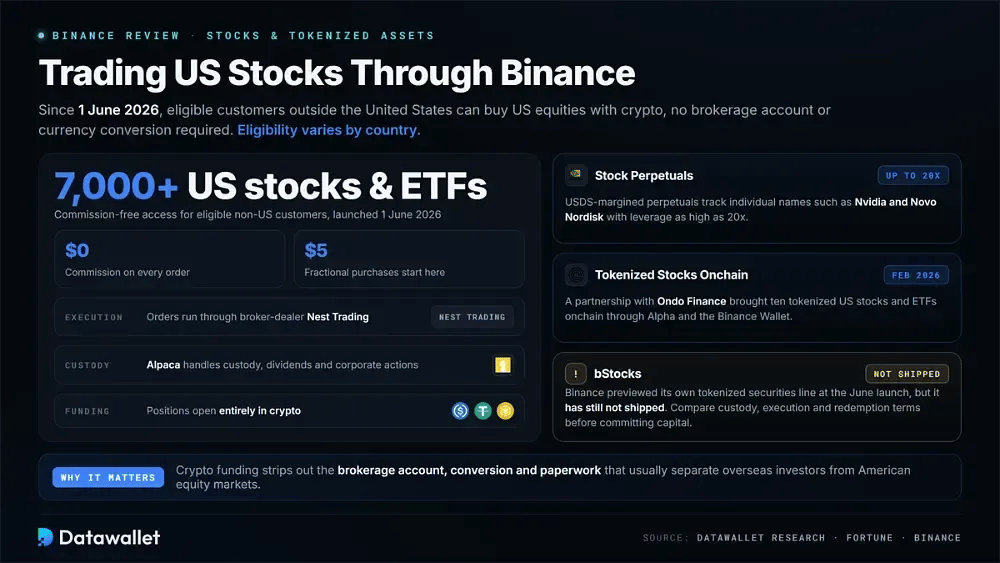
On 1 June 2026, Binance opened access to more than 7,000 US-listed stocks and ETFs for eligible customers outside the United States. Orders carry zero commission, fractional purchases start at just $5, and execution runs through broker-dealer Nest Trading, with custody, dividends and corporate actions handled by Alpaca.
Funding happens entirely in crypto. Positions can be opened using USDC, USDT, BNB or several other digital assets, which strips out the brokerage account, currency conversion and paperwork that usually separate overseas investors from American equity markets, and it removes most of the usual settlement delay as well.
Two adjacent products round out the equities push. USDS-margined perpetuals track individual names such as Nvidia and Novo Nordisk with leverage up to 20x, while a February 2026 partnership with Ondo Finance brought ten tokenized US stocks and ETFs onchain through Alpha and the wallet.
Binance previewed bStocks, its own tokenized securities line, at that same June launch. That product has still not shipped, and anyone weighing up the category should carefully compare custody arrangements, execution quality and redemption terms across tokenized stock platforms before committing any real capital to a position.
Prediction markets inside Binance Wallet
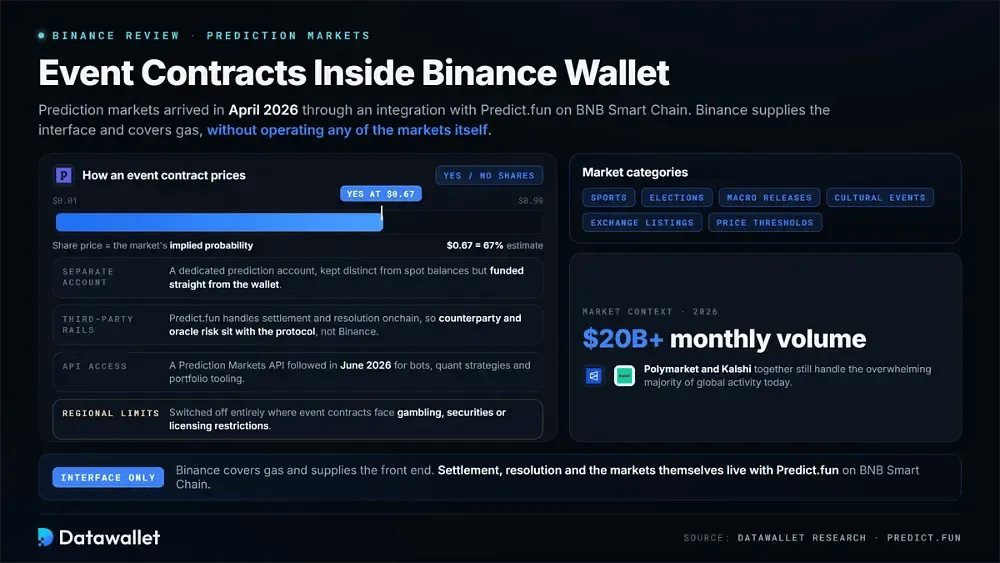
Event contracts arrived in April 2026 through an integration with Predict.fun, an onchain protocol built on BNB Smart Chain. Binance supplies the interface and covers gas costs, without operating any of the markets itself.
Here is how prediction markets work inside Binance Wallet:
- Separate account: Trading event contracts requires a dedicated prediction account, kept distinct from spot balances though funded directly from the same wallet without any extra deposit step.
- Share pricing: Every outcome trades as a yes or no share priced between $0.01 and $0.99, reflecting the market's collective probability estimate at that exact moment.
- Market categories: Contracts span sports fixtures, elections, macroeconomic releases, cultural events and crypto-specific questions such as exchange listings or whether a price crosses some agreed threshold before expiry.
- Third-party rails: Predict.fun handles settlement and resolution onchain, which places counterparty and oracle risk with that protocol instead of with Binance, acting only as your interface provider.
- Programmatic access: A Prediction Markets API followed in June 2026, letting eligible users run bots, quantitative strategies and portfolio tooling against live event markets without manual clicking.
- Regional limits: Availability depends on your jurisdiction, and the feature stays switched off entirely in countries where event contracts face gambling, securities or other licensing restrictions.
- Market context: Monthly prediction market volumes passed $20 billion during 2026, though Polymarket and Kalshi together still handle the overwhelming majority of that global activity today.
Is Binance Regulated?
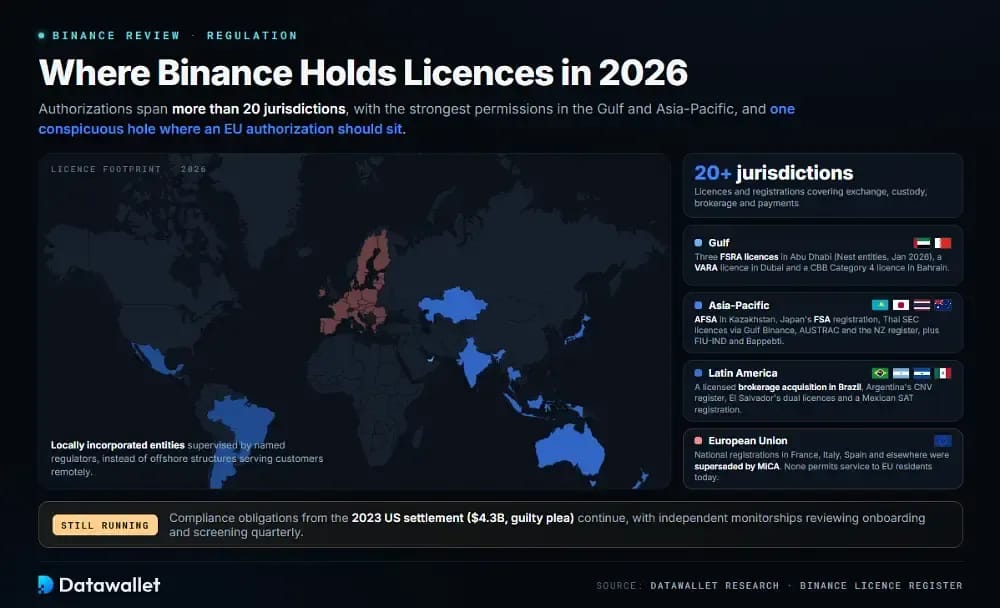
Binance holds licences or registrations across more than 20 jurisdictions, supervised by authorities covering exchange, custody, brokerage and payment activity. The coverage is genuinely global, with one conspicuous hole where a European Union authorization should sit instead.
Where Binance holds licences
The strongest permissions sit in the Gulf and Asia-Pacific, where Binance operates through locally incorporated entities supervised by named regulators instead of offshore structures serving customers remotely from a distance.
Here are the jurisdictions where Binance currently holds authorization:
- Abu Dhabi: Three FSRA licences held by Nest Exchange, Nest Clearing and Custody, and Nest Trading, covering exchange, clearing, custody and brokerage activity from January 2026 onward.
- Dubai: Binance FZE runs under a Virtual Asset Service Provider licence from VARA, permitting broker-dealer, exchange, management, lending and investment services for clients based locally in the emirate.
- Bahrain: Binance Bahrain BSC(c) operates as a Category 4 crypto-asset service provider, licensed and supervised by the Central Bank of Bahrain to run a regulated exchange and custody platform.
- Kazakhstan: BN KZ Technologies Limited holds three separate permissions from the Astana Financial Services Authority, operating inside the Astana International Financial Centre free zone since the middle of 2022.
- Japan: Binance Japan Inc. is registered with the Financial Services Agency as a crypto-asset exchange service provider, running a separate domestic platform that serves Japanese residents under local rules.
- Australia and New Zealand: InvestbyBit Pty Ltd reports to AUSTRAC as a digital currency exchange provider, while the New Zealand arm appears on the Financial Service Providers Register.
- India and Indonesia: Binance registers with FIU-IND as a reporting entity under local anti-money-laundering rules, while Tokocrypto trades under an Indonesian Bappebti physical crypto asset trader licence.
- Thailand: Gulf Binance, a joint venture with the technology arm of Gulf Energy, holds digital asset exchange and brokerage licences issued by the Thai SEC.
- Latin America: Coverage spans Brazil through a licensed brokerage acquisition, Argentina's CNV register, El Salvador's dual digital asset and Bitcoin licences, plus a Mexican SAT registration.
- European Union: National registrations in France, Italy, Spain, Poland, Sweden and Lithuania were superseded by MiCA, and none of them permits service to EU residents today.
Oversight, monitorships and open investigations
Compliance obligations from the 2023 US settlement are all still running today. Binance pleaded guilty to anti-money-laundering and sanctions violations, paid more than $4.3 billion, and accepted independent monitorships that keep reviewing customer onboarding, sanctions screening and transaction surveillance on a rolling quarterly basis under that agreement.
Political scrutiny returned during 2026. A group of Senate Democrats asked the Treasury and Justice departments in February to investigate the exchange's illicit-finance controls, citing its commercial relationship with World Liberty Financial, the USD1 stablecoin, and the presidential pardon granted to Zhao during October 2025.
Ownership sits at the center of both files. Zhao remains the exchange's majority shareholder despite stepping away from daily management back in 2023, and that single fact shaped Europe's fit-and-proper assessment just as directly as it now shapes the questions arriving from lawmakers and regulators in Washington.
Binance in Europe After MiCA
The Markets in Crypto-Assets Regulation reshaped European access during 2026, and Binance ended up outside the perimeter. What happened, what still functions, and what comes next all matter for the millions of accounts caught by it.
What changed on 1 July 2026
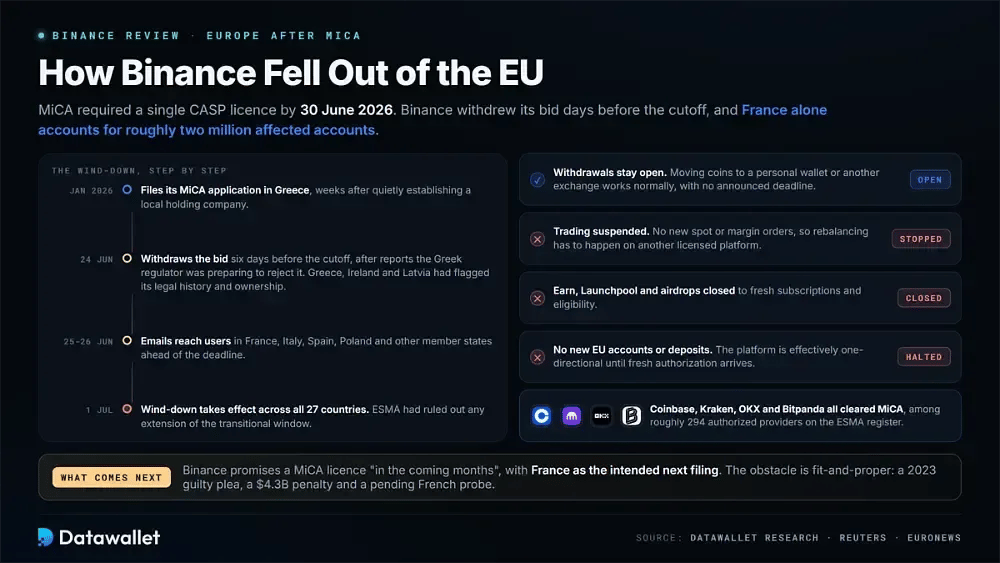
MiCA required every crypto firm serving the bloc to hold a Crypto-Asset Service Provider licence from one member state by 30 June 2026. That single authorization passports across all 27 countries, and the European Securities and Markets Authority ruled out any extension of the transitional window.
Binance filed its application in Greece during January 2026, having quietly established a local holding company only weeks earlier. It withdrew that application on 24 June, just six days before the cutoff, following reports that the Hellenic Capital Market Commission was already preparing to reject it outright.
Reuters reported that regulators in Greece, Ireland and Latvia had jointly examined the bid, raising concerns about the company's legal history and past penalties, its complex corporate structure, and whether its majority owner could satisfy the fit-and-proper test that MiCA applies to owners and controllers.
Emails reached users in France, Italy, Spain, Poland and several other member states over 25 and 26 June, ahead of the deadline. France alone accounts for roughly two million affected accounts, and the wind-down took effect across the entire bloc six days later on 1 July.
What EU users can still do
Nothing about the suspension touches custody itself. Binance has repeatedly confirmed that balances remain safe and accessible, and the restrictions apply to new regulated activity rather than to money already sitting inside existing accounts.
Here is exactly where EU residents stand with Binance today:
- Withdrawals open: Moving coins to a personal wallet or another exchange still works normally, and no deadline has been announced for closing that particular route down.
- Trading suspended: New spot and margin orders stopped for EU residents, so positions cannot be opened and any rebalancing now has to happen on another licensed platform.
- Earn products closed: Fresh subscriptions to savings, staking and structured yield products ended, alongside eligibility for Launchpool farming, Megadrop rounds and the various HODLer airdrop programs run for BNB holders.
- Registrations halted: No new EU account can be created, which also rules out re-verifying under a different email address or residency from anywhere inside the bloc.
- Deposits restricted: Adding funds is no longer available to affected accounts, which makes the platform effectively one-directional until fresh authorization eventually arrives from a member state.
- Alternatives licensed: Coinbase, Kraken, OKX and Bitpanda all cleared MiCA, and roughly 294 authorized providers now appear across the ESMA register that covers the whole bloc.
Where the licence application goes next
Binance has been publicly unambiguous about its intention to return to the region. Company statements promise a MiCA licence "in the coming months," and the Financial Times reported that France is the intended next filing, after earlier conversations with regulators in Ireland and Latvia stalled.
The obstacle here is reputational instead of procedural. Fit-and-proper assessments examine the owners and senior managers behind an applicant, which puts the 2023 guilty plea, a $4.3 billion penalty and a pending French judicial probe into money laundering allegations at the center of any assessment a regulator makes.
Timing on all of that remains genuinely open for now. Anyone inside the bloc who needs uninterrupted market access should compare regulated European exchanges now instead of waiting, because a fresh application still has to clear a full authorization process that typically runs for several months.
Is Binance Safe?
Binance runs institutional-grade custody controls and has covered user losses in every major incident it caused directly. The record also includes one serious hack, a bridge exploit and a chaotic market event whose causes remain contested.
Security architecture and reserves
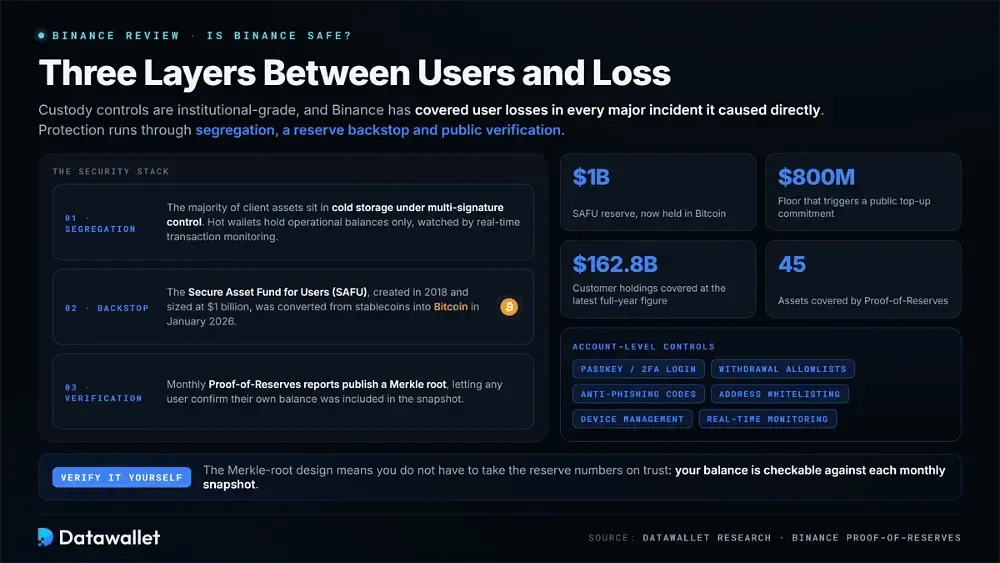
Protection starts with strict segregation of funds. The majority of client assets sit in cold storage under multi-signature control, while hot wallets hold operational balances only, supported by device management, withdrawal allowlists, anti-phishing codes, address whitelisting, real-time transaction monitoring and passkey or authenticator-based two-factor login.
The Secure Asset Fund for Users provides the financial backstop. Created in 2018 and sized at $1 billion, the reserve was converted from stablecoins into Bitcoin in January 2026, with a public commitment to top the reserve up again whenever its balance falls under $800 million.
Verification forms the third layer of the system. Monthly Proof-of-Reserves reports publish a Merkle root that lets any user confirm their own balance was included in the snapshot, covering 45 separate assets and roughly $162.8 billion in customer holdings at the most recent full-year figure.
Binance security incidents
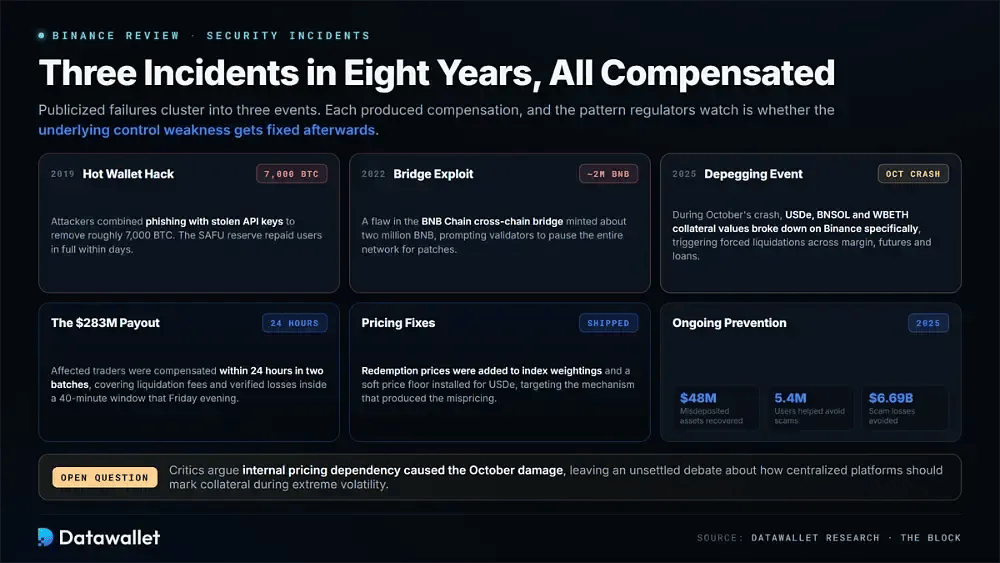
Publicized failures cluster into three events across eight years of operation. Each one produced compensation, and the pattern regulators watch is whether the underlying control weakness actually gets fixed afterwards.
These are the incidents worth knowing about before depositing:
- 2019 hot wallet hack: Attackers combined phishing with stolen API keys to remove roughly 7,000 BTC, which the SAFU reserve repaid in full within days of the initial discovery.
- 2022 bridge exploit: A flaw in the BNB Chain cross-chain bridge minted about two million BNB, prompting validators to pause the entire network while patches were deployed.
- 2025 depegging event: During October's crash, USDe, BNSOL and WBETH collateral values broke down on Binance specifically, which triggered forced liquidations across margin, futures and loan products.
- The $283M payout: Binance compensated affected traders within 24 hours in two separate batches, covering liquidation fees and verified losses inside a 40-minute window that Friday evening.
- Pricing fixes: The exchange added redemption prices to its index weightings and installed a soft price floor for USDe, targeting the mechanism that produced the mispricing.
- Ongoing prevention: Binance reported recovering $48 million in misdeposited assets and helping 5.4 million users avoid $6.69 billion in scam losses over the course of 2025.
- Open questions: Critics argue internal pricing dependency caused the October crash damage, leaving an unsettled debate about how centralized platforms should mark collateral during extreme volatility.
Binance Ecosystem
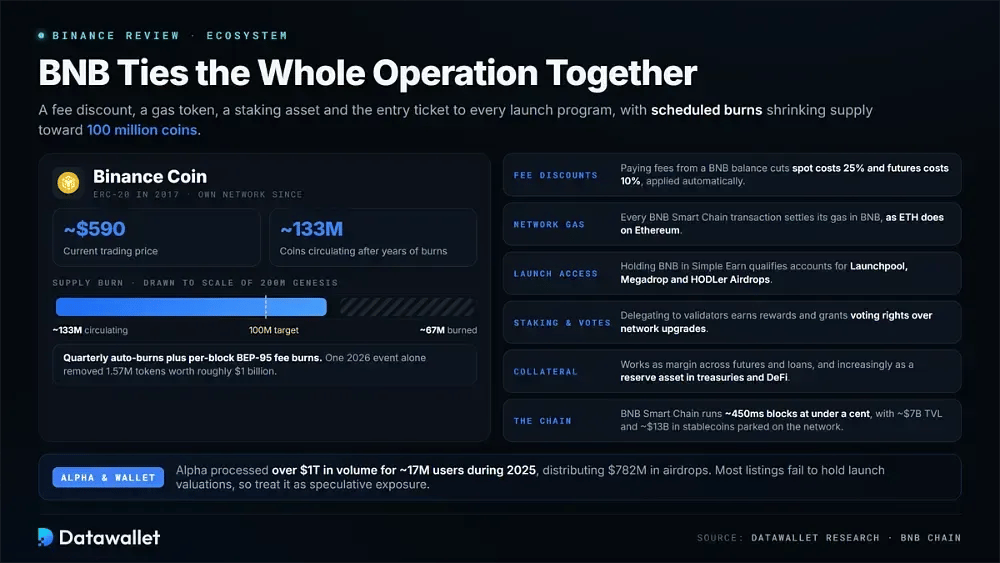
BNB ties the whole operation together, working as a fee discount, a gas token, a staking asset and the entry ticket to launch programs. Around that token sit a blockchain, a self-custody wallet and an early-stage discovery layer.
Binance Coin (BNB)
BNB launched as an ERC-20 token in 2017 before migrating to its own network, and it now trades near $590 with roughly 133 million coins circulating after years of scheduled burns.
BNB serves these functions across the Binance ecosystem:
- Fee discounts: Paying trading fees from a BNB balance cuts spot costs by 25% and futures costs by 10%, applied automatically once the setting is enabled.
- Network gas: Every transaction on BNB Smart Chain settles its gas in BNB, in the same way that ETH pays for computation and storage across Ethereum.
- Launch eligibility: Holding BNB inside Simple Earn qualifies accounts for Launchpool farming, Megadrop rounds and HODLer Airdrops, with no additional registration, subscription or lockup step required.
- Staking and governance: Delegating coins to validators earns protocol rewards and grants voting rights over network upgrades and economic parameter changes on the chain itself each cycle.
- Supply burns: Quarterly auto-burns and per-block BEP-95 fee burns shrink supply toward 100 million, with one 2026 event alone removing 1.57 million tokens worth roughly $1 billion.
- Collateral use: BNB works as margin across futures and loans, and increasingly as a reserve asset held inside BNB Chain treasury companies and DeFi protocols on the network.
BNB Chain
BNB Smart Chain remains among the busiest EVM networks in operation anywhere, running roughly 450-millisecond block times with transaction costs that stay under a single cent. Total value locked sits near $7 billion, supported by a stablecoin base of around $13 billion parked on the network.
Throughput work continues through the second half of 2026 and beyond. The published roadmap targets substantially higher transaction capacity alongside sub-second finality for users, while developer tooling has moved toward autonomous AI agents through an SDK that handles onchain payments, identity and automation primitives natively.
Real-world assets have become the main growth engine on the network. Ondo has already brought hundreds of tokenized stocks and ETFs onto the chain itself, BlackRock's BUIDL fund holds a substantial position on the chain, and users can bridge assets across from Ethereum and other major networks.
Binance Wallet and Alpha
Binance retired its standalone decentralized exchange in favor of a self-custody wallet embedded directly inside the main trading app. Users keep their own keys while swapping across chains, farming onchain yields and reaching decentralized applications without ever exporting a seed phrase into a separate browser extension.
Alpha 2.0 sits alongside that wallet as a discovery layer for early-stage tokens and pre-listing assets. The product processed over $1 trillion in volume and attracted around 17 million users during 2025, distributing $782 million in airdrops to participants who traded qualifying assets on the platform.
Both of those surfaces carry real risk worth pricing in first. Community analyses suggest that most Alpha listings fail to hold their launch valuations for long, so treat the section as speculative exposure and keep any serious balances in dedicated wallets that you alone control.
Fees Schedule
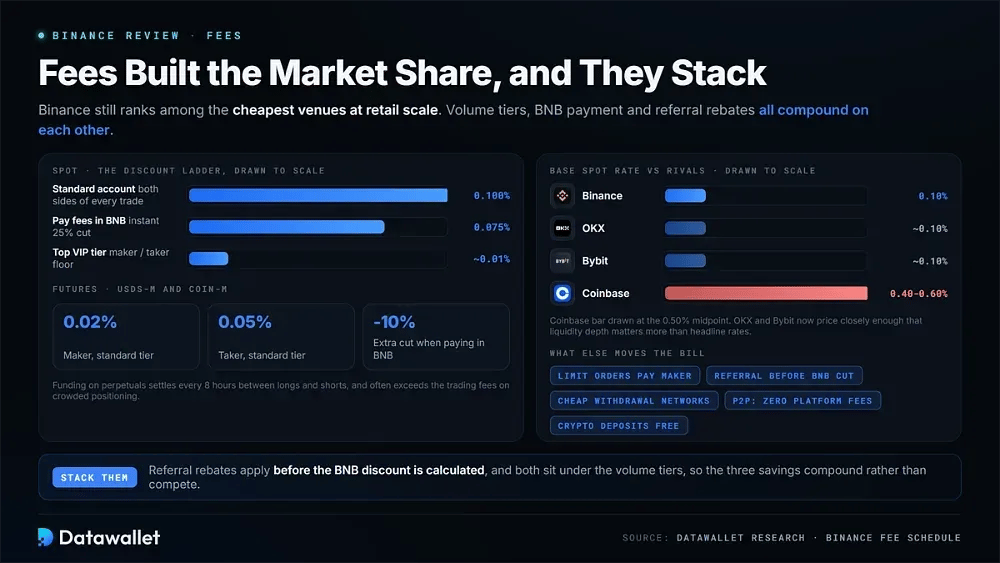
Binance built its market share on price, and the published schedule still ranks among the cheapest available at retail scale. Costs fall further through volume tiers, BNB payment and referral rebates, all of which stack on each other.
Spot Trading
Standard accounts pay 0.1% on both sides of every spot trade, whether the order rests patiently in the book or crosses it immediately. A handful of USDC pairs price slightly below that level, and the same rate otherwise applies uniformly across roughly 450 listed assets.
Discounts then compound quickly from that starting point. Paying your trading fees from a BNB balance removes another 25% immediately, which drops the effective cost to 0.075%, and a referral rebate trims that number further still, before any volume-based tier even comes into play at all.
At the very top of the ladder, spot costs fall toward roughly 0.01% maker and 0.02% taker. Reaching those levels demands enormous monthly turnover plus a substantial BNB balance, which is why the VIP tier system matters mainly to funds, market makers and algorithmic desks.
Futures and Derivatives Trading
Derivatives consistently price lower than the spot markets do on this platform. USDⓈ-M and COIN-M contracts start at 0.02% for makers and 0.05% for takers on standard accounts, and paying fees in BNB removes another 10% from both sides of that published schedule automatically at checkout.
The maker-taker spread runs considerably wider here than it does on spot, so limit orders that add liquidity save meaningfully over time. Top VIP tiers approach zero maker fees with taker rates near 0.017%, which stays competitive with anything on offer across crypto futures platforms.
Funding payments deserve separate budgeting entirely from fees. Perpetual contracts settle funding every eight hours directly between longs and shorts on each individual market, and on crowded positioning that recurring cost frequently exceeds all the trading fees you paid to open and close the position itself.
Deposit and Withdrawal Fees
Crypto deposits arrive free of charge on every supported network. Fiat costs depend entirely on which rail you choose to use, with bank transfers usually cheapest and card purchases the most expensive, typically running somewhere between 0.1% and 2% depending on the provider, the currency and your country.
Withdrawal pricing tracks live network conditions instead of applying a fixed percentage charge. Sending Bitcoin costs a flat amount that Binance adjusts alongside mempool congestion levels, and picking a cheaper settlement network for stablecoins routinely cuts the total cost by an entire order of magnitude.
P2P trading sits outside that published fee schedule altogether. Binance charges nothing at all on peer-to-peer orders arranged between two users, though merchant quotes embed a spread against the mid-market rate, and third-party rails such as card or wallet transfers still carry their own separate processing costs.
BNB Discounts and the VIP Program
Two discount systems run in parallel here, and they stack on top of each other. The first rewards holding and spending BNB, while the second rewards raw volume measured on a rolling 30-day basis.
Here is how to reduce what you pay in Binance fees:
- Enable BNB payment: Switching fee deduction to BNB immediately removes 25% from spot trades and 10% from futures, with no volume requirement or lockup attached at all.
- Use limit orders: Orders that rest in the book always pay the lower maker rate, which on derivatives costs 0.02% against the 0.05% charged to market orders.
- Climb VIP tiers: Each level demands higher 30-day volume plus a minimum BNB holding, cutting both spot and derivatives rates progressively as you climb further up the ladder.
- Apply a referral: Signing up through a referral link returns a share of your trading fees, and that rebate applies before the BNB discount gets calculated on top.
- Pick cheap networks: Withdrawing stablecoins over low-cost chains instead of Ethereum mainnet often saves more money over a full year of activity than any trading fee discount will.
- Compare alternatives: Retail rates sit far below Coinbase fees, though OKX and Bybit now price closely enough that liquidity depth matters more than the headline percentages.
How Binance Compares to Other Exchanges
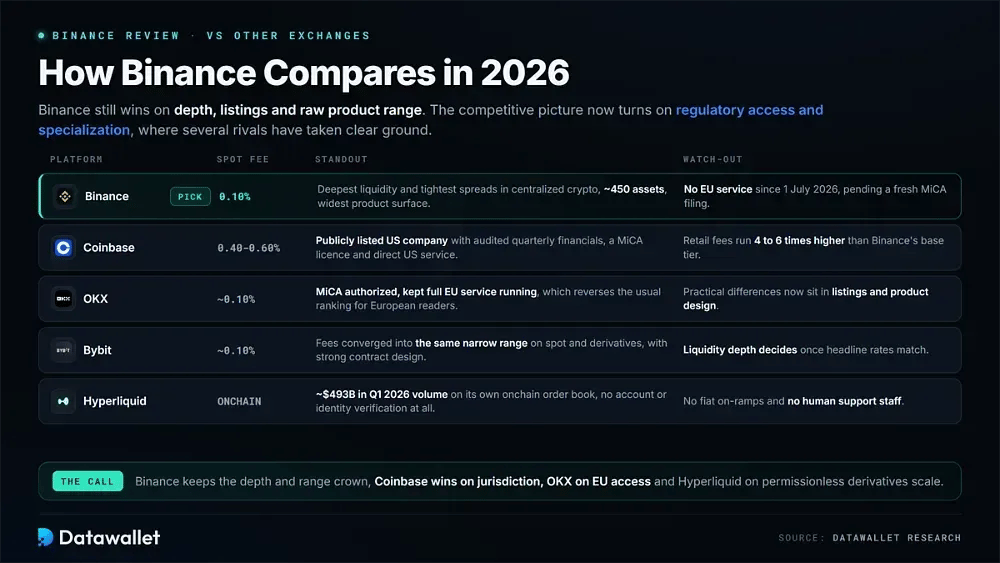
Binance still wins on depth, listings and raw product range across almost every category worth measuring here. The competitive picture during 2026 turns instead on regulatory access and specialization, where several rivals have taken clear ground.
Binance vs. Coinbase
Cost separates these two platforms immediately and fairly decisively. Binance charges 0.1% at its base tier against Coinbase retail rates running from 0.4% to 0.6%, a gap that is wide enough to dominate almost any comparison for traders moving meaningful size on a regular basis.
Coinbase counters with jurisdiction, disclosure and simplicity of use. It is a publicly listed US company publishing audited quarterly financials, holds a MiCA licence covering the European Union, and serves American customers directly, all points our Coinbase and Binance comparison weighs in far more detail.
Binance vs. OKX and Bybit
Fees have converged across all three platforms in recent years. OKX and Bybit both price spot trading near 0.1% and derivatives within the same narrow range, so the practical differences now sit in listings, product design and where each platform is legally permitted to operate.
Regulatory access is now the deciding swing factor for European readers in particular. OKX secured MiCA authorization and kept full EU service running throughout, which reverses the usual ranking entirely, so both the OKX and Bybit matchups now deserve close attention before you decide to switch.
Binance vs. Hyperliquid
Decentralized derivatives platforms finally reached meaningful scale during 2026. Hyperliquid cleared roughly $493 billion in first-quarter volume on its own onchain order book alone, entering the top ten derivatives platforms globally and taking share that would previously have flowed toward centralized order books almost automatically.
The trade-offs stay distinct between these two platforms. Hyperliquid requires no account or any identity verification at all and settles everything onchain, while Binance offers deeper spot liquidity, fiat on-ramps and human support staff, a set of contrasts our Hyperliquid comparison examines much more closely.
Final Thoughts
Binance remains the default answer for anyone who needs deep liquidity, wide token coverage and genuinely low fees together inside a single trading account. No competitor currently matches its combination of spot depth, derivatives volume and sheer product breadth anywhere across the wider exchange market.
The European exit changes that calculus completely for a very large group of our readers this year. Until a MiCA licence actually arrives, EU residents cannot open new positions at all, which makes an authorized alternative the practical choice today instead of an optional preference.
Everyone outside the bloc faces a far simpler decision here. The fee schedule, the equities expansion and the improved reserve transparency all argue clearly in Binance's favor, provided that you accept how its regulatory history keeps drawing sustained scrutiny from lawmakers and financial supervisors alike.