



Compare Top Uzbek Crypto Exchanges
1. Binance
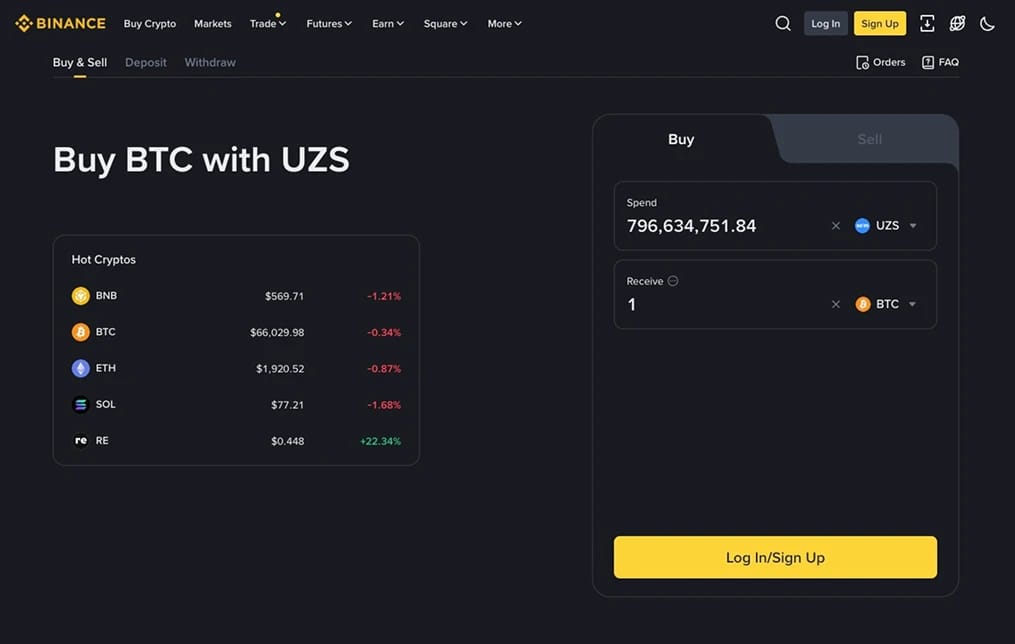
Binance became legally available to Uzbek residents in January 2025 after NAPP signed an agreement allowing the world's largest exchange to operate under crypto exchange license No CE#0004, issued to COINPAY LLC. The integration matters because it solved the single biggest problem in the market, which was moving soum on and off an exchange without breaking the law.
UZS deposits and withdrawals work through Humo and Uzcard as well as domestic bank transfers. When we funded an account through a Humo card, the soum balance appeared within a couple of minutes and converted to USDT at a visible rate before confirming. Once inside, you get genuine Binance liquidity on spot pairs, which means spreads on BTC and ETH that no purely local venue can match.
Since UzNEX handed back its license in May 2026, this is now the default choice for most serious traders in the country, and volumes have migrated here accordingly. One of the only downsides is that the dedicated Uzbek platform lacks the same features that the global Binance brand offers, such as derivatives trading.
Pros
- The only fully licensed route to a tier-one global exchange, operating under NAPP license CE#0004 held by COINPAY LLC.
- Direct soum funding through Humo, Uzcard, and national payment systems, with no grey-area P2P step required.
- Access to Binance's deep order books keeps spreads on major pairs far tighter than local-only alternatives.
Cons
- The product surface is narrower than global Binance, and derivatives are not part of the licensed offering for residents.
- Coinpay's own standalone platform is still maturing, and several advertised features rolled out slowly after launch.
- Binance was fined just over $8,500 by an Uzbek court in 2024 for earlier compliance breaches, a reminder that its local standing depends on the Coinpay arrangement holding.
2. Bitget
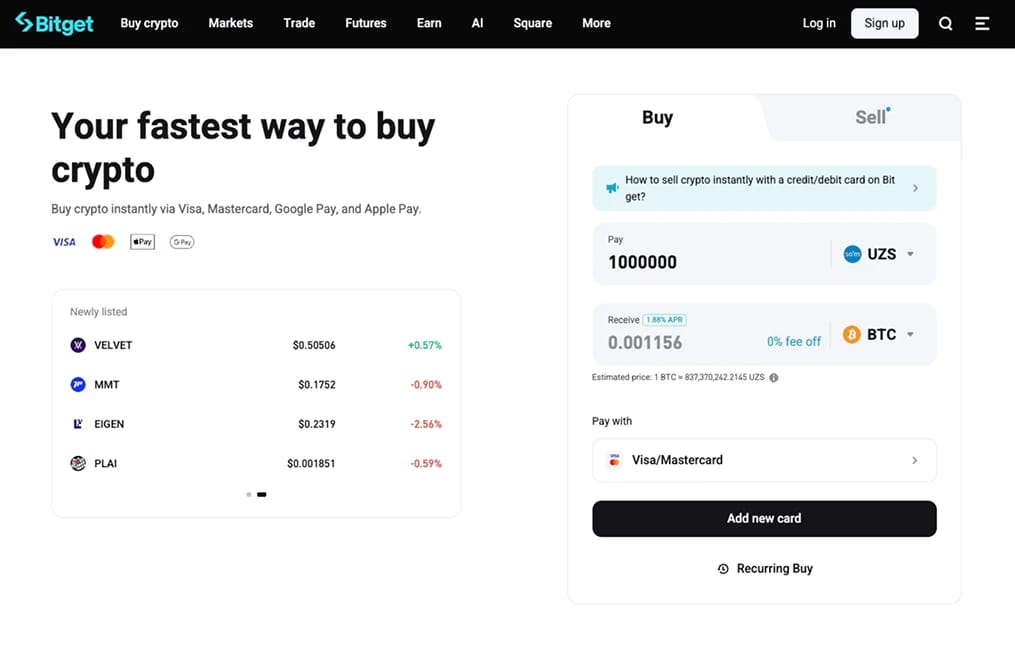
Bitget has become the go-to platform for Uzbek traders who want to follow rather than lead. Its copy trading system is the largest of its kind, letting you browse thousands of elite traders, filter them by ROI, drawdown, and assets under management, and mirror their positions automatically with your own risk limits attached.
UZS support is genuinely usable. The P2P marketplace runs an active soum corridor where counterparties settle through Humo and Uzcard transfers, and third-party gateways allow direct card purchases quoted in UZS. We tested a small P2P buy and the merchant released USDT within a few minutes of the card transfer confirming, though picking high completion rate merchants remains essential.
Beyond copying, Bitget offers spot, futures, a Launchpool for new token rewards, and a protection fund that publicly holds over $300 million as a backstop against security incidents. One thing to be clear about is that Bitget holds no NAPP license, so residents using it are stepping outside the licensed framework, with the legal and tax consequences that carries.
Pros
- The most developed copy trading ecosystem available to Uzbek users, with transparent trader statistics and flexible risk controls.
- Active UZS P2P market with Humo and Uzcard settlement plus third-party card gateways for direct soum purchases.
- A publicly verifiable protection fund and proof-of-reserves reporting add a meaningful security layer.
Cons
- Not licensed by NAPP, so use by residents breaches the domestic-provider requirement and forfeits the licensed-platform tax exemption.
- Copy trading results are heavily marketed, and past trader performance regularly fails to repeat.
- Access from Uzbekistan depends on workarounds and can break without notice if blocking tightens.
3. MEXC
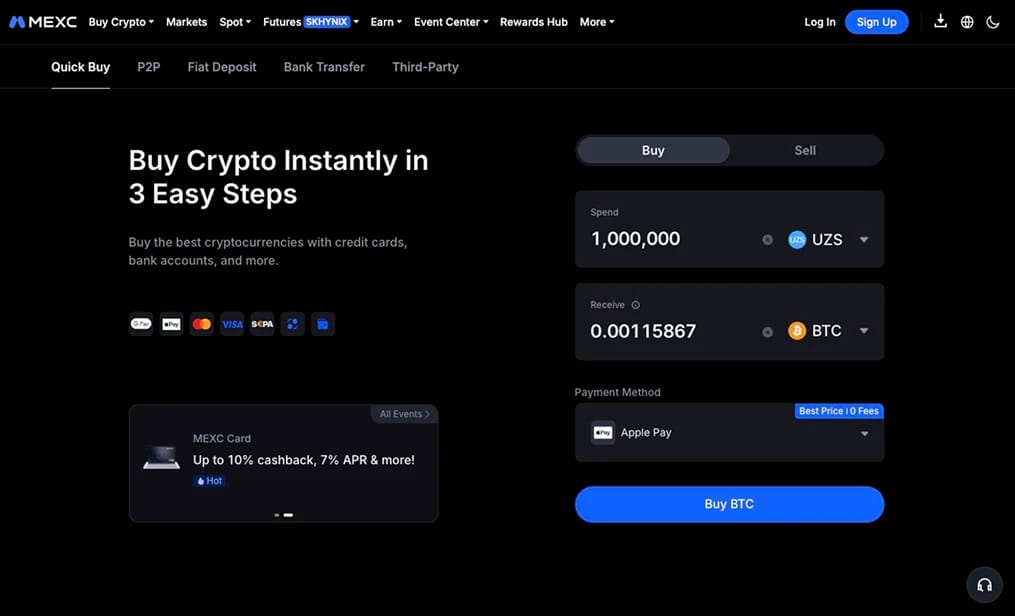
MEXC is the platform Uzbek derivatives traders gravitate toward, and the reason is blunt. It offers perpetual futures with leverage up to 500x on major pairs, some of the highest available anywhere, combined with 0% maker fees on spot and among the lowest futures fees in the industry. Users can also access spot trading, copy trading, trading bots, and TradFi with Gold and Silver trading supported.
The other draw is breadth. With over 3,000 listed cryptocurrencies, MEXC lists new and micro-cap tokens faster than almost any competitor, which suits the appetite for early-stage altcoins that is very real among younger traders in Tashkent. Its UZS P2P market settles through Humo and Uzcard like the other offshore venues, and card gateways price purchases directly in soum.
We want to be equally blunt about the risks. MEXC holds no NAPP license, so the same legal exposure applies as with any offshore platform, and 500x leverage is an instrument that liquidates accounts in seconds on normal volatility. Treat the leverage headline as a ceiling that exists, not a setting to use.
Pros
- Industry-leading fee structure with 0% maker fees on spot and very low futures costs.
- The deepest altcoin selection accessible from Uzbekistan, with over 3,000 tokens and rapid new listings.
- UZS deposits work through an active P2P market and card gateways, with straightforward USDT settlement.
Cons
- Not licensed by NAPP, meaning residents trade outside Uzbek law and lose the tax exemption attached to licensed platforms.
- Extreme leverage up to 500x makes total loss of margin trivially easy for inexperienced traders.
- Rapid listing standards mean plenty of low-quality tokens, so due diligence falls entirely on you.
4. Asterium
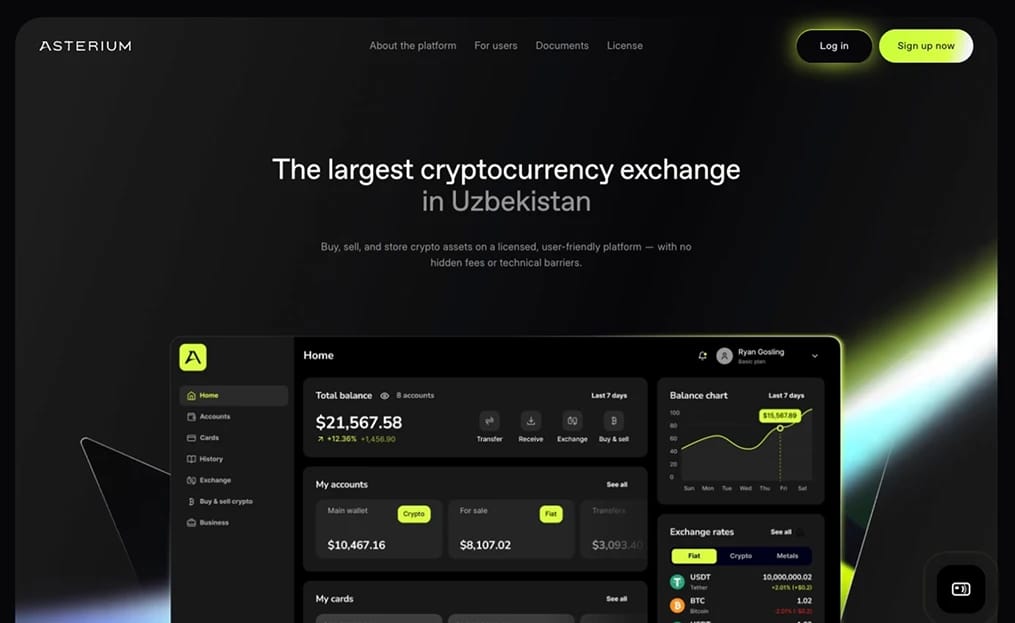
Asterium is one of only two companies holding an active NAPP crypto exchange license following the UzNEX exit, and it has carved out a clear identity as the platform for people who want to actually spend their crypto. It issues physical and virtual cards on the Humo, Visa, and Mastercard rails, funded directly by assets like USDT, BTC, and ETH held on the exchange.
The card products are the standout. A virtual card activates instantly for online purchases, while the plastic card arrives within about three business days and works for in-store payments and ATM withdrawals. The Humo version only works inside Uzbekistan, but the Visa and Mastercard versions are accepted internationally, which fills a real gap since domestic Humo and Uzcard cards are awkward to use abroad.
Trading itself is straightforward spot exchange across the major coins, with soum funding from local cards. We found the asset list thin compared to what Binance offers through Coinpay, so we treat Asterium less as a trading venue and more as the licensed bridge between a crypto balance and everyday spending.
Pros
- Holds a full NAPP crypto exchange license, one of only two active in the country as of mid-2026.
- Crypto-funded cards on Humo, Visa, and Mastercard let you pay merchants and withdraw cash directly from USDT or BTC balances.
- Direct UZS deposits from Humo and Uzcard with streamlined KYC for Uzbek citizens.
Cons
- The coin selection is limited to majors, so altcoin traders will find the spot market restrictive.
- Card issuance and maintenance carry fees, and pricing is less transparent upfront than on larger exchanges.
- Order book depth is modest, meaning larger trades move the price more than they would on Binance liquidity.
5. OKX
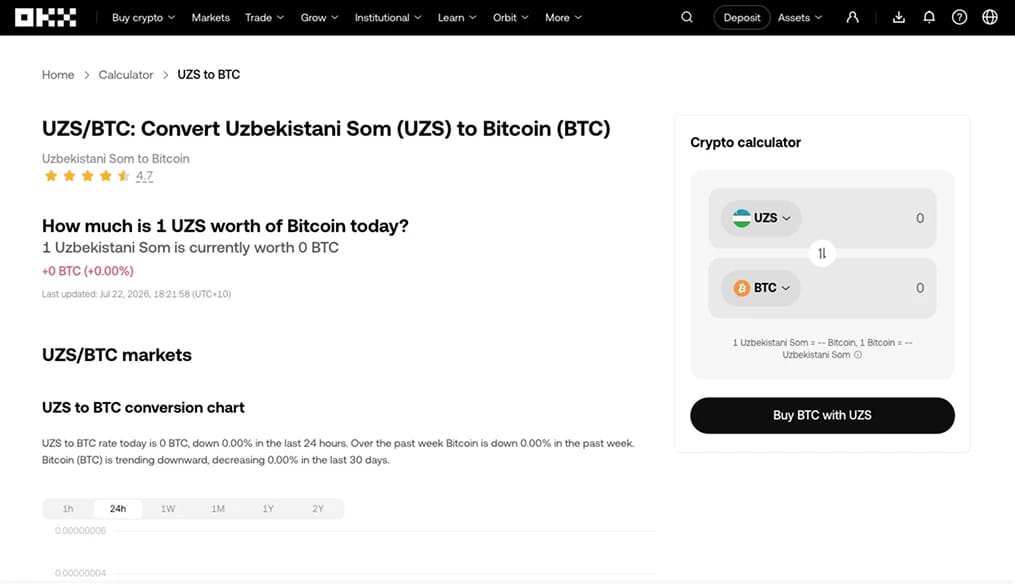
OKX is the strongest option for Uzbek users whose priorities are USDT liquidity and access to Web3. Its particular strength in this region is the stablecoin corridor. Uzbekistan received $14.8 billion in remittances in 2024, and a growing share of that flow moves as USDT on TRON before being converted to soum. OKX's P2P market handles that conversion with some of the tightest UZS spreads available.
UZS deposits work through that P2P marketplace with Humo and Uzcard settlement, alongside third-party card gateways. Combined with cheap and fast TRC-20 withdrawals, it suits families receiving transfers from relatives working abroad, which is the use case that genuinely drives crypto volume in this country.
Beyond P2P, the platform offers a polished spot and derivatives suite, maker fees from 0.08%, and an excellent self-custody Web3 wallet that opens DApps, DeFi yields, and NFT markets from one interface. Like the other offshore venues here, OKX holds no NAPP license, so residents using it accept the legal exposure and the loss of the licensed-platform tax exemption.
Pros
- Among the tightest USDT/UZS P2P spreads available, which is why it dominates the informal remittance conversion flow.
- The best integrated Web3 wallet on this list, giving self-custody access to DeFi and DApps beyond the exchange itself.
- Low trading fees from 0.08% for makers plus cheap TRC-20 transfers suit cross-border use cases.
Cons
- Unlicensed in Uzbekistan, meaning use by residents breaches the domestic-provider requirement and carries penalty risk.
- No official soum on-ramp exists, so every fiat conversion depends on individual P2P counterparties.
- Account access from Uzbekistan is unstable and can require constant workarounds.
6. Bitunix
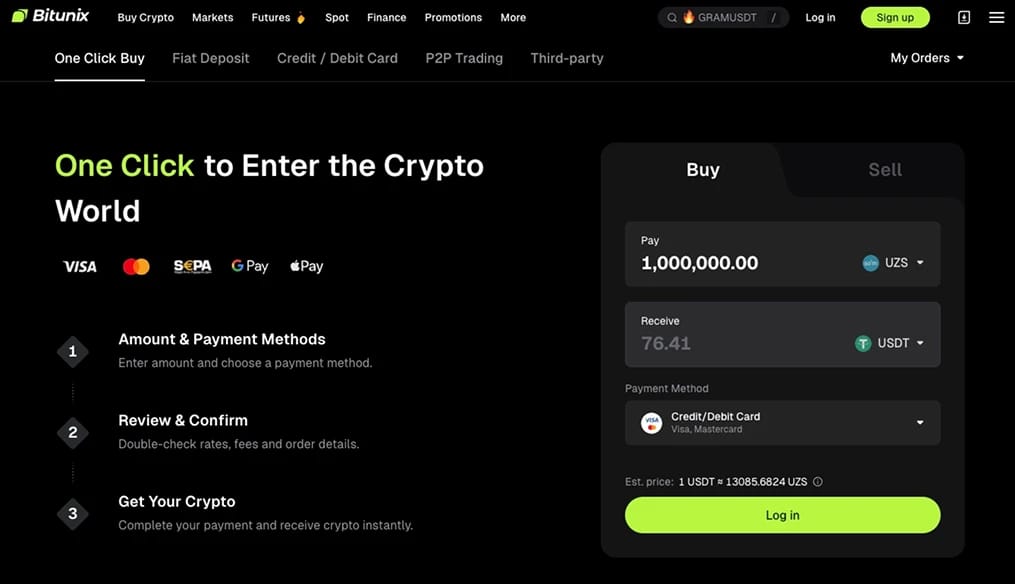
Bitunix is a younger exchange that has built a surprisingly loyal following in Uzbekistan, helped by an interface localized for the region and marketing aimed squarely at Central Asian users. For traders who find the dense dashboards of the giants exhausting, its cleaner layout and TradingView-integrated charts are a genuine relief.
The platform focuses on spot, futures, and an Earn section with aggressive staking rates, including headline APYs on stablecoin products that comfortably beat anything a local bank pays on soum deposits. Copy trading is available too, though the trader pool is smaller than Bitget's. UZS funding runs through P2P settlement and card gateways, and we found the flow simple enough, with the usual caution about vetting counterparties.
The trade-offs are track record and legality. Bitunix launched years after its larger rivals and maintains 1:1 proof of reserves, but it simply has less history to judge. It also holds no NAPP license, so the same compliance warning applies as with every offshore platform in this guide.
Pros
- A localized, uncluttered interface that suits Uzbek users better than most global platforms.
- High staking APYs on flexible and fixed products, particularly attractive on stablecoins.
- UZS deposits supported through P2P and card gateways, with 1:1 proof of reserves published.
Cons
- Not licensed by NAPP, so residents using it operate outside the legal framework and lose the tax exemption.
- A shorter operating history than rivals means less evidence of resilience through market stress.
- Smaller liquidity pools than Binance, OKX, or MEXC, with wider spreads on less popular pairs.
How to Choose a Crypto Exchange in Uzbekistan
Choosing a platform in Uzbekistan is a legal decision before it is a product decision. Only two exchanges hold NAPP licenses, everything else operates offshore, and that gap defines the risk you take on. We run five checks before funding anything.
- Check the NAPP register first: The National Agency of Perspective Projects publishes the official register of licensed crypto service providers, and it should be your first stop because the list changes. Today, only Coinpay and Asterium hold active exchange licenses. Binance's local operation runs on license CE#0004 held by COINPAY LLC, and the licensed access point is coinpay.uz, not binance.com. NAPP has suspended and annulled licenses before, so a platform that was compliant last year may not be today.
- Test the UZS deposit method before scaling up: Licensed platforms connect to Humo, Uzcard, and the national payment systems directly, while offshore platforms rely on P2P card settlement between individuals. Send a minimal amount first, confirm it lands, and confirm a withdrawal back to the same card before committing real money.
- Vet P2P counterparties on offshore platforms: Stick to merchants with long histories and high completion rates, and never settle outside the platform's escrow protection. Individual counterparties carry the settlement risk that a licensed connection removes.
- Know what the licensed platforms cannot do: The licensed market covers spot trading, custody, and increasingly cards, but not derivatives, and NAPP has explicitly declined to legalize P2P trading until it can supervise it. For long-term BTC and USDT accumulation the licensed venues cover the need. If your strategy depends on futures or leverage, no compliant option currently exists, and going offshore costs you the tax exemption while adding potential penalties and counterparty risk with no local recourse.
- Keep records to the same standard the law sets: Licensed providers must retain transaction data for at least five years, identification is mandatory everywhere, and anonymous transactions are prohibited outright. Export your histories regularly, since the UzNEX exit showed balances and records can become hard to retrieve on short notice, and keep proof that your coins came through licensed providers, because the tax exemption attaches specifically to those transactions.
Crypto & Bitcoin Regulation in Uzbekistan
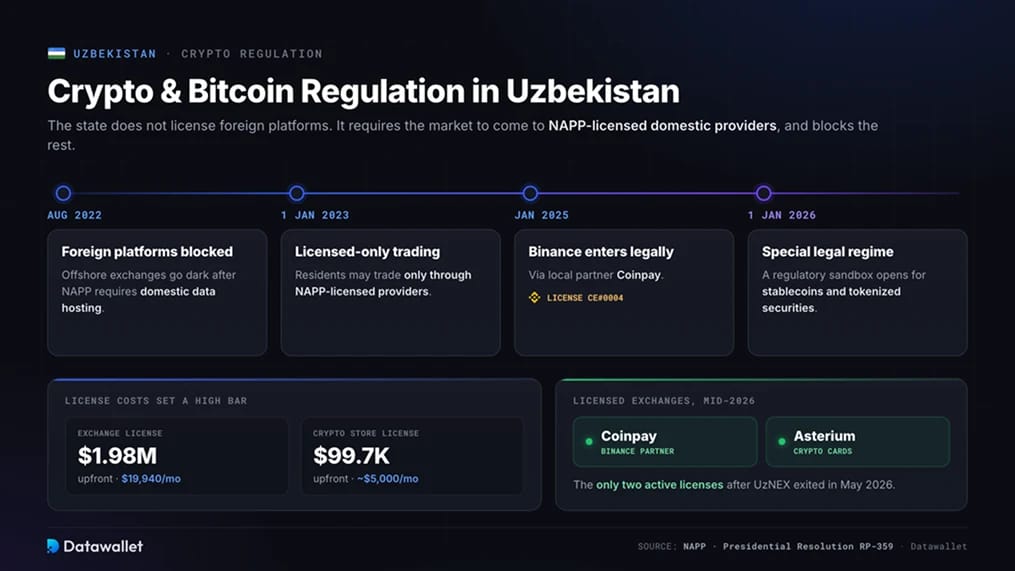
Uzbekistan regulates crypto through a centralized model that has very few parallels globally. Rather than licensing foreign platforms to serve the market, the state requires the market to come to its licensed providers, and it blocks the rest.
The framework has been built through presidential decrees since 2018, with the pivotal rules arriving in 2022 and taking full effect on 1 January 2023. From that date, residents have been permitted to trade crypto only through domestic Crypto Asset Service Providers licensed by NAPP, an agency that reports directly to the President and also regulates capital markets and insurance.
The key features of the regime as it stands in 2026:
- Licensed categories: NAPP licenses crypto exchanges, crypto stores, crypto depositories, and mining pools, each with steep entry costs. An exchange license costs roughly $1.98 million to obtain with monthly operational fees around $19,940, while a crypto store license runs near $99,700 plus about $5,000 per month. Monthly fees were doubled in 2024.
- Foreign platform ban: Offshore exchanges have been blocked since August 2022, when NAPP required servers and customer data to be hosted domestically. Binance was fined 300 basic calculation units, a little over $8,500, by a Tashkent court in 2024 before entering legally through Coinpay in January 2025.
- The 2026 special regime: Presidential Resolution No RP-359 of 27 November 2025 introduced a special legal regime from 1 January 2026, creating a regulatory sandbox run jointly by NAPP and the Central Bank of Uzbekistan for stablecoins as payment instruments, alongside a framework for tokenized stocks and bonds issued by Uzbek companies.
- Mining rules: Mining is legal for registered companies but is steered hard toward solar power, with grid-powered operations paying doubled electricity tariffs plus surcharges at peak hours.
- Market consolidation: UzNEX, the first licensed exchange, had its license annulled on 25 May 2026 at its own request, leaving Coinpay and Asterium as the only licensed exchanges.
How Does the State Tax Committee Treat Crypto?
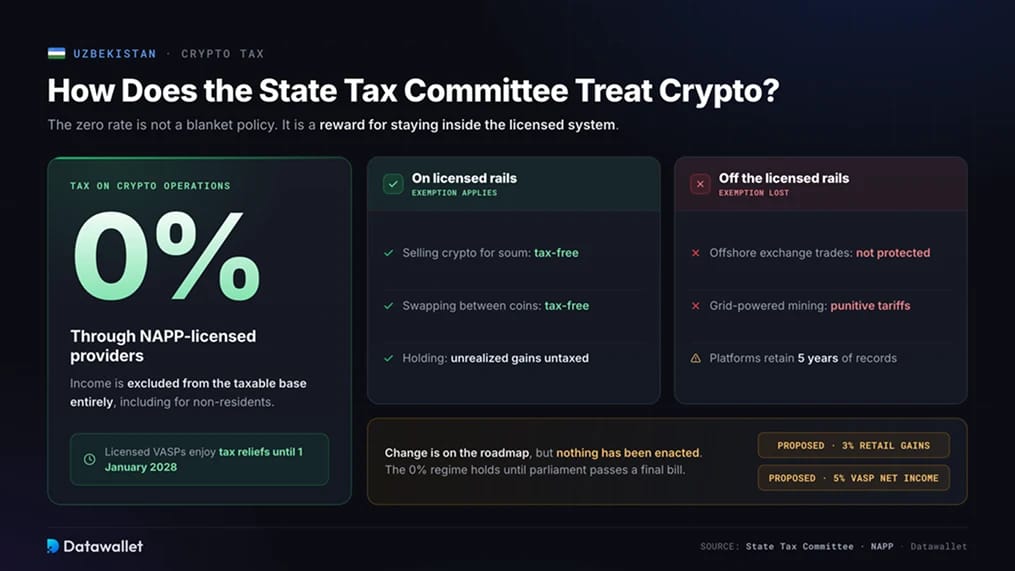
Uzbekistan currently applies one of the most generous crypto tax regimes in the world, but the exemption is conditional in a way that catches people out. The zero rate is not a blanket policy. It is a reward for staying inside the licensed system.
Operations with crypto assets carried out through NAPP-licensed providers are exempt from taxation for both individuals and legal entities, including non-residents. Income from these transactions is excluded from the taxable base entirely, and licensed VASPs themselves enjoy profit tax and VAT reliefs that run until 1 January 2028.
The conditions and exceptions worth knowing:
- The exemption follows the license: Selling crypto for soum, or swapping between coins, is tax-free when done on a licensed platform. Trade on an unlicensed offshore exchange and the exemption no longer protects that income.
- Buying and holding is not taxed: Unrealized gains are disregarded, and there is no wealth-style levy on crypto balances.
- Mining income has its own carve-outs: Registered miners using solar energy receive income tax exemptions, while grid-based operations face punitive electricity pricing instead.
- Change is on the roadmap: The government's 2025 to 2027 budget planning asked NAPP and the Ministry of Finance to design a phased taxation model, with proposals floated around a 3% flat rate on retail gains and a 5% levy on VASP net income. Nothing has been enacted, and the 0% regime holds until parliament passes a final bill.
The State Tax Committee can request records, and licensed platforms retain five years of transaction data that the authorities can access, so the practical advice is simple. Keep your activity on licensed rails and keep your own export of every transaction.
Cryptocurrency Adoption in Uzbekistan
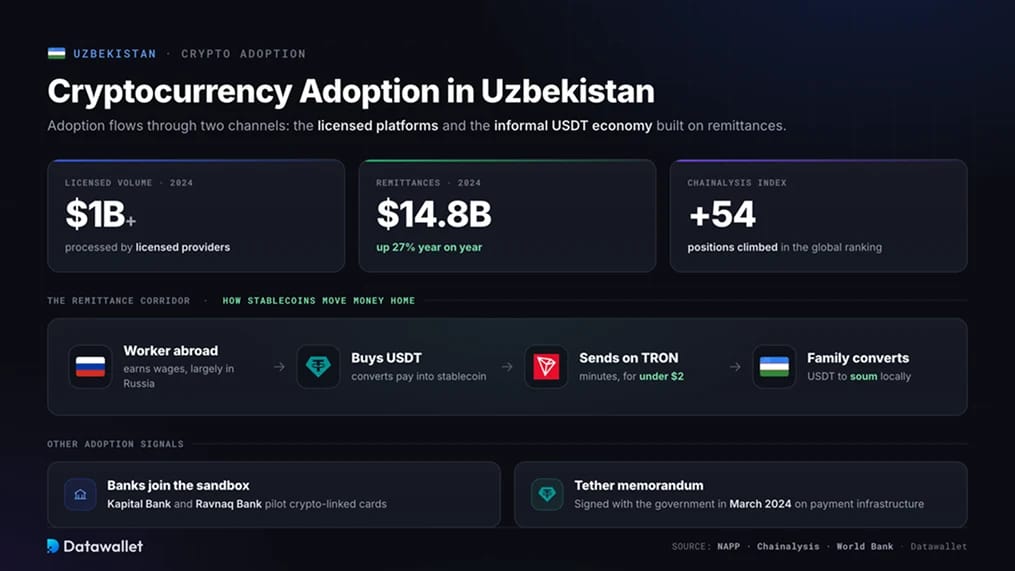
Adoption in Uzbekistan is strong and growing fast, but it looks different from open markets because so much of it flows through two channels, the licensed platforms and the informal USDT economy.
On the formal side, licensed providers processed more than $1 billion in transactions in 2024, with UzNEX alone crossing the billion-dollar mark before its 2026 exit. NAPP issued nine new licenses during 2024, and the Binance entry in January 2025 pulled a significant share of previously offshore activity into the regulated system.
The informal driver is remittances. Uzbekistan received $14.8 billion in remittances in 2024, up 27% year on year, mostly from workers in Russia, and stablecoins have become a meaningful corridor for that money. A worker abroad buys USDT, sends it home on TRON for under a couple of dollars, and family converts to soum locally.
Other adoption signals worth noting:
- Regional standing: Uzbekistan ranks among the most active crypto markets in Central Asia alongside Kazakhstan and Kyrgyzstan, and government analysis highlighted a 54-position climb in the Chainalysis Global Crypto Adoption Index.
- Banking integration: Kapital Bank and Ravnaq Bank have participated in the regulatory sandbox developing crypto-linked card products, and Asterium's Humo-based crypto card puts digital assets directly into everyday retail payments.
- Institutional groundwork: The March 2024 memorandum between the government and Tether on payment infrastructure, plus the 2026 tokenized securities framework, signal that the state intends adoption to keep running through channels it controls.
How to Buy Bitcoin in Uzbekistan
Buying Bitcoin legally in Uzbekistan is genuinely straightforward now, which was not true even three years ago. The process below keeps you entirely inside the licensed framework:
- Choose a licensed platform: For most people this means Binance via coinpay.uz, or Asterium if card spending matters more than asset selection. Confirm the license against the NAPP register before registering.
- Complete identification: Anonymous accounts are illegal, so KYC is mandatory. You will need your Uzbek passport or ID card, and verification typically runs through integrated services like MyID within minutes to a few hours.
- Deposit soum: Fund the account from a Humo or Uzcard, or by bank transfer. Deposits from your own cards land quickly, and I would always start with a small test amount on a first deposit.
- Place the trade: Convert soum to USDT or buy BTC directly depending on the platform's pairs, review the quoted rate against the global price, and confirm. The Bitcoin credits to your platform wallet immediately.
If you plan to hold long term, weigh custody carefully. The UzNEX wind-down forced customers through a refund process with a 3 to 10 business day window, which is a live demonstration of why balances you do not need on-platform are better held in a wallet you control.
Final Thoughts
Uzbekistan has built something unusual, a crypto market that is simultaneously restrictive and generous. You give up platform choice and derivatives, and in exchange you get a 0% tax rate, direct Humo and Uzcard rails, and a regulator that actively polices the venues you are allowed to use.
For 2026, the licensed path is stronger than it has ever been. Binance through Coinpay delivers global liquidity inside the legal framework, and Asterium turns crypto balances into spendable cards.
The offshore platforms, whether Bitget for copy trading, MEXC for derivatives, OKX for USDT flow, or Bitunix for its localized experience, still offer more features, but they now compete against a licensed option that is actually good, which was never previously the case.
Our approach is to keep core activity on the licensed rails, keep thorough records, and treat any offshore exposure as a risk position rather than a convenience.
Our Methodology
We ranked these platforms as a resident would experience them, not as their marketing describes them. Accounts were verified with Uzbek documents, funded in soum through Humo, Uzcard, and P2P transfers, put through real orders, and emptied back out. Six criteria set the order.
- Trust Score: Our proprietary 5-point rating, shaped by legal standing under Uzbek law first, since NAPP licensing is the dividing line in this market, alongside reserve transparency, incident history and resolution, and years in operation.
- Uzbekistan Availability: Confirmed each platform accepts Uzbek sign-ups and documents, tested the licensed access point at coinpay.uz against the blocked global domain, and checked each offshore venue's blocking history and current reachability.
- UZS Funding Methods: Tested direct Humo and Uzcard deposits on the licensed platforms and soum P2P orders on the offshore ones, recording merchant depth, settlement times, and spreads against the interbank rate.
- Security Track Record: Studied each platform's incident record, where client assets are held, how regularly reserves are attested, what protection funds exist, and which account defenses can be switched on.
- Assets and Liquidity: Worked BTC, USDT, and one smaller pair on every venue with real orders, recording spread cost, quote depth, and how cleanly orders closed, with extra attention to thin soum conversion points.
- Fee Structure: Priced a complete soum round trip on each platform, counting trading fees, the P2P spread paid at entry and again at exit where relevant, and withdrawal costs on the networks Uzbeks realistically use.
Platforms that reject Uzbek users were excluded before testing began, and UzNEX was removed from consideration after its license annulment in May. We tested through the first half of the year and re-verified licensing status against the NAPP register in July.