







About Bitget
Sandra Lou founded Bitget in 2018, while Gracy Chen has led the company as chief executive since 2024. Its operating company, BG Limited, is incorporated in Seychelles. Copy trading originally distinguished the exchange and remains the largest program of its kind. Over the past year, however, Bitget has rebuilt its platform around a broader concept.
The company calls this model the Universal Exchange, or UEX. One USDT account funds crypto spot and futures, tokenized equities, commodity and forex CFDs, structured notes, and an AI trading agent. The CoinGlass 2026 derivatives report ranked Bitget second worldwide for ETH order book depth and fourth for BTC.
CoinGecko awards Bitget its maximum 10/10 trust score. It lists 536 coins across 603 spot pairs and roughly $6 billion in on-chain exchange reserves. Bitget reports more than 125 million registered users across 150 countries and regions.
Its regulatory position has moved in the opposite direction. Bitget entered 2026 without European authorization, closed French accounts in March, announced its withdrawal from Japan, and remained on an Australian regulator's warning list. These developments account for much of the caution in this review.
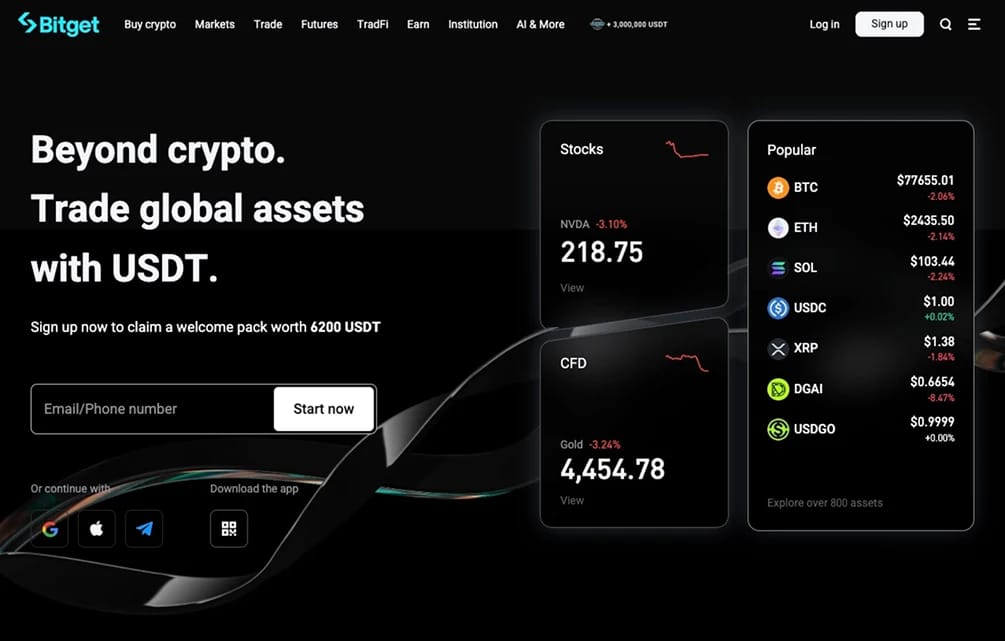
Bitget Features
Bitget's main navigation separates Spot, Margin, Futures, CFD, and Stocks. Copy, Bots, Earn, and the AI section sit one layer below. Its Unified Trading Account, or UTA, allows a single collateral pool to support spot, margin, futures, and eligible tokenized stock positions simultaneously.
Trading Types
These are the main trading products on the exchange:
- Spot: More than 800 assets trade against USDT and USDC, alongside a smaller selection of EUR and BRL markets. During our checks, BTC/USDT spreads were close to 0.01%. CoinGecko also rates the exchange's liquidity as high.
- Margin: Cross and isolated margin provide borrowed exposure on spot pairs. An April app update introduced order chasing and order editing for isolated mode.
- Perpetual futures: Traders can use USDT, USDC, or the underlying coin as collateral. Leverage reaches 125x on flagship pairs, with funding settled every eight hours. Our funding rates tracker compares Bitget's rates with competing venues.
- Stock perpetuals: More than 40 USDT-settled contracts track companies such as Apple, Tesla, and Nvidia, as well as the QQQ index. Trading runs 24/5 with leverage capped at 10x. Funding is charged hourly instead of following the eight-hour cycle used for crypto perpetuals.
- CFDs: The MetaTrader 5 brokerage covers forex and precious metals, plus oil, indices, and stock CFDs. Fixed leverage reaches 500x. Dynamic leverage on gold increased to 800x in August, as discussed in the TradFi section below.
- Delta Neutral Mode: Introduced in May, this setting combines spot, margin, and futures positions to capture funding or basis without taking directional exposure. It is suitable only for experienced accounts.
- Convert and Block Trade: Convert exchange assets at a quoted price. Block Trade handles negotiated positions away from the public order book.
New users should read our guide to how perpetuals differ from spot before opening the futures tab. The app makes leverage as easy to activate as a spot purchase, without adding friction for first-time traders.
Earn Options
Bitget Earn includes principal-stable savings alongside structured products whose payouts depend on the closing price of a stock or cryptocurrency.
The main yield products include:
- Simple Earn: Flexible and fixed-term deposits pay floating rates set for each asset. Promotions advertising very high APYs usually apply to small caps.
- On-chain Earn: Bitget packages staking and DeFi strategies for exchange users. Gauntlet-curated Morpho vaults on Morph have been available since July.
- Structured Earn: Dual Investment and Shark Fin products quote high yields, but the asset received at expiry depends on the settlement price. Rates above 100% are possible because the principal may be converted at an unfavorable price.
- Fixed Coupon Notes: Introduced on August 18, these structured notes pay a fixed USDT coupon. If the share price falls through a barrier, they may deliver tokenized stocks such as NVDA or MU at maturity. Principal is not protected.
- Loans and Auto-Invest: Crypto loans provide liquidity against collateral. Auto-Invest and Smart Portfolio make recurring purchases using USDT or USDC.
Additional Services
- Copy trading: More than 130,000 elite traders and 800,000 copiers participate across spot, futures, bot, and CFD strategies. Each leader requires at least 50 USDT, while profit shares generally range from 4% to 10%. Per-leader stop-losses and daily loss limits are why Bitget leads our ranking of copy trading platforms.
- GetAgent: Bitget's AI assistant takes plain-language instructions, analyzes strategies, and can place orders around the clock. In July, the GetAgent Playbook added support for tokenized stocks. Its output should be treated as another signal that requires independent checking.
- Trading bots: Spot Grid, Futures Grid, DCA, and funding rate arbitrage bots follow rule-based strategies. These bots continue operating when a token is delisted, which caused losses for at least one grid trader in August.
- Onchain: Users can purchase selected on-chain tokens with USDT or USDC held in their spot accounts. On-chain withdrawals became available in March. Smart-contract risk applies in addition to price risk.
- Bitget Wallet: The self-custodial wallet passed 100 million users in July and supports more than 130 blockchains. It has a separate $300 million protection fund that does not cover exchange balances.
- P2P marketplace: Local-currency purchases use escrow and support dozens of payment methods. Recent reviews most often complain about P2P disputes.
- Bitget Institutional: Project Archimedes, announced in August, commits $300 million to quantitative firms and asset managers. Bitget also provides a CFD liquidity service for proprietary trading desks.
.webp)
Bitget rTokens and TradFi Products
Bitget's traditional-asset business has expanded significantly since our previous review. Four product families now appear under the TradFi and Stocks tabs, each carrying a different legal structure and risk profile.
- rTokens: Bitget's issuance platform, Reality, launched on May 26. Stocks 2.0 followed on June 2 with 36 tokenized US equities and ETFs, and the catalog has since grown beyond 500. A FINRA-registered US brokerage holds one share for every rToken. Eligible dividends are paid in USDT, while stock splits are reflected automatically.
- Collateral use: More than 100 rTokens can be used as margin within the Unified Trading Account. They can also support copy trading or be placed in yield products.
- Ondo conversion: Stock tokens previously issued by Ondo were converted into rTokens through a voluntary program in June and an automatic upgrade in July. Adjustments were based on exposure to the underlying shares rather than a one-for-one conversion.
- Stock perpetuals: USDT-margined contracts covering more than 40 US shares and indices provide long and short exposure at up to 10x leverage. Positions can still be liquidated while the underlying market is closed.
- CFDs on MT5: A Mauritius-registered entity operates the contracts-for-difference platform. It opened in January, introduced copy trading in April, and launched sub-accounts on August 20. Dynamic gold leverage of up to 800x arrived the following day. Bitget fixes the leverage level, and traders cannot lower it manually.
According to Bitget's July transparency report, rToken assets under management reached $114 million within five weeks. Cumulative volume totaled $671 million, with more than 100,000 users participating. These products provide neither legal share ownership nor voting rights. The CFD operation also retains the exchange's offshore structure.
.webp)
What Is BGB and Morph?
BGB is Bitget's exchange token, although an external foundation now controls its economics. It launched in 2021 with a supply of 2 billion tokens. An 800 million burn in December 2024 reduced that figure to 1.2 billion. In September 2025, Bitget transferred 440 million BGB to the Morph Foundation. The foundation immediately burned half and locked the remainder, which vests at 2% per month.
Morph is an Ethereum Layer 2 designed for stablecoin payments. Under the agreement, BGB became its gas and governance token. The foundation replaced Bitget's profit-linked buybacks with quarterly burns tied to Morph network fees, with a long-term supply target of 100 million tokens. Morph Payments launched in August.
The second-quarter burn removed 3,010,400 BGB, even though Morph produced only $4,071 in net protocol fees during the period. At an average BGB price of $1.92, network usage supported the burning of 2,120 tokens. A 1,420x calibration multiplier raised the amount to the published total. Until on-chain activity increases, the burn rate depends on a governance-set multiplier rather than organic demand.
BGB still has practical uses on the exchange:
- Spot fee discount: Paying spot fees with BGB lowers the rate by 20%, from 0.1% to 0.08%. Futures fees receive no discount.
- VIP qualification: An account holding 20,000 USDT in BGB reaches VIP 1. The same tier is available to traders with 500,000 USDT in 30-day spot volume.
- Launchpool and PoolX: Users can lock BGB to receive allocations of newly listed tokens during campaign periods.
- Gas on Morph: BGB pays transaction fees on the Morph chain, and Bitget Wallet provides a native bridge for the token.
- Card cashback: Rewards from the exchange-linked Bitget Card are distributed in BGB.
BGB traded near $1.94 at the time of writing. Its price reflects sentiment toward the exchange as much as its tokenomics. Buying it solely for discounted fees introduces price risk that may exceed the savings.
%201.webp)
Is Bitget Regulated?
Bitget maintains anti-money-laundering registrations in several countries, but no major market financial regulator oversees its trading conduct. Its compliance page currently identifies seven jurisdictions, compared with ten at the beginning of the year. Italy, Poland, Lithuania, Bulgaria, and the Czech Republic disappeared from the list after their national registrations expired under MiCA.
The registrations currently published are:
- Australia: AUSTRAC registration subjects spot trading to reporting rules but does not authorize derivatives. In July 2025, ASIC warned investors that Bitget lacked an Australian financial services license for its 125x futures. Licensed alternatives are listed in our best crypto exchanges in Australia guide.
- El Salvador: The central bank provides Bitget's Bitcoin Service Provider registration, while CNAD issued its Digital Asset Service Provider registration.
- United Kingdom: An FCA-authorized firm approves Bitget's UK promotions under Section 21 of FSMA. That approval applies only to the marketing material. Bitget does not hold FCA permission.
- Georgia: Registration in the Tbilisi Free Zone covers exchange, wallet, and custody services.
- Argentina: Bitget's CNV VASP registration supports its largest Latin American market.
- Mexico and Switzerland: The remaining registrations consist of vulnerable-activity status with Mexico's tax authority and membership in a FINMA-recognized self-regulatory organization.
Europe remains the largest gap. Vienna-based Bitget EU applied for a MiCA license from Austria's Financial Market Authority in June, but the ESMA register showed no authorization when we checked on August 22. MiCA is the EU licensing framework for crypto service providers, and its transition period ended on July 1.
Bitget says it will not provide services to European Economic Area residents until the FMA approves its application. French accounts entered restricted mode on March 31. Remaining balances above 10 USDC were transferred to a licensed third party. Approved platforms are covered in our MiCA-licensed exchange guide.
New registrations from Japanese residents ended on August 3. Any remaining open positions as of December 31 will be forcibly liquidated, and card services will end that day. The Terms of Use continue to prohibit residents of the United States, Canada, Singapore, and mainland China. Our Bitget restricted countries page contains the full list.
.webp)
Is Bitget Safe?
Bitget provides some of the industry's most consistent solvency disclosures, but its trading engine has experienced two compensated incidents in sixteen months. We use it as a trading account and store long-term holdings elsewhere.
The exchange has released monthly Proof of Reserves reports without interruption since December 2022. Its June 2026 report, the 43rd publication in the series, reported a combined reserve ratio of 123% across BTC, ETH, USDT, and USDC. The surplus has fallen from 169% in February, although every reported ratio has remained above 100%.
Users can check their inclusion with the open-source MerkleValidator tool. Published wallet addresses also support on-chain verification. Bitget produces these reports internally rather than obtaining attestations from an independent auditor.
Account Safety Measures
We switch on the following before the first deposit of any size:
- Authenticator 2FA: Codes generated by an authentication app protect logins and withdrawals. Passkeys provide device-bound approval.
- Anti-phishing code: A user-selected phrase appears in official emails, making fraudulent messages easier to identify.
- Withdrawal whitelist: Transfers can only be sent to pre-approved addresses. Adding a new address triggers a 24-hour withdrawal lock.
- Fund code and PIN: A separate fund code protects security changes. Users can also require a PIN for trading activity.
- Security-change lock: Password or 2FA changes suspend withdrawals for 24 hours.
- Level 2 verification: Proof of address unlocks the highest account limits. Completing it may also reduce the chance of entering the facial re-verification loop described by several recent reviewers during withdrawals.
Asset Protection
Bitget's Protection Fund is a self-funded reserve held separately from customer deposits, with a committed minimum of $300 million. It covered compensation following the April 2025 VOXEL incident. Most customer assets are stored in offline multi-signature wallets. Chainalysis monitors deposits and withdrawals for exposure to illicit finance. Bitget Wallet has another $300 million fund dedicated to self-custody users.
Security History
Bitget has never reported a hot wallet breach. Its recorded incidents instead originated from market structure.
- VOXEL, April 2025: A fault in Bitget's market-making logic allowed eight accounts to extract more than $20 million from the VOXEL perpetual market. Bitget reversed the trades, froze the accounts, and began legal action. It promised to distribute any recovered funds to users.
- TUT, LOBSTER, and BICO, August 2026: On August 9, abnormal price movements across three perpetual contracts pulled mark prices away from their indices and caused forced liquidations. Bitget confirmed that compensation would be paid in USDT. A VIP trader disputed the proposed settlement on Trustpilot, reporting losses of about 45,000 USDT across three connected accounts against an initial offer of 9,600 USDT.
- COTI liquidation, August 2026: Another complaint concerned a mark-price wick that liquidated a position while the last traded price remained above the stop-loss level. Bitget support confirmed that liquidations use mark price. Stop-loss orders linked to the last price therefore offer no protection during oracle spikes.
Each case followed a similar course. Thin perpetual contracts moved sharply, Bitget acknowledged the incident, and compensation was negotiated without a published formula. Use low leverage on illiquid contracts and configure stop-loss orders against mark price.
.webp)
Bitget User Reviews
Public sentiment has weakened since our previous audit. Bitget's mobile apps retain strong ratings, while its Trustpilot score has dropped below 2.
- Trustpilot: Bitget has a score of 1.8 out of 5 from 1,712 reviews, with 74% awarding one star. Complaints posted in August discuss repeated facial verification checks and P2P counterparties marking orders as paid without transferring funds.
- Apple App Store: The app is rated 4.6 out of 5 from approximately 5,400 ratings. Positive reviewers highlight execution speed and the depth of its trading tools. Lower ratings often concern rewards withheld after campaign terms changed.
- Google Play: Its rating is 4.6 out of 5 from more than 320,000 reviews, with 10 million installs. Recent comments repeat concerns about P2P disputes, including an account flagged after a case the reviewer believed was not properly investigated.
Our testing aligned more closely with the app-store feedback. Orders executed quickly, the Unified Trading Account worked as described, and a small withdrawal arrived in under ten minutes. Trustpilot still shows where the greatest risk lies. Most serious complaints begin during a withdrawal or dispute, and users have no supervising regulator in their country to handle an escalation.
Bitget Fee Schedule
Bitget uses a standard maker and taker schedule, with lower rates across seven VIP levels.
Spot Fees
- Base rate: Makers and takers both pay 0.1%, matching Binance and Bybit. Payment in BGB lowers the rate to 0.08%.
- VIP tiers: VIP 1 requires 500,000 USDT in 30-day spot volume, a balance of 30,000 USDT, or 20,000 USDT held in BGB. At the highest tier, maker fees fall to 0% and taker fees to 0.03%.
- rToken promotion: A launch campaign set maker and taker fees for tokenized stock markets at 0.05% through August 31.
Futures and TradFi Fees
- Perpetuals: Base fees are 0.02% for makers and 0.06% for takers. The taker charge exceeds Binance's 0.05% and Bybit's 0.055%. Paying with BGB does not reduce either rate.
- Stock perpetuals: Funding accrues hourly during market hours, faster than the eight-hour schedule used for crypto contracts.
- CFDs: Charges are built into MT5 spreads, with additional swap costs for positions held overnight. Zero-commission promotions run from time to time.
- Copy trading: Followers pay ordinary trading fees on every copied order as well as the leader's profit share. Frequent trading can therefore increase costs quickly.
The 0.06% base futures taker fee is a clear drawback for strategies that depend on market orders. Exchanges with lower derivatives fees appear in our futures exchange rankings.
Funding and Withdrawal Costs
- Crypto deposits: Bitget charges no deposit fee, although the sending network still applies its transaction fee.
- Withdrawals: Charges are fixed by asset and network. USDT withdrawals on Tron cost roughly 1 USDT, while Bitcoin costs 0.0005 BTC, both above the cheapest competitors.
- Fiat purchases: Card payments and third-party providers add processing charges and spreads that differ by vendor and region.
- P2P: Most markets carry no platform fee. EUR merchants face a 24-hour withdrawal hold on funds purchased through posted advertisements.
.webp)
Bitget Card and Bitget Wallet Card
Bitget offers two cards with separate issuers, payment networks, and reward structures.
- Bitget Card: This Visa card draws from the exchange account and pays cashback in BGB. Reward tiers reach 8%. Access expanded to all users in selected Asia-Pacific markets in April, with promotional cashback advertised at up to 20%. Level 2 verification is mandatory.
- Bitget Wallet Card: The Mastercard prepaid card spends USDC and USDT held in the self-custodial wallet. It is available in more than 50 countries across the EEA, UK, Latin America, and Asia-Pacific. Conversion and foreign exchange fees are refunded on the first $400 spent each month. A 1.7% FX fee applies after that threshold. The card supports Apple Pay and Google Pay.
- Assetback: Since August 1, Wallet Card cashback can be received in Bitcoin, XAUT gold, or tokenized stocks and ETFs. The base reward is 2% for all cardholders and 3% for new users or customers who meet a monthly spending threshold.
Neither card includes an IBAN. Merchants that apply pre-authorization holds may also reject the prepaid Wallet Card.
Final Thoughts
Bitget has created the broadest single-account product range among large exchanges. One USDT balance supports tokenized stocks with dividend pass-through and collateral use, MT5 CFDs, stock perpetuals, structured notes, and the industry's deepest copy trading pool.
Its regulatory position weakened during the same period. Bitget reached the end of the MiCA transition without authorization, withdrew from France, and is preparing to leave Japan. An active ASIC warning also remains in place. Two liquidation incidents within sixteen months, case-by-case compensation, and a 1.8 Trustpilot rating warrant caution with substantial balances.
Eligible traders seeking tokenized equities, deep perpetual markets, and copy trading in one app may find Bitget difficult to match on product coverage. Those who require a supervised counterparty should review licensed competitors in our Bybit vs Bitget comparison and Bybit review before choosing a platform.
.webp)