





About Kraken
Founded in 2011 by Jesse Powell and operated by parent company Payward, Kraken is one of the oldest cryptocurrency exchanges still running. It serves more than 15 million clients across 190+ countries and ranks among the largest global exchanges, with Kaiko placing it as the top spot venue in late 2025.
A planned public listing now drives much of the strategy. The company filed a confidential S-1 with the SEC in November 2025, paused in March as crypto prices fell, and co-CEO Arjun Sethi later called the firm roughly 80% ready, with a debut expected in the second half of the year. Private marks have ranged from about $13.3 billion, implied by a Deutsche Börse stake, to the $20 billion of earlier rounds.
Alongside the listing, Payward has spent more than $2 billion acquiring retail futures platform NinjaTrader, derivatives exchange Bitnomial, tokenisation specialist Backed Finance, and stablecoin firm Reap. Each deal filled a gap, which is why a spot exchange now lists equities and clears its own perpetuals.
Kraken vs Kraken Pro
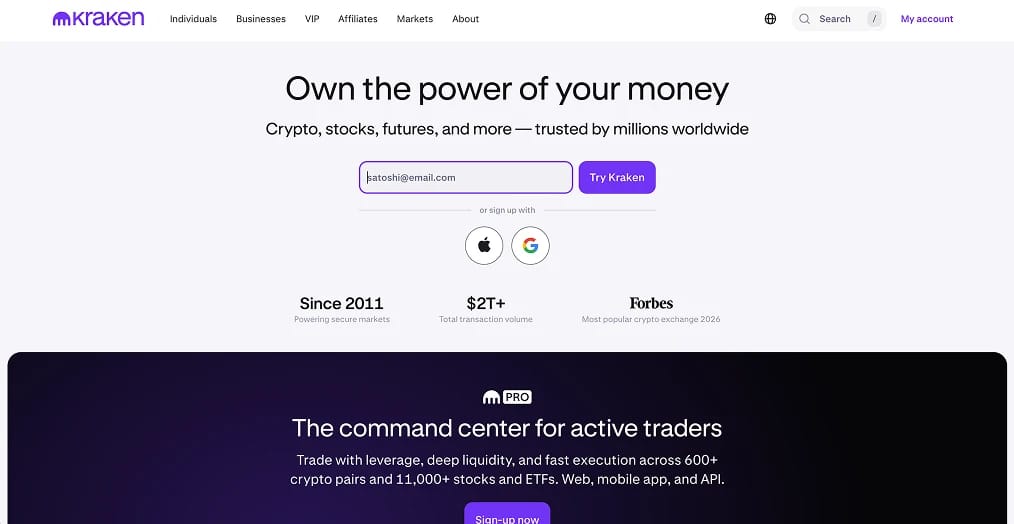
New users meet two front ends that share one account, one login, and the same pooled funds. Choosing the right one is the biggest factor in what you pay.
The standard Kraken app and website handle buying, selling, and converting in a few taps. The interface is clean and beginner-friendly, but instant trades carry a flat 1% fee plus a baked-in spread, making it an expensive home for frequent activity.
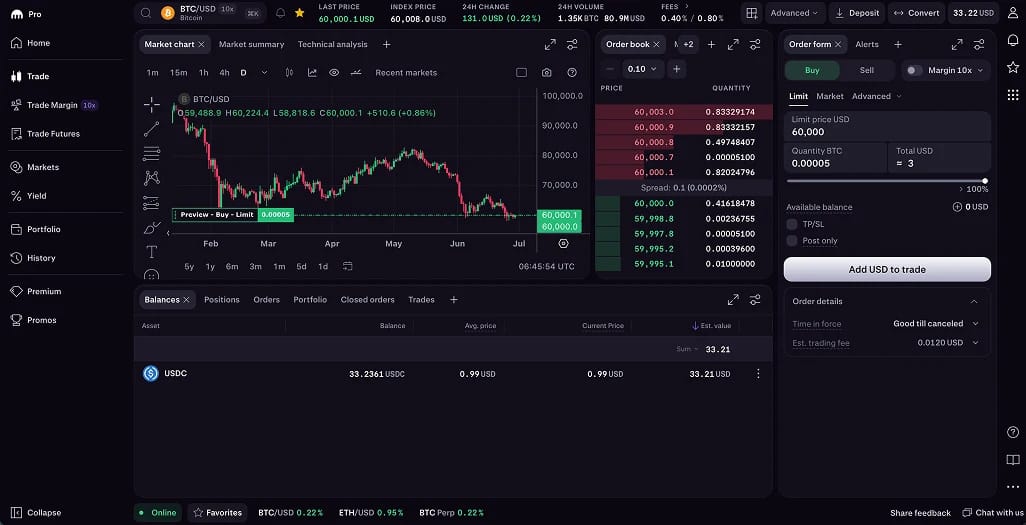
Kraken Pro, formerly Kraken Trade, is the advanced venue and costs nothing extra. It runs a volume-based maker-taker model and adds TradingView charting, deeper order books, and order types the simple app lacks, including limit, stop-loss, trailing-stop, and iceberg. Margin, futures, and API trading also live here.
Key differences between the two interfaces:
- Pricing model: Kraken charges around 1% on instant buys and sells, while Kraken Pro starts at 0.25% maker and 0.40% taker and falls with 30-day volume.
- Products: Standard Kraken covers spot buying and selling, whereas Kraken Pro adds margin, perpetual and dated futures, and advanced charting.
- Apps: Each has its own mobile app, and you can switch anytime without moving funds or opening a second account.
- Audience: The simple app suits first purchases and long-term holding, while Pro fits anyone placing limit orders or trading actively.
Whatever your experience level, the practical advice is the same. Use Pro and limit orders instead of the one-tap buy screen, and the cost of the same trade drops sharply. Kraken also offers Kraken Desktop, a standalone charting client, and the self-custodial Kraken Wallet for holding assets off the exchange.
Trading Products and Markets
Beneath the two interfaces sits a market set that has widened sharply over the past year.
- Spot trading: Kraken lists more than 400 cryptocurrencies across over a thousand pairs, with strong liquidity on majors and fiat on-ramps including USD, EUR, GBP, CAD, and AUD.
- On-chain trading: Since June, eligible clients in the US and 100+ countries can trade roughly 2,500 Solana tokens inside the Kraken app, with no separate wallet or seed phrase, many not yet on any centralised exchange.
- Margin trading: Verified clients can open leveraged spot positions of up to 5x against account collateral, with funding and rollover fees charged separately.
- Stocks and ETFs: US clients in supported states can buy real, commission-free shares and ETFs, separate from the tokenised xStocks below.
- Auto-Invest and Bundles: Recurring buys automate dollar-cost averaging, and pre-built baskets spread one purchase across a themed group of assets.
xStocks: Tokenised Stocks on Kraken
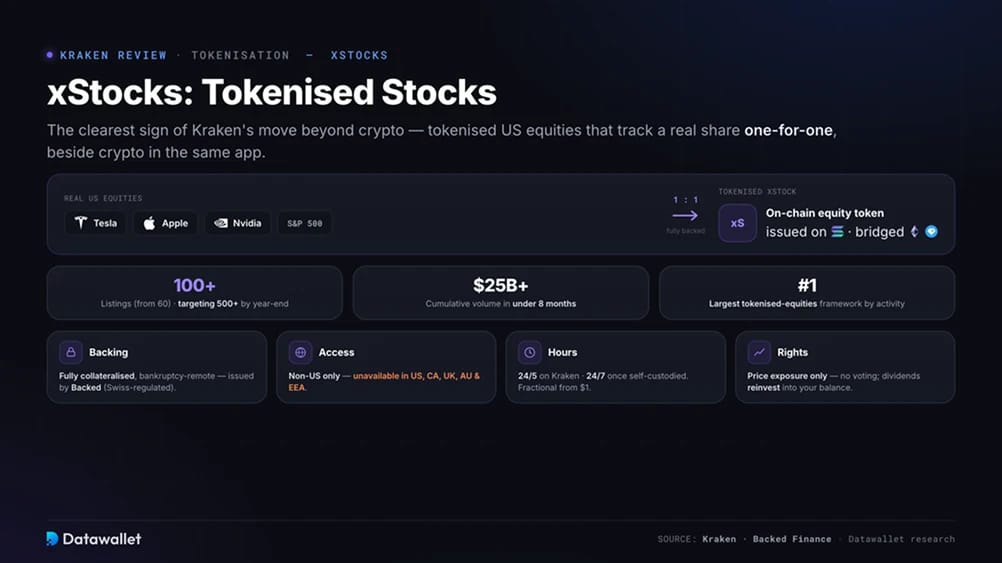
The clearest sign of Kraken's move beyond crypto is xStocks, its range of tokenised US equities. Each xStock tracks a real share or ETF one-for-one, issued on Solana and now bridged to Ethereum and TON.
The product launched in mid-2025 with 60 listings and has since passed 100, covering names like Tesla, Apple, Nvidia, and the S&P 500 tracker beside crypto in the same app. Kraken targets more than 500 listings by year-end, and cumulative volume across centralised and decentralised venues passed $25 billion in under eight months, making xStocks the largest tokenised-equities framework by holders and activity.
The mechanics differ from a traditional broker, and the trade-offs run both ways:
- Backing and issuer: Each token is fully collateralised by the underlying share, held by a licensed custodian in a bankruptcy-remote structure. Tokens are issued by Backed, the Swiss-regulated firm Kraken acquired, through Payward Digital Solutions under a Bermuda licence.
- Access: xStocks are open only to eligible non-US clients and unavailable in the US, Canada, UK, Australia, and the EEA.
- Trading hours: Tokens trade 24/5 on Kraken, with weekend trading in development, and 24/7 once withdrawn to a self-custodial wallet, so weekend earnings and overnight macro moves still price in.
- Cost and minimums: Buying with USDG or USD carries no trading fee, other assets attract standard instant-buy fees, and positions are fractional from $1.
- Rights and dividends: Holders get price exposure only, with no voting rights or claim on the company. Dividends reinvest automatically by raising your token balance instead of paying cash, and supported tokens earn up to 1% in rewards.
We rate xStocks the most credible on-chain equities product available today, though the synthetic structure and regional limits matter. Our guide to the best tokenised stock trading exchanges sets it against the alternatives.
Kraken Perpetual Futures and Derivatives
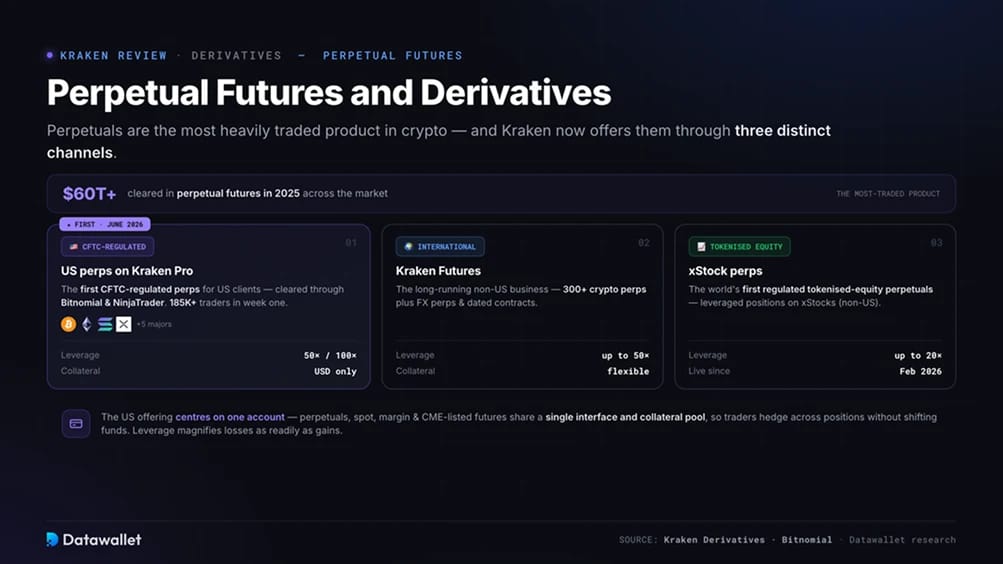
Perpetuals are the most heavily traded product in crypto, clearing more than $60 trillion in 2025, and Kraken now offers them through three channels.
The headline change is onshore access. In June, Kraken became the first platform to launch CFTC-regulated perpetual futures for US clients on Kraken Pro. The product rests on Bitnomial, which holds the exchange, clearing, and brokerage licences, with brokerage run by NinjaTrader Clearing as Kraken Derivatives US. It covers nine majors including BTC, ETH, SOL, and XRP, with USD-only collateral, up to 50x leverage for retail and 100x for institutions, and funding settled as a single daily cash adjustment. More than 185,000 derivatives traders registered in the first week.
Outside the US, the long-running Kraken Futures business offers over 300 crypto perpetuals plus FX perps and dated contracts, with up to 50x leverage and flexible collateral spanning crypto, stablecoins, and select fiat. A third strand, live since February, is the world's first regulated tokenised-equity perpetual futures, letting eligible non-US traders take leveraged positions on xStocks at up to 20x.
The US offering centres on one account. Perpetuals, spot, margin, and CME-listed futures share a single interface and collateral pool, so traders hedge across positions without shifting funds between venues. Compare the wider market in our roundup of the best crypto futures exchanges. Leverage magnifies losses as readily as gains, and funding can run high in trending markets.
Staking and Earning on Kraken
Kraken supports on-chain staking across more than 20 assets, with bonded staking that locks coins for an unbonding period and flexible options you can exit sooner. Commission runs up to 20% on flexible staking and the opt-in rewards programme, taken before rewards reach you, with bonded rates varying by asset.
Auto-Earn pays opt-in rewards on selected assets and stablecoins for holding them, and balances in Kraken's USDG stablecoin earn a variable yield that Kraken+ subscribers can boost. Note the regional gaps. Staking and rewards are closed to UK retail customers under FCA rules, and US staking was restructured after a 2023 SEC settlement before relaunching. Older articles quoting fixed Kraken staking APYs are often stale, so check the live rate in-app first.
Krak: Kraken's Global Money App
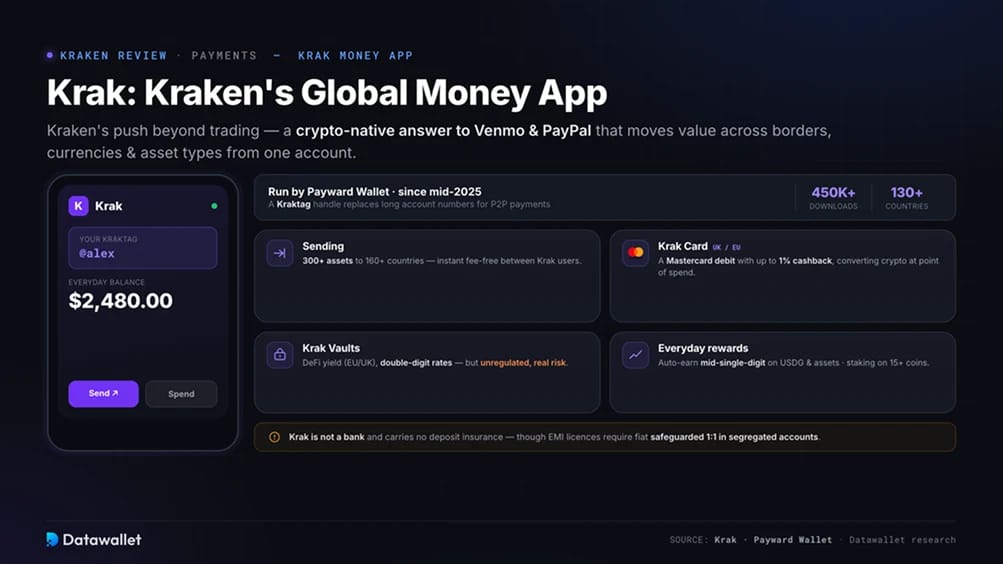
Krak is Kraken's push beyond trading into everyday money. Launched in mid-2025 and run by Payward Wallet, it pitches itself as a crypto-native answer to Venmo and PayPal, and passed 450,000 downloads across 130+ countries by late in the year.
The core idea is one account that moves value across borders, currencies, and asset types. Each user gets a Kraktag, a username-style handle that replaces long account numbers and wallet addresses for peer-to-peer payments.
Key features inside Krak:
- Sending money: Transfer 300+ fiat, stablecoin, and crypto assets to more than 160 countries, with instant fee-free transfers between Krak users and a conversion fee only when you switch assets before sending.
- Krak Card: A Mastercard debit card with up to 1% cashback, rolling out first across the UK and EU, that converts crypto to fiat at the point of spending. See how it compares in our guide to the best crypto debit cards.
- Krak Vaults: A higher-yield earn product built on audited DeFi protocols, offered in the EU and UK across tiered risk levels, with advertised rates reaching double digits. Vaults are unregulated, so the yield carries real risk.
- Everyday rewards: Auto-earn pays a variable yield on USDG and supported assets in the mid-single digits, and staking covers 15+ coins. See our overview of the best stablecoin interest rates.
Kraken has bigger plans, with salary deposits and named IBANs coming for UK and EU users. It stresses that Krak is not a bank and carries no deposit insurance, though its EMI licences require fiat to be safeguarded one-to-one in segregated accounts.
In testing, the split between the Krak "Everyday" balance and the main Kraken account caused the most confusion, so expect a short learning curve moving funds between the two.
Is Kraken Regulated?
Kraken's regulatory build-out has become a real differentiator, and the picture shifted materially this year.
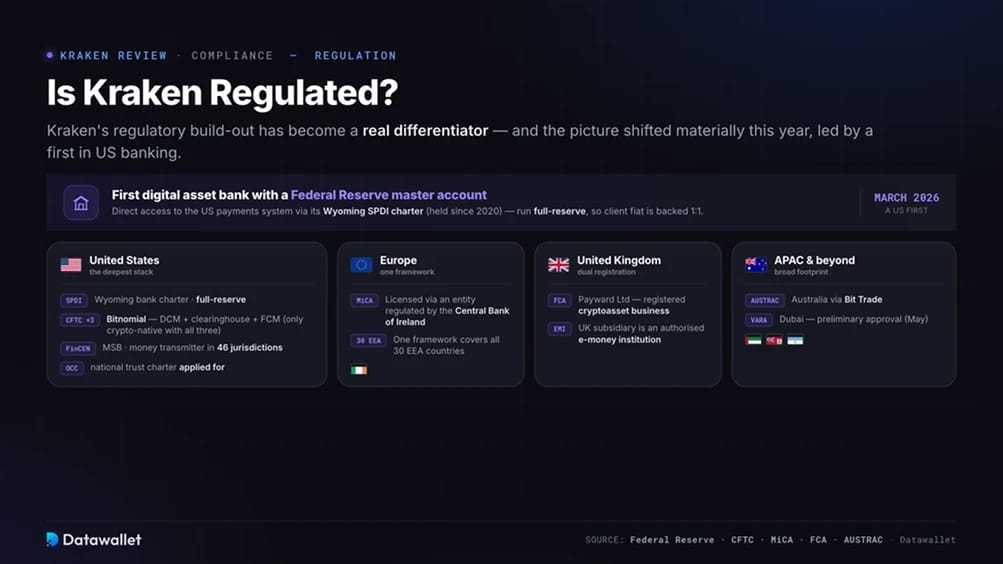
In March, Kraken Financial became the first digital asset bank to secure a Federal Reserve master account, gaining direct access to the US payments system through its Wyoming Special Purpose Depository Institution charter. That SPDI, held since 2020, runs on a full-reserve basis, so client fiat is backed one-to-one rather than lent out. Payward has since applied for an OCC national trust charter to add a federally regulated custody entity.
On derivatives, Bitnomial gives Kraken a Designated Contract Market, clearinghouse, and Futures Commission Merchant, the only crypto-native firm in the US with all three CFTC licences, plus a second FCM through NinjaTrader Clearing. Both fall under National Futures Association oversight.
Internationally, the footprint is just as broad:
- Europe: Kraken holds a MiCA licence via an entity regulated by the Central Bank of Ireland, covering all 30 EEA countries under one framework.
- United Kingdom: Payward Ltd is FCA-registered as a cryptoasset business, and its UK subsidiary is an authorised Electronic Money Institution.
- United States: Payward Interactive is a FinCEN-registered Money Services Business with money transmitter licences across 46 jurisdictions.
- Asia-Pacific and beyond: Australia runs through AUSTRAC-registered Bit Trade, Dubai granted preliminary VARA approval in May, and Kraken also holds registrations in Bermuda, the British Virgin Islands, and Argentina.
Is Kraken Safe?
Kraken's reputation was built on security, with the founders launching it after the Mt. Gox collapse on a defence-first approach. It keeps the large majority of funds in cold storage, enforces multi-factor authentication including FIDO2 hardware keys, supports withdrawal whitelisting and a global settings time lock, and offers no SMS recovery to blunt SIM-swap attacks.
Transparency is a further pillar. Kraken publishes Proof of Reserves audits verified by an independent firm, so clients can confirm it holds more assets than liabilities, and it carries ISO/IEC 27001 and SOC 2 certifications.
The record is strong but not spotless, and the gaps deserve naming:
- No major fund loss: Kraken has avoided a large-scale hack draining customer balances across its history, a rare record in this sector.
- 2023 bug: Researchers found a flaw allowing artificial balance inflation and roughly $3 million in withdrawals. Kraken patched it quickly and said no customer funds were lost.
- Regulatory settlements: Kraken settled with OFAC in 2022 over sanctions-related transactions and paid $30 million to the SEC in 2023 over its US staking programme, before the SEC dropped its broader case in March 2025.
- Insider incidents: Kraken disclosed that two support staff improperly accessed limited support data for around 2,000 accounts, or 0.02% of clients. A criminal group then attempted extortion, which Kraken refused, stressing that its core systems were never breached and funds never at risk.
The insider case shows that strong technical defences can still be tested through people rather than code. As with any exchange, the safest home for long-term holdings is one of the best crypto wallets you control, since exchange balances are not government-insured.
Kraken Fees Explained
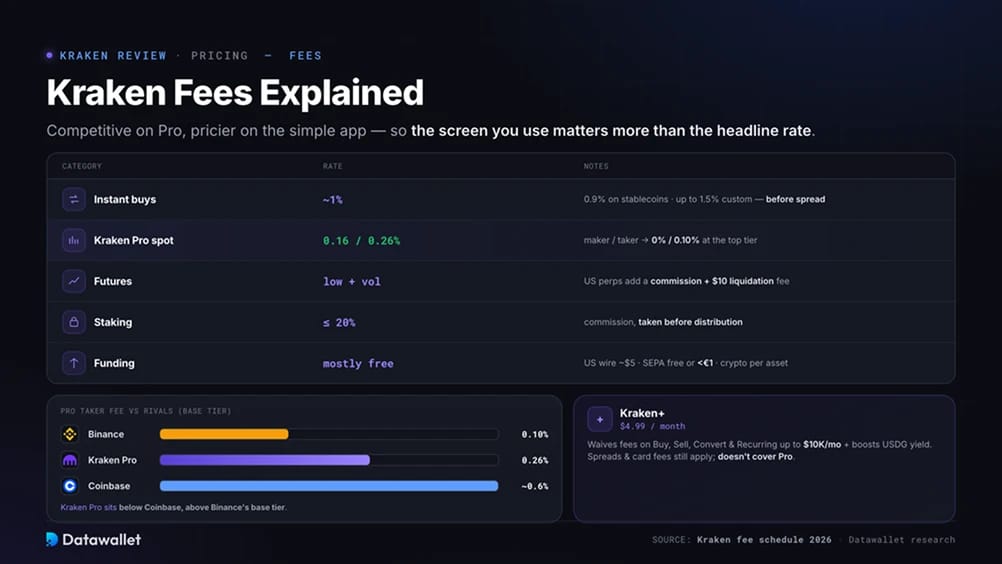
Kraken's pricing is competitive on Pro and pricier on the simple app, so the screen you use matters more than the headline rate.
- Instant buys: The standard Kraken app charges around 1% on crypto, 0.9% on stablecoins, and up to 1.5% on custom orders, all before spread and card or payment fees.
- Kraken Pro spot: Maker fees start at 0.25% and taker fees at 0.40%, falling toward 0% maker and 0.10% taker at the top tier, below Coinbase's standard rates and above Binance's base tier.
- Futures: International perpetual and dated contracts use low maker-taker rates that scale with volume, while US perpetuals on Bitnomial add their own commission plus liquidation fees from $10.
- Staking: Commission runs up to 20% on flexible staking and the rewards programme, taken before distribution.
- Funding: Most crypto deposits are free, US domestic wires cost around $5, and SEPA transfers are usually free or under €1, with crypto withdrawal fees set per asset.
- Kraken+: A $4.99 monthly subscription waives trading fees on Buy, Sell, Convert, and Recurring orders up to $10,000 a month in major currencies and boosts USDG yield, with a one-month free trial. Spreads and card fees still apply, and it does not cover Kraken Pro.
Active traders chasing the lowest costs can compare Kraken against the field in our guide to the best low-fee crypto exchanges.
Final Thoughts
Kraken has changed more in the past year than in the decade before it. The exchange that built its name on security and deep liquidity now clears regulated perpetuals onshore, runs the largest tokenised-equities framework, operates a chartered bank with direct Fed access, and ships a payments app aimed at neobanks. Few platforms match that breadth across spot, derivatives, equities, and staking under one regulated roof.
The trade-offs are real. The simple app overcharges anyone who skips Kraken Pro, several flagship products are walled off by region, staking is closed to UK retail, and the recent insider incident shows scale brings new attack surfaces. None of it is hidden, and Kraken's disclosure has been candid.
For a new user, we would open an account, verify, and trade on Kraken Pro with limit orders to dodge the instant-buy premium, then move long-term holdings into self-custody. Anyone choosing between the major US-regulated venues can weigh it in our Coinbase vs Kraken comparison, or see where it ranks among the best crypto exchanges in the USA.
.webp)