






Who Is Jesse Powell?
Jesse Powell is an American entrepreneur who co-founded Kraken in July 2011 with Thanh Luu and Michael Gronager, and later served as CEO for over a decade before handing the role to Dave Ripley in 2022. He remains chairman of the board and is widely reported as the company's largest individual shareholder.
Powell occupies an unusual position among exchange founders. He never courted celebrity the way CZ or Brian Armstrong did, yet his libertarian politics, his combative posts on X, and a 2022 internal culture fight made him one of the industry's most polarizing figures anyway.
His fortune is also among the hardest to measure in this series. Kraken has never gone public, Powell's exact stake has never been disclosed, and he holds Bitcoin that he began mining in 2011 that has never been mapped onchain. Every estimate we cite below is built on private valuation marks rather than a ticker.
.webp)
Jesse Powell's Background
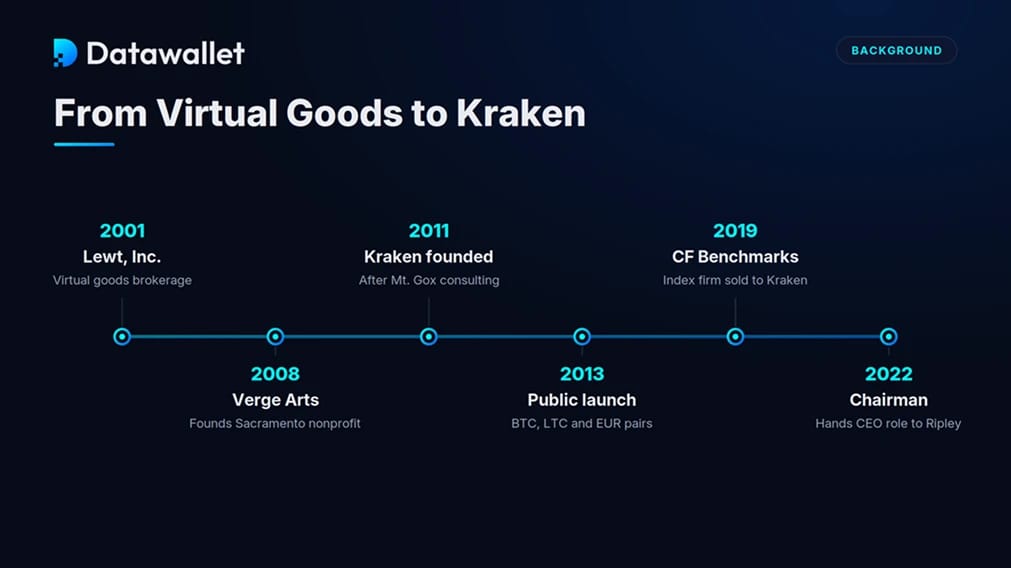
Powell's road to Kraken runs through virtual goods markets for online games, a Sacramento arts nonprofit, and a front-row seat at the most infamous exchange collapse in crypto history.
Early Life and Education
Powell grew up in Sacramento, California, and studied philosophy at California State University, Sacramento, concentrating on law and ethics. That combination shaped how he later argued with regulators, often framing enforcement actions as philosophical disputes about property and consent rather than compliance matters.
He was also a competitive Magic: The Gathering player, an early education in scarce digital-adjacent assets and secondary markets. In 2001, he founded Lewt, Inc., a brokerage for virtual currencies and items from online games, effectively trading digital assets seven years before Bitcoin existed.
Mt. Gox and the Case for Kraken
Powell started mining Bitcoin in 2011 and quickly became embedded in the early community. When Mt. Gox suffered its first major security breach that year, he flew to Tokyo to help the exchange recover, and what he saw convinced him the industry's largest venue was structurally unsound.
He began building an alternative that same year. Kraken was incorporated under parent company Payward in July 2011 and launched publicly in September 2013, initially offering Bitcoin, Litecoin, and euro pairs. When Mt. Gox finally collapsed in 2014, Kraken was appointed to assist with the bankruptcy claims process, a role that cemented its security-first reputation.
Outside crypto, Powell founded the Verge Center for the Arts in Sacramento in 2008 and later created CF Benchmarks, an FCA-regulated crypto index provider that Kraken acquired in 2019. Both would matter to his story in very different ways.
CEO Exit and the Chairman Era
Powell stepped down as CEO in September 2022, describing the job as draining after eleven years, and moved to chairman while COO Dave Ripley took over. The exit followed a bruising public fight over Kraken's libertarian "culture document," which offered four months of severance to employees who disagreed with it.
The chairman's years have been quieter but not passive. Powell stayed loud on policy, donated to pro-crypto candidates, and kept his board seat through Kraken's aggressive expansion into derivatives, tokenized equities, and its push toward the public markets.
Jesse Powell's Net Worth in 2026
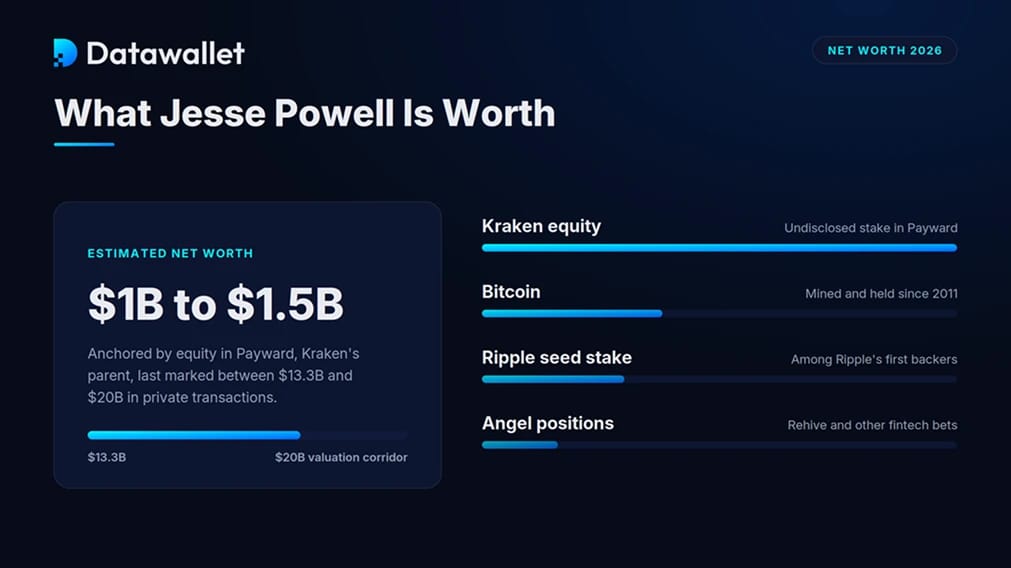
Jesse Powell's net worth in 2026 is estimated at between $1 billion and $1.5 billion, derived almost entirely from his undisclosed equity stake in Payward, Kraken's parent company. He has never appeared on the Forbes or Bloomberg billionaire lists, largely because his wealth sits in a private company and unmapped crypto holdings.
The estimate is built from four components:
- Kraken equity: Powell is reported as the largest individual shareholder in Payward, which raised $800 million at a $20 billion valuation in November 2025 with backing from Jane Street, Tribe Capital, and Citadel Securities.
- Early Bitcoin: He began mining BTC in 2011, when coins traded in the single digits, though he has never disclosed how much he still holds or where it sits.
- Ripple seed stake: Powell wrote one of the earliest checks into Ripple, an investment that appreciated enormously as XRP entered the top ranks of crypto assets.
- Angel positions: Smaller stakes in fintech firms, such as Rehive, round out a deliberately narrow portfolio, as listed on PitchBook and Crunchbase.
The honest answer is that nobody outside Kraken's cap table knows. What we can track is the valuation of the asset that dominates his balance sheet, and that number has been volatile.
How the IPO Changes the Math
Kraken's private marks swung hard through 2026. The $20 billion valuation from November 2025 gave way to an implied $13.3 billion in April 2026, when Deutsche Börse bought a 1.5% stake through a secondary sale during a broader crypto downturn.
By May, Payward was reportedly seeking fresh capital at $20 billion again. Until shares trade publicly, Powell's fortune moves inside that $13 billion to $20 billion corridor, multiplied by a stake percentage only he and the company know.
We estimated Jesse Powell’s net worth by using Payward's reported private valuation range of $13.3 billion to $20 billion, applying a conservative assumed founder-shareholder stake range, then adding disclosed or reported non-Kraken assets where available. Because Powell’s exact stake and crypto wallets are not public, this is an estimate, not a verified net worth figure.
Jesse Powell's Investment Portfolio
Powell invests nothing like the high volume founders we cover elsewhere. Where CZ built a sprawling venture empire through Binance Labs and YZi Labs, Powell has kept his disclosed portfolio to a handful of positions across two decades.
His verified holdings and investments include:
- Payward (Kraken): The core asset. Kraken generated $1.5 billion in revenue in 2024 and posted a record $648 million in Q3 2025 alone, with $59.3 billion in platform assets.
- Ripple: A seed-stage investment in the payments company behind XRP, made in Ripple's earliest funding round and never publicly sold down.
- Rehive: A white-label fintech platform that lets businesses launch their own financial apps, one of his few disclosed angel checks.
- CF Benchmarks: The regulated index provider he founded in 2018 was sold to Kraken in 2019 and is now powering reference rates for major crypto derivatives and ETFs.
- Bitcoin and Ethereum: Undisclosed personal holdings dating to 2011, plus the ETH he visibly controlled when he donated $1 million, mostly in Ether, to Donald Trump's campaign in June 2024.
The pattern is concentration. Powell has spent fifteen years betting on one company and the assets it trades, and the coming IPO will reveal how large that single bet became.
Why Did the FBI Raid Jesse Powell?
For two years, the biggest overhang on Powell's reputation had nothing to do with crypto. In March 2023, FBI agents raided his Los Angeles home and seized dozens of devices over allegations he had hacked and cyberstalked the Verge Center for the Arts, the nonprofit he founded and funded, after its board removed him in 2022.
The case ended without a single charge. In July 2025, court filings revealed the Justice Department had dropped the investigation entirely, issued a formal declination letter to Powell's lawyers in April, and returned every seized phone and laptop.
Powell called the raid devastating and has continued a civil suit against Verge board members, alleging they conspired to remove him and defamed him in the process. The closure mattered commercially as well as personally, clearing a legal cloud from Kraken's public-listing preparations at exactly the right moment.
What Is Powering Jesse Powell's Wealth in 2026?
Everything now points to one event. Payward confidentially filed its S-1 with the SEC in November 2025, paused the listing in March 2026 when Bitcoin fell roughly 40% from its October record, then confirmed the filing publicly in April. Co-CEO Arjun Sethi has since said the company is about 80% ready to list, with reporting pointing at the second half of 2026.
The business Powell would be taking public looks very different from the exchange he ran. The $1.5 billion NinjaTrader acquisition pushed Kraken deep into US futures, tokenized stocks trade under its xStocks banner, and the SEC dismissed its lawsuit against the exchange with prejudice in March 2025.
Key catalysts shaping Powell's net worth this year include:
- The IPO itself: A listing anywhere near the $20 billion private mark would convert Powell's paper stake into priced, partially liquid wealth for the first time since 2011.
- Valuation recovery: The gap between the $13.3 billion Deutsche Börse mark and the $20 billion raise target is the single widest swing factor in any estimate of his fortune.
- Revenue diversification: Derivatives, payments, and equities revenue reduces Kraken's dependence on spot trading fees, the metric public investors punished Coinbase for in past cycles.
- Regulatory clearing: With the SEC case dismissed and the DOJ probe closed, Powell enters the listing window with no active US enforcement or criminal matters attached to his name.
- Crypto prices: Exchange valuations track volumes, and volumes track the market. A deeper 2026 downturn would compress both Kraken's multiple and Powell's net worth with it.
Final Thoughts
Jesse Powell's net worth is a fifteen-year position in a single private company, plus Bitcoin nobody can count. The $1 billion to $1.5 billion range is defensible on the current private marks, but it is an inference, and Powell has never confirmed or corrected it.
That makes him different from the founders around him on our list. Brian Armstrong's wealth is repriced every trading day through COIN, while Powell's has stayed frozen at venture-round valuations since 2011. Few billion-dollar crypto fortunes have gone this long without a public number.
The 2026 IPO is the moment that changes. If Payward lists near its $20 billion target, Powell's stake gets a price, a float, and a place on the wealth rankings that have ignored him for a decade. If markets stay weak and the listing slips again, his fortune stays where it has always lived, on a private cap table only he can see.
.webp)