
Which Countries Does Kraken Restrict?
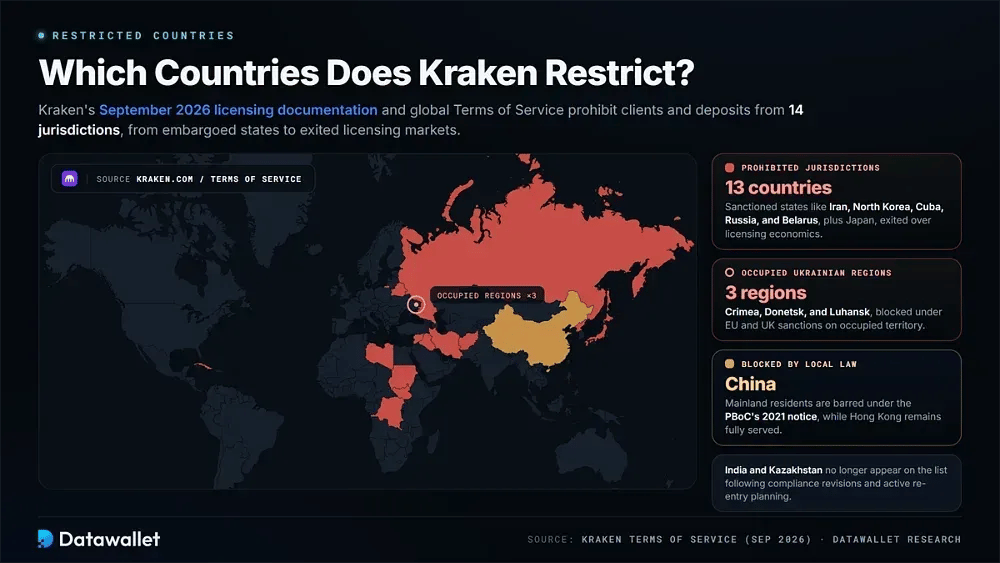
According to its September 2026 licensing documentation and official global Terms of Service, Kraken currently prohibits clients and deposits from 14 jurisdictions. India and Kazakhstan no longer appear on the list after recent compliance revisions and active market re-entry planning.
Kraken Restricted Countries List in 2026
Every prohibited jurisdiction is organized below by geographic region, following the exchange's current onboarding and deposit policies.
Why Does Kraken Restrict These Countries?
Kraken's geographic restrictions reflect overlapping requirements from sanctions authorities, financial intelligence units, and licensing regulators. Complying with those rules also protects the exchange's banking relationships and pending public listing from the legal exposure associated with servicing high-risk regions.
1. Compliance with International Sanctions
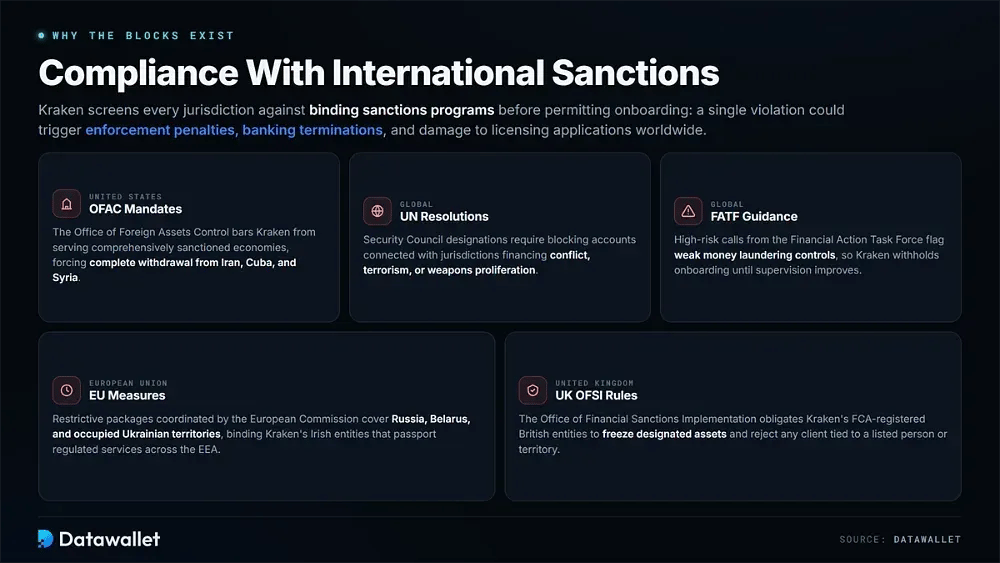
Before allowing onboarding, the exchange screens each jurisdiction against binding sanctions programs. A single violation could bring enforcement penalties or banking terminations and cause lasting damage to licensing applications Kraken maintains around the world.
Key sanctions frameworks shaping Kraken's prohibited regions policy include:
- OFAC Mandates: Directives from the Office of Foreign Assets Control prevent Kraken from serving comprehensively sanctioned economies. As a result, it must withdraw entirely from embargoed markets including Iran, Cuba, and Syria.
- UN Resolutions: Security Council designations from the United Nations require the exchange to block accounts linked to jurisdictions financing conflict, terrorism, or weapons proliferation across its global operations.
- FATF Guidance: High-risk jurisdiction calls from the Financial Action Task Force identify countries with weak money laundering controls. Kraken may withhold onboarding until supervision standards demonstrably improve.
- EU Measures: Restrictive packages coordinated by the European Commission apply to Russia, Belarus, and occupied Ukrainian territories. These measures bind Kraken's Irish entities, which passport regulated services throughout the European Economic Area.
- UK OFSI Rules: The Office of Financial Sanctions Implementation requires Kraken's FCA-registered British entities to freeze designated assets and reject clients tied to listed persons or territories.
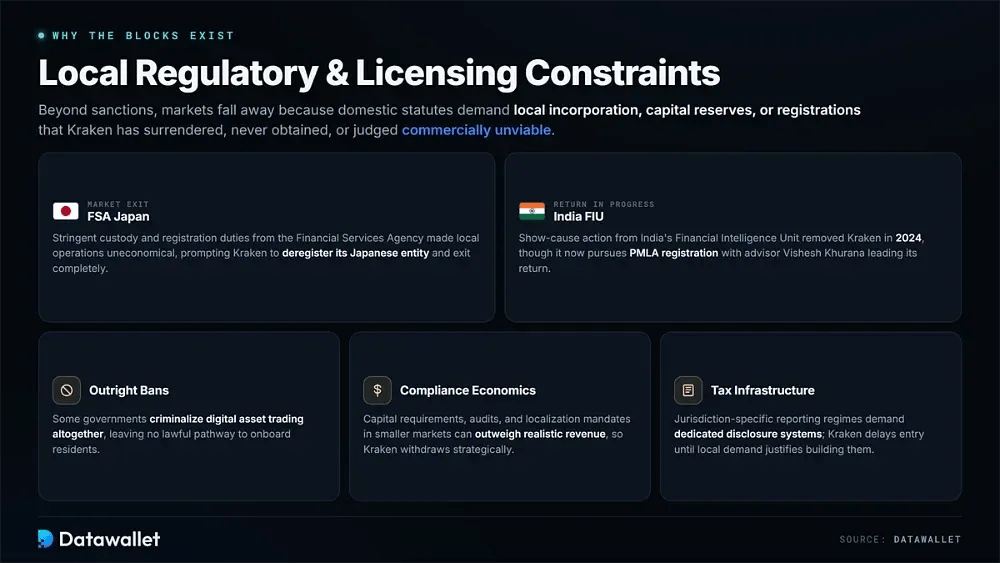
2. Local Regulatory and Licensing Constraints
Sanctions are not the only reason certain markets are unavailable. Domestic laws may require local incorporation, capital reserves, or registrations that Kraken has surrendered, never obtained, or decided are commercially unviable for the size of the addressable market.
Local legal factors that currently determine where Kraken can operate:
- FSA Japan: Stringent custody and registration duties enforced by the Financial Services Agency made local operations uneconomical. Kraken subsequently deregistered its Japanese entity and exited the market completely.
- India FIU: Show-cause action from India's Financial Intelligence Unit removed Kraken in 2024. The exchange is now pursuing PMLA registration and has appointed advisor Vishesh Khurana to lead its return.
- Outright Bans: Some governments criminalize digital asset trading altogether. In those jurisdictions, Kraken has no lawful route to onboard residents, regardless of the strength of its internal compliance program.
- Compliance Economics: In smaller markets, capital requirements, audits, and localization mandates can cost more than realistic revenue supports. Kraken may therefore withdraw rather than operate at a persistent regulatory loss.
- Tax Infrastructure: Jurisdiction-specific reporting regimes require dedicated transaction disclosure systems. Entry can be delayed where local user demand does not yet justify building that infrastructure.
Which US States Does Kraken Restrict?
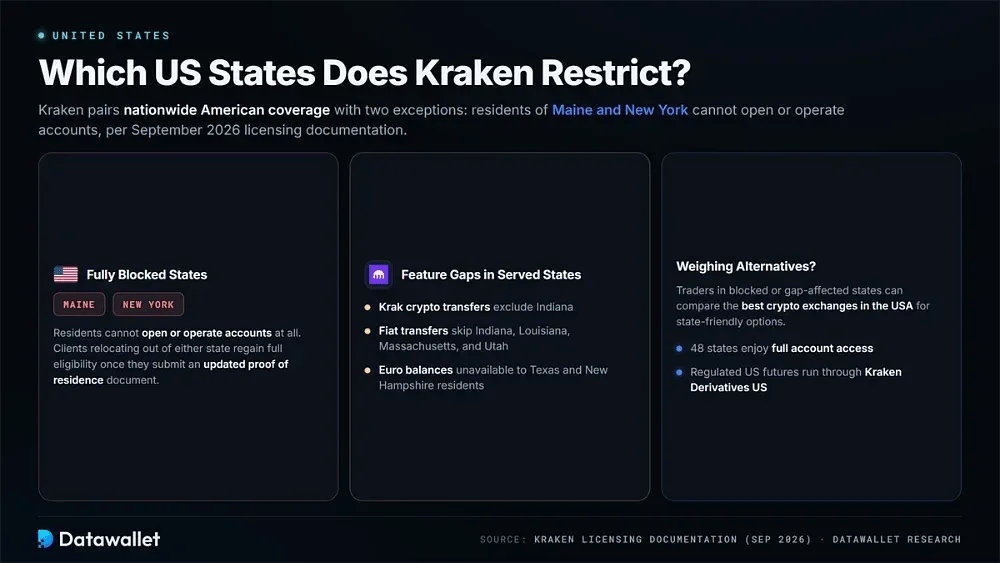
Kraken offers nationwide American coverage with two notable exceptions. Residents of Maine and New York cannot open or operate accounts, according to the platform's September 2026 licensing documentation. Clients who relocate out of those states regain full eligibility after submitting updated proof of residence.
More limited feature restrictions also apply in states Kraken otherwise serves. Krak crypto transfers exclude Indiana, while fiat transfers are unavailable in Indiana, Louisiana, Massachusetts, and Utah. Residents of Texas and New Hampshire cannot hold euros. Traders comparing alternatives can review the best crypto exchanges in the USA for state-friendly options.
Kraken Supported Countries
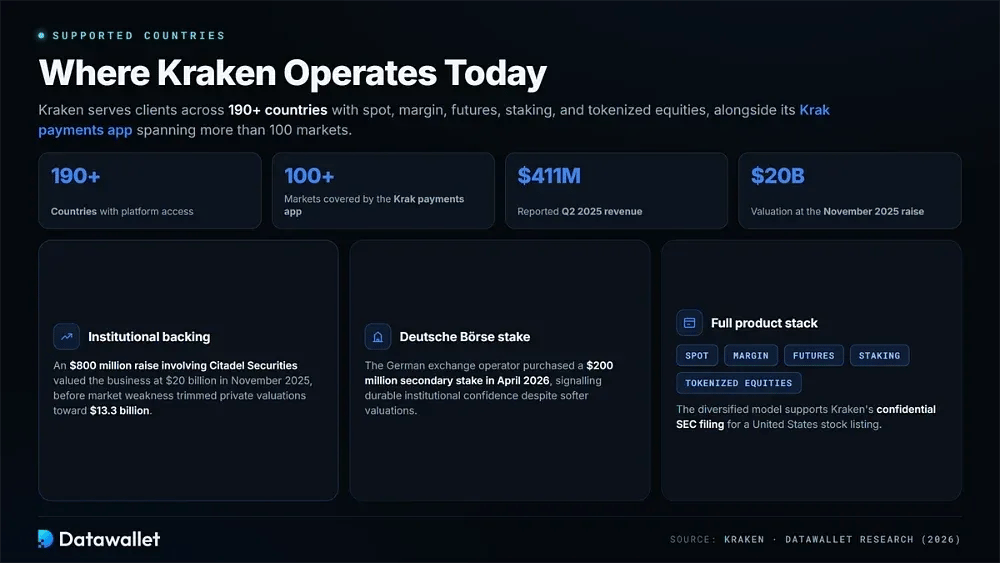
Kraken serves clients in 190+ countries through spot, margin, futures, staking, and tokenized equities. Its Krak payments app extends across more than 100 markets. Reported revenue of $411 million in Q2 2025 highlights the diversified model behind its confidential SEC filing for a United States stock listing.
Institutional demand rose after November 2025. An $800 million raise involving Citadel Securities valued the business at $20 billion. Market weakness later reduced private valuations toward $13.3 billion, but Deutsche Börse still acquired a $200 million secondary stake in April 2026, signalling durable confidence.
Is Kraken Available in China?
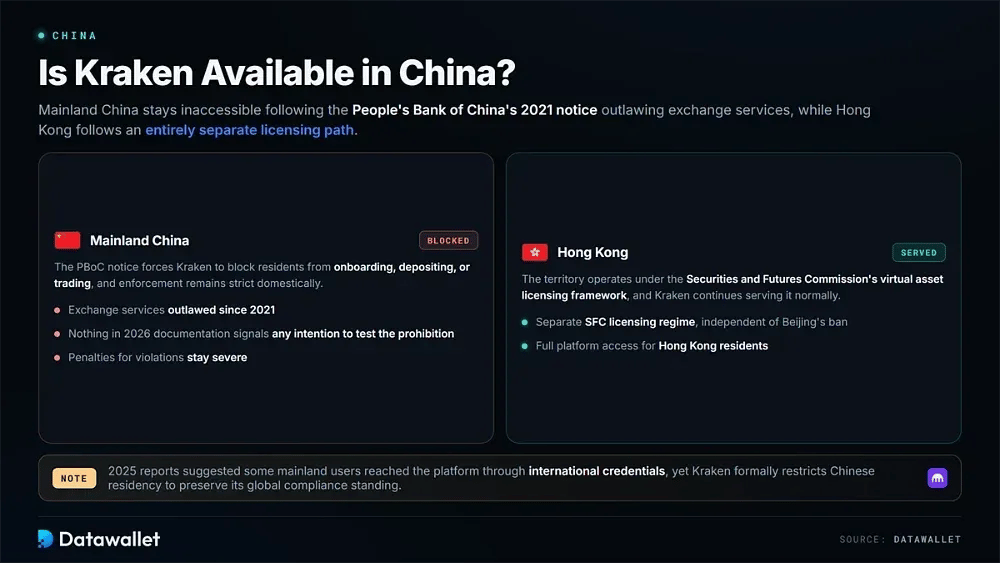
Mainland China remains inaccessible after the People's Bank of China's 2021 notice outlawing exchange services. Kraken must therefore block residents from onboarding, depositing, or trading. Domestic enforcement remains strict, and nothing in the platform's 2026 documentation indicates any intention to test that prohibition while penalties remain severe.
Hong Kong operates under a separate system governed by the Securities and Futures Commission's virtual asset licensing framework, and Kraken continues to serve the territory normally. Reports from 2025 indicated that some mainland users reached the platform with international credentials. Kraken nevertheless formally restricts Chinese residency to preserve its global compliance standing.
What Currencies Does Kraken Support?
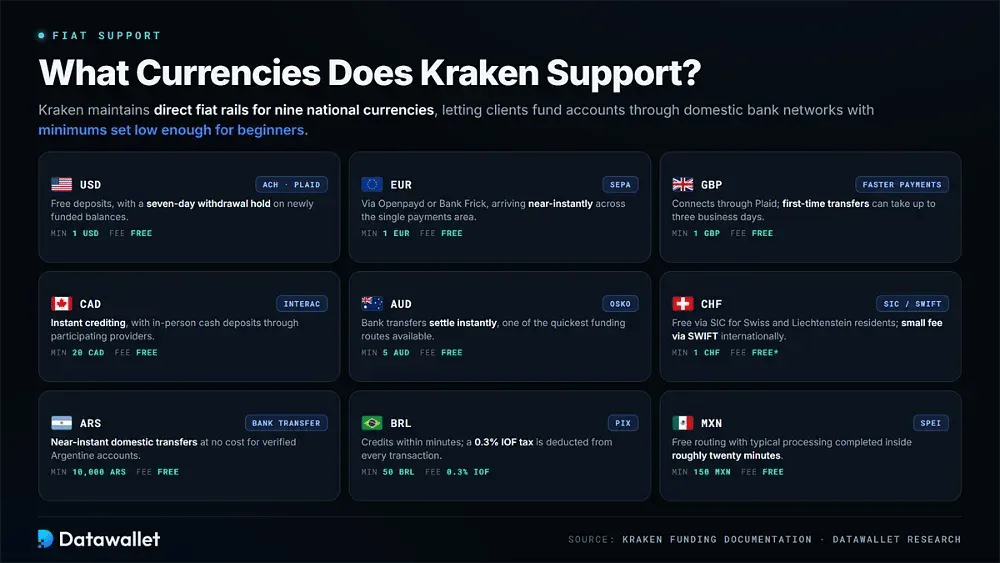
Kraken provides direct fiat rails for nine national currencies. Clients can fund accounts through domestic banking networks instead of relying on costly international wires, and minimum deposits remain low enough for beginners testing the platform cautiously.
Primary fiat currencies and their funding terms on Kraken today:
- USD (US Dollar): American clients can deposit through ACH via Plaid with a 1 USD minimum and free processing. Newly funded balances are subject to a seven-day withdrawal hold.
- EUR (Euro): SEPA transfers through Openpayd or Bank Frick arrive near-instantly, carry no fees, and have a 1 EUR minimum across the entire single payments area.
- GBP (Pound Sterling): Faster Payments deposits connect through Plaid with no charges and a 1 GBP minimum. First-time transfers can take as long as three business days.
- CAD (Canadian Dollar): Interac e-Transfer funding is free, requires a 20 CAD minimum, and credits instantly. Participating providers also support in-person cash deposits as an alternative.
- AUD (Australian Dollar): Osko bank transfers settle instantly with a 5 AUD minimum and zero cost, making them one of the quickest funding routes available to Australian traders.
- CHF (Swiss Franc): Residents of Switzerland and Liechtenstein can use the SIC network free of charge. International clients fund through SWIFT for a small fee with a 1 CHF minimum.
- ARS (Argentine Peso): Verified Argentine accounts use near-instant domestic bank transfers at no cost. Each standard deposit is subject to a 10,000 ARS minimum.
- BRL (Brazilian Real): Brazil's PIX network credits deposits within minutes with a 50 BRL minimum. A 0.3% IOF tax is deducted automatically from every individual transaction.
- MXN (Mexican Peso): Mexican clients fund accounts through SPEI free of charge with a 150 MXN minimum. Processing typically finishes within roughly twenty minutes.
Kraken Feature Availability by Region
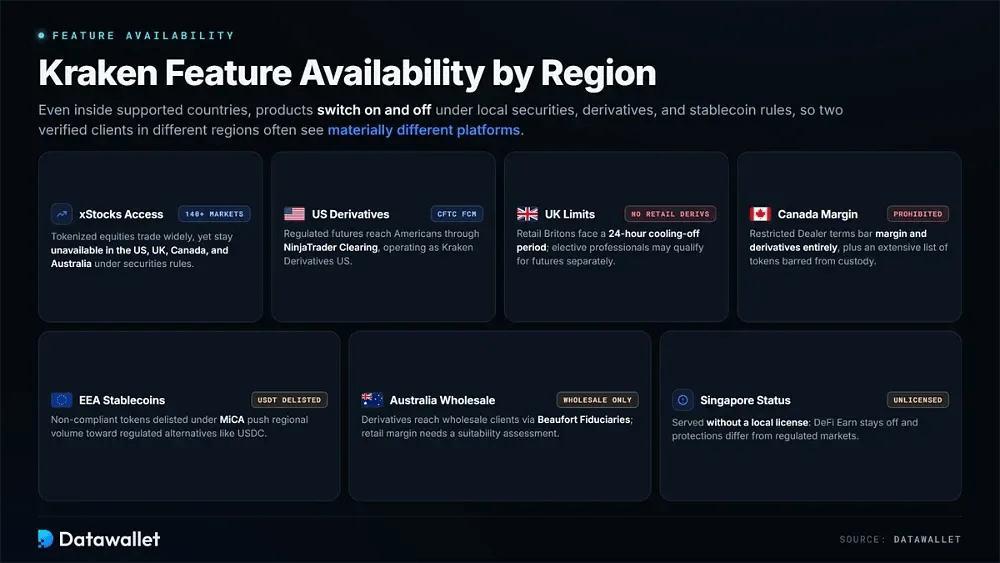
Supported countries do not all receive the same Kraken products. Local securities, derivatives, and stablecoin rules determine which features are enabled, meaning two verified clients in different regions can see materially different versions of the platform.
Regional product differences every prospective Kraken client should verify first:
- xStocks Access: Tokenized equities are available across 140+ eligible markets. Securities rules keep them unavailable to clients in the United States, United Kingdom, Canada, and Australia.
- US Derivatives: American traders receive regulated futures through NinjaTrader Clearing, operating as Kraken Derivatives US, a CFTC-registered Futures Commission Merchant and National Futures Association member.
- UK Limits: Retail Britons cannot trade derivatives and must complete a 24-hour cooling-off period after verification. Elective professional clients may separately qualify for futures access.
- Canada Margin: Canadian accounts operate under Restricted Dealer terms that prohibit margin and derivatives trading entirely. Local custody is also unavailable for an extensive list of tokens.
- EEA Stablecoins: European clients cannot deposit or trade USDT and other non-compliant tokens delisted under MiCA. Regional volume is instead pushed toward regulated alternatives such as USDC.
- Australia Wholesale: Derivatives are available only to wholesale Australian clients through licensed broker Beaufort Fiduciaries. Retail margin access requires users to pass a product suitability assessment first.
- Singapore Status: Kraken serves Singapore without a local license. Products such as DeFi Earn therefore remain disabled, and client protections differ from those in regulated markets.
Kraken Regulation and Licenses
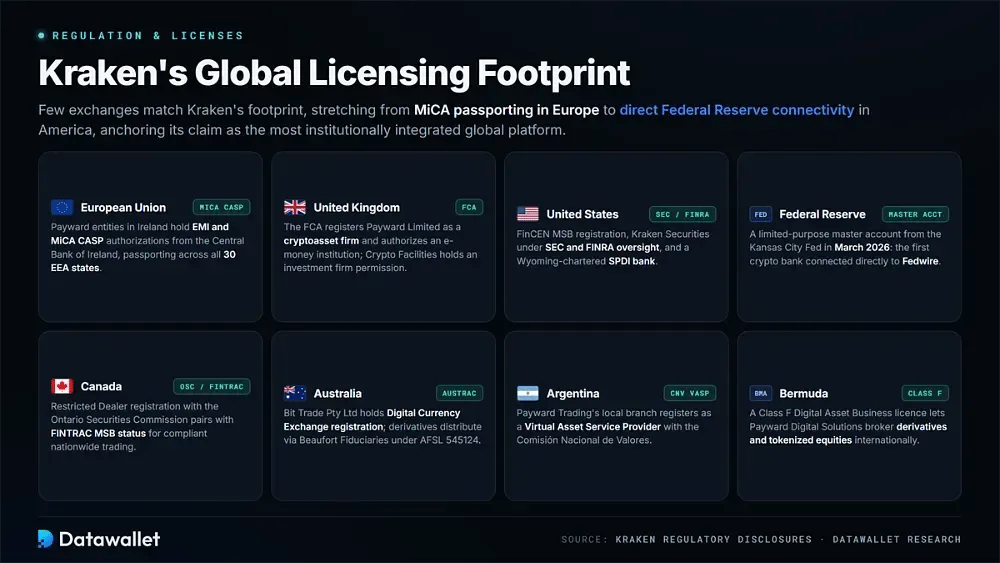
Kraken's licensing footprint now extends from MiCA passporting in Europe to direct Federal Reserve connectivity in America. Few exchanges match that breadth, which anchors its claim as the most institutionally integrated global crypto platform.
Principal registrations and supervised entities across Kraken's major operating regions:
- European Union: Payward entities in Ireland hold EMI and MiCA CASP authorizations from the Central Bank of Ireland, allowing regulated crypto services to be passported across all 30 EEA member states.
- United Kingdom: The Financial Conduct Authority registers Payward Limited as a cryptoasset firm and authorizes an e-money institution. Crypto Facilities holds a separate investment firm permission.
- United States: Payward Interactive maintains FinCEN MSB registration. Kraken Securities operates under SEC and FINRA oversight, while Kraken Financial runs a Wyoming-chartered SPDI bank.
- Federal Reserve: In March 2026, Kraken Financial obtained a limited-purpose master account from the Kansas City Fed, becoming the first crypto bank connected directly to Fedwire.
- Canada: Restricted Dealer registration with the Ontario Securities Commission, together with FINTRAC MSB status, permits compliant nationwide trading under provincial securities regimes.
- Australia: Bit Trade Pty Ltd holds AUSTRAC Digital Currency Exchange registration. Derivatives are distributed through Beaufort Fiduciaries under Australian Financial Services Licence number 545124.
- Argentina: Payward Trading's local branch is registered as a Virtual Asset Service Provider with the Comisión Nacional de Valores, covering regulated custody and exchange services for Argentine residents.
- Bermuda: Payward Digital Solutions holds a Class F Digital Asset Business licence from the Bermuda Monetary Authority, allowing it to broker derivatives and tokenized equities for international clients.
Does Kraken Require KYC?
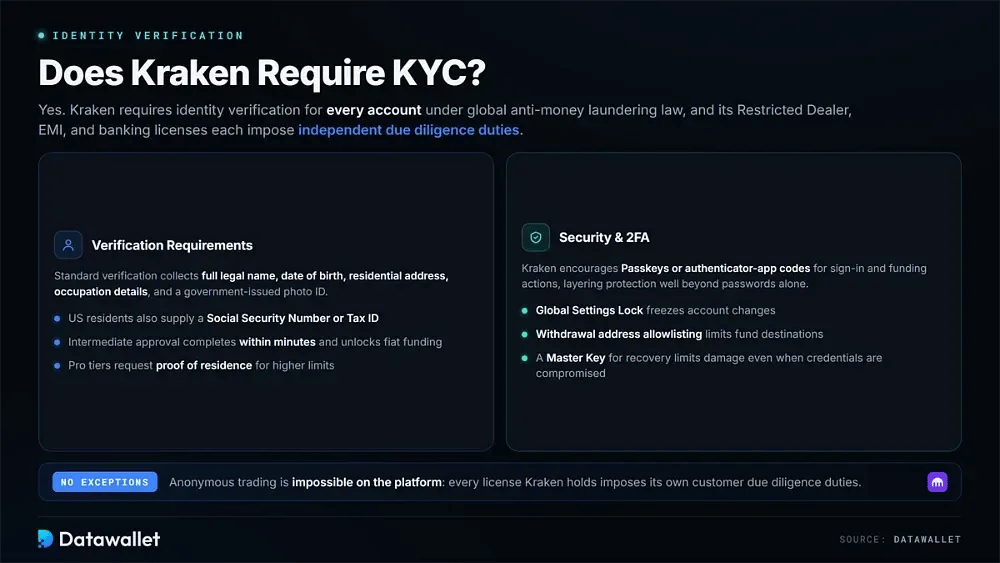
Yes. Kraken requires identity verification for every account under global anti-money laundering law. Its Restricted Dealer, EMI, and banking licenses also impose separate customer due diligence obligations, making anonymous trading impossible on the platform.
1. Verification Requirements
Standard verification requires a full legal name, date of birth, residential address, occupation details, and a government-issued photo ID. US residents must also provide a Social Security Number or Tax ID. Intermediate approval usually completes within minutes and enables fiat funding, while Pro tiers require proof of residence documents for higher limits.
2. Security and 2FA
Kraken recommends Passkeys or authenticator-app codes for sign-in and funding actions, adding protection beyond passwords. A Global Settings Lock can freeze account changes, withdrawal address allowlisting limits permitted destinations, and a Master Key supports recovery. Together, these controls reduce potential damage even if login credentials are fully compromised.
Can Kraken be Accessed Via VPN?
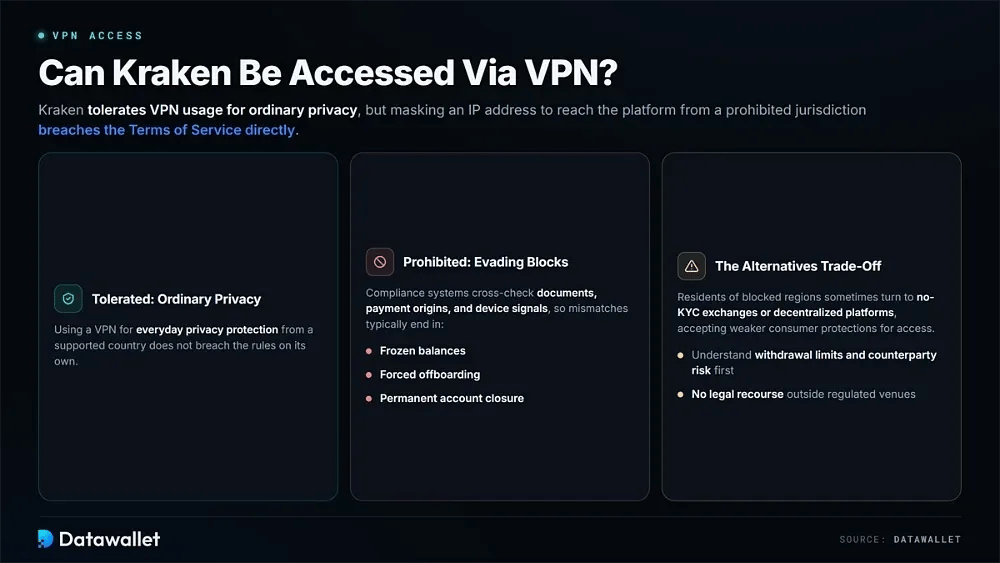
Kraken permits VPN use for ordinary privacy purposes. Using one to disguise an IP address and access the platform from a prohibited jurisdiction, however, directly violates the Terms of Service. Its compliance systems compare documents with payment origins and device signals, so mismatches commonly result in frozen balances, forced offboarding, or permanent account closure.
Some residents of blocked regions use no-KYC exchanges or decentralized platforms instead, trading stronger consumer protections for access. Anyone considering that route should understand withdrawal limits and counterparty risk, as well as the lack of legal recourse, before moving meaningful capital outside regulated venues.
About Kraken
Founded in 2011 by Jesse Powell and headquartered in the United States, Kraken is among the longest-operating exchanges. It also pioneered cryptographic Proof of Reserves audits that verify client holdings. Co-CEOs Arjun Sethi and David Ripley now lead a strategy centered on combining traditional finance with crypto rails.
That pivot accelerated through acquisitions. The $1.5 billion NinjaTrader purchase in March 2025 brought CFTC-regulated futures to American clients, and the Breakout deal added proprietary trading funding. Kraken later introduced the xStocks program, listing tokenized equities across 140+ markets and even distributing exposure to the SpaceX IPO.
Kraken confidentially filed for a US listing with the SEC in November 2025. Months afterward, it became the first crypto firm with direct Federal Reserve payment access. Those milestones reinforce why its country policies remain conservative: regulatory credibility now underpins the business as it heads toward public markets.
Final Thoughts
Kraken maintains a short, transparent restricted list driven almost entirely by sanctions law rather than commercial caution. The exchange remains legally available across the overwhelming majority of the world, while its licensing depth, banking integration, and pending listing support confidence that regional rules will remain predictable over the long term.
Before registering, users should confirm which products are actually available in their jurisdiction. Derivatives, margin, staking rewards, and tokenized equities vary substantially by country. Reading our full Kraken review together with the platform's own regional documentation is the fastest way to determine exactly what a verified account unlocks.