






Profitable positions can disappear without warning during severe market swings. Auto-Deleveraging rules allow exchanges to close winning accounts when insurance funds fail, protecting platform stability during periods of extreme and unpredictable volatility.
Avoiding that outcome requires understanding how modern derivative platforms handle forced settlements and rank accounts for deleveraging. Knowing these mechanics is essential if you want to keep profits protected when markets come under systemic stress.
Discover how to protect your trades from these automated liquidations. 👇
What is Auto-Deleveraging (ADL)?
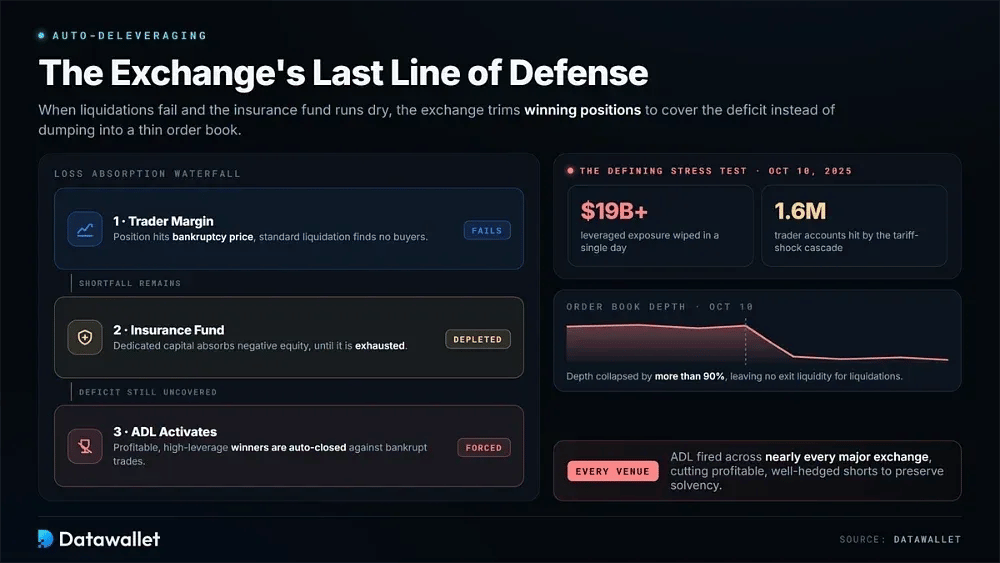
Auto-Deleveraging (ADL) is an exchange-level risk mechanism used in leveraged futures. When liquidations create a shortfall because the bankruptcy price cannot cover losses and the insurance fund is unable to absorb them, the exchange automatically reduces positions held by traders on the opposing side.
Instead of forcing disorderly market sells into a thin order book, ADL closes positions on the winning side to offset the deficit. Exchanges typically rank traders using a score that combines unrealized profit with leverage, placing higher-ranked accounts first in line for reductions.
The defining example occurred on October 10, 2025. A tariff shock wiped out more than $19 billion of leveraged exposure across roughly 1.6 million accounts in a single day. Order book depth fell by more than 90%, and ADL activated across nearly every major venue, cutting profitable, well-hedged shorts to preserve solvency.
How Does ADL Work in Crypto?
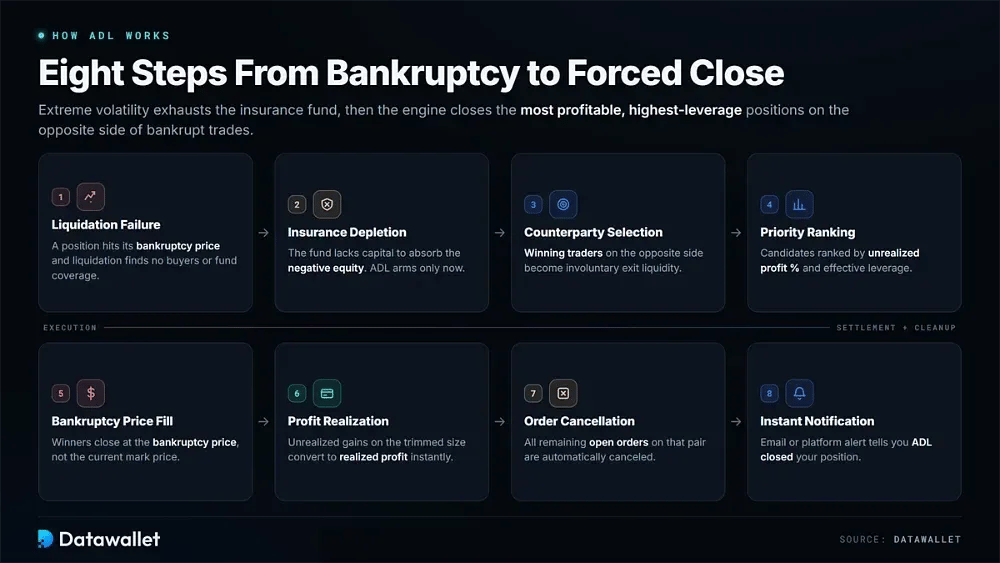
The auto-deleveraging process begins when extreme market volatility exhausts insurance funds. Exchanges then automatically close the most profitable, high-leverage positions on the opposite side of bankrupt trades.
This complex mechanism follows a specific multi-step operational sequence:
- Liquidation Failure: The process starts when a position reaches its bankruptcy price and standard liquidation cannot find buyers or sufficient insurance fund coverage.
- Insurance Depletion: ADL activates only when the platform's dedicated insurance fund does not have enough capital to absorb negative equity from bankrupt traders.
- Counterparty Selection: Winning traders on the opposite side of the liquidated position are automatically identified to provide involuntary exit liquidity.
- Priority Ranking: Candidates are ranked according to their unrealized profit percentages and the effective leverage currently applied to their positions.
- Bankruptcy Price Execution: Selected winning positions are closed at the bankrupt account's bankruptcy price rather than the current mark price.
- Unsettled Profit Realization: When ADL partially closes an active position, the affected trader's unrealized gains are immediately converted into realized profits.
- Order Cancellation: After a trader is selected for deleveraging, all remaining open orders for that specific pair are automatically canceled.
- Automated Notification: Exchanges send immediate email or platform notifications informing selected users that ADL closed their positions.
How ADL Changed After the October 2025 Crash
The October cascade pushed deleveraging from a relatively obscure mechanism into an industry-wide crisis. Reforms introduced afterward are changing how major venues manage forced closures under extreme market stress.
These are the biggest structural shifts traders should understand in 2026:
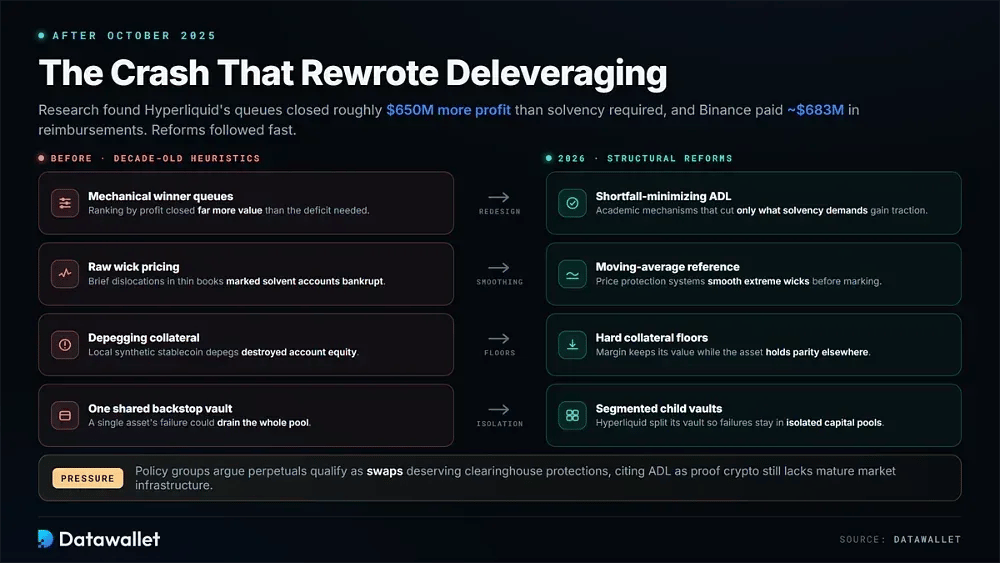
- Algorithm Scrutiny: Research published on arXiv found that production queues on Hyperliquid closed roughly $650 million more profit than solvency required, exposing decade-old heuristics.
- Compensation Precedents: Binance paid approximately $683 million through reimbursement programs after collateral mispricing intensified liquidations, creating accountability expectations that derivatives platforms had not previously faced.
- Reference Pricing: New moving-average price protection systems smooth extreme wicks, reducing the risk that brief dislocations in thin order books mark solvent accounts into bankruptcy.
- Collateral Floors: Hard price floors applied to synthetic stablecoins used as margin prevent localized depegs from destroying account equity while the asset continues to hold parity elsewhere.
- Vault Segmentation: Hyperliquid split its backstop vault into child vaults assigned to separate markets, limiting any single asset's failure to an isolated pool of capital.
- Risk-Based Redesigns: Academic proposals for optimized ADL mechanisms focus on minimizing future shortfall instead of mechanically ranking winners, and they are gaining serious traction with exchanges.
- Regulatory Pressure: Policy groups increasingly argue that perpetuals qualify as swaps and should receive clearinghouse protections, citing ADL as evidence that crypto still lacks mature market infrastructure.
How to Avoid Liquidations From ADL
Knowing how platforms such as Bybit rank traders lets you adjust the account metrics that determine whether your position is selected during major market volatility.
Use these essential strategies to protect your winning trades:
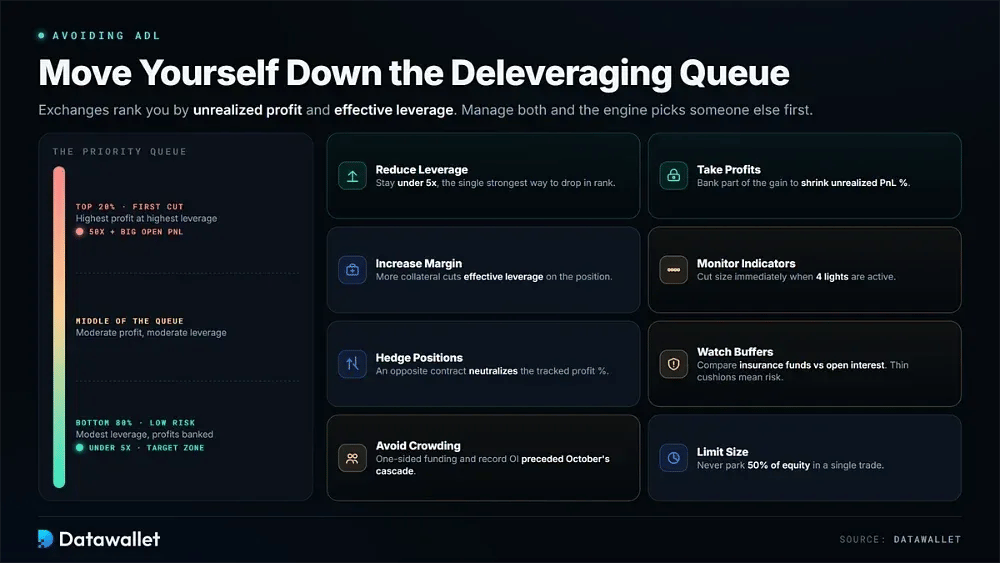
- Reduce Leverage: Lowering leverage is the most effective way to move down the ranking. Keep your leverage under 5x to minimize the chance of selection.
- Take Profits: Close portions of profitable trades to reduce your unrealized profit percentage. Doing so can significantly lower your priority in the automated deleveraging queue.
- Increase Margin: Add collateral to active positions to bring effective leverage down. A higher margin ratio helps keep your account off the priority list.
- Monitor Indicators: Most exchanges display visual light systems showing ADL risk. Reduce your position size immediately if 4 lights are active.
- Hedge Positions: An opposite contract can neutralize directional risk. The resulting balance lowers the total profit percentage tracked by ADL systems.
- Watch Buffers: Compare insurance fund balances with open interest through our crypto liquidations tracker. Shrinking cushions make deleveraging substantially more likely.
- Avoid Crowding: Extreme one-sided funding and record open interest came before October's cascade. Avoid crowded trades where forced selling is concentrated against your direction.
- Limit Size: Keep individual positions small relative to your total balance. Do not concentrate 50% of your equity into 1 trade.
Pros and Cons of Auto-Deleveraging (ADL)
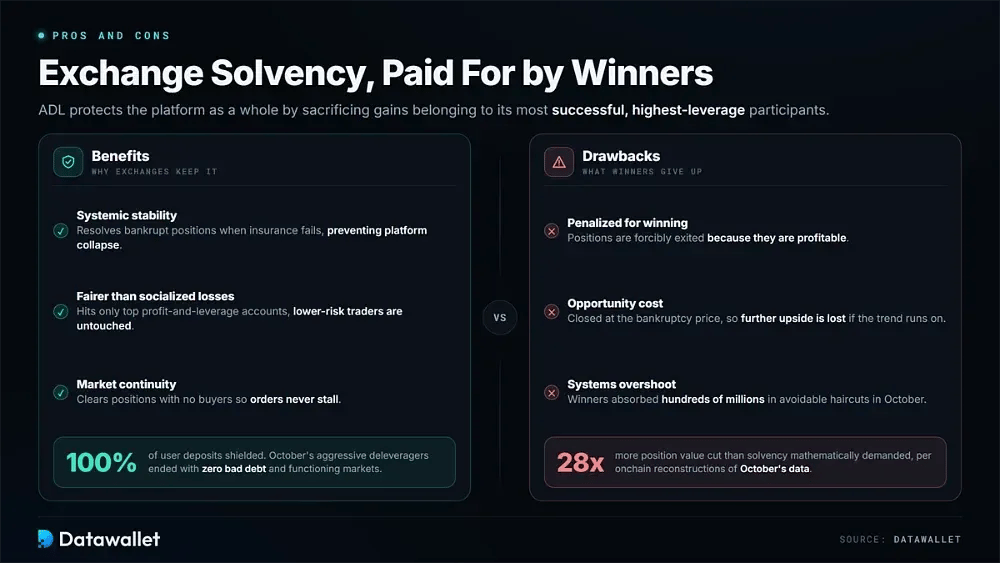
ADL creates a difficult trade-off. It protects the financial health of the exchange as a whole by sacrificing some gains belonging to successful, high-leverage participants.
Benefits of ADL
Its main advantage is systemic stability. ADL resolves bankrupt positions when insurance funds fail, helping prevent total platform collapse and keeping the exchange solvent. In doing so, it protects 100% of user deposits from a massive platform-wide failure.
The mechanism is also more equitable than the socialized loss systems used historically. Rather than taking a percentage from every profitable trader, ADL affects only those with the highest profit and leverage, leaving lower-risk participants untouched during volatile periods.
Market continuity is another benefit. By dealing with positions that cannot find buyers at bankruptcy prices, ADL prevents orders from stalling. October 2025 demonstrated that the system can operate at record scale: venues that deleveraged aggressively finished the cascade with zero bad debt and functioning markets.
Drawbacks of ADL
The clearest disadvantage is that successful investors can be penalized for winning their trades. A position may be forcibly exited simply because it is profitable, turning a calculated victory into an involuntary departure from the market.
Opportunity cost can also be substantial. When ADL closes contracts at the bankruptcy price, traders cannot capture additional upside if the trend continues. Their eventual profit may therefore be lower than it would have been had the position stayed open.
Recent research found that these systems can overshoot by a wide margin. Analysts reconstructing October's onchain data concluded that queue-based mechanisms cut roughly 28 times more position value than solvency mathematically demanded. Winning traders consequently absorbed hundreds of millions in avoidable haircuts.
ADL on Centralized Exchanges vs Perp DEXs
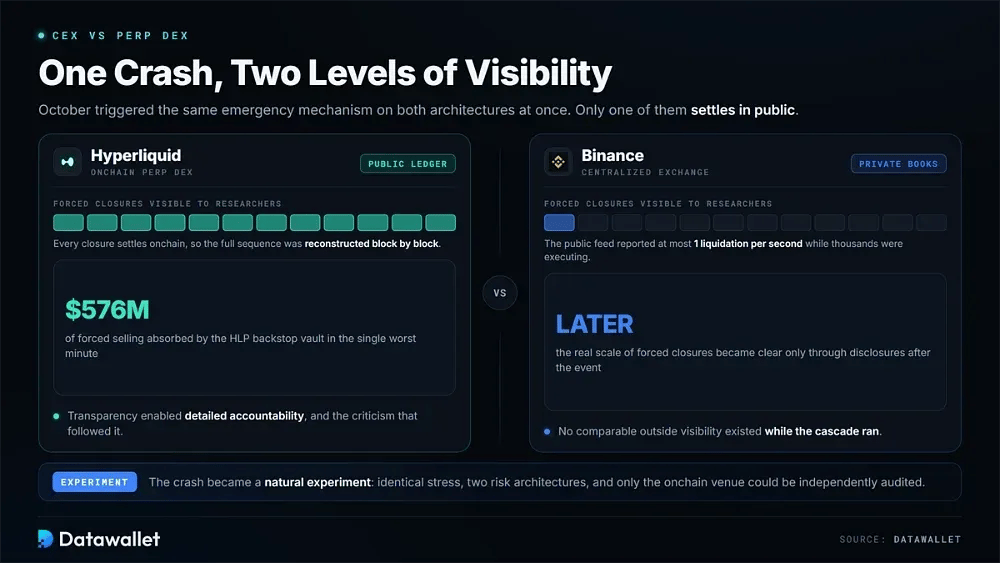
October's crash acted as a natural experiment because the same emergency mechanism triggered across two very different architectures at the same time. What outside observers could verify afterward became one of the defining derivatives stories of 2026.
Onchain venues settle publicly, allowing researchers to reconstruct Hyperliquid's sequence block by block. They found that its HLP backstop vault absorbed roughly $576 million of forced selling during the single worst minute. That transparency made detailed accountability possible and also enabled the criticism that followed.
No comparable visibility existed on centralized platforms. Binance's public feed reported at most one liquidation per second even while thousands were executing, so the real scale of forced closures became clear only through later disclosures. Our Hyperliquid vs Binance comparison examines both risk architectures in full.
How to Read Your ADL Priority Indicator
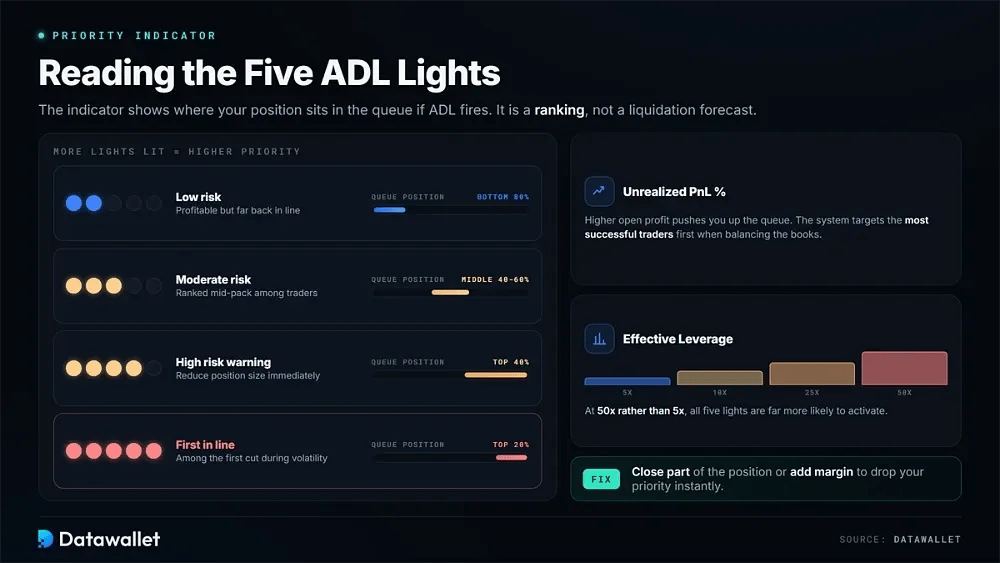
Your ADL priority indicator identifies where a position sits in the auto-deleveraging queue. It does not predict a liquidation on its own. Instead, it shows how likely the position is to be reduced if ADL activates.
The visual tool breaks down your risk level using these stages:
- More lights lit = higher priority for ADL: On Binance, the indicator ranks positions from the lowest to the highest queue priority. If every light is lit, your position may be reduced during an ADL event.
- 1 to 2 Lights: 1 or 2 illuminated lights indicate low risk and place your profitable position in the bottom 80% of the queue.
- 3 Lights Active: 3 lights represent moderate risk, with your account currently ranked in the middle 40% to 60% of traders.
- 4 Lights Warning: 4 orange lights signal high risk and show that your position has entered the top 40% for potential deleveraging.
- 5 Lights Priority: When all 5 lights are lit, you are in the top 20% and among the first targets for forced closure during volatility.
- PnL Percentage Factor: Higher profit percentages raise your ranking because the system targets the most successful traders when balancing the exchange's books.
- Effective Leverage Component: Ranking also rises with leverage. Using 50x rather than 5x makes it significantly more likely that all 5 lights will activate.
- Reducing Your Ranking: Closing part of a profitable position or adding margin can immediately lower your priority by reducing effective leverage.
What To Do If Your Crypto Positions Gets ADL'd
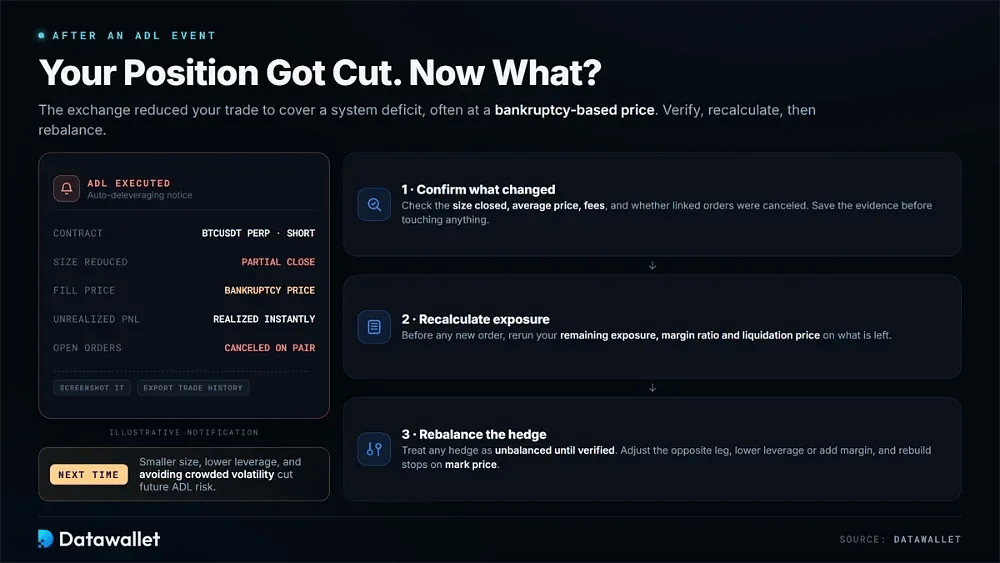
An ADL event means the exchange automatically reduced or closed part of your position to cover a system deficit following extreme liquidations, often using a bankruptcy-based price. The immediate priorities are to identify what changed, restore your risk controls, and make sure any hedge has not been left unbalanced.
Start by confirming the reduction details, including the size closed, average price, fees, and whether linked orders were canceled. Save a screenshot or export trade history. Before placing new orders, recalculate your remaining exposure along with the margin ratio and liquidation price.
Treat a previously hedged position as unbalanced until you verify otherwise. Rebalance by adjusting the opposite leg, lowering leverage, or adding margin. Rebuild stops and take-profits with mark price references. Going forward, smaller position sizes and lower leverage reduce ADL risk, as does avoiding crowded volatility.
Does My Exchange Support Auto-Deleveraging?
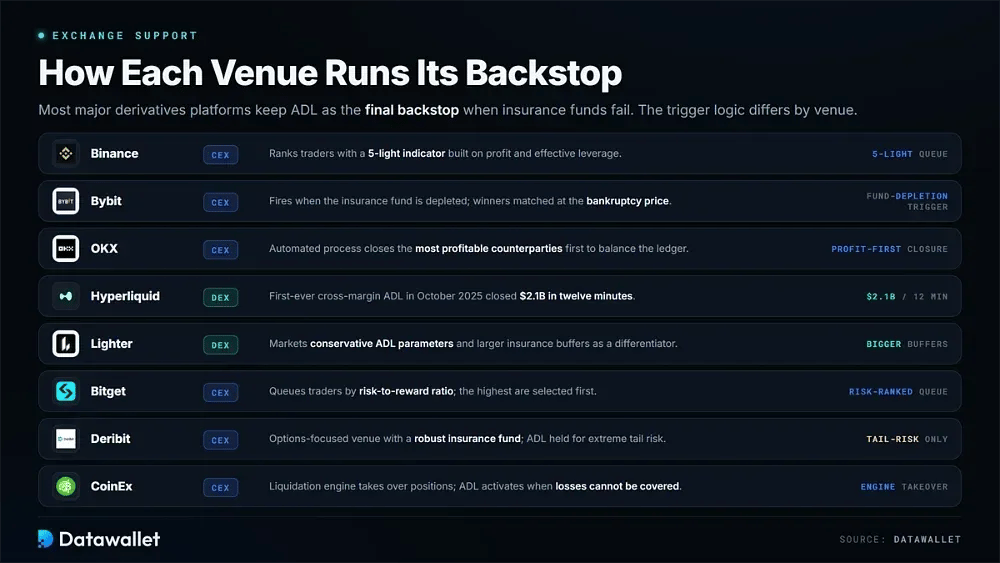
Most major derivatives platforms use ADL as a final backstop against insolvency when insurance funds fail during tremendous volatility. Our best crypto futures exchanges guide compares the full risk framework used by each venue.
Review this list to see how different exchanges manage risk:
- Binance: Uses a 5-light indicator system that ranks traders according to their specific profit and effective leverage levels.
- Bybit: Deleveraging occurs when the insurance fund is depleted, with high-profit accounts matched against bankrupt positions at the current bankruptcy price.
- OKX: Uses an automated process that prioritizes closure of the most profitable counterparty positions to keep the market ledger balanced.
- Hyperliquid: The decentralized leader activated cross-margin ADL for the first time in October 2025 and closed $2.1 billion of positions in twelve minutes.
- Lighter: This high-speed order book DEX now promotes deliberately conservative deleveraging parameters and larger insurance buffers as a competitive differentiator.
- Bitget: Places users in a queue where traders with the highest risk-to-reward ratios are selected first for involuntary contract closure.
- Deribit: The options-focused exchange maintains a robust insurance fund while retaining ADL protocols for extreme tail risks in crypto markets.
- CoinEx: Supports ADL in futures trading; its liquidation engine takes over positions, with ADL activating when losses cannot be covered.
Final Thoughts
Auto-Deleveraging is a vital safeguard for crypto trading platforms because it helps prevent systemic insolvency during periods of unprecedented market chaos.
A forced exit from a winning trade can be frustrating. The alternative, however, is a total platform collapse in which all users lose access to their entire account balances.
Understanding priority indicators, keeping an eye on insurance buffers, and controlling leverage can help you navigate the next cascade without unnecessarily exposing profitable positions to the ADL queue.
%20Explained.webp)