




Prediction markets are one of crypto’s largest volume categories. CoinGecko data puts second-quarter 2026 notional across the sector at $113.8 billion, as sports events, macro data, and price milestones increasingly trade as probabilities rather than positions.
Hyperliquid responded with HIP-4, moving outcome contracts onto the matching engine already used for perpetuals. Four months after its mainnet launch, the upgrade has progressed from a single BTC binary to a marketplace where builders can deploy their own markets.
Keep reading to see how the mechanics, builders, fees, and risks look. 👇
What is Hyperliquid Improvement Proposal 4 (HIP-4)?
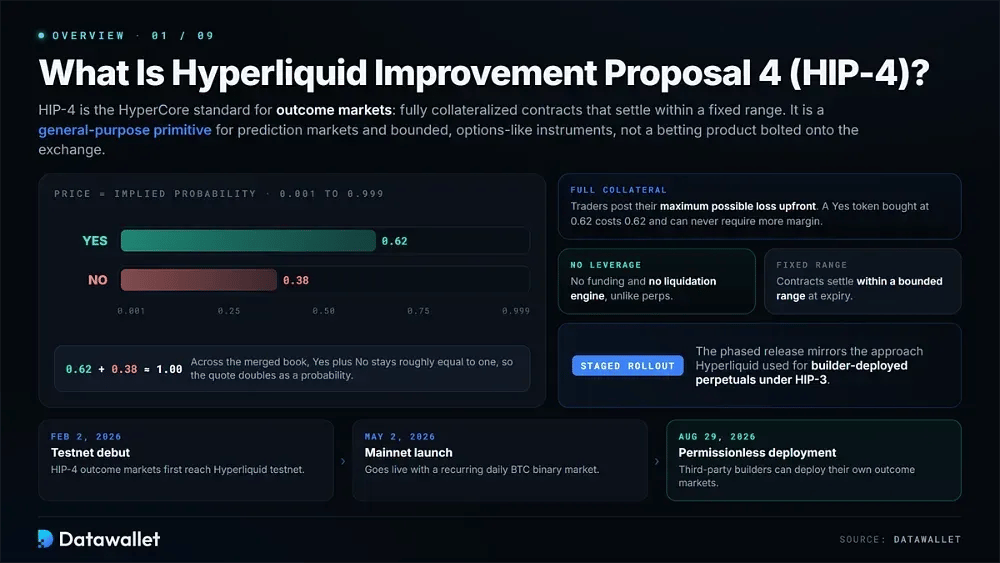
Hyperliquid Improvement Proposal 4 (HIP-4) is the protocol standard for “outcome markets” on HyperCore. The official HIP-4 specification defines outcomes as fully collateralized contracts that settle within a fixed range. That makes them a general-purpose primitive for prediction markets and bounded, options-like instruments rather than a separate betting product bolted onto the exchange.
A market typically has Yes and No sides, each priced between 0.001 and 0.999 so the quote also represents an implied probability. Traders post their maximum possible loss upfront. As a result, outcomes use no leverage or funding and require no liquidation engine, separating them sharply from Hyperliquid’s perpetual markets.
HIP-4 first reached testnet on February 2, 2026. Mainnet followed on May 2, 2026 with a recurring daily BTC binary, while permissionless third-party deployment opened on August 29, 2026. The staged rollout resembles the approach Hyperliquid used for builder-deployed perpetuals under HIP-3.
How Does Hyperliquid's HIP-4 Work?
HIP-4 treats each outcome as a native HyperCore asset with its own order book. Settlement, collateral, and fees sit around the same account model Hyperliquid already uses for spot and perpetual trading.
Its mechanics can be understood through three areas: the outcome contract, the merged-book system that keeps Yes and No prices aligned, and the rules governing settlement and fees.
1. Outcome Contract Mechanics
An outcome contract is straightforward from a trader’s perspective, although several protocol rules determine how positions open, trade, and settle. Every HIP-4 user interacts with these components either directly or through a builder frontend.
The core building blocks of a HIP-4 outcome contract include:
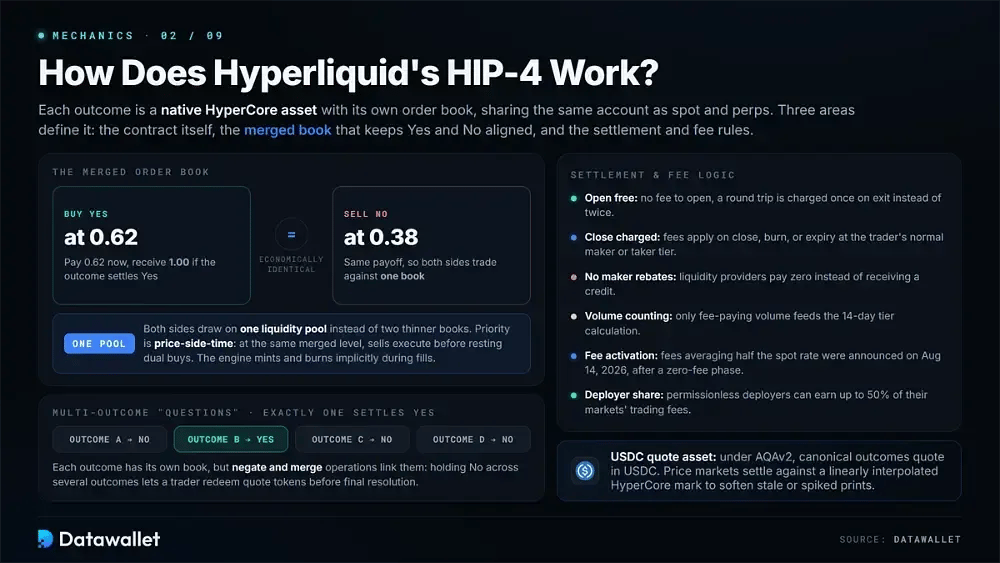
- Full Collateral: Every position is backed by the full amount it could lose at settlement. A Yes token purchased at 0.62 therefore costs 0.62 and can never require additional margin.
- Probability Pricing: Prices range from 0.001 to 0.999 and directly express the market’s implied probability. Across the merged book, Yes plus No remains roughly equal to one.
- Binary Settlement: At expiry, the protocol applies a settleFraction. Yes tokens convert to that fraction of the quote asset and No tokens receive the remainder, typically one and zero.
- Dated Expiry: Outcomes settle at a fixed timestamp rather than running perpetually. This introduces time value and lets traders express a view on when something will happen as well as whether it will happen.
- Native Assets: The Yes and No sides are HyperCore assets, not wrapped ERC-20 tokens. Existing order, cancel, and websocket tooling therefore requires only minor encoding changes.
- Shared Account: Outcome positions remain in the same account as spot and perps, allowing related exposures to be managed without transferring collateral between separate venues.
- Mark Interpolation: Price-based markets settle against a linearly interpolated HyperCore mark price around the settlement timestamp. This reduces the impact of a single stale or spiked print.
- Quote Asset: Under AQAv2, canonical outcome markets quote in USDC. The original USDH pairs were wound down after Coinbase became Hyperliquid’s official treasury deployer in May.
2. Merged Order Books and Questions
HIP-4’s merged order book is one of its most distinctive engineering choices. Buying Yes at price p is economically identical to selling No at 1 minus p. Both sides can therefore draw on one liquidity pool instead of trading through separate, thinner books.
Orders follow “price-side-time” priority. When orders rest at the same merged price level, sell orders execute before resting dual buy orders. Advanced users can also split or merge outcomes manually to move between primary and dual balances. Otherwise, the matching engine handles minting and burning implicitly during fills.
Multi-outcome markets are organized into “Questions.” Exactly one outcome settles to Yes, while every other outcome settles to No. Each outcome has a separate book, but negate and merge operations link them. A trader holding No across several outcomes within the same question can therefore redeem quote tokens before final resolution.
3. Settlement and Fee Logic
HIP-4 does not use the same fee structure as spot or perpetuals. Those differences affect round-trip costs, VIP tier progression, and market-making economics. Hyperliquid’s fee documentation identifies the cases in which an outcome trade incurs a charge.
Here is how fees and settlement are applied in practice:
- Open Free: Opening an outcome position carries no fee. A round trip is charged once on exit instead of twice, as is common with perpetual trading.
- Close Charged: A fee applies when the position closes, is burned against the opposite side, or settles at expiry. The trader’s normal maker or taker tier determines the rate.
- No Rebates: Maker rebates do not apply to outcomes. Liquidity providers who might earn a rebate on spot pay zero instead of receiving a credit.
- Volume Counting: Only fee-paying volume contributes to the 14-day tier calculation. Raw outcome notional therefore accumulates fee-tier history more slowly than the headline volume suggests.
- Fee Activation: Mainnet outcomes initially traded with zero fees during testing. On August 14, 2026, Hyperliquid said the next upgrade would activate fees averaging half the spot rate.
- Builder Codes: Builders can attach fees to sell orders routed through their code, as they can on spot. This gives frontends a revenue source separate from protocol fees.
- Deployer Share: Permissionless market deployers can receive up to 50% of the trading fees their markets generate. Configurable fees are planned for a later upgrade.
When Did HIP-4 Go Live On Hyperliquid Mainnet?
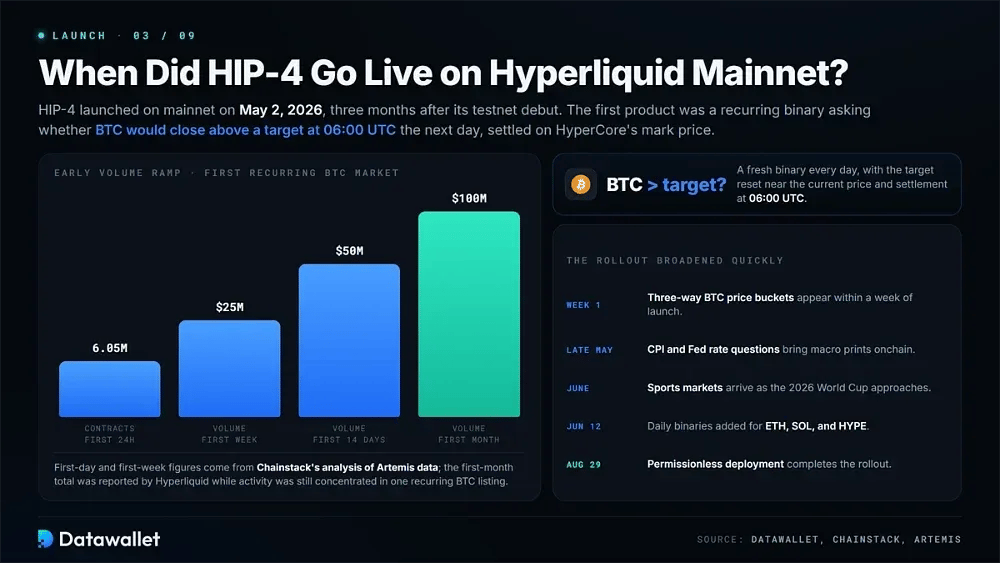
HIP-4 launched on Hyperliquid mainnet on May 2, 2026, about three months after its February 2 testnet debut. Its first product was a recurring binary that asked whether BTC would close above a target price at 06:00 UTC the following day, with settlement based on HyperCore’s mark price.
Chainstack’s analysis of Artemis data found that the inaugural market generated 6.05 million contracts during its first 24 hours and roughly $25 million in its first week. Hyperliquid later reported around $100 million in outcome volume during the first full month of mainnet trading.
The rollout broadened quickly. Three-way BTC price buckets appeared within a week, followed by CPI and Fed rate questions in late May. Sports markets arrived in June, and daily binaries for ETH, SOL, and HYPE were added on June 12. Permissionless deployment completed the rollout on August 29, 2026.
How HIP-4 Permissionless Deployment Works
Permissionless deployment turned HIP-4 from a curated feature into infrastructure. Announced on July 20, 2026 and activated on mainnet August 29, the system moved validators away from operating individual markets and toward approving templates that independent builders can use.
1. Deployer Requirements
Hyperliquid adopted the economic security model already used by HIP-3 for builder-deployed perpetuals, then added rules specific to outcome capacity and settlement deadlines. The Block reported the requirements when the specification was announced.
Key obligations for a HIP-4 deployer are as follows:
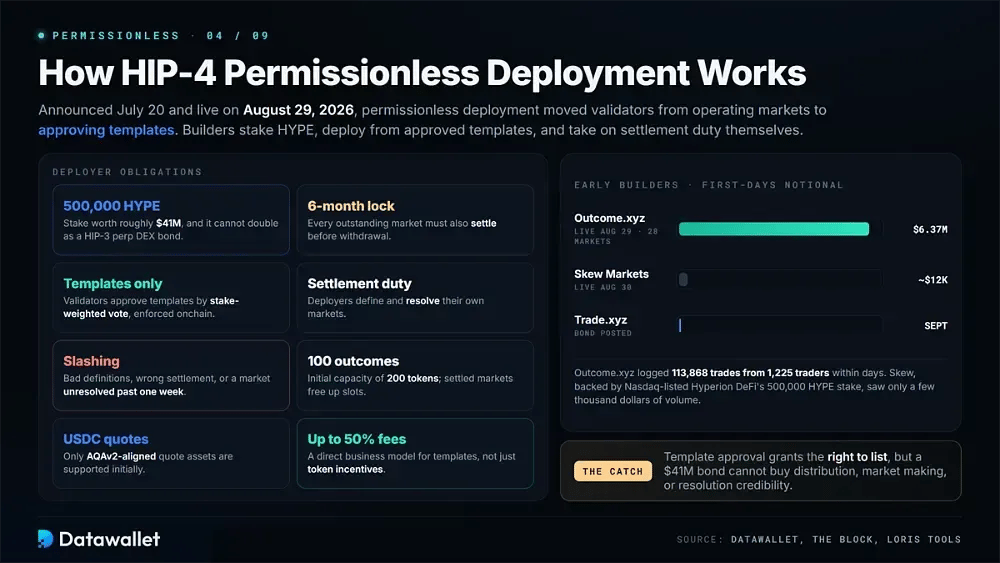
- HYPE Stake: A deployer must stake 500,000 HYPE, worth roughly $41 million at recent prices. The same stake cannot also count toward an existing HIP-3 perpetual DEX deployment.
- Six-Month Lock: The stake remains locked for at least six months. Every outstanding market must also settle before any of it can be withdrawn.
- Template Use: Builders may instantiate only templates approved by validators through a stake-weighted vote. Their specifications are stored and enforced onchain rather than off-chain.
- Settlement Duty: Each deployer defines and resolves markets according to the chosen template’s criteria, assuming the operational responsibility previously handled by validators for canonical markets.
- Slashing Exposure: Validators may slash some or all of the stake for poorly defined markets, incorrect settlement, or any market that remains unresolved for more than one week.
- Outcome Capacity: A deployer initially receives capacity for 100 outcomes, equivalent to 200 outcome tokens. Multi-outcome questions use more slots, while settled markets release capacity.
- Aligned Quotes: Permissionless outcome markets initially support only AQAv2-aligned quote assets, which currently means USDC.
- Fee Revenue: Deployers can earn up to 50% of fees generated by their markets, creating a direct business model for templates rather than relying solely on token incentives.
2. Early HIP-4 Builders
Outcome.xyz became the first permissionless HIP-4 deployer on August 29, 2026. It staked 500,000 HYPE and opened 28 markets covering crypto price touches, Fed policy outcomes, and index milestones. Within days, Loris Tools recorded $6.37 million in notional across 113,868 trades from 1,225 unique traders on those markets.
Skew Markets deployed the next day with support from Nasdaq-listed Hyperion DeFi, which is supplying its 500,000 HYPE stake. Its first listings, however, recorded only a few thousand dollars in volume. Trade.xyz, the dominant HIP-3 venue, has posted its bond and is expected to begin deploying in early September.
The difference between those first two deployers highlights the core challenge for permissionless outcomes. Template approval provides the ability to list a market, but it does not create distribution or market-making commitments, nor does it establish resolution credibility. A $41 million bond alone cannot supply those conditions.
Types of Hyperliquid HIP-4 Markets
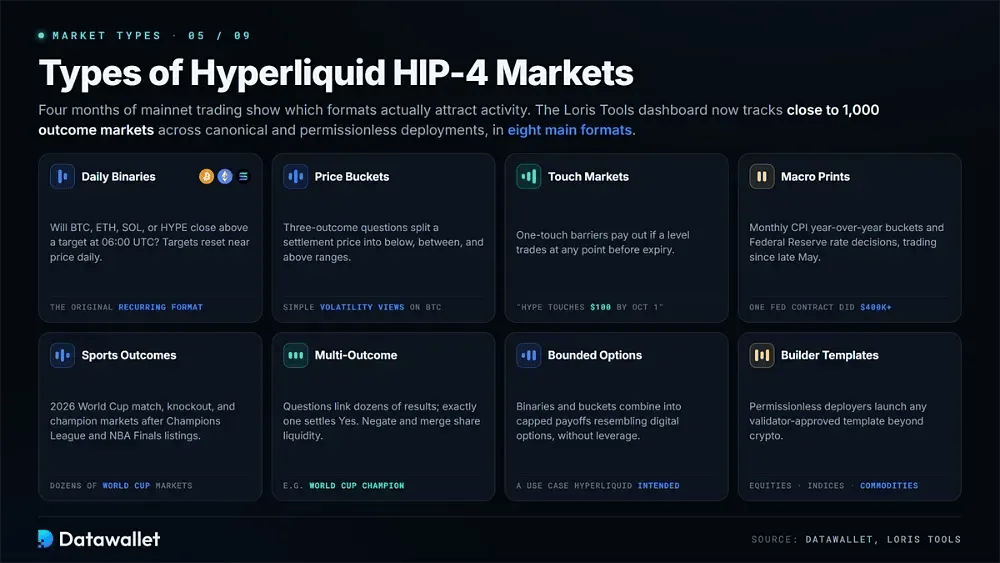
Four months of mainnet trading have provided a clearer picture of which HIP-4 formats attract activity. The Loris Tools HIP-4 dashboard now tracks close to 1,000 individual outcome markets across multiple categories.
The main market types that have actually traded include:
- Daily Binaries: The original recurring format asks whether BTC, ETH, SOL, or HYPE will close above a target at 06:00 UTC. Each day’s target resets near the current price.
- Price Buckets: Three-outcome questions divide a settlement price into below, between, and above ranges, offering a relatively simple way to express volatility views on Bitcoin.
- Touch Markets: Builder templates introduced one-touch barriers such as “HYPE touches $100 by October 1,” which pay out if the specified level trades at any point before expiry.
- Macro Prints: Monthly CPI year-over-year buckets and Federal Reserve rate decisions have traded since late May. One no-change policy contract alone generated more than $400,000 in volume.
- Sports Outcomes: The 2026 World Cup produced dozens of match, knockout-round, and champion markets after validators had already curated Champions League winner and NBA Finals listings.
- Multi-Outcome Questions: Markets such as the World Cup champion question link dozens of possible results, exactly one of which settles Yes. Negate and merge operations allow them to share liquidity.
- Bounded Options-Like: Binaries and buckets can be combined into capped payoffs resembling digital options without leverage, a use case Hyperliquid explicitly intended the primitive to support.
- Builder Templates: Permissionless deployers can launch any validator-approved template. Early builders already list equities, indices, commodities, and broader sports coverage on their public roadmaps.
HIP-4 Statistics & Adoption Trends
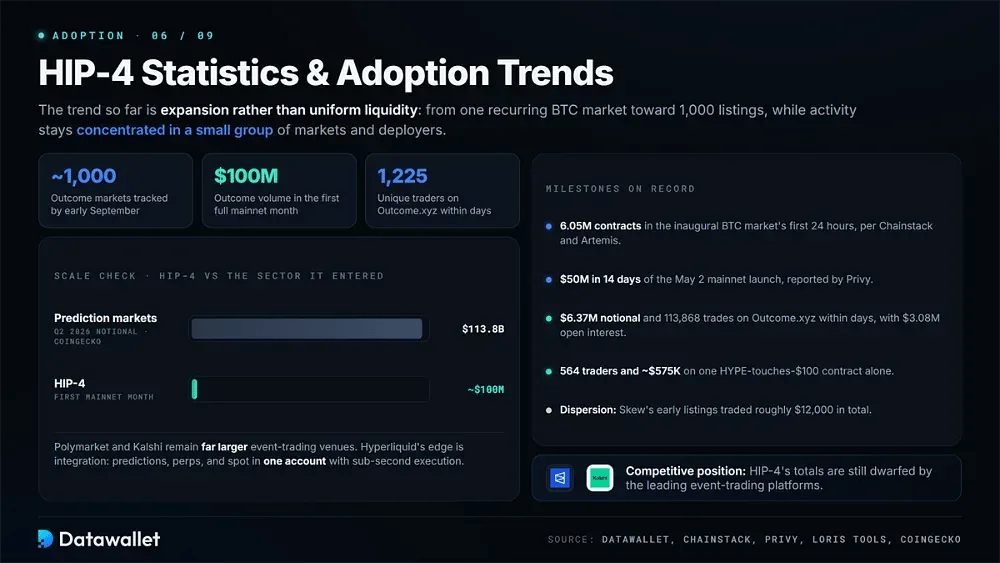
HIP-4 remains small relative to the wider prediction-market sector, but its first four months provide several useful benchmarks for adoption. The figures below draw on Hyperliquid’s reported volumes alongside data and analysis from Chainstack, Privy, and the Loris Tools HIP-4 dashboard.
- Sector Scale: CoinGecko data puts prediction-market notional at $113.8 billion in the second quarter of 2026, establishing the broader market in which HIP-4 is competing.
- First-Day Activity: The inaugural recurring BTC market processed 6.05 million contracts during its first 24 hours, according to Chainstack’s analysis of Artemis data.
- First-Week Volume: The same market generated roughly $25 million in its first week.
- Two-Week Milestone: Privy reported that HIP-4 crossed $50 million in volume within 14 days of its May 2, 2026 mainnet launch.
- First Full Month: Hyperliquid later reported around $100 million of outcome volume during the first complete month of mainnet operation, when activity was still concentrated in one recurring BTC listing and fees were zero.
- Market Count: By early September, Loris Tools was tracking close to 1,000 individual outcome markets across canonical and permissionless deployments.
- Outcome.xyz Adoption: Within days of launching, Outcome.xyz generated $6.37 million in notional from 113,868 trades by 1,225 unique traders. Its markets held about $3.08 million in end-of-day open interest.
- Single-Market Demand: One HYPE-touches-$100 contract attracted 564 unique traders and approximately $575,000 of notional within days.
- Liquidity Dispersion: Adoption remains uneven across builders. While Outcome.xyz reached millions of dollars in activity, Skew’s early listings traded roughly $12,000 in total.
- Competitive Position: Polymarket and Kalshi remain far larger event-trading venues, while broader prediction market statistics continue to dwarf HIP-4’s totals.
The trend so far is expansion rather than uniform liquidity. HIP-4 began with one recurring BTC market, then added new asset classes and event formats before permissionless builders pushed the number of available outcomes toward 1,000. Trading activity, however, remains concentrated in a relatively small group of markets and deployers.
HIP-4 Pros and Cons
HIP-4 expands Hyperliquid beyond its established markets, but outcome trading introduces different assumptions around resolution sources, deployer behaviour, and fees. Traders should account for those differences rather than treating outcomes as another form of perpetual contract.
The main advantages and trade-offs look like this:
How HIP-4 Affected Hyperliquid's HYPE Token
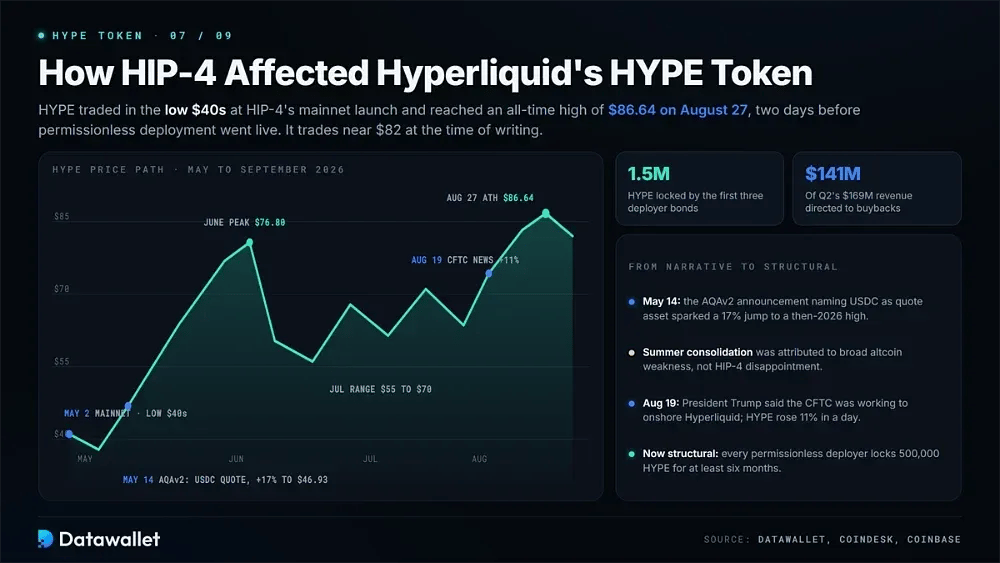
HYPE traded in the low $40s around HIP-4’s May 2 mainnet launch before falling below $39 by mid-May. On May 14, the AQAv2 announcement identified USDC as the future quote asset for canonical HIP-4 markets. HYPE then jumped 17% to $46.93, its 2026 high at the time.
The token continued higher through June, setting a new record near $76.80 before pulling back sharply toward $52. For most of July and early August, it traded in a range of roughly $55 to $70. Analysts largely attributed that consolidation to broader altcoin weakness rather than disappointment with HIP-4 adoption.
Late August brought the strongest move. President Trump’s August 19 statement that the CFTC was working to onshore Hyperliquid pushed HYPE up 11% in one day. The token reached an all-time high of $86.64 on August 27, two days before permissionless HIP-4 deployment launched.
HIP-4’s direct effect on the token is now structural rather than narrative. Every permissionless deployer must lock 500,000 HYPE for at least six months, and three deployers have already committed bonds. Separately, the Assistance Fund directed $141 million of Q2’s $169 million in revenue toward buybacks. HYPE trades near $82 at the time of writing.
Hyperliquid HIP-4 vs HIP-3 vs HIP-2 vs HIP-1
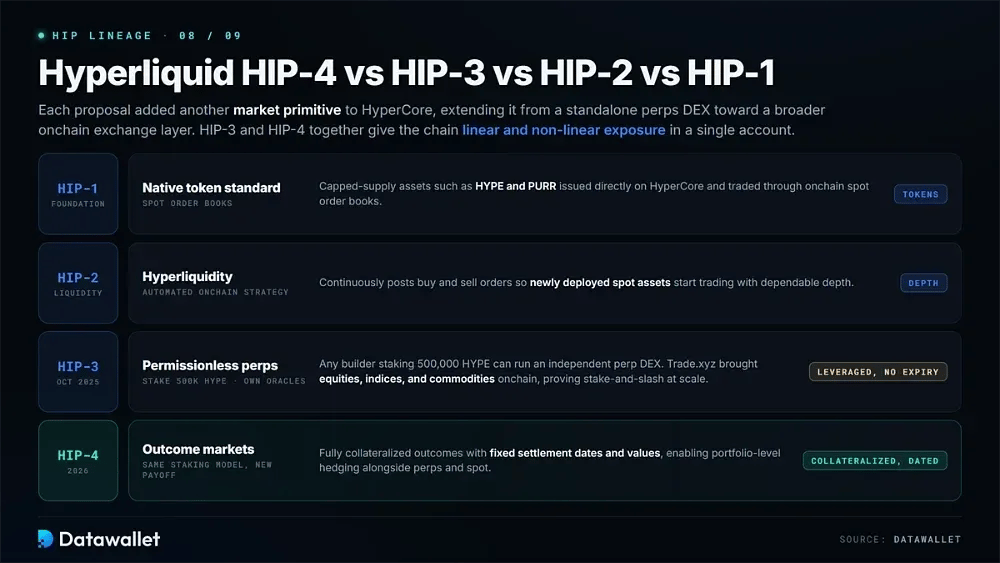
Each Hyperliquid improvement proposal has added another market primitive to HyperCore, gradually extending the protocol beyond a standalone perpetuals DEX toward a broader onchain exchange layer. Looking at the proposals in sequence shows which parts of HIP-4 came from earlier upgrades and which capabilities are new.
HIP-1 introduced HyperCore’s native token standard, allowing capped-supply assets such as HYPE and PURR to be issued directly and traded through onchain spot order books. HIP-2 followed with Hyperliquidity, an automated onchain strategy that continuously posts buy and sell orders so newly deployed spot assets can begin trading with dependable depth.
In October 2025, HIP-3 brought permissionless deployment to perpetual futures. Any builder staking 500,000 HYPE could operate an independent perp DEX with its own oracles, margining, and fee settings. Builders including Trade.xyz used the model to bring equities, indices, and commodities onchain, demonstrating the stake-and-slash framework at scale.
HIP-4 carries that staking model into a different payoff structure. Rather than leveraged contracts without expiry, it offers fully collateralized outcomes with fixed settlement dates and values. HIP-3 and HIP-4 together give HyperCore linear and non-linear exposure, making portfolio-level hedging within a single account possible.
Risks of Hyperliquid HIP-4
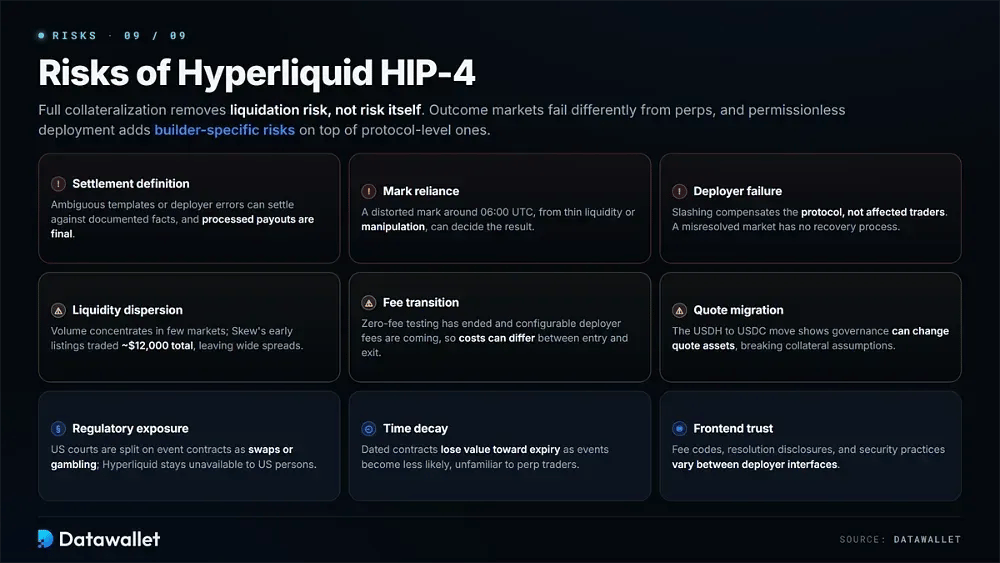
Full collateralization removes liquidation risk, not risk itself. Outcome markets have different failure modes from perpetuals, and permissionless deployment adds risks specific to individual builders on top of those at the protocol level.
Consider these practical risks before trading or deploying:
- Settlement Definition: A market depends on its resolution rule. Ambiguous templates or deployer errors can produce a settlement that conflicts with documented facts, and processed payouts are final.
- Mark Reliance: Price markets settle against interpolated HyperCore marks. A distorted mark around 06:00 UTC, whether caused by thin liquidity or deliberate manipulation, can therefore determine the result.
- Deployer Failure: Slashing penalizes a deployer after a failure, but the stake compensates the protocol rather than affected traders. A misresolved market has no built-in recovery process.
- Liquidity Dispersion: Volume is concentrated in a limited number of markets. Skew’s early listings traded roughly $12,000 in total, leaving many positions exposed to wide spreads and unreliable exit prices.
- Fee Transition: The initial zero-fee testing phase has ended, while configurable deployer fees are still coming. Effective trading costs can therefore differ between entry and exit.
- Quote Migration: The move from USDH to USDC demonstrates that governance can change quote assets. Such changes affect builder collateral assumptions and tooling that remains denominated in USDH.
- Regulatory Exposure: US courts are split on whether event contracts should be treated as swaps or gambling. Hyperliquid also remains unavailable to US persons despite ongoing CFTC onshoring discussions.
- Time Decay: Dated contracts can lose value as expiry approaches when the underlying event becomes less likely, a dynamic that may be unfamiliar to traders used to perpetual futures with no expiry.
- Frontend Trust: Most users access builder markets through third-party interfaces. Fee codes, resolution disclosures, and security practices can vary significantly between deployers.
Final Thoughts
HIP-4 has progressed from proposal to production quickly by Hyperliquid’s standards. Over four months, it launched a recurring BTC binary, expanded into buckets, macro questions and sports, moved its quote asset to USDC, activated fees, and opened deployment to builders prepared to post $41 million bonds.
For traders, the practical benefit is consolidation. A directional perpetual, a hedge around a macro release, and a position on a football match can all sit in one account, while the outcome legs remain outside the liquidation engine. The resolution rule should be treated as the product, not the interface.
For HYPE, HIP-4 creates a second staking sink alongside HIP-3 and connects builder demand directly to token lockups. Whether outcomes grow into a meaningful share of Hyperliquid’s volume now depends on builders, along with how US regulators and the Clarity Act ultimately resolve the prediction-market question.