



What is Polymarket?
Polymarket is an information market where participants trade shares linked to real-world events. Founded in 2020 and headquartered in New York, the platform settles trades onchain, allowing positions, volumes and resolutions to be audited without relying on the operator.
Mainstream attention accelerated during the 2024 US presidential election. Polymarket's odds favoured Donald Trump while many traditional polls showed a coin-flip race. The result drew commentary from Elon Musk and brought prediction markets into broader financial coverage.
The platform has expanded dramatically since then. Combined international and US volume reached $12.9 billion in July, while annualised revenue passed $1.2 billion, up from the $1 billion disclosed by the company in late June.
Growth has not been consistent across every measure. Kalshi has moved ahead on raw volume with roughly 74.5% of category share. Polymarket's main platform also fell 26% month-on-month in July, as the company reportedly entered talks to raise about $1 billion above a $20 billion valuation.
How Does Polymarket Work?
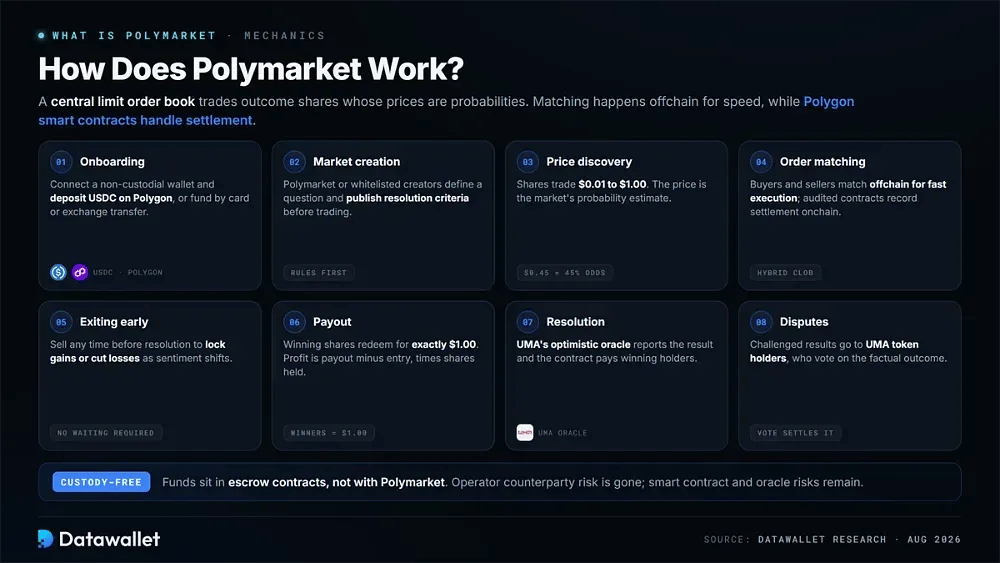
Polymarket uses a central limit order book to trade outcome shares whose prices represent probabilities. Orders are matched offchain for speed, while smart contracts on Polygon handle settlement.
The mechanics work as follows:
- Onboarding: Users connect a non-custodial wallet and deposit USDC on Polygon, or use card payments and exchange transfers to fund the international platform.
- Market creation: Polymarket or whitelisted participants define a question with categorical outcomes, then publish the resolution criteria before trading begins.
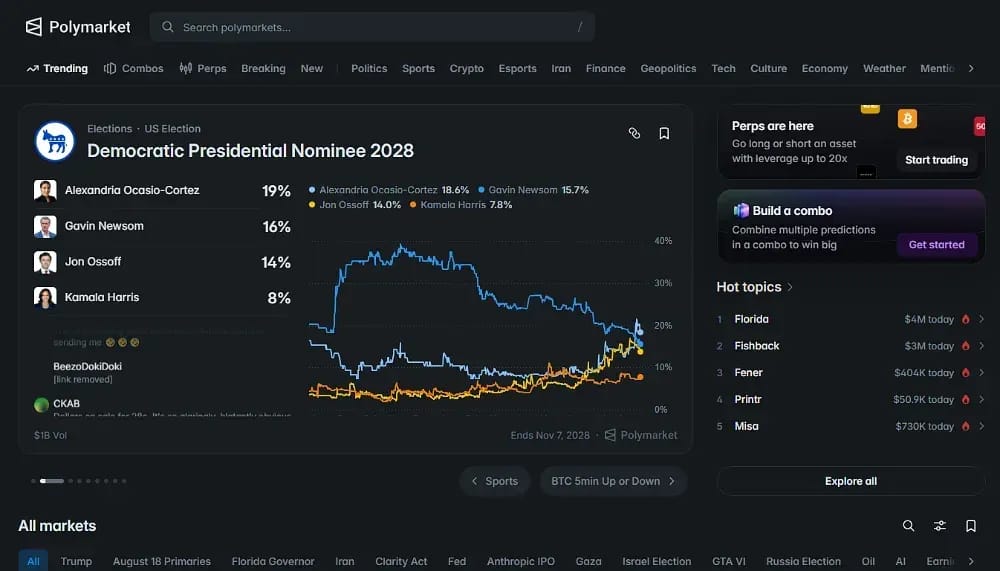
- Price discovery: Shares trade from $0.01 to $1.00, with the price directly representing the market's collective probability estimate for the outcome.
- Order matching: Buyers and sellers are matched offchain for faster execution, while audited contracts record final settlement onchain.
- Exiting early: Positions can be sold at any time before resolution, allowing participants to realise gains or cut losses as sentiment changes instead of waiting for the event.
- Payout: Winning shares redeem for exactly $1.00. Profit equals the payout minus the entry price, multiplied by the number of shares held.
- Resolution: UMA's optimistic oracle reports the result to the settlement contract, which automatically distributes funds to holders of the winning shares.
- Disputes: If a resolution is challenged, the dispute goes to UMA token holders, who vote on the factual outcome to protect settlement integrity.
Trades are custody-free because funds remain in escrow contracts rather than being held by Polymarket. This removes operator counterparty risk, though smart contract and oracle risks remain.
Polymarket US vs the International Platform
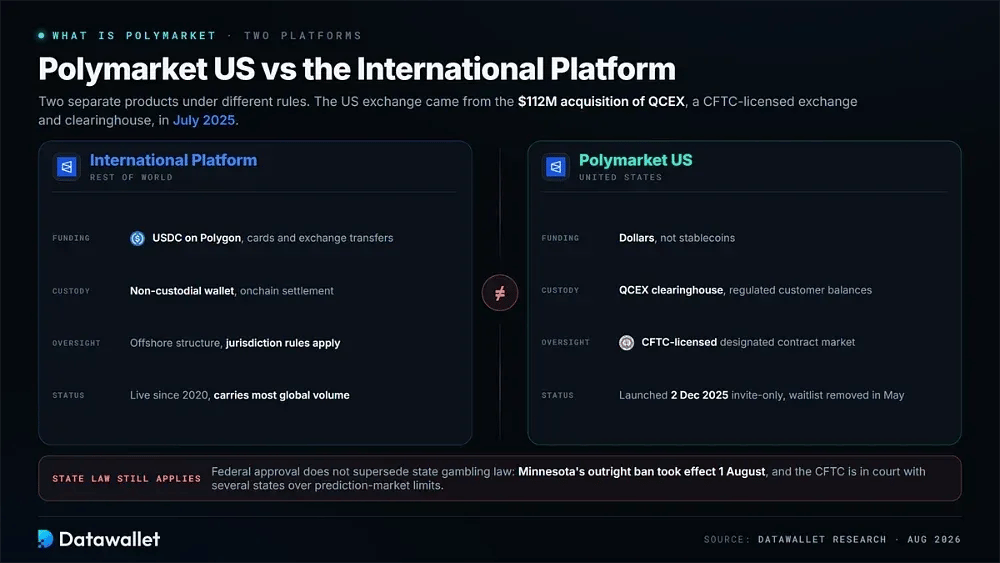
Polymarket operates two separate products under different rules. Distinguishing between them is important:
Polymarket created its US exchange through the $112 million acquisition of QCEX, a CFTC-licensed exchange and clearinghouse, in July 2025. The service launched on 2 December 2025 with invite-only access before removing the waitlist in May.
Availability still depends on the state. Federal approval does not supersede state gambling law. Minnesota imposed an outright ban effective 1 August, while the CFTC has sued several states seeking to restrict prediction markets. Our Polymarket versus Kalshi comparison explains how access differs between the two venues.
Polymarket Perpetuals Explained
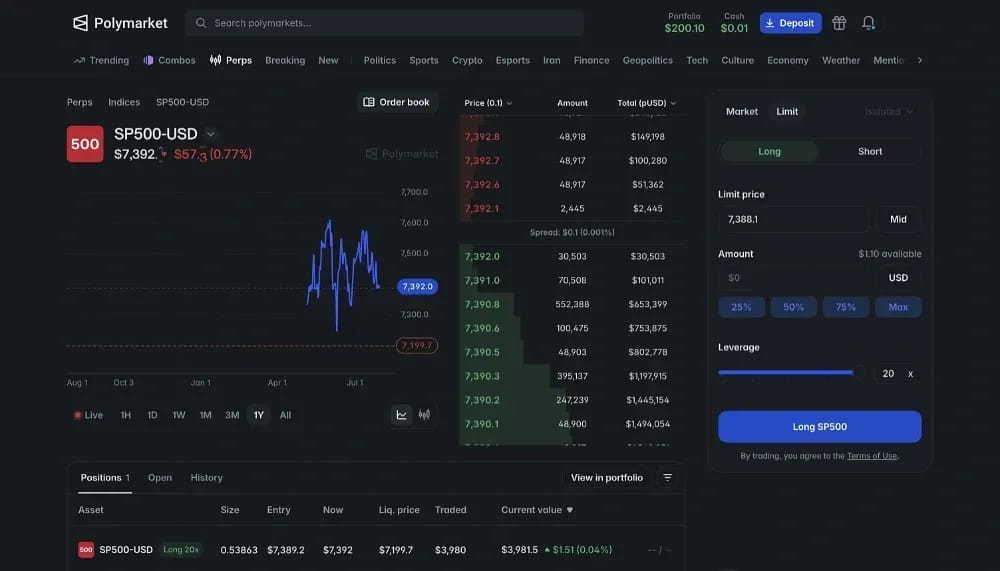
On 21 April, Polymarket announced perpetual futures, expanding beyond binary event contracts into leveraged derivatives. Rather than settling at $1 or $0, the product continuously tracks live asset prices and borrows its structure from crypto venues such as Hyperliquid.
Competition shaped the timing. Kalshi had teased a perps product for 27 April. Polymarket announced its version six days earlier, saying that it prices the future and traders can now lever it.
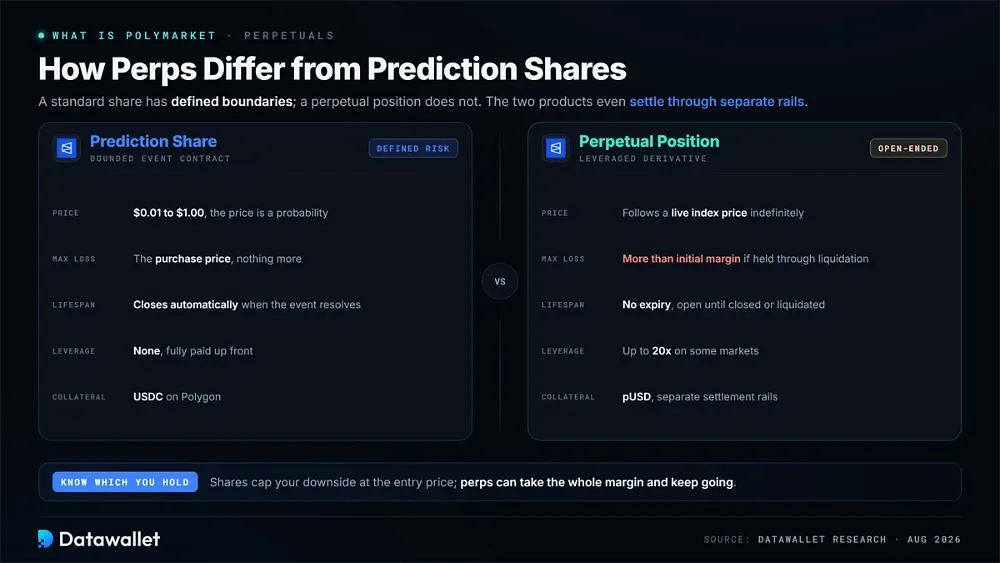
How Perps Differ from Prediction Shares
A standard Polymarket share has defined boundaries. It costs between $0.01 and $1.00, the most a trader can lose is the purchase price, and the position closes automatically when the event resolves. Perpetuals do not share those characteristics.
A perpetual position follows an index price indefinitely and has no expiry. It also uses leverage and can lose more than the initial margin if held through liquidation. These positions use pUSD as collateral instead of USDC, with the two products settling through separate rails.
The initial lineup includes Bitcoin, gold and Nvidia stock, with equities, indices and commodities added since. Perps are not leveraged versions of political markets. They track asset prices rather than event probabilities.
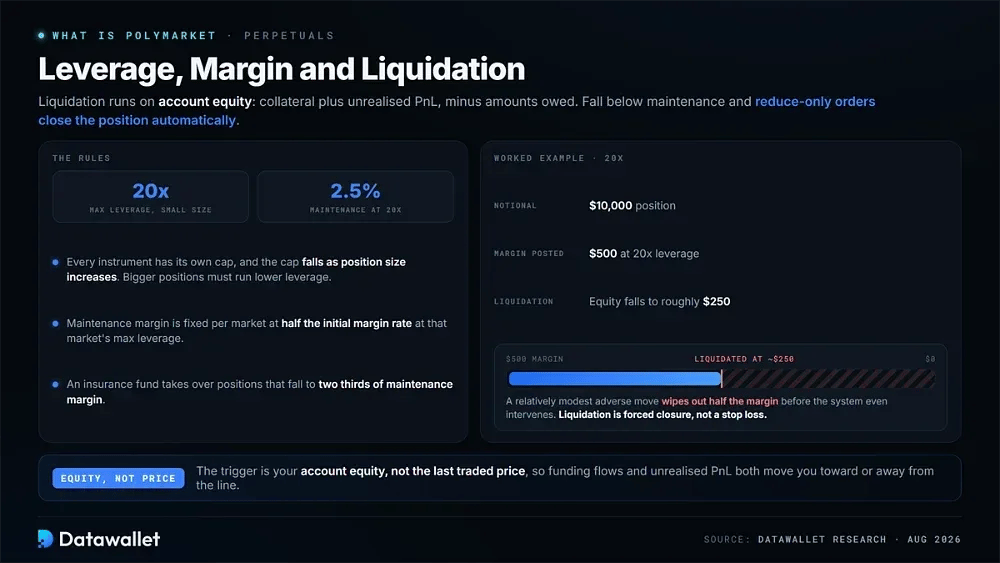
Leverage, Margin and Liquidation
Each instrument has its own leverage limit, and the cap falls as position size increases. Some markets permit up to 20x leverage at smaller notional values. Larger positions therefore require traders to reduce leverage rather than increase the cap proportionally.
Maintenance margin is fixed by market and equals half the initial margin rate at that market's maximum leverage. A market with 20x leverage consequently has a 2.5% maintenance margin rate. That threshold determines how far a position can move before forced closure.
The effect is significant. A trader who opens a $10,000 notional position using $500 of margin at 20x is liquidated once equity falls to roughly $250. A relatively modest adverse move therefore wipes out half the margin before the system intervenes.
Liquidation is based on account equity, not the last traded price. Equity is calculated from collateral plus unrealised profit and loss, minus amounts owed. If it falls below the maintenance threshold, reduce-only orders automatically close the position. An insurance fund takes over positions that fall to two thirds of maintenance margin.
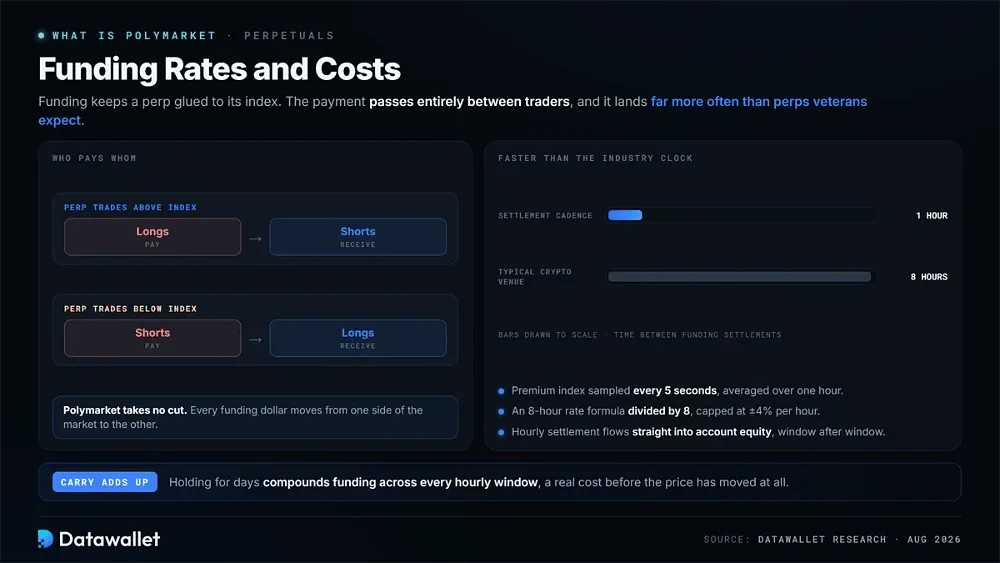
Funding Rates and Costs
Funding payments are designed to keep perpetual contracts aligned with their index price. When the perp trades above the index, longs pay shorts. If it trades below, shorts pay longs instead. Polymarket does not take a cut, so the payment passes entirely between traders.
Sampling occurs more frequently than the eight-hour standard used by many crypto venues. Polymarket measures a premium index every five seconds and averages those observations over one hour. It then applies an eight-hour rate formula divided by eight, with a cap of plus or minus 4% per hour.
Funding settles every hour instead of once every eight hours. As a result, it flows into account equity much more frequently than traders coming from other perpetuals exchanges may expect. Carrying a position for several days compounds that cost across every window.
Access and Restrictions
Perps are still in early access. Rollout occurs in waves for traders with a referral or invite code rather than across all accounts at once. Fee tiers, leverage limits and the available instruments continue to change during the rollout, similar to developments around Kalshi's rival product.
The jurisdictional restrictions are tighter than those for prediction shares. Order placement is blocked from the United States, Canada, Cuba, Iran, North Korea, Syria, Crimea, Donetsk and Luhansk. The CFTC-regulated route that allows Americans to trade shares therefore does not extend to perpetuals.
How to Bet on Polymarket
Trading on Polymarket involves funding an account and buying outcome shares with stablecoins. The process below runs from deposit through settlement. Our guide to Polymarket trading strategies covers what to do after the account is set up.
Step 1: Funding Your Account
The international platform requires USDC for trading, while Polymarket US uses dollars. Funding options include:
- Buy USDC with a credit or debit card through MoonPay.
- Link a Coinbase account for fee-free transfers.
- Send USDC directly from an Ethereum or Polygon wallet.
- Bridge assets across chains for larger deployments.
- Swap other cryptocurrencies into USDC inside the interface.
Step 2: Selecting Your Market
Browse available categories for an event where you have a view, with particular attention to genuine market depth. Thin liquidity creates wider spreads, reducing potential returns before the event has even resolved.
- Filter by trending volume or approaching close date.
- Choose categories such as geopolitics, sports or business.
- Read resolution criteria closely to avoid ambiguity.
- Check total liquidity available at your intended size.
- Save markets to a watchlist for ongoing tracking.
Step 3: Interpreting Market Odds
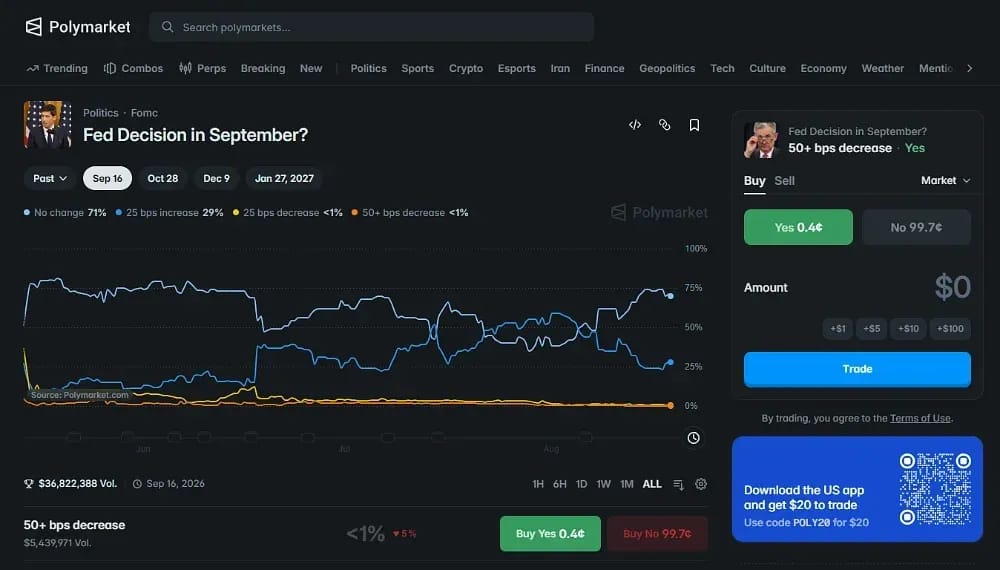
A share price expresses the market's probability estimate in cents. If a share trades at $0.45, the implied probability is 45%. Value exists only when you believe the true likelihood differs from the market price.
- Prices span $0.01 to $1.00 per share.
- A $0.50 price reflects even odds.
- Cheaper shares offer larger percentage returns at lower hit rates.
- Expensive shares are safer but cap the upside.
- The midpoint sits between current bid and ask.
Step 4: Using the Order Book
Before entering a trade, the order book shows the buy and sell orders already waiting in the market. That depth matters because placing a large order into a thin market can create substantial slippage.
- Bids show what buyers will currently pay.
- Asks show the lowest prices sellers accept.
- The spread is the gap between the two.
- Charts track how probability shifted over time.
- Trade history shows recent sizes and fills.
Step 5: Executing the Trade
Choose YES or NO, enter either the stake or number of shares, and check the projected payout before confirming. Market orders favour immediate execution, whereas limit orders provide control over price.
- Choose market or limit order type.
- Enter the total amount for the position.
- Adjust maximum slippage on larger orders.
- Confirm the buy to submit.
- Sign the transaction in your connected wallet.
Step 6: Managing Your Position
Your portfolio displays each position with its current valuation. Winners held through resolution pay the full $1.00 per share. Selling earlier instead turns changes in market probability into realised profit or loss.
- Track profit and loss per market.
- Sell into strength to lock gains early.
- Close losing positions to preserve capital.
- Set limit sells for automated exits.
- Hold to resolution for the full payout.
Polymarket Fees
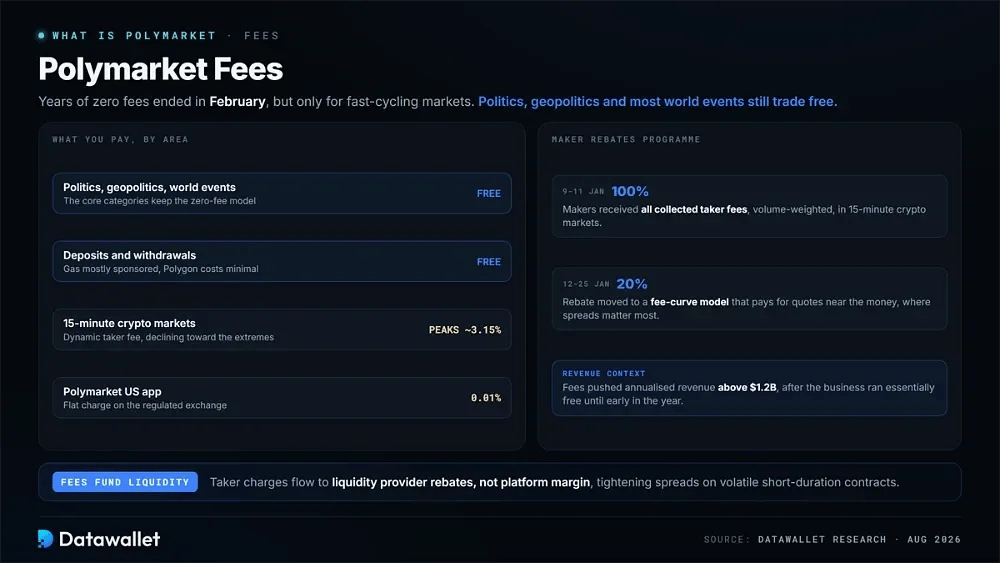
For years, Polymarket charged no trading fees, a major part of its appeal. That changed in February, when fees were introduced for certain types of markets while most event contracts remained free.
The zero-fee model continues to apply to politics, geopolitics and most world-event markets. Deposits and withdrawals also remain free. Charges now apply in areas where fast-cycling markets require additional liquidity support:
- 15-minute crypto markets: Dynamic taker fees peak near 3.15% at even odds and decline as probabilities move toward the extremes.
- Polymarket US app: Transactions on the regulated American exchange carry a flat 0.01% charge.
- Fee direction: The charges fund liquidity provider rebates rather than platform margin, helping tighten spreads on volatile short-duration contracts.
- Gas costs: Polygon network charges are minimal, while Polymarket sponsors most transaction costs for traders.
- Revenue context: The introduction of fees pushed annualised revenue above $1.2 billion, after the business had operated essentially for free until early in the year.
Maker Rebates Program
The maker rebates programme compensates liquidity providers for quoting in 15-minute crypto markets. From 9 to 11 January, makers received 100% of collected taker fees through volume-weighted calculations.
Between 12 and 25 January, the rebate fell to 20% of collected fees and moved to a fee-curve model. Instead of rewarding raw volume, the revised approach pays makers according to the fee value generated by their quotes. This favours quotes near the money, where spreads have the greatest impact.
Largest Polymarket Markets by Volume
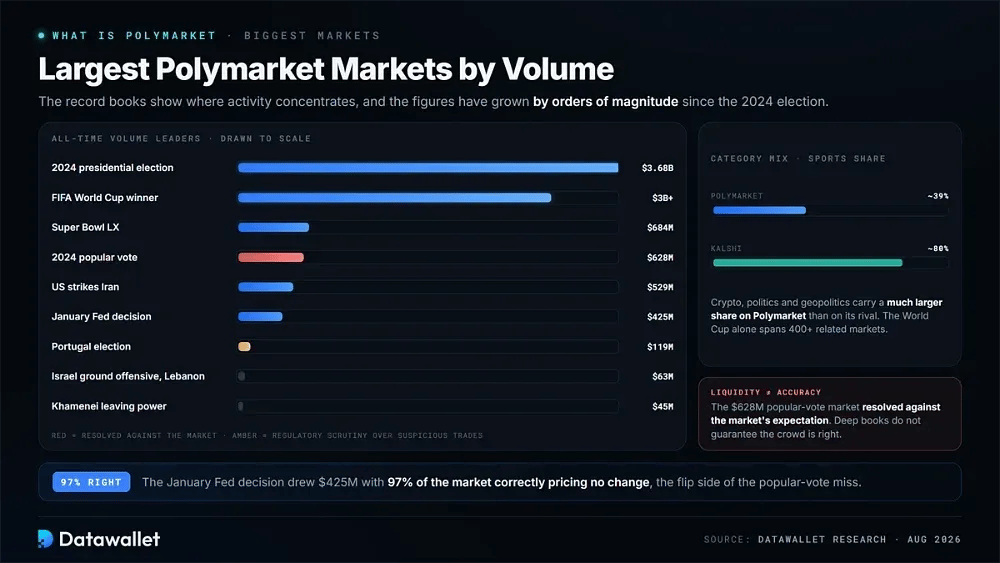
Polymarket's highest-volume markets illustrate where trading activity has concentrated. The figures have increased by orders of magnitude since the 2024 election.
The largest contracts on record include:
- FIFA World Cup winner: Passed $3 billion in trading volume by late June, making it the most liquid sports prediction market Polymarket has ever run, supported by more than 400 related World Cup markets.
- 2024 presidential election: Recorded roughly $3.68 billion in volume. A French trader known as Théo wagered $153 million across accounts and made about $85 million backing Trump.
- US strikes Iran: Live since 22 December, the contract accumulated $529 million in volume and ranks among the largest single markets hosted by the platform.
- Super Bowl LX: Reached roughly $684 million as traders priced Seattle and New England as leading contenders during the playoff run.
- 2024 popular vote: Drew $628 million but resolved incorrectly against the market's expectation, showing that high liquidity does not guarantee accuracy.
- Israel ground offensive in Lebanon: Attracted $63 million as conflict in the Middle East escalated. It sits within a geopolitics category that now spans 590 markets.
- Khamenei leaving power: A contract on the Ayatollah leaving power by 31 March attracted $45 million during the peak of the Iran crisis.
- January Fed decision: Drew $425 million in wagers, with 97% of the market correctly pricing no change in interest rates.
- Portugal election: Surpassed $119 million and drew regulatory scrutiny after suspicious trading appeared shortly before the results were published.
The category mix differs sharply from Kalshi's. Sports represents roughly 39% of Polymarket volume, compared with 80% on Kalshi. Crypto, politics and geopolitics account for a much larger share of activity on Polymarket than on its rival.
Does Polymarket Have a Token?
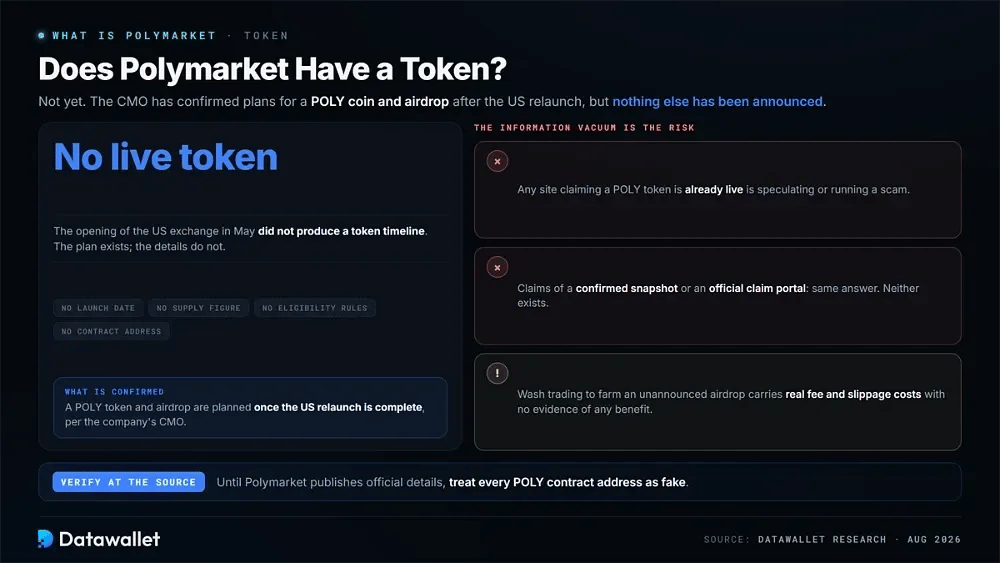
Polymarket does not currently have a live token. The company's CMO has confirmed plans for a POLY coin and accompanying airdrop after the US relaunch is complete.
No further details have been announced. There is no published launch date, supply figure, eligibility rule or contract address, and the opening of the US exchange in May did not produce a token timeline.
That lack of information creates a specific risk. Any site claiming that a POLY token is already live, that a snapshot has been confirmed or that an official claim portal exists is either speculating or operating a scam. Wash trading to farm an unannounced airdrop also carries real costs without evidence that it will provide any benefit.
Is Polymarket Legal?
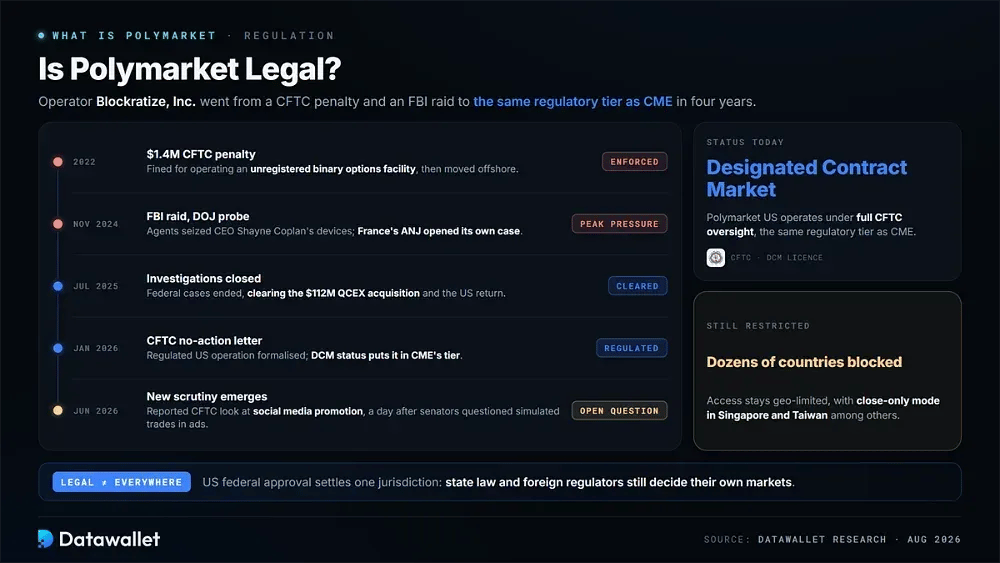
Polymarket is operated by Blockratize, Inc., a Manhattan company that paid a $1.4 million CFTC penalty in 2022 for operating an unregistered binary options facility. It later operated offshore through the 2024 election cycle.
Regulatory scrutiny intensified after the election. In November 2024, the FBI raided CEO Shayne Coplan's New York apartment and seized devices while the DOJ investigated whether Americans had been permitted to trade. France's ANJ also opened an investigation.
Those federal investigations closed in July 2025, clearing the way for the QCEX acquisition and Polymarket's regulated return to the US. The CFTC issued a no-action letter in January. Polymarket US now operates as a Designated Contract Market, placing it in the same regulatory tier as CME.
A different set of pressures has since emerged. Reports of a CFTC investigation into Polymarket's business and social media promotion appeared in late June, one day after senators questioned whether operators may lawfully use simulated trades in promotional material. The platform also restricts users in dozens of countries, with close-only access in jurisdictions including Singapore and Taiwan.
Who Owns Polymarket?
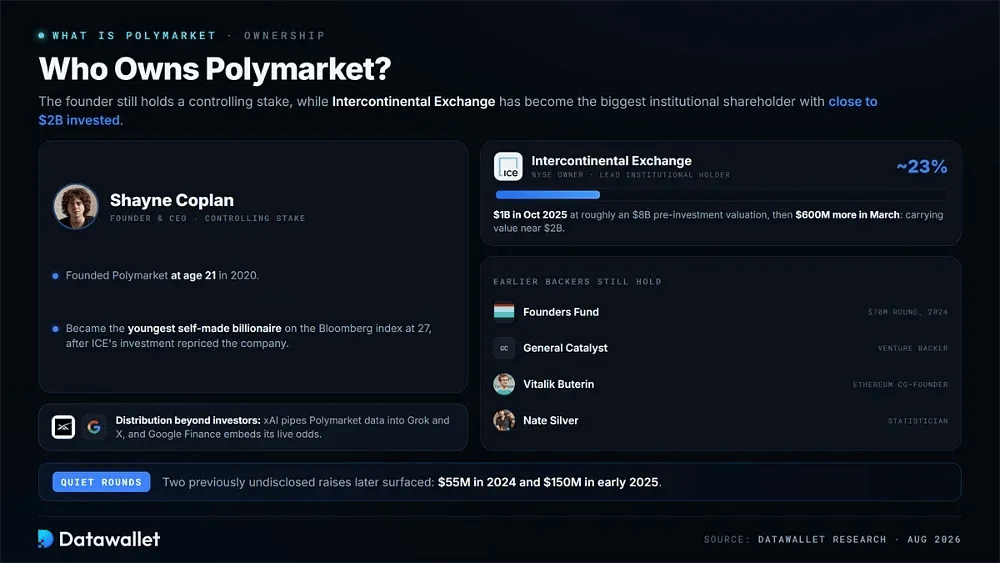
Shayne Coplan founded Polymarket at age 21 and still holds a controlling stake. Following ICE's initial investment, which repriced the company, he became the youngest self-made billionaire on the Bloomberg index at 27.
Intercontinental Exchange has become the company's most significant institutional shareholder. ICE invested $1 billion in October 2025 at roughly an $8 billion pre-investment valuation. It followed with another $600 million in March, bringing the carrying value of its total investment close to $2 billion for about 23% of outstanding shares.
Earlier investors remain shareholders. They include Founders Fund and General Catalyst, Ethereum co-founder Vitalik Buterin and statistician Nate Silver. Two previously undisclosed funding rounds also came to light, with $55 million raised in 2024 and $150 million in early 2025.
Distribution partnerships have expanded Polymarket's reach beyond its investors. A partnership with xAI supplies Polymarket data to Grok and X. Google Finance has also started embedding its live odds alongside Kalshi's, bringing prediction-market data into mainstream financial interfaces.
Risks to Understand Before Trading
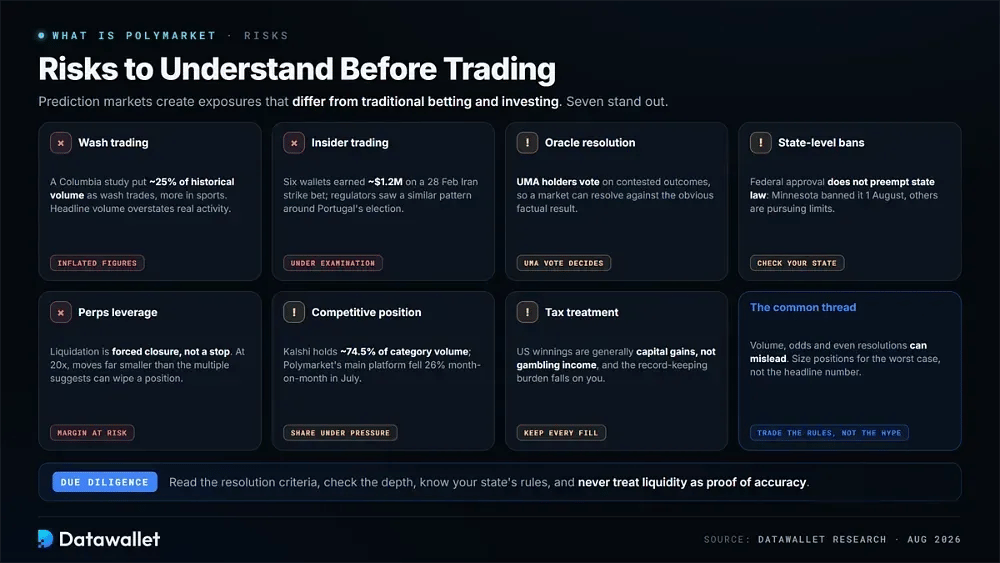
Prediction markets create exposures that differ from those in traditional betting and investing. Key risks include:
- Wash trading estimates: A Columbia University study estimated roughly 25% of Polymarket's historical volume came from wash trading, with a higher rate in sports markets. Headline volume therefore overstates genuine activity.
- Insider trading: Onchain analysts identified six wallets that earned about $1.2 million by correctly betting on a 28 February US strike on Iran. Regulators have examined this pattern alongside similar activity surrounding the Portugal election.
- Oracle and resolution risk: UMA holders decide contested outcomes by vote, which means a market can resolve differently from what participants viewed as the obvious factual result.
- State-level bans: Federal approval does not preempt state law. Minnesota's ban took effect on 1 August, while other states are pursuing restrictions.
- Perpetuals leverage: Liquidation forces a position closed rather than functioning as a controlled stop. With 20x leverage, adverse moves much smaller than the leverage multiple might suggest can wipe out a position.
- Competitive position: Kalshi accounts for roughly 74.5% of category volume and has broader platform coverage. Polymarket's main platform volume dropped 26% month-on-month in July, a shift reflected across prediction market statistics.
- Tax treatment: US winnings are generally treated as capital gains rather than gambling income, with the burden of record-keeping falling on the trader.
Final Thoughts
Polymarket has developed from a niche crypto experiment into financial infrastructure now distributed through Google, ICE and xAI. Its markets frequently price events faster than polls or newsrooms, while the onchain record makes the process auditable in a way traditional bookmakers do not.
The competitive backdrop is more difficult than the funding headlines alone imply. Kalshi controls roughly three quarters of category volume, Polymarket's monthly totals have declined from their March peak, and a new CFTC inquiry has emerged as state-level bans take effect.
For traders, Polymarket remains the deepest venue for politics, geopolitics and international events as the broader prediction market category continues to expand quickly. Perpetuals should be treated as a separate instrument that requires derivatives experience. Traders should also confirm which product their jurisdiction allows and size positions with wash trading and resolution risks in mind.