

About MetaMask
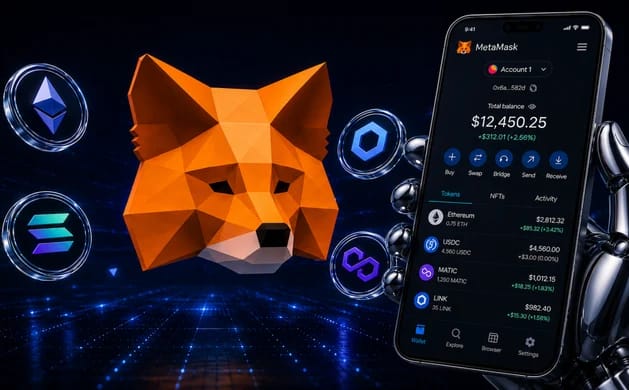
MetaMask is a self-custodial crypto wallet built by Consensys for storing assets, connecting to dapps, and signing onchain transactions. It started as an Ethereum browser extension, but now supports mobile, portfolio tracking, swaps, bridges, staking, cards, and more multichain tools for everyday crypto wallet users.
Unlike a centralized exchange, MetaMask does not hold private keys or custody customer funds. Users control a Secret Recovery Phrase and sign transactions locally, which makes it powerful for non-custodial wallet ownership but unforgiving if backups are lost, phishing links are trusted, or permissions are granted carelessly.
The wallet is strongest for people who actively use DeFi, NFTs, Layer 2 networks, and onchain apps. MetaMask’s official FAQs say it supports ETH, Ethereum token standards, Bitcoin, Solana, TRON, Polygon, Avalanche, and other assets, though network coverage, payment methods, and features still vary by region.
Its product suite now includes MetaMask Portfolio, Card, Snaps, tokenized market access, and Hyperliquid-powered Perps, making it closer to an onchain operating layer than a simple browser plugin for active DeFi users and traders.
MetaMask Features & Products
MetaMask combines wallet custody, dapp access, portfolio management, and trading tools in one interface. The most useful products depend on whether you mainly hold assets, move between networks, use NFTs, manage payments, or actively trade onchain markets.
Wallet & Network Access
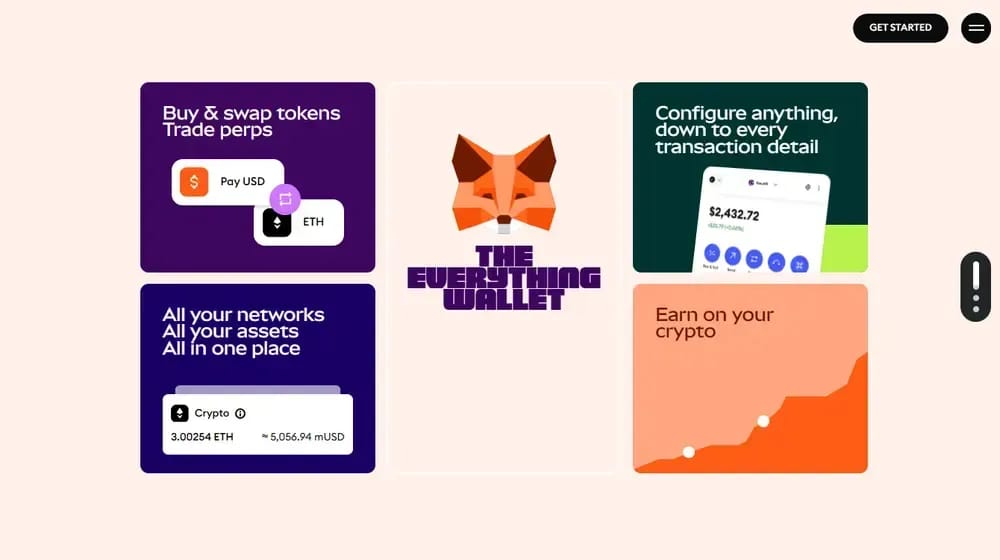
MetaMask’s core wallet still matters most: it stores account keys locally, connects to dapps, and lets users manage multiple networks from one extension or app.
Key wallet capabilities include the following everyday functions:
- Self custody: Private keys and Secret Recovery Phrases stay with the user, so MetaMask cannot reverse mistaken transfers, freeze assets, or recover wallets after backup loss.
- Dapp login: Users can connect directly to DeFi protocols, NFT marketplaces, games, and DAO tools, making MetaMask a standard sign-in layer across Web3 ecosystems today.
- Network access: Default networks include Ethereum, Bitcoin, Linea, Base, Solana, TRON, Polygon, BNB Chain, Arbitrum, Optimism, Avalanche, HyperEVM, and several emerging chains.
- Custom RPCs: Advanced users can add custom RPC endpoints when default nodes are slow, restricted, unavailable, or temporarily degraded.
- Token support: MetaMask supports fungible tokens, NFTs, and popular assets across multiple ecosystems, though some tokens still must be imported manually to display correctly in-wallet.
- Hardware wallets: MetaMask can connect Ledger, Trezor, Lattice, Keystone, and other hardware wallets, adding cold-storage signing to a flexible browser or mobile setup.
Portfolio, Swaps & Bridges
MetaMask Portfolio turns the wallet into a web dashboard for balances, buying, selling, swapping, bridging, staking, and moving assets between chains without opening multiple apps.
The most important portfolio products are listed below:
- Dashboard: Portfolio shows tokens, NFTs, and accounts across connected networks, helping users review balances before making swaps, transfers, staking decisions, or bridge transactions.
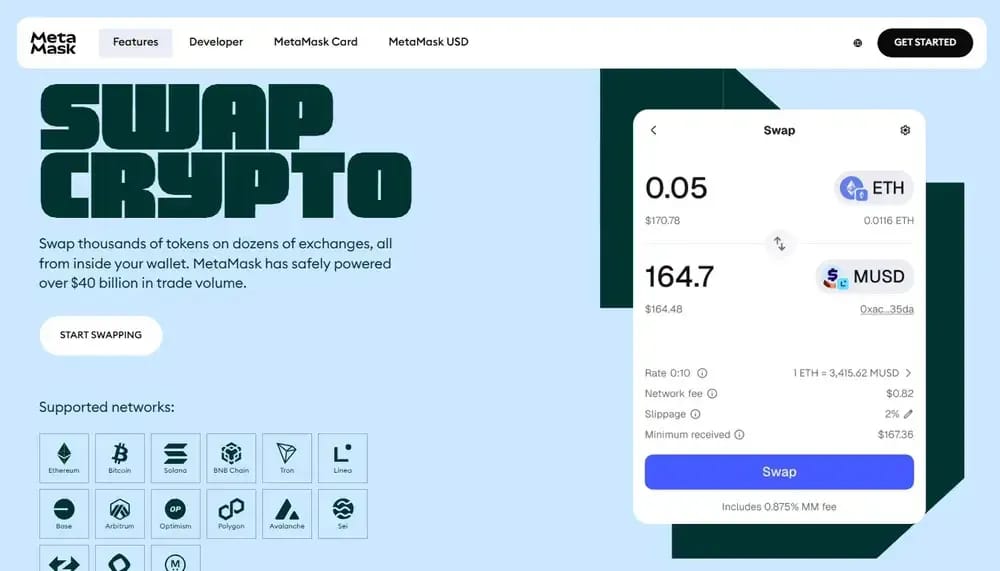
- Swaps: MetaMask Swaps compares routes across liquidity sources, displays quote rate, network fee, and MetaMask fee, then lets users execute inside the wallet.
- Bridges: MetaMask Bridge aggregates routes through providers such as LI.FI and Socket, helping users compare estimated cost, speed, and destination-chain availability before confirming transactions.
- Buy crypto: The Buy flow connects users with regional payment providers, so available assets, cards, bank transfers, and KYC steps vary by jurisdiction and provider selection.
- Sell crypto: The Sell feature lets eligible users cash out to fiat destinations where providers operate, but unsupported regions still need external exchanges or manual transfers.
- Staking: Users can access pooled staking, liquid staking, or validator staking, depending on ETH balance, risk preference, provider availability, rewards, and withdrawal needs.
Snaps, Card & Extra Products
Beyond basic wallet use, MetaMask adds optional products that expand functionality into payments, third-party extensions, market access, and everyday spending across supported chains and regions.
Additional products worth reviewing include these practical options:
- Snaps: MetaMask Snaps lets users install third-party wallet extensions for notifications, transaction insights, interoperability, and specialized workflows from the official directory safely and freely.
- Card: MetaMask Card links supported self-custodied tokens to Mastercard acceptance, converting crypto at checkout while users keep funds in wallet until payment authorization occurs.
- Rewards: MetaMask Rewards assigns levels to eligible activity, with potential benefits such as perps fee discounts, priority support, and campaign-specific incentives over time for users.
- RWAs: MetaMask lists access to tokenized stocks and ETFs through supported product flows, but availability, issuer risk, and compliance requirements may vary by market location.
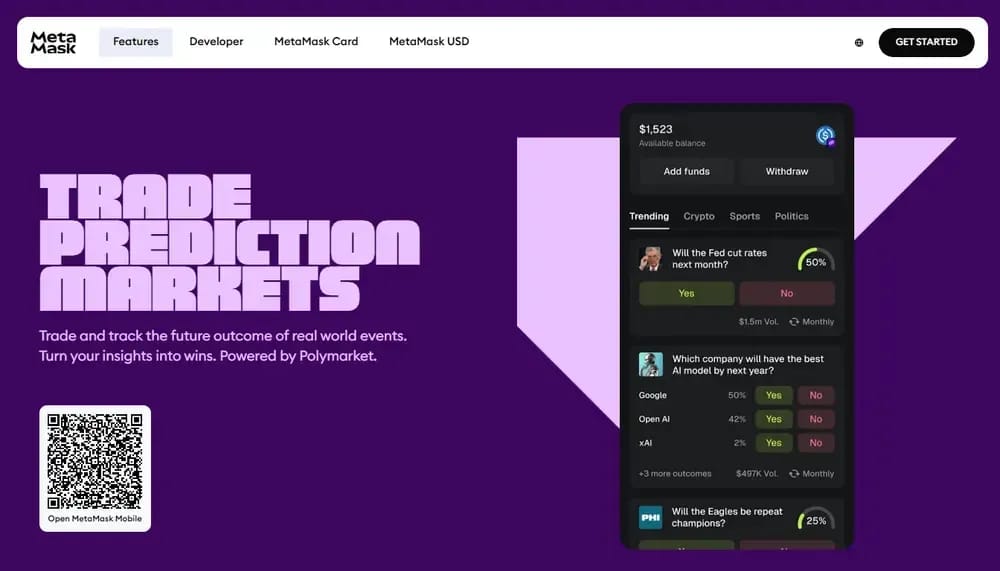
- Predictions: Prediction market access lets users trade real-world outcomes from the wallet interface, adding another speculative product beyond spot swaps and perps trading activity.
- Mobile app: MetaMask Mobile brings the same wallet, browser, QR, token management, card, and perps features to iOS and Android users on the go daily worldwide.
MetaMask Perpetuals Explained
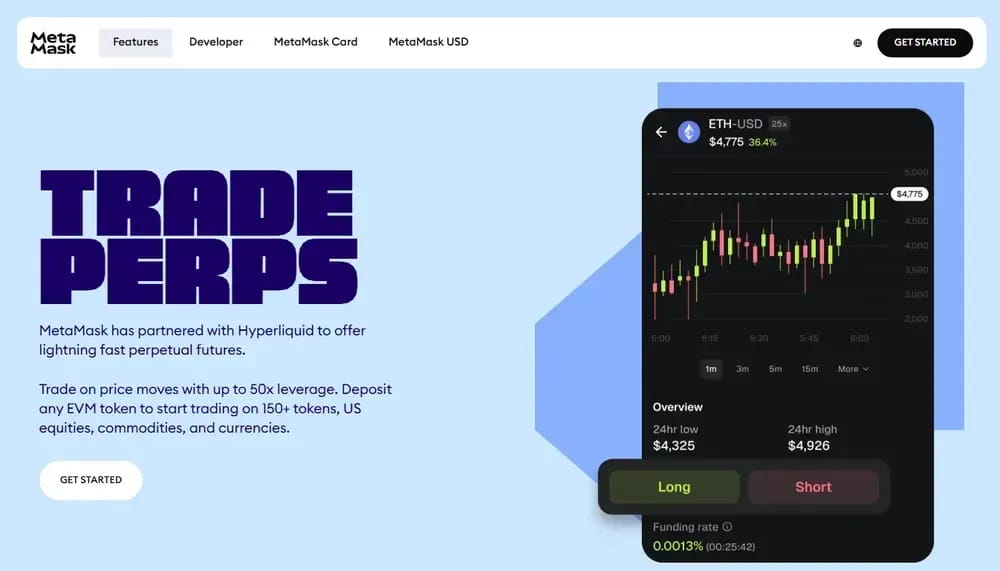
MetaMask Perps is MetaMask’s in-wallet perpetual futures product, powered by Hyperliquid. It lets eligible users go long or short on crypto, stock, commodity, and currency markets without leaving MetaMask, using leverage rather than buying the underlying asset directly through spot markets or exchange custody.
Unlike spot swaps, perpetuals are derivative contracts with no fixed expiry. Traders post margin, choose direction and leverage, pay trading and funding costs, and can be liquidated if price moves against them, making MetaMask Perps suitable only for users who understand perpetual futures risk carefully.
MetaMask Perps Features
MetaMask Perps focuses on fast account funding, simple order controls, isolated margin, and native position management inside MetaMask Mobile or Extension for eligible users.
Key trading features are summarized in this list:
- Asset range: Users can trade 150+ markets through Hyperliquid, including major crypto pairs, selected equities, commodities, currencies, and index-style markets from one wallet interface.
- Leverage: MetaMask says Perps supports up to 50x leverage, which can amplify gains but also compress liquidation distance dramatically during volatile market moves quickly too.
- Funding: Users can fund with EVM tokens from many networks; MetaMask routes deposits into USDC on Hyperliquid, while Solana funding is not supported yet currently.
- Margin: Perps use isolated margin, meaning only the margin assigned to a specific position is at risk, not the available wallet balance or tokens outside.
- Order tools: Users can set long or short direction, leverage, take profit, stop loss, and close positions partially or fully from the Perps tab directly inside.
- Fees: MetaMask says it charges no perps transaction fee, while Hyperliquid provider fees, withdrawal fees, network fees, bridge fees, and slippage may apply separately.
- Notifications: The interface provides live charts and position updates, with push notifications for take-profit, stop-loss, and major market events during active trading periods.
How to Use MetaMask Perps
Using Perps is straightforward, but users should test small sizes first because leverage, funding, slippage, and liquidation can change outcomes quickly in volatile markets.
Typical setup steps follow this practical order below:
- Update app: Download MetaMask Mobile or update the extension, then confirm Perps appears in the interface for your eligible location and account before funding trades safely.
- Open Perps: Tap or click the Perps tab, review the regional warning, and start only after reading MetaMask’s risk notes and trading guide carefully.
- Add funds: Deposit an EVM token from your wallet or fund directly where supported; the system converts the balance to USDC for Hyperliquid trading automatically inside.
- Choose market: Select a crypto, stock, commodity, currency, or index perp, then review volume, open interest, funding, chart, and liquidity conditions first before entering exposure.
- Set trade: Choose long or short, enter margin, adjust leverage, and consider stop-loss or take-profit levels before submitting any order to market execution.
- Confirm order: Review liquidation price, fees, slippage, position size, and collateral source, then sign only if every field matches your plan exactly and clearly.
- Manage risk: Monitor PnL, funding payments, and margin health, reducing or closing positions early when volatility moves faster than expected against you sharply intraday.
- Withdraw funds: Close positions, withdraw available balance, and remember that Hyperliquid charges a flat $1 withdrawal fee to return funds to your wallet afterward.
Is MetaMask Regulated?
MetaMask’s core wallet is not regulated like a bank, exchange, broker-dealer, or qualified custodian because it is self-custodial software. Consensys’s Terms of Use frame certain MetaMask services as licensed software, including staking tools, while users remain responsible for keys, transactions, and legal compliance.
Product-specific rails can involve regulated partners. MetaMask Card is delivered with Crypto Life, a Baanx brand, and Mastercard payment infrastructure; Baanx describes itself as FCA-approved or registered through its entities. Card onboarding also requires KYC, sanctions screening, and country eligibility checks before spending.
Furthermore, MetaMask’s wallet is accessible globally, with buy coverage above 175 countries; default Infura access restricts seven sanctioned regions, while Perps adds separate product bans.
Is MetaMask Safe?
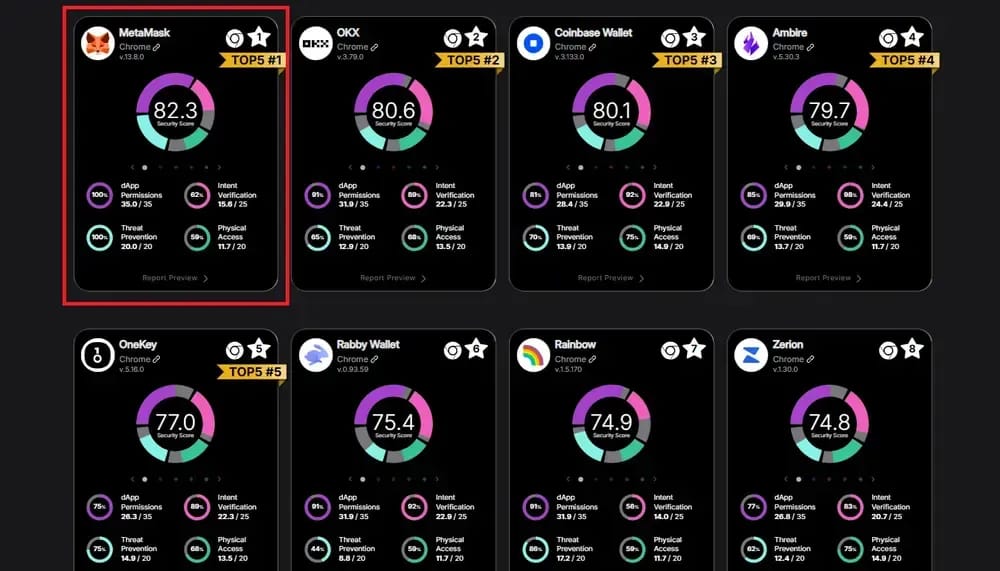
MetaMask is safe in the sense that it does not custody user funds and cannot spend assets without a valid signature. It also provides security alerts that flag scams, phishing, impersonation, and malicious activity before users approve risky actions in-wallet.
However, MetaMask is still a hot wallet, so its weakest point is user behavior. A fake website, seed phrase leak, malicious approval, compromised device, or rushed signature can drain funds faster than support can intervene, trace, or reverse reliably afterward.
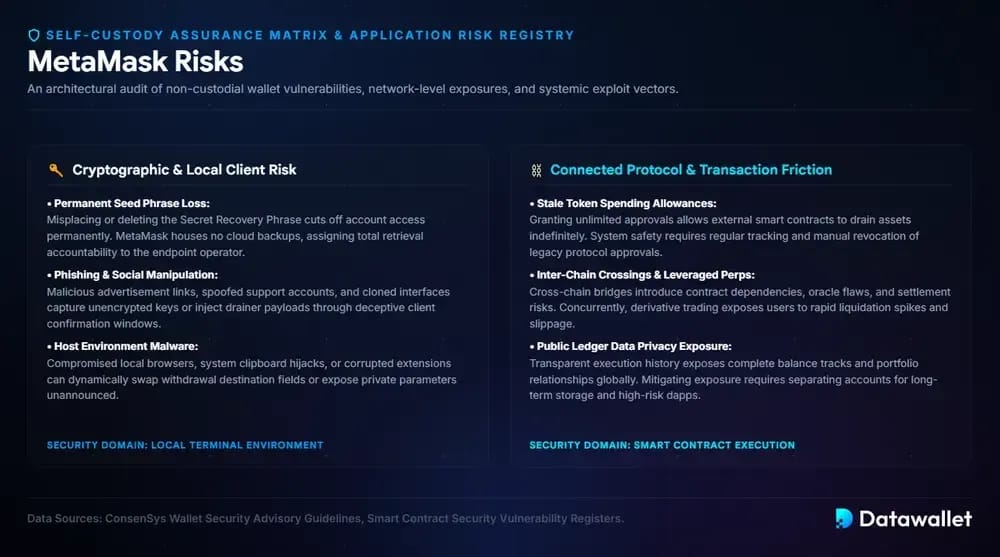
MetaMask Risks
The main risks come from self-custody responsibility, smart-contract permissions, social engineering, and market products that users can access directly from the wallet.
Important MetaMask risks to review before depositing funds:
- Seed Loss: If the Secret Recovery Phrase is lost, MetaMask cannot recover the wallet, and assets may become permanently inaccessible without another valid backup.
- Phishing: Fake support accounts, cloned websites, malicious ads, and wallet-drainer links can trick users into revealing phrases or signing harmful transactions.
- Approvals: Unlimited token approvals let smart contracts spend approved assets later, so old permissions should be reviewed and revoked periodically with care.
- Malware: A compromised browser, phone, clipboard, or extension can alter addresses, expose keys, or redirect users to malicious dapp interfaces unexpectedly.
- Smart Contracts: MetaMask shows transaction prompts, but it cannot guarantee that every connected protocol is audited, solvent, or free of exploitable code.
- Perps Risk: Leveraged positions can be liquidated quickly, and funding payments, slippage, or thin markets may worsen losses during volatile moves.
- Bridge Risk: Cross-chain routes depend on bridges and aggregators, which can introduce contract, liquidity, oracle, and settlement risk beyond normal gas costs.
- Privacy: Public wallet addresses expose onchain history, so users should separate accounts for trading, NFTs, payments, and long-term storage when needed.
MetaMask Fees Schedule
MetaMask costs depend on the action. Users should separate wallet network fees from MetaMask service fees, provider charges, bridge quotes, and product-specific spreads.
The main fee categories are listed below for users:
- Swap fee: MetaMask Swaps charges a 0.875% MetaMask fee on swaps, shown alongside quote rate and network gas before confirmation.
- Gas fees: Every onchain transfer, approval, swap, bridge, stake, or revocation requires network gas, usually paid in that chain’s native token.
- Bridge fees: Bridge routes can include network gas, bridge provider charges, destination-chain costs, and price differences between available routes.
- Perps fees: Perps trading fees vary by MetaMask Rewards level; provider fees apply on opens and closes, plus a flat $1 withdrawal fee.
- Funding rates: Perpetual positions may pay or receive funding while open, and those periodic payments can materially affect leveraged trades.
- Card fees: MetaMask Card says it does not add extra foreign-exchange fees, but users should review transaction-level fees and regional limits.
- Staking fees: Validator staking rewards are reduced by a MetaMask fee; MetaMask support lists a 10% fee on validator rewards.
- Provider fees: Buy and Sell flows rely on third-party providers, so card, bank, spread, KYC, and cash-out charges vary by region.
MetaMask Pros & Cons
MetaMask is best for active onchain users who value control, dapp access, and multichain tools. It is less suitable for beginners who want account recovery, fixed fees, or exchange-style support.
Table below summarizes the main trade-offs.
MetaMask Lawsuit
In June 2024, the SEC sued Consensys, alleging that MetaMask Swaps operated as an unregistered broker and that MetaMask Staking involved unregistered offers and sales of securities through Lido and Rocket Pool staking programs, according to the SEC complaint and Reuters coverage.
The case did not claim the basic wallet was unlawful, but it put DeFi routing and staking interfaces under scrutiny. In March 2025, the SEC filed a joint stipulation dismissing the civil enforcement action with prejudice, while saying the dismissal was not a merits finding.
Final Thoughts
MetaMask remains one of the most capable self-custody wallets for DeFi, NFTs, multichain activity, and in-wallet trading. Its biggest advantage is control; its biggest weakness is that control requires discipline.
For casual holders, MetaMask works best alongside a hardware wallet, clean backups, limited token approvals, and conservative dapp habits. For active traders, Perps and swaps add convenience but increase risk.
Overall, MetaMask is a strong wallet for users who understand self-custody. Beginners should start small, learn transaction prompts, and treat every signature as a real financial decision with consequences.