







Can I Buy Bitcoin with Sberbank?
Sberbank customers can buy Bitcoin peer-to-peer by paying a verified seller in rubles. The bank currently offers no retail crypto service in its app. It has been under full blocking sanctions from the US Treasury since April 2022, alongside EU and UK designations and removal from SWIFT, so no foreign exchange accepts its bank transfers.
In our test, we paid from a СберКарта account through SBP, the Bank of Russia's phone-number transfer system. USDT arrived in our Bybit wallet about ninety seconds after the transfer confirmed. A card-to-card purchase took closer to six minutes. Neither payment prompted a query from Sberbank, though both were below 50,000 rubles and sent in our own name.
Through SberInvestments, qualified investors can buy structured bonds and digital financial assets, or tokenised securities, linked to Bitcoin and Ether. That status requires substantial assets or income. Sberbank also piloted a Bitcoin-collateralised loan with miner Intelion Data last December. These products do not let retail customers hold coins in the app. A retail wallet and digital depository are due in СберБанк Онлайн and SberInvestments by 1 December.
How to Buy Crypto with Sberbank
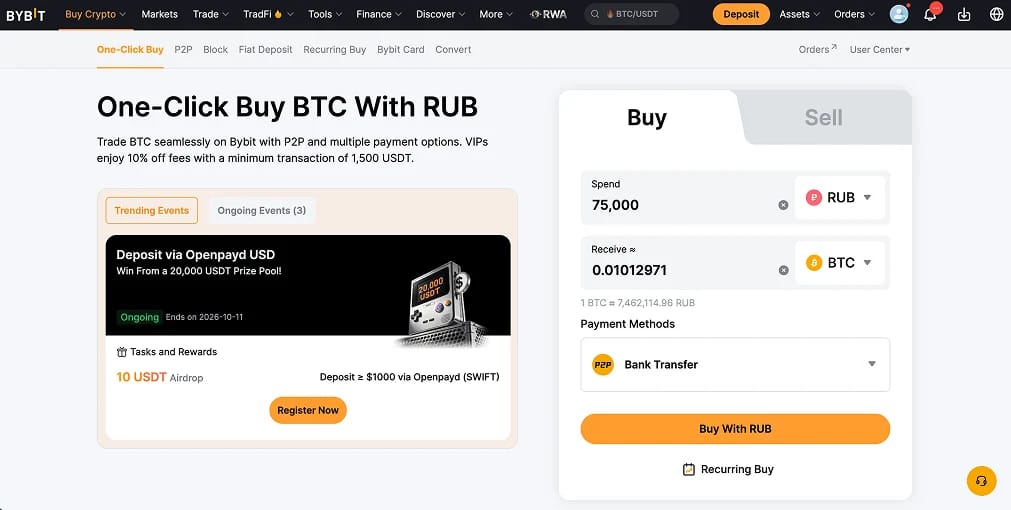
The cheapest route from Sberbank rubles to Bitcoin you can withdraw is to buy USDT on Bybit's peer-to-peer market using SBP, then place a spot limit order at a price you set. Sberbank sees the payment as an ordinary transfer to another person.
Steps to buy crypto with Sberbank:
- Create and verify a Bybit account: Register on Bybit and complete identity checks using your Russian internal passport. Applicants are screened against US, EU and UK sanctions lists. Bybit excludes Crimea, Sevastopol and the occupied Ukrainian regions, so log in from your real location.
- Open the P2P market and filter merchants: Select Buy Crypto, then P2P Trading. Set the currency to RUB and the asset to USDT, and filter by SBP. Look for merchants with completion rates above 97% and several hundred finished orders. Compare their quotes with the official ruble exchange rate.
- Check your Sberbank limits before ordering: Bank of Russia rules allow free SBP transfers to other people up to 100,000 rubles a month, with a maximum of 1 million rubles per transfer. Sberbank also sets a daily ceiling, shown in the app under Лимиты и ограничения. Keep each order within these limits.
- Pay the merchant from your own account: Bybit holds the merchant's USDT in escrow and displays their phone number or card details. Transfer the exact ruble amount from an account in your own name and save the receipt. Mark the order as paid only once the transfer confirms.
- Buy Bitcoin on the spot market: After the merchant releases the USDT, transfer it from your Funding account to your Unified Trading account. Open BTC/USDT and place a limit order. We use Bybit's one-click convert only for a small test because its quoted spread is wider than the 0.10% spot fee.
Fees, Tax and Transfer Limits for Sberbank Customers
Within the free SBP allowance, Sberbank charges nothing for the payment used to make a peer-to-peer purchase. Your costs come from the merchant's spread, meaning the markup over the market rate, and exchange fees. The main risk is the bank's fraud monitoring.
Sberbank costs and limits
- SBP to other people: Transfers are free up to 100,000 rubles a calendar month. Above that, the fee is up to 0.5%, capped at 1,500 rubles per transfer. The maximum single SBP transfer is 1 million rubles, and banks must allow at least 150,000 rubles a day under Bank of Russia rules.
- Daily ceiling: Each customer's limit appears in СберБанк Онлайн under Лимиты и ограничения. Increases take effect immediately for most accounts. Repeatedly raising the limit and then transferring money to strangers, however, is a pattern the bank's algorithms flag.
- Fraud monitoring: On 1 January, the Bank of Russia expanded its mandatory fraud indicators from six to twelve. Sberbank must pause transfers that match an indicator, including frequent payments to unfamiliar cards. Keep peer-to-peer volumes modest and spaced out.
- Dropper database: Customers listed in the regulator's database of suspected money mules face a transfer cap of 100,000 rubles a month. Lending a card to a third party has carried criminal liability since July 2025.
- Sanctions on the bank itself: Sberbank's Visa and Mastercard cards cannot be used outside Russia, and the bank has lost SWIFT access. Ruble funding therefore goes through merchants and SBP instead of direct deposits.
- Deposit insurance: The Deposit Insurance Agency covers ruble deposits up to 1.4 million rubles. Russia provides no insurance for crypto held on any exchange.
Bybit fees
- P2P purchase: Buyers pay no Bybit fee, but merchants include a spread in their ruble quotes. Across our checks, this ranged from 0.6% to 1.4% above the interbank rate.
- Spot trading: Standard-tier maker and taker fees are both 0.10%, with no volume requirement. See our Bybit review for the derivatives fee schedule.
- Crypto withdrawal: Only a network fee applies. USDT withdrawals on Tron (TRC-20) usually cost about a dollar, making transfers to your own wallet inexpensive.
- Selling back to rubles: Bybit also charges no P2P fee when selling. Sberbank monitors incoming payments from multiple buyers, so keep sales to moderate amounts.
Russian tax on crypto
- Personal income tax: Since 1 January 2025, cryptocurrency has been treated as property for tax purposes. Residents pay 13% on annual gains up to 2.4 million rubles and 15% above that threshold. Gains are calculated as proceeds minus documented acquisition costs.
- Foreign holdings: Residents must disclose cryptocurrency held on foreign platforms to the Federal Tax Service under Federal Law 282-FZ.
- Filing: Submit the 3-НДФЛ declaration by 30 April following the tax year and pay by 15 July. Bybit neither withholds tax nor reports to Moscow, leaving you responsible for holding the acquisition-price record for each purchase.
For a 100,000 ruble purchase within the SBP allowance, Sberbank charges nothing. The merchant spread is roughly 1,000 rubles, with another 100 rubles in Bybit spot fees.
Best Exchanges for Sberbank Customers
None of these platforms holds a Russian licence yet. Our comparison considers ruble funding and costs, alongside published evidence that customer assets are backed. Bybit leads for peer-to-peer depth, while Gate offers the broadest altcoin selection. MEXC has the lowest trading fees, and Bitget suits copy traders. The full rankings appear in our best crypto exchanges in Russia guide.
Sberbank Cryptocurrency Policy
Sberbank currently offers qualified investors structured bonds and digital financial assets linked to Bitcoin and Ether. Customers cannot yet hold crypto in its apps, though First Deputy Chairman Kirill Tsarev has committed to launching a retail wallet and depository by 1 December. Pricing, supported assets and eligibility remain unpublished pending the Bank of Russia's final rules.
Sanctions restrict where customers can use a Sberbank account. The US Treasury added the bank and 42 subsidiaries to the SDN list on 6 April 2022. The EU removed it from SWIFT that June, while the UK froze its assets. Under the EU's Article 5b ban on crypto-asset services to Russian nationals, every MiCA-licensed exchange, including Bybit's EU entity, is closed to anyone living in Russia.
Since Federal Law 282-FZ took effect on 1 September, legal crypto trading has been restricted to Bank of Russia licensed intermediaries. Bybit operates outside that framework. Retail investors must pass a knowledge test and can buy up to 300,000 rubles a year per intermediary. Qualified investors have no cap, but paying for goods with crypto remains prohibited.
The deadline for intermediaries to obtain a licence is 1 July 2027. The law allows individuals to trade abroad only through foreign bank accounts, leaving ruble peer-to-peer purchases on offshore platforms outside its framework during the transition.
Existing bank controls still apply. Laws 115-FZ and 161-FZ require Sberbank to suspend transfers that match the regulator's fraud indicators. Since 15 May 2025, customers flagged in the dropper database have been limited to 100,000 rubles in monthly transfers. Lending a card became a criminal offence that July. Our guide to buying USDT in Russia explains how these rules affect stablecoin trades.
About Sberbank
Sberbank began with the savings banks established by decree of Nicholas I in 1841. Today, PJSC Sberbank, branded Sber, is Russia's largest financial institution. The Russian government owns a controlling stake through the Ministry of Finance.
Its scale far exceeds that of domestic rivals. Retail client funds reached 29.7 trillion rubles at the end of the first half of last year, and its loan portfolio stood at 48.4 trillion rubles by the third quarter. More than 100 million retail customers use СберБанк Онлайн, SberInvestments and branches across every region. Beyond banking, the group includes SberDevices and the GigaChat language model, as well as a digital financial asset platform registered with the Bank of Russia.
Sanctions ended Sberbank's foreign footprint. Sberbank Europe AG entered insolvency, and the Czech bank was declared bankrupt. Its Kazakh subsidiary passed to state holding Baiterek, while m3 Groupe acquired the Swiss unit. The remaining business focuses on Russia and a few markets the bank describes as friendly.
Bottom Line
Until December, Sberbank customers must buy crypto outside the bank's own services. Sanctions prevent direct deposits to foreign exchanges, so funding Bybit means paying a peer-to-peer merchant in rubles through SBP. Purchase sizes depend far more on Sberbank's fraud monitoring and the dropper database, together with the 100,000 ruble free SBP allowance, than on fees.
We continue to recommend Bybit inside Russia for its unmatched ruble market depth, flat pricing and Russian interface. Retain every receipt and keep volumes ordinary. Watch for Sber's wallet launch, with a licensed domestic option available for the first time from 1 December.
.webp)