




Can I Buy Bitcoin with Standard Bank?
You can buy Bitcoin with Standard Bank by transferring rand to an external exchange. Crypto purchases are not available directly through the Banking App or Internet Banking. The bank publishes no crypto-specific allowance, rolling payment window, or blocked exchange list, making your standard EAP limit the main restriction.
Standard Bank has also played a direct role in shaping South African crypto law. The bank took the Reserve Bank to court over a forfeiture involving Bitcoin transfers. In May 2025, the Gauteng High Court ruled that crypto assets fall outside the Exchange Control Regulations. The SARB has appealed, leaving the judgment suspended.
How to Buy Crypto with Standard Bank
Funding Bybit through instant EFT keeps the total purchase cost below a quarter of a percent. Ozow handles authorisation through your existing banking login, and purchased coins can be withdrawn from the platform whenever you choose.
Steps to buy crypto with Standard Bank:
- Create and verify a Bybit account: Register with Bybit and complete the identity checks using your smart ID card, green ID book, or passport. FICA requires verification for rand deposits. Your Standard Bank account must also be registered in the same name as your Bybit profile.
- Check your EAP limit: Open Accounts in the Banking App and tap EAP limit. This monthly ceiling applies to third-party payments made through the app, Internet Banking, or ATMs. You can increase it yourself to a maximum of R500,000. Transfers between your own Standard Bank accounts are excluded, but Instant Money vouchers count toward the limit.
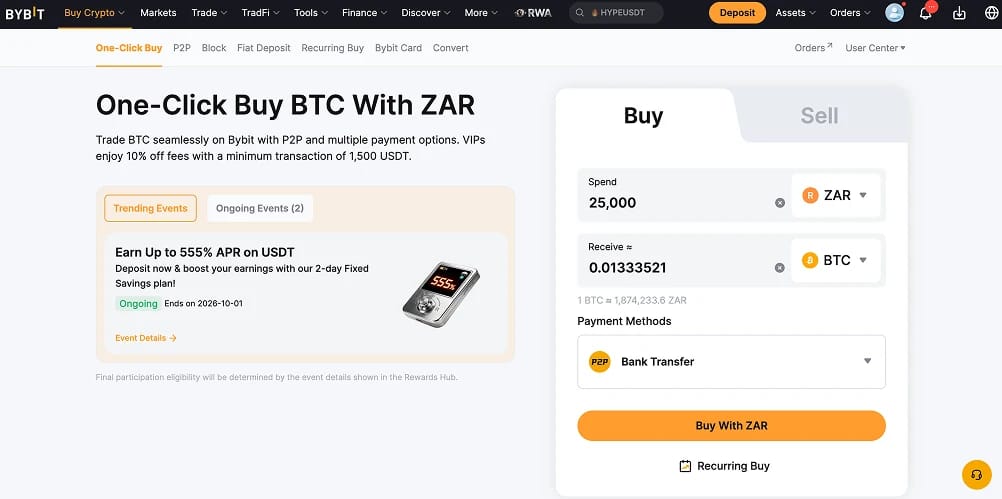
- Start an instant EFT deposit: Open Buy Crypto in Bybit, choose One-Click Buy, and select ZAR. Pick Instant EFT as the payment method, enter the amount, and confirm the order to open Ozow.
- Authorise the payment through Ozow: Choose Standard Bank, sign in with your usual credentials, then approve the transaction in the app when prompted. Deposits most often stall when the name on the paying account does not match the verified Bybit account.
- Place your order: After the rand arrives, open BTC/USDT or another spot pair and place a limit order. One-Click Buy includes a wider spread than the 0.1% order book fee, making the spot market cheaper for purchases above a few hundred rand.
Fees, Tax and Transfer Limits for Standard Bank Customers
Sending rand to an exchange is inexpensive. The more important considerations are the EAP ceiling, card surcharges, and transaction data now reported to SARS.
Standard Bank costs and limits
- EAP limit: This monthly cap covers all third-party payments and can be adjusted in the app up to R500,000. If the setting is greyed out on a new profile, call 0860 123 000 to activate it. You can manage the limit yourself afterward.
- Standard EFT: Transfers settle on the same day or within one business day, depending on the receiving bank and cut-off time. This method suits larger planned deposits where speed is less important.
- Instant EFT via Ozow: The payment is authorised through your Standard Bank login and is typically credited by Bybit within ten minutes. Bybit charges no deposit fee.
- PayShap: Standard Bank caps PayShap at R3,000 per transaction. It is designed for payments to a registered ShapID and cannot fund an exchange account.
- Cards: Standard Bank Visa and Mastercard cards work through exchange card gateways, but these services typically add surcharges of 1.5% to 3.5%. We only use cards for a small initial deposit.
- No crypto cap: Standard Bank publishes no crypto-specific payment allowance and screens transactions individually. A large first payment may trigger an in-app fraud confirmation or phone check. The payment proceeds once you confirm that it was intentional.
- FICA reviews: Licensed exchanges are accountable institutions under the Financial Intelligence Centre Act. Large incoming payments from an exchange may prompt source-of-funds checks, which can usually be answered with exchange statements.
Bybit fees
- ZAR deposit: Ozow instant EFT deposits are free. The bank account holder's name must match the verified name on Bybit.
- Spot trading: Standard-tier maker and taker fees are both 0.1%, among the lowest rates available to South African customers.
- One-Click Buy and cards: The quoted price includes a wider spread, so the order book is cheaper for purchases above a few hundred rand.
- Crypto withdrawal: Only the network fee applies. Sending USDT over Tron (TRC-20) to your own wallet usually costs less than R20.
- Getting rand back: Sell your crypto for USDT, then use Bybit's P2P market to receive ZAR directly in your Standard Bank account. Trade only with verified merchants that have high completion rates and keep the transaction within Bybit's escrow. The platform holds the coins until the payment clears.
South African tax on crypto
- Capital Gains Tax: SARS treats crypto gains as taxable. Investors pay CGT with a 40% inclusion rate and a R40,000 annual exclusion. For top earners, the effective rate is capped at 18%.
- Income tax: Profits from frequent trading, mining, and staking rewards are taxed as revenue at marginal rates of up to 45%. SARS considers both intention and trading patterns when determining the appropriate treatment.
- CARF reporting: South Africa implemented the OECD's Crypto-Asset Reporting Framework on 1 March this year. Licensed platforms now collect client transaction data and report it to SARS. Export your trading history each season, as the tax year runs from 1 March to the end of February.
A R10,000 purchase costs nothing to fund and R10 to execute at Bybit's standard spot rate. Card surcharges and undeclared gains are the most expensive avoidable mistakes for South African customers.
Best Exchanges for Standard Bank Customers
Each platform below accepts rand from a Standard Bank account and operates within the FSCA licensing framework through a different arrangement.
Standard Bank Cryptocurrency Policy
Standard Bank has no retail crypto product and publishes no policy that restricts payments to exchanges. Its broader involvement in the sector is more substantial than many customers realise.
The bank was central to a defining South African crypto case. The SARB's Financial Surveillance Department forfeited more than R26 million from accounts connected to Leo Cash and Carry, which had transferred roughly 4,406 Bitcoin worth R556 million to an exchange in Seychelles. Standard Bank challenged the order to recover money it was owed. The High Court found that crypto assets are neither currency nor capital under the 1961 regulations. The SARB appealed in June 2025, and the ruling remains suspended while that appeal continues.
Lawmakers are now addressing the gap exposed by the case. During the Budget Speech on 25 February 2026, the Finance Minister announced that crypto assets would be added to the capital flows framework. National Treasury then published the draft Capital Flow Management Regulations for public comment on 17 April. Once finalised, the new rules will replace the 1961 regulations and govern crypto transfers to non-residents. They are not aimed at rand purchases made through licensed local platforms, although anyone transferring coins offshore should monitor the final text.
Standard Bank Group also operates a Blockchain Centre of Excellence and holds a seat on the Hedera Governing Council, which oversees a public blockchain network. The FSCA supervises crypto platforms, with 300 crypto asset service provider licences approved from 512 applications by December 2025.
About Standard Bank
Standard Bank began operating in Port Elizabeth in 1862. It has since become Africa's largest banking group by assets, with Standard Bank Group active across 20 African markets. China's ICBC owns a stake of roughly 20%. In South Africa, its retail accounts range from entry-level MyMo to Prestige, Private, and Signature banking.
Customers manage EAP limits, PayShap, and beneficiary payments through the Standard Bank App or Internet Banking. The group also developed Shyft, a foreign exchange wallet for holding and spending major currencies within annual offshore allowances.
The Standard Bank of South Africa Limited is regulated by the Prudential Authority within the SARB, while the FSCA oversees its market conduct. Qualifying deposits are protected by the Corporation for Deposit Insurance up to R100,000 per depositor per bank.

Bottom Line
Standard Bank places few direct restrictions on crypto purchases. It publishes no dedicated crypto cap or blocked exchange list, while customers can raise their EAP limit in the app to R500,000. This provides considerably more room for a meaningful Bitcoin purchase than many global banks allow.
Bybit remains our preferred exchange for Standard Bank customers. It combines free Ozow instant EFT deposits with 0.1% spot trading and local marketing authorisation through Money Doc (FSP 52081). Ensure the paying account name matches your Bybit profile, use the order book instead of One-Click Buy for larger purchases, and regularly export your trading history because SARS now receives transaction data directly.
Our guides to the best crypto exchanges in South Africa and buying crypto with Capitec or FNB cover the rest of the local market.