







Can I Buy Bitcoin with WeChat Pay?
Yes, but never in the app. WeChat Pay has no crypto product and no custody, and Tencent closes merchant accounts caught dealing in virtual currency. The only method anywhere is a peer-to-peer trade, paying a verified seller's WeChat and receiving crypto into an exchange wallet.
In practice that market is priced in yuan. The P2P desks where sellers accept WeChat are deep, and they sit inside China's September 2021 ban on all virtual currency business. Offshore exchanges cannot serve mainland residents either, Gate included, so trading here runs against local law and bank screening.
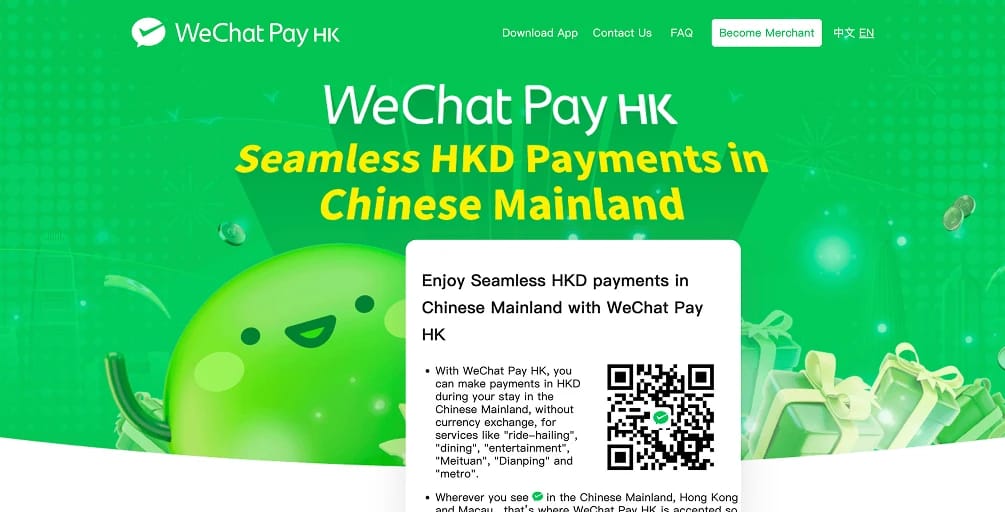
Hong Kong is the legal side. WeChat Pay HK is a Tencent-run HKD wallet, and crypto trading is licensed in the city. The catch is that its SFC-licensed exchanges onboard by bank transfer and FPS rather than WeChat, so the clean HKD path skips WeChat entirely. Choose WeChat and you are back in the yuan P2P market.
How to Buy Crypto with WeChat Pay
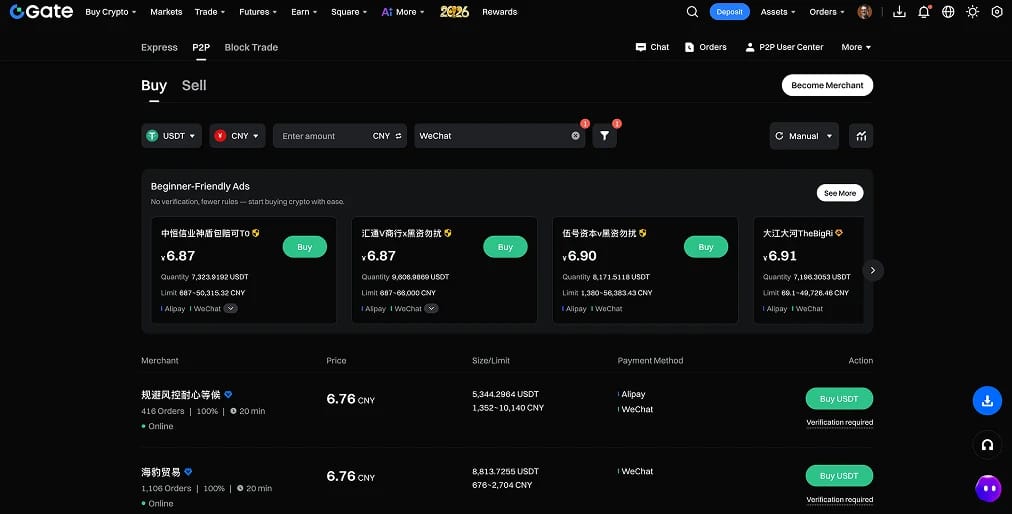
Buying through Gate means getting yuan to a seller, then placing the trade. Gate's WeChat market is a USDT and CNY order book filtered to merchants who accept WeChat, with escrow holding the crypto until your payment clears.
Steps to buy crypto with WeChat Pay:
- Create an account: Sign up on Gate and finish KYC with your ID. Verification is required before P2P or spot trading opens, and your WeChat real-name profile should match your exchange account, or a seller may reject the payment.
- Open P2P and set WeChat Pay: Go to Buy Crypto > P2P, choose USDT, set the currency to CNY and add WeChat as the payment method. It must match what the seller accepts, so set it before browsing offers.
- Pick a seller and check limits: Sort by completion rate and order count, and read the seller's terms. WeChat caps what an account can send, with a fully verified wallet clearing far more than a basic one, so split a large buy across orders if needed.
- Pay and mark complete: Place the order, send the agreed amount to the seller's WeChat, and add a plain note or none at all. Never type "USDT", "crypto" or a coin name into the transfer message, the fastest way to get a wallet or card flagged. Mark the order paid once sent.
- Buy your asset: The seller releases crypto to your funding wallet, usually within minutes. If you bought USDT, go to spot, search BTC/USDT or your pair, and place a limit order, which sidesteps the wider spread on the one-click buy.
Fees, Limits and the Freezing Risk for WeChat Pay Users
Three things shape your real cost, the WeChat transfer, the exchange leg and the freezing risk that comes with crypto-linked money here. The last one carries the genuine danger.
WeChat Pay costs and limits
- Wallet transfers: A WeChat payment to a P2P seller carries no fee on your side. You pay only the price agreed with the seller.
- Account limits: WeChat Pay binds to a real-name verified card, and send ceilings scale with verification. A fully verified WeChat wallet clears much more than a basic one, so check yours before a large order.
- Funding source: A WeChat balance topped up from your own bank account is cleaner than routing through cards. Keep the source consistent so the trail is easy to explain.
- No reversal: WeChat transfers settle instantly and cannot be clawed back, which is why exchange escrow matters. Never release a trade outside the platform.
Gate costs
- P2P deposit: Free. There is no transaction fee on the P2P leg.
- Spot trading: 0.20% standard, lower with GT holdings or higher volume.
- One-click buy: A wider spread sits inside the quoted price. Fine for a first test, dearer than spot at size.
- Crypto withdrawal: Network fee only. USDT on Tron (TRC-20) is usually around a dollar.
The freezing risk
This is the part most WeChat Pay guides skip. On the mainland, banks and police run virtual currency screening, and accounts receiving money traced to crypto, fraud or gambling get frozen, sometimes for a single coin name typed into a transfer memo. Unfreezing means proving the funds were clean, which can take weeks with no guarantee.
In Hong Kong, the HKMA holds WeChat Pay HK to stored-value AML rules and fined it in 2024 for due-diligence lapses, so unusual patterns draw scrutiny there too. Trading through escrow, keeping orders modest and leaving transfer notes plain are the practical defences. Gate's wider profile, including past security incidents, sits in our Gate review.
Best Exchanges for WeChat Pay Users
Every working option here is a yuan P2P desk, since that is where WeChat crypto liquidity sits and no major exchange takes WeChat as a direct deposit. What separates them is depth and escrow rather than currency, and Gate pairs an active CNY WeChat book with free P2P and a broad licensing footprint.
WeChat Pay Cryptocurrency Policy
WeChat Pay provides no crypto service, and Tencent enforces that hard, suspending merchant and personal accounts tied to virtual currency dealing. The stance follows the law at home.
China moved from a 2013 notice treating Bitcoin as a virtual commodity, to the 2017 shutdown of domestic exchanges and token sales, to the September 2021 Notice from the People's Bank of China and nine other bodies, which declared every crypto business activity illegal and pulled offshore exchanges serving residents into scope. Non-bank payment institutions, WeChat among them, cannot provide any crypto-related service.
Hong Kong took the opposite path. Since 1 June 2023 the SFC has licensed virtual asset trading platforms under the Anti-Money Laundering Ordinance, with thirteen approved by mid-2026 and retail access allowed under investor-protection rules. WeChat Pay HK runs on a Monetary Authority stored-value facility licence held since 2016, separate from the crypto regime.
The two systems coexist, which is why Hong Kong's regulated venues sit on firmer ground than the yuan P2P market that WeChat actually feeds.
About WeChat Pay
WeChat Pay is the payment layer inside WeChat, the Tencent super-app used by more than a billion people. On the mainland it operates as Weixin Pay in yuan and splits the mobile-payment market with Alipay. In Hong Kong it runs as WeChat Pay HK, a separate Hong Kong dollar wallet that became the first overseas e-wallet cleared to spend across mainland China, and it holds close to half the city's mobile-payment usage.
Beyond those two markets, WeChat Pay settles in sixteen currencies for cross-border merchants and reaches users across Malaysia and other parts of Asia. Funding comes from a linked card or stored balance, and money moves through QR codes, in-app payments and, in Hong Kong, the Faster Payment System. Tencent answers to the People's Bank of China on the mainland and the Hong Kong Monetary Authority for the HK wallet.
For other ways into crypto from the same ecosystem, our guides on Alipay and Bank of China cover the closest siblings.
Bottom Line
Buying crypto with WeChat Pay means using a P2P desk and being honest about where you are. There is no in-app purchase, no direct deposit at any major exchange, and the legal footing swings from banned on the mainland to regulated in Hong Kong.
Gate is our pick because its WeChat P2P market in yuan is deep and escrow-protected, the P2P leg is free, and 3,800+ assets open up once funds land. That market sits inside China's ban, so trade modest sizes, lean on escrow, and never label a WeChat transfer with anything that reads as crypto. Hong Kong residents who want the fully legal path are better off on a licensed HKD exchange funded by bank transfer.
The risk to manage here is the frozen account rather than the fee.
.webp)