







Can I Buy Bitcoin with a Credit Card?
Most regulated exchanges outside the US allow credit card purchases, provided your card issuer approves them. Visa's Merchant Data Standards Manual requires crypto payments to use merchant category code 6051 or 6012, which identify cash-like products, and carry a dedicated crypto marker. The issuer can identify the purchase as crypto before authorising payment.
How banks handle these payments varies. Some process them as ordinary purchases; many apply cash advance terms. The CFPB lists buying cryptocurrency among transactions that trigger cash advance fees and interest from the transaction date. Barclaycard in the UK and CommBank in Australia refuse them altogether.
Using Apple Pay or Google Pay does not change this treatment because the issuer receives the same merchant code. In our tests, Kraken rejected a US-issued credit card at the add-card screen before attempting a charge. A German-issued Visa credit card on a second account cleared on the first attempt.
How to Buy Crypto with a Credit Card
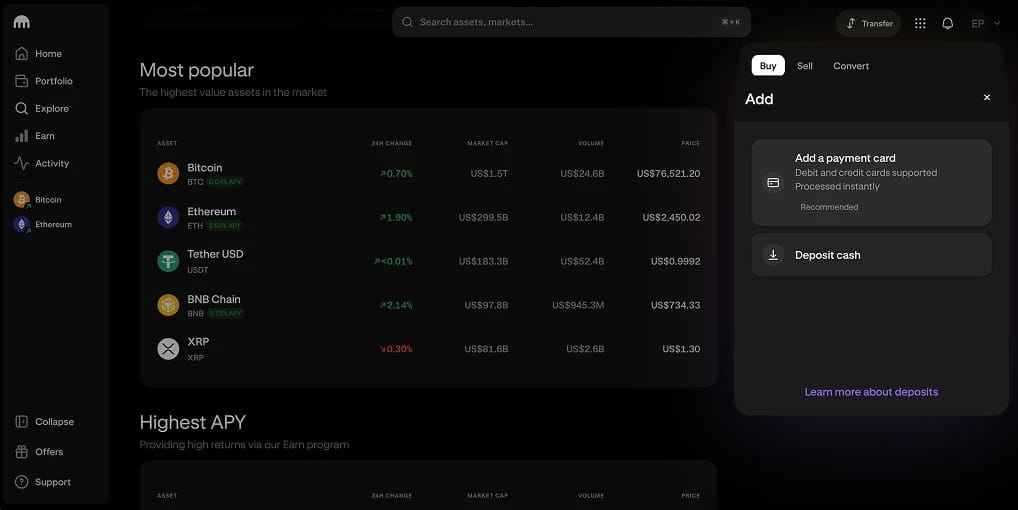
You need a verified Kraken account and one 3D Secure approval from your bank to buy by card. We use Kraken because it has a locally licensed entity in each major market. Bitcoin reached our account within a minute of placing a 100 EUR test order.
Steps to buy crypto with a credit card:
- Open and verify a Kraken account: Sign up on Kraken and complete identity checks (KYC) using a passport or driving licence. For UK accounts, a mandatory 24-hour cooling-off period applies before the first trade, so register a day ahead.
- Check the card before you add it: Kraken accepts Visa and Mastercard in your own legal name with 3D Secure enabled. It does not support American Express. You can successfully save a card only four times in any rolling 30-day period.
- Ask your issuer how it bills crypto: Check the cash advance section of your card agreement or call the number on the back. If the issuer classifies crypto as a cash advance, its fee and daily interest apply even when Kraken's checkout succeeds.
- Place the order in Buy Crypto: Choose an asset and enter an amount in your local currency. Select the saved card, then approve your bank's 3D Secure prompt. Kraken itemises its fee on the confirmation page. Purchases are final once submitted.
- Wait out the hold, then withdraw: Each card purchase locks an equivalent value from withdrawal for 72 hours. After the hold lifts, move long-term holdings to a personal wallet you control. Compare options in our best crypto wallets guide.
If a card charge produces no crypto, Kraken voids the transaction within two hours. The pending entry usually disappears from your statement within a day.
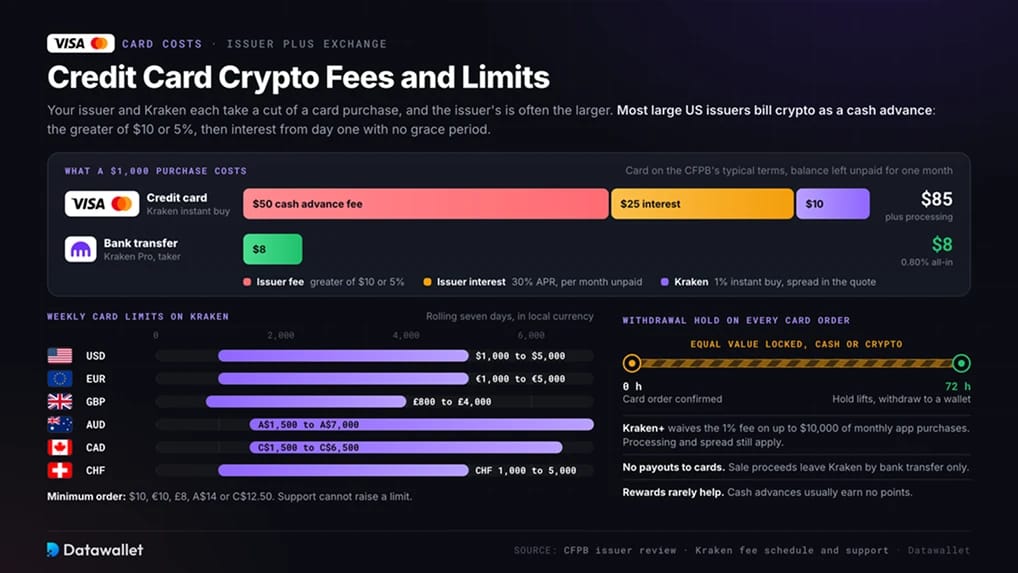
Credit Card Crypto Fees and Limits
A card purchase can incur charges from both Kraken and your issuer. The issuer's portion is often larger.
What your card issuer may charge
- Cash advance fee: In its review of agreements from seven large US issuers, the CFPB found that most charge the greater of $10 or 5% of the transaction. Rates elsewhere depend on the issuer.
- Cash advance interest: There is no grace period. Interest begins on the transaction date, even if you pay your balance in full each month. The same review found that 30% was the most common cash advance APR, the annual percentage rate charged on the balance.
- Foreign transaction fee: This applies when payment is billed in another currency. Kraken uses your verified country of residence to set the payment currency, so most buyers pay in their home currency.
- Rewards: Cash advances usually earn neither points nor cashback. A rewards card therefore rarely offsets the cost.
Kraken card fees
- Instant buy fee: Under Kraken's fee schedule, instant and recurring orders cost 1%, while custom orders cost 1.5%. The quoted price also includes a spread, the gap between the market rate and the rate you receive.
- Card processing fee: There is no published fixed card rate. The charge depends on the payment method and appears on the final confirmation page.
- Kraken+: Paid members have the 1% fee waived on up to $10,000 of monthly app purchases. The spread and card processing charges still apply.
- Kraken Pro by bank transfer: Since 9 July, Kraken Pro's entry-level order book fees have been 0.40% maker and 0.80% taker. See our Kraken fees breakdown for the new tiers and our maker vs taker explainer for definitions of the two order types.
Kraken card limits and holds
- Weekly purchase limits: $1,000 to $5,000 in USD; €1,000 to €5,000; £800 to £4,000; A$1,500 to A$7,000; C$1,500 to C$6,500; CHF 1,000 to 5,000. These limits apply over a rolling seven-day period and change with account history. Support cannot raise them.
- Minimum purchase: $10, €10, £8, A$14, or C$12.50.
- Daily transaction count: Worldpay processes card payments. Kraken caps successful card transactions within any rolling 24-hour period.
- Withdrawal hold: Each card purchase places a 72-hour hold on an equivalent value in cash or crypto. USD purchases may face the hold on every order.
- No card withdrawals: Sale proceeds must leave by bank transfer because Kraken cannot pay out to a card.
Under the CFPB's typical card terms, a $1,000 purchase incurs a $50 cash advance fee and roughly $25 in interest for each month the balance remains unpaid. Add $10 for Kraken's 1% fee, followed by the card processing charge and spread. Funding the same $1,000 through a free bank transfer and buying on Kraken Pro costs $8 at the taker rate. This cost difference is why we limit our own card use to small test orders.
Best Exchanges That Accept Credit Cards
All four platforms below base card acceptance on where the card was issued. We rank local licensing and fee disclosure above coin count because they determine whether a card order clears and how much it costs.
For cardholders in the EEA, Canada, and Australia who want a locally licensed provider, Kraken leads. Bybit has the lowest published card rates for EU-issued cards, while OKX offers licensed entities in Dubai and Singapore. Coinbase suits US buyers using debit cards.
Credit Card Crypto Rules by Region
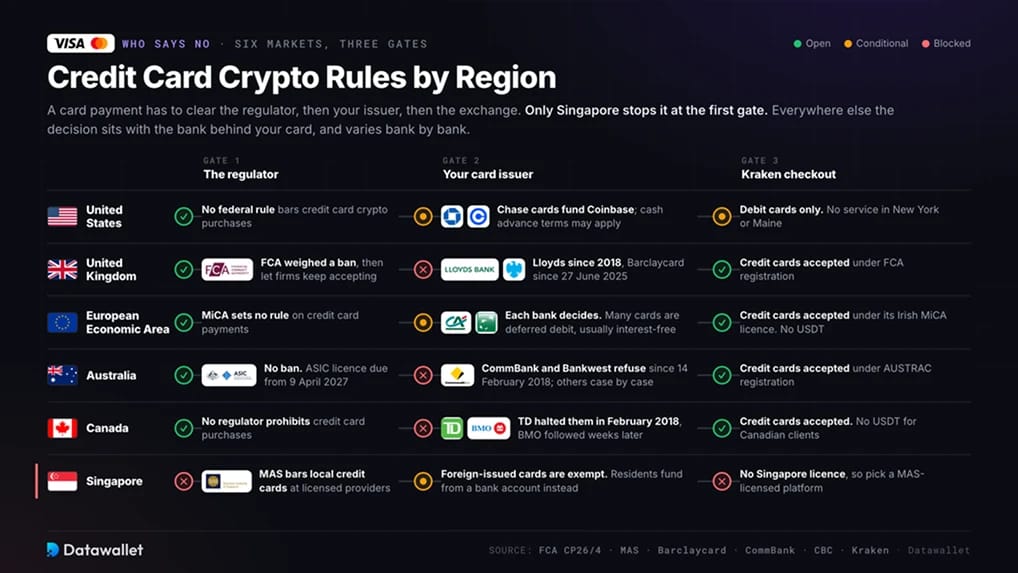
Singapore is the only market below that restricts credit card crypto purchases through regulation. In the other regions, card issuers decide whether to approve them, with policies varying by bank.
- United States: Federal rules do not prohibit credit card crypto purchases, but exchanges impose stricter limits. Coinbase's US payment methods list debit cards without a credit option. In July 2025, JPMorgan and Coinbase announced that Chase credit cards would fund Coinbase accounts. Coinbase warned that cash advance terms may apply. Compare licensed platforms in our best US exchanges guide.
- United Kingdom: After considering a ban on buying crypto with credit, the FCA, the UK's financial regulator, concluded in consultation paper CP26/4 that firms could continue accepting it. Issuer restrictions remain. Lloyds Banking Group has refused these payments since 2018. Citing unaffordable debt, Barclaycard followed on 27 June 2025. UK buyers instead fund FCA-registered exchanges by debit card or bank transfer, subject to the caps covered in our Barclays guide. Our best UK exchanges guide tracks registered firms.
- European Economic Area: Each bank sets its policy because MiCA, the EU's crypto licensing regime, imposes no rule on credit card payments. Many European cards are deferred debit cards, which collect a month's spending from your current account in one payment, usually without interest. French banks including Crédit Agricole and BNP Paribas label these cards CRÉDIT.
- Australia: Since 14 February 2018, CommBank has refused credit card purchases of virtual currencies, including on Bankwest cards. Other issuers decide case by case. Exchanges must register with AUSTRAC, the anti-money laundering regulator. From 9 April 2027, the Digital Assets Framework Act also requires platforms holding customer crypto to have an ASIC licence. PayID, Australia's instant bank transfer, is covered in our CommBank and NAB guides.
- Canada: Credit card purchases face no regulatory prohibition. TD voluntarily halted them in February 2018, with BMO following weeks later. For bank funding, our RBC and Scotiabank guides explain Interac e-Transfer, Canada's instant bank transfer.
- Singapore: Licensed crypto providers are prohibited by the Monetary Authority of Singapore from accepting locally issued credit cards from retail customers. The restriction exempts foreign-issued cards. Residents should choose a MAS-licensed platform from our best Singapore exchanges guide and fund it through a DBS or OCBC account.
Under its local registrations, Kraken accepts credit cards in the UK, EEA, Canada, and Australia. US customers can use debit cards only. Kraken does not serve New York or Maine and has no Singapore licence. It also cannot sell USDT to EEA or Canadian clients, a restriction addressed separately in our USDT by credit card guide. For a market-by-market list of availability and product restrictions, see Kraken supported countries.
About Credit Cards and Crypto Payments
Credit cards let you borrow from a bank up to an agreed limit and repay later. In the US, UK, Canada, and Australia, the standard product is a revolving card, which charges interest on balances carried beyond the due date. Charge cards and Europe's deferred debit cards instead collect the full balance each month. The card type determines whether a crypto purchase can become interest-bearing debt.
Although Visa and Mastercard set merchant codes, banks make their own credit risk decisions. This explains why two cards on the same network can produce different results at the same checkout.
Your bank uses 3D Secure to ask you to approve an online payment through its app or a one-time code. Branded as Visa Secure or Mastercard Identity Check, it helps European banks meet strong customer authentication rules.
Dispute rights cover unauthorised payments and goods that never arrive. They do not cover a coin losing value after it reaches your account. Exchanges also treat completed card purchases as final and non-refundable.
Bottom Line
Buying crypto with a credit card means borrowing at cash advance rates to purchase a volatile asset. Many large issuers in the UK, Canada, and Australia refuse to lend for that purpose. Where payment is approved, speed is the only advantage over a bank transfer.
For buyers who still want this option, we recommend Kraken. It accepts credit cards where local rules and its licences allow, with the full fee shown before payment. Check your issuer's treatment of crypto before placing an order. Keep purchases small and clear the balance before the statement closes.
Withdraw your long-term holdings after the 72-hour hold expires. Coins held on any exchange remain that exchange's liability to you.
.webp)