




About Gate
Gate began life in 2013 as Bter.com, a Chinese exchange founded by Lin Han, who still leads the group as Dr. Han. Bter suffered a theft of 7,170 BTC in February 2015, and after Beijing shut down domestic crypto trading in 2017, the business relaunched offshore as Gate.io under a Cayman Islands-based company.
The 2025 rebrand dropped the ".io" entirely. The exchange now operates as Gate on the Gate.com domain, backed by sponsorships of Oracle Red Bull Racing and Inter Milan that signal how aggressively it is chasing mainstream reach. Dr. Han has framed the repositioning around tokenized real-world assets, and the product lineup increasingly reflects that.
The scale is easy to underestimate. Reported turnover reached $3.8 trillion in 2024, with derivatives contributing slightly more than half of it, and the user base cleared 30 million in mid-2025 before topping 40 million by November. On most days, it ranks among the top five exchanges for spot volume on CoinGecko and CoinMarketCap and among the top handful for perpetual futures.
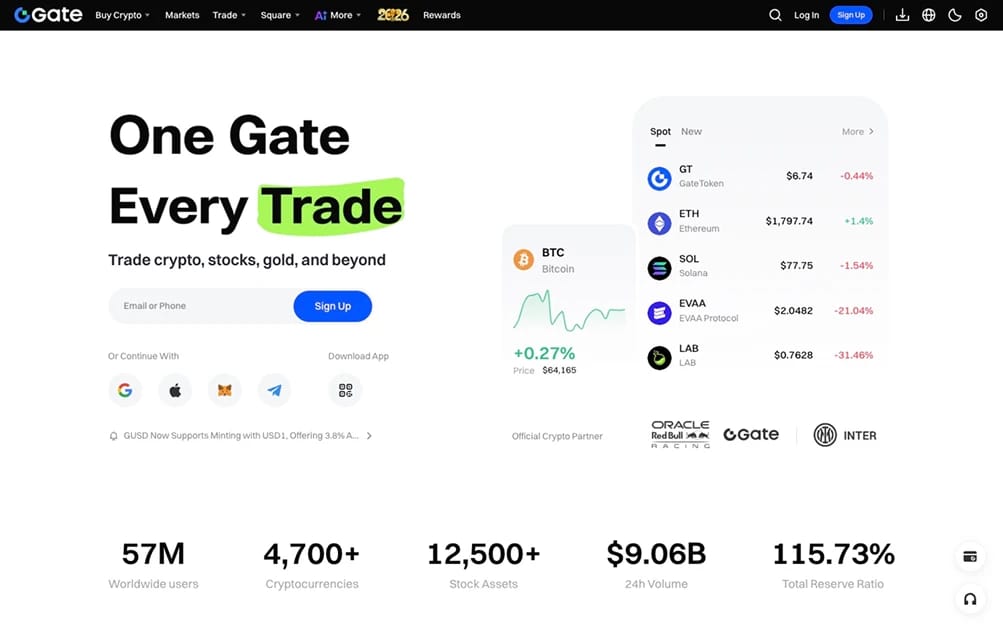
Gate Features
Gate's identity has always been breadth. New tokens frequently list here weeks before larger exchanges touch them, and the surrounding product stack has grown into one of the busiest in the industry. The density can overwhelm a first-time user, so it helps to know what each layer does before opening the app.
The main products across the platform include:
- Spot and margin trading: Over 3,500 coins across thousands of pairs, with strong depth on majors and a long tail of small caps where spreads widen quickly. Margin is available in isolated and cross modes inside the unified account.
- Perpetual and delivery futures: Hundreds of USDT-margined perpetuals plus inverse BTC contracts and dated delivery futures, with leverage up to 100x on major pairs.
- Options and leveraged tokens: European-style vanilla options on top assets sit alongside leveraged ETF tokens that rebalance automatically, giving amplified exposure without margin management or liquidation risk.
- Stocks and traditional assets: Eligible users can trade real US, Hong Kong, and Korean equities, USDT-settled stock futures on names like Nvidia, tokenized stocks backed by real shares, and CFDs on gold and other traditional markets.
- Copy trading and bots: Grid, DCA, and strategy bots run alongside a large copy trading marketplace, which we compare against rivals in our roundup of the best crypto copy trading platforms.
- Launch programs: Launchpad and Launchpool distribute new tokens to GT and stablecoin stakers; CandyDrop handles airdrop campaigns, and the Alpha points system introduced in 2025 gates early token events by platform activity.
- Earn, loans, and payments: Staking, dual investment, and crypto-backed loans cover the yield side, while Gate Pay and the Visa-linked Gate Card handle spending.
- Web3 ecosystem: GT, the exchange token, feeds a buyback-and-burn program funded by 20% of annual profits, and GateChain anchors Gate Wallet and a standalone Gate DEX.
New users signing up can also check our Gate referral code guide before registering, since welcome rewards are tied to deposit and trading tasks completed in the first days.
.webp)
Funding a Gate Account
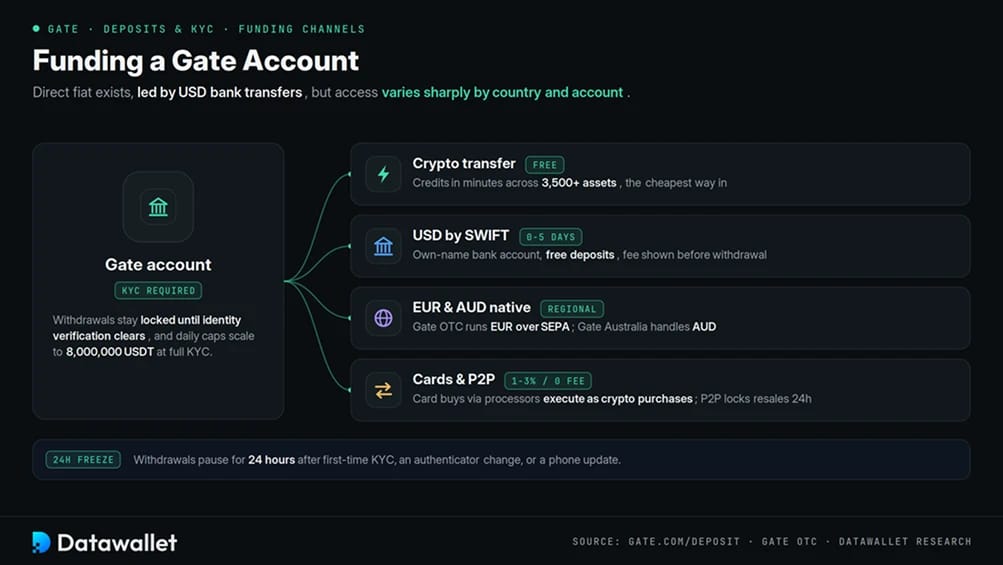
Funding on Gate is broader than most reviews suggest, but access varies sharply by country and account. Direct fiat deposits exist, led by USD bank transfers, while other channels convert your money to crypto at the point of purchase.
When we funded a test account, a USDT transfer over TRC-20 from another exchange was credited within minutes and cost nothing on Gate's side. Getting money back out took longer, because the withdrawal screen stays locked until identity verification clears, with no workaround.
How each funding channel works:
- Crypto deposits: Free across the full asset list, with most major coins supported on several networks. Match the network to your sending wallet exactly, since a wrong-chain transfer is often unrecoverable.
- Card purchases: Debit and credit card purchases run through third-party processors such as Banxa, MoonPay, and Coinify rather than Gate itself. Expect 1% to 3% plus a spread, and the cardholder name must match your Gate account.
- P2P trading: The peer-to-peer market covers dozens of local currencies with zero taker fees and escrowed settlement. Crypto bought via P2P is locked for 24 hours before it can leave the platform, an anti-fraud measure that caught us mid-trade.
- USD bank deposits: Eligible users can wire USD by SWIFT from a bank account in their own name into a fiat balance, then buy crypto against it. Gate quotes settlement at 0 to 5 business days and charges nothing on deposits.
- USD withdrawals: Supported where available, with the withdrawal fee displayed before you confirm. Correspondent banks along the SWIFT chain can take their own cut.
- Regional entities: Gate's licensed local arms process native fiat in their home currencies. The MiCA and PSD2-covered European business handles EUR deposits and withdrawals, and AUSTRAC-registered Gate Australia does the same for AUD through domestic banking.
- Gate OTC: Bank transfer deposits and withdrawals through Gate OTC serve eligible accounts, aimed mainly at larger transactions.
- Buy & Sell channels: Visa, Mastercard, SEPA, and other regional methods work in supported markets, though these execute as crypto purchases rather than as funding a reusable fiat balance.
Verification runs in tiers. Personal details and an ID number come first, a document scan and selfie next, and proof of address last, lifting the daily withdrawal cap to 8,000,000 USDT.
A 24-hour withdrawal freeze follows first-time KYC, an authenticator change, or a phone number update. We tripped it after swapping authenticator apps, so schedule security changes for a day you won't move funds.
Gate Fees Explained
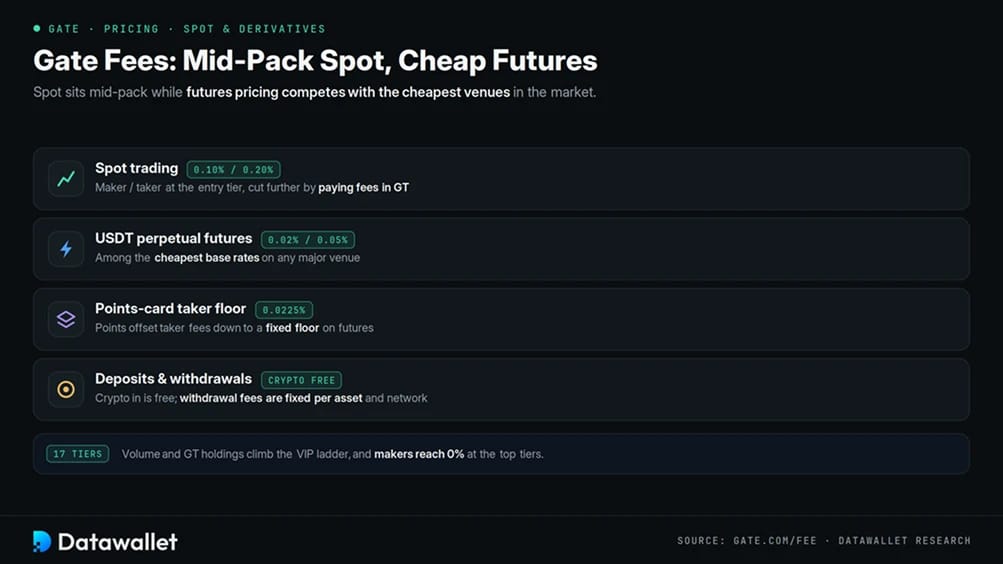
Gate has a 17-tier VIP ladder on both spot and futures trading, and the entry-level rates tell two different stories. Spot is slightly above average, while derivatives pricing competes directly with Binance and Bybit.
The main costs to understand before trading:
- Spot trading: Entry-tier fees are 0.1% maker and 0.2% taker, and paying fees in GT applies a further discount that pulls the effective taker rate meaningfully lower. Volume and GT holdings climb the ladder, with makers reaching 0% at the highest tiers.
- Futures trading: USDT perpetuals start at 0.02% maker and 0.05% taker, among the cheapest base rates on any major venue. Points cards can offset taker fees down to a floor of 0.0225%, and top tiers earn maker rebates on delivery contracts.
- Convert: The convert tool advertises zero fees for simple swaps, with the cost sitting in the quoted rate rather than as a line item.
- Deposits and withdrawals: Crypto deposits are free, while withdrawal fees are fixed per asset and network. A few assets sit above the market norm, so check the live fee schedule before moving size.
- Fiat channels: Card and bank purchases carry processor fees of roughly 1% to 3%, which makes a plain crypto transfer from another platform the cheapest way in by a wide margin.
If the maker and taker mechanics are new to you, our explainer on maker vs taker fees covers how limit and market orders are charged differently. Cost-focused traders can also weigh Gate against the field in our guide to the best low-fee crypto exchanges.
Is Gate Regulated?
Gate's compliance position changed more in the past 18 months than in the previous decade, and the shift is the strongest argument for taking the platform more seriously in 2026.
The anchor is Europe. In October 2025, Gate Technology Ltd in Malta received a MiCA license from the MFSA covering crypto exchange and custody, which passports across all 30 EEA countries, and the same entity added its PSD2 Payment Institution license in February 2026.
The rest of the group's licenses span most major regions:
- Middle East: Gate Technology FZE holds a full operational license from Dubai's VARA, granted in April 2025.
- United States: After years of blocking American users, Gate US opened in August 2025 as a separate American company, and by early 2026, it offered spot trading in roughly 30 states, with each state deciding its own access.
- Asia-Pacific: Gate entered Japan by acquiring licensed provider Coin Master in 2024, now operating as Gate Japan, and Gate Australia went live in November 2025 under an AUSTRAC registration. Australians can see how it stacks up locally in our best crypto exchanges in Australia guide.
- Other registrations: Entities in Italy, Lithuania, Gibraltar, the Bahamas, Hong Kong, and Argentina hold VASP or equivalent approvals.
The global platform most users trade on is still operated from the Cayman Islands, and every license attaches to one entity in one place. Your contractual counterparty depends on where you live, and any protections stop at that entity's borders.
Several regions also remain blocked outright, including mainland China and Canada. Our Gate restricted countries page maps availability in detail.
.webp)
Is Gate Safe?
Gate's transparency tooling is genuinely strong. It publishes monthly proof of reserves using zk-SNARK verification, and the January 2026 report put reserves near $9.5 billion at a 125% coverage ratio, covering close to 500 distinct assets and sitting comfortably above the 100% solvency benchmark. The platform holds ISO 27001 certification and supports authenticator and hardware-key 2FA, withdrawal whitelists, and anti-phishing codes, with the bulk of assets in cold storage.
The 2015 Bter hack predates the current brand but involved the same founder. In January 2019, a 51% attack on Ethereum Classic cost Gate around $200,000, which it disclosed openly and covered from company funds. Separately, outside researchers have alleged a far larger 2018 loss that Gate has never acknowledged, and that gap between disclosed and alleged incidents is worth reading in full in our deeper look at whether Gate is safe and legit.
Our standing advice applies with extra force on a platform this large. Treat the exchange as a trading venue and park long-term positions in one of the best crypto wallets under your own keys, since exchange balances carry counterparty risk that no reserve ratio fully removes.
Gate User Reviews
Gate's public reputation splits harder than almost any major exchange. Its mobile apps rate solidly across millions of users, while complaint platforms score it near the bottom of the industry.
The pattern behind the split is consistent. App reviewers rate the day-to-day product, meaning charts, coin coverage, and execution, while complaint-site reviewers write at the moment a withdrawal stalls, an account locks, or an enhanced due diligence request loops without resolution.
Current review signals across major platforms include:
- Trustpilot: Gate scores around 3.4/5 from roughly 120 reviews on the main listing, with regional domains running somewhat higher. Recurring complaints center on frozen accounts, withdrawals stuck in verification, document request loops, and templated support replies.
- Google Play: The Android app holds 4.2/5 from about 88,000 reviews and 10M+ downloads, indicating broadly positive sentiment among active mobile traders, with login friction and support speed the most common gripes.
- Apple App Store: The Apple app ratings vary by regional storefront, but the global rating is 4.5/5 stars based on 725 reviews. Written reviews praise navigation and asset coverage while echoing the same withdrawal delay frustrations found elsewhere.
Read together, the signals suggest the trading product itself satisfies most users, while the risk sits in edge cases. Once compliance reviews, security freezes, or delistings touch an account, resolution speed becomes the real test, and that is where Gate's record is weakest.
.webp)
Final Thoughts
Gate in 2026 is a materially different proposition from the Gate.io of a few years ago. The altcoin catalog remains unmatched, futures pricing competes with anyone, and the MiCA license, Dubai approval, US relaunch, and Australian registration have converted its weakest category into a credible strength.
The trade-offs are specific. Fiat support is real but fragmented. USD SWIFT, OTC transfers, and the native EUR and AUD services of Gate's regional entities each carry their own eligibility rules, while global card channels execute as crypto purchases.
To weigh alternatives, compare it against a close rival in our Bybit vs Gate breakdown or browse the best Gate alternatives before committing.