


Who is Michael Burry?
Michael Burry (@michaeljburry on X) is a physician turned fund manager who founded Scion Capital and later Scion Asset Management. He became famous for buying credit default swaps against subprime mortgage bonds before the 2008 crisis. Christian Bale re-enacted the trade and portrayed him in the blockbuster film, The Big Short.
Born on 19 June 1971 in San Jose, California, Burry survived retinoblastoma as a toddler and has worn a prosthetic left eye since. While studying medicine, he researched stocks at night and built a following on early internet forums. His ideas eventually attracted professional investors.
Burry wound down Scion Asset Management in late 2025 and returned outside capital. He then terminated the firm's SEC registration. Cassandra Unchained launched days later as a paid newsletter, which he describes as his sole professional focus. He maintains that he has not retired. Its name refers to Warren Buffett calling him "Cassandra" during congressional testimony on the financial crisis.
Michael Burry's Background
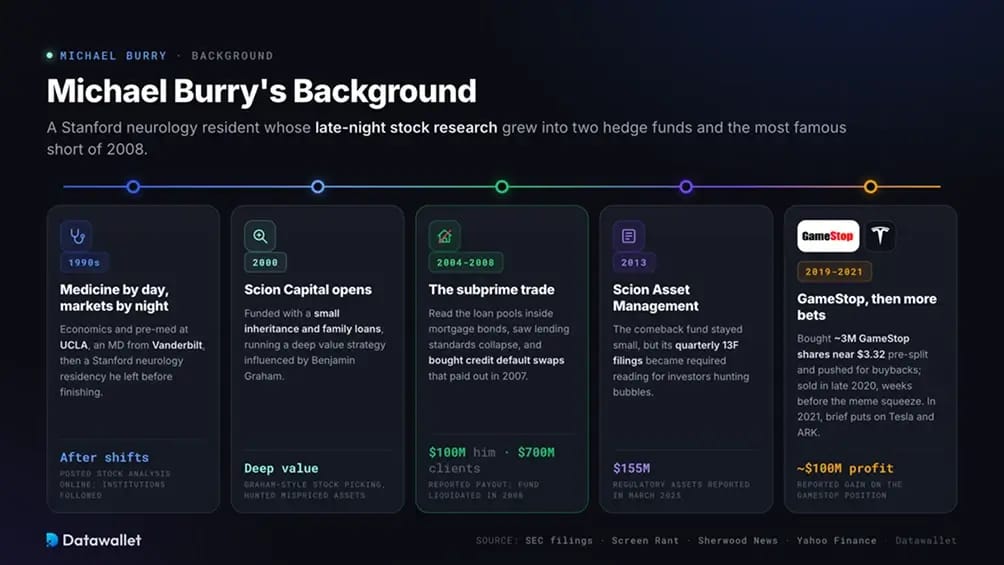
Michael Burry left medicine during his residency after a stock research hobby grew into a full-time career. He later built his first fund using an inheritance and loans from relatives.
Education and Early Career
He earned an economics and pre-med degree from UCLA before completing a Doctor of Medicine at Vanderbilt University School of Medicine. He began a neurology residency at Stanford but left before finishing to pursue markets full-time.
After hospital shifts, Burry published detailed stock analysis online. Institutional readers began following his work. In 2000, he used a small inheritance and family loans to open Scion Capital, applying a deep value strategy influenced by Benjamin Graham.
The Subprime Trade
Beginning in 2004, Burry examined the loan pools within mortgage-backed securities and concluded that lending standards had collapsed. He persuaded Wall Street banks to sell him credit default swaps covering the bonds he considered most fragile.
Those contracts paid out after the housing market cracked in 2007. The trade reportedly produced around $100 million for Burry personally and approximately $700 million for his investors. He liquidated Scion Capital in 2008, then stepped back to manage his own money.
Scion Asset Management
He returned in 2013 with Scion Asset Management. The smaller fund's quarterly filings soon became required reading for investors searching for bubbles. In March 2025, the firm reported about $155 million in regulatory assets.
GameStop became its best-known trade. From 2019, Scion accumulated roughly three million shares at a pre-split cost near $3.32 and pressed the board to conduct buybacks. Burry sold everything in late 2020, earning a reported profit of around $100 million. The sale came only weeks before the meme squeeze that he failed to anticipate.
In 2021, he also disclosed put options against Tesla and the flagship ARK fund managed by Cathie Wood. Both positions were closed within months.
Michael Burry's Net Worth in 2026
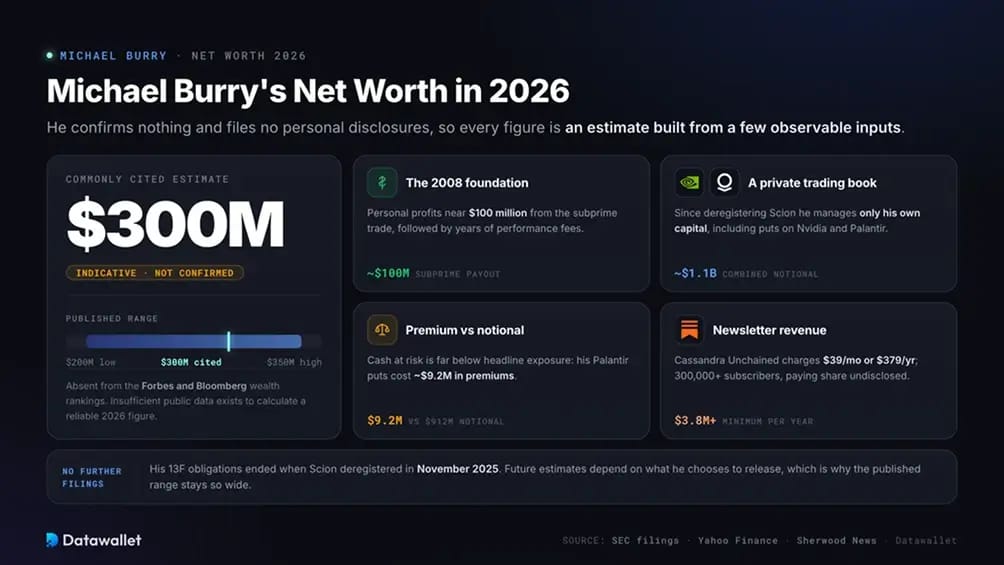
Michael Burry's net worth in 2026 is generally estimated at approximately $300 million. Published figures extend from $200 million to $350 million, although he has never confirmed his wealth and files no personal disclosures. He is also absent from the Forbes and Bloomberg wealth rankings.
The estimate draws on a few observable inputs:
- The 2008 foundation: His fortune began with personal profits near $100 million from the subprime trade, followed by years of performance fees.
- A private trading book: Since deregistering Scion, Burry has managed only his own capital. His holdings include put options on Nvidia and Palantir with a combined notional value near $1.1 billion.
- Premium versus notional: The amount of cash at risk is much lower than the headline exposure. Burry has said his Palantir puts cost roughly $9.2 million in premiums, only a small part of the notional value reported in the press.
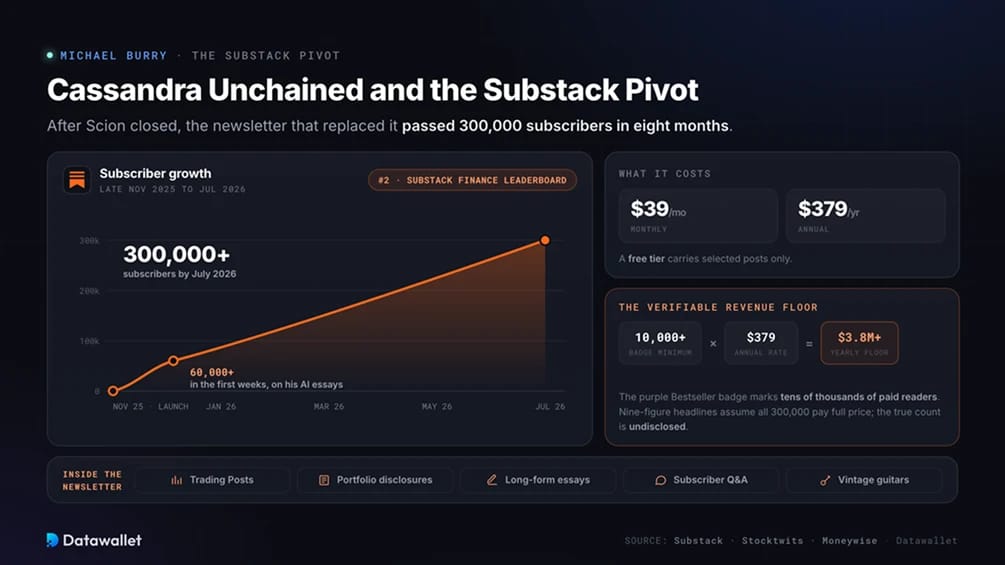
- Newsletter revenue: Cassandra Unchained costs $39 per month or $379 per year, and based on this, the minimum he would earn a year would be $3.8 million. Its audience of more than 300,000 subscribers has generated speculation about nine-figure income, but the number paying remains undisclosed.
- No further filings: His 13F obligations ended when Scion deregistered in November 2025. Future estimates will depend on information he chooses to release.
This uncertainty explains the wide range. His wealth now depends heavily on volatile options positions and a subscription publication, neither of which can be measured reliably from outside.
The AI Big Short: Nvidia, Palantir and Oracle
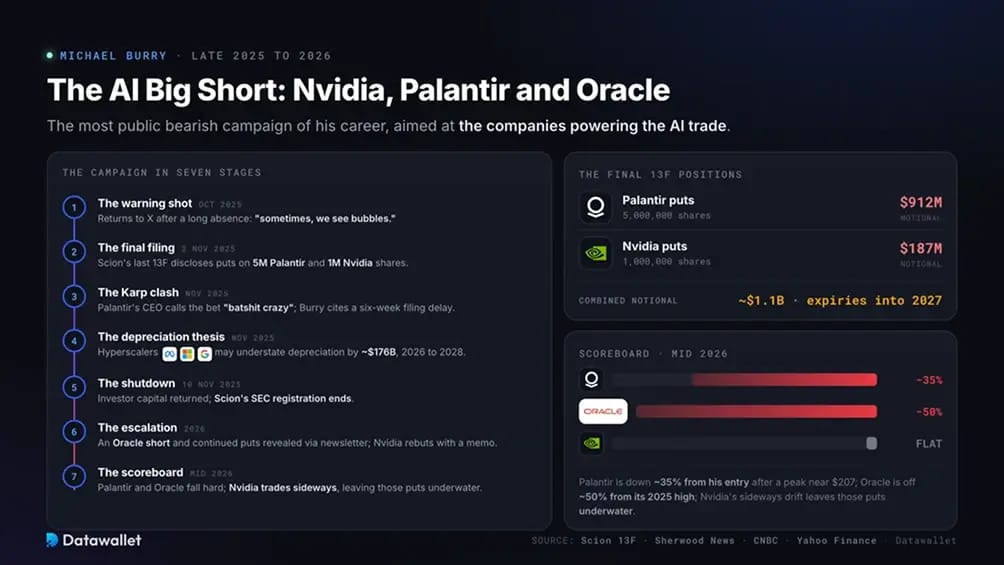
In late 2025, Burry began the most public bearish campaign of his career. His targets were the companies powering the artificial intelligence trade.
The campaign progressed through seven stages:
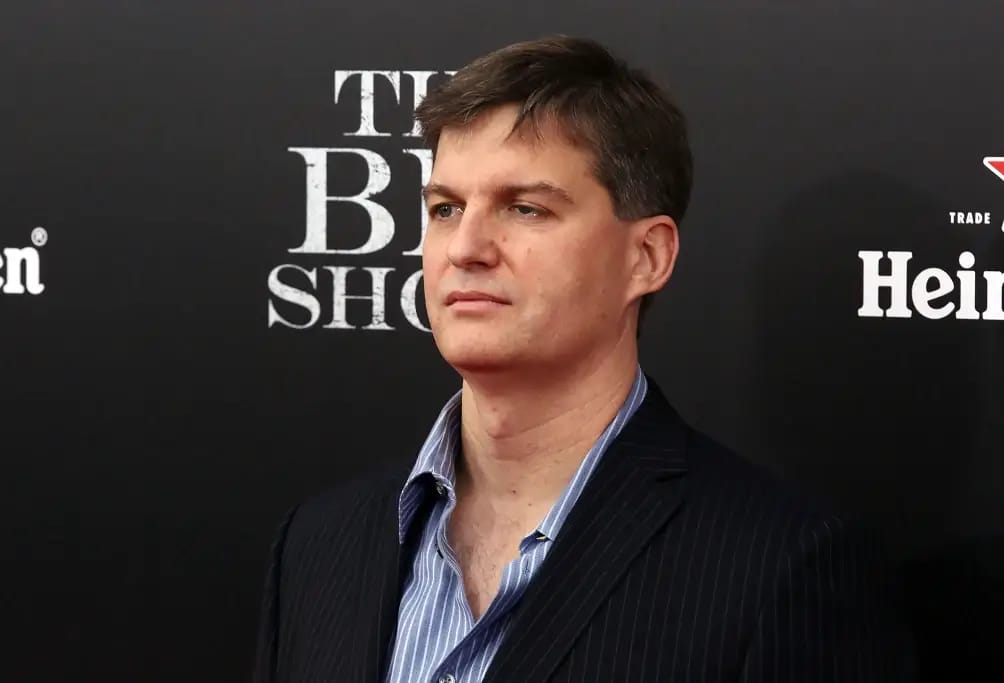
- The warning shot: After a long absence, Burry returned to X in October 2025. He posted an image of his character from The Big Short with the warning that "sometimes, we see bubbles."
- The final filing: Scion submitted its last 13F on 3 November 2025. It disclosed put options on five million Palantir shares and one million Nvidia shares, carrying notional values of $912 million and $187 million.
- The Karp clash: Palantir chief executive Alex Karp described the position as "batshit crazy" on CNBC. Burry responded that Karp had misunderstood a filing released with a six-week delay.
- The depreciation thesis: Burry argued that hyperscalers including Meta, Microsoft, Google and Oracle were extending the accounting lives of chips and servers. He estimated that this practice could understate depreciation by about $176 billion from 2026 through 2028.
- The shutdown: Investors were told in late October 2025 that their capital would be returned. Scion's registration ended on 10 November.
- The escalation: During 2026, Burry used his newsletter to reveal additional positions. These included an Oracle short and continued puts against both AI companies. Nvidia responded by publishing a memo that challenged his accounting claims.
- The scoreboard: By mid-2026, Palantir had fallen about 35% from his entry after reaching a peak near $207. Oracle was down roughly 50% from its 2025 high, while Nvidia had traded sideways and left those puts underwater.
The options extend into 2027. This makes the trade a multi-year judgment on AI capital spending, rather than a prediction tied to a single quarter.
Cassandra Unchained and the Substack Pivot
Shutting Scion removed the disclosure requirements and client obligations that had limited Burry's public commentary. Cassandra Unchained launched in late November 2025. Its first essays on AI attracted more than 60,000 subscribers within weeks.
The publication had exceeded 300,000 subscribers by July 2026 and ranked second on Substack's finance leaderboard. It became Burry's main outlet for trade disclosures, entry prices, and valuation research. Regular Trading Posts appear alongside longer essays. He also publishes subscriber Q&A sessions and occasional pieces about vintage guitars.
The nine-figure estimates quoted in headlines assume every subscriber pays the full annual rate. However, a verifiable floor exists because the publication carries Substack's purple Bestseller badge, awarded at tens of thousands of paid subscribers. At the badge's 10,000 minimum and the $379 annual rate, the newsletter earns at least $3.8 million a year before Substack's cut.
This format gives his work a different economic model. Fund managers earn fees on assets while answering to investors. Publishers receive recurring revenue for their analysis, and Burry says the newsletter now has his full attention.
Does Michael Burry Own Bitcoin?
Burry has never reported owning cryptocurrency. His public comments remain firmly opposed to the asset class. Speaking on Michael Lewis's podcast in December 2025, he called Bitcoin "the tulip bulb of our time" and said its six-figure price was ridiculous.
His criticism intensified during the 2026 decline. By February, Bitcoin had fallen from an October 2025 peak above $126,000 toward the low $60,000s. Burry warned the decline could force institutions to sell as much as $1 billion in gold and silver to cover crypto losses. He also suggested that miners could face bankruptcy if Bitcoin approached $50,000.
Burry's argument is that Bitcoin behaves like a leveraged risk asset, not a hedge, because it falls with equities when liquidity tightens. Pressure on listed Bitcoin treasury companies has strengthened that view during 2026. The sector is built around Michael Saylor's Strategy.
Final Thoughts
Michael Burry enters late 2026 with more influence than at any time since 2008, even though his estimated $300 million fortune has barely changed on paper. Scion is closed, his audience has grown enormously, and the AI short is unfolding in public one position at a time.
The most significant change is the source of his income. Subscription revenue continues whether Palantir drops another 40% or Nvidia proves his thesis wrong. For the first time, his earnings do not depend entirely on the accuracy of his trades.
One question remains. Burry's housing bet took years and almost complete conviction to pay off. His Nvidia puts, which expire in 2027, will test whether the same patience can succeed again.