
What is Pepe Coin ($PEPE)?
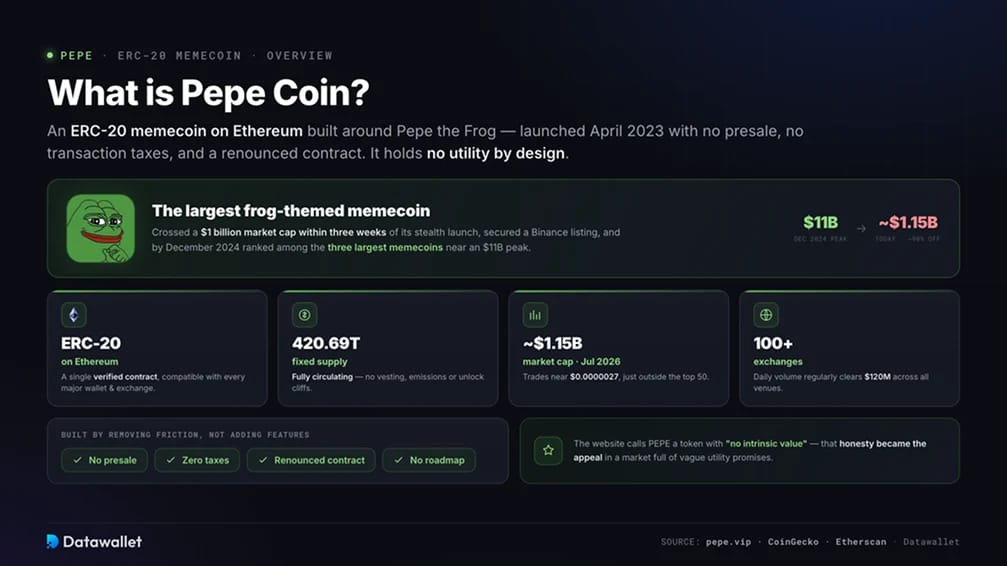
Pepe Coin is a memecoin deployed on Ethereum in April 2023, named after Pepe the Frog, the cartoon character Matt Furie first drew for his 2005 comic Boy's Club. The token carries no affiliation with Furie and makes no claim to one. It simply borrowed the most recognizable amphibian on the internet.
The project's own website describes PEPE as having no intrinsic value, no formal team, and no roadmap, existing purely for entertainment. That honesty became the appeal in a market full of memecoins dressed up with vague utility promises.
The bet paid off faster than almost any token launch in crypto history. PEPE crossed a $1 billion market capitalization within three weeks of its stealth launch, secured a Binance listing in early May 2023, and by December 2024 briefly ranked among the three largest memecoins with a peak valuation near $11 billion.
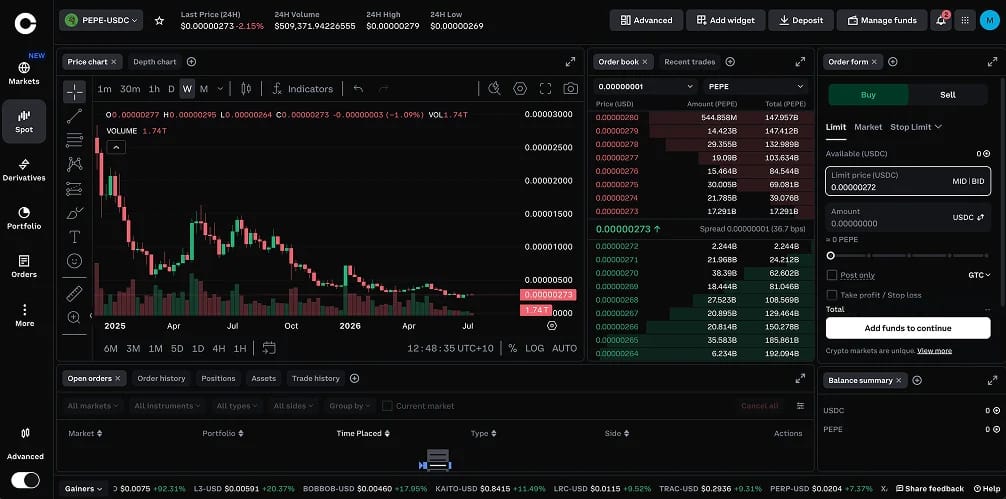
PEPE now trades near $0.0000027 with a market cap around $1.15 billion, placing it just outside the top 50 cryptocurrencies. Daily volume regularly clears $120 million across more than 100 venues, and a spot ETF filing has pulled it into institutional territory.
How Does Pepe Coin Work?
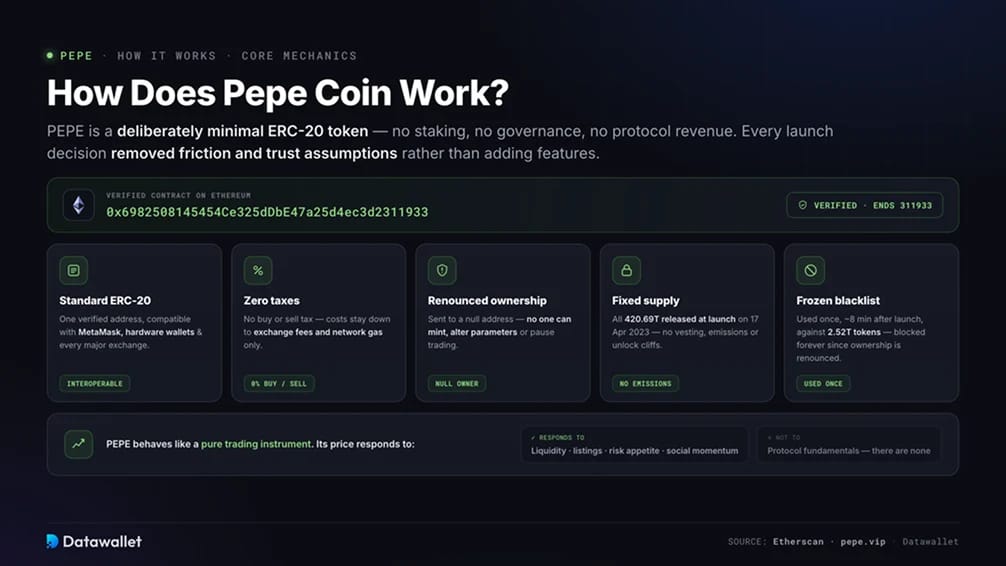
PEPE is a deliberately minimal ERC-20 token. There is no staking, no governance, no protocol revenue, and no smart contract ecosystem attached to it. Every launch decision removed friction and trust assumptions rather than adding features.
The core mechanics behind PEPE include:
- Standard ERC-20 contract: PEPE lives at a single verified contract address on Ethereum, compatible with MetaMask, hardware wallets, and every major exchange.
- Zero transaction taxes: Unlike many 2021-era memecoins, PEPE charges no buy or sell tax, which keeps trading costs down to exchange fees and network gas.
- Renounced ownership: The deployer sent contract ownership to a null address shortly after launch, so no one can mint new tokens, alter parameters, or pause trading.
- Fixed supply: All 420.69 trillion tokens were released at launch on April 17, 2023, with no vesting schedules, emissions, or unlock cliffs remaining.
- A frozen blacklist entry: The contract's blacklist function was used exactly once, about eight minutes after launch, against an address holding roughly 2.52 trillion tokens. Because ownership was renounced, that address is blocked forever.
PEPE therefore behaves like a pure trading instrument. Its price responds to liquidity, exchange listings, broader risk appetite, and social momentum rather than protocol fundamentals, which is why traders watch sentiment gauges like the crypto Fear and Greed Index closely when positioning around it.
PEPE Tokenomics & Supply
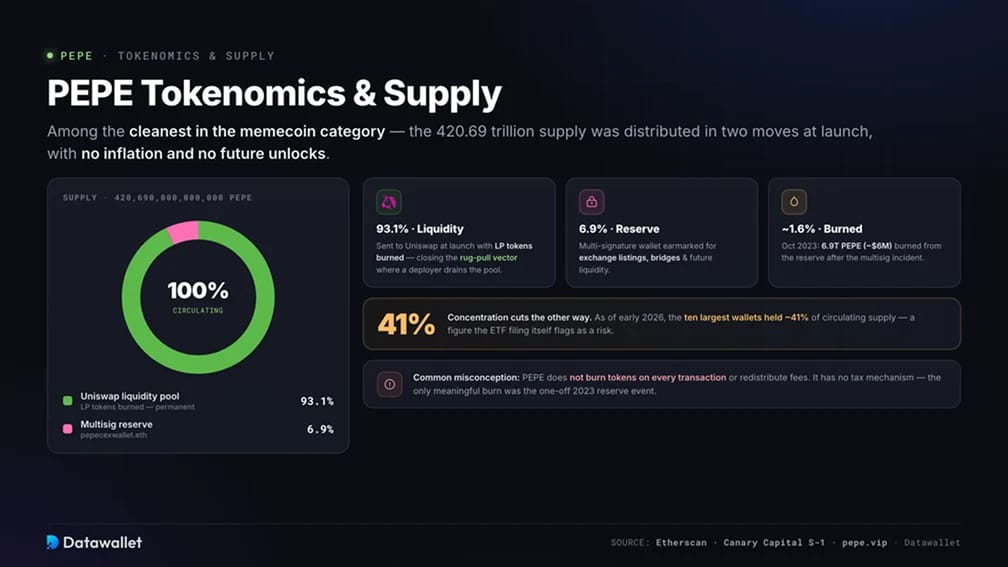
PEPE's tokenomics are among the cleanest in the memecoin category, which is part of why it survived while thousands of imitators died. The 420.69 trillion total supply, a nod to internet numerology rather than economics, was distributed in two moves at launch, a split documented on CoinMarketCap, and has never changed.
The full supply breaks down as follows:
- Liquidity pool (93.1%): Sent to the Uniswap pool at launch, with the LP tokens burned, making the liquidity permanent and closing the rug-pull vector where a deployer drains the pool.
- Multisig reserve (6.9%): Held in a multi-signature wallet, trackable under the ENS name pepecexwallet.eth and earmarked for centralized exchange listings, bridges, and future liquidity needs.
- Burned tokens (~1.6%): In October 2023, 6.9 trillion PEPE worth roughly $5.5 million were burned from the reserve following the multisig incident covered below, as CoinDesk reported.
Supply modeling for PEPE is simple because there is no inflation and there are no future unlocks, and Canary Capital's ETF prospectus confirms the full supply already circulates. Concentration cuts the other way. As of early 2026, the ten largest wallets held around 41% of circulating supply, a figure the ETF filing itself flags as a risk.
A common misconception is that PEPE burns tokens on every transaction or redistributes fees to holders. It does neither. The token has no tax mechanism at all, and the only meaningful burn in its history was the one-off 2023 reserve burn. Its deflationary character rests on that event and on tokens lost to the frozen blacklist rather than on any ongoing mechanism.
Pepe Coin Price History
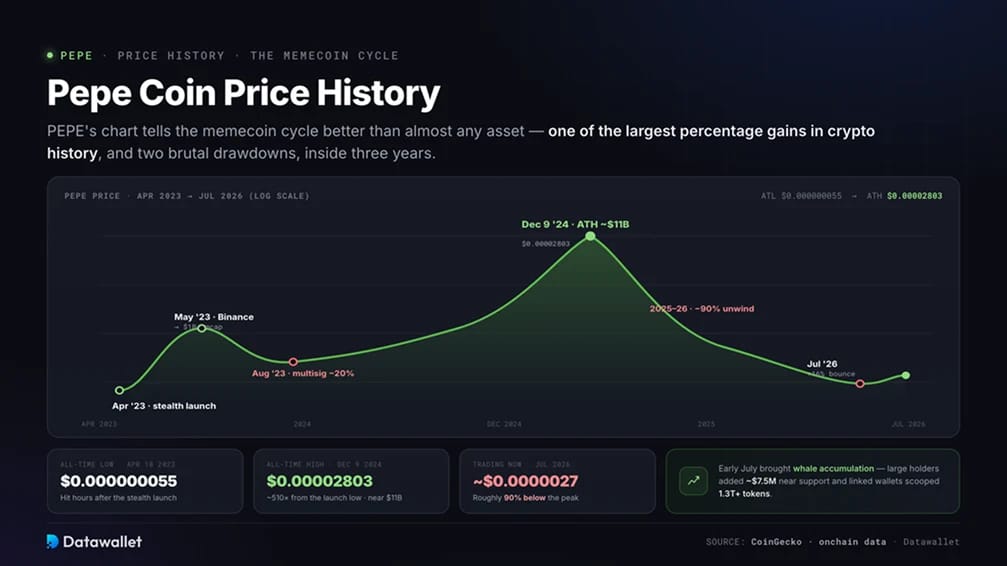
PEPE's chart tells the memecoin cycle story better than almost any other asset, spanning one of the largest percentage gains in crypto history and two brutal drawdowns inside three years.
The major chapters so far:
- April 2023, stealth launch: PEPE deployed with no presale or marketing, hit its all-time low of about $0.000000055 on April 18, then went vertical as Crypto Twitter discovered it.
- May 2023, Binance listing: A listing in Binance's Innovation Zone within three weeks of launch cemented PEPE as the breakout token of the cycle and pushed its market cap past $1 billion.
- August 2023, the multisig shock: The unauthorized transfer of 16 trillion tokens by former team members knocked the price down nearly 20% and tested community conviction.
- December 2024, all-time high: PEPE peaked at $0.00002803 on December 9, 2024, during the post-election memecoin mania, valuing the token near $11 billion.
- 2025 to 2026, the long unwind: As the memecoin sector deflated, PEPE fell roughly 90% from its high, finding a floor near $0.0000023 before stabilizing in the $0.0000025 to $0.0000030 range.
Early July 2026 brought a 16% single-day bounce and visible whale accumulation, with large holders adding around $7.5 million in PEPE near support and linked wallets scooping up more than 1.3 trillion tokens. Whether that marks a durable base or a bear-market rally depends on where the broader cycle sits, which is why the Altcoin Season Index remains a useful companion chart for PEPE traders.
The Canary Capital PEPE ETF Filing
The biggest recent development is a regulated US investment product built around the frog, something nobody predicted in 2023. On April 8, 2026, asset manager Canary Capital filed an S-1 registration statement with the SEC for the Canary PEPE ETF, a spot fund that would hold the token directly.
The proposed structure mirrors existing spot crypto ETFs. The Delaware statutory trust, registered in January 2026, would create and redeem shares in 10,000-unit baskets, hold up to 5% of assets in ETH to cover Ethereum transaction costs, and give investors PEPE price exposure through a standard brokerage account with no wallets or private keys involved.
Approval is far from guaranteed. The SEC has historically wanted a regulated market of significant size behind spot products, and PEPE lacks the CME futures market that supported the Bitcoin and Ethereum approvals. Analysts widely frame the filing as a long-shot test of how far the memecoin ETF wave can run, and PEPE's price barely moved on the news.
Precedent is building regardless. Dogecoin already has three live US spot ETFs from Grayscale, 21Shares, and Bitwise, and Canary has parallel filings covering MOG and PENGU. Net inflows into the Dogecoin products have been modest, a useful reality check for anyone extrapolating from the institutional demand visible in the Bitcoin ETF tracker to smaller, purely memetic assets.
How to Buy Pepe Coin
PEPE is one of the most accessible altcoins, listed on more than 100 exchanges with deep spot and derivatives liquidity. The centralized exchange path is the simplest for most buyers, while onchain purchases through Uniswap suit users who prefer self-custody.
Buying PEPE through an exchange works like this:
- Pick a platform: Choose a reputable exchange like Coinbase that lists PEPE spot pairs, weighing fees, regulation, and withdrawal costs. Our guide to the best low-fee crypto exchanges compares the leading options.
- Complete verification: Register and finish KYC, since nearly all major centralized venues require identity verification before fiat deposits.
- Fund the account: Deposit local currency by bank transfer or card, or move in a stablecoin like USDT if you already hold crypto elsewhere.
- Place a limit order: Open the PEPE/USDT pair and use a limit order rather than instant buy, which typically saves 1% or more on the spread.
- Decide on custody: Active traders can leave tokens on the exchange, while long-term holders should withdraw to a self-custody wallet, remembering that Ethereum withdrawals incur gas that you can estimate with our Ethereum gas fee tool.
- Verify the contract: If buying onchain instead, always confirm the official contract address ending in 311933 before swapping, since fake PEPE tokens are among the most common honeypot scams on Ethereum.
Is Pepe Coin Safe?
PEPE's contract-level security is strong for a memecoin. The renounced ownership, burned LP tokens, and fully circulating supply eliminate the most common technical rug vectors, and the contract was audited early in its life with the owner confirmed as the zero address. The risks that remain are market risks, and they are severe.
The main risks to weigh before buying include:
- Extreme volatility: PEPE has swung more than 90% in both directions across its short life, and leveraged positions on it are regularly wiped out during broader crypto liquidation cascades.
- Whale concentration: With the top ten wallets holding around 41% of supply, coordinated selling by a handful of holders can overwhelm bid-side liquidity quickly.
- No fundamental floor: With no revenue, utility, or burn engine, there is no valuation anchor, so drawdowns can extend further than they would for productive assets.
- Governance opacity: The multisig reserve is controlled by anonymous individuals, and the events of 2023 proved that control can change hands without warning.
- Copycat scams: Hundreds of derivative tokens use the Pepe name and imagery, and buying the wrong contract remains the most common way retail buyers lose money on the theme.
The 2023 Multisig Incident
The defining stress test came on August 24, 2023, when roughly 16 trillion PEPE worth about $15 million left the project's multisig wallet for OKX, Binance, KuCoin, and Bybit, and the wallet's signing threshold was quietly cut from a 5-of-8 arrangement to 2-of-8, as CoinDesk reported at the time.
The remaining founder attributed the transfers to three former team members who sold the tokens and deleted their accounts, framing it as an internal betrayal rather than an external hack, per Cointelegraph's coverage. The price fell close to 20% before recovering, and the episode remains the clearest illustration that a renounced contract does not eliminate human risk around treasury wallets.
The cleanup strengthened the token's supply profile. The remaining reserve moved to a fresh wallet, 6.9 trillion tokens were burned in October 2023, and a new group of advisors took over stewardship of the brand, after which PEPE went on to make its all-time high the following year.
Who Created Pepe Coin?
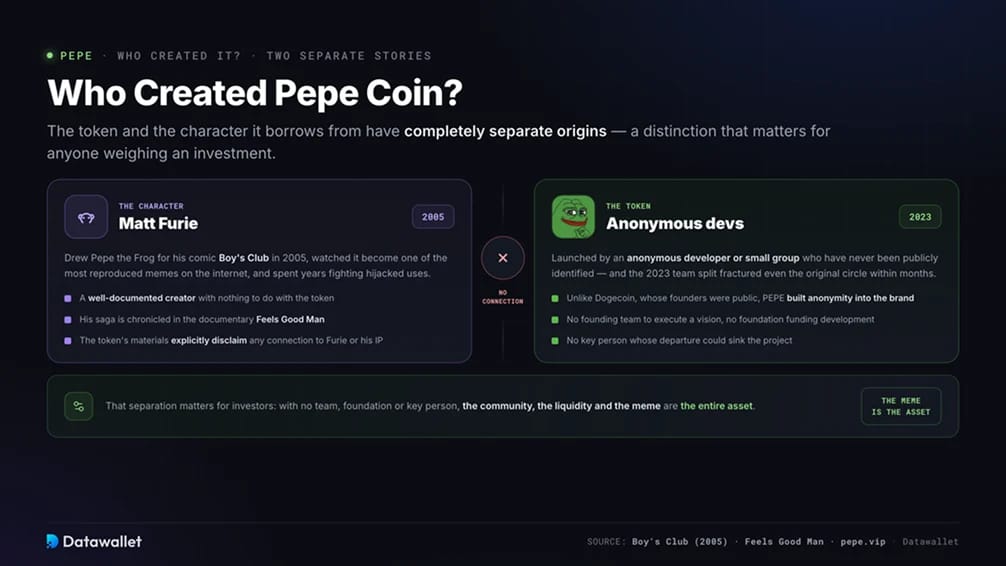
PEPE was launched by an anonymous developer or small group who have never been publicly identified, and the 2023 team split means even the original circle fractured within months of launch. Unlike Dogecoin, whose founders were public from day one, PEPE's creators built anonymity into the brand.
The character itself has a well-documented creator who has nothing to do with the token. Matt Furie drew Pepe for Boy's Club in 2005, watched the frog become one of the most reproduced memes on the internet, and spent years fighting hijacked uses of the character, a saga chronicled in the documentary Feels Good Man. The token's own materials explicitly disclaim any connection to Furie.
That separation matters for investors. There is no founding team to execute a vision, no foundation funding development, and no key person whose departure could sink the project. The community, the liquidity, and the meme are the entire asset.
Final Thoughts
Pepe Coin reduced the memecoin trade to a fixed supply, an unstoppable contract, zero pretense of utility, and a character with two decades of cultural equity behind it. That formula produced one of the fastest wealth-creation events in crypto history and has kept PEPE liquid and relevant long after most 2023 launches went to zero.
The current setup is two-sided. Bulls point to a token 90% off its highs with deep liquidity, persistent whale accumulation, and an ETF filing that would have sounded absurd two years ago. Bears see a maturing memecoin whose explosive discovery phase has passed, competing in a sector where attention constantly rotates to newer tickers.
Anyone trading it should take the project's website at its word and treat PEPE as an entertainment asset with no expectation of financial return. Verify the contract, size positions as money you can afford to lose, and let the frog be a small, speculative slice of a portfolio rather than its foundation.