



Stablecoins are now one of crypto's largest markets, with $322 billion in onchain supply per DefiLlama and USDT alone holding 58.7% of that total.
Tron carries most of the actual dollar movement, settling close to $2 trillion in USDT transfers in Q1 2026 while hosting roughly half of all USDT in existence.
Understanding TRC20 USDT means understanding the rail that emerging markets, exchanges, and a growing layer of AI payment systems run on by default. 👇
What is TRC20 USDT?
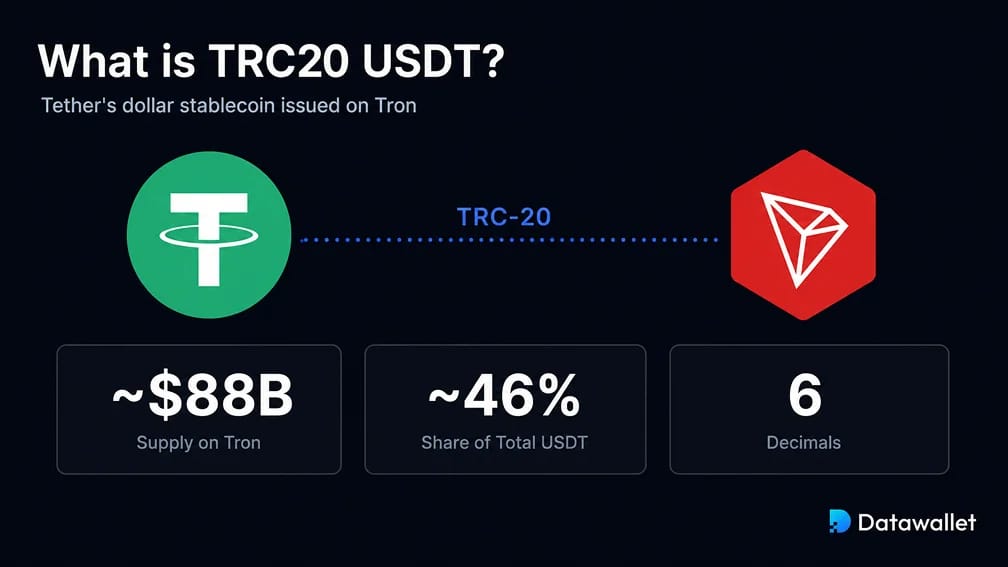
TRC20 USDT is Tether's US dollar stablecoin issued on the Tron blockchain using the TRC-20 token standard. Each unit is backed 1:1 by Tether's reserves and operates independently of USDT deployments on Ethereum, Solana, or any other chain.
The TRC-20 standard is Tron's equivalent of Ethereum's ERC-20: a smart contract interface defining how a fungible token reports balances, transfers, allowances, and total supply. Tokens deployed under this standard run inside the Tron Virtual Machine (TVM), which keeps most Ethereum bytecode portable but uses Tron's own account model and resource system rather than gas.
Tether first deployed USDT on Bitcoin's Omni layer in 2014, migrated to Ethereum in 2017, and added Tron in 2019. That third deployment reshaped the stablecoin market. Tron's low fees and fast confirmations made it the natural settlement layer for high-frequency dollar transfers, and the supply on Tron has climbed almost vertically since 2021.
The result is a clear division of labor across USDT's chains. Ethereum holds the deepest institutional and DeFi liquidity, Solana is growing in consumer payments, and Tron carries the bulk of remittance and peer-to-peer traffic. Tron and Ethereum now each host roughly $80 billion in USDT supply, trading the top spot back and forth as new mints land.
How Does TRC20 USDT Work?
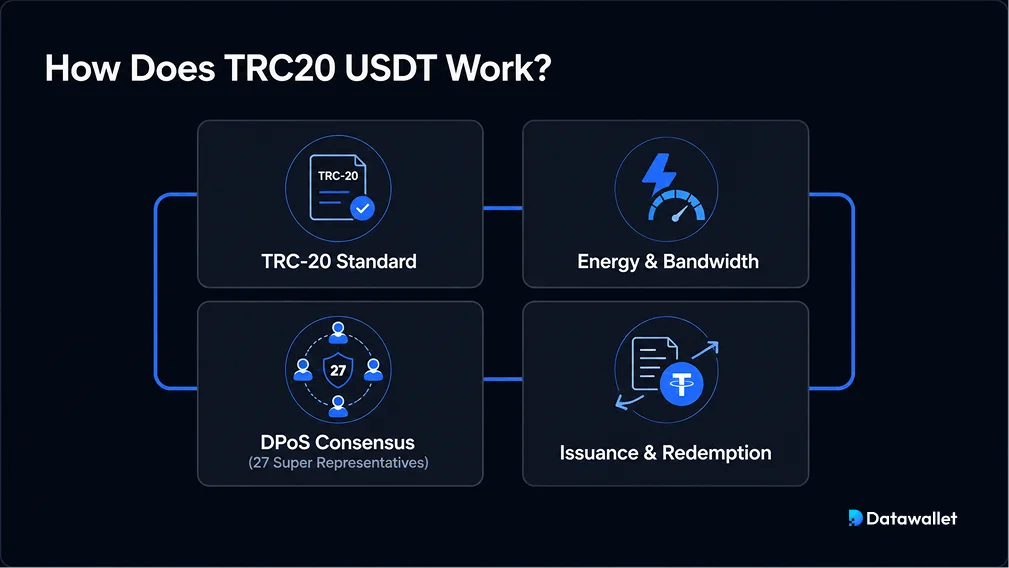
TRC20 USDT combines a standard token contract with Tron's resource-based fee model, where transactions consume energy and bandwidth rather than gas. The result is a system that can deliver near-zero marginal cost transfers at scale, provided users have staked TRX or stay within the network's free daily allowance.
1. The TRC-20 Standard
The TRC-20 standard defines the minimum set of functions a fungible token contract must implement on Tron, including transfer, balanceOf, approve, allowance, and totalSupply. The official USDT contract sits at TR7NHqjeKQxGTCi8q8ZY4pL8otSzgjLj6t with six decimals, and Tron's transfer function selector a9059cbb matches Ethereum's ERC-20 signature.
That symmetry is intentional. Tron was an Ethereum ERC-20 token before migrating to its own chain in 2018, and the TVM was built to keep most ERC-20 contract code portable. The architectural break sits below the contract layer, in how Tron meters execution costs and structures account state.
2. Energy and Bandwidth
Tron does not use gas pricing. Every transaction consumes two resources: bandwidth, measured in bytes of the serialized transaction, and energy, measured in computational units consumed by the TVM. A standard TRC20 USDT transfer to an activated address takes about 345 bytes of bandwidth and roughly 65,000 energy, with transfers to brand-new addresses needing closer to 130,000 energy because the token account must be initialized.
Every Tron account receives 600 free bandwidth points per day, enough for several small transactions. Energy has no free allowance and must be obtained in one of three ways:
- Stake TRX: Lock TRX through Stake 2.0 to receive a recurring energy allocation proportional to total network stake. Around 6,000 TRX produces enough energy for one USDT transfer per day depending on overall demand.
- Rent energy: Services like Tronsave let users pay 2 to 5 TRX for a one-time energy delegation that covers a single TRC20 transfer, significantly cheaper than the burn alternative.
- Burn TRX: Without staked or delegated energy, the network burns TRX from the sender's balance at the rate set by Super Representatives, currently 100 sun per energy unit after Proposal #104 cut the rate in half on 29 August 2025.
For a user with no staked resources, the burn cost lands at roughly 13.4 TRX (around $3 to $4) for a transfer to an existing USDT wallet, or 27.6 TRX to a new wallet. With rented energy, the same transfer costs $0.50 to $1.50.
3. Consensus and Finality
Tron runs Delegated Proof of Stake with 27 elected Super Representatives producing blocks in three-second rounds. Block times are deterministic and the chain processes around 2,000 transactions per second at sustained load, with daily transaction counts on Tronscan typically above 11 million.
That throughput is what makes TRC20 USDT viable at the scale it operates today. Settlement is effectively instant from a user perspective, with one to two block confirmations giving sufficient assurance for exchange deposits and merchant settlement under most threat models.
4. Issuance and Redemption
Like USDT on every other chain, TRC20 USDT is minted and burned by Tether based on direct verified-customer activity. New supply appears on Tron when institutional clients deposit dollars with Tether, and supply contracts when those clients redeem. Onchain mints are visible in real time through Tether's transparency dashboard and chain explorers, and Lookonchain regularly tracks billion-dollar Tron mints as they happen.
TRC20 USDT vs ERC20 USDT
USDT exists on more than a dozen chains, but Tron and Ethereum carry the vast majority of supply. The two versions are not interchangeable. Sending TRC20 USDT to an Ethereum address, or vice versa, results in permanent loss of funds unless the receiving wallet holds the private key on both networks.
The practical differences shape which network suits which use case:
- Address Format: Tron addresses begin with
Tand are base58-encoded; Ethereum addresses begin with0xin hexadecimal. Mismatching the address and network selection is the single most common error in stablecoin transfers. - Fee Model: Tron fees range from effectively zero (with staked energy) to around $1-4 per transfer (burning TRX). Ethereum gas pricing fluctuates with block demand and can cost $1 to $20+ for a standard ERC-20 transfer.
- Settlement Speed: Tron settles in about three seconds; Ethereum settles in roughly 12 seconds, and most exchanges require 12 to 30 block confirmations before crediting deposits.
- Liquidity Depth: Ethereum hosts deeper DeFi liquidity, perpetual DEX collateral, and institutional float. Tron hosts deeper peer-to-peer and remittance liquidity across Latin America, Southeast Asia, and Africa.
- DeFi Footprint: Ethereum is the dominant home for decentralized finance protocols using USDT as collateral. Tron's DeFi ecosystem is concentrated in JustLend and SunSwap and accounts for a small fraction of the chain's actual USDT activity.
For an institutional desk or DeFi user, ERC-20 USDT is the canonical reference. For a remittance corridor, P2P trader, or merchant moving small dollar amounts, TRC20 USDT is overwhelmingly the better choice.
%201.webp)
TRC20 USDT Market Data
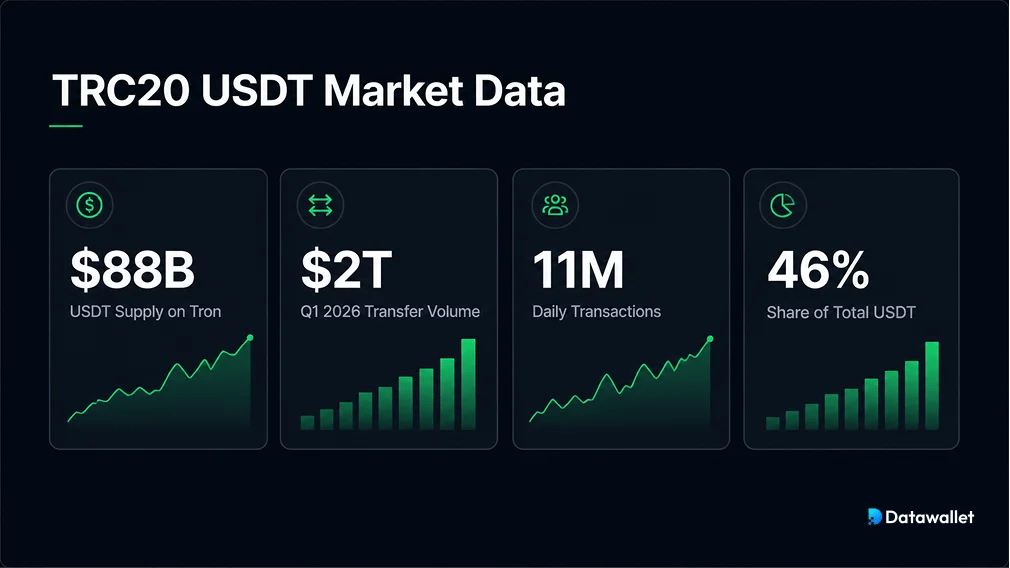
The DefiLlama numbers tell a clearer story than any market commentary. Tron's stablecoin market cap sits at $90.74 billion, with USDT representing 97.83% of that supply. Across all chains, Tron carries around 46% of USDT's global float, depending on the week.
Activity is more striking than supply. Tron processed close to $2 trillion in USDT transfer volume in Q1 2026 per CoinDesk Research, following $7.9 trillion across the full year 2025. The network turns over roughly 20 to 30% of its stablecoin supply daily in transacted volume, indicating active utilization rather than passive holding.
Other metrics worth understanding:
- Active addresses: ~3.74 million daily active addresses, with 3.2 million daily active users as a quarterly average for Q1 2026.
- Transaction count: ~11 million daily transactions across the chain.
- Chain revenue: Tron generated $82.2 million in protocol fees in Q1 2026, second only to Hyperliquid among major Layer 1 networks per CoinDesk Research.
- DEX volume: Around $32 million in 24-hour DEX volume, a tiny fraction of Tron's settlement throughput.
- TVL: $5.13 billion in DeFi total value locked, well below Tron's stablecoin market cap because most USDT on Tron sits in transit rather than locked in protocols. For broader context, see Datawallet's TVL tracker.
The disconnect between Tron's small DeFi footprint and its enormous stablecoin throughput defines how the network gets used. Tron operates as a payment rail first, with smart contracts serving as a secondary function.
TRC20 USDT Use Cases
TRC20 USDT dominates segments where the alternative is traditional remittance infrastructure or higher-fee chains. Its appeal is the combination of dollar-denominated stability, sub-second settlement, and per-transfer costs that scale down to fractions of a cent at high volume.
Where TRC20 USDT is most commonly used:
- Remittances: Tron carries the bulk of stablecoin remittance volume in Latin America, Southeast Asia, and parts of Africa. UQUID research found Tron accounts for 45% of stablecoin payment transactions in Latin America, 35% in Africa, and 25% in Asia. Sending $200 home on Tron costs cents; Western Union typically charges $10 to $20.
- Exchange Transfers: Most major exchanges support TRC20 deposits and withdrawals with lower minimum fees than ERC-20 alternatives. Binance, Bybit, OKX, and HTX collectively capture the majority of labeled stablecoin inflows on Tron per Arkham Intelligence.
- Peer-to-Peer Trading: P2P marketplaces denominate listings in USDT, and Tron has become the default network on platforms like Binance P2P due to lower exit costs for sellers cashing out to local currency.
- Merchant Payments: Argentina's SUBE transit card now supports USDT top-ups on Tron, and Web3 commerce platforms are integrating TRC20 USDT for sub-cent retail payments across emerging markets.
- Cross-Exchange Arbitrage: Traders moving stablecoins between exchanges use TRC20 USDT to minimize the fee drag on trades that would otherwise be uneconomic on Ethereum.
- Treasury Holding: Crypto-native businesses, including offshore exchanges and OTC desks, hold operational USDT balances on Tron because withdrawal fees stay low and predictable.
- Agentic Payments: Tron joined the Linux Foundation's Agentic AI Foundation as a Gold Member in March 2026, with Justin Sun positioning TRC20 USDT as a settlement layer for autonomous AI agents handling small recurring payments.
- Yield Generation: USDT holders can deploy capital into onchain lending markets, though most yield opportunities sit on Ethereum and Solana rather than Tron. Datawallet's USDT yield guide covers the main venues.
Geographic concentration matters. Asia accounts for the largest share of regional Tron USDT volume, and the chain has become structurally embedded in how cross-border value moves through dollar-shortage economies.
How to Buy and Store TRC20 USDT
Buying TRC20 USDT is straightforward on most centralized exchanges, with network selection happening at the withdrawal step rather than during purchase. The asset is the same USDT regardless of which chain it lives on; the network determines settlement cost and destination wallet compatibility.
General process for acquiring TRC20 USDT:
- Open an exchange account: Sign up with a regulated exchange and complete identity verification. Bybit, Binance, Kraken, OKX, and HTX all support TRC20 USDT. For US-specific guidance, see Datawallet's USDT in USA guide.
- Fund the account: Deposit fiat via bank transfer, card, or P2P, or deposit existing crypto from another wallet or exchange.
- Buy USDT: Place a spot order for USDT/USD, USDT/EUR, or another local currency pair, or buy directly through the exchange's instant buy feature.
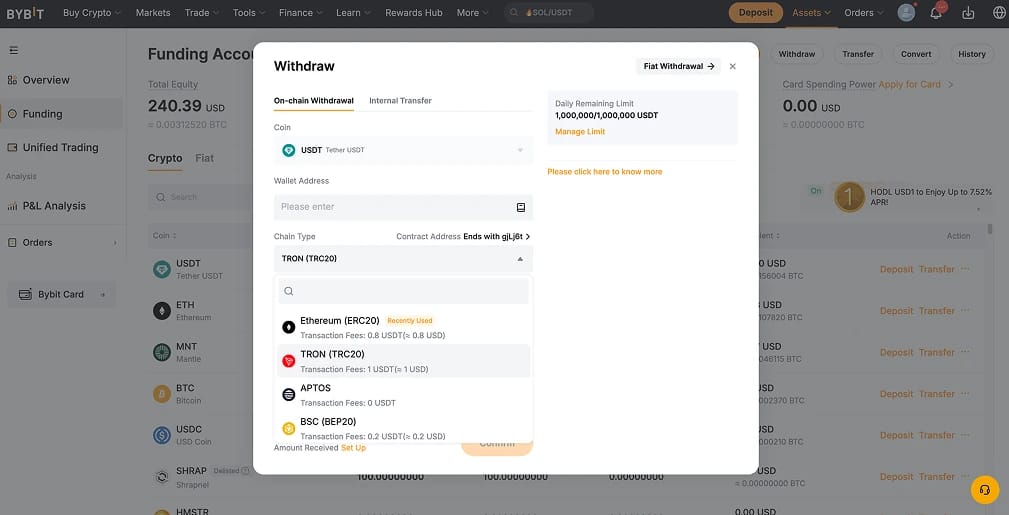
- Select TRC20 at withdrawal: Choose the Tron (TRC-20) network from the withdrawal network dropdown. The recipient address must begin with
T. - Hold a small TRX balance: Send 20 to 50 TRX to your wallet alongside the USDT so you can cover energy and bandwidth costs on outbound transfers.
For wallet storage, Tron-native and multichain wallets both work but differ in how deeply they expose Tron's features. Datawallet's best Tron and TRC-20 wallets guide covers the main options, including TronLink, Trust Wallet, Ledger, and SafePal.
MetaMask added native Tron support in early 2026, letting TRC20 USDT sit alongside ERC-20 assets in the same interface. The setup is covered in Datawallet's Add Tron to MetaMask guide. For ERC-20 USDT specifically, see How to add USDT to MetaMask.
TRC20 USDT Risks
TRC20 USDT's scale is the source of both its utility and its risk concentration. The same features that make it the dominant remittance rail also expose holders to centralized control, regulatory pressure, and counterparty exposure to a single non-US issuer.
Key risks to weigh before using TRC20 USDT at scale:
- Issuer Centralization: Tether can freeze any USDT balance, including on Tron, through contract-level blacklisting. As of May 2026, BlockSec data shows more than $500 million in USDT frozen across all chains in a single 30-day period, with 328 of those addresses on Tron.
- T3 Financial Crime Unit Enforcement: The T3 FCU joint initiative between Tether, Tron, and TRM Labs has frozen more than $450 million in illicit USDT since its September 2024 launch, including a $344 million freeze in coordination with OFAC and US law enforcement in April 2026.
- Reserve Composition Risk: Tether's reserves sit at $141 billion in US Treasuries with $6.3 billion in excess reserves per BDO Italia's year-end 2025 attestation, but the issuer has only published quarterly attestations rather than full financial audits. Tether engaged a Big Four firm for its first full audit in March 2026, with no delivery timeline.
- Wrong-Network Transfers: TRC20 USDT and ERC20 USDT are deployed on separate chains with incompatible address formats. Sending TRC20 USDT to an Ethereum address (
0x...) results in permanent loss unless the receiving party can sign for the address on Tron, which is rare. - Address Poisoning: Attackers send zero-value transactions from addresses whose first and last characters match the user's intended recipient. The user later copies the wrong address from their transaction history. Always verify the full address before sending.
- Fake Token Contracts: Tokens labeled "USDT" deployed by attackers on Tron can appear in wallets after free airdrops. Only the official contract at
TR7NHqjeKQxGTCi8q8ZY4pL8otSzgjLj6tis genuine. - Energy Cost Volatility: Burn costs for unstaked users vary with TRX price and on-chain parameters voted by Super Representatives. A transfer costing $3 today could cost $6 if TRX doubles.
- Regulatory Concentration: USDT has been delisted from major EU exchanges since MiCA took effect on 30 December 2024. Self-custody access remains available but EEA-licensed venues no longer serve customers with USDT spot pairs.
- Smart Contract Risk: While the USDT contract has been battle-tested for years, interactions with other Tron protocols carry typical smart contract exposure, including admin keys, upgrade functions, and approval risks.
- Tron Network Centralization: Tron's 27 Super Representatives concentrate block production and governance authority in a small set of operators, which differs sharply from Ethereum's broader validator base.
The freeze authority is the risk most users underestimate. Tether and Tron can immobilize specific addresses within 24 hours of law enforcement requests, and that capability operates without judicial review at the protocol level. For users moving large balances or operating in adversarial jurisdictions, USDT on any chain, including Tron, is not censorship-resistant in any meaningful sense.
TRC20 USDT Regulation and Compliance
The regulatory environment for TRC20 USDT in 2026 is more developed than at any prior point, with three frameworks now directly shaping its accessibility and use.
The GENIUS Act, signed into US law on 18 July 2025, established the first federal framework for payment stablecoins. The Act requires US-domiciled issuers to maintain 1:1 cash and short Treasury reserves, publish monthly attestations, submit to annual third-party audits, and accept federal supervision. Tether is not eligible because it is not US-domiciled, and its January 2025 relocation to El Salvador strengthened its non-US posture rather than positioning it for licensure.
To serve US institutional clients, Tether launched USAT, a separate US-regulated stablecoin issued through Anchorage Digital Bank with Deloitte attestation, on 27 January 2026. USAT initially launched on Ethereum and added Celo in March 2026, with Solana support targeted by year-end. Tron is not on the USAT roadmap, reflecting the chain's offshore-distribution profile.
In Europe, MiCA took effect for stablecoins on 30 December 2024. Major EU-regulated exchanges including Binance, Coinbase, Kraken, and Bitstamp completed USDT delisting for EEA customers between late 2024 and early 2025. USDT remains accessible through self-custody, but European users can no longer trade it directly on EEA-licensed venues.
Issuer-level freezing is the most consequential active enforcement mechanism. The T3 Financial Crime Unit coordinates with law enforcement across 23 jurisdictions, and the Financial Action Task Force cited T3 FCU in its January 2026 Asset Recovery Guidance as a leading model for public-private partnership in digital asset enforcement. The unit typically executes freezes within 24 hours of credible law enforcement requests.
For most users, the picture is straightforward: TRC20 USDT remains legal to hold and use in most jurisdictions outside the EU, but issuer-level controls mean it functions less like cash and more like a digitized bank balance. Datawallet's safest stablecoin comparison covers the broader picture across USDC, USDT, RLUSD, and other major issuers.
%201.webp)
Final Thoughts
TRC20 USDT is the closest thing crypto has to a global dollar payment rail. Its dominance in remittances, peer-to-peer commerce, and emerging-market trading is now structural, and the network effects around Tron's $88 billion in USDT supply make it difficult to displace through technical superiority alone.
The trade-offs are real and sharpening. Issuer-level freezing has become routine rather than exceptional, MiCA has fenced USDT out of the European retail market, and the GENIUS Act has split Tether's product line into a regulated US version and a non-US legacy that still does most of the volume. Holders of TRC20 USDT are choosing convenience and scale over regulatory protection.
For traders, payment users, and businesses moving dollars across borders, TRC20 USDT remains the most efficient choice available today. For long-term treasury holdings or any use case requiring regulatory certainty, USDC, USAT, or another GENIUS-compliant alternative is the more defensible position. The right answer in 2026 is usually some combination of both.