






Can You Add Avalanche to MetaMask?
Avalanche is available in MetaMask's built-in network list, so you may not need to enter any details manually. The wallet connects to the C-Chain, Avalanche's EVM-compatible environment for smart contracts and dApps.
Avalanche has three built-in chains. Validators are coordinated through the P-Chain, while the X-Chain handles native asset transfers. Neither supports the EVM, so MetaMask only interacts with the C-Chain.
Your existing wallet address carries over unchanged as the same 0x string used on Ethereum. Its balance will initially show zero because each network maintains a separate state. Avalanche fees are paid in AVAX rather than ETH, so the wallet needs a small AVAX balance before it can send transactions. Our general MetaMask network guide explains the setup screen in more detail.
How to Add Avalanche to MetaMask
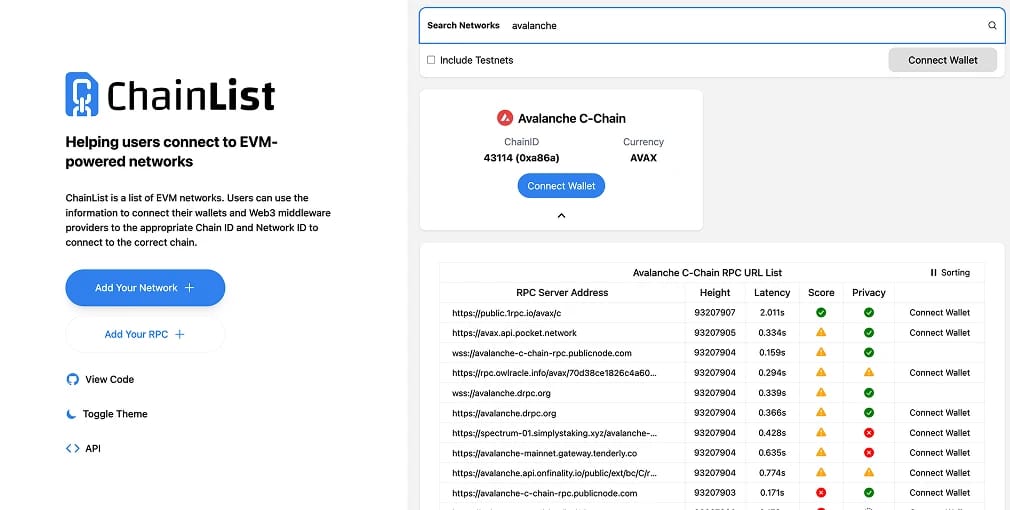
If the preset entry is unavailable, we recommend ChainList. It sources network parameters from the community-audited ethereum-lists registry. We also compare those details with Avalanche's documentation before approving the connection:
- Open ChainList: Visit the Avalanche page on ChainList, confirm that the address bar reads chainlist.org, and click 'Connect Wallet'.
- Verify the listing: The mainnet entry should display Chain ID 43114 and AVAX as the gas currency. Fuji appears under the testnets toggle with Chain ID 43113. Make sure mainnet is selected before continuing.
- Add the network: Click 'Add to MetaMask'. Check every field in the pop-up against the official network table, then approve the request.
- Switch over: Select Avalanche from MetaMask's network menu. Any AVAX or tokens already held at your address will appear immediately.
Do not copy RPC details from group chats, screenshots, or social media replies. A hostile endpoint controls what your wallet displays and could show fake balances or present a malicious transaction as a routine request.
Avalanche C-Chain RPC and Chain ID
For manual setup, open "Add a custom network" in MetaMask's settings. The following values match Avalanche's official documentation. Check them against that source again before saving:
- Network Name: Avalanche C-Chain
- RPC URL: https://api.avax.network/ext/bc/C/rpc
- Chain ID: 43114
- Currency Symbol: AVAX
- Block Explorer URL: https://snowtrace.io
The public endpoint is suitable for everyday wallet activity but has rate limits. Bots and indexers should use a dedicated provider such as Alchemy or QuickNode. Ava Labs also operates explorer.avax.network, which covers the P-Chain and X-Chain as well as the C-Chain.
Avalanche Fuji Testnet RPC and Chain ID
Fuji is Avalanche's public testnet. Developers can use it to test contracts and new dApps without putting real money at risk. Add the network with these settings:
- Network Name: Avalanche Fuji C-Chain
- RPC URL: https://api.avax-test.network/ext/bc/C/rpc
- Chain ID: 43113
- Currency Symbol: AVAX
- Block Explorer URL: https://testnet.snowtrace.io
Mainnet and Fuji both use AVAX as their gas symbol. The Chain ID is therefore the only reliable way to determine which network you are signing on. Free test AVAX is available through the faucet in Avalanche's Builder Console. If it runs dry, our Avalanche testnet faucet guide covers the alternatives.
How to Get AVAX for Gas
A newly added network starts with an empty balance. You will need some AVAX to pay transaction fees before moving any assets. The main funding options are:
- Exchange withdrawal: Most major exchanges allow direct AVAX withdrawals to the C-Chain. Some also offer the X-Chain as a destination, but MetaMask cannot display X-Chain balances. Always select C-Chain before confirming the withdrawal.
- Core: Ava Labs' Core platform includes a bridge for moving assets from Ethereum and other networks onto Avalanche.
- Third-party bridges: Aggregators provide quotes from dozens of source chains, with transfers usually settling within minutes. Our best crypto bridges guide compares their fees and security models.
Send a small test amount first. Recovering funds transferred to the wrong network can be difficult, while the additional fee is inexpensive insurance.
About Avalanche (AVAX)
Avalanche is a proof-of-stake Layer 1 launched by Ava Labs in September 2020. Its consensus design finalizes transactions in under two seconds. The network also supports sovereign blockchains with independent validators and rules. Previously called Subnets, these are now known as Avalanche L1s.
Several protocol upgrades have since reshaped the network. Avalanche9000 activated in December 2024. It replaced the 2,000 AVAX stake previously required from each Subnet validator with a low monthly fee. The upgrade also reduced the C-Chain's minimum base fee from 25 nAVAX to 1 nAVAX, with each nAVAX equal to one billionth of an AVAX.
The Octane upgrade followed in April 2025. Its dynamic fee discovery system lets validators increase capacity as network demand grows. Granite reached mainnet that November, introducing dynamic block times and more reliable cross-chain messaging. It also added support for the secp256r1 signature curve used by Face ID and passkeys.
Helicon activated on Fuji this July and represents the largest overhaul of Avalanche's staking economics since launch. Once it reaches mainnet, the upgrade will bring Continuous Execution to the C-Chain, separating transaction execution from block ordering.
Adoption has developed alongside these technical changes. FIFA uses a dedicated Avalanche L1 for its World Cup collectibles and ticket-access program. Progmat, Japan's largest security token platform, is migrating more than $2 billion in tokenized assets to the network.
In the US, VanEck listed the first spot AVAX ETF on Nasdaq in January 2026. A portion of the fund's holdings is staked to earn rewards. Current market data is available on our AVAX price page.
Final Thoughts
Adding Avalanche to MetaMask takes less than a minute using the preset list, ChainList, or a manual entry with Chain ID 43114 and the official RPC. Check every field against Avalanche's documentation before approving the network. A malicious endpoint is the main setup error that could put real funds at risk.
Once connected, withdraw a small amount of AVAX from an exchange using the C-Chain to cover gas. Avalanche has completed four major upgrades without changing Chain ID 43114, so the saved entry should remain valid through future releases. Helicon's mainnet activation is the next milestone to watch.
.webp)