







Best Cosmos Wallets in 2026
The safest Cosmos setup in late 2026 pairs Keplr with a hardware signer such as the Ledger Nano S Plus or Keystone 3 Pro, keeping keys offline while preserving staking, governance, and IBC transfers across Osmosis, Celestia, Injective, and dYdX.
With Cosmostation and Leap discontinued, the remaining alternatives are multichain apps rather than Cosmos-native rivals. The table below compares each recommended wallet by custody type, network coverage, and the kind of Cosmos user it suits best.
Wallet | Rating | Type | Chains | Best For | Visit |
|---|---|---|---|---|---|
 KeplrTop pick | 4.9/5 | Hot / Non-custodial | Cosmos appchains, Ethereum, Bitcoin, Starknet | Deep staking, governance, and IBC power use | Visit Keplr |
 Ledger Nano S Plus | 4.8/5 | Hardware / Cold storage | Thousands of assets (Bitcoin, Ethereum, Cosmos) | Securing staked ATOM offline on a budget | Visit Ledger Nano S Plus |
 Keystone 3 Pro | 4.6/5 | Hardware / Air-gapped | 5,500+ assets (Cosmos, Bitcoin, Ethereum) | QR-signed cold storage with no cable exposure | Visit Keystone 3 Pro |
 Trust Wallet | 4.5/5 | Hot / Non-custodial | 100+ chains (Cosmos Hub, Ethereum, Bitcoin) | Simple mobile ATOM staking in one app | Visit Trust Wallet |
 OKX Wallet | 4.4/5 | Hot / Non-custodial | 130+ networks (Cosmos Hub, Osmosis, Celestia) | Multichain trading with Cosmos access | Visit OKX Wallet |
 MetaMask | 4.3/5 | Hot / Non-custodial | EVM chains, Cosmos EVM, Cosmos via Snap | EVM-first users adding Cosmos exposure | Visit MetaMask |
1. Keplr
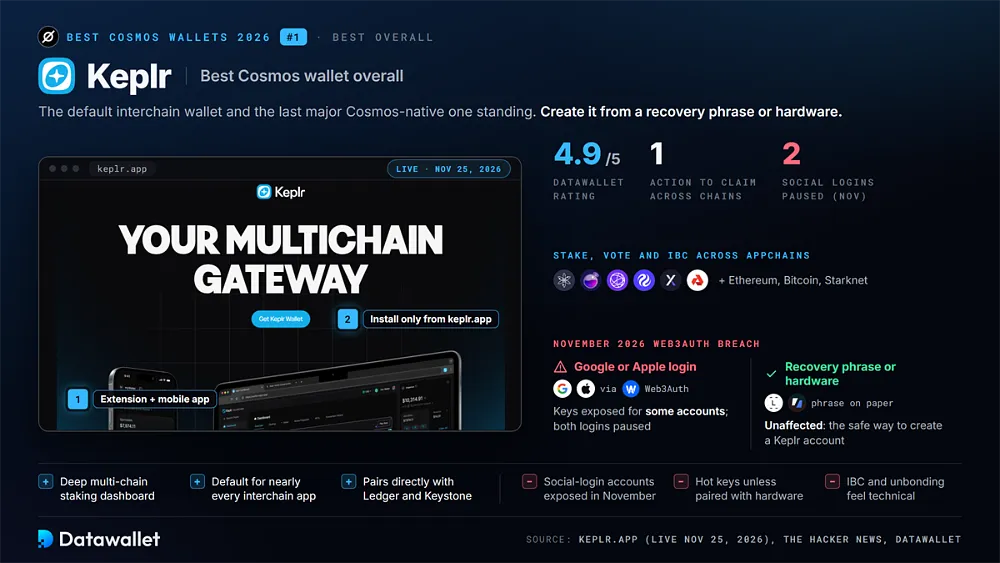
Keplr is still the default connection for interchain apps, and after the closures of Leap and Cosmostation it is the only major Cosmos-native wallet left standing. Its staking dashboard covers Cosmos Hub, Osmosis, Celestia, Injective, dYdX, and Akash, while the extension also manages Ethereum, Bitcoin, and Starknet accounts.
Staking remains its strongest feature. You can delegate ATOM, redelegate between validators, vote on proposals, and claim rewards across chains in one action, then estimate your staking returns before committing. Keplr also supports Bitcoin staking through Babylon and pairs with Ledger and Keystone for hardware-confirmed signing.
The caveat is recent. In November 2026, a flaw at login provider Web3Auth exposed private keys for some accounts created with Google or Apple sign-in, and Keplr paused both options. Accounts built on a recovery phrase or hardware wallet were unaffected, so create yours with those methods only.
Pros
- Staking depth: Delegate, redelegate, vote, and claim rewards across many Cosmos chains from one dashboard with clear validator information.
- Ecosystem default: Nearly every interchain app supports Keplr first, so new chains, airdrops, and governance portals work without workarounds.
- Hardware pairing: Ledger and Keystone connect directly, letting you keep full Cosmos functionality while keys stay on a separate device.
Cons
- Social-login breach: Google and Apple login accounts were exposed through Web3Auth in November 2026, and those sign-in options remain a risk to avoid.
- Hot storage: Keys live in a browser or phone unless you pair a hardware device, leaving the recovery phrase as a single point of failure.
- Learning curve: Concepts like IBC channels, unbonding, and chain-specific addresses make the first sessions feel technical for newcomers.
2. Ledger Nano S Plus
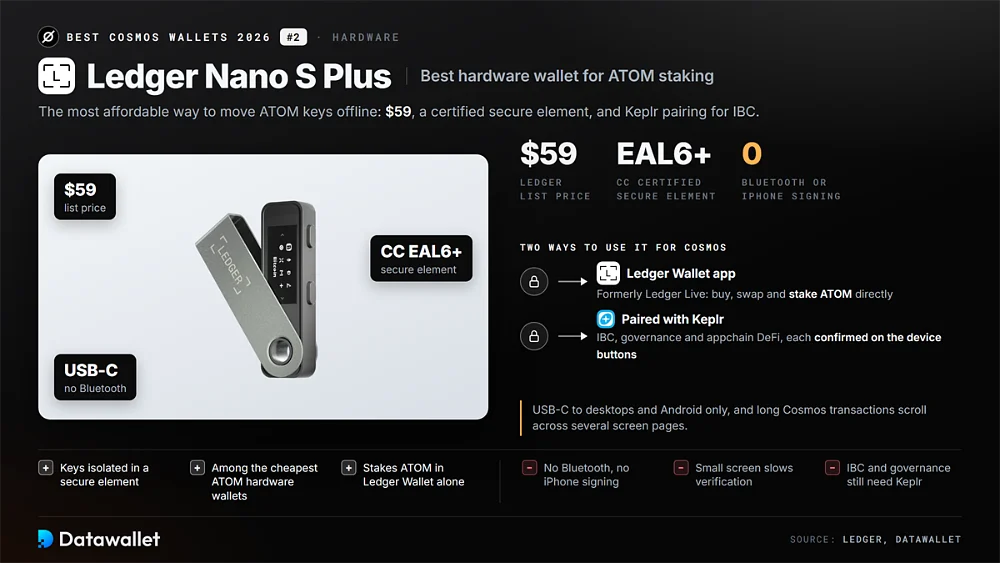
The Ledger Nano S Plus is the most affordable way to move ATOM keys offline, with Ledger listing the device at $59. Private keys sit inside a CC EAL6+ certified secure element and never touch an internet-connected machine, which removes most of the phishing and malware exposure that software wallets carry.
Setup runs through the Ledger Wallet app, formerly Ledger Live, which supports buying, swapping, and staking ATOM directly. For IBC transfers, governance votes, and appchain DeFi, connect the device to Keplr instead, so every transaction still requires a physical confirmation on the hardware buttons before it is broadcast.
The trade-offs are practical. The device connects by USB-C to desktops and Android phones only, with no Bluetooth or iPhone signing, and its small screen spreads long transactions across several pages. Buyers weighing an upgrade can read our Nano S Plus vs Nano X comparison first.
Pros
- Offline keys: A certified secure element isolates private keys from online threats during every Cosmos signing operation.
- Low price: At $59 it is among the cheapest reputable hardware wallets that support ATOM staking and Keplr pairing.
- Direct staking: The Ledger Wallet app can delegate ATOM on its own, without installing any third-party interface.
Cons
- No Bluetooth: USB-only connectivity rules out iPhone signing and makes mobile use less convenient than wireless Ledger models.
- Small screen: Long Cosmos transactions scroll across multiple pages, which makes careful on-device verification slower.
- Needs Keplr: IBC transfers, governance, and appchain dApps still require pairing the device with a software wallet.
3. Keystone 3 Pro
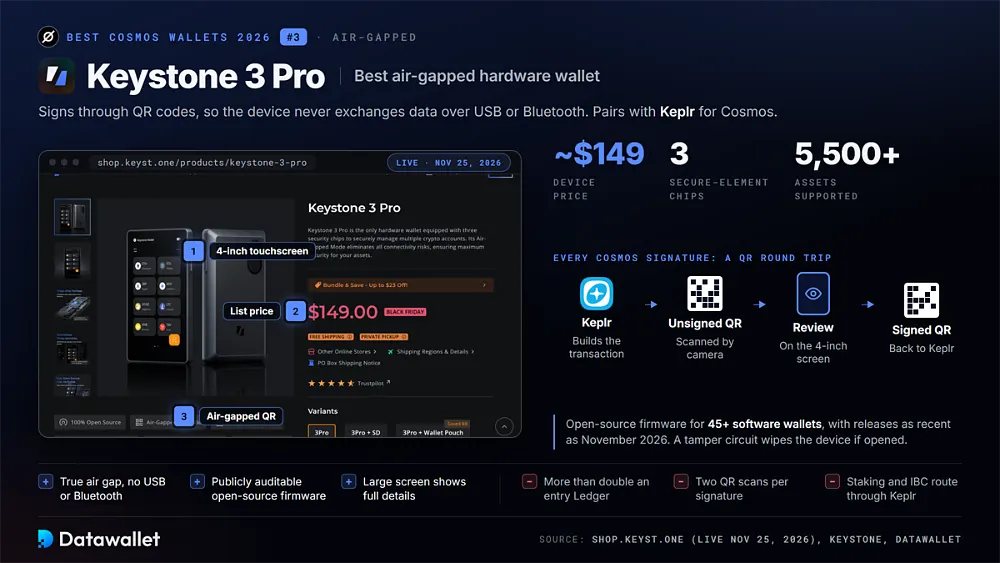
Keystone 3 Pro is our pick for air-gapped custody, signing transactions through QR codes so the device never exchanges data over USB or Bluetooth. It costs about $149, carries a 4-inch touchscreen, and splits secrets across three secure-element chips with a tamper circuit that wipes the device if opened.
For Cosmos, Keystone pairs with Keplr: you scan an unsigned transaction, review it on the large display, and return a signed QR code. The open-source firmware supports more than 5,500 assets and over 45 software wallets, with new releases published as recently as November 2026.
The trade-offs are cost and speed. Keystone is pricier than entry-level devices, and scanning codes for every delegation or IBC transfer adds steps to routine tasks. For holders who treat an air gap as non-negotiable, though, it delivers verifiable hardware security alongside the full Keplr interface.
Pros
- True air gap: QR-code signing keeps the device offline, removing USB and Bluetooth as possible attack paths.
- Open-source firmware: Publicly auditable code lets researchers verify security claims instead of trusting a closed system.
- Large display: The 4-inch touchscreen shows full transaction details, making it easier to spot a malicious request.
Cons
- Higher price: At roughly $149 it costs more than double an entry-level Ledger, which may deter smaller holders.
- QR friction: Scanning two codes per signature slows frequent staking, voting, and IBC activity.
- Pairing required: Cosmos staking and IBC still route through Keplr, so the device is not a standalone interface.
4. Trust Wallet
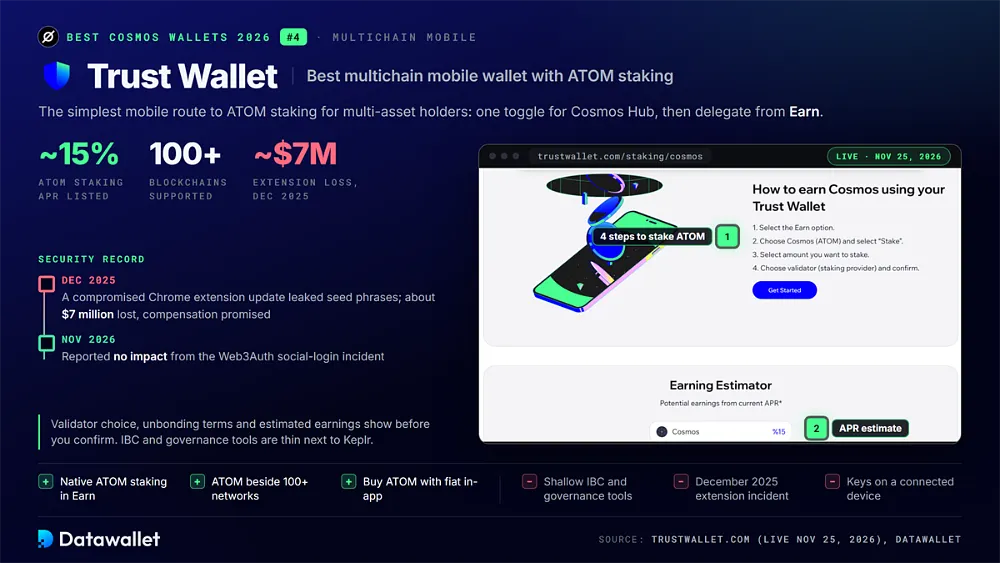
Trust Wallet is the simplest mobile route to ATOM staking for people who hold many different assets. The self-custody app spans more than 100 blockchains and lists Cosmos staking at roughly 15% APR, with validator choice, unbonding terms, and estimated earnings displayed before you confirm anything.
Enabling Cosmos Hub takes one toggle, after which you can buy ATOM with fiat, receive it from an exchange, and delegate from the Earn tab. Trust Wallet also reported no impact from the November Web3Auth incident, which matters for anyone moving away from a social-login account elsewhere.
Its limits are depth and history. IBC tooling and appchain governance are thin compared with Keplr, and a compromised Chrome extension update in December 2025 leaked seed phrases and caused about $7 million in losses, with compensation promised to affected users. Keep the extension updated and verify every download source.
Pros
- Native ATOM staking: Delegate from the Earn tab with APR, unbonding period, and validator details shown before confirmation.
- True multichain: ATOM sits beside assets from 100-plus networks, which suits a single diversified mobile portfolio.
- Easy on-ramp: Fiat purchases inside the app remove the need to route ATOM through an exchange first.
Cons
- Shallow IBC: It lacks the transfer dashboard, appchain coverage, and governance tools that Keplr provides.
- Extension incident: A malicious browser extension update in December 2025 exposed seed phrases and drained about $7 million.
- Software custody: Security rests on protecting one recovery phrase, since keys live on a connected phone or browser.
5. OKX Wallet
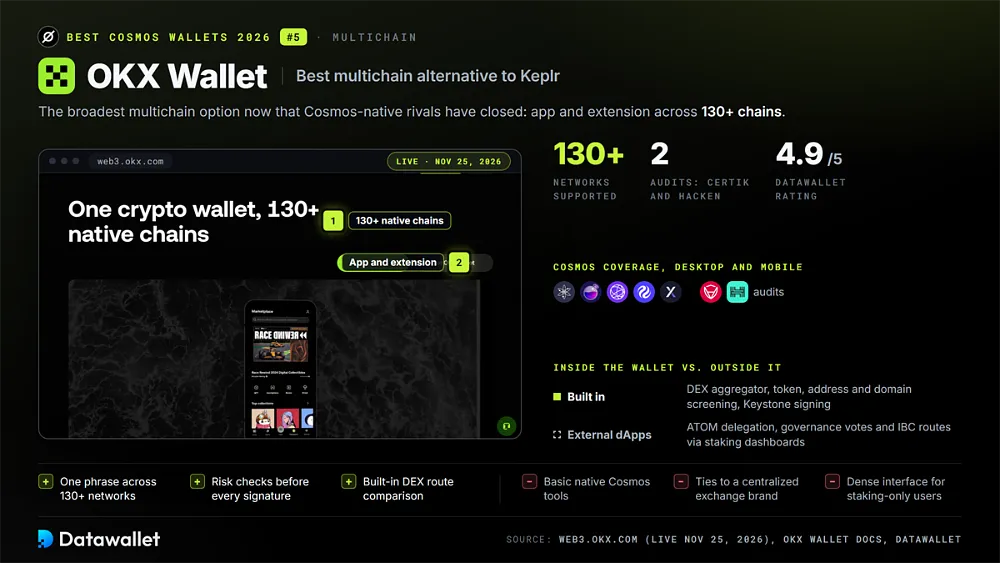
OKX Wallet is the broadest multichain alternative now that Cosmos-native rivals have closed. As our OKX Wallet review details, the self-custodial app and extension support 130-plus chains, including Cosmos Hub, Osmosis, Celestia, Injective, and dYdX, and its connection standard covers Cosmos on both desktop and mobile.
It suits traders who move between ecosystems. A built-in DEX aggregator compares liquidity routes, security tooling screens tokens, addresses, and domains before you sign, and audits from CertiK and Hacken back the codebase. Hardware devices, including Keystone, can also be connected so approvals happen on a separate offline signer.
Cosmos depth is the weakness. Delegating ATOM, voting on proposals, and managing IBC routes generally means connecting to an external staking dashboard or appchain interface, because the native Cosmos tools are basic. Treat it as a capable multichain hub that complements Keplr, not as a full replacement for it.
Pros
- Broad coverage: One recovery phrase manages Cosmos, EVM, Bitcoin, and Solana accounts across more than 130 networks.
- Risk screening: Token, address, and domain checks flag suspicious requests before a signature is approved.
- Built-in routing: The DEX aggregator compares liquidity sources for swaps without leaving the wallet.
Cons
- Basic Cosmos tools: Staking, governance, and IBC management lean on external dApps instead of a native dashboard.
- Exchange branding: Some users prefer wallets with no ties to a centralized exchange, even though custody is separate.
- Feature density: The interface packs in trading modes and discovery tabs that can overwhelm staking-only holders.
6. MetaMask
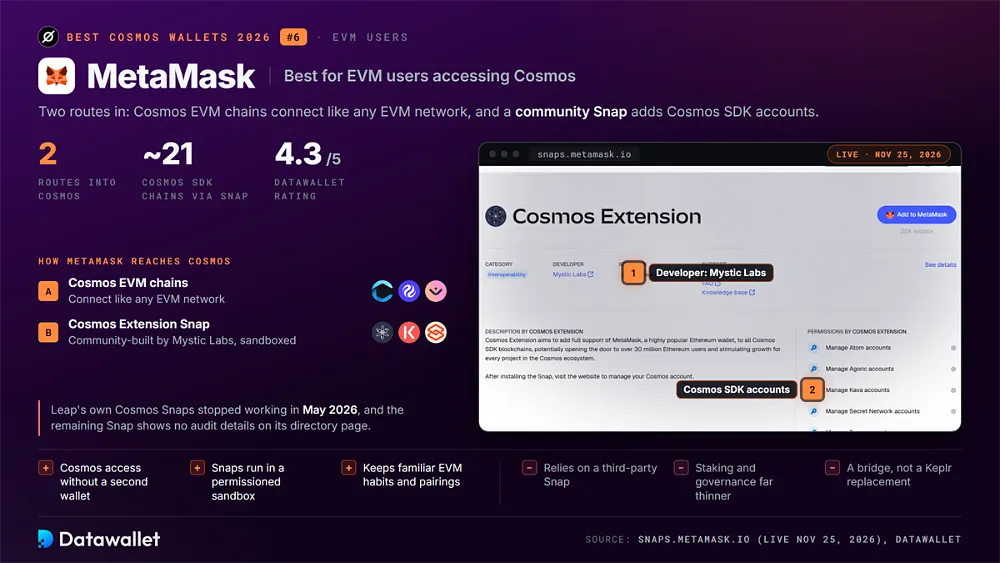
MetaMask reaches Cosmos in two ways. Cosmos EVM chains such as Cronos, Injective, and Mantra connect like any other EVM network, while the community-built Cosmos Extension Snap from Mystic Labs adds accounts for about 21 Cosmos SDK chains, including Cosmos Hub, Kava, and Secret Network.
That keeps EVM-first users inside a familiar interface, and Snaps run in an isolated, permissioned environment so existing Ethereum accounts stay separate. When Leap closed, Mantra pointed its holders toward Keplr or MetaMask, a sign of how far EVM compatibility has spread across Cosmos-built chains this year.
Reliability is the concern. Leap's own Cosmos Snaps stopped working in May 2026, and the remaining Snap shows no audit details on its directory page. Our MetaMask review covers the wallet in depth, but for staking and IBC, use it as a bridge alongside Keplr.
Pros
- No second wallet: Cosmos EVM chains and a Cosmos Snap add interchain access without a separate app.
- Isolated permissions: Snaps run in a sandbox, extending functionality without exposing existing Ethereum accounts.
- Familiar workflow: EVM users keep the interface, hardware pairings, and habits they already rely on daily.
Cons
- Snap reliability: Cosmos SDK access depends on a third-party Snap, and Leap's version was discontinued in 2026.
- Limited staking: Delegation, redelegation, and governance flows are far less complete than in Keplr.
- Bridge, not replacement: Heavy interchain users still need a Cosmos-native wallet for full chain coverage.
What Is Cosmos?
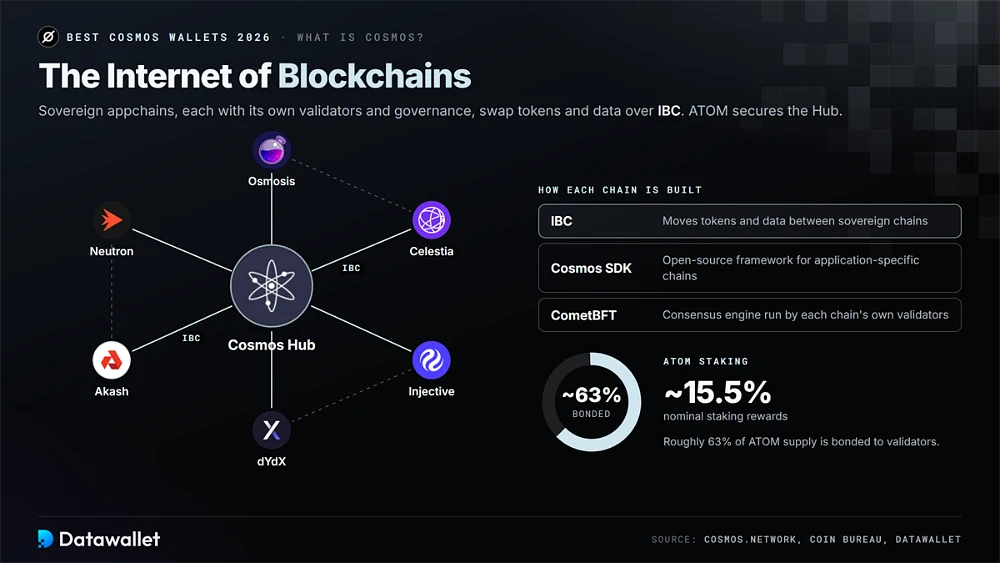
Cosmos is a network of sovereign, application-specific blockchains that exchange tokens and data through the Inter-Blockchain Communication (IBC) protocol. Each chain runs its own validators and governance, an architecture often described as the Internet of Blockchains.
Developers build these chains with the open-source Cosmos SDK and CometBFT consensus engine. The Cosmos Hub anchors the network, and ATOM secures it through staking, where roughly 63% of supply is bonded and nominal rewards sit near 15.5%.
The Late-2026 Cosmos Landscape: Consolidation and Redesign
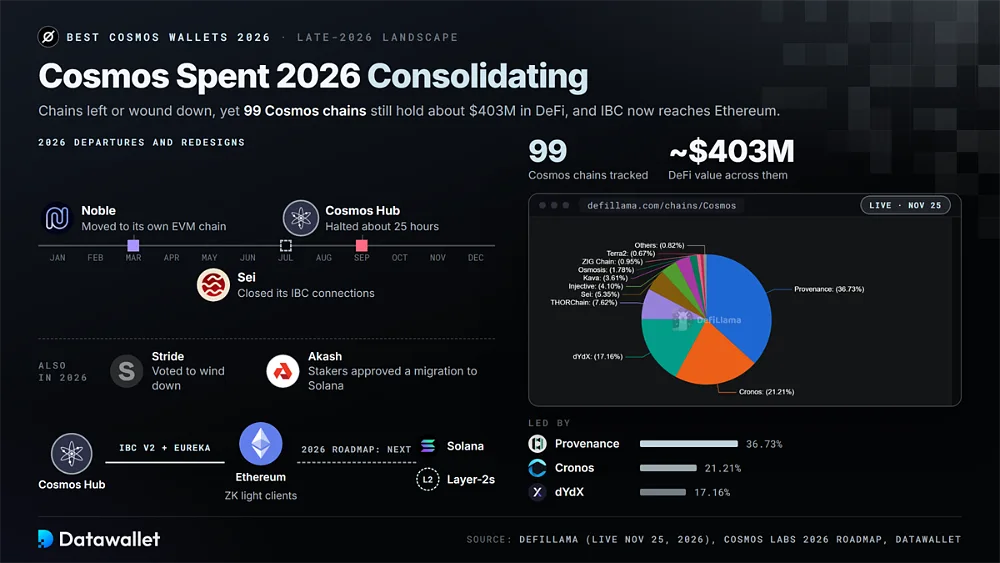
Cosmos spent 2026 consolidating. Noble moved to its own EVM chain in March, Sei closed its IBC connections in July, Stride voted to wind down, and Akash stakers approved a migration to Solana. DefiLlama still lists 99 Cosmos chains holding about $403 million in DeFi value, led by Provenance, Cronos, and dYdX.
Connectivity kept expanding regardless. IBC v2 and Eureka linked the Hub to Ethereum through zero-knowledge light clients, and the Cosmos Labs 2026 roadmap targets Solana and Layer-2 support next. For wallet users, that makes it easier to bridge assets to Osmosis or hold Celestia and Ethereum tokens together.
Security events tested the Hub as well. After a September governance attack on Neutron sent stolen funds to Cosmos Hub, validators halted the chain for roughly 25 hours and moved 1.23 million ATOM into a recovery multisig. The Hub itself was not exploited, but transfers and staking actions paused for everyone.
ATOM's economics are also under review. With the token near $1.30 and about 97% below its peak, contributors plan separate governance proposals on issuance, long-term staking incentives, and routing Hub revenue to stakers, with public discussion expected from early December. Nothing has been approved, so current staking terms still apply.
What Are Cosmos Wallets?
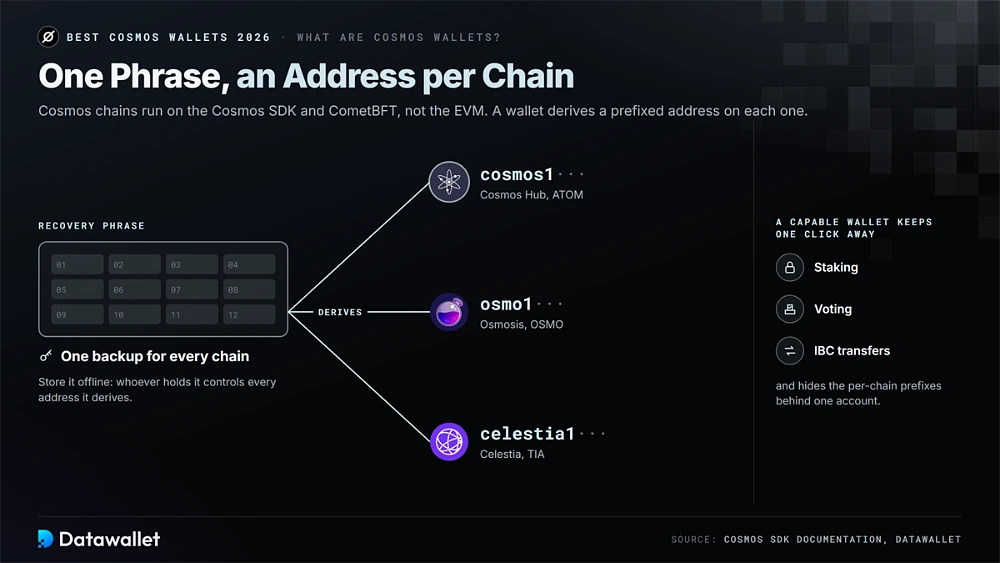
Cosmos wallets are software or hardware tools for storing, staking, and moving assets across the interchain. Because Cosmos chains run on the Cosmos SDK and CometBFT instead of the EVM, they need capabilities that general Ethereum wallets lack.
One recovery phrase typically derives a separate address on every Cosmos chain, each with its own prefix, such as cosmos, osmo, or celestia. A capable wallet hides that complexity while keeping staking, voting, and transfers one click away.
Core Features of a Cosmos Wallet
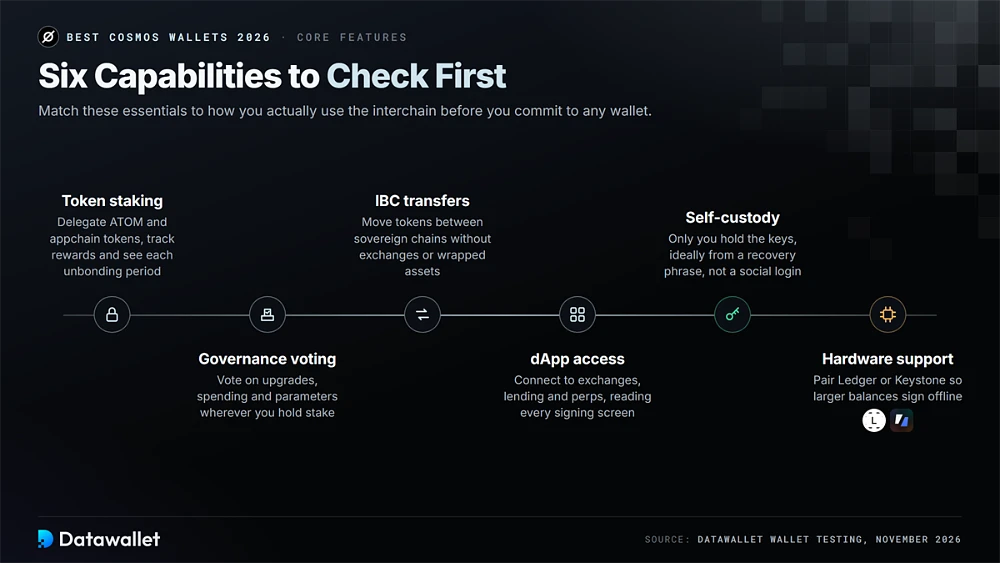
The features that define a capable Cosmos wallet cluster around a handful of essentials, and knowing them helps you match a wallet to how you actually use the interchain each day.
Look for these six capabilities before you commit to any wallet:
- Token staking: Hold ATOM and appchain tokens while delegating to validators inside the wallet, with reward tracking, redelegation, and clear visibility into the unbonding period for each chain.
- Governance voting: Cast votes on network proposals directly from the interface, shaping upgrades, spending, and parameters on every chain where you hold a staked balance.
- IBC transfers: Move tokens between sovereign chains over native IBC channels, without relying on centralized exchanges or wrapped assets issued by third-party crypto bridges.
- dApp access: Connect to exchanges, lending markets, and perpetuals platforms across Cosmos through native integrations or WalletConnect sessions, approving each request from a readable signing screen.
- Self-custody: Keep private keys under your sole control with a non-custodial design, ideally created from a recovery phrase instead of an email or social account.
- Hardware support: Pair with devices such as Ledger or Keystone so larger balances are protected by offline signing while the software interface stays fully usable.
Software vs. Hardware Wallets in Cosmos
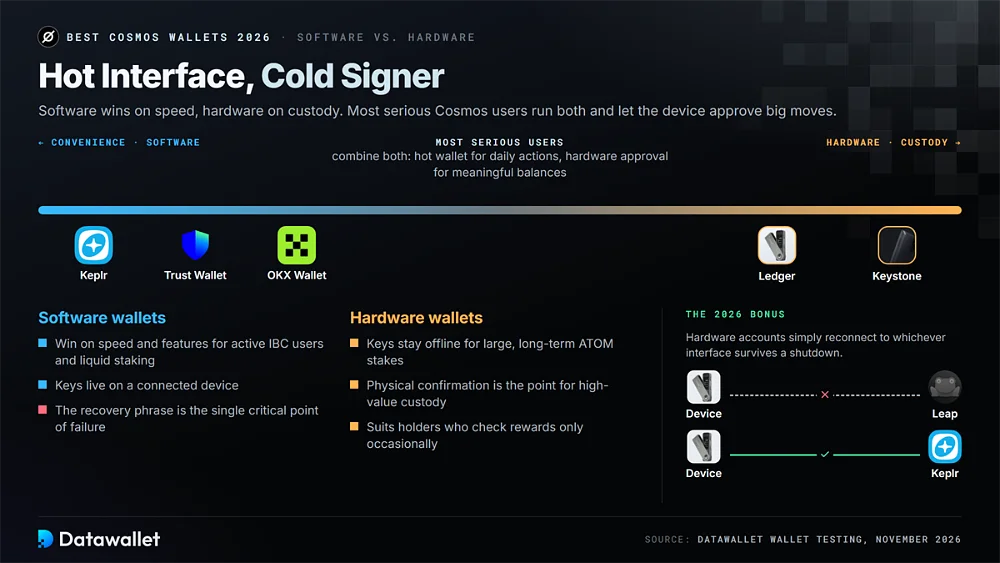
Choosing between a software and a hardware wallet comes down to how you balance convenience against custody. Most serious Cosmos users end up combining both, using a hot wallet interface for everyday actions and a hardware signer to approve anything that touches a meaningful balance or a long-term staking position.
Software wallets like Keplr, Trust Wallet, and OKX Wallet win on speed and features, which suits active users who move assets across IBC chains or into liquid staking protocols. The trade-off is that keys live on a connected device, so the recovery phrase becomes the single critical point of failure.
Hardware wallets such as Ledger and Keystone keep keys offline, which suits long-term holders staking large ATOM positions and checking rewards occasionally. The friction of physical confirmation is the point for high-value custody, and the 2026 shutdowns showed another benefit: hardware accounts simply reconnect to whichever interface survives.
Why Is Cosmos Not Supported on EVM Wallets?
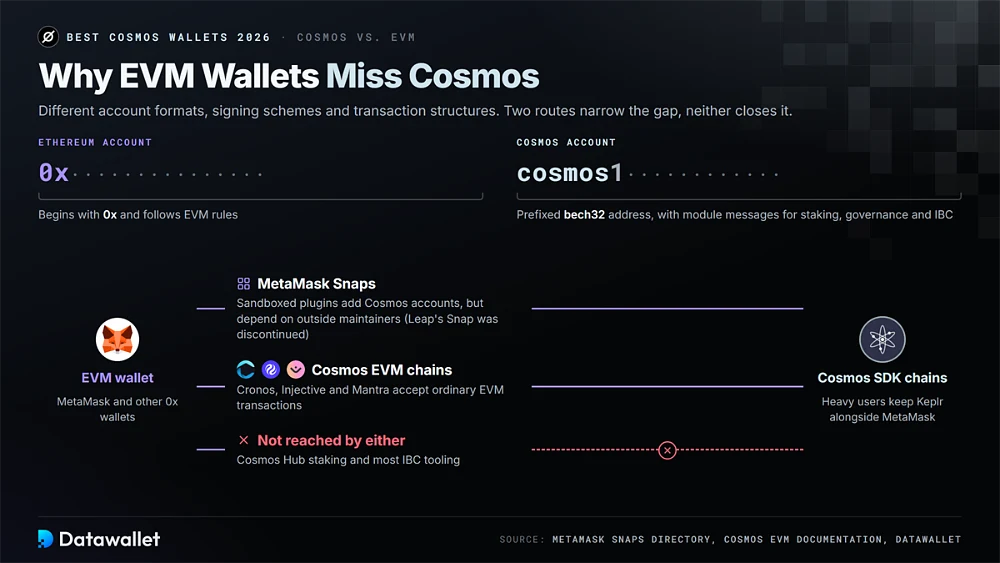
Cosmos SDK assets are natively incompatible with EVM wallets because the two ecosystems use different account formats, signing schemes, and transaction structures. Ethereum addresses begin with 0x and follow EVM rules, while Cosmos chains use prefixed bech32 addresses and module-based messages for staking, governance, and IBC.
Two developments narrow that gap. MetaMask Snaps let third-party developers add Cosmos account support inside a sandboxed plugin, and the Cosmos EVM framework lets chains such as Cronos, Injective, and Mantra accept ordinary EVM transactions, so you can add those networks to MetaMask like any other chain.
Neither route is a full substitute. Snaps depend on outside maintainers, as Leap's discontinued version showed, and EVM compatibility does not reach Cosmos Hub staking or most IBC tooling. Heavy Cosmos users therefore keep a native wallet such as Keplr alongside MetaMask instead of relying on one interface for everything.
How to Migrate After the Leap and Cosmostation Shutdowns
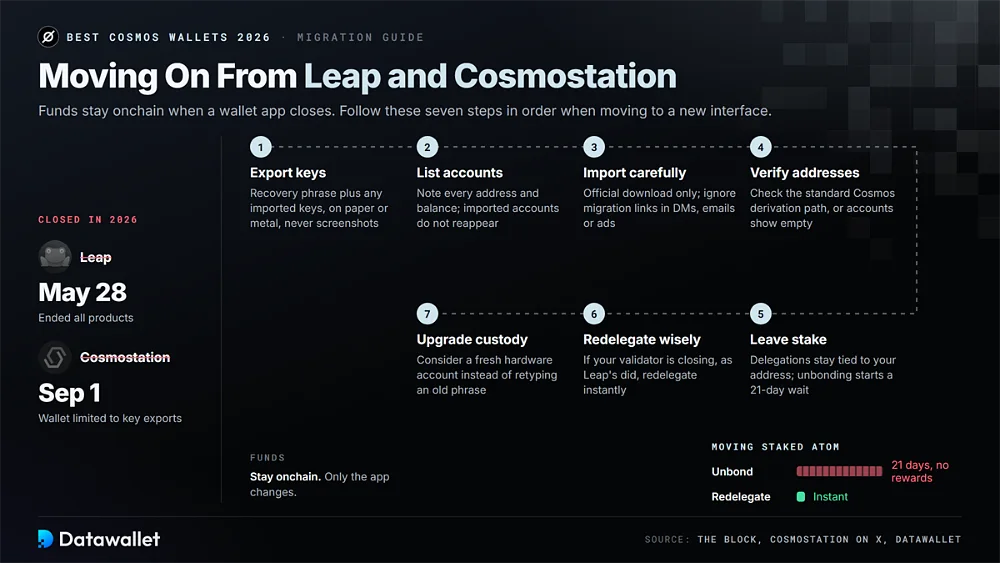
Leap ended all products on May 28, 2026, and Cosmostation limited its wallet to key exports from September 1. Funds stay on-chain, but former users must move to a new interface carefully.
Follow these steps in order when moving to another wallet:
- Export keys: Record the recovery phrase and any separately imported private keys from the old app, writing them on paper or metal and never saving screenshots or cloud notes.
- List accounts: Note every address and balance you used, because accounts imported individually will not reappear automatically when you restore a single recovery phrase in a new wallet.
- Import carefully: Restore the phrase in Keplr or another supported wallet downloaded from its official site, ignoring migration links sent through direct messages, emails, or search ads.
- Verify addresses: Compare the restored addresses and balances with your notes, confirming the wallet uses the standard Cosmos derivation path, since a different path shows empty accounts.
- Leave stake: Keep delegations in place, as staked ATOM and unclaimed rewards remain tied to your address, and unbonding would only start a 21-day wait without rewards.
- Redelegate wisely: Check whether your validator is closing, as Leap's did, and redelegate to an active operator, which moves stake instantly without triggering the unbonding period.
- Upgrade custody: Consider creating a fresh account on a hardware wallet and transferring liquid funds there, instead of typing an old recovery phrase into another connected device.
Is Social Login Safe for a Cosmos Wallet?
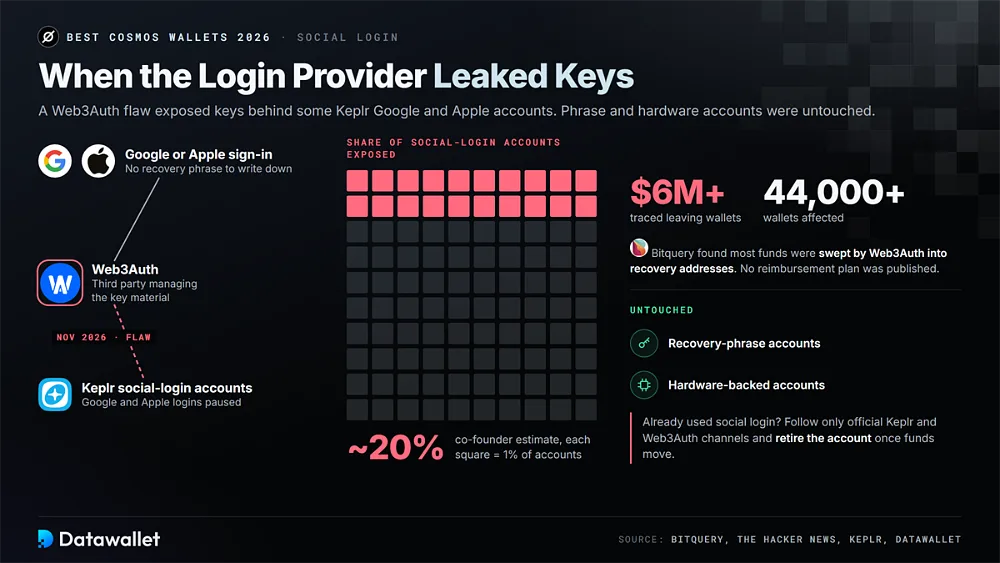
Social login lets you create a wallet with a Google or Apple account instead of a recovery phrase, with a third-party service managing the key material behind the scenes. It lowers the barrier for newcomers, but it also adds a company whose infrastructure must stay secure for your funds to remain safe.
That dependency failed in November 2026. Web3Auth disclosed a vulnerability that exposed keys for some Keplr social-login accounts, and Bitquery traced at least $6 million leaving more than 44,000 wallets, most of it swept by Web3Auth into recovery addresses. Keplr's co-founder estimated about 20% of social-login accounts were exposed.
The lesson is narrow but important. Keplr's core wallet code was not breached, and recovery-phrase and hardware accounts were untouched, yet affected users were told not to deposit, not to re-import those accounts, and to move liquid funds elsewhere. No reimbursement plan had been published at the time of writing.
For any balance you would miss, create the wallet from a recovery phrase you store offline, or pair it with a hardware signer. If you already used social login, follow only official Keplr and Web3Auth channels, ignore unsolicited recovery offers, and treat that account as retired once funds are moved.
How to Choose a Cosmos Wallet
Picking the right Cosmos wallet means matching a tool to how you actually use the interchain, weighing custody, chain coverage, staking needs, and the provider's staying power before you move a single token into a new account.
1. Match the Wallet to Your Usage
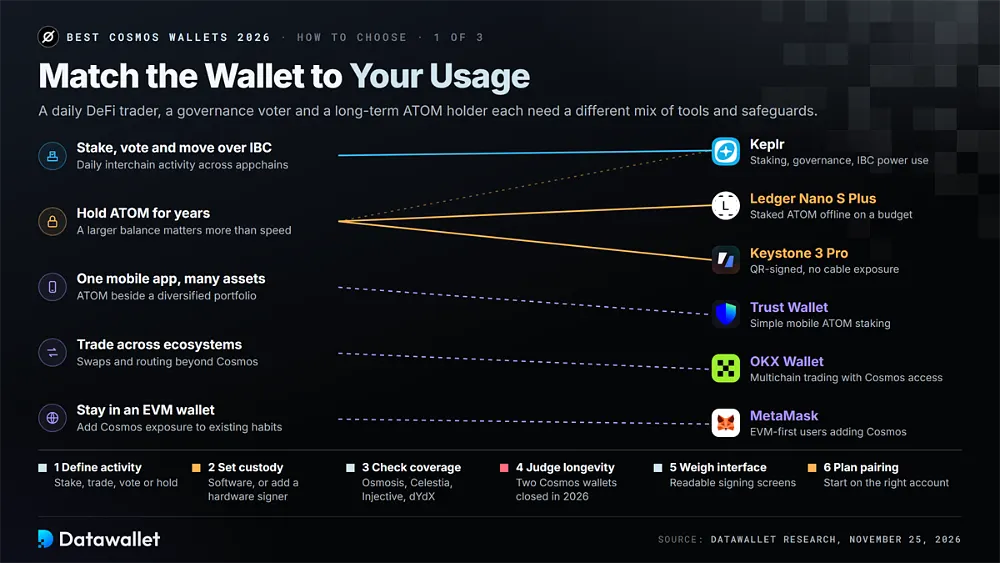
Before comparing brands, decide how you interact with Cosmos, because a daily DeFi trader, a governance participant, and a long-term ATOM holder each need a noticeably different combination of tools and safeguards.
Work through these six questions in order before you decide:
- Define activity: Decide whether you mainly stake, trade across appchains, vote in governance, or simply hold ATOM for years, since each pattern rewards different wallet strengths.
- Set custody: Choose a software wallet for speed and frequent access, or add a hardware signer when protecting a larger balance matters more than saving a few seconds.
- Check coverage: Confirm the wallet natively supports the specific chains you use, such as Osmosis, Celestia, Injective, or dYdX, including staking and IBC transfers on each.
- Judge longevity: Favor wallets with funding, active releases, and a clear business model, because two established Cosmos wallets closed in 2026 and forced rushed migrations.
- Weigh interface: Pick a layout you can read confidently, since crowded dashboards and unclear signing screens increase the odds of approving something you did not intend.
- Plan pairing: Decide early whether a hardware device will sit behind your software wallet, so your addresses, delegations, and history start on the right account.
2. Verify Security and Custody
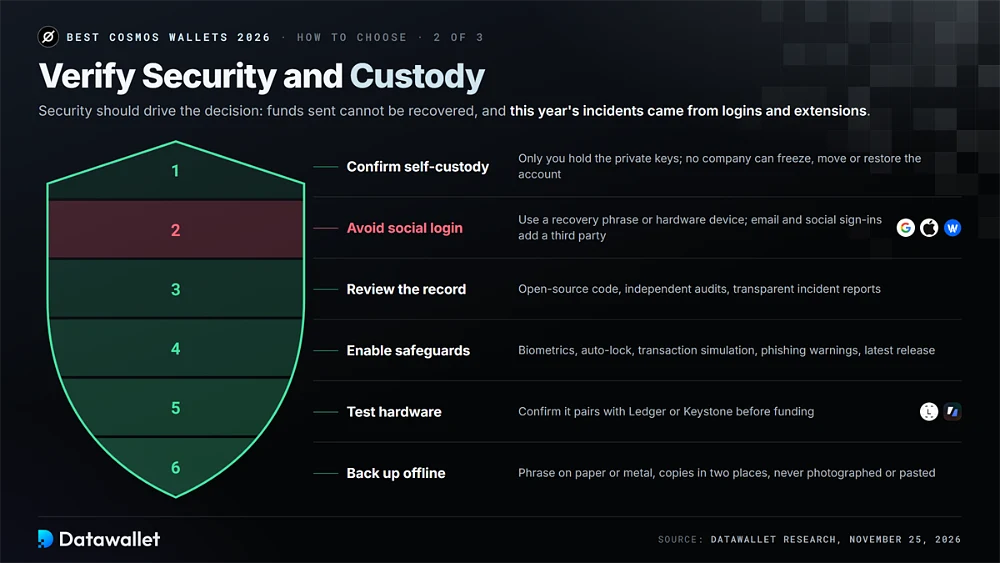
Security should drive the decision more than any single feature, because a wallet controls access to funds that cannot be recovered once sent, and this year's incidents came from logins and extensions.
Run through this checklist before trusting a wallet with funds:
- Confirm self-custody: Make sure the wallet is fully non-custodial, meaning only you hold the private keys and no company can freeze, move, or restore your account.
- Avoid social-login: Create accounts from a recovery phrase or hardware device, since email and social sign-ins add a third party that can leak key material.
- Review record: Look for open-source code, independent audits, and transparent incident reports, and read how the team handled past breaches before committing meaningful funds.
- Enable safeguards: Turn on biometrics, auto-lock, transaction simulation, and phishing warnings during setup, and keep the app or extension updated to the latest official release.
- Test hardware: Verify the wallet pairs with a device like Ledger or Keystone before funding it, especially if you plan to hold staked positions long term.
- Backup offline: Write the recovery phrase on paper or metal, store copies in two secure places, and never photograph it or paste it into any website.
3. Set Up Your Wallet Safely
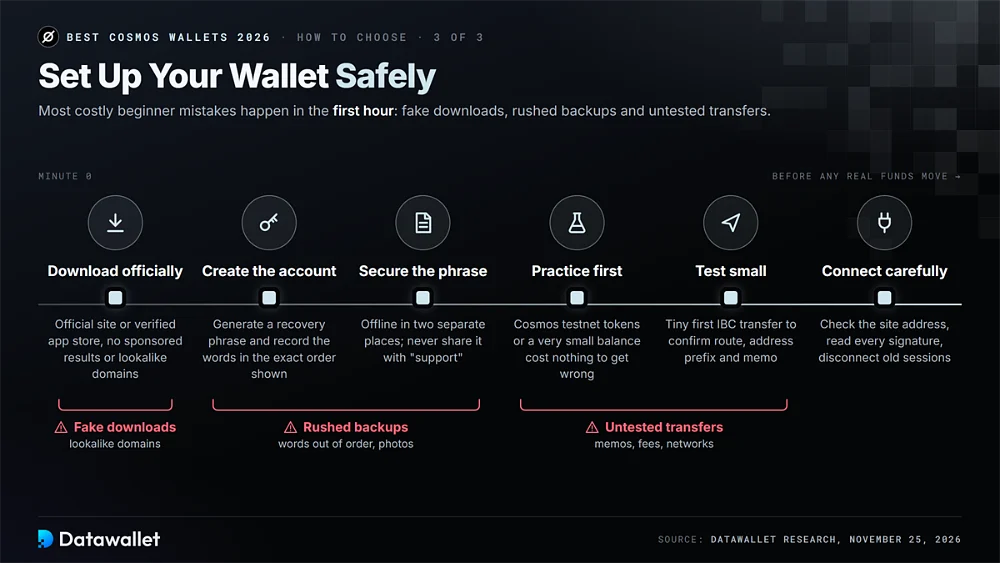
Once you have chosen a wallet, a careful setup prevents the most common and costly beginner mistakes, most of which happen in the first hour through fake downloads, rushed backups, or untested transfers.
Complete each of these steps before transferring any real funds:
- Download officially: Install only from the wallet's official website or a verified app store listing, avoiding sponsored search results, lookalike domains, and links shared in community chats.
- Create account: Generate a new wallet with a recovery phrase and record the words in the exact order shown, checking spelling carefully before moving to the next screen.
- Secure phrase: Store the recovery words offline in two separate physical locations, away from cameras and connected devices, and never share them with anyone claiming to be support.
- Practice first: Try unfamiliar actions with Cosmos testnet tokens or a very small balance, so mistakes with memos, fees, or networks cost nothing meaningful.
- Test small: Send a tiny amount on your first IBC transfer or exchange withdrawal to confirm the route, address prefix, and memo before moving a larger sum.
- Connect carefully: Approve dApp connections only after checking the site address, read every signature request in full, and disconnect sessions you no longer use.
Risks of Using Cosmos Wallets
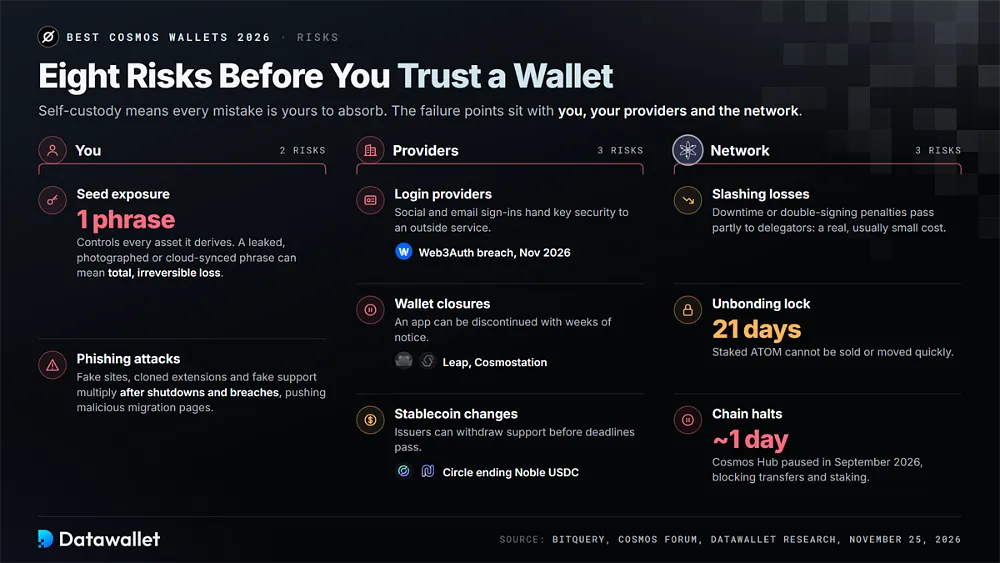
Self-custody puts you in full control, which also means every mistake is yours to absorb, so understanding the common failure points matters before staking, swapping, or moving assets across the interchain.
Weigh each of these eight risks before trusting any wallet fully:
- Seed exposure: Anyone who obtains your recovery phrase controls every asset it derives, so a leaked, photographed, or cloud-synced phrase can mean total and irreversible loss.
- Login providers: Social and email sign-ins hand part of your key security to an outside service, and the November 2026 Web3Auth breach showed how that can fail.
- Phishing attacks: Fake wallet sites, cloned extensions, and fraudulent support messages multiply after shutdowns and breaches, tricking users into entering recovery phrases on malicious migration pages.
- Wallet closures: A provider can discontinue its app with weeks of notice, leaving you to export keys and rebuild your setup elsewhere under time pressure.
- Slashing losses: Validators penalized for downtime or double-signing pass part of that loss to delegators, so careless validator selection carries a real, if usually small, cost.
- Unbonding lock: The 21-day unbonding period freezes staked ATOM, meaning you cannot sell or transfer it quickly if prices fall or an account is compromised.
- Chain halts: Validators can pause a network during emergencies, as Cosmos Hub did for about a day in September 2026, temporarily blocking transfers and staking actions.
- Stablecoin changes: Asset issuers can withdraw support, as Circle is doing with Noble-issued USDC, requiring holders to migrate tokens before redemption and access deadlines pass.
Final Thoughts
Selecting the best Cosmos wallet in 2026 is less about feature counts and more about durability. Two established wallets closed, a login provider leaked keys, and the Hub itself paused for a day, yet users holding their own recovery phrases or hardware devices kept full control throughout each event.
Keplr remains the most complete interface for staking, governance, and IBC, while Trust Wallet, OKX Wallet, and MetaMask serve multichain and EVM-first users. For most people, pairing Keplr with a Ledger Nano S Plus or Keystone 3 Pro still offers the strongest balance of security and ecosystem access.
Our Methodology
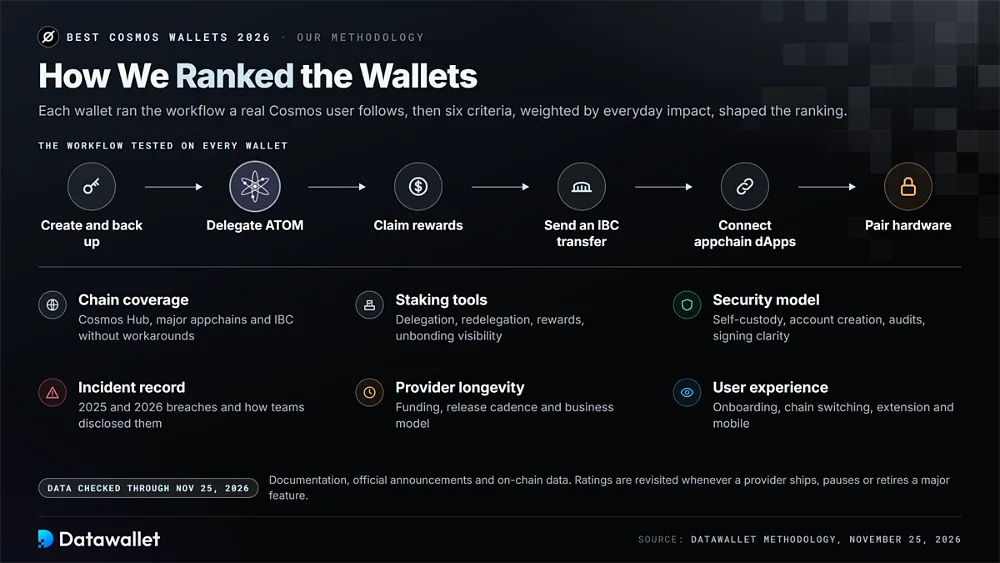
We evaluated each wallet against the workflow a real Cosmos user follows: creating and backing up an account, delegating ATOM, claiming rewards, sending an IBC transfer, connecting to appchain dApps, and pairing hardware.
Six criteria shaped the final ranking, weighted by everyday impact:
- Chain coverage: We checked native support for Cosmos Hub and major appchains, plus non-Cosmos networks, and whether IBC transfers and staking worked on each without workarounds.
- Staking tools: We assessed delegation, redelegation, reward claiming, unbonding visibility, and validator information, favoring wallets that handle multiple chains clearly from a single interface.
- Security model: We compared self-custody design, account creation methods, hardware pairing, audits, and how clearly each wallet presents signing requests and permission risks to users.
- Incident record: We reviewed 2025 and 2026 breaches, extension compromises, and provider responses, weighing how quickly teams disclosed problems and what affected users were told.
- Provider longevity: We considered funding, release cadence, and business model, since the Leap and Cosmostation closures showed that an unsupported wallet becomes a liability.
- User experience: We examined onboarding, portfolio views, chain switching, and signing clarity across extension and mobile, noting where friction helps security and where it only slows users.
Wallet features, chain support, and provider status change quickly in Cosmos, so this update reflects documentation, official announcements, and on-chain data checked through November 25, 2026. Ratings combine documented capabilities with each wallet's security history, and we revisit them whenever a provider ships, pauses, or retires a major feature.