
Can I Add Sepolia to MetaMask?
Yes. Sepolia is a proof-of-stake Ethereum testnet that behaves almost exactly like mainnet, which is why it is the default place to validate contract logic, gas behavior, and dApp interactions before touching real funds. Because it is fully EVM-compatible, MetaMask treats it like any other custom network once the parameters are in.
Depending on your MetaMask version, Sepolia may already appear once you enable test networks. Adding it through ChainList or a manual RPC is more reliable, since you choose the endpoint yourself instead of relying on a default that changes between releases. The currency shows as ETH, but it is test ETH with no value, given out free through faucets.
How to Add Sepolia to MetaMask
ChainList is the fastest method because it fills in the verified parameters for you. We still check those values against the official network details before approving, since a mismatched Chain ID or malicious RPC is the usual way wallet connections go wrong.
Here is the process from start to funded:
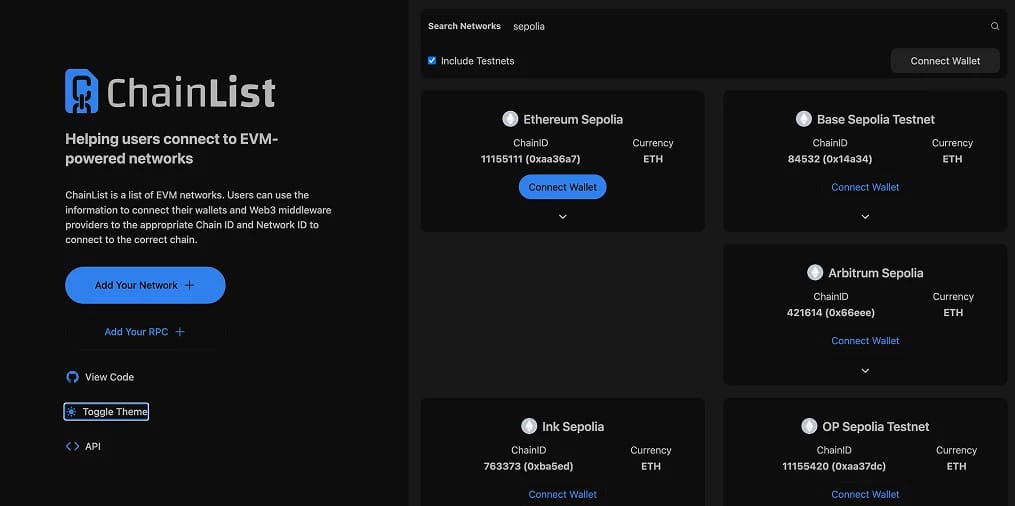
- Open ChainList: Go to the ChainList website, confirm the domain reads chainlist.org, and connect MetaMask. Enable the "Include Testnets" toggle so Sepolia appears.
- Confirm the network: Check the entry shows Chain ID 11155111 and ETH. Searching "Sepolia" also surfaces Layer 2 instances and look-alikes, so confirm you are on the Ethereum Sepolia entry.
- Add to MetaMask: Click "Add to MetaMask," then compare the wallet popup against the settings below before approving.
- Switch and fund: Select Sepolia in MetaMask's network menu, then claim test ETH from a faucet, since nothing runs without gas.
Sepolia RPC and Chain ID
To configure the network by hand, or to add it to a wallet other than MetaMask, use the settings below. Confirm them any time on the Sepolia block explorer:
- Network Name: Sepolia
- RPC URL: https://ethereum-sepolia-rpc.publicnode.com
- Chain ID: 11155111 (0xaa36a7 in hexadecimal)
- Currency Symbol: ETH
- Block Explorer URL: https://sepolia.etherscan.io
The public endpoint above works for wallet use without an API key. For automated test suites, indexers, or anything firing high request volumes, a keyed endpoint from Alchemy or Infura gives higher rate limits and more stability. Avoid the shared demo keys in old tutorials, which are heavily rate limited and unreliable for real work.
How to Get Sepolia Test ETH
Once the network is added, you need test ETH for gas. Several faucets distribute it, and most now gate requests behind a small mainnet ETH balance to deter bots. The main options:
- Google Cloud Web3 Faucet: Drips about 0.05 test ETH daily and requires a small Ethereum mainnet balance to qualify.
- Alchemy Sepolia Faucet: Gives up to 0.1 ETH every 24 hours, with a minimum mainnet balance near 0.001 ETH plus some account history.
- QuickNode Multi-Chain Faucet: One drip per network every 12 hours, covering Ethereum Sepolia and several Layer 2 Sepolia testnets.
- PoW Faucet: A no-login option where you solve a browser proof-of-work challenge for test ETH, useful when gated faucets reject your wallet.
If a source is dry or your wallet does not qualify, pre-fund one address with a larger request instead of hitting faucets repeatedly. Our guide on getting Sepolia testnet tokens walks through each option. When you request funds, check the faucet sends to Ethereum Sepolia, not a Layer 2 Sepolia, since the two are separate.
Sepolia and Layer 2 Testnets
Most major rollups run their own Sepolia testnet that settles to Ethereum Sepolia as the underlying Layer 1. Base Sepolia (Chain ID 84532), Arbitrum Sepolia (421614), and OP Sepolia draw their security and data availability from it, which makes Sepolia the anchor for cross-rollup development. Testing a contract that spans a Layer 2 network and mainnet usually means holding test ETH on both Ethereum Sepolia and the relevant L2 Sepolia.
Moving test funds between these networks works through a testnet bridge, not a faucet. Our guide on bridging to Sepolia covers tools that transfer across Ethereum Sepolia, Base, Arbitrum, and other instances. Adding each L2 Sepolia to MetaMask uses the same ChainList or manual process, with a different Chain ID per network.
About Sepolia
Sepolia is a proof-of-stake Ethereum testnet from 2021. Its permissioned validator set, run by client and testing teams, keeps the chain stable and quick to sync, which made it the default home for application and contract development.
It is also where Ethereum stages mainnet upgrades. Pectra ran here before its May 2025 launch, and Fusaka was tested on Sepolia in October 2025 ahead of its December activation, giving developers an early read on production behavior.
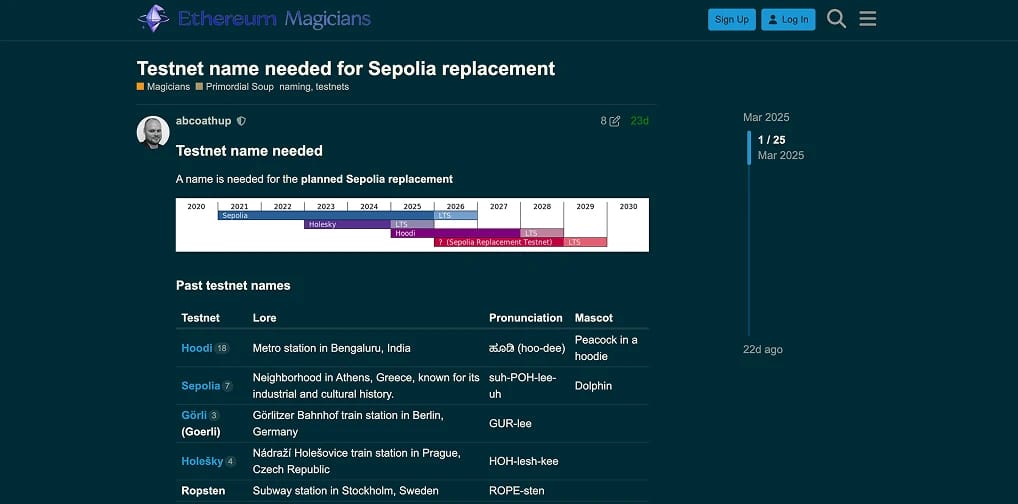
Watch the lifecycle. Ethereum has set Sepolia toward end-of-life near September 2026, with a successor testnet due in 2026 that runs alongside it during a grace period. A parallel reshuffle replaced Holesky with Hoodi, the open-validator-set testnet for stakers. Use Sepolia for contract testing and Hoodi for validator setups, and confirm the timeline with the Ethereum Foundation before any long-running deployment.
Final Thoughts
Adding Sepolia to MetaMask takes about a minute through ChainList and slightly longer by hand, and the settings above match the network's official configuration. Two habits save you trouble: verifying Chain ID 11155111 in the MetaMask popup before approving, and funding your wallet from a faucet so transactions can run.
Treat the testnet roadmap as part of your planning too. Sepolia remains the right choice for dApp and contract work in 2026, but with its retirement scheduled and a replacement coming, track the migration timeline rather than assuming the network stays indefinitely.
Verify the parameters once, watch the lifecycle, and every connection after is a single click.