







Compare Top Argentine Crypto Exchanges
1. Bybit
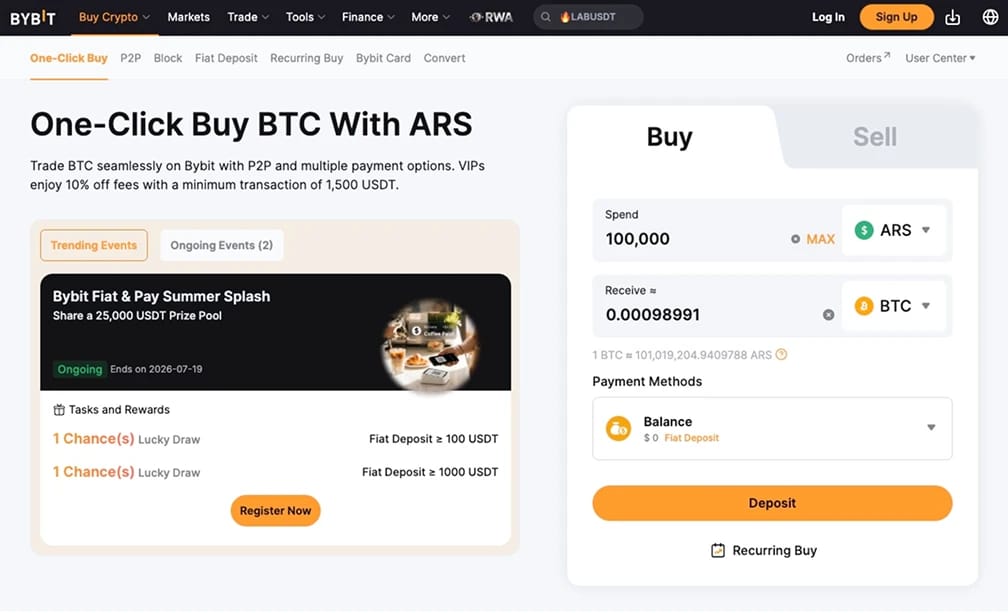
Bybit keeps the top spot because it pairs regulatory standing in Argentina with a product depth no local platform approaches. The exchange registered as a Virtual Asset Service Provider in August 2024, a filing that also covered card operation services, and behind it sit more than 2,000 listed assets, perpetual futures, copy trading, Earn products, and a flat 0.10% spot fee.
Peso funding is where Bybit pulls ahead. The ARS fiat deposit portal accepts direct bank transfers that credit your Funding Account with a peso balance. The P2P market still runs alongside it, quoting USDT against ARS with Mercado Pago and bank-transfer sellers, while card purchases cover small purchases. Our test deposit landed as an ARS balance ready to convert.
Know what the registration means for your data. As a registered platform, Bybit reports qualifying activity to Argentine authorities, which suits anyone keeping their tax position clean and deters those who came to crypto for privacy. The derivatives suite also puts 100x leverage a few taps from the deposit screen, a temptation worth respecting. Our Bybit review covers the platform end-to-end.
Pros
- Registered VASP in Argentina since August 2024, with card services included in the filing.
- 2,000+ assets, futures, copy trading, and Earn behind a flat 0.10% spot fee.
- Liquid USDT/ARS P2P market with Mercado Pago and bank transfer support.
Cons
- Reports qualifying activity to Argentine authorities, a drawback for privacy-first traders.
- Direct deposits reject transfers from accounts that do not match your KYC name.
- 100x leverage sits close to the deposit screen, making it easy to misuse without discipline.
2. Binance
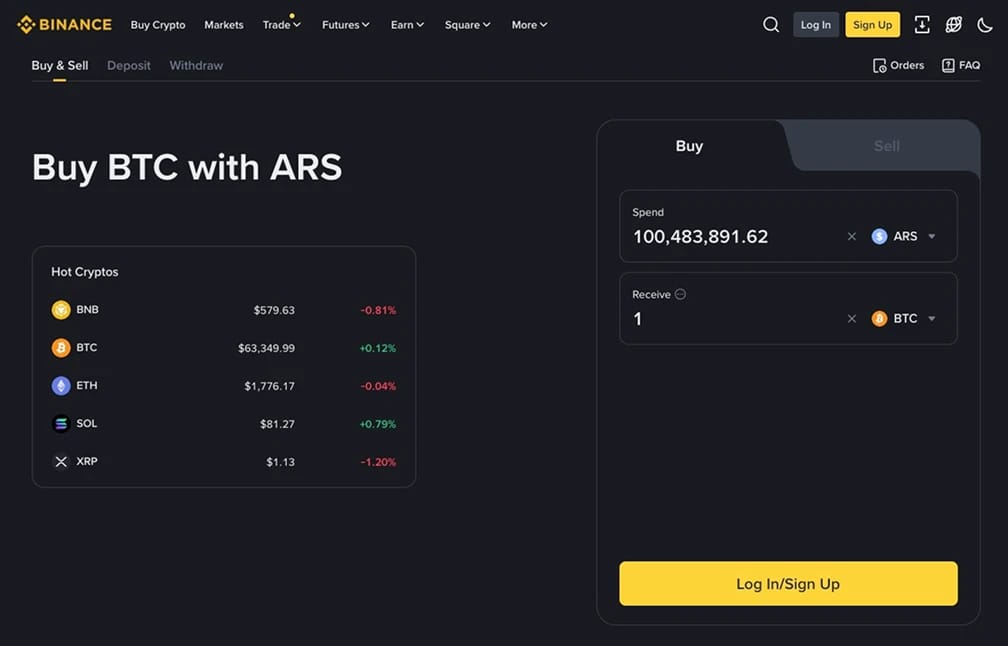
Binance runs the deepest peso market in the country and was among the first global names to formalize here. Binance Services Latinoamérica S.A. de C.V. entered the CNV registry as PSAV number 76 in September 2024, and the platform pairs that standing with 400+ assets, spot fees of 0.10% that fall to 0.075% when paid in BNB, Earn products, and automated trading bots.
For everyday use, the ARS integration is the draw. Pesos arrive by bank transfer from a CBU or CVU; the P2P desk is the most liquid in Argentina, with Mercado Pago sellers active around the clock, and Spanish-language support actually answers. We funded an account from a Santander Argentina account and had USDT in hand inside ten minutes, a loop worth testing yourself since bank practices differ.
The registration cuts both ways. As a registered PSAV, Binance reports client balances and movements to Argentine authorities under the UIF and ARCA information regimes, which is exactly what a compliant investor should want and exactly what sends privacy-minded traders to offshore venues. The global entity's 2023 settlement with the US Department of Justice also still colors its history, as our Binance review details.
Pros
- CNV PSAV registration number 76, held since September 2024.
- Deepest ARS P2P market, plus direct bank transfer deposits from CBU and CVU accounts.
- 0.10% spot fees with a BNB discount, Earn, and trading bots on one account.
Cons
- Reports user activity to the UIF and ARCA, which some traders prefer to avoid.
- The 2023 US DOJ settlement remains a mark on the global record.
- The interface packs in more products than a first-time buyer needs.
3. MEXC
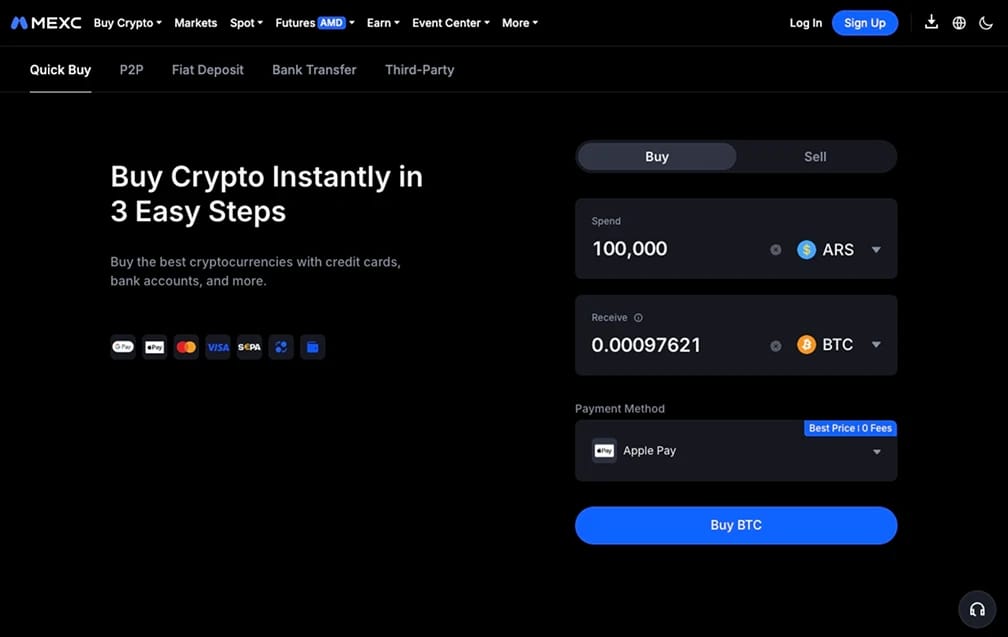
MEXC is where Argentine derivatives traders end up once leverage becomes the point. Futures run to 500x across more than 1,000 pairs, spot listings pass 3,000 coins, and the fee schedule is the most aggressive in this comparison, with 0% maker fees on spot and futures taker fees from 0.02%. New tokens tend to list here weeks before the regulated venues touch them.
Funding from Argentina works through the P2P market, where USDT trades against pesos via bank transfer and Mercado Pago, or through third-party card processors at a premium. Our P2P test order filled quickly at a spread close to Binance's, and the platform's demo trading mode is a genuinely useful sandbox before risking real margin. Traders comparing venues for perpetuals can weigh it against the field in our best crypto futures exchanges guide.
Unfortunately, we found no MEXC entry in the CNV's PSAV registry, so it serves Argentines from offshore, without local supervision and without the recourse a registered platform offers if something breaks. The long tail of listings also carries thin books and real drawdown risk. Treat it as a trading venue for specific opportunities rather than a home for savings, and see our MEXC review for the full assessment.
Pros
- 0% spot maker fees and futures takers from 0.02%, the cheapest schedule here.
- 3,000+ listings and 500x futures reach markets, something that regulated exchanges skip.
- Demo trading and frequent airdrop campaigns reward active users.
Cons
- Not in the CNV's PSAV registry, so Argentines use it without local oversight.
- Thin liquidity on long-tail listings punishes careless entries.
- Extreme leverage liquidates undercapitalized positions in minutes.
4. OKX
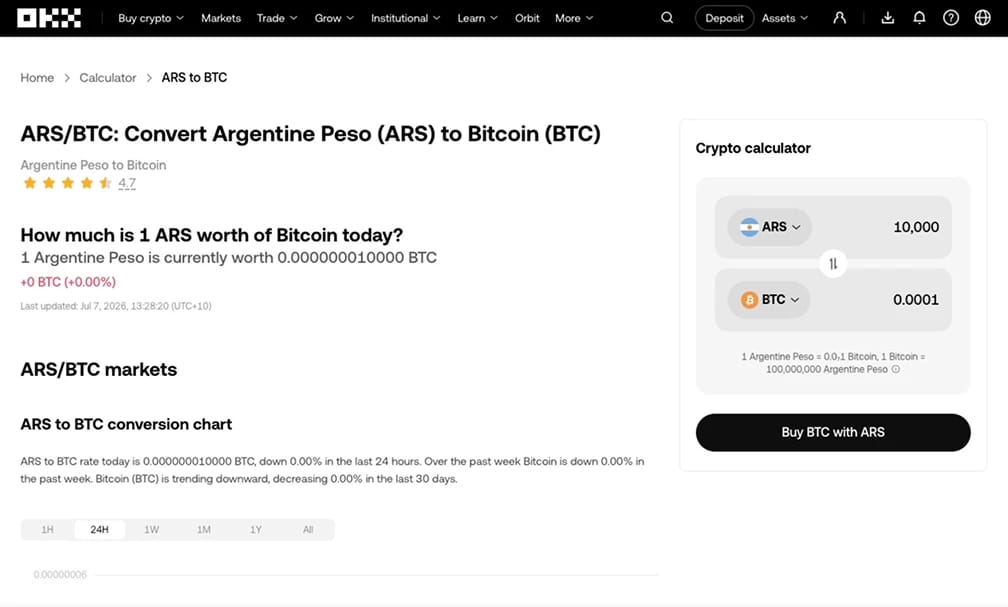
OKX made Argentina a strategic market before most rivals noticed it. The exchange launched a localized platform in February 2024 with a country manager in Buenos Aires, Spanish-language support, and P2P payment methods tuned to local rails. Spot fees of 0.08% maker and 0.10%, and monthly proof-of-reserves attestations verified with zk-STARK cryptography have shown collateralization above 100% since 2022.
The Web3 side is what separates it. The self-custodial OKX Wallet spans 100+ chains and includes a built-in DEX aggregator, so a user can buy USDT on the P2P market, move it on-chain, and farm DeFi yield without leaving the app. That matters in a country where holding stablecoins in self-custody is a mainstream savings behavior rather than a hobbyist niche. Our peso deposit through a P2P bank transfer cleared in minutes.
Check the registry before treating it as your regulated home base. OKX operates a localized service and applies KYC and Travel Rule checks. Still, we could not confirm a current PSAV registration under its name, so verify its standing on the CNV's public registry if supervision matters to your setup. The breadth of products can also overwhelm someone who only wants monthly BTC purchases. The complete picture is in our OKX review.
Pros
- Localized Argentine platform with Spanish support and local P2P payment methods.
- 0.08% maker fees and monthly zk-STARK proof-of-reserves above 100%.
- Web3 wallet covering 100+ chains with DEX aggregation built in.
Cons
- PSAV standing should be verified against the CNV registry before relying on it.
- ARS pairs run thinner than the global USDT books.
- Feature depth is more than a buy-and-hold investor needs.
5. Coinbase
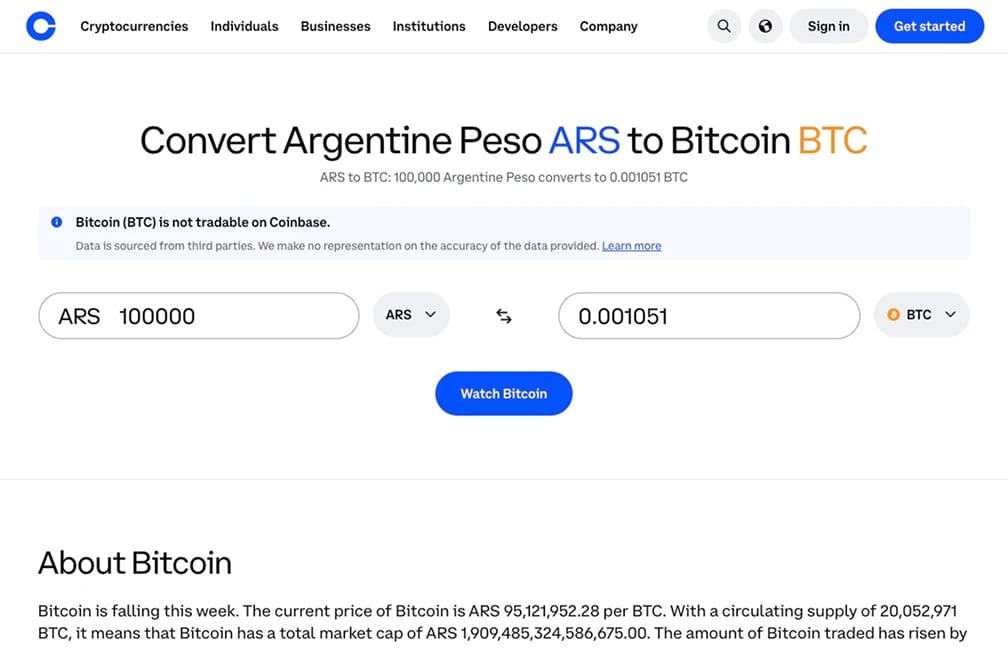
Coinbase is the answer when the priority is a counterparty that cannot quietly disappear. It entered the CNV's PSAV registry in January 2025 and staffed the local operation with an executive who previously ran operations at Buenbit, so the Argentine launch was built by people who know this market. As a Nasdaq-listed company, it publishes audited financials every quarter, a disclosure no crypto-native rival in this lineup matches.
The product suits careful money. USDC support gives Argentines a fully reserved dollar stablecoin from a US public company; staking covers the majors, and around 250 assets trade on the retail app. The catch we keep flagging on every Coinbase page applies here too, since the simple buy screen stacks a spread on top of fees while Coinbase Advanced prices from roughly 0.40% maker and 0.60% taker.
Peso rails are the weak point. There is no direct ARS bank deposit or P2P market, so funding comes from card purchases at a premium or crypto deposits from another platform, and most Argentines we know use Coinbase as the vault, with a P2P venue handling the peso conversion. Our Coinbase review weighs the full trade-off.
Pros
- CNV PSAV registration plus the audited transparency of a Nasdaq listing.
- USDC support gives a credible, regulated stablecoin for dollar savings.
- Advanced Trade offers proper order books once you leave the simple buy screen.
Cons
- No ARS bank deposits or P2P, so peso funding is expensive or indirect.
- Simple-buy pricing is the costliest path in this comparison.
- Smaller asset list than the crypto-native platforms.
6. Uphold
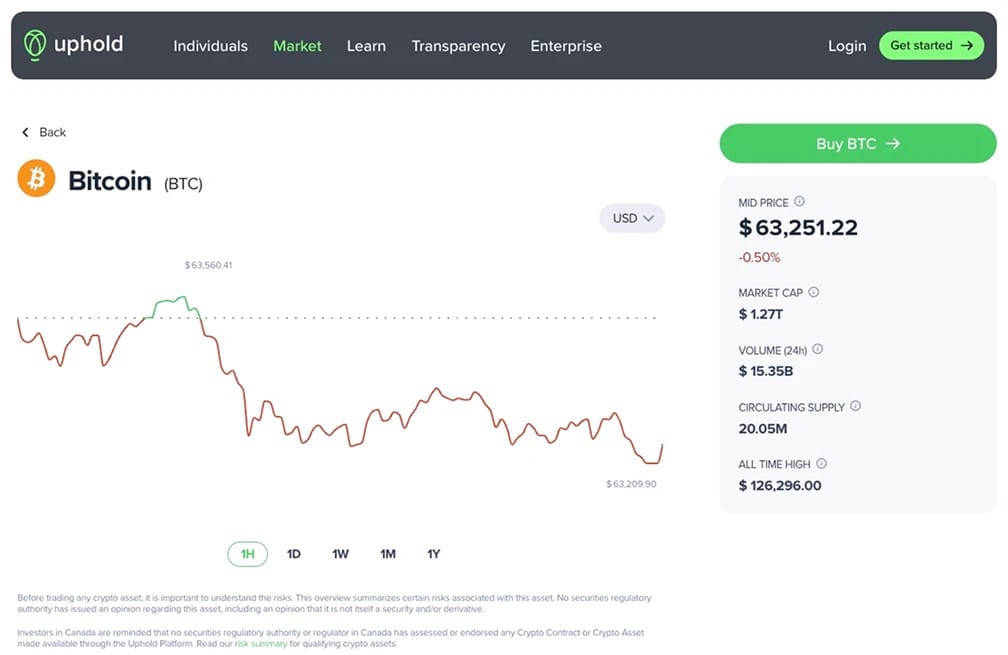
Uphold closes the list as the simplest on-ramp for someone who wants exposure without learning an order book. Its one-step trading moves value directly between any two supported assets, spanning 300+ cryptocurrencies, 27 fiat currencies, and four precious metals, so a single click can turn a card deposit into BTC or swap XRP into gold.
The platform is registered with FinCEN and regulated by the FCA in its home markets, and it publishes its assets and liabilities in near real time. For Argentines, the appeal is a low-friction dollar-linked account. Cards, Apple Pay, and Google Pay fund instantly; staking pays on 20+ assets; and the interface never buries a beginner in leverage products. Weekly recurring purchases make it easy to automate a dollar-cost-averaging habit.
Cost and rails are the trade-offs. Pricing is spread-based and ranges from roughly 1% to 2% depending on the asset, several times what an order-book venue charges. There is no ARS balance or peso P2P market, so every deposit incurs card or FX costs. Uphold is also not in the CNV's PSAV registry, serving Argentines from its offshore entities. Our Uphold review breaks down the fee mechanics.
Pros
- One-step trading across crypto, fiat currencies, and precious metals.
- Real-time published reserves and FinCEN and FCA registrations in home markets.
- The gentlest interface here, with recurring buys and instant staking.
Cons
- Spread-based pricing of roughly 1% to 2% costs far more than order-book fees.
- No peso deposits or P2P market, so funding runs through cards or FX.
- Not registered in the CNV's PSAV registry, which could be a concern for local investors.
How to Choose a Crypto Exchange in Argentina
Since Resolución General 1058 took full effect, the sensible checks start with the registry and end with how your pesos actually move.
- Check the PSAV registry before depositing: Registration attaches to a legal entity, and the CNV publishes the list. The regulator can ask courts to block the websites of unregistered platforms operating locally, so a registry entry is now the difference between a supervised counterparty and one that could lose its .com.ar access overnight.
- Decide how your pesos get in: Local platforms and P2P markets take instant transfers to a CVU or CBU, plus Mercado Pago. Global venues without peso rails need cards or crypto deposits, so price the full loop, because a 3% card fee erases months of low trading fees.
- Know what gets reported: Registered PSAVs are UIF reporting subjects and file monthly information with ARCA, covering balances and movements above set thresholds. That transparency protects you in a dispute and also means your trading is visible, so pick your venue with your tax position already in order.
- Match the platform to your real use case: Someone converting salary to USDT monthly needs deep peso P2P liquidity and nothing else, which points to Binance or Bybit. A futures trader needs MEXC's leverage. Long-term dollar savings sit best on Coinbase in USDC or in self-custody.
- Test the exit before you need it: Deposit a small amount, buy, sell, and withdraw pesos back to your bank. Some banks question inbound transfers from crypto platforms, and finding that out with ARS 50,000 costs less than finding out with your savings.
Crypto and Bitcoin Regulation in Argentina
Crypto is legal in Argentina, and after years of near-total silence, the country now runs one of Latin America's more developed supervisory frameworks, with the CNV as the registrar, the UIF handling anti-money-laundering, and the BCRA still fencing off the banking system.
- March 2024: Ley 27.739 amended the AML law to define Virtual Asset Service Providers, and the CNV created the PSAV registry through Resolución General 994/2024, while the UIF set AML duties under Resolución 49/2024. Operating without registration became unlawful.
- September 2024 to March 2025: The global platforms were formalized. Binance registered as PSAV number 76, Bybit filed its VASP registration, Coinbase entered the registry in January 2025, and Crypto.com followed in March, joining local firms like Lemon, Ripio, Buenbit, Belo, and Bitso.
- May 2025: Resolución General 1058/2025 took effect, converting the registry into a supervisory regime with minimum net worth by activity category, a requirement for foreign PSAVs to constitute a local company or branch, custody and segregation standards, and the power to seek judicial blocking of unregistered sites.
- April 2025 onward: The cepo was dismantled for individuals in April 2025 under the IMF agreement, replaced by a floating band. From January 2026, the bands index to inflation with a two-month lag, while restrictions on companies persist.
- The banking wall, still standing: Comunicación A 7506 of 2022 bars banks from offering crypto and Comunicación A 7759 of 2023 extends the ban to payment apps, which is why Mercado Pago cannot sell you Bitcoin. The BCRA has been drafting rules to let banks in, with the industry expecting publication during 2026, but as of July, the prohibition remains in force.
The direction of travel is unmistakable. Argentina went from unregulated to registered to supervision in under three years, and the next step, banks selling crypto from home banking, is a pending resolution rather than a question of if.
How is Crypto Taxed in Argentina?
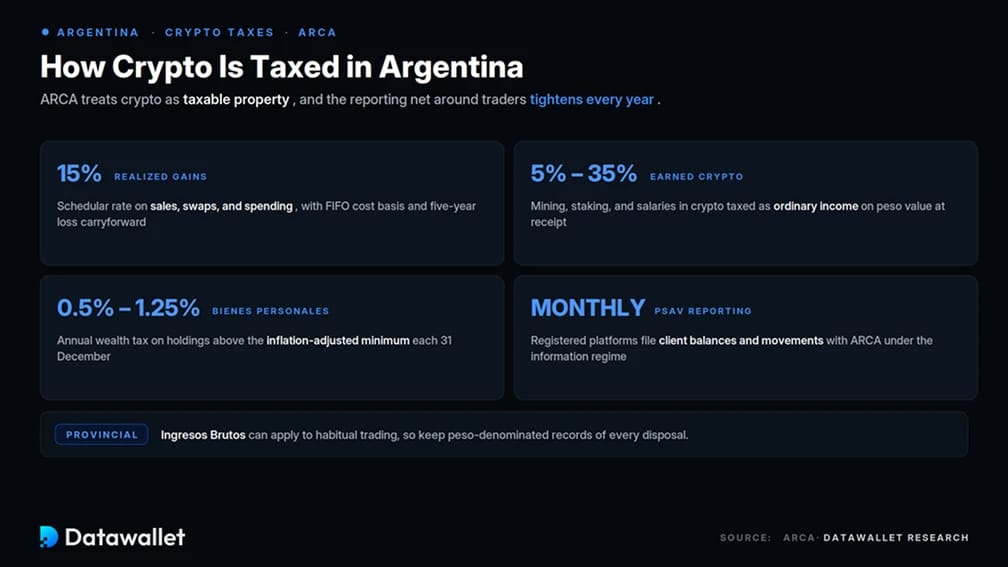
ARCA, the agency that replaced AFIP in late 2024, treats crypto as taxable property, and the reporting net around Argentine traders has tightened considerably.
- 15% on realized gains: Individuals pay a schedular income tax on profits when they sell, swap, or spend crypto, generally at 15%, with a reduced 5% rate reserved for peso-denominated operations without adjustment clauses. Cost basis follows first in, first out, and losses carry forward against same-category gains for five years.
- Income rates on earned crypto: Mining rewards, staking income, and payment for work received in crypto are taxed as ordinary income on their peso value at receipt, at progressive rates from 5% to 35%.
- Bienes Personales reaches holdings: ARCA's Dictamen 2/2022 confirmed crypto counts toward the personal assets tax, declared each 31 December once total wealth passes the inflation-adjusted minimum, at rates running from 0.5% to 1.25%. Taxpayers who prepaid under the REIBP scheme during the 2024 blanqueo are exempt for the covered years.
- Provinces take their cut: Several jurisdictions, including the City and Province of Buenos Aires, apply Ingresos Brutos to habitual crypto trading, at rates that can reach high single digits depending on the province.
Keep peso-denominated records of every disposal with dates and rates. None of this replaces advice from a matriculado accountant, and anything touching DeFi belongs with a specialist.
Cryptocurrency Adoption in Argentina
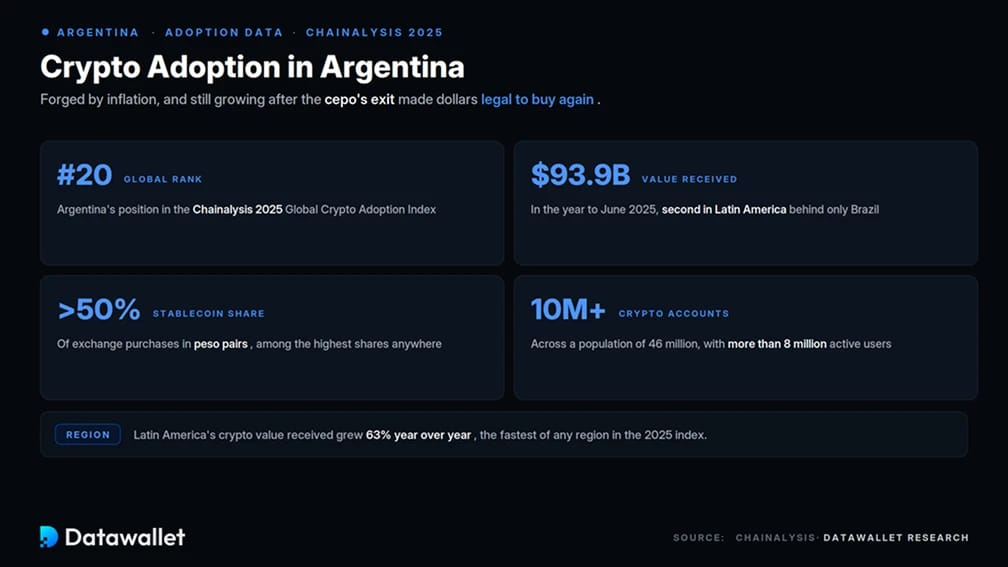
Argentine adoption was forged by inflation, and it survived the arrival of relative stability in better shape than many predicted.
- A top-20 market globally: Argentina placed 20th in the Chainalysis 2025 Global Adoption Index and received an estimated $93.9 billion in crypto value over the year to June 2025, second in Latin America behind only Brazil, within a region growing 63% year over year.
- Stablecoins are the product: Dollar-pegged tokens account for more than half of exchange purchases in peso pairs, among the highest shares anywhere. Even with the cepo gone for individuals, USDT remains the default savings vehicle for people who spent decades watching pesos evaporate, which is why our guide to buying USDT in Argentina stays one of our most-read local pages.
- The user base is mainstream: Industry estimates put more than 10 million crypto accounts and upward of 8 million active users in a country of 46 million, with usage spread across income levels rather than concentrated among traders. Freelancers invoicing abroad in USDT and shops quoting electronics in dólar cripto are common.
Global comparisons sit on our crypto adoption statistics page. What distinguishes Argentina is that crypto here solved a payments and savings problem first and became an investment afterward.
How to Buy Bitcoin in Argentina
Buying BTC takes about fifteen minutes once your DNI is at hand, and the cheapest path runs through a stablecoin.
- Pick a venue that fits your funding: Binance or Bybit for peso P2P depth, Coinbase for regulated custody, MEXC for trading breadth. Confirm the platform's PSAV standing on the CNV registry if supervision matters to you.
- Complete KYC with your DNI or passport: Verification on the major platforms is cleared in minutes for us. Enter your name exactly as printed, since mismatches cause most stalled applications.
- Move pesos in: Use bank transfer from your CBU or CVU where direct deposits exist, or buy USDT on the P2P market with Mercado Pago or transferencia. Start small on P2P and stick to counterparties with long completion histories.
- Convert to BTC with a limit order: On the spot market, a limit order on BTC/USDT nearly always beats the instant-buy quote. The extra minute of patience is the cheapest discount in crypto.
- Decide where the BTC lives: Active traders can leave funds on a registered venue. Long-term holders should withdraw to self-custody after double-checking the address and network, and our best crypto wallets guide compares the options.
Selling reverses the same path, and noting the peso value and date of every disposal as you go saves a painful reconstruction at filing time.
Final Thoughts
Bybit is the account we would open first in Argentina today, pairing a local VASP registration with the deepest product shelf. Binance is the strongest pure peso on-ramp with its PSAV number on display, MEXC serves traders chasing listings and leverage from offshore, OKX blends low fees with the best Web3 tooling, Coinbase turns a Nasdaq listing into custody peace of mind, and Uphold keeps things simple for a first-time buyer.
The register now matters more than the brand. Argentina spent three years building a framework, the CNV can pursue blocking of unregistered platforms, and the coming BCRA rules will pull banks into the same arena. The venues worth your pesos are the ones already operating as if that future arrived.
Whatever you choose, run a small loop first. Move ARS 50,000 in, buy USDT, sell it, and withdraw. The round-trip cost and how your bank reacts will tell you more than any ranking, this one included. For the neighboring markets, our guides to the best crypto exchanges in Brazil and Mexico map the wider region.
Our Methodology
We ranked these platforms by using them as an Argentine would. That meant completing KYC with local documents, funding via bank transfers, Mercado Pago on P2P markets, and cards, trading on live books, and withdrawing pesos. Six criteria set the scores.
- Trust Score: Our proprietary rating out of 5, weighting PSAV registration status, custody and reserve transparency, security history, platform longevity, and audit coverage.
- ARS Funding Methods: Confirmed bank transfer, P2P, and card support, measuring settlement speed, P2P spreads against the dólar cripto reference, and withdrawal reliability to Argentine accounts.
- Regulatory Standing: Verified each platform's entry in the CNV's PSAV registry and its adaptation to Resolución General 1058, the dividing line in this market since 2025.
- Security Track Record: Weighed breach history, custody arrangements, proof-of-reserves cadence, and account protections like 2FA and withdrawal whitelists.
- Assets and Liquidity: Ran market and limit orders on USDT/ARS, BTC/USDT, and a mid-cap pair on each venue, recording spreads, depth, and fill quality.
- Fee Structure: Compare maker and taker fees, P2P spreads, card premiums, and the all-in cost of a peso round trip.
Testing ran from April through July 2026, with registry statuses rechecked before publication. Platforms without a workable funding path from Argentina were excluded.
%20(3).webp)