




Compare Top Austrian Crypto Exchanges
1. Bybit
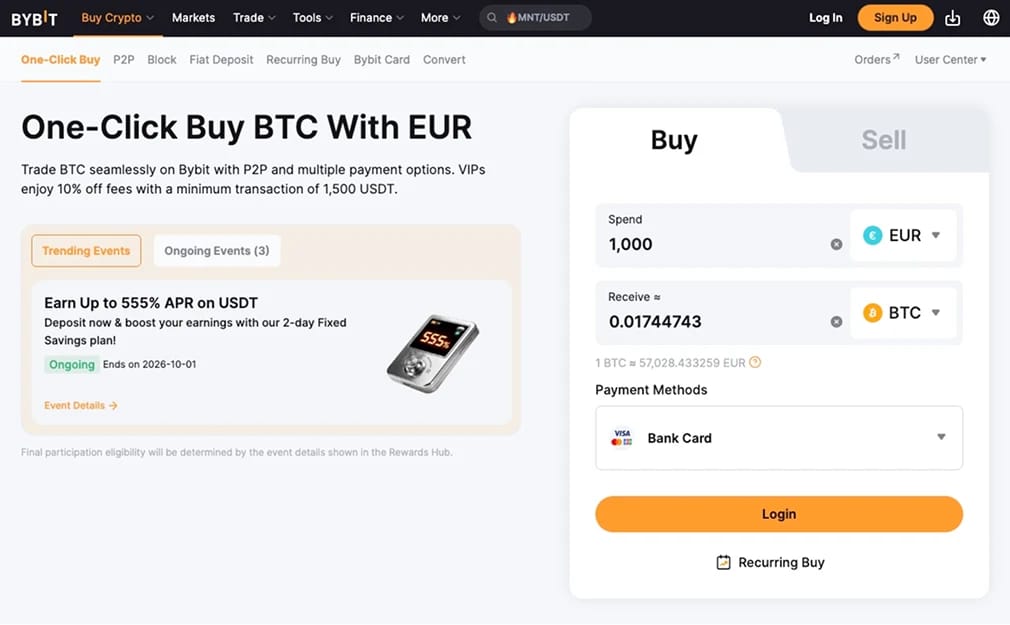
Bybit takes first place in Austria because it offers the most comprehensive product set on this list and genuine local regulatory standing. Bybit EU GmbH was authorized as a CASP by the FMA on 28 May 2025 and runs its entire European operations out of Vienna, with the company pledging to hire over 100 local staff. That shared FMA footing means a SEPA payment from an Austrian bank to Bybit is unlikely to be flagged.
Austrians trade on the dedicated bybit.eu platform, which offers spot in EUR and USDC pairs, spot margin up to 10x, Bybit Earn, crypto loans, copy trading and the Bybit Card, all at a flat 0.1% spot fee. Our SEPA Instant transfer from George landed within minutes. Note that perpetual futures and options stay on the global site and are not available to EU users, who trade spot and margin only.
The EU spot listing is narrower than the global platform, so some smaller tokens are missing, and margin leverage still carries real risk for newcomers. Bybit also does not withhold KESt, so export your trade history regularly rather than rebuilding it in June. The full toolset of this exchange is covered in our Bybit review.
Pros
- FMA-licensed and Vienna-based, the same regulatory standing as Bitpanda.
- Flat 0.1% spot fees, the cheapest of the regulated mainstream venues here.
- Spot margin up to 10x, Earn, the Bybit Card, and SEPA Instant funding.
Cons
- No perpetual futures or options for EU users; spot and margin only.
- The EU spot selection is narrower than the global platform.
- No automatic KESt withholding, so you handle tax reporting yourself.
2. Bitpanda
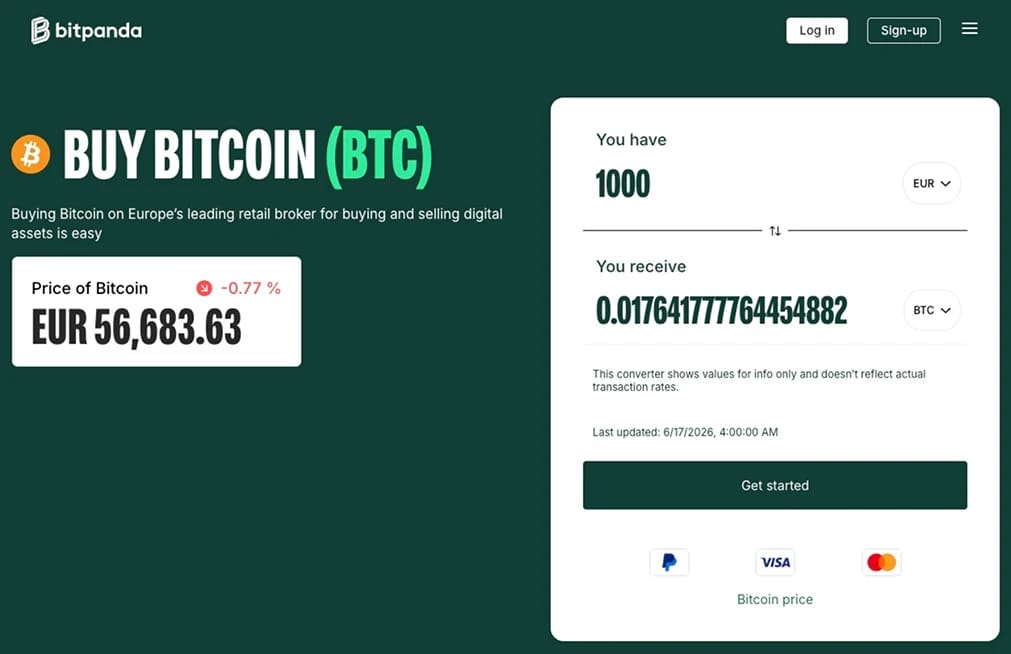
Bitpanda is the platform most Austrians start with, and for good reason. Founded in Vienna in 2014, it holds a full MiCA CASP authorization from the FMA, so the company answers to the same regulator as your bank. For a first-time buyer who wants one account that simply works inside the Austrian system, nothing else here is as frictionless.
Its decisive feature is tax. Since 1 January 2024, Bitpanda has withheld the 27.5% KESt on taxable disposals and remits it to the Austrian authorities for you, the same way a bank handles tax on a savings account. On every other platform in this guide, that calculation and payment fall to you at filing time. For many residents, that single difference outweighs the higher trading cost.
Funding is where its roots show. We topped up via SEPA Instant, and the balance was tradable in under a minute. The platform also accepts eps-Überweisung, cards, Klarna, Skrill, and even cash through Bitpanda To Go vouchers sold at Post offices and Trafiken. The catch is the roughly 1.49% spread on buy and sell orders, fine for a monthly savings plan and expensive for a large lump sum.
Pros
- FMA-licensed in Vienna and regulated like an Austrian bank.
- Automatically withholds and remits the 27.5% KESt, removing the filing burden.
- Crypto, stocks, ETFs, metals, plus SEPA Instant, EPS, card, and cash funding.
Cons
- The 1.49% spread is far above the 0.1% order-book fees on Bybit or Binance.
- Stock and ETF products are derivative contracts, not direct share ownership.
- Spread pricing is less transparent than an open order book.
3. Kraken
Kraken is the pick for Austrians who put custody safety above coin count. Operating since 2011 without a major hack, it publishes Proof-of-Reserves audits confirming client assets are backed 1:1 and keeps most holdings in cold storage. For anyone leaving a meaningful balance on an exchange rather than in self-custody, that record carries real weight.
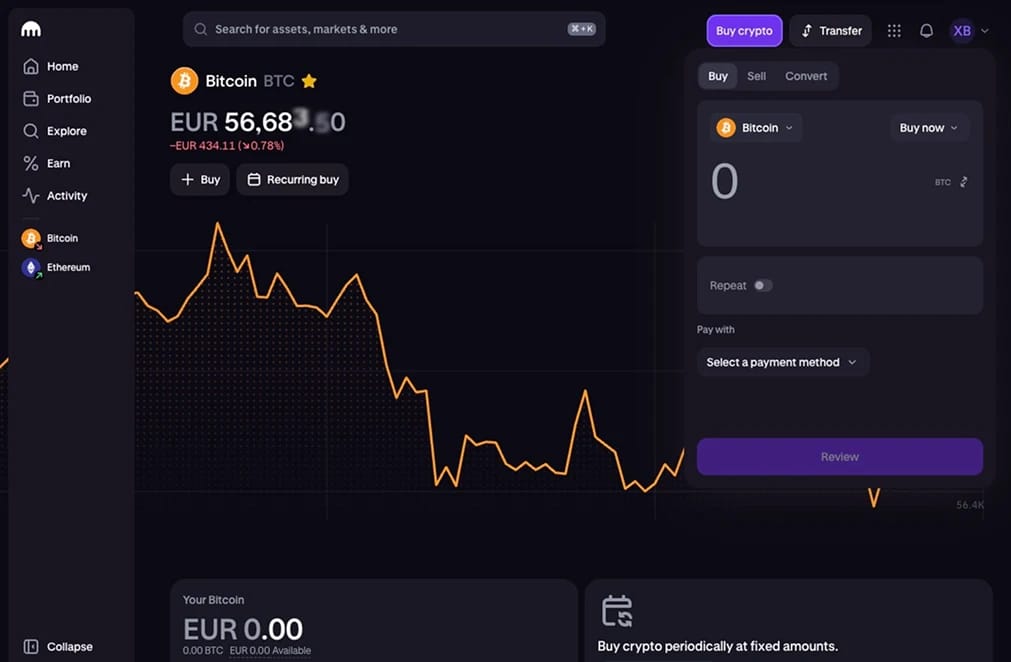
It serves Austrian users under a MiCA license held through Ireland's central bank, and euro funding has always been its natural channel. We sent a SEPA Instant transfer from a Bank Austria account, and it cleared the same day, after which Kraken Pro brought fees down to roughly 0.40% maker and 0.80% taker at base volume across 475+ assets, with staking and an OTC desk for larger orders.
The trade-off is reach. Kraken's listing policy is conservative, so newer small caps arrive late or never, and the casual instant-buy screen carries a spread that the Pro interface avoids. Like the other foreign venues here, it does not withhold KESt, so your tax records remain your responsibility. More details about the exchange and its features can be found in our Kraken review.
Pros
- Fourteen years of operation with no major security breach.
- 1:1 Proof-of-Reserves, cold storage, and an OTC desk for size.
- SEPA Instant euro deposits from Austrian banks settle quickly.
Cons
- Fewer altcoins than Bybit, Binance, or Gate due to cautious listings.
- The "Instant Buy" screen hides a wide spread; only Kraken Pro trades at the quoted fees.
- A cautious listing policy means trending tokens often arrive late, or never.
4. Coinbase
Coinbase brings something none of the others can: the accountability of a public company. Listed on NASDAQ under COIN since April 2021, it files audited financial statements with the SEC every quarter, making its solvency the most scrutinized in the industry. For a cautious Austrian who values external oversight, that transparency is the draw.
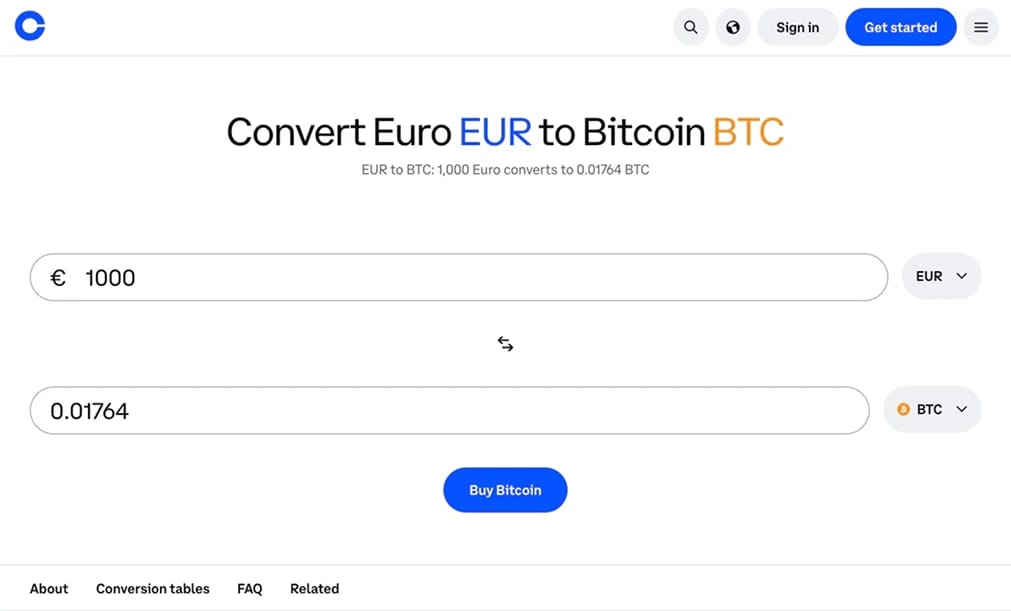
It serves EU users under a MiCA license held through Ireland and supports SEPA transfers and cards, though the simple-buy screen carries a markup that Advanced Trade avoids. Once you switch to Advanced Trade, taker fees fall toward 0.60% across 250+ assets, with staking and one of the deepest USDC ecosystems anywhere. The full breakdown is in our Coinbase review.
The limits are real for Austria. The asset list is the shortest of the global venues here, the default buy screen is pricey, and there is no KESt withholding. It works best as a secondary, USDC-focused account rather than a primary euro on-ramp.
Pros
- NASDAQ listing brings quarterly audited financials and SEC oversight.
- A strong custody record with no major loss of customer funds.
- Advanced Trade fees fall well below the headline simple-buy rate.
Cons
- 250+ assets is the narrowest selection of the platforms here.
- The one-click buy screen is among the priciest entry points until you switch to Advanced Trade.
- EUR support is thinner than on the Vienna platforms, so some users fund via a stablecoin transfer.
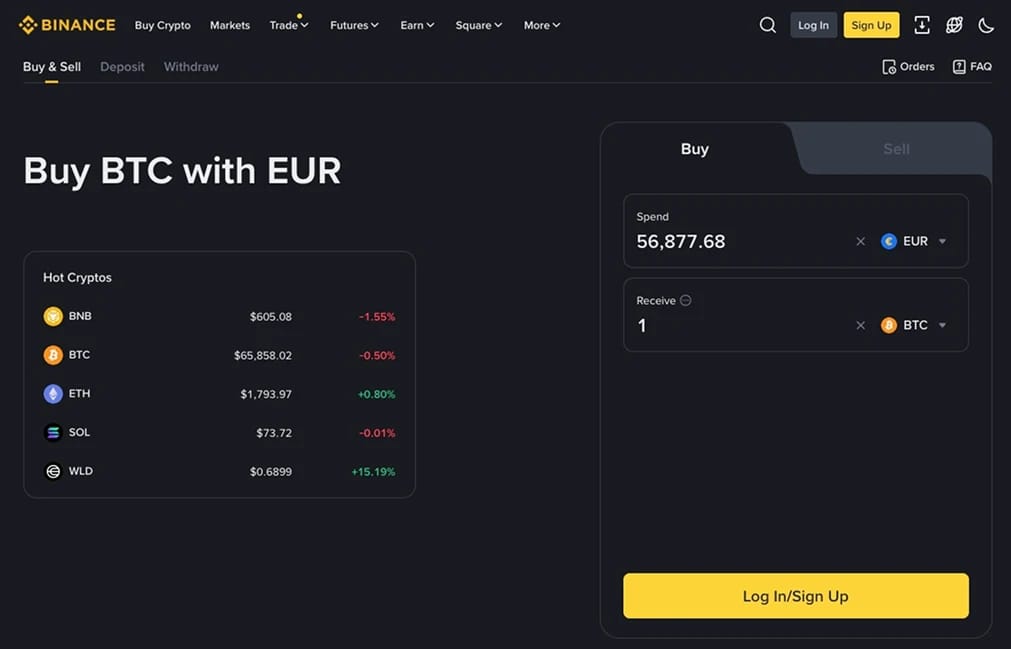
5. Binance
Binance remains the platform with the deepest liquidity of anything an Austrian can access, which matters most to anyone moving size. It lists 500+ assets, and its order books on majors are deep enough that large fills barely move the price, something no smaller platform can match. Spot fees start at 0.1% before BNB discounts, with Earn, Launchpool, and Auto-Invest rounding out the passive side.
Binance’s EU MiCA status should be checked before signup, as its authorization position was still uncertain ahead of the July 2026 transition deadline. Euro funding works over SEPA, cards, and P2P, and my SEPA transfer from an Austrian bank arrived without issue. The fee tiers are explained in our Binance review.
The honest downsides are familiar ones. The 2023 US settlement still shadows the compliance history, the app's feature sprawl is heavy going for a first-time buyer, and there is no KESt withholding, so keeping your own matching records is the only way to stay ahead of the Finanzamt.
Pros
- The deepest spot liquidity of any platform available in Austria.
- Full MiCA passport covering all EU member states since 2025.
- Broad Earn suite with Launchpool and a long-running SAFU fund.
Cons
- The 2023 US settlement and $4.3 billion penalty still shadow its compliance record.
- The app packs in so many products that newcomers struggle to find the basics.
- MiCA rules have stripped some tokens and stablecoin features from EEA accounts.
6. Gate
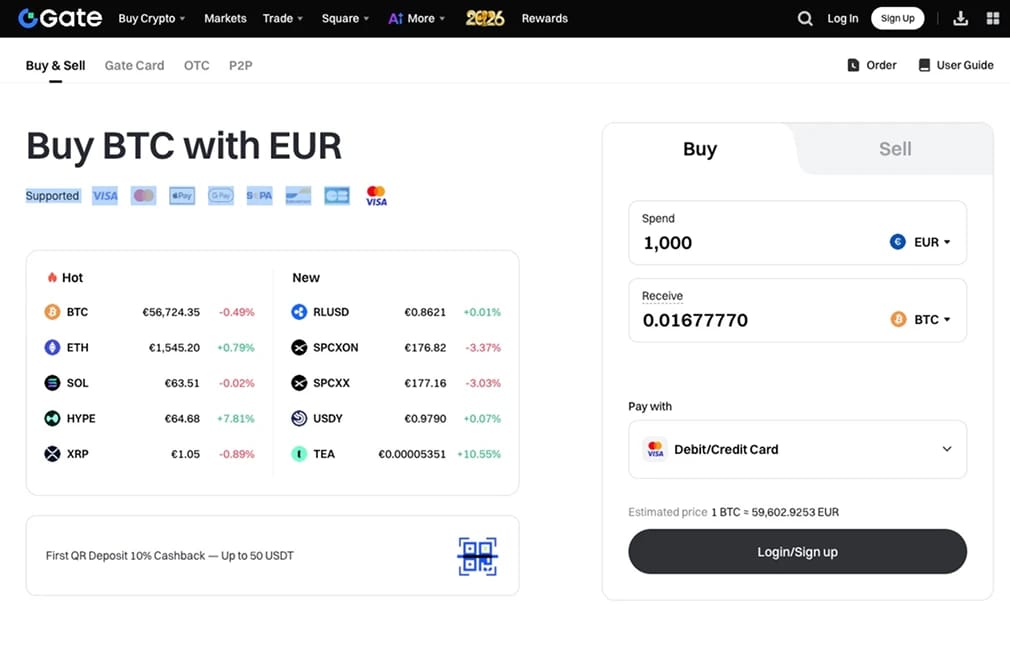
Gate earns its place on sheer breadth. With 3,800+ listed assets, it offers the widest selection on this list by a wide margin, making it the natural home for anyone hunting long-tail tokens, new listings, or pre-market access that more conservative venues never offer. Spot fees start at 0.1% for regular users, with further discounts for GT token holders and higher-volume tiers.
For Austrian users, the regulatory picture firmed up recently. Gate Technology Ltd, the group's Malta entity known as Gate Europe, secured a MiCA license from the MFSA in late 2025 and added a PSD2 payment institution license in February 2026, with EU and EEA users served through that Malta-regulated arm. Euro funding runs over SEPA, alongside cards, P2P, and crypto deposits.
Gate is licensed in Malta rather than by the FMA, so it lacks the home-regulator standing of Bybit or Bitpanda. EU access is routed through the Gate.MT entity, and the enormous asset list includes thin, speculative small caps that demand caution. As with every foreign venue, KESt is yours to report. The platform is covered in more detail in our Gate review.
Pros
- 3,800+ assets, the widest selection of any platform in this guide.
- MiCA-licensed via Malta with a PSD2 payment license added in 2026.
- 0.1% spot fees with further GT token and volume discounts.
Cons
- Licensed via Malta, so no FMA home-regulator standing for Austrians.
- The vast asset list includes thin, high-risk small caps that demand caution.
- No automatic KESt withholding, adding an extra step.
How to Choose a Crypto Exchange in Austria
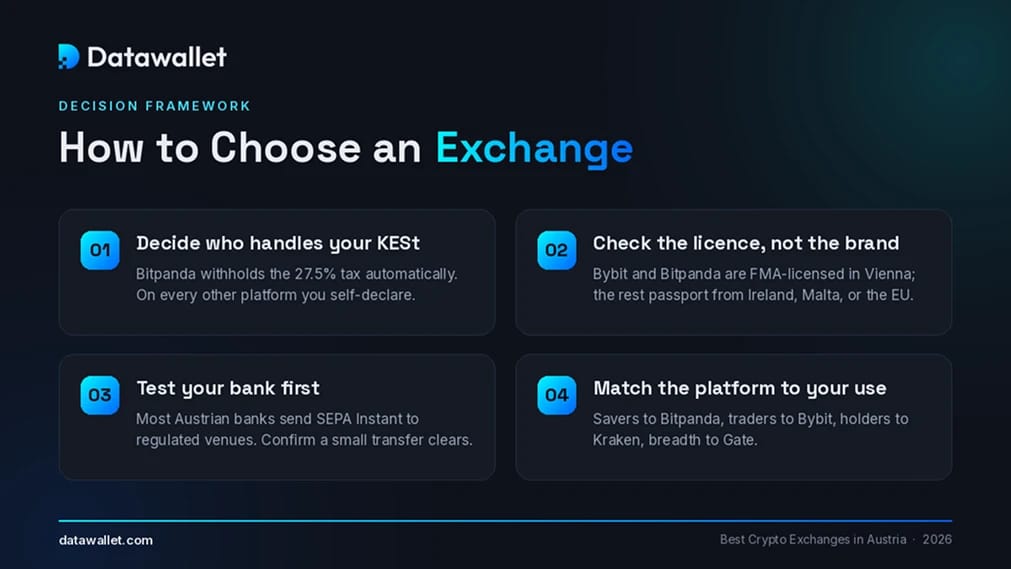
The Austrian decision turns less on funding, which is easy in a euro country, and more on regulation and tax handling. These are four things to consider when choosing an exchange in Austria:
- Decide who handles your KESt: Bitpanda withholds and remits the 27.5% tax automatically, which removes the single biggest admin task. On every other platform, you self-declare, so be honest about whether you will keep records before choosing one.
- Check the license: Bybit and Bitpanda are authorized by the FMA in Vienna, while Kraken and Coinbase passport in from Ireland, Binance from its EU entity, and Gate from Malta. All are legal to use, but a payment to an FMA-licensed venue is the least likely to be queried by your bank.
- Test your bank with a small transfer first: Most Austrian banks, including Erste/George, Raiffeisen, Bank Austria, and BAWAG, process SEPA Instant to regulated exchanges without trouble. Send a small amount and confirm it clears before scaling up.
- Match the platform to what you actually do: Beginners and savers are best served by Bitpanda, active traders by Bybit, long-term holders by Kraken plus a hardware wallet, USDC-heavy users by Coinbase, and altcoin hunters by Gate.
Crypto and Bitcoin Regulation in Austria
Austria regulates crypto through the EU framework, applied locally by a notably conservative supervisor. The key points:
- The FMA is the competent authority. The Finanzmarktaufsicht (FMA) supervises crypto-asset service providers under MiCA (Regulation EU 2023/1114), enforced nationally through the MiCA-Vollzugsgesetz. Austria is recognized for its banking-style approach, which is why an FMA license is regarded as a mark of credibility.
- CASP authorization is now mandatory. Providers must hold a CASP license to serve Austrian clients. Austria took the maximum 18-month transition, so legacy firms registered under the old FM-GwG anti-money-laundering regime before 30 December 2024 could operate until 30 June 2026, after which authorization is required.
- Two licensed venues are based in Vienna. Bybit EU GmbH was authorized on 28 May 2025, and Bitpanda holds an FMA CASP authorization, both headquartered in the capital. The others' passports are from Ireland (Kraken, Coinbase), Malta (Gate), and Binance's EU entity.
- Reporting tightened in 2026. From 1 January 2026, Austria applies the OECD Crypto-Asset Reporting Framework (CARF) alongside the EU's DAC8 directive, so licensed providers report client transaction data to the tax authorities. Crypto activity is no longer invisible to the Finanzamt.
Using any of these platforms is legal for residents, but the FMA-licensed pair is the only channel where your provider answers to Austria's own regulator.
How is Crypto Taxed in Austria?
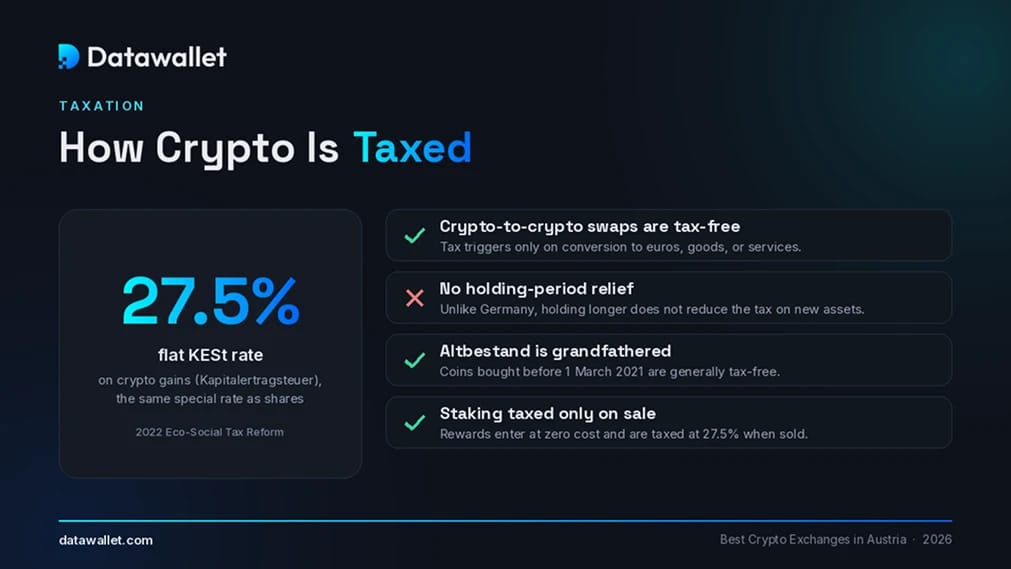
Austria's crypto tax rules, reshaped by the 2022 ökosoziale Steuerreform and overseen by the Federal Ministry of Finance (BMF), are simple in rate but distinctive in detail:
- A flat 27.5% rate (KESt): Gains on selling crypto for euros, or spending it, are taxed at a flat 27.5% Kapitalertragsteuer, the same special rate applied to shares and bonds. There is no progressive scaling for ordinary investors.
- Crypto-to-crypto swaps are tax-free: Unlike most countries, exchanging one crypto for another, for example, BTC to ETH, is not a taxable event in Austria. Tax is only triggered when you convert to fiat, goods, or services. This is one of the most investor-friendly features in the EU.
- No holding-period relief, but Altbestand is grandfathered: Unlike Germany's one-year rule, holding longer does not reduce the tax on assets bought after 28 February 2021. However, "Altbestand" acquired before 1 March 2021 keeps the old speculative treatment and is generally tax-free.
- Staking, withholding, and NFTs: Staking rewards are not taxed on receipt; they are treated as acquired at a cost of zero and taxed at 27.5% only when later sold. Domestic providers like Bitpanda withhold the KESt automatically, while NFTs sit outside this regime and follow the older progressive rules.
This is general information, not tax advice; please confirm your position with an Austrian Steuerberater. For wider context, see our guide to the best low-tax crypto countries.
Cryptocurrency Adoption in Austria
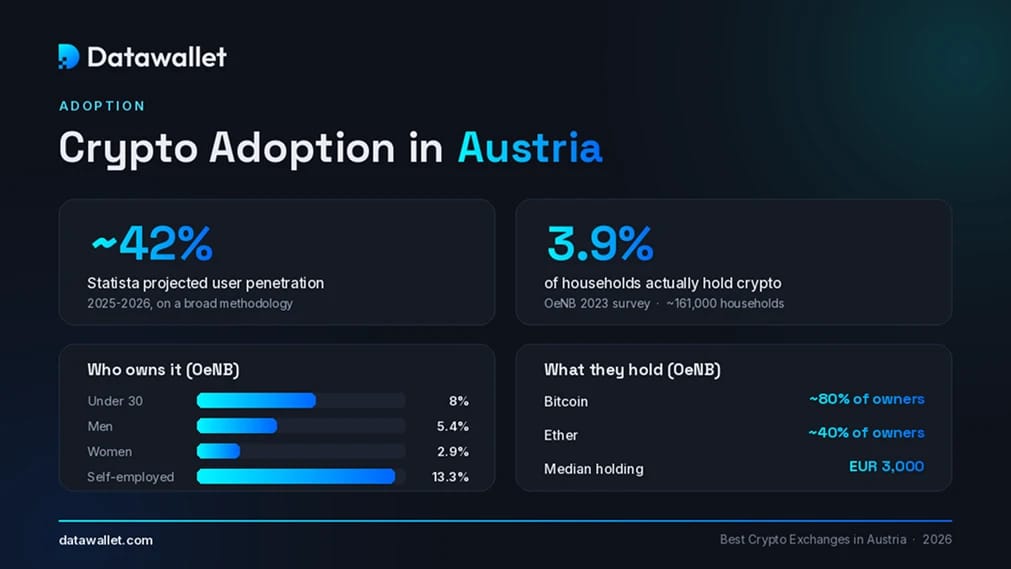
Austria is something of a paradox in European crypto: deep infrastructure and an outsized corporate footprint, but relatively few households that actually own coins.
Awareness is high, and the rails are mature, with two major exchanges run from Vienna, yet ownership stays concentrated among a young, financially confident minority. The figures below show how wide that gap runs:
- A large, steady user base: Statista Market Insights projects user penetration of around 42% for 2025 and 2026, among the higher figures in Europe. However, its methodology counts broadly and should be read as an upper bound rather than active holders.
- A home-grown industry: Bitpanda became Austria's first tech unicorn in 2021 and remains one of Europe's most recognizable exchanges, while Bybit's choice of Vienna as its entire EEA headquarters in 2025 signaled that Austria is now a genuine regulatory hub, not just a market.
- Mature retail infrastructure: Austria had some of Europe's earliest Bitcoin ATMs, and Bitpanda To Go cash vouchers have long been sold through Post offices and Trafiken, giving the country a physical retail layer for crypto that most of the EU lacks.
Two patterns define the market. Demand tracks profit expectations rather than distrust of banks, which the OeNB found is not a meaningful driver; as a result, ownership rises and falls with the price cycle and clusters among higher-income, risk-tolerant investors.
With MiCA supervision and CARF reporting arriving in 2026 to formalize the market, the likelier path is steadier, better-documented growth than a sudden retail surge. The wider figures sit on our crypto adoption statistics page.
How to Buy Bitcoin in Austria
The clean path pairs cheap euro funding with records that hold up at tax time. The sequence I use:
- Pick your venue by need: Beginners and savers open Bitpanda for its automatic tax handling, active traders use Bybit, and security-first holders use Kraken.
- Clear KYC with Austrian documents: A Personalausweis or Reisepass, plus a selfie, was verified within hours on every platform we tested. Enter your name exactly as printed, including any umlauts the form accepts.
- Fund in euros: Send a SEPA Instant transfer from George, Raiffeisen, Bank Austria, or BAWAG for near-instant settlement; use eps-Überweisung on Bitpanda, or pay by card for speed. Keep the confirmation, since it anchors your acquisition cost.
- Buy BTC with a limit order: On Bybit, Kraken, or Binance, place a limit order on the BTC/EUR pair rather than using the instant-buy screen, which carries a spread of 1% or more.
- Move long-term holdings to self-custody: Anything you are not actively trading belongs in your own wallet. Our best crypto wallets guide covers hardware and software options.
If you sell through Bitpanda, the KESt is handled at source; on the other platforms, record every disposal for your Einkommensteuererklärung.
Final Thoughts
Austria offers a rare combination: a clear EU framework, a flat 27.5% tax softened by tax-free swaps and grandfathered Altbestand, and two FMA-licensed exchanges based in its own capital.
Bybit leads in overall capability while maintaining genuine local regulatory standing; Bitpanda removes tax admin entirely for residents; Kraken wins on custody safety; Coinbase on public-company accountability; Binance on liquidity; and Gate on sheer asset breadth.
For the wider regional picture, our guide to the best crypto exchanges in Europe covers the rest of the MiCA-regulated market.
Our Methodology
We assessed over 40 crypto exchanges by following the steps an Austrian user takes in practice: registering with local documents, funding by SEPA Instant and EPS from Austrian banks, executing spot trades, and checking how each handles KESt. Six criteria shaped the rankings:
- Trust Score: A 5-point rating weighing licensing status, security history, reserve transparency, and years of operation.
- Austrian Funding Access: How cheaply and reliably euros move in, tested across SEPA Instant, eps-Überweisung, cards, and cash vouchers.
- Fees: Headline maker and taker rates plus the all-in cost of a funded round trip, including spreads and card markups.
- Tax Practicality: Whether the platform withholds KESt or leaves it to you, and how usable its statements are as acquisition-cost evidence.
- Asset Range: Coverage from majors and stablecoins through long-tail tokens, derivatives, and non-crypto asset classes.
- Local Usability: App performance, KYC friction with Austrian documents, and home-regulator standing under the FMA.
Tax handling and regulatory standing weighed more heavily here than raw coin counts, because in Austria, the cleanest platform is the one that keeps you square with the Finanzamt. Testing ran from March to June 2026.